
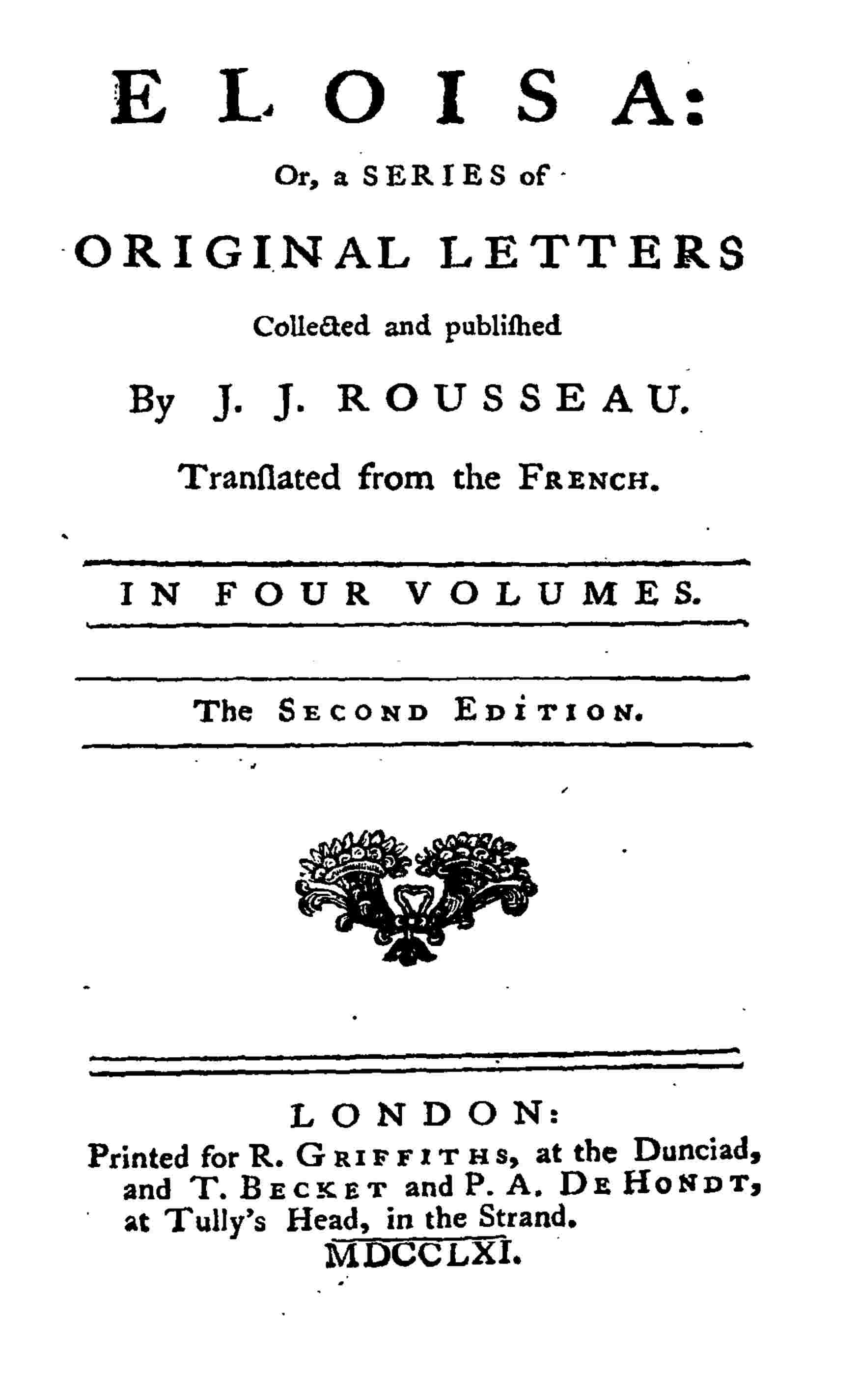
Eloisa
Volume I
Letter I. To Eloisa.
I must fly from you, madam, in truth I must. I am to blame for continuing with you so long, or rather, I ought never to have beheld you. But, situated as I am, what can I do? How shall I determine? You have promised me your friendship; consider my perplexity, and give me your advice.
You are sensible that I became one of your family in consequence of an invitation from your mother. Believing me possessed of some little knowledge, she thought that I might be of service in the education of her beloved daughter, in a situation where proper masters were not to be obtained. Proud to be instrumental in adding a few embellishments to one of nature’s most beautiful compositions, I dared to engage in the perilous task, unmindful of the danger, or, at least, unapprehensive of the consequence. I will not tell you that I begin to suffer for my presumption. I hope I shall never so far forget myself as to say any thing which you ought not to hear, or fail in that respect which is due to your virtue, rather than to your birth or personal charms. If I must suffer, I have the consolation, at least, that I suffer alone. I can enjoy no happiness at the expense of yours.
And yet I see you and converse with you every day of my life, and am but too sensible that you innocently aggravate a misfortune which you cannot pity, and of which you ought to be ignorant. It is true, I know what prudence would dictate, in a case like this, where there is no hope; and I should certainly follow her advice if I could reconcile it with my notions of probity. How can I with decency quit a family into which I was so kindly invited, where I have received so many obligations, and where, by the tenderest of mothers, I am thought of some utility to a daughter whom she loves more than all the world? How can I resolve to deprive this affectionate parent of the pleasure she proposes to herself in, one day, surprizing her husband with your progress in the knowledge of things of which he must naturally suppose you ignorant? Shall I impolitely quit the house without taking leave of her? Shall I declare to her the cause of my retreat, and would not she even have reason to be offended with this confession from a man whose inferior birth and fortune must for ever remain insuperable bars to his happiness?
There seems but one method to extricate me from this embarrassment: the hand which involved me in it must also relieve me. As you are the cause of my offence, you must inflict my punishment: out of compassion, at least, deign to banish me from your presence. Shew my letter to your parents; let your doors be shut against me; spurn me from you in what manner you please; from you I can bear any thing; but of my own accord I have no power to fly from you.
Spurn me from you! fly your presence! why? Why should it be a crime to be sensible of merit, and to love that which we cannot fail to honour? No, charming Eloisa; your beauty might have dazzled my eyes, but it never would have misled my heart, had it not been animated with something yet more powerful. It is that captivating union between a lively sensibility and invariable sweetness of disposition; it is that tender feeling for the distresses of your fellow creatures; it is that amazing justness of sentiment, and that exquisite taste which derive their excellence from the purity of your soul; they are, in short, your mental charms much more than those of your person, which I adore. I confess it may be possible to imagine beauties still more transcendently perfect; but more amiable, and more deserving the heart of a wise and virtuous man,——no, no, Eloisa, it is impossible.
I am sometimes inclined to flatter myself that, as in the parity of our years, and similitude of taste, there is also a secret sympathy in our affections. We are both so young that our nature can hitherto have received no false bias from any thing adventitious, and all our inclinations seem to coincide. Before we have imbibed the uniform prejudices of the world, our general perceptions seem uniform; and why dare I not suppose the same concord in our hearts, which in our judgment is so strikingly apparent? Sometimes it happens that our eyes meet; involuntary sighs betray our feelings, tears steal from——O! my Eloisa! if this unison of soul should be a divine impulse——if heaven should have destined us——all the power on earth——Ah pardon me! I am bewildered: I have mistaken a vain wish for hope: the ardour of my desires gave to their imaginary object a solidity which did not exist. I foresee with horror the torments which my heart is preparing for itself. I do not seek to flatter my misfortune; if it were in my power I would avoid it. You may judge of the purity of my sentiments by the favour I ask. Destroy, if possible, the source of the poison that both supports and kills me. I am determined to effect my cure or my death, and I therefore implore your rigorous injunction, as a lover would supplicate your compassion.
Yes, I promise, I swear, on my part, to do every thing within my power to recover my reason, or to bury my growing anxiety in the inmost recesses of my soul. But, for mercy’s sake, turn from me those lovely eyes that pierce me to the heart; suffer me no longer to gaze upon that face, that air, those arms, those hands, that engaging manner; disappoint the imprudent avidity of my looks; no longer let me hear that enchanting voice, which cannot be heard without emotion; be, alas! in every respect, another woman, that my soul may return to its former tranquillity.
Shall I tell you, without apology? When we are engaged in the puerile amusements of these long evenings, you cruelly permit me, in the presence of the whole family, to increase a flame that is but too violent already. You are not more reserved to me than to any of the rest. Even yesterday you almost suffered me, as a forfeit, to take a kiss: you made but a faint resistance. Happily, I did not persist. I perceived by my increasing palpitation, that I was rushing upon my ruin, and therefore stopped in time. If I had dared to indulge my inclination, that kiss would have proved my last sigh, and I should have died the happiest of mortals.
For heaven’s sake, let us quit those plays, since they may possibly be attended with such fatal consequences; even the most simple of them all is not without its danger. I tremble as often as our hands meet, and I know not how it happens, but they meet continually. I start the instant I feel the touch of your finger; as the play advances I am seized with a fever, or rather delirium; my senses gradually forsake me, and, in their absence, what can I say, what can I do, where hide myself, or how be answerable for my conduct?
The hours of instruction are not less dangerous. Your mother, or your cousin, no sooner leave the room than I observe a change in your behaviour. You at once assume an air so serious, so cold, that my respect, and the fear of offending, destroys my presence of mind, and deprives me of my judgment: with difficulty and trembling, I babble over a lesson, which even your excellent talents are unable to pursue. This affected change in your behaviour is hurtful to us both: you confound me and deprive yourself of instruction, whilst I am entirely at a loss to account for this sudden alteration in a person naturally so even-tempered and reasonable. Tell me, pray tell me, why you are so sprightly in public, and so reserved when by ourselves? I imagined it ought to be just the contrary, and that one should be more or less upon their guard, in proportion to the number of spectators. But instead of this, when with me alone, you are ceremonious, and familiar when we join in mixed company. If you deign to be more equal, probably my torment will be less.
If that compassion which is natural to elevated minds, can move you in behalf of an unfortunate youth, whom you have honoured with some share in your esteem; you have it in your power, by a small change in your conduct, to render his situation less irksome, and to enable him, with more tranquility, to support his silence and his sufferings: but if you find yourself not touched with his situation, and are determined to exert your power to ruin him, he will acquiesce without murmuring: he would rather, much rather, perish by your order, than incur your displeasure by his indiscretion. Now, though you are become mistress of my future destiny, I cannot reproach myself with having indulged the least presumptive hope. If you have been so kind as to read my letter, you have complied with all I should have dared to request, even though I had no refusal to fear.
Letter II. To Eloisa.
How strangely was I deceived in my first letter! instead of alleviating my pain, I have increased my distress by incurring your displeasure: and, alas! that, I find, is the least supportable of all misfortunes. Your silence, your cold, and reserved behaviour, but too plainly indicate my doom. You have indeed granted one part of my petition, but it was to punish me with the greater severity.
E poi ch’ amor di me vi fece accorta
Fur i biondi capelli allor velati,
E l’amorosi sguardo in se raccolto.
You have withdrawn that innocent familiarity in public of which I foolishly complained; and in private you are become still more severe: you are so ingeniously cruel, that your complaisance is as intolerable as your refusal.
Were it possible for you to conceive how much your indifference affects me, you would certainly think my punishment too rigorous. What would I not give to recall that unfortunate letter, and that I had born my former sufferings without complaint! So fearful am I of adding to my offence, that I should never have ventured to write a second letter, if I did not flatter myself with the hopes of expiating the crime I committed in the first. Will you deem it any satisfaction if I confess that I mistook my own intention? or shall I protest that I never was in love with you?——O! no; I can never be guilty of such a horrid perjury! The heart which is impressed with your fair image must not be polluted with a lye. If I am doomed to be unhappy——be it so. I cannot stoop to any thing mean or deceitful to extenuate my fault. My pen refuses to disavow the transgression of which my heart is but too justly accused.
Methinks I already feel the weight of your indignation, and await its final consequence as a favour which I have some right to expect; for the passion which consumes me deserves to be punished, but not despised. For heaven’s sake, do not leave me to myself; condescend, at least, to determine my fate; deign to let me know your pleasure. I will obey implicitly whatever you think proper to command. Do you impose eternal silence? I will be silent as the grave. Do you banish me your presence? I swear that I will never see you more. Will my death appease you? that would be, of all, the least difficult. There are no terms which I am not ready to subscribe, unless they should enjoin me not to love you; yet even in that I would obey you if it were possible.
A hundred times a day I am tempted to throw myself at your feet, bathe them with my tears, and to implore your pardon, or receive my death: but a sudden terror damps my resolution; my trembling knees want power to bend; my words expire upon my lips, and my soul finds no support against the dread of offending you.
Was ever mortal in so terrible a situation! My heart is but too sensible of its offence, yet cannot cease to offend: my crime and my remorse conspire in its agitation, and, ignorant of my destiny, I am cruelly suspended between the hope of your compassion and the fear of punishment.
But, no! I do not hope; I have no right to hope: I ask no indulgence, but that you will hasten my sentence. Let your just revenge be satisfied. Do you think me sufficiently wretched to be thus reduced to solicit vengeance on my own head? Punish me, it is your duty; but if you retain the least degree of compassion for me, do not, I beseech you, drive me to despair with those cold looks, and that air of reserve and discontent. When once a criminal is condemned to die, all resentment should cease.
Letter III. To Eloisa.
Do not be impatient, madam; this is the last importunity you will receive from me. Little did I apprehend, in the dawn of my passion, what a train of ills I was preparing for myself! I then foresaw none greater than that a hopeless passion, which reason, in time, might overcome; but I soon experienced one much more intolerable in the pain which I felt at your displeasure, and now the discovery of your uneasiness is infinitely more afflicting than all the rest. O Eloisa! I perceive it with bitterness of soul, my complaints affect your peace of mind. You continue invincibly silent; but my heart is too attentive not to penetrate into the secret agitations of your mind. Your eyes appear gloomy, thoughtful, and fixed upon the ground; sometimes they wander and fall undesignedly upon me; your bloom fades; an unusual paleness overspreads your cheeks; your gaiety forsakes you; you seem oppressed with grief and the unalterable sweetness of your disposition alone enables you to preserve the shadow of your good humour.
Whether it be sensibility, whether it be disdain, whether it be compassion for my sufferings, I see you are deeply affected. I fear to augment your distress, and I am more unhappy on this account, than flattered with the hope it might possibly occasion; for, if I know myself, your felicity is infinitely dearer to me than my own.
I now begin to be sensible that I judged very erroneously of the feelings of my heart, and, too late, I perceive, that what I at first took for a fleeting phrenzy, is but too inseparably interwoven with my future destiny. It is your late melancholy that has made the increasing progress of my malady apparent. The lustre of your eyes, the delicate glow of your complexion, your excellent understanding, and all the enchantment of your former vivacity, could not have affected me half so much as your present manifest dejection. Be assured, divine maid, if it were possible for you to feel the intolerable flame, which your last eight pensive days of languor and discontent have kindled in my soul, you yourself would shudder at the misery you have caused. But there is now no remedy: my despair whispers, that nothing but the cold tomb will extinguish the raging fire within my breast.
Be it so: he that cannot command felicity may at least deserve it. You may possibly be obliged to honour with your esteem the man whom you did not deign to answer. I am young, and may, perchance, one day, merit the regard of which I am now unworthy. In the mean time, it is necessary that I should restore to you that repose which I have lost for ever, and of which you are, by my presence, in spite of myself, deprived. It is but just that I alone should suffer, since I alone am guilty. Adieu, too, too charming Eloisa! Resume your tranquillity, and be again happy. Tomorrow I am gone for ever. But be assured, that my violent, spotless passion for you, will end only with my life; that my heart, full of so divine an object, will never debase itself by admitting a second impression; that it will divide all its future homage between you and virtue, and that no other flame shall ever profane the altar where Eloisa was adored.
Billet I. From Eloisa.
Be not too positive in your opinion that your absence is become necessary. A virtuous heart will overcome its folly, or be silent, and so might, perhaps, in time——But you——you may stay.
Answer.
I was a long time silent; your cold indifference forced me to speak at last. Virtue may possibly get the better of folly, but who can bear to be despised by one they love? I must be gone.
Billet II. From Eloisa.
No, Sir; after what you have seemed to feel; after what you have dared to tell me; a man, such as you feign yourself, will not fly; he will do more.
Answer.
I have feigned nothing except the moderate passion of a heart filled with despair. To-morrow you shall be satisfied; and notwithstanding all you can say, the effort will be less painful than to fly from you.
Billet III. From Eloisa.
Foolish youth! if my life be dear to thee, do not dare to attempt thy own. I am beset, and can neither speak nor write to you till to-morrow. Wait.
Letter IV. From Eloisa.
Must I then, at last, confess, the fatal, the ill-disguised, secret! How often have I sworn that it should never burst from my heart but with my life! Thy danger wrests it from me. It is gone, and my honour is lost for ever. Alas, I have but too religiously performed my vow; can there be a death more cruel than to survive one’s honour?
What shall I say, how shall I break the painful silence? or rather, have I not said all, and am I not already too well understood? Alas! thou hast seen too much not to divine the rest; Imperceptibly deluded into the snare of the seducer, I see, without being able to avoid it, the horrid precipice before me. Artful man! It is not thy passion, but mine, that excites thy presumption. Thou observest the distraction of my soul; thou availest thyself of it to accomplish my ruin, and now that thou hast rendered me despicable, my greatest misfortune is, that I am forced to behold thee also in a despicable light. Ungrateful wretch! In return for my esteem, thou hast ruined me. Had I supposed thy heart capable of exulting, believe me, thou hadst never enjoyed this triumph.
Well thou knowest, and it will increase thy remorse, that there was not in my soul one vicious inclination. My virtue and innocence were inexpressibly dear to me, and I pleased myself with the hopes of cherishing them in a life of industrious simplicity. But to what purpose my endeavour, since heaven rejects my offering? The very first day we met, I imbibed the poison which now infects my senses and my reason; I felt it instantly, and thy eyes, thy sentiments, thy discourse, thy guilty pen, daily increase its malignity.
I have neglected nothing to stop the progress of this fatal passion. Sensible of my own weakness, how gladly would I have evaded the attack; but the eagerness of thy pursuit hath baffled my precaution. A thousand times I have resolved to cast myself at the feet of those who gave me being; a thousand times I have determined to open to them my guilty heart: but they can form no judgment of its condition; they would apply but common remedies to a desperate disease; my mother is weak and without authority; I know the inflexible severity of my father, and I should bring down ruin and dishonour upon myself, my family, and thee. My friend is absent, my brother is no more.
I have not a protector in the world to save me from the persecution of my enemy. In vain I implore the assistance of heaven; heaven is deaf to the prayers of irresolution. Every thing conspires to increase my anxiety; every circumstance combines to abandon me to myself, or rather cruelly to deliver me up to thee; all nature seems thy accomplice; my efforts are vain, I adore thee in spite of myself. And shall that heart which, in its full vigour, was unable to resist, shall it only half surrender? Shall a heart which knows no dissimulation attempt to conceal the poor remains of its weakness? No, the first step was the most difficult, and the only one which I ought never to have taken. Shall I now pretend to stop at the rest? No, that first false step plunged me into the abyss, and my degree of misery is entirely in thy power.
Such is my horrid situation, that I am forced to turn to the author of my misfortunes, and implore his protection against himself. I might, I know I might, have deferred this confession of my despair; I might, for some time longer, have disguised my shameful weakness, and by yielding gradually, have imposed upon myself. Vain dissimulation! which could only have flattered my pride, but could not save my virtue: away, away! I see but too plainly whither my first error tends, and shall not endeavour to prepare for, but to escape, perdition.
Well then, if thou art not the very lowest of mankind, if the least spark of virtue lives within thy soul, if it retains any vestige of those sentiments of honour which seemed to penetrate thy heart, thou canst not possibly be so vile as to take any unjust advantage of a confession forced from me by a fatal distraction of my senses. No, I know thee well; thou wilt support my weakness, thou wilt become my safeguard, thou wilt defend my person against my own heart. Thy virtue is the last refuge of my innocence; my honour dares confide in thine, for thou canst not preserve one without the other. Ah! let thy generous soul preserve them both, and, at least, for thy own sake, be merciful.
Good God! am I thus sufficiently humbled? I write to thee on my knees; I bathe my paper with my tears; I pay to thee my timorous homage: and yet thou art not to believe me ignorant that it was in my power to have reversed the scene; and that, with a little art, which would have rendered me despicable in my own eyes, I might have been obeyed and worshipped. Take the frivolous empire, I relinquish it to my friend, but leave me, ah! leave me my innocence. I had rather live thy slave and preserve my virtue, than purchase thy disobedience at the price of my honour. Shouldst thou deign to hear me, what gratitude mayest thou not claim from her who will owe to thee the recovery of her reason? How charming must be the tender union of two souls unacquainted with guilt! Thy vanquished passions will prove the source of happiness, and thy pleasures will be worthy of heaven itself.
I hope, nay I am confident, that the man to whom I have given my whole heart will not belie my opinion of his generosity; but I flatter myself also, if he is mean enough to take the least unseemly advantage of my weakness, that contempt and indignation will restore my senses, and that I am not yet sunk so low as to fear a lover for whom I should have reason to blush. Thou shalt be virtuous, or be despised; I will be respected, or be myself again; it is the only hope I have left, preferable to the hope of death.
Letter V. To Eloisa.
Celestial powers! I possessed a soul capable of affliction, O inspire me with one that can bear felicity! Divine love! spirit of my existence, O support me! for I sink down opprest with extasy. How inexpressible are the charms of virtue! How invincible the power of a beloved object! fortune, pleasure, transport, how poignant your impression! O how shall I withstand the rapid torrent of bliss which overflows my heart! and how dispel the apprehensions of a timorous maid? Eloisa——no! my Eloisa on her knees! My Eloisa weep!——Shall she, to whom the universe should bend, supplicate the man who adores her, to be careful of her honour, and to preserve his own? Were it possible for me to be out of humour with you, I should be a little angry at your fears; they are disgraceful to us both. Learn, thou chaste and heavenly beauty, to know better the nature of thy empire. If I adore thy charming person, is it not for the purity of that soul by which it is animated, and which bears such ineffable marks of its divine origin? You tremble with apprehension: good God! what hath she to fear, who stamps with reverence and honour every sentiment she inspires? Is there a man upon earth who could be vile enough to offer the least insult to such virtue?
Permit, O permit me, to enjoy the unexpected happiness of being beloved——beloved by such——Ye princes of the world, I now look down upon your grandeur. Let me read a thousand and a thousand times, that enchanting epistle, where thy tender sentiments are painted in such strong and glowing colours; where I observe with transport, notwithstanding the violent agitation of thy soul, that even the most lively passions of a noble heart never lose sight of virtue. What monster, after having read that affecting letter, could take advantage of your generous confession, and attempt a crime which must infallibly make him wretched and despicable even to himself. No, my dearest Eloisa, there can be nothing to fear from a friend, a lover, who must ever be incapable of deceiving you. Though I should entirely have lost my reason, though the discomposure of my senses should hourly increase, your person will always appear to me, not only the most beautiful, but the most sacred deposit with which mortal was ever instructed. My passion, like its object, is unalterably pure. The horrid idea of incest does not shock me more than the thought of polluting your heavenly charms with a sacrilegious touch: you are not more inviolably safe with your own parent than with your lover. If ever that happy lover should in your presence forget himself but for a moment——O ’tis impossible. When I am no longer in love with virtue, my love for my Eloisa must expire: on my first offence, withdraw your affection and cast me off for ever.
By the purity of our mutual tenderness, therefore, I conjure you, banish all your suspicion. Why should your fear exceed the passions of your lover! To what greater felicity can I aspire, when that with which I am blest, is already more than I am well able to support? We are both young, and in love unexperienced, it is true: but is that honour which conducts us, a deceitful guide? can that experience be needful which is acquired only from vice? I am strangely deceived, if the principles of rectitude are not rooted in the bottom of my heart. In truth, my Eloisa, I am no vile seducer, as, in your despair, you were pleased to call me; but am artless and of great sensibility, easily discovering my feelings, but feeling nothing at which I ought to blush. To say all in one word, my love for Eloisa is not greater than my abhorrence of the crime. I am even doubtful, whether the love which you inspire be not in its nature incompatible with vice; whether a corrupt heart could possibly feel its influence. As for me, the more I love you, the more exalted are my sentiments. Can there be any degree of virtue, however unattainable for its own sake, to which I would not aspire to become more worthy of my Eloisa?
Letter VI. Eloisa To Clara.
Is my dear cousin resolved to spend her whole life in bewailing her poor Chaillot, and will she forget the living because of the dead? I sympathize in your grief, and think it just, but shall it therefore be eternal? Since the death of your mother, she was assiduously careful of your education; she was your friend rather than your governess. She loved you with great tenderness, and me for your sake; her instructions were all intended to enrich our hearts with principles of honour and virtue. All this I know, my dear, and acknowledge it with gratitude; but confess with me also, that in some respects she acted very imprudently; that she often indiscreetly told us things with which we had no concern; that she entertained us eternally with maxims of gallantry, her own juvenile adventures, the management of amours; and that to avoid the snares of men, though she might tell us not to give ear to their protestations, yet she certainly instructed us in many things with which there was no necessity for young girls to be made acquainted. Reflect therefore upon her death as a misfortune, not without some consolation. To girls of our age, her lessons grew dangerous, and who knows but heaven may have taken her from us the very moment in which her removal became necessary to our future happiness. Remember the salutary advice you gave me when I was deprived of the best of brothers. Was Chaillot dearer to you? Is your loss greater than mine?
Return, my dear, she has no longer any occasion for you. Alas! whilst you are wasting your time in superfluous affliction, may not your absence be productive of greater evils? Why are you not afraid, who know the beatings of my heart, to abandon your friend to misfortunes which your presence might prevent. O Clara! strange things have happened since your departure. You will tremble to hear the danger to which I have been exposed by my imprudence. Thank heaven, I hope I have now nothing to fear: but unhappily I am as it were at the mercy of another. You alone can restore me to myself: haste therefore to my assistance. So long as your attendance was of service to poor Chaillot, I was silent; I should even have been the first to exhort you to such an act of benevolence. Now that she is no more, her family are become the objects of your charity: of this obligation we could better acquit ourselves, if we were together, and your gratitude might be discharged without neglecting your friend.
Since my father took his leave of us we have resumed our former manner of living. My mother leaves me less frequently alone; not that she has any suspicion. Her visits employ more time than would be proper for me to spare from my little studies, and in her absence Bab fills her place but negligently. Now though I do not think my good mother sufficiently watchful, I cannot resolve to tell her so. I would willingly provide for my own safety, without losing her esteem, and you alone are capable of managing this matter. Return then, my dear Clara, prithee return. I regret every lesson at which you are not present, and am fearful of becoming too learned. Our preceptor is not only a man of great merit, but of exemplary virtue, and therefore more dangerous. I am too well satisfied with him to be so with myself. For girls of our age, it is always safer to be two than one, be the man ever so virtuous.
Letter VII. Answer.
I understand, and tremble for you: not that I think your danger so great as your imagination would suggest. Your fears make me less apprehensive for the present; but I am terrified with the thought of what may hereafter happen: should you be unable to conquer your passion, what will become of you! Alas, poor Chaillot, how often has she foretold, that your first sigh would mark your fortune. Ah! Eloisa, so young, and thy destiny already accomplished? Much I fear we shall find the want of that sensible woman whom, in your opinion, we have lost for our advantage. Sure I am, it would be advantageous for us to fall into still safer hands; but she has made us too knowing to be governed by another, yet not sufficiently so to govern ourselves: she only was able to shield us from the danger to which, by her indiscretion, we are exposed. She was extremely communicative, and, considering our age, we ourselves seem to have thought pretty deeply. The ardent and tender friendship which hath united us, almost from our cradles, expanded our hearts, and ripened them into sensibility perhaps a little premature. We are not ignorant of the passions, as to their symptoms and effects; the art of suppressing them seems to be all we want. Heaven grant that our young philosopher may know this art better than we.
By we you know who I mean: for my part, Chaillot used always to say, that my giddiness would be my security in the place of reason, that I should never have sense enough to be in love, and that I was too constantly foolish to be guilty of a great folly. My dear Eloisa, be careful of yourself! the better she thought of your understanding, the more she was apprehensive of your heart. Nevertheless, let not your courage sink. Your prudence and your honour, I am certain, will exert their utmost, and I assure you, on my part, that friendship shall do every thing in its power. If we are too knowing for our years, yet our manners have been hitherto spotless and irreproachable. Believe me, my dear, there are many girls, who though they may have more simplicity, have less virtue than ourselves: we know what virtue means, and are virtuous by choice; and that seems to me the most secure.
And yet, from what you have told me, I shall not enjoy a moment’s repose till we meet; for if you are really afraid, your danger is not entirely chimerical. It is true, the means of preservation are very obvious. One word to your mother, and the thing is done: but I understand you; the expedient is too conclusive: you would willingly be assured of not being vanquished, without losing the honour of having sustained the combat. Alas! my poor cousin——if there was the least glimmering——Baron D'Etange consent to give his daughter, his only child, to the son of an inconsiderable tradesman, without fortune! Dost thou presume to hope he will?——or what dost thou hope? what would’st thou have? poor Eloisa!——Fear nothing however on my account. Your friend will keep your secret. Many people might think it more honest to reveal it, perhaps they are right. For my part, who am no great casuist, I have no notion of that honesty, which is incompatible with confidence, faith, and friendship. I imagine that every relation, every age, have their peculiar maxims, duties, and virtues; but what might be prudence in another, in me would be perfidy; and that to confound these things, would more probably make us wicked than wise and happy. If your love be weak, we will overcome it; but if it be extreme, violent measures may produce a tragical catastrophe, and friendship will attempt nothing for which it cannot be answerable. After all, I flatter myself that I shall have little reason to complain of your conduct when I have you once under my eye. You shall see what it is to have a duenna of eighteen!
You know, my dear girl, that I am not absent upon pleasure; and really the country is not so agreeable in the spring as you imagine: one suffers at this time both heat and cold; for the trees afford us no shade, and in the house it is too cold to live without fire. My father too, in the midst of his building, begins to perceive that the gazette comes later hither than to town; so that we all wish to return, and I hope to embrace thee in a few days. But what causes my inquietude is, that a few days make I know not what number of hours, many of which are destined to the philosopher: to the philosopher, cousin! you understand me. Think, O think, that the clock strikes those hours entirely for him!
Do not blush, my dear girl, nor drop thy eyes, nor look grave; thy features will not suffer it. Thou knowest I never, in my life, could weep without laughing, and yet I have not less sensibility than other people: I do not feel our separation less severely, nor am less afflicted with the loss of poor Chaillot. Her family I am resolved never to abandon, and I sincerely thank my kind friend for her promise to assist me: but to let slip an opportunity of doing good, were to be no more thyself. I confess the good creature was rather too talkative, free enough on certain occasions, a little indiscreet with young girls, and that she was fond of old stories and times past. So that I do not so much regret the qualities of her mind, though among some bad ones, many of them were excellent: the loss which I chiefly deplore is the goodness of her heart, and that mixture of maternal and sisterly affection, which made her inexpressibly dear to me. My mother I scarce knew; I am indeed loved by my father, as much as is possible for him to love; your amiable brother is no more; and I very seldom see my own. Thus am I left desolate, like an orphan. You are my only consolation. Yes, my Eloisa lives, and I will weep no more!
P. S. For fear of accident, I shall direct this letter to our preceptor.
Letter VIII. [6] To Eloisa.
O, my fair Eloisa, what a strange capricious deity is Love! My present felicity seems far to exceed my most sanguine expectations, and yet I am discontented. You love me, you confess your passion, and yet I sigh. My presumptuous heart dares to wish still farther, though all my wishes are gratified. I am punished with its wild imaginations; they render me unhappy in the very bosom of felicity. Do not, however, believe that I have forgotten the laws you have imposed, or lost the power of obedience: no, but I am displeased to find the observance of those laws irksome to me alone; that you, who not long ago, was all imbecility, are now become so great a heroine; and that you are so excessively careful to prevent every proof of my integrity.
How you are changed, and you alone, within these two months! Where is now your languor, your disgust, your dejected look? The graces have again resumed their post; your charms are all returned; the new-blown rose is not more fresh and blooming; you have recovered your vivacity and wit; you banter, even with me, as formerly; but what hurts me more than all this, is that you swear eternal fidelity with as much gaiety and good humour as if it were something droll, or indifferent.
O, my fair inconstant! is this characteristic of an ungovernable passion? If you were, in any degree, at war with your inclinations, would not the constraint throw a damp upon your enjoyments? O how infinitely more amiable you were, when less beautiful! How do I regret that pathetic paleness, that precious assurance of a lover’s happiness, and hate the indiscretion of that health which you have recovered at the expense of my repose! Yes, I could be much better satisfied with your indisposition, than with that air of content, those sparkling eyes, that blooming complexion, which conspire to insult me. Have you already forgot the time when you were glad to sue for mercy? Eloisa, Eloisa! the violent tempest hath been very suddenly allayed.
But what vexes me most, is that, after having committed yourself entirely to my honour, you should seem apprehensive and mistrustful where there is no danger. Is it thus I am rewarded for my discretion? Does my inviolable respect deserve to be thus affronted? Your father’s absence is so far from giving you more liberty, that it is now almost impossible to catch you alone. Your constant cousin never leaves you a moment. I find we are insensibly returning to our former circumspection, with this difference only that what was then irksome to you is now become matter of amusement.
What recompense can I expect for the purity of my adoration, if not your esteem? And to what purpose have I abstained even from the least indulgence, if it produces no gratitude? In short, I am weary of suffering ineffectually, and of living in a state of continued self-denial, without being allowed the merit of it. I cannot bear to be despised whilst you are growing every day more beautiful. Why am I to gaze eternally at those delicious fruits which my lips dare not touch? Must I relinquish all hope, without the satisfaction of a voluntary sacrifice? No, since you depend no longer upon my honour, it stands released from its vain engagement; your own precautions are sufficient. You are ungrateful, and I am too scrupulous; but for the future I am resolved not to reject the happiness which fortune, in spite of you, may throw in my way. Be it as it will, I find that I have taken upon me a charge that is above my capacity. Eloisa, you are once more your own guardian. I must resign the deposit which I cannot preserve without being tempted to a breach of faith, and which you yourself are able to secure with less difficulty than you were pleased to imagine.
I speak seriously; depend upon your own strength, else banish me, or in other words, deprive me of existence. The promise I made, was rash and inconsiderate; and I am amazed how I have been able to keep it so long. I confess it ought to remain for ever inviolable; but of that I now perceive the impossibility. He who wantonly exposes his virtue to such severe trials, deserves to fall. Believe me, fairest among women! by him who desired life only on your account, you will always be honoured and respected; but reason may forsake me, and my intoxicated senses may hint the perpetration of a crime, which, in my cooler hours, I should abhor. I am however happy in the reflection that I have not hitherto abused your confidence. Two whole months have I triumphed over myself; but I am intitled to the reward due to as many ages of torment.
Letter IX. From Eloisa.
I comprehend you: the pleasures of vice, and the reward of virtue, would just constitute the felicity you wish to enjoy. Are these your morals? Truly, my good friend, your generosity had a short duration. Is it possible that it could be entirely the effect of art? There is something droll, however, in complaining of my health. Was it that you hoped to see it entirely destroyed by my ridiculous passion, and expected to have me at your feet, imploring your pity to save my life? or did you treat me with respect whilst I continued frightful, with an intention to retract your promise as soon as I should, in any degree, become an object of desire? I see nothing so vastly meritorious in such a sacrifice.
With equal justice, you are pleased to reproach me for the care I have lately taken to prevent those painful combats with yourself, when in reality you ought to deem it an obligation. You then retract your engagement, on account of its being too burthensome a duty; so that in the same breath, you complain of having too much trouble, and of not having enough. Recollect yourself a little, and endeavour to be more uniform, that your pretended sufferings may have a less frivolous appearance: or perhaps it would be more advisable to put off that dissimulation which is inconsistent with your character. Say what you will, your heart is much better satisfied with mine than you would have me think. Ungrateful man! you are but too well acquainted with its feelings. Even your own letter contradicts you by the gaiety of its stile; you would not have so much wit if you had less tranquility. But, enough of vain reproach to you: let me now reproach myself; it will probably be with more reason.
The content and serenity with which I have been blest of late, is inconsistent with my former declaration, and I confess you have cause to be surprized at the contrast. You were then a witness to my despair, and you now behold in me too much tranquility; hence you pronounce me inconstant and capricious. Be not, my good friend, too severe in your judgment. This heart of mine cannot be known in one day. Have patience, and, in time, you may probably discover it to be not unworthy your regard.
Unless you were sensible how much I was shocked when I first detected my heart in its passion for you, it is impossible to form any idea of what I suffered. The maxims I imbibed in my education were so extremely severe, that love, however pure, seemed highly criminal. I was taught to believe, that a young girl of sensibility was ruined the moment she suffered a tender expression to pass her lips: my disordered imagination confounded the crime with the confession of my love, and I had conceived so terrible an idea of the first step, that I saw little or no interval between that and the last. An extreme diffidence of myself increased the alarm; the struggles of modesty appeared to be those of virtue; and the uneasiness of silence seemed the importunity of desire. The moment I had spoke I concluded myself lost beyond redemption; and yet I must have spoken, or have parted with you for ever. Thus, unable to disguise my sentiments, I endeavoured to excite your generosity, and depending rather upon you than on myself, I chose to engage your honour in my defence, as I could have little reliance on a resource of which I believed myself already deprived.
I soon discovered my error: I had scarce opened my mind when I found myself much easier; the instant I received your answer I became perfectly calm; and two months experience has informed me that my too tender heart hath need of love, but that my senses can rest satisfied without a lover. Now judge, you who are a lover of virtue, what joy I must have felt at this discovery. Emerged from the profound ignominy into which my fears had plunged me, I now taste the delicious pleasure of a guiltless passion: it constitutes all my happiness; it hath influenced my temper and my health, I can conceive no paradise on earth equal to the union of love and innocence.
I feared you no longer; and when I endeavoured to avoid being alone with you, it was rather for your sake than my own. Your eyes, your sighs betrayed more transport than prudence; but though you had forgotten the bounds you yourself prescribed, I should not.
Alas, my friend, I wish I could communicate to you that tranquility of soul which I now enjoy! Would it were in my power to teach you to be contented and happy! What fear, what shame can imbitter our felicity? In the bosom of love we might talk of virtue without a blush.
E v’ è il piacer con l’ onestade accanto.
And yet a strange foreboding whispers to my heart, that these are the only days of happiness allotted us by heaven. Our future prospect presents nothing to my view, but absence, anxiety, dangers and difficulties. The least change in our present situation must necessarily be for the worse. Were we even united for ever, I am not certain whether our happiness would not be destroyed by its excess; the moment of possession is a dangerous crisis.
I conjure thee, my kind, my only friend, endeavour to calm the turbulence of those vain desires which are always followed by regret, repentance and sorrow. Let us peaceably enjoy our present felicity. You have a pleasure in giving me instruction, and you know, but too well, with what delight I listen to be instructed. Let your lessons be yet more frequent, that we may be as little asunder as decency will allow. Our absent moments shall be employed in writing to each other, and thus none of the precious time will pass in vain, which one day possibly we might give the world to recall. Would to heaven, that our present happiness might end only with our lives! To improve one’s understanding, to adorn one’s mind, to indulge one’s heart: can there possibly be any addition to our felicity?
Letter X. To Eloisa.
How entirely was my Eloisa in the right when she said that I did not yet know her sufficiently! I constantly flatter myself that I have discovered every excellence of her soul, when new beauties daily meet my observation. What woman, but yourself, could ever unite virtue and tenderness so as to add new charms to both? In spite of myself I am forced to admire and approve that prudence which deprives me of all comfort, and there is something so excessively engaging in the manner of imposing your prohibitions, that I almost receive them with delight.
I am every day more positive, that there is no happiness equal to that of being beloved by Eloisa; and so entirely am I of this opinion that I would not prefer even the person of Eloisa to the possession of her heart. But why this bitter alternative? Can things be incompatible which are united in nature? Our time, you say, is precious; let us enjoy our good fortune without troubling its pure stream with our impatience. Be it so: but shall we, because we are moderately happy, reject supreme felicity? Is not all that time lost which might have been better employed? If it were possible to live a thousand years in one quarter of an hour, what purpose would it answer to tell over the tedious number of days when they were past?
Your opinion of our present situation is very just; I am convinced I ought to be happy, and yet I am much the reverse. The dictates of wisdom may continue to flow from your lips, but the voice of nature is stronger than yours: and how can we avoid listening to her, when she speaks the language of our own hearts? Of all sublunary things, I know of nothing, except yourself, which deserves a moment’s attention. Without you, nature would have no allurements: her empire is in your charms, and there she is irresistible.
Your heart, divine Eloisa, feels none of this. You are content to ravish our senses, and are not at war with your own. It should seem that your soul is too sublime for human passions, and that you have not only the beauty but the purity of angels: a purity which murmuring I revere, and to which I would gladly aspire. But, no: I am condemned to creep upon the earth, and to behold Eloisa a constellation in the heavens. O may you continue to be happy though I am wretched; enjoy your virtues; and perdition catch the vile mortal who shall ever attempt to tarnish one of them! Yes, my Eloisa, be happy, and I will endeavour to forget my own misery, in the recollection of your bliss. If I know my heart, my love is as spotless as its adorable object. The passions which your charms have inflamed, are extinguished by the purity of your soul; I dare not disturb its serenity. Whenever I am tempted to take the least liberty, I find myself restrained rather by the dread of interrupting your peace of mind, than by the fear of offending. In my pursuit of happiness, I have considered only in what degree it might affect my Eloisa; and finding it incompatible with hers, I can be wretched without repining.
With what inexplicable, jarring, sentiments you have inspired me! I am at once submissive and daring, mild and impetuous. Your looks inflame my heart with love, and when I hear your voice I am captivated with the charms of innocence. If ever I presume to indulge a wishful idea, it is in your absence. Your image in my mind is the only object of my passionate adoration.
And yet I languish and consume away; my blood is all on fire, and every attempt to damp the flame serves but to increase its fervour. Still I have cause to think myself very happy; and so I do. Surely I have little reason to complain, when I would not change my situation with the greatest monarch on earth. But yet some sad fiend torments me whose pursuits it is impossible to elude. Methinks I would not die, and yet I am daily expiring; for you only I wish to live, and you alone are the cause of my death.
Letter XI. From Eloisa.
My attachment to my dear friend grows every day stronger; your absence becomes insupportable, and I have no relief but in my pen. Thus my love keeps pace with yours; for I judge of your passion by your real fear of offending: your former fears were only feigned, with an intent to advance your cause. It is an easy matter to distinguish the dictates of an afflicted heart from the phrenzy of a heated imagination, and I see a thousand times more affection in your present constraint than in your former delirium. I know also that your situation, confined as it is, is not entirely bereft of pleasure. A sincere lover must be very happy in making frequent sacrifices to a grateful mistress, when he is assured that not one of them will be forgotten, but that she will treasure the remembrance in her heart.
But who knows whether, presuming on my sensibility, this may not be a deeper, and therefore a more dangerous plot than the former? O, no! the supposition was unjust; you certainly cannot mean to deceive me. And yet prudence tells me to be more suspicious of compassion than even of love; for I find myself more affected by your respect than by all your transport: so that, as you are grown more honest, you are become in proportion more formidable.
In the overflowing of my heart I will tell you a truth, of which your own feelings cannot fail to convince you: it is, that in spite of fortune, parents, and of ourselves, our fates are united for ever, and we can be only happy or miserable together. Our souls, if I may use the expression, touch in all points, and we feel an entire coherence: correct me if I speak unphilosophically. Our destiny may part us, but cannot disunite us. Henceforward our pains and pleasures must be mutual; and, like the magnets, of which I have heard you speak, that have the same motion though in different places, we should have the same sensations at the two extremities of the world.
Banish, therefore, the vain hope, if you ever entertained it, of exclusive happiness to be purchased at the expense of mine. Do not flatter yourself with the idle prospect of felicity founded upon Eloisa’s dishonour, or imagine that you could behold my ignominy and my tears, without horror. Believe me, my dear friend, I know your heart better than yourself. A passion so tender and so true, cannot possibly excite an impure wish; but we are so attached, that if we were on the brink of perdition it would be impossible for us to fall singly; of my ruin yours is the inevitable consequence.
I should be glad to convince you how necessary it is for us both that I should be entrusted with the care of our destiny. Can you doubt that you are as dear to me as myself, or that I can enjoy any happiness exclusive of yours? No, my dear friend, our interest is exactly the same, but I have rather more at stake, and have therefore more reason to be watchful. I own I am youngest; but did you never observe that if reason be generally weaker and sooner apt to decay in our sex, it also comes more early to maturity than in yours? as in vegetation the most feeble plants arrive at their perfection and dissolution in the least time. We find ourselves, from our first conception of things, instructed with so valuable a treasure, that our dread of consequences soon unfolds our judgment, and an early sense of our danger excites our vigilance.
In short, the more I reflect upon our situation, the more I am convinced that love and reason join in my request: suffer yourself then to be lead by the gentle deity; for though he is blind, he is not without a guide.
I am not quite certain that this language of my heart will be perfectly intelligible to yours, or that my letter will be read with the same emotion with which it was written: nor am I convinced that particular objects will ever appear to us in the same light; but certain I am, that the advice of either which tends least towards separate happiness, is that which we ought to follow.
Letter XII. To Eloisa.
O my Eloisa, how pathetic is the language of nature! How plainly do I perceive in your last letter, the serenity of innocence and the solicitude of love! Your sentiments are exprest without art or trouble, and convey a more delicious sensation to the mind, than all the refined periods of studied elocution. Your reasons are incontrovertible, but urged with such an air of simplicity, that they seem less cogent at first than they really are; and your manner of expressing the sublimest sentiments is so natural and easy, that without reflection one is apt to mistake them for common opinions.
Yes, my Eloisa, the care of our destiny shall be entirely yours: not because it is your right, but as your duty, and as a piece of justice I expect from your reason, for the injury you have done to mine. From this moment to the end of my life, I resign myself to your will; dispose of me as of one who hath no interest of his own, and whose existence hath no connection but with you. Doubt not that I will fly from my resolution, be the terms you impose ever so rigorous; for though I myself should profit nothing by my obedience, if it adds but one jot to your felicity, I am sufficiently rewarded. Therefore I relinquish to you without reserve, the entire care of our common happiness; secure but your own and I will be satisfied. As for me, who can neither forget you a single moment, nor think of you without forbidden emotion, I will now give my whole attention to the employment you were pleased to assign me.
It is now just a year since we began our studies, and hitherto they have been directed partly by chance, rather with a design to consult your taste than to improve it. Besides, our hearts were too much fluttered to leave us the perfect use of our senses. Our eyes wandered from the book, and our lips pronounced words, without any ideas. I remember, your arch cousin, whose mind was unengaged, used frequently to reproach us with want of conception; she seemed delighted to leave us behind, and soon grew more knowing than her preceptor. Now though we have sometimes smiled at her pretensions, she is really the only one of the three who retains any part of our reading.
But to retrieve, in some degree, the time we have lost, (Ah! Eloisa, was ever time more happily spent?) I have formed a kind of plan, which may possibly, by the advantage of method, in some measure, compensate our neglect. I send it you inclosed; we will read it together; at present I shall only make a few general observations on the subject.
If, my charming friend, we were inclined to parade with our learning, and to study for the world rather than for ourselves, my system would be a bad one; for it tends only to extract a little from a vast multiplicity of things, and from a large library to select a small number of books.
Science, in general, may be considered as a coin of great value, but of use to the possessor, only in as much as it is communicated to others; it is valuable but as a commodity in traffic. Take from the learned the pleasure of being heard, and their love of knowledge would vanish. They do not study to obtain wisdom, but the reputation of it: philosophy would have no charms if the philosopher had no admirers. For our parts, who have no design but to improve our minds, it will be most advisable, to read little and think much; or, which is better, frequently to talk over the subjects on which we have been reading. I am of opinion, when once the understanding is a little developed by reflection, it is better to reason for ourselves than to depend upon books for the discovery of truth; for by that means it will make a much stronger impression; whilst on the contrary, by taking things for granted, we view objects by halves and in a borrowed light. We are born rich, says Montaigne, and yet our whole education consists in borrowing. We are taught to accumulate continually, and, like true misers, we chuse rather to use the wealth of other men, than break into our own store.
I confess there are many people whom the method I propose would not suit, who ought to read much and think little, because every borrowed reflection is better than any thing they could have produced. But I recommend the contrary to you, who improve upon every book you read. Let us therefore mutually communicate our ideas; I will relate the opinions of others, then you shall tell me yours upon the same subject, and thus shall I frequently gather more instruction from our lecture than yourself.
The more we contract our circle, the more necessary it is to be circumspect in the choice of our authors. The grand error of young students, as I told you before, is a too implicit dependence upon books, and too much diffidence in their own capacity; without reflecting that they are much less liable to be misled by their own reason, than by the sophistry of systematical writers. If we would but consult our own feelings, we should easily distinguish virtue and beauty: we do not want to be taught either of these; but examples of extreme virtue, and superlative beauty are less common, and these are therefore more difficult to be understood. Our vanity leads us to mistake our own peculiar imbecility for that of nature, and to think those qualities chimerical which we do not perceive within ourselves; idleness and vice rest upon pretended impossibility, and men of little genius conclude that things which are uncommon have no existence. These errors we must endeavour to eradicate, and by using ourselves to contemplate grand objects, destroy the notion of their impossibility: thus, by degrees, our emulation is roused by example, our taste refines, and every thing indifferent becomes intolerable.
But let us not have recourse to books for principles which may be found within ourselves. What have we to do with the idle disputes of philosophers, concerning virtue and happiness? Let us rather employ that time in being virtuous and happy, which others waste in fruitless enquiries after the means: let us rather imitate great examples, than busy ourselves with systems and opinions.
I always believed, that virtue was in reality active beauty; or at least that they were intimately connected, and sprung from the same source in nature. From this idea it follows, that wisdom and taste are to be improved by the same means, and that a mind truly sensible of the charms of virtue, must receive an equal impression from every other kind of beauty. Yet accurate and refined perceptions are to be acquired only by habit; and hence it is, that we see a painter, in viewing a fine prospect or a good picture, in raptures at certain objects, which a common observer would not even have seen. How many real impressions do we perceive, which we cannot account for? How many Je-ne-sais-quois frequently occur, which taste only can determine? Taste is, in some degree, the microscope of judgment; it brings small objects to our view, and its operations begin where those of judgment end. How then shall we proceed in its cultivation? By exercising our sight as well as feeling, and by judging of the beautiful from inspection, as we judge of virtue from sensation. I am persuaded there may be some hearts upon which the first sight, even of Eloisa, would make no impression.
For this reason, my lovely scholar, I limit your studies to books of taste and manners. For this reason, changing my precepts into examples, I shall give you no other definitions of virtue than the pictures of virtuous men; nor other rules for writing well, than books which are well written.
Be not surprized that I have thus contracted the circle of your studies; it will certainly render them more useful: I am convinced, by daily experience, that all instruction which tends not to improve the mind, is not worth your attention. We will diminish the languages, except the Italian, which you understand and admire. We will discard our elements of algebra and geometry. We would even quit our philosophy were it not for the utility of its terms. We will, for ever, renounce modern history, except that of our own country, and that only on account of our liberty, and the ancient simplicity of our manners: for let nobody persuade you that the history of one’s own country is the most interesting; it is false. The history of some countries will not even bear reading. The most interesting history is, that which furnishes the most examples, manners, and characters; in a word, the most instruction. We are told that we possess all these in as great a degree as the ancients; but turn to their histories and you will be convinced that this is also a mistake.
There are people whose faces are so unmeaning, that the best painter cannot catch their likeness, and there are governments so uncharacteristic as to want no historian; but able historians will never be wanting where there is matter deserving the pen of a good writer. In short, they tell us that men are alike in all ages, that their virtues and vices are the same, and that we admire the ancients only because they are ancients. This is also false: in former times great effects were produced by trifling causes, but in our days it is just the reverse. The ancients were cotemporary with their historians, and yet we have learnt to admire them: should posterity ever admire our modern historians, they certainly will not have grounded their opinion upon ours.
Out of regard to our constant companion, I consent to a few volumes of belles lettres, which I should not have recommended to you. Except Petrarch, Tasso, Metastasio, and the best French theatrical authors, I leave you none of those amorous poets, which are the common amusement of your sex. The most inspired of them all cannot teach us to love? Ah, Eloisa, we are better instructed by our own hearts! The phrases borrowed from books are cold and insipid to us who speak the language of our souls. It is a kind of reading which cramps the imagination, enervates the mind, and dims its original brightness. On the contrary, real love influences all our sentiments, and animates them with new vigour.
Letter XIII. From Eloisa.
I told you we were happy, and nothing proves it more than the uneasiness we feel upon the least change in our situation: if it were not true, why should two days separation give us so much pain? I say us, for I know my friend shares my impatience; he feels my uneasiness, and is unhappy upon his own account; but to tell me this were now superfluous.
We have been in the country since last night only; the hour is not yet come in which I should see you if I were in town; and yet this distance makes me already find your absence almost insupportable. If you had not prohibited geometry, I should say, that my inquietude increases in a compound ratio of the intervals of time and space; so sensible am I that the pain of absence is increased by distance. I have brought with me your letter, and your plan of study, for my meditation; I have read the first already twice over, and own I was a good deal affected with the conclusion. I perceive, my dear friend, that your passion deserves the name of real love, because you still preserve your sense of honour, and are capable of sacrificing every thing to virtue. To delude a woman in the disguise of her preceptor is surely, of all the wiles of seduction, the most unpardonable; and he must have very little resource in himself, who would attempt to move his mistress by the assistance of romance. If you had availed yourself of philosophy to forward your designs, or if you had endeavoured to establish maxims favourable to your interest, those very methods of deceit would soon have undeceived me; but you have more honesty, and are therefore more dangerous. From the first moment I perceived in my heart the least spark of love, and the desire of a lasting attachment, I petitioned heaven to unite me to a man whose soul was amiable rather than his person; for well I knew that the charms of the mind were least liable to disgust, and that probity and honour adorn every sentiment of the heart. I chose with propriety, and therefore, like Solomon, I have obtained, not only what I asked for, but also what I did not ask. I look upon this as a good omen, and I do not despair but I shall, one day, have it in my power to make my dear friend as happy as he deserves. We have indeed many obstacles to surmount, and the expedients are slow, doubtful and difficult. I dare not flatter myself too much; be assured, however, that nothing shall be forgotten which the united efforts of love and patience can accomplish. Mean while, continue to humour my mother, and prepare yourself for the return of my father, who at last retires, after thirty years services. You must learn to endure the haughtiness of a hasty old gentleman, jealous of his honour, who will love you without flattering, and esteem you without many professions.
I broke off here to take a ramble in the neighbouring woods. You, my amiable friend, you were my companion, or rather I carried thee in my heart. I sought those paths which I imagined we should have trod, and marked the shades which seemed worthy to receive us. The delightful solitude of the groves seemed to heighten our sensibility, and the woods themselves appeared to receive additional beauty from the presence of two such faithful lovers.
Amidst the natural bowers of this charming place, there is one still more beautiful than the rest, with which I am most delighted, and where, for that reason, I intend to surprize you. It must not be said that I want generosity to reward your constant respect. I would convince you, in spite of vulgar opinions, that voluntary favours are more valuable than those obtained by importunity. But lest the strength of your imagination should lead you too far, I must inform you, that we will not visit these pleasant bowers without my constant companion.
Now I have mentioned my cousin, I am determined, if it does not displease you, that you shall accompany her hither on Monday next. You must not fail to be with her at ten o’clock. My mother’s chaise will be there about that time; you shall spend the whole day with us, and we will return all together the next day after dinner.
I had wrote so far when I bethought myself, that I have not the same opportunity here, for the conveyance of my letter, as in town. I once had an inclination to send you one of your books by Gustin the gardener’s son, and to inclose my letter in the cover. But, as there is a possibility that you may not be aware of this contrivance, it would be unpardonably imprudent to risk our all on so precarious a bottom. I must therefore be contented to signify the intended rendezvous on Monday by a billet, and I will myself give you this letter. Besides, I was a little apprehensive lest you might comment too freely on the mystery of the bower.
Letter XIV. To Eloisa.
Ah! Eloisa, Eloisa! what have you done? You meant to requite me, and you are the cause of my ruin. I am intoxicated, or rather, I am mad. My brains are turned, all my senses are disordered by this fatal kiss. You designed to alleviate my pain; but you have cruelly increased my torment. The poison I have imbibed from your lips will destroy me, my blood boils within my veins; I shall die, and your pity will but hasten my death.
O immortal remembrance of that illusive, frantic, and enchanting moment! Never, never to be effaced so long as Eloisa lives within my soul; till my heart is deprived of all sensation thou wilt continue to be the happiness and torment of my life!
Alas! I possessed an apparent tranquility; resigned myself entirely to your supreme will, and never murmured at the fate you condescended to overrule. I had conquered the impetuous sallies of my imagination; I disguised my looks, and put a lock upon my heart; I but half expressed my desires, and was as content as possible. Thus your billet found me, and I flew to your cousin; we arrived at Clarens, my heart beat quick at the sight of my beloved Eloisa; her sweet voice caused a strange emotion; I became almost transported, and it was lucky for me that your cousin was present to engage your mother’s attention. We rambled in the garden, dined comfortably, you found an opportunity, unperceived, to give me your charming letter, which I durst not open before this formidable witness; the sun began to decline, and we hastened to the woods for the benefit of shade. Alas! I was quite happy, and I did not even conceive a state of greater bliss.
As we approached the bower, I perceived, not without a secret emotion, your significant winks, your mutual smiles, and the increasing glow in thy charming cheeks. Soon as we entered, I was surprized to see your cousin approach me, and with an affected air of humility, ask me for a kiss. Without comprehending the mystery, I complied with her request; and, charming as she is, I never could have had a more convincing proof of the insipidity of those sensations which proceed not from the heart. But what became of me a moment after, when I felt——My hands shook——A gentle tremor——Thy balmy lips——My Eloisa’s lips——touch, pressed to mine, and myself within her arms? Quicker than lightening a sudden fire darted through my soul. I seemed all over sensible of the ravishing condescension, and my heart sunk down oppressed with insupportable delight; when all at once, I perceived your colour change, your eyes close; you leant upon your cousin, and fainted away. Fear extinguished all my joy, and my happiness vanished like a shadow.
I scarce know any thing that has past since that fatal moment. The impression it has made on my heart will never be effaced. A favour?——it is an extreme torment——No, keep thy kisses, I cannot bear them——They are too penetrating, too painful——they distract me. I am no more myself, and you appear to me no more the same object. You seem not as formerly chiding and severe; but methinks I see and feel thee lovely and tender as at that happy instant when I pressed thee to my bosom. O Eloisa! whatever may be the consequence of my ungovernable passion, use me as severely as you please, I cannot exist in my present condition, and I perceive I must at last expire at your feet——or in your arms.