
[72] The letter here alluded to is not inserted in this collection. The reason of it, will be seen hereafter.
[73] There is near Clarens a village called Moutru, the right of common to which is sufficient to maintain the inhabitants, though they had not a foot of land of their own. For which reason, the freedom of that village is almost as difficult to be obtained as that of Berne. It is a great pity that some honest magistrate is not appointed to make these burghers a little more sociable, or their burghership less dear.
[74] Man, perverted from his first state of simplicity, becomes so stupid that he even knows not what to desire. His wishes always tend to wealth and never to happiness.
[75] To give to beggars, say some people, is to raise a nursery of thieves: though it is, on the contrary, to prevent their becoming such. I allow that the poor ought not to be encouraged to turn beggars; but, when once they are so, they ought to be supported, lest they should turn robbers. Nothing induces people to change their profession so much as their not being able to live by it: now those, who have once experienced the lazy life of a beggar, get such an aversion to work that they had rather go upon the highway, at the hazard of their necks, than betake themselves again to labour. A farthing is soon asked for and soon refused; but twenty farthings might provide a supper for a poor man, whom twenty refusals might exasperate to despair: and who is there who would ever refuse so slight a gift, if he reflected that he might thereby be the means of saving two men, the one from theft, and perhaps the other from being murdered? I have somewhere read that beggars are a kind of vermin, that hang about the wealthy. It is natural for children to cling about their parents; but the rich, like cruel parents, disown theirs, and leave them to be maintained by each other.
[76] And that it does so, appears to me indisputable. There is true magnificence in the proportion and symmetry of the parts of a great palace; but there is none in a confused heap of irregular buildings. There is a magnificence in the uniformity of a regiment in battalia; but none in the crowd of people, that stand gazing on them, although perhaps there is not a man among them whose apparel is not of more value than those of any individual soldier. In a word, magnificence is nothing more than a grand scene of regularity, whence it comes to pass that, of all sights imaginable, the most magnificent are those of nature.
[77] The noise of people in a house of distinction continually disturbs the quiet of the master of it. It is impossible for him to conceal any thing from so many Arguses. A crowd of creditors make him pay dear for that of his admirers. His apartments are generally so large and splendid, that he is obliged to betake himself to a closet that he may sleep at ease, and his monkey is often better lodged than himself. If he would dine, it depends on his cook and not on his appetite; if he would go abroad, he lies at the mercy of his horses. A thousand embarrassments stop him in the streets; he is impatient to be where he is going, but knows not the use of his legs. His mistress expects him, but the dirty pavement frightens him, and the weight of his laced coat oppresses him, so that he cannot walk twenty paces. Hence he loses, indeed, the opportunity of seeing his mistress; but he is well repaid by the by-standers for the disappointment, every one remarking his equipage, admiring it, and saying aloud to the next person, There goes Mr. Such-a-one!
[78] Locke himself, the sagacious Locke, has forgot it, instructing us rather in the things we ought to require of our children, than in the means.
[79] This doctrine, so true in itself, surprizes me as adopted by Mr. Wolmar; the reason of it will be seen presently.
[80] If there ever was a man upon earth made happy by his vanity, it is past a doubt, that he was a fool.
[81] Here appears to be some little mistake. Nothing is so useful to the judgment as memory: it is true, however, that it is not the remembrance of words.
[82] The translator cannot help observing that it was extraordinary in Mr. Rousseau to put such a false, ridiculous, assertion in the mouth of an Englishman.
[83] God forbid, that I should give a sanction to assertions so rash and severe; I insinuate only, that there are people who make such assertions; and for whose indiscretion, the conduct of the clergy in every country and of all religions, often give but too much occasion. So far am I, however, from intending meanly to screen myself by this note, that my real opinion on this subject is, that no true believer can be a persecutor and an enemy to toleration. If I were a magistrate, and the law inflicted death on atheists, I would begin to put it in execution, by burning the first man that should come to accuse and prosecute another.
[84] How! Will the deity take up with only the refuse of his creatures? not so; all the love the human heart can possess for created beings is so little, that when they think it is replete, it is yet vacant; an infinite object only can possess it entirely.
[85] It is certain, the mind must be fatigued by the unequal talk of contemplating the deity. Such ideas are too sensible for the vulgar, who require a more sensible object of devotion. Are the Catholics to blame, then, in filling their legends, their calendars, and their churches with little angels, cherubs, and handsome saints? The infant Jesus, in the arms of his modest and beautiful mother, is one of the most affecting, and, at the same time, the most agreeable spectacles that Christian devotion can present to the view of the faithful.
[86] How much more natural is this humane sentiment, than the horrid zeal of persecutors, always employed in tormenting the unbeliever, as if, to damn him in this life, they themselves were the fore-runners of devils? I shall ever continue to repeat it; a persecutor of others cannot be a believer himself.
[87] There is here a long letter wanting, from Lord B—— to Eloisa. It is mentioned in the sequel; but, for particular reasons, I was obliged to suppress it.
[88] Hunting indeed might be added. But this exercise is now made so commodious, that there is not half the fatigue or pleasure in it there used to be. But I shall not here treat of this subject, which would furnish too much matter to be inserted in a note: I may take occasion, perhaps, to speak of it elsewhere.
[89] The vintage is very late in this country; because the principal crop is of white wines; to which the frost is of service.
[90] This will be better understood by the following extract of a letter from Eloisa, not inserted in this collection. This, says Mr. Wolmar, taking me aside, is the second proof I intended to put him to, if he had not paid great respect to your father, I should have mistrusted him. But, said I, how shall we reconcile that respect to the antipathy that subsists between them? It subsists no longer, replied he. Your father’s prejudices have done St. Preux all the harm they could; he has no farther reason to fear them, he is not angry at your father, but pities him. The baron, on his side, is no longer jealous of St. Preux; he has a good heart; is sensible he has injured him, and is sorry for it. I see they will do very well together, and will for the future see each other with pleasure. From this moment therefore I shall put an entire confidence in him.
[91] In Switzerland they drink a great deal of bitter wine; and in general, as the herbs of the Alps have more virtue than the plants of other countries, they make great use of infusions.
[92] If hence arises a kind of equality not less agreeable to those who descend, than to those who are elevated, does it not follow, that all conditions of life are in themselves almost indifferent, since people are not always confined to them? Beggars are unhappy, because they are always beggars; kings are miserable, because they are always kings. People in a middling condition are the happiest, because they can easier vary their circumstances, to enjoy the pleasures of those above or those below them. They are also more intelligent, because they have an opportunity of knowing more of the prejudices of mankind and of comparing them with each other. This seems to me the principal reason why, generally speaking, people of a middling station in life are the most happy and are persons of the best sense.
[93] For the better understanding this letter, the reader should have been made acquainted with the adventures of Lord B——, which at first I had indeed some notion of inserting in this collection. But, on second thought, I could not resolve to spoil the simplicity of this history of the two lovers, with the romance of his. It is better to leave something to the reader’s imagination.
[94] By a letter not published in this collection, it appears that Lord B—— was of opinion, that the souls of the wicked are annihilated in death.
[95] At present they do not take the trouble to seek the vices of foreigners: the latter are ready enough to bring them.
[96] It is to be remembered that these letters were written some years ago, a circumstance, I am afraid, that will be often suggested to the reader.
[97] Some men are continent without having any merit in it, others are so through virtue, and I doubt not there are many Romish priests in the latter situation: but to impose a state of celibacy on so numerous a body of men as the clergy of that church, it is not to bid them abstain from women, but to be content with the wives of other men. I am really surprized that in countries where morals are held in any esteem, the legislature should tolerate such scandalous engagements.
[98] This is a direct contradiction to what he asserted before. The poor philosopher seems to be in a droll dilemma between two pretty women. One might be apt to think he chose to make love to neither, that he might the better love them both.
[99] St. Preux supposes moral conscience to depend on sentiment not on judgment, which is contrary to the opinion of the philosophers. I am apt to think however that he is in the right.
[100] This is not the matter in dispute. It is to know whether the will be determined without a cause, or what is the cause that determines the will.
[101] Our gallant philosopher having imitated Abelard in his practice, seems desirous also of adopting his principles. Their notion of prayer being a good deal alike.
[102] A sort of enthusiasts that take it into their heads to follow the gospel strictly according to the letter; in the manner of the Methodists in England the Moravians in Germany, and the Jansenists in France; excepting, however, that the latter want only to be masters to be more severe and persecuting than their enemies.
[103] Hence it is that every sovereign who aspires to be despotic, aspires to the honour of being miserable. In every kingdom in the world, would you see the man who is the most unhappy of all his countrymen, go directly to the sovereign, particularly if he be an absolute monarch.
[104] This is not quite exact. Suetonius tells us that Vespasian employed himself as usual, and gave audience on his deathbed: but perhaps he had done better to have risen to give audience, and to have gone to bed again to die. This I know, that Vespasian, if not a great man, was at least a great prince; but it is not a time to put on the comedian at the hour of death.
[105] Plato says, that the souls of the just, who have contracted no uncleanness on earth, disengage themselves by death of all matter, and recover their original purity. But as to the souls of those who have indulged themselves in filthy and vicious passions, they do not soon recover that purity, but drag along with them certain terrestrial particles, that confine them, as it were, to hover about the receptacles of their bodies. Hence, says he, are seen those apparitions, which sometimes haunt burial places, etc. in expectation of new transmigrations,——It is a madness common to philosophers in all ages, to deny the existence of what is real, and to puzzle their brains to explain what is only imaginary.
[106] This seems to me to be well expressed; for what can it be to meet the Deity face to face, but to be able to read the supreme intelligence.
[107] It is easy to understand that, by the word see, is here meant purely an act of the intellect, such as that whereby we are said to see the Deity, and the Deity to see us. We cannot perceive the immediate communication of spirits: but we can conceive it very well; and better, in my opinion, than the communication of motion between bodies.
[108] It is clearly to be seen that the dream of St. Preux, of which Mrs. Orbe’s imagination was constantly full, suggested the expedient of the veil. I conceive also that if we examine into matters of this kind strictly, we shall find the same relation between many predictions and their accomplishment. Events are not always predicted because they are to happen; but they happen because they were predicted.
[109] The people of this country, though protestants, are extremely superstitious.
[110] After having read these letters several times over, I think I have discovered the reason why the interest, which I imagine every well-disposed reader will take in them, though perhaps not very great, is yet agreeable: and this is, because, little as it may prove, it is not excited by villainies or crimes, nor mixed with the disagreeable sensations of hatred. I cannot conceive what pleasure it can give a writer, to imagine and describe the character of a villain; to put himself in his situation as often as he represents his actions, or to set them in the most flattering point of view. For my part, I greatly pity the authors of many of our tragedies, so full of wickedness and horror, who spend their lives in making characters act and speak, which one cannot see or hear without shuddering. It would be to me a terrible misfortune to be condemned to such labour; nor can I think but that those who do it for amusement must be violently zealous for the amusement of the public. I admire their genius and talents; but I thank God, that he has not bestowed such talents upon me.——
Finis.
Transcriber’s Note
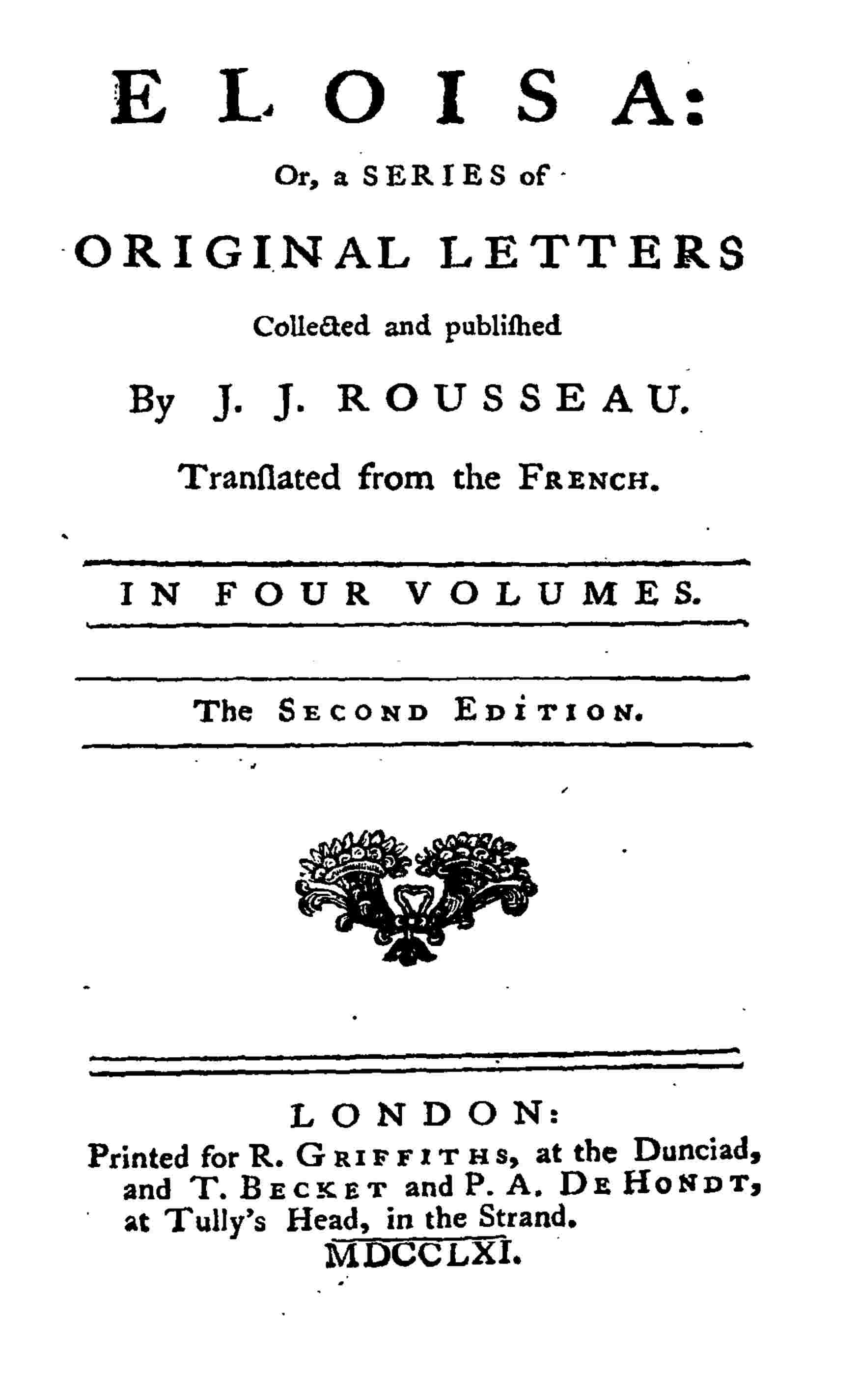
This e-book was prepared by Veronica Litt and based on the text of the second London edition of Kenrick’s translation of Rousseau’s novel. The second London edition was printed for R. Griffiths, T. Becket, and P.A. De Hondt in 1761. I accessed this version of the text via Gale Cengage’s Eighteenth-Century Collections Online (ECCO) database. The document is used with their permission.
When preparing this edition for e-publication, I retained original spellings and only intervened in particular circumstances. These include silently regularizing spellings that shifted over the course of the text (i.e. D’Etange replaced D’ Etange and d’Etange; Valaisian replaced Valaisan, Valiasan, entire replaced a combination of entire and intire, phrenzy replaced a combination of phrensy, phrenzy, and frenzy, farewell replaced a combination of farewel and farewell, etc). In all instances, I used the spelling that was more frequently featured in the text. I also silently corrected obvious printer's errors, including misnumbered letters (i.e. two letters in a row mislabeled as letter CVI).
In accordance with Project Gutenberg policy, eighteenth-century verb conventions (exprest instead of expressed) and spelling (risque instead of risk) have been retained.
In the original text, em dashes vary significantly in length as was usual in eighteenth-century literature. This digital edition renders all em dashes as follows:——
In the original text, ellipses vary significantly in length as was usual in eighteenth-century literature. This digital edition renders all ellipses as follows: ...
Rousseau frequently includes Italian and Latin quotes as well as occasional French turns of phrase. These are not translated in this edition. Stewart and Vaché’s modern translation of Rousseau’s original French text includes translations of most of these sources as well as excellent scholarly notes. See Julie, or the New Heloise, trans. Philip Stewart and Jean Vaché (University Press of New England, 1997).