
The Project Gutenberg eBook of Eloisa
Title: Eloisa
or, A series of original letters
Author: Jean-Jacques Rousseau
Translator: W. Kenrick
Release date: August 6, 2025 [eBook #76639]
Language: English
Original publication: London: Griffiths, Becket, and DeHondt, 1761
Credits: Veronica Litt and Subyeta Haque from scans generously made available by Gale Cengage.
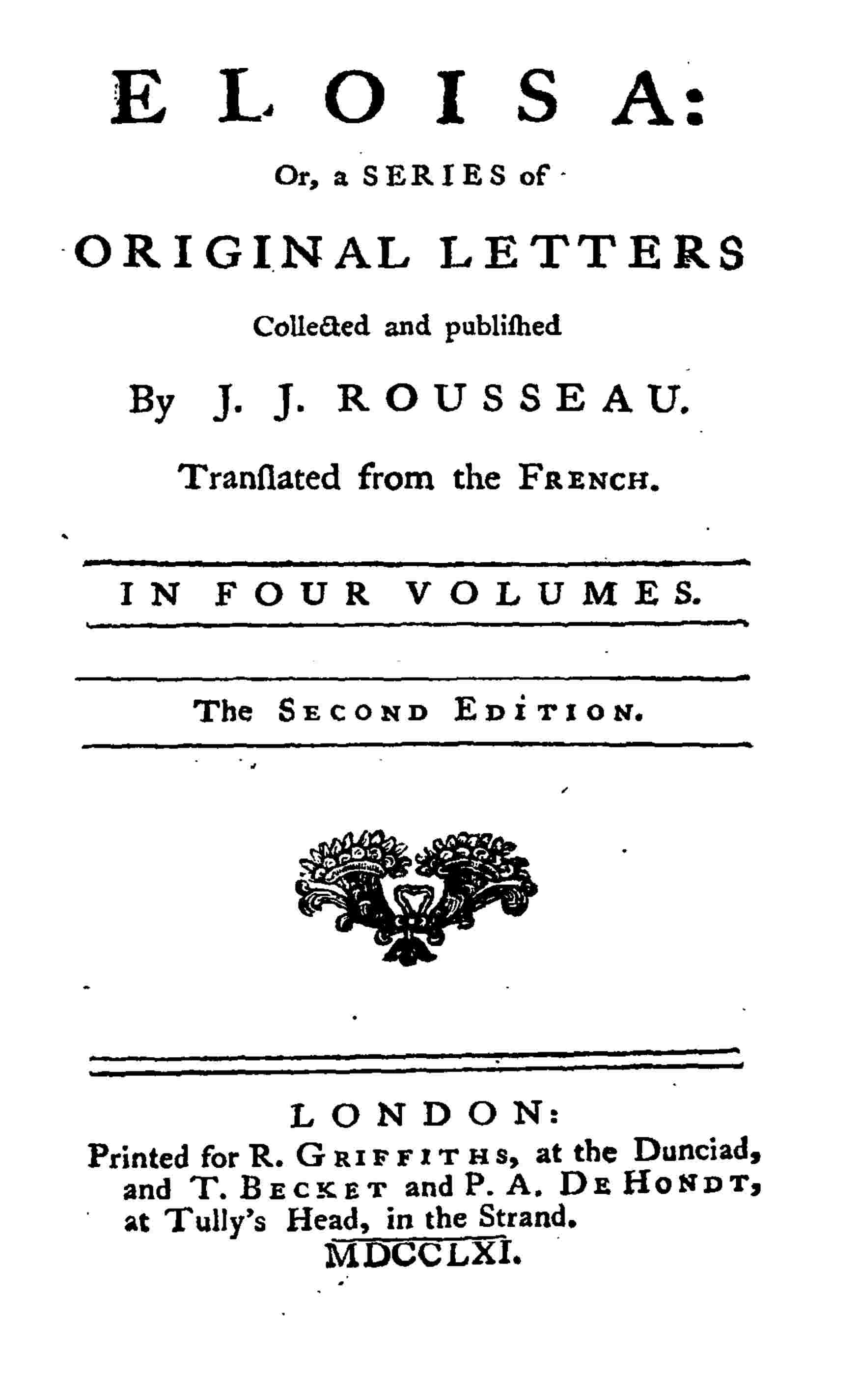
Eloisa:
Or, a Series of Original Letters
Collected and published by J.J. Rousseau
Translated from the French.
In Four Volumes.
The Second Edition.
London: Printed for R. Griffiths, at the Dunciad, and T. Becket and P.A. DeHondt at Tully's Head, in the Strand.
MDCCLXI.
Table of Contents
Translation of M. Rousseau's Preface
Preface by the Translator
A Dialogue Between a Man of Letters and Mr. J. J. Rousseau
Advertisement
Volume I
Volume II
Volume III
Volume IV
Translation of M. Rousseau’s Preface
Great cities require public theatres, and romances are necessary to a corrupt people. I saw the manners of the times, and have published these letters. Would to heaven I had lived in an age when I ought rather to have thrown them in the fire!
Though I appear only as the editor of this work, I confess that I have had some share in the composition. But am I the sole author, and is the entire correspondence fictitious? Ye people of the world, of what importance is it to you? Certainly, to you, it is all a fiction.
Every honest man will avow the books which he publishes. I have prefixed my name to these letters, not with a design to appropriate them to myself, but that I might be answerable for them. If they deserve censure, let it fall on me; if they have any merit, I am not ambitious of the praise. If it is a bad book, I am the more obliged to own it: I do not wish to pass for better than I am.
As to the reality of the history, I declare that, though I have been several times in the country of the two lovers, I never heard either of Baron D’Etange, his daughter, Mr. Orbe, Lord B——, or Mr. Wolmar. I must also inform the reader that there are several topographical errors in this work; but whether they are the effect of ignorance or design, I leave undetermined. This is all I am at liberty to say: let every one think as he pleases.
The book seems not calculated for an extensive circulation, as it is not adapted to the generality of readers. The stile will offend people of taste, to austere men the matter will be alarming, and all the sentiments will seem unnatural to those who know not what is meant by the word virtue. It ought to displease the devotee, the libertine, the philosopher; to shock all the ladies of gallantry, and to scandalize every modest woman. By whom, therefore, will it be approved? Perhaps only by myself: certain I am, however, that it will not meet with moderate approbation from any one.
Whoever may resolve to read these letters ought to arm himself with patience against faults of language, rusticity of stile, and pedantry of expression; he ought to remember that the writers are neither natives of France, wits, academicians, nor philosophers; but that they are young and unexperienced inhabitants of a remote village, who mistake the romantic extravagance of their own imagination, for philosophy.
Why should I fear to speak my thoughts? This collection of letters, with all their gothic air, will better suit a married lady than books of philosophy: it may even be of service to those who, in an irregular course of life, have yet preserved some affection for virtue. As to young ladies, they are out of the question; no chaste virgin ever read a romance: but if perchance any young girl should dare to read a single page of this, she is inevitably lost. Yet let her not accuse me as the cause of her perdition: the mischief was done before; and since she has begun, let her proceed, for she has nothing worse to fear.
May the austere reader be disgusted in the first volume, revile the Editor, and throw the book into the fire. I shall not complain of injustice; for probably, in his place, I might have acted in the same manner. But if after having read to the end, any one should think fit to blame me for having published the book, let him, if he pleases, declare his opinion to all the world, except to me; for I perceive it would never be in my power to esteem such a man.
Preface by the Translator
It is by no means my design to swell the volume, or detain the reader from the pleasure he may reasonably expect in the perusal of this work: I say reasonably, because the author is a writer of great reputation. My sole intention is to give a concise account of my conduct in the execution of this arduous task; and to anticipate such accusations as may naturally be expected from some readers: I mean those who are but imperfectly acquainted with the French language, or who happen to entertain improper ideas of translation in general.
If I had chosen to preserve the original title, it would have stood thus: Julia, or the New Eloisa, in the general title-page; and in the particular one, Letters of two Lovers, inhabitants of a small village at the foot of the Alps, collected and published, &c. Whatever objection I might have to this title, upon the whole, my principal reason for preferring the name of Eloisa to that of Julia, was, because the public seemed unanimous in distinguishing the work by the former rather than the latter, and I was the more easily determined, as it was a matter of no importance to the reader.
The English nobleman who acts a considerable part in this romance, is called in the original, Lord Bomston, which I suppose Mr. Rousseau thought to be an English name, or at least very like one. It may possibly sound well enough in the ears of a Frenchman; but I believe the English reader will not be offended with me for having substituted that of Lord B—— in its room. It is amazing that the French novelists should be as ignorant of our common names, and the titles of our nobility, as they are of our manners. They seldom mention our country, or attempt to introduce an English character, without exposing themselves to our ridicule. I have seen one of their celebrated romances, in which a British nobleman, called the Duke of Workinsheton, is a principal personage; and another, in which the one identical lover of the heroine is sometimes a Duke, sometimes an Earl, and sometimes a simple Baronet; Catombridge is, with them, an English city: and yet they endeavour to impose upon their readers by pretending that their novels are translations from the English.
With regard to this Chef d’oeuvre of Mr. Rousseau, it was received with uncommon avidity in France, Italy, Germany, Holland, and, in short, through every part of the Continent where the French language is understood. In England, besides a very considerable number first imported, it has been already twice reprinted; but how much soever the world might be delighted with the original, I found it to be the general opinion of my countrymen, that it was one of those books which could not possibly be translated with any tolerable degree of justice to the author: and this general opinion, I own, was my chief motive for undertaking the work.
There are, in this great city, a considerable number of industrious labourers, who maintain themselves, and perhaps a numerous family, by writing for the booksellers, by whom they are ranged in separate classes, according to their different abilities; and the very lowest class of all, is that of Translators. Now it cannot be supposed that such poor wretches as are deemed incapable of better employment, can be perfectly acquainted either with their own or with any other language: besides, were they ever so well qualified, it becomes their duty to execute as much work, in as little time, as possible; for, at all events, their children must have bread: therefore it were unreasonable to expect that they should spend their precious moments in poring over a difficult sentence in order to render their version the more elegant. This I take to be the true reason why our translations from the French are, in general, so extremely bad.
I confess, the idioms of the two languages are very different, and therefore that it will, in some instances, be impossible to reach the sublime delicacy of expression in an elegant French writer; but in return, their language is frequently so vague and diffuse, that it must be entirely the fault of the English translator if he does not often improve upon his original; but this will never be the case, unless we sit down with a design to translate the ideas rather than the words of our author.
Most of the translations which I have read, appear like a thin gauze spread over the original: the French language appears through every paragraph; but it is entirely owing to the want of bread, the want of attention, or want of ability in the translator. Mr. Pope, and some few others, have shewn the world, that not only the ideas of the most sublime writers may be accurately expressed in a translation, but that it is possible to improve and adorn them with beauties peculiar to the English language.
If in the following pages, the reader expects to find a servile, literal, translation, he will be mistaken. I never could, and never will, copy the failings of my author, be his reputation ever so great, in those instances where they evidently proceed from want of attention. Mr. Rousseau writes with great ease and elegance, but he sometimes wants propriety of thought, and accuracy of expression.
As to the real merit of this performance, the universal approbation it has met with is a stronger recommendation than any thing I could say in its praise.
A Dialogue Between a Man of Letters and Mr. J. J. Rousseau
N. There, take your Manuscript: I have read it quite through.
R. Quite through? I understand you: you think there are not many readers will follow your example.
N. Vel duo, vel nemo.
R. Turpe & miserabile. But let me have your sincere opinion.
N. I dare not.
R. You have dared to the utmost by that single word: Pray explain yourself.
N. My opinion depends upon your answer to this question: is it a real, or fictitious, correspondence?
R. I cannot perceive the consequence. In order to give one’s sentiments of a book, of what importance can it be to know how it was written?
N. In this case it is of great importance. A portrait has its merit if it resembles the original, be that original ever so strange; but in a picture which is the produce of imagination, every human figure should resemble human nature, or the picture is of no value: yet supposing them both good in their kind, there is this difference, the portrait is interesting but to a few people, whilst the picture will please the public in general.
R. I conceive your meaning. If these letters are portraits, they are uninteresting; if they are pictures, they are ill done. Is it not so?
N. Precisely.
R. Thus I shall snatch your answers before you speak. But, as I cannot reply, directly to your question, I must beg leave to propose one in my turn. Suppose the worst: my Eloisa——
N. Oh! if she had really existed.
R. Well.
N. But certainly it is no more than a fiction.
R. Be it so.
N. Why then, there never was any thing more absurd: the letters are no letters, the romance is no romance, and the personages are people of another world.
R. I am sorry for it, for the sake of this.
N. Console yourself; there is no want of fools among us; but yours have no existence in nature.
R. I could——No, I perceive the drift of your curiosity. But why do you judge so precipitately? Can you be ignorant how widely human nature differs from itself? how opposite its characteristics? how prejudice and manners vary according to times, places, and age. Who is it that can prescribe bounds to nature and say, Thus far shalt thou go, and no farther?
N. If such reasoning were allowed, monsters, giants, pygmies and chimeras of all kinds might be specifically admitted into nature: every object would be disfigured, and we should have no common model of ourselves. I repeat it, in a picture of human nature, every figure should resemble man.
R. I confess it; but then we should distinguish between the variety in human nature and that which is essential to it. What would you say of one who should only be able to know mankind in the picture of a Frenchman?
N. What would you say of one who, without expressing features or shape, should paint a human figure covered with a veil? Should we not have reason to ask, where is the man?
R. Without expressing features or shape? Is this just? There is no perfection in human nature: that is indeed chimerical. A young virgin in love with virtue, yet swerving from its dictates, but reclaimed by the horror of a greater crime; a too easy friend punished at last by her own heart for her culpable indulgence; a young man, honest and sensible, but weak, yet in words a philosopher; an old gentleman bigotted to his nobility, and sacrificing every thing to opinion; a generous and brave Englishman, passionately wise, and, without reason, always reasoning.
N. A husband, hospitable and gay, eager to introduce into his family his wife’s quondam paramour.
R. I refer you to the inscription of the plate.[1]
N. Les belles ames——Vastly fine!
R. O philosophy! What pains thou takest to contract the heart and lessen human nature!
N. It is fallaciously elevated by a romantic imagination. But to the point. The two friends——What do you say of them?——and that sudden conversion at the altar?——divine grace, no doubt.——
R. But Sir.
N. A pious Christian, not instructing her children in their catechism; who dies without praying; whose death nevertheless edifies the parson, and converts an Atheist——Oh!
R. Sir——
N. As to the reader being interested, his concern is universal, and therefore next to none. Not one bad action; not one wicked man to make us fear for the good. Events so natural, and so simple, that they scarce deserve the name of events; no surprize; no dramatic artifice; every thing happens just as it was expected. Is it worth while to register such actions as every man may see any day of his life in his own house or in that of his neighbour?
R. So that you would have common men, and uncommon events? Now I should rather desire the contrary. You took it for a romance: it is not a romance: but, as you said before, a collection of letters.
N. Which are no letters at all: this, I think, I said also. What an epistolary stile! how full of bombast! What exclamations! What preparation! How emphatical to express common ideas! What big words and weak reasoning! Frequently neither sense, accuracy, art, energy, nor depth. Sublime language and groveling thoughts. If your personages are in nature, confess, at least, that their stile is unnatural.
R. I own that in the light in which you are pleased to view them, it must appear so.
N. Do you suppose the public will not judge in the same manner; and did you not ask my opinion?
R. I did, and I answer you with a design to have it more explicitly: now it appears that you would be better pleased with letters written on purpose to be printed.
N. Perhaps I might; at least I am of opinion that nothing should be printed which is not fit for the press.
R. So that in books we should behold mankind only as they chuse to appear.
N. Most certainly, as to the author; those whom he represents, such as they are. But in these letters this is not the case. Not one strong delineation; not a single personage strikingly characterized; no solid observations; no knowledge of the world. What can be learnt in the little sphere of two or three lovers or friends constantly employed in matters only relative to themselves?
R. We may learn to love human nature, whilst in extensive society we learn to hate mankind. Your judgment is severe; that of the public ought to be still more so. Without complaining of injustice, I will tell you, in my turn, in what light these letters appear to me; not so much to excuse their defects, as to discover their source.
The perceptions of persons in retirement are very different from those of people in the great world; their passions being differently modified, are differently exprest; their imaginations constantly imprest by the same objects, are more violently affected. The same small number of images constantly return, mix with every idea, and create those strange and false notions so remarkable in people who spend their lives in solitude; but does it follow that their language is energic? No; ’tis only extraordinary: it is in our conversation with the world that we learn to speak with energy; first, because we must speak differently and better than others, and then, being every moment obliged to affirm what may not be believed, and to express sentiments which we do not feel, we endeavour at a persuasive manner which supplies the place of interior persuasion. Do you believe that people of real sensibility express themselves with that vivacity, energy, and ardor which you so much admire in our drama and romances? No; true passion, full of itself, is rather diffusive than emphatical; it does not even think of persuasion, as it never supposes that its existence can be doubtful. In expressing its feelings it speaks rather for the sake of its own ease, than to inform others. Love is painted with more vivacity in large cities, but is it in the village therefore less violent?
N. So that the weakness of the expression is a proof of the strength of their passion.
R. Sometimes, at least, it is an indication of its reality. Read but a love letter written by an author who endeavours to shine as a man of wit; if he has any warmth in his brain, his words will set fire to the paper; but the flame will spread no farther: you may be charmed, and perhaps a little moved, but it will be a fleeting agitation which will leave nothing except the remembrance of words. On the contrary, a letter really dictated by love, written by a lover influenced by a real passion, will be tame, diffuse, prolix, unconnected, and full of repetitions: his heart overflowing with the same sentiment, constantly returns to the same expressions, and like a natural fountain flows continually without being exhausted. Nothing brilliant, nothing remarkable; one remembers neither words nor phrases; there is nothing to be admired, nothing striking: yet we are moved without knowing why. Though we are not struck with strength of sentiment, we are touched with its truth, and our hearts, in spite of us, sympathize with the writer. But men of no sensibility, who know nothing more than the flowery jargon of the passions, are ignorant of those beauties and despise them.
N. I am all attention.
R. Very well. I say, that in real love letters, the thoughts are common, yet the stile is not familiar. Love is nothing more than an illusion; it creates for itself another universe; it is surrounded with objects which have no existence but in imagination, and its language is always figurative; but its figures are neither just nor regular: its eloquence consists in its disorder, and when it reasons least it is most convincing. Enthusiasm is the last degree of this passion. When it is arrived at its greatest height, its object appears in a state of perfection; it then becomes its idol; it is placed in the heavens; and as the enthusiasm of devotion borrows the language of love, the enthusiasm of love also borrows the language of devotion. Its ideas present nothing but Paradise, angels, the virtue of saints, and the delights of heaven. In such transport, surrounded by such images, is it not natural to expect sublime language? Can it possibly debase its ideas by vulgar expressions? Will it not on the contrary raise its stile, and speak with adequate dignity? What then becomes of your epistolary stile? it would do mighty well, to be sure, in writing to the object of one’s adoration: in that case they are not letters, but hymns.
N. We shall see what the world will say.
R. No: rather see the winter on my head. There is an age for experience, and another for recollection. Our sensibility may be extinguished by time; but the soul which was once capable of that sensibility remains. But to return to our letters: if you read them as the work of an author who endeavours to please, or piques himself on his writing, they are certainly detestable. But take them for what they are, and judge of them in their kind. Two or three young people, simple, if you will, but sensible, who mutually expressing the real sentiments of their hearts, have no intention to display their wit. They know and love each other too well for self-admiration to have any influence among them. They are children, and therefore think like children. They are not natives of France, how then can they be supposed to write correctly? They lived in solitude, and therefore could know but little of the world. Entirely filled with one single sentiment, they are in a constant delirium, and yet presume to philosophise. Would you have them know how to observe, to judge, and to reflect? No: of these they are ignorant; but they are versed in the art of love, and all their words and actions are connected with that passion. Their ideas are extravagant, but is not the importance which they give to these romantic notions more amusing than all the wit they could have displayed. They speak of every thing; they are constantly mistaken; they teach us nothing, except the knowledge of themselves; but in making themselves known, they obtain our affection. Their errors are more engaging than the wisdom of the wise. Their honest hearts, even in their transgressions, bear still the prejudice of virtue, always confident and always betrayed. Nothing answers their expectations; every event serves to undeceive them. They are deaf to the voice of discouraging truth: they find nothing correspond with their own feelings, and therefore, detaching themselves from the rest of the universe, they create, in their separate society, a little world of their own, which presents an entire new scene.
N. I confess, that a young fellow of twenty, and girls of eighteen, though not; uninstructed, ought not to talk like philosophers, even though they may suppose themselves such. I own also, for this distinction has not escaped me, that these girls became wives of merit, and the young man a better observer. I make no comparison between the beginning and the end of the work. The detail of domestic occurrences may efface, in some measure, the faults of their younger years: the chaste and sensible wife, the worthy matron, may obliterate the remembrance of former weakness. But even this is a subject for criticism: the conclusion of the work renders the beginning reprehensible: one would imagine them to be two different books, which ought not to be read by the same people. If you intended to exhibit rational personages, why would you expose them before they were become so? Our attention to the lessons of wisdom is destroyed by the child’s play by which they are preceded: we are scandalized at the bad, before the good can edify us. In short, the reader is offended and throws the book aside in the very moment when it might become serviceable.
R. On the contrary, I am of opinion, that to those who are disgusted with the beginning, the end would be entirely superstitious: and that the beginning will be agreeable to those readers to whom the conclusion can be useful. So that, those who do not read to the end will have left nothing, because it was an improper book for them; and those to whom it may be of service would never have read it, if it had begun with more gravity. Our lessons can never be useful unless they are so written as to catch the attention of those for whose benefit they were calculated.
I may have changed the means, and not the object. When I endeavoured to speak to men, I was not heard; perhaps in speaking to children I shall gain more attention; and children would have no more relish for naked reason, than for medicines ill disguised.
Cosi all’ egro fanciul porgiamo aspersi
Di soave licor gl’orli del vaso;
Succhi amari ingannato in tanto ei beve,
E da l’ inganno suo vita riceve.
N. Here again I am afraid you are deceived: they will sip on the edge of the vessel, but will not drink the liquor.
R. Be it so; it will not be my fault: I shall have done all in my power to make it palatable. My young folks are amiable; but to love them at thirty it is necessary to have known them when they were ten years younger: One must have lived with them a long time to be pleased with their company; and to taste their virtues, it is necessary we should first have deplored their failings. Their letters are not interesting at first; but we grow attached by degrees, and can neither continue nor quit them. They are neither elegant, easy, rational, sensible, nor eloquent; but there is sensibility which gradually communicates itself to our hearts, and which at last is found to supply the place of all the rest. It is a long romance, of which no one part has power to move us, and yet the whole produces a proper effect. At least, such were its effects upon me: pray were not you touched in reading it?
N. No; yet I can easily conceive your being affected: if you are the author, nothing can be more natural; and if not, I can still account for it. A man of the world can have no taste for the extravagant ideas, the affected pathos, and false reasoning of your good folks; but they will suit a recluse, for the reason which you have given: now, before you determine to publish the manuscript, you would do well to remember that the world is not composed of hermits. All you can expect is that your young gentleman will be taken for a Celadon, your Lord B—— for a Don Quixote, your young damsels for two Astreas, and that the world will laugh at them for a company of fools. But a continued folly cannot be entertaining. A man should write like Cervantes before he can expect to engage his reader to accompany him through six volumes of nonsense.
R. The very reason which would make you suppress this work, will induce me to print it.
N. What! the certainty of its not being read?
R. A little patience, and you will understand me. As to morals, I believe that all kinds of reading are useless to people of the world: first, because the number of new books which they run through, so generally contradict each other, that their effect is reciprocally destroyed. The few choice books which deserve a second perusal, are equally ineffectual: for, if they are written in support of received opinions, they are superfluous; and if in opposition, they are of no use; they are too weak to break the chain which attaches the reader to the vices of society. A man of the world may possibly, for a moment, be led from his wonted path by the dictates of morality; but he will find so many obstacles in the way, that he will speedily return to his former course. I am persuaded there are few people, who have had a tolerable education, that have not made this essay, at least once in their lives; but, finding their efforts vain, they are discouraged from any future attempt, and consider the morality of books as the jargon of idleness. The farther we retreat from business, great cities, and numerous societies, the more the obstacles to morality diminish. There is a certain point of distance where these obstacles cease to be insurmountable and there it is that books may be of use. When we live in solitude, as we do not then read with a design to display our reading, we are less anxious to change our books, and bestow on them more reflection; and as their principles find less opposition from without, their internal impression is more effectual. In retirement, the want of occupation, obliges those who have no resource in themselves, to have recourse to books of amusement. Romances are more read in the provincial towns than at Paris, in towns less than in the country, and there they make the deepest impression: the reason is plain.
Now it happens unfortunately that the books which might amuse, instruct, and console the people in retirement, who are unhappy only in their own imagination, are generally calculated to make them still more dissatisfied with their situation. People of rank and fashion are the sole personages of all our romances. The refined taste of great cities, court maxims, the splendour of luxury, and epicurean morality; these are their precepts, these their lesson of instruction. The colouring of their false virtues tarnishes their real ones. Polite manners are substituted for real duties, fine sentiments for good actions, and virtuous simplicity is deemed want of breeding.
What effect must such representations produce in the mind of a country gentleman, in which his freedom and hospitality is turned into ridicule, and the joy which he spreads through his neighbourhood is pronounced to be a low and contemptible amusement? What influence must they not have upon his wife, when she is taught, that the care of her family is beneath a lady of her rank; and on his daughter, who being instructed in the jargon and affectation of the city, disdains for his clownish behaviour, the honest neighbour whom she would otherwise have married. With one consent, ashamed of their rusticity, and disgusted with their village, they leave their ancient mansion, which soon becomes a ruin, to reside in the metropolis; where the father, with his cross of St. Lewis, from a gentleman becomes a sharper; the mother keeps a gaming house; the daughter amuses herself with a circle of gamesters: and frequently all three, after having led a life of infamy, die in misery and dishonour.
Authors, men of letters, and philosophers are constantly insinuating, that in order to fulfil the duties of society, and to serve our fellow creatures, it is necessary that we should live in great cities: according to them, to fly from Paris, is to hate mankind; people in the country are nobody in their eyes; to hear them talk, one would imagine that where there are no pensions, academies, nor open tables, there is no existence.
All our productions verge to the same goal. Tales, romances, comedies, all are levelled at the country; all conspire to ridicule rustic simplicity; they all display and extol the pleasures of the great world; it is a shame not to know them; and not to enjoy them, a misfortune. How many of those sharpers and prostitutes, with which Paris is so amply provided, were first seduced by the expectations of these imaginary pleasures? Thus prejudice and opinion contribute to effect the political system by attracting the inhabitants of each country to a single point of territory, leaving all the rest a desert: thus nations are depopulated, that their capitals may flourish; and this frivolous splendor with which fools are captivated, makes Europe verge with celerity towards its ruin. The happiness of mankind requires that we should endeavour to stop this torrent of pernicious maxims. The employment of the clergy is to tell us that we must be good and wise, without concerning themselves about the success of their discourses; but a good citizen, who is really anxious to promote virtue, should not only tell us to be good, but endeavour to make the path agreeable which will lead us to happiness.
N. Pray, my good friend, take breath for a moment. I am no enemy to useful designs; and I have been so attentive to your reasoning, that I believe it will be in my power to continue your argument. You are clearly of opinion, that to give to works of imagination the only utility of which they are capable, they must have an effect diametrically opposite to that which their authors generally propose; they must combat every human institution, reduce all things to a state of nature, make mankind in love with a life of peace and simplicity, destroy their prejudices and opinions, inspire them with a taste for true pleasure, keep them distant from each other, and instead of exciting people to crowd into large cities, persuade them to spread themselves all over the kingdom, that every part may be equally enlivened. I also comprehend, that it is not your intention to create a world of Arcadian shepherds, of illustrious peasants labouring on their own acres and philosophising on the works of nature, nor any other romantic beings which exist only in books; but to convince mankind that in rural life there are many pleasures which they know not how to enjoy; that these pleasures are neither so insipid nor so gross as they imagine; that they are susceptible of taste and delicacy; that a sensible man, who should retire with his family into the country, and become his own farmer, might enjoy more rational felicity, than in the midst of the amusements of a great city; that a good housewife may be a most agreeable woman, that she may be as graceful and as charming as any town coquet of them all; in short, that the most tender sentiments of the heart will more effectually animate society, than the artificial language of polite circles, where the ill-natured laugh of satyr is the pitiful substitute of that real mirth which no longer exists. Have I not hit the mark?
R. ’Tis the very thing; to which I will add but one reflection. We are told that romances disturb the brain: I believe it true. In continually displaying to the reader the ideal charms of a situation very different from his own, he becomes dissatisfied, and makes an imaginary exchange for that which he is taught to admire. Desiring to be that which he is not, he soon believes himself actually metamorphosed, and so becomes a fool. If, on the contrary, romances were only to exhibit the pictures of real objects, of virtues and pleasures within our reach, they would then make us wiser and better. Books which are designed to be read in solitude, should be written in the language of retirement: if they are meant to instruct, they should make us in love with our situation; they should combat and destroy the maxims of the great world, by shewing them to be false and despicable, as they really are. Thus, Sir, a romance, if it be well written, or at least if it be useful, must be hissed, damned, and despised by the polite world, as being a mean, extravagant and ridiculous performance; and thus what is folly in the eyes of the world is real wisdom.
N. Your conclusion is self-evident. It is impossible better to anticipate your fall, nor to be better prepared to fall with dignity. There remains but one difficulty. People in the country, you know, take their cue from us. A book calculated for them must first pass the censure of the town: if we think fit to damn it, its circulation is entirely stopt. What do you say to that?
R. The answer is quite simple. You speak of wits who reside in the country; whilst I would be understood to mean real country folks. You gentlemen who shine in the capital, have certain prepossessions of which you must be cured: you imagine that you govern the taste of all France, when in fact three fourths of the kingdom do not know that you exist. The books which are damned at Paris often make the fortune of country booksellers.
N. But why will you enrich them at the expense of ours?
R. Banter me as you please, I shall persist. Those who aspire to fame must calculate their works for the meridian of Paris; but those who write with a view to do good, must write for the country. How many worthy people are there who pass their lives in cultivating a few paternal acres, far distant from the metropolis, and who think themselves exiled by the partiality of fortune? During the long winter evenings, deprived of society, they pass the time in reading such books of amusement as happen to fall into their hands. In their rustic simplicity they do not pride themselves on their wit or learning; they read for entertainment rather than instruction; books of morality and philosophy are entirely unknown to them. As to your romances, they are so far from being adapted to their situation, that they serve only to render it insupportable. Their retreat is represented to be a desert, so that whilst they afford a few hours amusement, they prepare for them whole months of regret and discontent. Why may I not suppose that, by some fortunate accident, this book, like many others of still less merit, will fall into the hands of those inhabitants of the fields, and that the pleasing picture of a life exactly resembling theirs will render it more tolerable? I have great pleasure in the idea of a married couple reading this novel together, imbibing fresh courage to support their common labours, and perhaps new designs to render them useful. How can they possibly contemplate the representation of a happy family without attempting to imitate the pleasing model? How can they be affected with the charms of conjugal union, even where love is wanting, without increasing and confirming their own attachment? In quitting their book, they will neither be discontented with their situation, nor disgusted at their labour: on the contrary, every object around them will assume a more delightful aspect, their duties will seem ennobled, their taste for the pleasures of nature will revive; her genuine sensations will be rekindled in their hearts, and perceiving happiness within their reach, they will learn to taste it as they ought: they will perform the same functions, but with another soul; and what they did before as peasants only, they will now transact as real patriarchs.
N. So far, you sail before the wind. Husbands, wives, matrons——but with regard to young girls; d’ye say nothing of those?
R. No. A modest girl will never read books of love. If she should complain of having been injured by the perusal of these volumes, she is unjust: she has lost no virtue; for she had none to lose.
N. Prodigious! attend to this, all ye amorous writers; for thus ye are all justified.
R. Provided they are justified by their own hearts and the object of their writings.
N. And is that the case with you?
R. I am too proud to answer to that question; but Eloisa had a certain rule by which she formed her judgment of books: [2] if you like it, use it in judging of this. Authors have endeavoured to make the reading of romances serviceable to youth. There never was a more idle project. It is just setting fire to the house in order to employ the engines. Having conceived this ridiculous idea, instead of directing the moral of their writings towards its proper object, it is constantly addressed to young girls, [3] without considering that these have no share in the irregularities complained of. In general, though their hearts may be corrupted, their conduct is blameless. They obey their mothers in expectation of the time when it will be in their power to imitate them. If the wives do their duty, be assured the girls will not be wanting in theirs.
N. Observation is against you in this point. The whole sex seem to require a time for libertinism, either in one state or the other. It is a bad leaven, which must ferment soon or late. Among a civilized people the girls are easy, and the wives difficult, of access; but where mankind are less polite, it is just the reverse: the first consider the crime only, the latter the scandal. The principal question is, how to be left secured from the temptation: as to the crime it is of no consideration.
R. If we were to judge by its consequences, one would be apt to be of another opinion. But let us be just to the women: the cause of their irregularities are less owing to themselves, than to our bad institutions. The extreme inequality in the different members of the same family must necessarily stifle the sentiments of nature. The vices and misfortunes of children are owing chiefly to the father’s unnatural despotism. A young wife, unsuitably espoused, and a victim to the avarice or vanity of her parents, glories in effacing the scandal of her former virtue by her present irregularities. If you would remedy this evil, proceed to its source. Public manners can only be reformed by beginning with private vices, which naturally arise from parents. But our reformers never proceed in this manner. Your cowardly authors preach only to the oppressed; and their morality can have no effect, because they have not the art to address the most powerful.
N. You, Sir, however run no risk of being accused of servility; but may you not possibly be too sincere? In striking at the root of this evil, may you not be the cause of more——
R. Evil? to whom? In times of epidemical contagion, when all are infected from their infancy, would it be prudent to hinder the distribution of salutary medicines under a pretence that they might do harm to people in health? You and I, Sir, differ so widely on this point, that if it were reasonable to expect that these letters can meet with any success, I am persuaded they will do more good than a better book.
N. Certainly your females are excellent preachers. I am pleased to see you reconciled with the ladies; for I was really concerned when you imposed silence on the sex. [4]
R. You are too severe; I must hold my tongue: I am neither so wise nor so foolish as to be always in the right. Let us leave this bone for the critics.
N. With all my heart, lest they should want one. But suppose you had nothing to fear from any other quarter, how will you excuse to a certain severe censor of the stage, those warm descriptions, and impassioned sentiments, which are so frequent in those letters? Shew me a scene in any of our theatrical pieces equal to that in the wood at Clarens, or that of the dressing room. Read the letter on theatrical amusements; read the whole collection. In short, be confident, or renounce your former opinions. What would you have one think?
R. I would have the critics be confident with themselves, and not judge till they have thoroughly examined. Let me intreat you to read once more with attention the parts you have mentioned; read again the preface to Narcisse, and you will there find an answer to the accusation of inconsistency. Those forward gentlemen who pretend to discover that fault in the Devin du Village, will undoubtedly think it much more glaring in this work. They will only act in character; but you——
N. I recollect two passages. [5] You do not much esteem your cotemporaries.
R. Sir, I am also their cotemporary! O why was I not born in an age in which I ought to have burnt this collection!
N. Extravagant as usual! however, to a certain degree, your maxims are just. For instance; if your Eloisa had been chaste from the beginning, she would have afforded us less instruction; for to whom would she have served as a model? In the most corrupt ages mankind are fond of the most perfect lessons of morality: theory supplies the place of practice, and at the small expense of a little leisure reading, they satisfy the remnant of their taste for virtue.
R. Sublime authors, relax a little your perfect models, if you expect that we should endeavour to imitate them. To what purpose do you vaunt unspotted purity? rather shew us that which may be recovered, and perhaps there are some who will attend to your instructions.
N. Your young hero has already made those reflections; but no matter, you would be thought no less culpable in having shewn us what is done, in order to shew what ought to be done. Besides, to inspire the girls with love, and to make wives reserved, is overturning the order of things, and recalling those trifling morals which are now totally proscribed by philosophy. Say what you will, it is very indecent, nay scandalous for a girl to be in love: nothing but a husband can authorise a lover. It was certainly very impolitic to be indulgent to the unmarried ladies, who are not allowed to read you, and severe upon the married ones, by whom you are to be judged. Believe me, if you were fearful of success, you may be quite easy: you have taken sufficient care to avoid an affront of that nature. Be it as it may, I shall not betray your confidence. I hope your imprudence will not carry you too far. If you think you have written a useful book, publish it; but by all means conceal your name.
R. Conceal my name! Will an honest man speak to the public from behind a curtain? Will he dare to print what he does not dare to own? I am the editor of this book, and I shall certainly fix my name in the title page.
N. Your name in the title-page!
R. Yes, Sir, in the title-page.
V. You are surely in jest.
R. I am positively in earnest.
N. What your real name? Jean Jacques Rousseau, at full length?
R. Jean Jacques Rousseau at full length.
N. You surely don’t think. What will the world say of you?
R. What they please. I don’t print my name with a design to pass for the author, but to be answerable for the book. If it contains any thing bad, let it be imputed to me; if good, I desire no praise. If the work in general deserves censure, there is so much more reason for prefixing my name. I have no ambition to pass for better than I am.
N. Are you content with that answer?
R. Yes, in an age when it is impossible for any one to be good.
N. Have you forgot les belles ames?
R. By nature belles, but corrupted by your institutions.
N. And so we shall behold, in the title-page of a book of love-epistles, by J.J. Rousseau, Citizen of Geneva!
R. No, not Citizen of Geneva. I shall not profane the name of my country. I never prefix it, but to those writings by which I think it will not be dishonoured.
N. Your own name is no dishonourable one, and you have some reputation to lose. This mean and weak performance will do you no service. I wish it was in my power to dissuade you; but if you are determined to proceed, I approve of your doing it boldly and with a good grace. At least this will be in character. But a propos; do you intend to prefix your motto?
R. My bookseller asked me the same question, and I thought it so humorous that I promised to give him the credit of it. No, Sir, I shall not prefix my motto to this book; nevertheless, I am now less inclined to relinquish it than ever. Remember that I thought of publishing those letters at the very time when I wrote against the theatres, and that a desire of excusing one of my writings, has not made me disguise truth in the other. I have accused myself before hand, perhaps, with more severity than any other person will accuse me. He who prefers truth to fame, may hope to prefer it to life itself. You say that we ought to be confident: I doubt whether that be possible to man, but it is not impossible to act with invariable truth. This I will endeavour to do.
N. Why then, when I ask whether you are the author of these letters, do you evade the question?
R. I will not lie, even in that case.
N. But you refuse to speak the truth.
R. It is doing honour to truth to keep it secret. You would have less difficulty with one who made no scruple of a lie. Besides, you know men of taste are never mistaken in the pen of an author. How can you ask a question which it is your business to resolve?
N. I have no doubt with regard to some of the letters; they are certainly yours: but in others you are quite invisible, and I much doubt the possibility of disguise in this case. Nature, who does not fear being known, frequently changes her appearance; but art is often discovered, by attempting to be too natural. These epistles abound with faults, which the most arrant scribbler would have avoided. Declamation, repetitions, contradictions, &c. In short, it is impossible that a man, who can write better, could ever resolve to write so ill. What man in his senses would have made that foolish Lord B—— advance such a shocking proposal to Eloisa? Or what author would not have corrected the ridiculous behaviour of his young hero, who though positively resolved to die, takes good care to apprize all the world of his intention, and finds himself at last in perfect health? Would not any writer have known that he ought to support his characters with accuracy, and vary his stile accordingly, and he would then infallibly have excelled even nature herself?
I have observed that in a very intimate society, both stile and characters are extremely similar, and that when two souls are closely united, their thoughts, words, and actions will be nearly the same. This Eloisa, as she is represented, ought to be an absolute enchantress; all who approach her, ought immediately to resemble her; all her friends should speak one language; but these effects are much easier felt than imagined: and even if it were possible to express them, it would be imprudent to attempt it. An author must be governed by the conceptions of the multitude, and therefore all refinement is improper. This is the touch-stone of truth, and in this it is that a judicious eye will discover real nature.
R. Well, and so you conclude——
N. I do not conclude at all. I am in doubt, and this doubt has tormented me inexpressibly, during the whole time I spent in reading these letters. If it be all a fiction, it is a bad performance; but say that these two women have really existed, and I will read their epistles once a year to the end of my life.
R. Strange! what signifies it whether they ever existed or not? They are no where to be found: they are no more.
N. No more? So they actually did exist.
R. The conclusion is conditional: if they ever did exist, they are now no more.
N. Between you and I, these little subtilties are more conclusive than perplexing.
R. They are such as you force me to use, that I may neither betray myself nor tell an untruth.
N. In short, you may do as you think proper; your Title is sufficient to betray you.
R. It discovers nothing relative to the matter in question; for who can tell whether I did not find this title in the manuscript? Who knows whether I have not the same doubts which you have? Whether all this mystery be not a pretext to conceal my own ignorance?
N. But however you are acquainted with the scene of action. You have been at Vevey, in the Pays de Vaud?
R. Often; and I declare that I never heard either of Baron D'Etange, or his Daughter. The name of Wolmar is entirely unknown in that country. I have been at Clarens, but never saw any house like that which is described in these letters. I passed through it in my return from Italy, in the very year when the sad catastrophe happened, and I found no body in tears for the death of Eloisa Wolmar. In short, as much as I can recollect of the country, there are, in these letters, several transpositions of places, and topographical errors, proceeding either from ignorance in the author, or from a design to mislead the reader. This is all you will learn from me on this point, and you may be assured that no one else shall draw any thing more from me.
N. All the world will be as curious as I am. If you print this work, tell the public what you have told me. Do more, write this conversation as a Preface: it contains all the information necessary for the reader.
R. You are in the right. It will do better than any thing I could say of my own accord. Though these kind of apologies seldom succeed.
N. True, where the author spares himself. But I have taken care to remove that objection here. Only I would advise you to transpose the parts. Pretend that I wanted to persuade you to publish, and that you objected. This will be more modest, and will have a better effect.
R. Would that be consistent with the character for which you praised me a while ago?
N. It would not. I spoke with a design to try you. Leave things as they are.
Advertisement
The following Dialogue was originally intended as a Preface to Eloisa; but its form and length permitting me to prefix to that Work only a few extracts from it, I now publish it entire, in hopes that it will be found to contain some useful hints concerning Romances in general. Besides, I thought it proper to wait till the Book had taken its chance, before I discussed its inconveniences and advantages, being unwilling either to injure the Bookseller, or supplicate the indulgence of the Public.
The following Account of this Work is taken from the Journal des Sçavans for June 1761, Printed at Paris.
This work is a strange, but memorable monument of the eloquence of the passions, the charms of virtue, and the force of imagination. Unfeeling spirits may, as long as they please, remark and exaggerate the faults of which the author does not scruple to accuse himself in his two most singular prefaces; they may arraign him for frequent want of taste, call his stile unequal and incorrect, his sentiments too refined, and his paradoxes inexplicable; they may complain that his notes are ludicrous and misplaced, as they frequently break in upon a tender sentiment, a pathetic situation, and that in general they are nothing more than an anticipated parody on the objections, whether just or groundless, which the author seems to expect from certain critics; they may even attempt to undermine the foundation of the work, and accuse the author of cold prolixity in his description of the peace and happiness of Clarens, after the violent agitation of those grand movements by which it is preceded; they may be shocked with the useless and abortive passion of Clara for St. Preux, the negotiation begun concerning their marriage, the impenetrable, obscure, and consequently uninteresting amours of Lord B—— in Italy; they may think the author extravagant in the general choice of his events; but whatever may be the present and future judgment of the public,
Ut cumque ferent ea facta minores,
Vincet Amor.
What heart can be unaffected with the dangers, the misfortunes, the weakness, and the virtues of Eloisa? Who can possibly be insensible to the ardor of her lover, the vigilant, active, and impatient friendship of Clara, the noble and encouraging protection of Lord B——, the unshaken wisdom of Wolmar, and all these characters moved by the most extraordinary springs? Who can resist those torrents of pathetic language which penetrate the inmost soul, and so tyrannically command our tears; those master-strokes of simplicity which open the recesses of the human heart, and excite the pleasure of weeping sensibility? How can we help admiring his talent of giving life to every object, of transporting the reader in the middle of the scene, and engaging him as a party in every action, by the happy choice of incidents, and if I may be allowed the expression, by the use of words the most identical to the things intended to be described? Can there be a reader who is not enamoured of the soul of Eloisa? Can there be a reader who does not feel the loss of her as if she were his own, and who does not join in the general mourning at Clarens, and the despair of Clara on the death of her friend?
A common author would have satisfied himself with giving us, once for all, a beautiful picture of his heroine, in which he would have shewn us, in one general point of view, the accomplishment of every duty, and the expansion of every sentiment, by loading our imagination with all the particular applications of this virtuous principle to every single event. Mr. Rousseau, on the contrary, in one continued adion, always before our eyes, displays his Eloisa fulfilling without study, and without the least confusion, all the duties of a wife, a friend, a daughter, a mother, and mistress of a family; so that we behold her constantly employed in these several situations, without confounding the rights of any of them; without favouring one at the expense of the other. He does not relate her actions, but makes her perform them in our sight, and by that means renders those things real, which in recital would appear hyperbolical, romantic, and incredible.
In the great number of different pictures which the author has here collected, whether he paints the respectable simplicity of Valesian manners, the brilliant corruption of great cities, the restricted impatience of expecting love, the wildness of despair, or the pathetic regret of a generous passion after an extraordinary sacrifice; whether, in the interesting scene of Meillerie, he displays all the eloquence of genius, and every tender emotion of the heart; whether excited by the plausibility of logic he collects his whole strength to destroy the sophisms of false honour; whether Virtue herself thunders with her respectable and sublime voice against the crime of suicide justified by eloquence; we always find his manner properly adapted both to the subject and to the speaker, which renders the illusion compleat.
Almost every trial which the soul can experience is represented either in the principal or accessory situations, or in the reflections. In short, the human soul is here penetrated and displayed in every point of view; so that every sensible heart may be certain of beholding itself in this mirror.
The nature and form of this work will not allow of a regular extract. It consists entirely of a gradual unfolding of ideas and sensations which admit of no analysis, and which can be pursued only in the work itself. The author in the catastrophe imitates the happy artifice of the artist who painted the sacrifice of Iphigenia. Eloisa dies; they weep round her ashes. The author paints this universal grief; he paints the silent but sincere affliction of her husband, the affecting stupor of the father, the extravagant sorrow of her friend: and now the despair of her lover remains to be described; but that was inexpressible: the author wisely draws a veil before him, and leaves the rest to our imagination.
The picture of Eloisa dying can be compared only to the scene of Alcestes expiring, in Euripides.
Upon the whole, it were needless to say how much this work deserves to be read, since the eagerness of the Public hath already sufficiently prevented us. We cannot better express our approbation of a performance in which even vice itself breathes an air of virtue, than in the words of Eloisa, who in speaking of Lord B—— says, was there ever a man without faults who possessed great virtues? And in like manner we ask, whether there was ever a work without blemish which might boast of such penetrating and sublime beauties?