
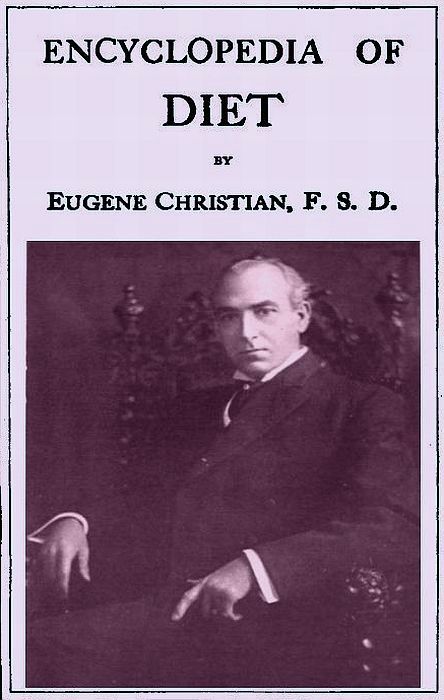
The Project Gutenberg eBook of Encyclopedia of Diet: A Treatise on the Food Question, Vol. 1
Title: Encyclopedia of Diet: A Treatise on the Food Question, Vol. 1
Author: Eugene Christian
Release date: August 5, 2014 [eBook #46511]
Most recently updated: October 24, 2024
Language: English
Credits: Produced by Juliet Sutherland, Jane Robins and the Online
Distributed Proofreading Team at http://www.pgdp.net
ENCYCLOPEDIA OF
DIET
A Treatise on the Food Question
IN FIVE VOLUMES
Explaining, in Plain Language, the
Chemistry of Food and the Chemistry of
the Human Body, together with the Art of
Uniting these Two Branches of Science in the
Process of Eating so as to Establish Normal
Digestion and Assimilation of Food and
Normal Elimination of Waste, thereby
Removing the Causes of Stomach,
Intestinal, and All Other
Digestive Disorders
BY
Eugene Christian, F. S. D.
Volume I
NEW YORK CITY
CORRECTIVE EATING SOCIETY, Inc.
1917
Copyright 1914
BY
EUGENE CHRISTIAN
Entered at
Stationers Hall, London
September, 1914
BY
EUGENE CHRISTIAN, F. S. D.
ALL RIGHTS RESERVED
Published August, 1914
TO THE
MOTHERS
AND TO THE NOBLE WORKERS
IN THE GREAT CAUSE OF HUMAN HEALTH
AND OF HUMAN SUFFERING
THESE VOLUMES ARE
Dedicated
BY
THE AUTHOR
PREFACE
Countless centuries have come and gone and have left on the earth myriad forms of life; but just what life is, from whence it came, whether or not there is purpose or design behind it, whether or not all the sacred books are mere conceptions of the infant mind, of the whence and whither, we do not know; but when we put life beneath the searchlight of science, we do know that it is a mere assembling of ionic matter into organic forms, and that this strange work is done in accordance with certain well-defined laws.
We know that these laws are a part of the great cosmic scheme. In harmony with them works evolution, which tends to lift to higher and higher degrees of perfection all forms of both animate and inanimate life. We believe that if all the natural laws governing life could be ascertained and obeyed, the number of disorders or interferences with Nature's scheme would be very greatly decreased.
Man's system of co-operating with his fellow-creatures, which we call civilization, has imposed certain restrictions, duties and limitations upon him, which make it impossible for him to live in strict accordance with these laws; therefore if he would have his birthright, which is health, he must employ science to fit him into his artificial environment.
Man has been brought to his present state of physical development on the rural, outdoor, close-to-nature plan, and since he must live in houses and pursue occupations foreign to those through which he was developed, he must make corresponding changes in the material from which his body is constantly being repaired and made; therefore, as the selections, combinations, and proportions of the various things he needs for nourishment are determined by his age, activity, and exposure to the open air, if he accurately or even approximately ascertains and observes these things, life will continually ascend in the scale of power and grandeur, and his endurance and period of longevity will be increased.
Nearly all forms of life on this globe, except man, live approximately eight times their period of maturity. Man matures at twenty-four; measured by this scale he should live about two hundred years. But the average life of civilized man, reckoning from the age of six, is only about forty years, while if we include the infant class, and reckon the average age from his birth, he scarcely gets his growth before his hair and teeth are disappearing, and his eyesight is being propped up by the lens of the oculist, and he quietly drops into his grave. One hundred and sixty years of life, then, is about what civilization has cost him up to date. This is very expensive, but of course he has something to show for it. He has aeroplanes, wireless communication, the mile-a-minute train, politics, several kinds of religion, rum and cocain, the tramp, the billionaire, and the bread line.
We cannot consistently leap over ten thousand years of heredity and habit, but we can recover some part of the one hundred and sixty years of life civilization has cost us. This can be done by feeding our bodies according to their requirements determined by age, temperature of environment, and work or activity; by cultivating mental tranquillity; by loving some one besides ourselves, and proving it; by breathing an abundance of fresh air, and by doing useful work. Of all these things food is the most important because it is the raw material that builds the temple wherein all other things dwell.
Civilization and science are doing but little real good for man if they cannot select for him the material necessary to develop his body and all its faculties to their highest degree, or at least free him from much of his disease and materially increase his "ease"; they have brought him but little, I say, if they cannot show him a way to live more than forty years. Science would have nothing of which to boast if it only pointed out a way by which man could exist for two hundred years, as this is his birthright. It can only boast when it has given him more than his natural heritage.
That man's general health and period of longevity have decreased, while all other branches of science have so vastly increased, is evidence sufficient to justify the assertion that he has not employed scientific methods to the art of living, or at least to those fundamental principles, such as nutrition, motion, and oxidation, which really govern his health and his life.
The difference between youth and age, between virility and senility, is in reality a chemical difference only. The difference between the flexible cartilage of youth, and the stiff cartilage of age is one of chemistry.
If, by the process of metabolism, the muscles, bones, tissues, and brain-cells can be made to multiply and to reproduce themselves at eighteen, it seems only logical that science should give us the secret by which this same thing could be done at eighty, and if at eighty, why not at a hundred and eighty? It is by no means extravagant to say that if science can teach us the actual demands of the body under the varied conditions of age, climate, and activity, and the means of supplying these demands with only such food elements as are needed, life can be prolonged to what seems to be our natural period of years.
Consider the human body as a machine that possesses the power of converting fuel or food into energy, using or expending that energy at will, reproducing itself piece by piece from the same fuel, and casting out the debris and ashes—if all this is done by the body automatically, and its power to act or to do these things depends so completely upon the fuel or the material with which the body has to work, then the question of the kind of fuel, the quantity, how to select it, how to combine it, how to proportion it, becomes at once the most important problem within the scope of human learning.
THE PURPOSE OF THIS WORK
When we compare man's longevity with other forms of life, and consider that he breathes the same air, drinks the same water, lives under the same sunshine, and that he differs from them chiefly in his habits of eating, the conviction is forced upon us that in his food is found the secret, or the causes of most of his physical ills and his shortened life. All elements composing the human body are well known. Its daily needs are matters of common knowledge. Science has separated the human body into all its various chemical elements or parts, and weighed and named them; it has also analyzed and separated his food or fuel into its various chemical elements or parts, and named these. It would seem, therefore, a most logical step to unite these two branches of science, and to give to the world the dual science of Physio-food Chemistry, or, what I have named Applied Food Chemistry.
The sciences of physiological chemistry and of food chemistry can be made useful only by uniting them—putting them together—fitting one into the other for the betterment of the human species. These two branches of science can be of use in no other possible way except by ascertaining the demands of the human body through physiological chemistry, and by learning how to supply these demands through the science of food chemistry. In the union of these hitherto separate branches of science I can see the most useful, the most important, and the most powerful department of human knowledge. It is this union that these volumes are designed to make.
The Author.
New York, August, 1914.
CONTENTS
Volume I
| Page | |
| Preface | vii |
| Lesson I | |
| The Interrelation of Food Chemistry and Physiological Chemistry | 1 |
| Food Chemistry and Physiological Chemistry United | 3 |
| Relation of Superacidity to Other Dis-eases | 6 |
| Chart Showing the Number of So-called Dis-eases Caused by Superacidity | 9 |
| Natural Laws Demand Obedience | 11 |
| How to Make Nutrition a Science | 14 |
| Our Food Must Fit into Our Civilization | 17 |
| Why the Science of Human Nutrition is in Its Infancy | 18 |
| Lesson II | |
| Simple Principles of General Chemistry | 23 |
| Chemical Elements | 27 |
| Air and Oxygen | 32 |
| Manufacture of Oxygen | 33 |
| Chemical Action of Oxygen: | |
| (a) Upon Substances | 36 |
| (b) In Living Bodies | 38 |
| Hydrogen and Water | 42 |
| Uses of Water in Chemistry | 48 |
| Importance of Solution to the Food Scientist | 50 |
| Importance of Water in the Human Body | 52 |
| Uses of Water in the Body | 53 |
| Nitrogen and Nitrogen Compounds | 58 |
| Chlorin | 63 |
| Hydrochloric Acid | 64 |
| Acids, Bases, Neutralization, Salts | 68 |
| Principles of Neutralizing Alkalies | 71 |
| Fluorin, Bromin, Iodin | 73 |
| Mineral Sulfur | 73 |
| Vegetable Sulfur in the Human Body | 75 |
| Metals | 76 |
| Lesson III | |
| Organic Chemistry | 79 |
| Carbon | 81 |
| Inorganic Carbon Compounds | 83 |
| Carbon Dioxid | 83 |
| Relation of Carbon Dioxid to Life | 85 |
| Carbon Monoxid | 86 |
| Organic Carbon Compounds | 87 |
| Classification of Organic Carbon | |
| Compounds: | |
| a Hydrocarbons | 89 |
| b Alcohols | 91 |
| c Glycerin | 92 |
| d Aldehydes and Ethers | 93 |
| e Organic Acids | 94 |
| Organic Nitrogenous Compounds | 99 |
| Lesson IV | |
| Chemistry of Foods | 103 |
| Carbohydrates | 107 |
| Classification of Carbohydrates | 108 |
| a Monosaccharids | 109 |
| b Disaccharids | 112 |
| c Polysaccharids | 114 |
| Fats and Oils | 122 |
| Proteids or Nitrogenous Food Substances | 125 |
| Mineral Salts in Food | 131 |
| Lesson V | |
| Chemistry of Digestion | 135 |
| Digestive Organs and Digestive Juices | 137 |
| Saliva | 142 |
| Gastric Juice | 144 |
| Composition of the Gastric Juice | 147 |
| Bile | 153 |
| Pancreatic Juice | 153 |
| Intestinal Juices | 157 |
| The Secretion of Digestive Juices | 158 |
| Abnormal Chemical Changes in the Digestive Organs | 165 |
| The Decomposition of Food | 173 |
| Digestive Experiments | 175 |
| Mechanics of Digestion | 180 |
| The Muscular Movement of Digestive Organs | 187 |
| Lesson VI | |
| Chemistry of Metabolism | 191 |
| The Building of Actual Body-tissue | 195 |
| The Generation of Heat and Energy | 197 |
| The Measure of Human Energy | 199 |
| Metabolism of Carbohydrates | 202 |
| Metabolism of Fat | 205 |
| Metabolism of Proteids | 209 |
| The Use of Proteids in the Body | 210 |
| The Action and the Composition of Proteids | 213 |
| Food Standards | 217 |
| True Food Requirements | 226 |
| Lesson VII | |
| Foods of Animal Origin | 233 |
| Meat | 250 |
| 1 Flesh or Lean Meat | 250 |
| 2 Animal Fats | 254 |
| Cold Storage of Meat | 256 |
| Contagious Dis-eases and Animal Food | 258 |
| Fish | 260 |
| Poultry as an Article of Food | 262 |
| Effects of Feeding Poultry | 265 |
| Eggs | 269 |
| Milk | 273 |
| The Adulteration of Milk | 279 |
| Milk Pasteurization | 280 |
| Cheese | 282 |
| Butter | 283 |
| Oleomargarin | 285 |