
The Project Gutenberg eBook of Encyclopedia of Diet: A Treatise on the Food Question, Vol. 2
Title: Encyclopedia of Diet: A Treatise on the Food Question, Vol. 2
Author: Eugene Christian
Release date: April 20, 2015 [eBook #48746]
Most recently updated: October 24, 2024
Language: English
Credits: Produced by Juliet Sutherland and the Online Distributed
Proofreading Team at http://www.pgdp.net
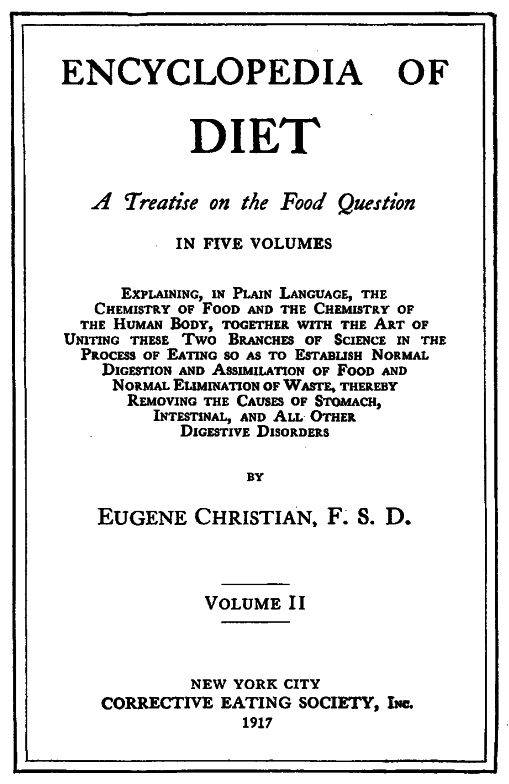
ENCYCLOPEDIA OF
DIET
A Treatise on the Food Question
IN FIVE VOLUMES
Explaining, in Plain Language, the
Chemistry of Food and the Chemistry of
the Human Body, together with the Art of
Uniting these Two Branches of Science in the
Process of Eating so as to Establish Normal
Digestion and Assimilation of Food and
Normal Elimination of Waste, thereby
Removing the Causes of Stomach,
Intestinal, and All Other
Digestive Disorders
BY
Eugene Christian, F. S. D.
Volume II
NEW YORK CITY
CORRECTIVE EATING SOCIETY, INC.
1917
Copyright 1914
BY
EUGENE CHRISTIAN
Entered at
Stationers Hall, London
September, 1914
BY
EUGENE CHRISTIAN, F. S. D.
ALL RIGHTS RESERVED
Published August, 1914
CONTENTS
| Volume II | |
| Lesson VIII | Page |
| Foods of Vegetable Origin | 287 |
| Grains | 289 |
| Uses of Grains: | |
| (1) Grain as a Source of Energy | 295 |
| (2) Grain as a Source of Nitrogen | 297 |
| (3) Grain as a Remedial Food | 298 |
| Nuts | 300 |
| Peanuts | 306 |
| Legumes | 307 |
| Fruits | 308 |
| Classification of Fruits according to acidity | 313 |
| Vegetables | 317 |
| Classification of Vegetables | 319 |
| Sugars and Sirups | 324 |
| Beet-Sugar | 325 |
| Honey | 330 |
| Confections | 332 |
| Vegetable Oils | 335 |
| Lesson IX | |
| Drugs, Stimulants, and Narcotics | 341 |
| Alkaloids and Narcotics | 349 |
| Opium | 350 |
| Cocain 353 | |
| Nux Vomica and Strychnin | 356 |
| Quinin | 356 |
| Acetanilid | 357 |
| Tobacco | 361 |
| Coffee | 363 |
| Tea | 365 |
| Cocoa and Chocolate | 366 |
| Alcohols and Related Compounds | 367 |
| Alcohol | 367 |
| Chloroform, Ether, and Chloral 372 | |
| Poisonous Mineral Salts and Acids | 373 |
| Mercury | 373 |
| Potassium Iodid | 374 |
| Lead and Copper | 375 |
| Purgatives and Cathartics | 375 |
| Lesson X | |
| Importance of Correct Diagnosis and Correct Treatment | 379 |
| Lesson XI | |
| Common Disorders—Their Cause and Cure | 403 |
| Health and Dis-ease Defined | 405 |
| Overeating | 413 |
| Superacidity | 418 |
| The Cause | 420 |
| The Symptoms | 421 |
| The Remedy | 423 |
| Fermentation (Superacidity) | 424 |
| The Cause | 425 |
| The Symptoms | 426 |
| The Remedy | 428 |
| Gas Dilatation | 431 |
| The Symptoms | 432 |
| Importance of Water-drinking | 434 |
| Constipation | 434 |
| The Cause | 434 |
| The Remedy | 436 |
| Foods that May Be Substituted for One Another | 439 |
| Constipating and Laxative Food | 446 |
| Constipating and Laxative Beverages | 446 |
| Gastritis | 447 |
| The Cause | 449 |
| The Symptoms | 449 |
| The Remedy | 450 |
| Nervous Indigestion | 453 |
| The Cause | 454 |
| The Symptoms | 455 |
| The Remedy | 458 |
| Subacidity | 460 |
| The Cause | 461 |
| The Symptoms | 462 |
| The Remedy | 463 |
| Biliousness | 465 |
| The Cause | 466 |
| The Symptoms | 466 |
| The Remedy | 466 |
| Cirrhosis of the Liver | 467 |
| The Cause | 467 |
| The Symptoms | 468 |
| The Treatment | 469 |
| Piles or Hemorrhoids | 471 |
| The Cause | 471 |
| The Symptoms | 472 |
| The Treatment | 472 |
| Diarrhea | 474 |
| The Cause | 474 |
| The Treatment | 476 |
| Emaciation or Underweight | 477 |
| The Cause | 478 |
| The Symptoms | 481 |
| The Remedy | 482 |
| Obesity or Overweight | 491 |
| The Cause | 493 |
| The Remedy | 495 |
| Neurasthenia | 503 |
| The Cause | 505 |
| The Symptoms | 506 |
| The Remedy | 506 |
| Malnutrition | 511 |
| Cause and Remedy | 511 |
| Locomotor Ataxia | 511 |
| The Cause | 511 |
| The Symptoms | 514 |
| The Remedy | 515 |
| Colds, Catarrh, Hay Fever, Asthma, Influenza | 519 |
| Colds—The Cause | 520 |
| The Symptoms | 521 |
| The Remedy | 523 |
| Catarrh—The Cause | 527 |
| The Symptoms | 528 |
| The Remedy | 528 |
| Hay Fever—The Cause | 530 |
| The Symptoms | 531 |
| The Remedy | 531 |
| Asthma—The Cause | 533 |
| The Symptoms | 533 |
| The Remedy | 534 |
| Influenza—The Cause | 536 |
| The Symptoms | 537 |
| The Remedy | 537 |
| Insomnia | 538 |
| The Cause | 538 |
| The Remedy | 539 |
| Rheumatism | 543 |
| Rheumatism—The Cause | 544 |
| The Symptoms | 545 |
| Gout—The Cause | 546 |
| The Symptoms | 547 |
| Rheumatism, Gout—The Remedy | 547 |
| Bright's Dis-ease | 550 |
| The Cause | 551 |
| The Symptoms | 551 |
| The Remedy | 552 |
| Diabetes | 556 |
| The Cause | 556 |
| The Symptoms | 557 |
| The Remedy | 557 |
| Consumption | 560 |
| The Treatment | 564 |
| Heart Trouble | 569 |
| The Cause | 571 |
| The Remedy | 573 |
| Dis-eases of the Skin | 574 |
| The Cause | 575 |
| The Treatment | 578 |
| Appendicitis | 580 |
| The Symptoms | 582 |
| The Treatment | 583 |
| Chronic or Severe Cases of Appendicitis | 586 |
LESSON VIII
Foods of Vegetable Origin
GRAINS
Grains constitute the most important article of human food, not so much on account of their superior nutritive, curative or remedial value, but chiefly because of their prolific growth and abundant production in all civilized countries throughout the world.
The variety of grain produced in the various countries depends largely upon the climate and the habits of the people.
The predominant use of rice by the Asiatics, wheat by the Europeans, and maize by the aboriginal American, shows how people adapt themselves to the foods of prodigal growth. It also shows the effect different foods have upon the physical development of the various tribes that inhabit these remote countries.
Wheat is said by some writers to be a complete food. This is not strictly true. Wheat contains a very small percentage of fat, and while fat can be made in the body from carbohydrates, it is more natural, and entails less work upon the digestive organs and the liver if the diet is balanced so as to contain the required amount of fat, and all other nutritive elements in the right or natural proportions.
A diet composed of wheat alone would contain 70 per cent of carbohydrates, chiefly in the form of starch. While this would be perfectly wholesome, it would give the body an excess of starch which would ultimately result in intestinal congestion, gout, rheumatism, hardening of the arteries, and premature old age. Wheat contains a larger quantity, and a greater variety of proteids than any other grain, but wheat proteids are more difficult to digest than the proteids of milk, eggs, or nuts.
Wheat varies greatly in composition, according to the soil and the climate in which it is produced. This fact is not recognized or considered by the average writer on dietetics, who eulogizes wheat as the wonderful "staff of life," because certain food tables show that wheat contains 13 per cent, while corn contains only 10 per cent of proteids. It is neither the proteid nor the carbohydrate content that determines the value of any grain as food, but rather the proportions of the different elements of nutrition it contains, that being the best which is more nearly balanced to meet the requirements of the human organism.
Rye may be considered in the same class as wheat. Chemically, the contents are very similar, and the effects upon the body are very much the same. It contains a larger per cent of cellulose, and less gluten than wheat, therefore as a remedial food it is superior to all other grains for exciting intestinal peristalsis, thereby removing the causes of constipation.
The nutritive elements of barley are similar to those of wheat and rye. It contains less cellulose fiber, and therefore a larger per cent of digestible nutrients than any one of the cereal group except rice. It has never become popular as a bread-making grain because—
1 The nitrogenous or gluten substances are not tenacious enough to make the conventional "raised" bread
2 The flour is dark in color
3 The grain is so hard and "flinty" that it is very difficult to mill it down to the required fineness
For these reasons barley has been greatly neglected as a food commodity. From a chemical standpoint it deserves a much higher place in our dietaries than it has hitherto been given.
The composition of oats varies somewhat from that of wheat, rye and barley. They contain a larger proportion of both fat and proteids, and form a desirable food if correctly prepared. The objection to oats as an article of diet is the hasty manner in which they are usually prepared, which converts them into a gummy mass of gelatinized starch, entangled with the peculiar gummy proteid of the oat grain. Thus prepared the oat is a most prolific source of disturbed digestion.
Corn is the cheapest material capable of nourishing the human body that is produced in the temperate zone. It is less digestible, and more deficient in the salts than the group of grains thus far mentioned. It is very wholesome, however, but in no way superior to other grains. In the future corn will probably play an increasing part in the problem of feeding the world, as a cheap source of carbohydrates, and for the purpose of manufacturing glucose.
In all tropical and semi-tropical countries rice occupies the same position that corn does in the temperate zone. It is more deficient in proteids and in fat than any other food grain, while the starch of rice is more easily digested than any other form of cereal starch. This grain, however, is almost entirely devoid of mineral constituents, and for this reason it is productive of serious nutritive derangements when indulged in too freely. This deficiency can be overcome by taking a liberal quantity of green salads, or fresh vegetables, whenever rice is eaten.
Buckwheat is a grain whose consumption is very limited, owing to the fact that it is dark in color. It compares favorably with wheat and corn as to nutritive elements, and is now much used as a winter food by the northern people.
USES OF GRAINS
The use of grains as an article of food may be considered under three headings:
1 As a source of energy
2 As a source of nitrogen
3 Grain as a remedial food; that is, as a source of cellulose or roughness, for the regulation of intestinal action
(1) GRAIN AS A SOURCE OF ENERGY
All grains are composed largely of starch, therefore the question of energy to be derived from this source is one of assimilation and use. The use of grains in the diet deserves the most careful consideration, and the study should not be confined to any particular grain, but to the entire group, and especially to the method of preparation, and the quantity that should be consumed under the varying conditions of age, temperature of environment, and work or activity. The conventional American diet contains such an abnormal quantity of grain-starch, and the methods of preparation are so unnatural, that the Food Scientist, in practise, will find many people whose digestive organs have become so deranged that he may deem it necessary to prohibit grain-starch almost entirely.
The grown person, pursuing the ordinary sedative occupation, should not eat more than three or four ounces of cereal food a day, while the manual laborer should not consume more than five or six ounces each twenty-four hours. This quantity contemplates cool, or winter weather. In summer this quantity should be reduced according to work or activity.
(2) GRAIN AS A SOURCE OF NITROGEN
Grain as a source of proteid has received undue consideration in hygienic works. Upon an allowance of one-fourth of a pound of grain per day, which would make four vienos, with a nitrogen factor of six, we see that 24 decigrams of nitrogen would be supplied from the grain. The variations between the proteids contained in two varieties of breakfast food is seldom more than two or three per cent. This would amount to a variation in the daily intake of nitrogen of about five decigrams, an amount too little to be worth consideration.
Grain proteids are not so easily digested as are the proteids of eggs, milk and nuts. The following list of grains and grain products is given in the order of the digestible nitrogen they contain:
1 Gluten or dietetic foods
2 Barley
3 Macaroni
4 White flour
5 Whole wheat—Graham flour
6 Rye
7 Oatmeal
8 Corn products
9 Buckwheat
10 Rice
11 Pure starches
(3) GRAIN AS A REMEDIAL FOOD
Grain is constipating or laxative in effect according to the way it is prepared and eaten. Whole grain, especially wheat and rye, will normalize intestinal action, and in some cases act as a laxative, while the same grains made into flour, and milled in the usual way, are constipating. Ordinary wheat bran is one of the most effective remedies known for intestinal congestion, and it can be administered or regulated with much accuracy, according to the severity of the case. An intelligent understanding of the use of bran in treating constipation is quite necessary. The object should be to employ bran as a remedy in chronic cases, and to vary the quantity, the quality, and the cellulose content of the meals. In rare cases, bran may produce irritation; in such cases it should be cooked three or hours, and eaten only with hot water. In other cases the mechanical stimulation of the peristaltic action is not effective. The practitioner can usually determine these questions on the third or the fourth day.
Bran should be administered about as follows: In cases of severe constipation, one rounding tablespoonful in water, just after rising; one-half teacupful, cooked, taken at each meal, and a heaping tablespoonful in water just before retiring.
The following table gives, in the order of their laxative effects, a few of the principal grains:
1 Flaked or whole rye
2 Flaked or whole wheat
3 Flaked or whole barley
4 Flaked or whole oats
NUTS
The true nut is the seed of trees and shrubs which stores the greater proportion of food material for nourishing the seedling in the form of vegetable oil. The nut is very largely a fuel food or heat producer, therefore among the primitive races, along the warmer belts of the earth's surface, the nut was not of so much importance, but in the northern or colder countries, where the body-heat meets with such powerful resistance from climatic environment, the nut is of equal, if not of more importance than fruits.
There are a few miscellaneous articles of food that are classed as nuts, which do not belong primarily to this group.
In the following discussion I will take up the several varieties of nuts in the order of their general value as articles of human nutrition: