
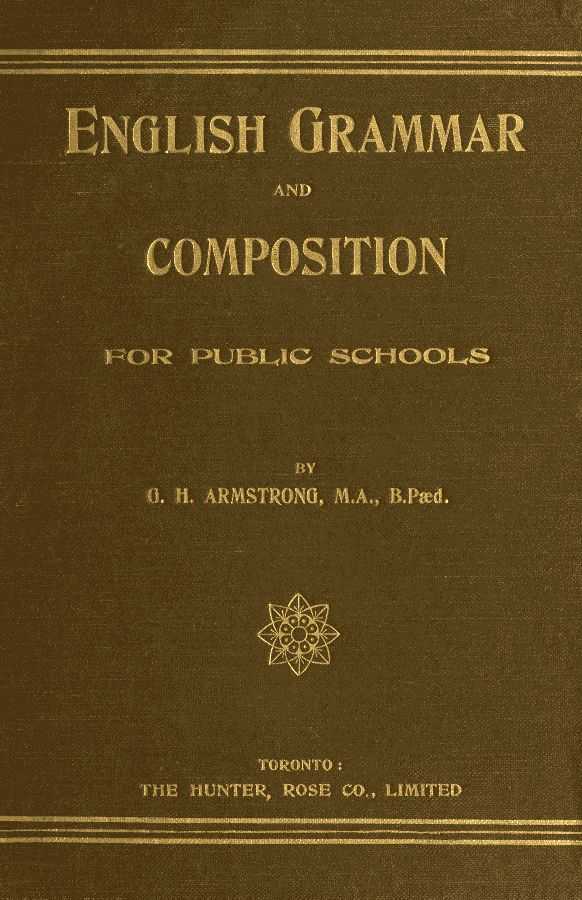
The Project Gutenberg eBook of English Grammar and Composition for Public Schools
Title: English Grammar and Composition for Public Schools
Author: G. H. Armstrong
Release date: April 14, 2015 [eBook #48702]
Most recently updated: October 24, 2024
Language: English
Credits: Produced by David T. Jones, Mardi Desjardins & the online
Distributed Proofreaders Canada team at
http://www.pgdpcanada.net
ENGLISH GRAMMAR
AND
COMPOSITION
FOR PUBLIC SCHOOLS.
BY
G. H. ARMSTRONG, M.A., B.Pæd.,
Principal Borden St. School, Toronto.
TORONTO:
The Hunter, Rose Co., Limited, Temple Building.
Entered according to Act of Parliament of Canada in the year one thousand nine hundred and one, by G. H. Armstrong, M.A., B.Pæd., in the office of the Minister of Agriculture.
PREFACE.
It is not considered necessary to offer an apology for the publication of a work on English grammar and composition for the Public Schools of Ontario.
The plan of the work is inductive and practical, and the author has endeavored to make the book a useful one for the purposes of teaching. Every principle is presented through the observation of examples of good English.
The study of grammar aids the student to master his mother-tongue, but its chief function is to secure mental discipline. For the development of the intellectual powers, the capable teacher, well furnished with rational methods, will find this study superior to all others. It is a study in recognizing similarities, in distinguishing differences, in making abstractions, in forming generalizations. The object of Parts I.-IV. of this book is to contribute something to the science of elementary English grammar.
Part V. treats of composition. The usual exercises in completing half-built sentences, in straightening out wrecks of sentences, in combining simple sentences into complex sentences, in expanding phrases into clauses, etc., will not be found therein. They have done quite enough towards fostering stupidity in our schools. The art of expression is acquired through steady practice, therefore pupils should write compositions not once a week, but during part of every period, about things which they understand. They should be taught good form in expression, and trained to correct their own exercises.
This part of the work, though brief, will be found suggestive. Teachers and pupils have not been deprived of the pleasure and profit of an independent examination of the construction of the prose selections.
This little volume owes something to several English grammars, and the debt is hereby acknowledged.
G. H. ARMSTRONG.
Table of Contents
| Part First. | —Sentences & Classes of Words |
| Lessons I—XII | |
| Part Second. | —Classes & Inflections of Parts of Speech |
| Lessons XIII—LV | |
| Part Third. | —Syntax |
| Lessons LVI—LXI | |
| Part Fourth. | —Analysis of Sentences |
| Lessons LXII—LXIV | |
| Part Fifth. | —Composition |
| Lessons LXV—LXXV | |
| Abbreviations | |
| Index | |
LESSON I.
Is there a complete thought expressed in each of the following groups of words?—
| 1. | The maple leaf is an emblem of Canada. | |
| 2. | Honor thy father and thy mother. | |
| 3. | Who gathered these beautiful flowers? | |
| 4. | How sweetly the birds sing in spring! |
A group of words that expresses a complete thought is called a sentence.
Which of the foregoing sentences declares something, which expresses a command, which asks a question, and which expresses a sudden feeling?
A sentence that asserts or declares something is called a declarative sentence.
A sentence that expresses a command or request is called an imperative sentence.
A sentence that asks a question is called an interrogative sentence.
A sentence that expresses a sudden or strong feeling is called an exclamatory sentence.
EXERCISE I.
State the use or office of each of the following sentences, and tell the kind of sentence:—
| 1. | The sun rises in the East. | |
| 2. | Every door opens to a smile. | |
| 3. | Keep thy heart with all diligence. | |
| 4. | Who is the author of that book? | |
| 5. | How tenderly a mother cares for her child! | |
| 6. | Every morn is the world made new. | |
| 7. | Sharpen this pencil for me. | |
| 8. | What bright uniforms the soldiers wear! | |
| 9. | The plowman homeward plods his weary way. | |
| 10. | How many lines have you written? |
EXERCISE II.
| 1. | Write four declarative sentences. | |
| 2. | Write four imperative sentences. | |
| 3. | Write three interrogative sentences. | |
| 4. | Write two exclamatory sentences. |
LESSON II.
THE SUBJECT AND THE PREDICATE.
Name the thing which is spoken of in each of the following sentences, and what is said about it:—
| 1. | Gold is a precious metal. | |
| 2. | Flowers grow in the fields. | |
| 3. | The sailor’s home is on the sea. | |
| 4. | The flag of England floats above the citadel. |
The part of a sentence that expresses the thing spoken of is called the subject.
The part of a sentence that expresses what is said about the subject is called the predicate.
The subject of a declarative sentence is generally placed before the predicate, but it is sometimes placed after the predicate; as,
Sweet was the sound of the evening bell.
Over the swift rapids went the boat.
EXERCISE I.
Name the subject and the predicate of each of the following sentences:—
| 1. | The city of Ottawa is the capital of Canada. | |
| 2. | Three wives sat up in the lighthouse tower. | |
| 3. | All the children were gathering flowers. | |
| 4. | Our friends have arrived in the city. | |
| 5. | Home they brought her warrior dead. | |
| 6. | John Cabot discovered Canada in 1497. | |
| 7. | All along the banks were the skeletons of canoes. | |
| 8. | Through this forest ran a beautiful river. | |
| 9. | Colder and louder blew the wind. | |
| 10. | Down sunk the bell with a gurgling sound. |
The subject of an imperative sentence is thou, ye or you. It is seldom expressed; as,
| Listen to the singing of the birds. | ||
| Carry these books for me. | ||
| Praise ye the Lord. |
EXERCISE II.
Name the subject and the predicate and state the kind of sentence of each of the following:—
| 1. | Who hath not lost a friend? | |
| 2. | Gather up the fragments. | |
| 3. | Here comes the train! | |
| 4. | Why did you take away my book? | |
| 5. | The shades of night were falling fast. | |
| 6. | How lightly she trips along! | |
| 7. | In one corner of the room stood my grandfather’s clock. | |
| 8. | Send this note to the post. | |
| 9. | How strange our old home looks! | |
| 10. | At the dawn of day he ascended the hill. |
EXERCISE III.
1. Write four examples of an assertive sentence and name the subject and the predicate of each sentence.
2. Write four examples of an imperative sentence and name the subject and the predicate of each sentence.
3. Write four examples of an interrogative sentence and name the subject and the predicate of each sentence.
4. Write four examples of an exclamatory sentence and name the subject and the predicate of each sentence.
LESSON III.
State the words that are used as names in the following sentences:—
| 1. | The shoes worn by the soldiers were made in England. | |
| 2. | Near this tree is the grave of a pioneer. | |
| 3. | Chaucer is the father of English poetry. | |
| 4. | Love had he found in huts where poor men lie. |
A word used as a name is called a noun.
EXERCISE I.
Name the nouns in the following sentences:—
| 1. | There are seven provinces in Canada. | |
| 2. | Then the fly lit his lamp of fire. | |
| 3. | The bloom of that fair face is wasted. | |
| 4. | The boy stood on the burning deck. | |
| 5. | And then my heart with pleasure fills, | |
| And dances with the daffodils. | ||
| 6. | He goes on Sunday to the church | |
| And sits among his boys. | ||
| 7. | I hear in the chamber above me | |
| The patter of little feet, | ||
| The sound of a door that is opened, | ||
| And voices soft and sweet. | ||
| 8. | A violet by a mossy stone, | |
| Half hidden from the eye! | ||
| Fair as a star, when only one | ||
| Is shining in the sky. |
EXERCISE II.
Write sentences containing—
| 1. | The name of a place. | |
| 2. | The name of a person. | |
| 3. | The name of a tree. | |
| 4. | The name of a metal. | |
| 5. | The name of an article of food. | |
| 6. | The name of an animal. | |
| 7. | The name of a quality. | |
| 8. | The name of an action. |
LESSON IV.
Name the nouns for which the words printed in italics are used in the following sentences:—
| 1. | The teacher went home when he finished the lesson. | |
| 2. | The mother kissed her boy when she received him. | |
| 3. | A baby was sleeping, | |
| Its mother was weeping | ||
| For her husband was far on the wild raging sea. |
A word used for a noun is called a pronoun.
By the use of the pronoun, a person or thing is referred to without naming it, and the too frequent repetition of the same noun is avoided.
EXERCISE I.
Select the pronouns in the following sentences, and state the noun for which each is used:—
| 1. | Men find plants where they least expect them. | |
| 2. | The parents returned home when they found their child. | |
| 3. | The king took the hand of his friend and pressed it to his heart. | |
| 4. | A boy who is always grumbling will lose the friends that he has, and will not make many new ones. | |
| 5. | The ball lies where you left it. | |
| 6. | The boy’s father was anxious to send him to college, and therefore he studied the Latin grammar till he could bear it no longer. | |
| 7. | Not a soldier discharged his farewell shot | |
| O’er the grave where our hero we buried. | ||
| 8. | As John and Charles were walking by the river, they both fell into it. | |
| 9. | Tell me what brings you, gentle youth, to Rome; | |
| To make myself a scholar, sir, I come. | ||
| 10. | Then the maiden clasped her hands and prayed | |
| That savèd she might be; | ||
| And she thought of Him who stilled the wave | ||
| On the Lake of Galilee. |
EXERCISE II.
1. Write a sentence containing a pronoun used for the speaker.
2. Write a sentence containing a pronoun used for the names of the speaker and others.
3. Write a sentence containing a pronoun used for the name of a person spoken to.
4. Write a sentence containing a pronoun used for the name of a person spoken of.
5. Write a sentence containing a pronoun used for the names of two or more persons spoken of.
6. Write a sentence containing a pronoun used for the name of a thing that has been previously spoken of.
LESSON V.
Select the words in the following sentences that are used to describe or point out the things named by the nouns:—
| 1. | A tall man gave me this book. | |
| 2. | That little boy has a kind sister. | |
| 3. | I bought two sweet oranges. | |
| 4. | These grassy fields are owned by a rich man. |
The word tall describes this particular man. The word this points out the particular book that is meant. Such words modify the nouns with which they are used.
A word used to modify a noun or pronoun is called an adjective.
EXERCISE I.
Name the adjectives in the following sentences, and state the use of each:—
| 1. | I found a rusty knife with a silver handle. | |
| 2. | Wise ministers and brave warriors flourished during Elizabeth’s reign. | |
| 3. | The sick girl was watched by a skilful nurse. | |
| 4. | Otters are much prized for their soft, glossy black fur. | |
| 5. | I lingered near the hallowed seat with listening ear. | |
| 6. | His withered cheek and tresses gray, | |
| Seemed to have known a better day. | ||
| 7. | Her aged hand on his strong young arm | |
| She placed; and so, without hurt or harm | ||
| He guided the trembling feet along, | ||
| Proud that his own were firm and strong. | ||
| 8. | His hair is crisp, and black, and long, | |
| His face is like the tan; | ||
| His brow is wet with honest sweat, | ||
| He earns whate’er he can, | ||
| And looks the whole world in the face, | ||
| For he owes not any man. |
Model.—The adjectives in the first sentence are a, rusty, a and silver. A points out or indicates the species of the thing knife. Rusty describes the thing knife.
EXERCISE II.
Write sentences containing adjectives used to show:—
| 1. | What quality of thing is spoken of. | |
| 2. | How many things are spoken of. | |
| 3. | Which thing is referred to. |
LESSON VI.
Select the words in the following sentences that tell or assert something of the thing spoken of:—
| 1. | Boys play. | |
| 2. | The sun shines. | |
| 3. | The snow melts. | |
| 4. | Mountains are high. |
A word that is used to make an assertion is called a verb.
Note.—The word verb is derived from the Latin word verbum, meaning a word, and this part of speech is so called because it is the word, the most important word in every sentence. There can be no sentence without a verb.
EXERCISE I.
Name the verbs in the following sentences, and state what each tells or asserts:—
| 1. | The girls gathered some water-lilies. | |
| 2. | That house was built last century. | |
| 3. | He slept for three hours. | |
| 4. | The gardener fell from a high tree. | |
| 5. | The coachman struck the horse, and it kicked him. | |
| 6. | King Edward I. nearly conquered Scotland. | |
| 7. | She must weep or she will die. | |
| 8. | And still they rowed amidst the roar | |
| Of waters fast prevailing: | ||
| Lord Ullin reached that fatal shore, | ||
| His wrath was changed to wailing. |
EXERCISE II.
Write sentences containing each of the following words used as subjects, and underline the verbs:—
Plants, rivers, paper, gold, pen, fish, birds, stars, flowers, money.
LESSON VII.
Name the words in the following sentences that modify the verbs, that show how, when or where actions were performed:—
| 1. | The girls recited well. | |
| 2. | The teacher often read a story. | |
| 3. | I left my pencil there. |
A word that is used to modify the meaning of a verb is called an adverb.
An adverb may also modify the meaning of an adjective, as, He is very quiet.
An adverb may also modify the meaning of another adverb; as, She writes more rapidly than you.
An adverb is a word that is used to modify the meaning of a verb, an adjective or another adverb.
EXERCISE I.
State the adverbs in the following sentences, and name the word which each modifies:—
| 1. | Here let us sit and talk of former times. | |
| 2. | I never saw so clear a sky. | |
| 3. | How proudly they strode along! | |
| 4. | Now let me die in peace. | |
| 5. | The grass is too damp yet. | |
| 6. | The face of the country suddenly changed. | |
| 7. | The next night it came again. | |
| 8. | The storm came on before its time; | |
| She wandered up and down, | ||
| And many a hill did Lucy climb, | ||
| But never reached the town. |
EXERCISE II.
1. Write four sentences each containing an adverb modifying a verb.
2. Write two sentences each containing an adverb modifying an adjective.
3. Write two sentences each containing an adverb modifying an adverb.
LESSON VIII.
Name the words in the following sentences that express the relation of a noun or pronoun to some other word:—
| 1. | We withdrew from the room. | |
| 2. | The boys ran through the hall. | |
| 3. | This box is made of paper. | |
| 4. | I went to school with him. |
A word that is used to express the relation of a noun or pronoun to some other word in the sentence is called a preposition.
The noun or pronoun which the preposition connects in sense with some other word in the sentence, is called its object; as, The men are in the field.
EXERCISE I.
Select the prepositions, and state the words between which each shows a relation:—
| 1. | He threw the ball over the fence. | |
| 2. | An old man fell into a pond. | |
| 3. | A stranger came within our gates. | |
| 4. | From many lands comes the cry for help. | |
| 5. | The boat went under the water. | |
| 6. | This letter was written by my sister. | |
| 7. | At noon I went home. | |
| 8. | I chatter over stony ways, | |
| In little sharps and trebles. | ||
| I bubble into eddying bays, | ||
| I babble on the pebbles. |
EXERCISE II.
1. Write three sentences each containing a preposition expressing a relation between a noun and a verb. Underline the object.
2. Write three sentences each containing a preposition expressing a relation between two nouns. Underline the object of the preposition.
3. Write three sentences each containing a preposition expressing a relation between a noun and an adjective.