
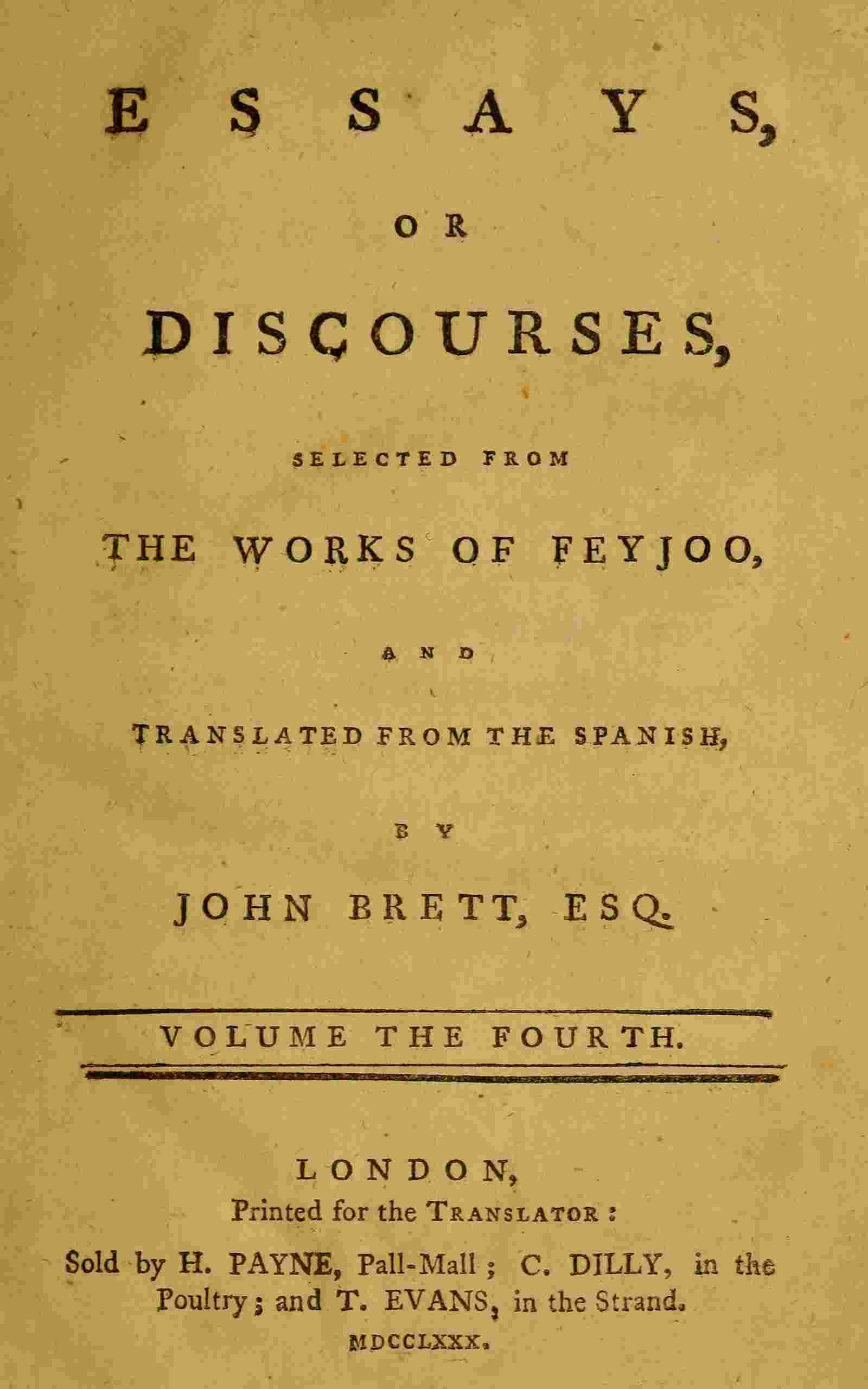
I. The Greek word Paradox, or Paradoxologia, does not properly signify a false or implicatory proposition, but an improbable or incredible one; and therefore, this word is commonly applied to those propositions, which in the eye of the generality of mankind, at first sight seem false and contradictory, and difficult to be assented to; but upon examining them strictly and with attention, appear to be either true or probable. In this discourse, we shall treat of some of the things of this species, which are to be found in the line of natural philosophy.
PARADOX I.
Elemental Fire is not hot in the highest Degree.
SECT. I.
II. Vulgar physics, distribute the four qualities which are called first, among the four elements, assigning to each element one of them that is intense in the highest degree, and another which approaches, or comes near to the highest. Thus to fire they attribute heat in the highest degree, and dryness which is nearly approaching to the highest. To the air, humidity in the highest degree, and heat near to it. To the water, coldness in the highest degree, and moisture near to it. To the earth, dryness in the highest degree, and coldness near to it. This distribution, which if regulated, not by a nice examination of the nature of things, but only by an imaginary proportion, is exposed to three serious and weighty objections which are started against it by the modern philosophers; and it is only to the proposition that fire is hot in the highest degree, that they have hitherto made no difficulty of assenting; but that is the point I at present mean to controvert.
III. That elemental fire is not hot in the highest degree, may be evinced, by shewing there is another heat which is much greater, and that is the heat of the sun, when its rays are concentrated in a burning-glass. It is certain, that the most vigorous effects and operations of elemental fire, does not come up in any degree of comparison, to those of that most ardent star. This has been proved evidently, by the experiments made with the burning-glass invented and fabricated by Mons. Villete, an eminent artist of Lions in France; a description of which, was printed and published at Liege in 1715, and was afterwards inserted in the Memoirs of Trevoux of the year 1716. The instant the focus of this burning-glass was applied to any sort of wood, be it ever so green or moist, it set it as suddenly in a flame, as elemental fire would do dry tow. In less than a minute, it melted metals which were the most difficult of liquefaction, such as copper, iron, gold, and all minerals in general. The highest operation the chymists have found elemental fire capable of performing, is that of vitrifaction, which is so called from its reducing matter to a species of glass; but the most intense fire, besides its being tardy in this operation, can perform it only on particular subjects; whereas the burning-glass vitrifies in a short time, every kind of matter, tiles, bricks, cement, bones, stones of all sorts, even marble, and porphyry; and what is most extraordinary, it vitrifies those sort of stones also, with which they make the bottoms of furnaces for melting iron ore in, which although they will endure that intense heat for many years together, will begin to dissolve almost immediately, upon applying the focus of the burning-glass to them.
IV. Although this is very wonderful, what we are about to relate is still more so. The analytic resolution of gold, or what is the same thing, the separation or division of its principal component parts, had till then been deemed impossible; for the misers are not more tenacious of hoarding or preserving their gold, than the gold is of preserving its intrinsic texture; for in spite of all the tortures by fire, which the chymists could invent to break this texture, they could never make it lose its original form. Yet notwithstanding the valour of this generous metal, it submitted obediently to the power of the sun exerted through the burning-glass; as if that power to whom it is said to owe its existence, was the only one to which it could bear to be subject.
V. Mons. Homberg, of the Academy Royal of Sciences, was the first who experienced this rare phenomenon, by resolving into smoak, with the focus of the burning-glass, at the Palace Royal at Paris, a great portion of its mass, which this celebrated chymist judged to be the mercurial part of the gold, and when this was gone, the residue which remained, appeared to be a terrestrial matter, mixed with somewhat of sulphur, that afterwards vitrified. So that in the opinion of Mons. Homberg, sulphur, and mercury, together with a portion of earth, is what gold is composed of, and although the two first are by their nature volatile, and capable of being dissipated and divided by the power of fire in all other metals, and in all other mixtures, they in gold are so intimately united, that no other force or influence can separate them, but that of the sun; it follows then, that the heat of the sun is much greater than that of elemental fire, and that this last cannot be hot in the highest degree, which is what we undertook to prove.
PARADOX II.
The Air ought rather to be esteemed cold, than hot.
SECT. II.
VI. The quality which Aristotle attributes to the air, is cold somewhat under the highest degree, or nearly approaching to the highest degree. Other philosophers, with more foundation of reason, esteem it indifferent to heat and cold; and I, without setting about to combat this second opinion, say it is more reasonable to suppose it cold than hot. Which I shall attempt to demonstrate in the following manner: in order to make a judgement of the qualities appertaining to a particular thing, we should consider it in a state, where it is divested of the influence of any extrinsic agent, by the operations of which it may be affected; the air then so circumstanced, will always be found to be cold; and from thence it should be inferred, that it naturally is cold. The minor of this proposition is proved, by the air being only warm while it is affected by the rays of the sun, and by its being found, that whenever that influence is withdrawn, it becomes cold again, and that it is by so much the more cold, in proportion to the absence of that influence. From whence it is observable, that in the temperate zones, the air is coldest when the nights are long; and that in the sub-polar, and circum-polar ones, it is extremely cold, on account of the influence of the sun being withdrawn from them for the space of six months together; and that when it returns to enlighten them, because of the obliquity of its rays, it still continues cold, far beyond the degree of mediocrity.
VII. Nor is saying that in the absence of the sun, the earth is the agent that cools the air any reply to this; for if this was so, the lower region of the air would be colder than the middle one, as being nearer to the infrigidating cause; but this is contradicted by our experience; for we very commonly see, that the water does not freeze in the lower region, when in the middle one it is frozen into hail in the clouds; and very often also, that which was frozen above, thaws suddenly upon its falling down.
VIII. If it should be objected to this, that Aristotle and the Peripatetics, when they say the air is warm, speak of the elemental air, and not of the air of the atmosphere which is mixed with an infinite number of heterogenous corpuscles, by some of which it may be made cold, and especially by the many nitrous ones with which it is impregnated. To this I answer first, that in the country where I am now writing, there is not the least appearance of the air being nitrous, for that there is not a grain of nitre to be found in the whole country, notwithstanding which, the cold in winter is sometimes pretty sharp. I answer secondly, that we can only talk of the pure elemental air by conjecture, for no mortal has yet ever breathed any of it, nor is it possible that any one ever should, on account of this element being an open expanse, exposed to the inroads of the effluvias of all other bodies; and we should reason upon sensible qualities, by pursuing the thread of palpable experiments; and not by pursuing that of ideal proportions, as Aristotle did in making the division of his elemental qualities; for the Author of nature is not confined to pursuing only such proportions as fall within the compass of our comprehension. This is the false principle, upon which all the Pythagorean and Aristotelic philosophy has proceeded, and with respect to the doctrine of the four elements, that seems to be tainted with the same vice, as I shall shew more fully in another place. All that I shall say at present is, that Aristotle dealt out, and distributed the four qualities among the four elements, as if he had been the absolute master of them all, and could dispose of and arrange them agreeable to his will and pleasure.
PARADOX III.
Water considered according to its Nature, is rather disposed to be solid, than fluid.
SECT. III.
IX. This may be demonstrated, upon the same principle the antecedent paradox was; remove for any length of time, the interposition of any extrinsic agent that may contribute to warm the water, and it will always be found to be solid, that is, in a frozen state. This then being so, we may conclude, that is the state it is disposed to continue in agreeable to its nature. This is evinced by the sea under the Poles, and in the adjacent parts, being, during the whole six months the sun is absent from them, frozen to such a degree, that after the sun has revisited them, and continued its influence for the other six months, it is never totally thawed; and it is for this reason, that it has always been found impracticable to sail to China by that rout.
X. The water being under this influence, is a proof ad hominem, that it cannot, agreeable to the doctrine of Aristotle, be cold in the highest degree, for if that was the case it must ever continue in a frozen state; so that we can only say, that by its nature it is most disposed to solidity.
XI. Frozen water being easily made liquid by a moderate heat, is no proof that it is not naturally inclined to solidity. Metals may be liquified by an intense heat, but that does not shew that they are not of a solid nature; and a thing being more easily, or with more difficulty dissolved, makes no difference with respect to this mode of reasoning; and therefore the water being made liquid with a less intense heat, than is found necessary to liquify metals, does not prove, that it is not disposed in its nature to be solid as well as them.
PARADOX IV.
Either all Qualities are occult, or none of them are so.
SECT. IV.
XII. The school philosophers call all those qualities occult, which are not reckoned among the four elemental ones, and which do not result from the various combinations of these elemental ones, because they suppose their operations move in a line superior to those which may be supposed to proceed from humidity, dryness, cold, heat, hardness, softness, colour, favour, &c. And although it is true, that some by pursuing the system of assigning second qualities, which result from the various combinations of the first; or third qualities, resulting from the various combinations of the second; and among these third, have placed the wonderful virtues of the load-stone, the operation of purges, and others of those which they call occult, and which by these means they have attempted to reduce to manifest ones; this mode of proceeding, has been abandoned by the generality of philosophers, and with reason; for it is very clear, that combine, and recombine, the qualities of humidity, dryness, heat, and cold, in what way you will, you will not be able to find out, that they are capable of directing the load-stone to the Pole, or of causing it to attract iron.
XIII. It is not my intention, to examine the nature and origin of all, or either of these qualities; but shall only say, that they are all equally occult, or are all equally manifest. In order to demonstrate this, we will compare the calefactive virtue of fire which is looked upon as the most manifest, with the attractive virtue of the load-stone, which is reputed the most occult. All that is known, or that is taught by the peripatetic doctrine, of the calefactory virtues of fire, may be reduced to this, that it is a property appertaining to that substance, or a quality that springs from, or arises out of its form, that produces the effect which we call heat, and that the action with which it causes it, is called calefaction; but so it is, that it is just in the same manner that we know the attractive virtue of the load-stone; viz. that it is a property or quality, springing from, or arising out of the form of this entity, that produces the sensible effect of drawing the iron to it, and that the action with which it causes it to approach towards it, is called attraction; it follows then, that we know just as much of the attractive virtue of the load-stone, as we know of the calefactory virtues of fire; and therefore, both of them are equally occult, and equally manifest.
XIV. And if we were to speak the truth, how could we deny, that the quality we call heat is occult, when it is even occult, whether it is or is not a quality? Not only the corpuscular philosophers deny it to be possessed of all quality or form, but many of those who admit those properties to be contained in it, constitute the heat to proceed from a vertical, or vibratory motion of the insensible particles of the body. And so long as we shall remain without an argument to convince us of the truth of these opinions, we shall not know which of them is right.
PARADOX V.
It is false, in a general and comprehensive sense, that Virtue by being united becomes the stronger.
SECT. V.
XV. The axiom Vis unita fortior, I apprehend, applies more justly to civil and political things, than to natural ones. If we attend, we shall find that two agents, each of which is strong in proportion to four, by being joined together, will not be stronger than in proportion to eight. If two men separately can support but four half hundreds each, by joining them together, you would find them not able to support above eight. It is true, that a man who breaks arrows one by one, cannot break a bundle of arrows tied together, which is the comparison that Scilurus availed himself of (Plut. in Apophth.) to persuade his sons to continue in fraternal union; but we should not understand by this, that by binding them together, each arrow separately acquired any additional strength, for this example was only intended to shew, that he who could with ease break each arrow separately, was not sufficiently strong to break the whole bundle united together. Suppose, for instance, the bundle was to consist of twenty arrows, if there was any thing less than a twentieth part of the force exerted to break a single arrow, than it was necessary to exert to break the whole bundle, it is as certain that that single arrow would not be broke, as that the whole bundle would not. Thus this example does not prove, that there is any additional virtue or strength added to the wood of which the arrows are made, by uniting them together, but only, that twenty joined together can resist a greater force than one singly, which is a thing that is self-evident.
XVI. Nothing can be plainer than this; but abstracted from the force of this reasoning, experience has shewn us, that in some agents, in contradiction to the common opinion, their union has diminished their strength. It is the general sentiment, that two threads twisted together and united in one cord, will support more weight than they will separately; and that a rope made of many fine threads, is stronger than all these threads divided. Mons. Reamur, of the Academy Royal of Sciences, demonstrated in 1711, that the fact was quite otherwise, and that the threads separate would support a greater weight than they would united. He made this experiment with two single threads, and found that each by itself would support nine pounds and a half, which put together make nineteen pounds; after this he caused them to be twisted together, and they were broke with sixteen pounds. He made another experiment with three threads, one of which supported six pounds and a half; another eight, and another eight and a half; the sum of all which put together amounted to twenty-three pounds; and after causing them to be made into a cord, they would not sustain more than seventeen.
XVII. It may perhaps be answered to this, that the threads in twisting them together might be stretched and made finer, and their strength weakened; and that besides this, they might have been strained by supporting the weight in the first instance; but this objection, although specious, is insufficient; for by attending to the relation of this matter in the History of the Academy Royal, we shall find, that by order of the Academy, another experiment was made in a quite opposite way, for a small silk cord which supported a little more than five pounds, was afterwards untwisted, and they found that the single threads among them all sustained six pounds and a half.
XVIII. The true cause of this phenomenon in my judgment, is, that the threads in the twisted cord do not bear equally alike, because it seems to me morally impossible in the twisting, to preserve the exact length or bearing of all the fibres, but that some of them must be more tense or tight, and some of them more slack than others; in consequence of which, the bearing of some must vary more from the perpendicular or central line of gravity, than that of the others, and that some part of them are upon the stretch, and others rather slack at one and the same time. From hence it follows, that the weight at first is not supported by all the fibres, but only by those which are the most tense, and the least distant from the central line of gravity, which not being of themselves sufficient to resist the strain, give way, and that the weight afterwards falling upon the others, they do the same; and that this is the case may be evidently seen, by observing when more weight is hung to a rope than it is able to sustain, it does not break instantly, but successively, and although the total separation is performed in a very little time, there is space enough before it is compleated, for us to perceive, that some threads break first, and others afterwards.
XIX. But although my opinion should not exactly coincide with the experiments made in the academy, I conclude, that the judgment we should make of this matter is, that both in this, and all other physical agents, virtue united is the same that it is separate; for the cord breaking with a less weight than the threads sustained separate, did not result from these last being stronger separate than they were united, but from the fibres of the threads acting more together in their separate state, than they did in their united one, as in the last case, the resistance of the fibres to the force, was made more in succession than it was in the first; or to speak more properly, although the threads were united in the cord, their power or virtue of resistance to the force, was not united or exerted together.
PARADOX VI.
The Sun in consequence of its own proper Nature, and intrinsic Disposition, heats and enlightens unequally at different Times.
SECT. VI.
XX. The common causes of our experiencing more or less heat, or more or less light from the sun, are the serene or loaded state of the atmosphere; the oblique direction with which the sun’s rays are reflected on us; the position, or situation of places; the length or shortness of the days; the tranquillity or agitation of the winds, and our vicinity to cold or warm places, such as snowy mountains, or warm subterraneous effluvia. But, abstracted from any of these sublunary or inferior causes, I say, that in the sun itself, is contained a cause, that occasions it to reflect more or less light or heat, and that it actually does reflect more or less light and heat, at some times than it does at others, and that this is in virtue of its own proper nature and disposition.
XXI. The reason of which phenomenon is, the transitory spots, which the astronomers have for some time past observed in the sun. These are a sort of darkish places, unequal in size and duration, which seem as if they were on the superficies of the star, and which at different times are more or less numerous, although it has happened, that for years together none of them have appeared. Some believe that the antient Chaldeans had some knowledge of them, for in the Book of Job, we read the following expression of Job’s friend Eliphaz to him, that the Heavens themselves are not exempt from their spots: Cæli non sunt mundi in conspectu ejus. On the other hand, the want of telescopes among the ancients, did not render their making observations on these things impossible; for some of these spots are so large, as to be visible without a telescope; as for example that was, which was seen in the year 1706, whose superficies according to the computation of the astronomers, was thirty-six times larger than the whole earth; and when they arrive at this magnitude, or if they are even much less, they may be discerned, by looking at the sun with a glass tinged with any dark colour.
XXII. But the first person we have any account of, who observed these spots, was Father Christopher Scheinerus a jesuit, who applied himself to it with such diligence, that between the years 1611 and 1627 he had made fourteen hundred observations of them, which he gives an account of in his Rosa Ursina. The celebrated Galileus Galilei began also to observe them about the same time that Scheinerus did; and since them, the most laborious astronomers of the last and the present century, have applied themselves to making the same observations; so that this is a matter, which at present there is not the least doubt about; and although some have entertained suspicions whether these spots were in the body of the sun, or at a little distance from it; others have removed those difficulties, by demonstrating, that they are inherent in, and exist on, the superficies of the sun; for they not only revolve in the same proportion the sun does, but they most probably remain upon it during the whole time it takes in making an intire revolution, which it does in twenty-seven days, and they are to be seen compleat for half the time of that period; which could not happen, if the spots were inferior to the star.
XXIII. And whether these spots are sooty or smoaky vapours, which arise from the great furnace of the sun, as some think, or are any other different thing; it is clear, that during their continuance, the light and the heat of it reflected on the lower elemental regions, must be diminished in proportion to the size and number of the spots; and to this cause may be attributed, some of the notable diminutions of the light and heat of the sun, which we find recorded in history, provided they were not occasioned by some obstructions in the atmosphere. Mayolus tells us, that in the time of the emperor Justinian, the light of the sun for the greatest part of a year was so dim and faint, that it scarce exceeded that of the moon; and Plutarch tells us, that at the time of the death of Julius Cæsar, the light of the sun was equally feeble for a whole year together; which Virgil also takes notice of in the following verses of the Second Book of his Georgics:
PARADOX VII.
The Rays of the Sun reflected on a Concave Body, produce a greater Heat in Winter than in Summer, which Heat is greater still in Proportion to the coldness of the weather.
SECT. VII.
XXIV. The experiments to prove this, were to the admiration of all the by-standers, repeatedly made with the burning-glass of Mons. Villete, which we have spoken of before; and it was observed at the time of making them, that by so much the more cold the burning-glass was, by so much the quicker and stronger was the operation of the focus; and that by so much the warmer it was, by so much the more tardy and remiss were its effects. Among those who read these accounts, some looked upon them as wonderful, and others as incredible.
XXV. But with all this, the reason of the phenomenon is not very hidden. It is certain, that cold condenses bodies, and that heat dilates them. It is also certain, that the more dense a body is, the more apt and fit it is to cause reflection, and that it is least so, the more lax it is. From these two premises it may be clearly inferred, that the effects we have mentioned were things of course; but for a further explanation of this matter, I will say they were so from two causes; for the burning-glass by being in a warm state, must consequently be less compact and hard, and the operations of its focus more remiss and languid. In the first place, because a great portion of the rays were absorbed in the pores of the metal, which had been dilated by the heat, and made no reflection at all. Secondly, by their being dilated, and as we may say, become more spungy, the concave superficies of the metal were less smooth and equal, from whence it would follow, that many rays by being obstructed in their descent by some insensible prominences, would not make their reflection in a right line on the point of the focus. This may be better understood, by attending to the reflections of a ball, that is struck against a wall with an unequal surface; and it is a position agreed to by all the mathematicians who have treated of catoptrics, that light and heat in their reflections, follow exactly the same rules, that heavy bodies do.
XXVI. Nor is there are any difficulty in supposing, that a body as hard as metal, may undergo some insensible rarefaction when it grows warm; for in the first place, if a very intense heat can dilate metal, so as to make it break all its ligatures and become fluid, a less heat would have the same effect, in proportion to the degree of it, and might dilate and rarefy it a little. Secondly, experience teaches us, that every sort of metal is more sonorous when it is cold, than when it is warm; from whence it may be evidently inferred, that heat and cold do somewhat alter its texture; it being certain, that upon the texture, depends its being more or less sonorous.
PARADOX VIII.
A flame extending itself upwards in a pyramidical or conic form, is occasioned by a violence done to the flame itself.
SECT. VIII.
XXVII. The endeavour of the flame to ascend, is the proof which is vulgarly exhibited, of there being an element or sphere of fire above us, by those who maintain that position; but we shall shew, that this is a very feeble proof, even admitting their own state of the case, because every thing that is lighter than the fluid that surrounds it, will, if it is not by violence restrained from doing so, rise above it, without being invited to ascend by a sphere of its own species that is aloft; and it is from hence, that flame, smoke, vapour, an infinity of elemental effluvia, and divers other species of things ascend, without the assistance or intervention of any other cause, except that of their being lighter than the inferior gross air.
XXVIII. To this we shall add, that there is not in the flame, the propensity to ascend which they suppose, and which seems to be indicated by its rising upwards in a conic form; for this ascent is violent, and not natural to the flame. We shall illustrate this paradox, by an experiment which my Lord Bacon mentions in the first Book of his Centuries. A small wax candle, fitted into an iron tube, and placed perpendicular in a vessel filled with spirit of wine, in which it must be immersed to such a depth, that when they are both set fire to, the flame of the candle shall not rise higher than that of the spirit; and you will see, the flame of the candle and that of the spirit being distinguishable by their different colour, that the flame of the candle will appear in the middle of that of the spirit, extending itself in breadth, and not in a pyramidical, but a round form, that occupies four or five times as much space, as that which it used to occupy when burning in the open air. This experiment proves, that the pyramidical form which the flame regularly assumes, is caused by the pressure of the air that surrounds it; and this is the sentiment of the modern philosophers, who without adverting to the experiment we have mentioned, would make no scruple of pronouncing, that the form it assumes is a violence done the flame.
XXIX. By this example it may be seen, that experiments, provided they are made with judgment, and attended to with subtil reflection, are the only means by which we can attain any certain knowledge of natural things; but if they are made in a lumping way, and without due attention, and exactness, they are the occasion of innumerable errors. Many have arisen, from attributing to a native inclination, or intrinsic virtue of some body, effects, which are only caused by the impulse of some other neighbouring body. Before the gravity and elasticity of the air were discovered, it was looked upon as a thing demonstrated by experience, that the water’s rising in the pump, was from its inclination to obstruct or oppose a vacuum, and now it is a thing evinced by experience, that the air is what impels it to that ascent.
PARADOX IX.
In the composition of all vegetables, there is contained a portion of metal.
SECT. IX.
XXX. This is a novelty in physics, which has not been discovered till of late years. Mons. Gofredy of the Academy Royal, having examined the ashes of many different plants, found in them all, some fine particles that would adhere to the load-stone; from whence he concluded, that these particles were either particles of iron, or else were particles of the load-stone itself. But, as it was a doubt which had never yet been cleared up, whether the load-stone would not attract other metallic particles, which were not part of itself, nor of iron; the Lemeries father and son, made some fresh enquiries, which removed all doubts respecting the matter. They with a burning-glass melted the particles which the load-stone had attracted from the ashes of the plants; which after much sparkling, liquefied into the very form and substance of the load-stone, and of iron also; and when grown cold, formed a lump of the consistence and hardness of metal. Even in honey, after it has been distilled, have been found these particles which were attractable by the load-stone; from whence it may be inferred, that this metallic composition, exists in, and is diffused through the most subtil juice of flowers and blossoms.
XXXI. But, after all this had been done, it still remained to be ascertained, whether these particles pre-existed in the plant; or were the production of the fire, and the result of their calcination; which second opinion appeared the most probable, because there seems no difficulty in supposing, that the fire might transmute into metal some of the particles of vegetables; but there appeared a very great one, in conjecturing that so heavy a metal as iron, could rise to the summit of trees, and pervade the most subtil fibres of their leaves.
XXXII. Mons. Lemeri the son cleared up this doubt, by various subtil and curious experiments, which not only evinced the volatility of iron, but also excited a belief, that this metal contributed greatly to promote the vegetation of all kinds of plants. The most remarkable experiment he made was the following one. Having poured spirit of nitre upon the filings of iron, there succeeded a violent effervescence, which after some time ceased, and left the metal dissolved into a red liquid; by afterwards pouring oil of tartar per deliquium to this liquid, another fermentation was excited, which went on increasing, till, at last, it formed on the sides of the vessel, various subtil branches, which after all the sensible fermentation had ceased, continued to grow till they reached the top of the vessel.
XXXIII. And although the first time he made this experiment, he obtained only the rude lineaments of a tree, by varying afterwards the quantity of the oil of tartar, till he hit upon the just proportion of it, he obtained a perfect metallic vegetation, and produced a tree completely formed, with its roots, trunks, branches, leaves, and flowers. This able chymist concluded from his various observations on this matter, that both the volatility, and the vegetation, were owing to the filings of the iron; for without them, he could only produce some crystalline lumps at the bottom of the vessel, which he concluded proceeded from the nitre that had been dissolved. Whoever is desirous of knowing more of the manner and effects of these operations, may read the accounts of them in the Journals of the Academy Royal, of November 1706.
XXXIV. But we are not to conclude from hence, that metallic vegetation is only to be produced by iron. The Abbé Vallemont in his first volume, on the natural Curiosities and Art of Agriculture, says, that there were exhibited at Paris, such like artificial metallic vegetations, produced from gold, silver, iron, and copper. But that which was the most common, and the most in vogue there, was the vegetation procured from silver, which the chymists called the Tree of Diana; and which was produced in the following manner. Dissolve an ounce of silver, in two or three ounces of spirit of nitre. Evaporate this dissolution in a sand-heat; till nearly half of it is consumed. Mix the remainder in a vessel, properly proportioned and suited for the business, with twenty ounces of clear water, and two ounces of quick-silver. By leaving this mixture afterwards in a state of rest for forty days, a silver tree will grow, and in that space of time will be compleatly formed, very nearly resembling a natural one, in shape and figure. Mons. Homberg, a celebrated chymist of the Academy Royal, by making use of the same materials, contrived to form a metallic tree in less than a quarter of an hour; the receipt for doing which, together with the physical explanation of this phenomenon, given by Mons. Homberg, may be seen in the Memoirs of the Academy Royal, of the thirteenth of November 1692.
XXXV. These metallic vegetations, joined to the discovery beforementioned, of our having found iron in the ashes of all sorts of plants, not only prove that metals may, by virtue of certain fermentations, be made sufficiently volatile to enable them to rise upwards, and pervade all the tubes through which the alimentary juices of plants circulate, but also make it probable, that to this metallic mixture, they in great measure owe their vegetation.
XXXVI. This is the substance of what, in support of this paradox, I have found in the Works of the before-quoted philosophers; to which I shall add a conjecture of my own, which appears to me very efficacious to render credible, the formal existence of particles of iron, or load-stone, in all vegetables whatever; whether they are of load-stone, or iron, makes very little difference, as all experimental philosophers are agreed, that load-stone is nothing else but a fat or rich vein of iron.
XXXVII. My conjecture is founded on a theory, which is embraced at present by all the mathematicians, and confirmed by conclusive reasonings, which are founded on the earth being endued with a magnetic virtue. The truth of this theory, is proved by innumerable observations. It has been found, that the magnetic needle poised in equilibrio, accommodates itself to the meridian of the earth, in the same manner the load-stone does, that is, it does not point to the poles of the heavens, but to those of the earth; for it has been observed in the northern regions, that it does not appear to elevate or point towards the pole of the heavens, but rather seems to depress, or point down towards that of the earth; and generally, in all, and every particular, the magnetic needle has been found to be affected in the same proportions with respect to the terraqueous poles, that it is with respect to the load-stone. The various declinations that it is liable to, from the pole of the earth, in different places, cannot be attributed to any other cause, than that of the unequal magnetism, of the terraqueous globe in different regions; and the different declinations of the poles of the load-stone are attributed to the unequal magnetism or perfection of the parts of the stone. It has been found, that the earth itself, can communicate the magnetic virtue to iron; for if you take a bar of iron red-hot from the forge, and place it perpendicular in the earth, and there let it remain till it becomes cold, it will manifestly acquire the magnetic virtue; and if it is afterwards poised in equilibrio, it will point to the poles of the earth, in the same manner as if it had been touched by a load-stone. It will also acquire the same virtue, if it has remained for many years in a perpendicular position, without its having been placed so in the earth red-hot; and the same has been experienced with respect to bars, that have been set before windows in an upright position. The same effect will also be produced, by laying a hot bar upon the ground, exactly in a north and south direction, till it gets cold; but if it is so laid without being previously heated, and suffered to continue in that position for several years together, it will be found to be impregnated with the magnetic virtue. Whoever is desirous of seeing an account of these observations more at large, and to satisfy himself how they evince the magnetical quality of the earth, should read the mathematical authors who treat of the load-stone, and he will find, that all the modern ones make some remarks upon that particular.
XXXVIII. This magnetic property of the terraqueous globe being admitted, it may be inferred from it, that excepting the exterior crust of the earth, which is composed of such heterogeneous parts, as are necessary for the growth and increase of the various productions and mixtures with which it abounds, all the rest, is nothing else, but a solid quarry of load-stone; and this is the opinion that is strenuously maintained by some; although there are others, who think that the magnetic virtue, is distributed through all the parts of the terraqueous globe.
XXXIX. Both these opinions may be right, for they do not seem incompatible one with another; but in favour of the second, which is that which conduces best to support my sentiment, we may urge another celebrated piece of experience, which evinces efficaciously, that this very exterior earth which we touch and stand on, is impregnated with many insensible particles of load-stone or iron; and this is manifest, from the earth itself being endued with this magnetic virtue, or inclination of pointing to the pole; for bricks that are made from it, and are well burned and purged or freed from all foreign humour or moisture, and especially if they are made long and narrow, by being touched with a load-stone will acquire the virtue of pointing to the poles; and they will even acquire it without being touched, if they are laid in a north and south position, and suffered to continue so for many years together. (See Father Dechales, lib. 1 & 2, de Magnete.) It being then certain, that this quality of pointing to the pole, is peculiar to the load-stone, or the iron, and incommunicable to all other substances, it must evidently be inferred from this property in the bricks, that the very earth we touch and stand upon, is impregnated with particles of load-stone or iron. All vegetables then receiving their nourishment from the earth, it is not wonderful that there should be found in them all, some of these particles.
XL. I would recommend it to those who take delight in philosophy, to endeavour to inform themselves, whether it is not probable, that all other mixtures are impregnated with these particles; for if that should be found to be the case, we should discover the cause of the descent of heavy bodies; for there being in the earth the magnetic virtue, and in all other mixtures particles of iron, in spite of all our endeavours to separate them, they always would be brought together again by attraction. But as he who is a lover of the truth, should conceal no objection that may be made to any supposition that he advances, I will not dissemble, that I find a terrible one against this idea of mine; which is, that according to this system, iron should be heavier than gold; for although we should admit, that some iron, or magnetic particles are mixed with the gold, it is not credible, that the quantity of them should be equal to those in the iron itself; for if that was the case, the load-stone would attract the gold, as it does the iron. But whether there is in the terraqueous globe, another attractive quality distinct in kind from that of the load-stone, in virtue of which, all bodies may be disposed to approach it which we call heavy, by having in themselves a propensity to do it correspondent to that there is between the load-stone and the iron, is very difficult to be proved.