
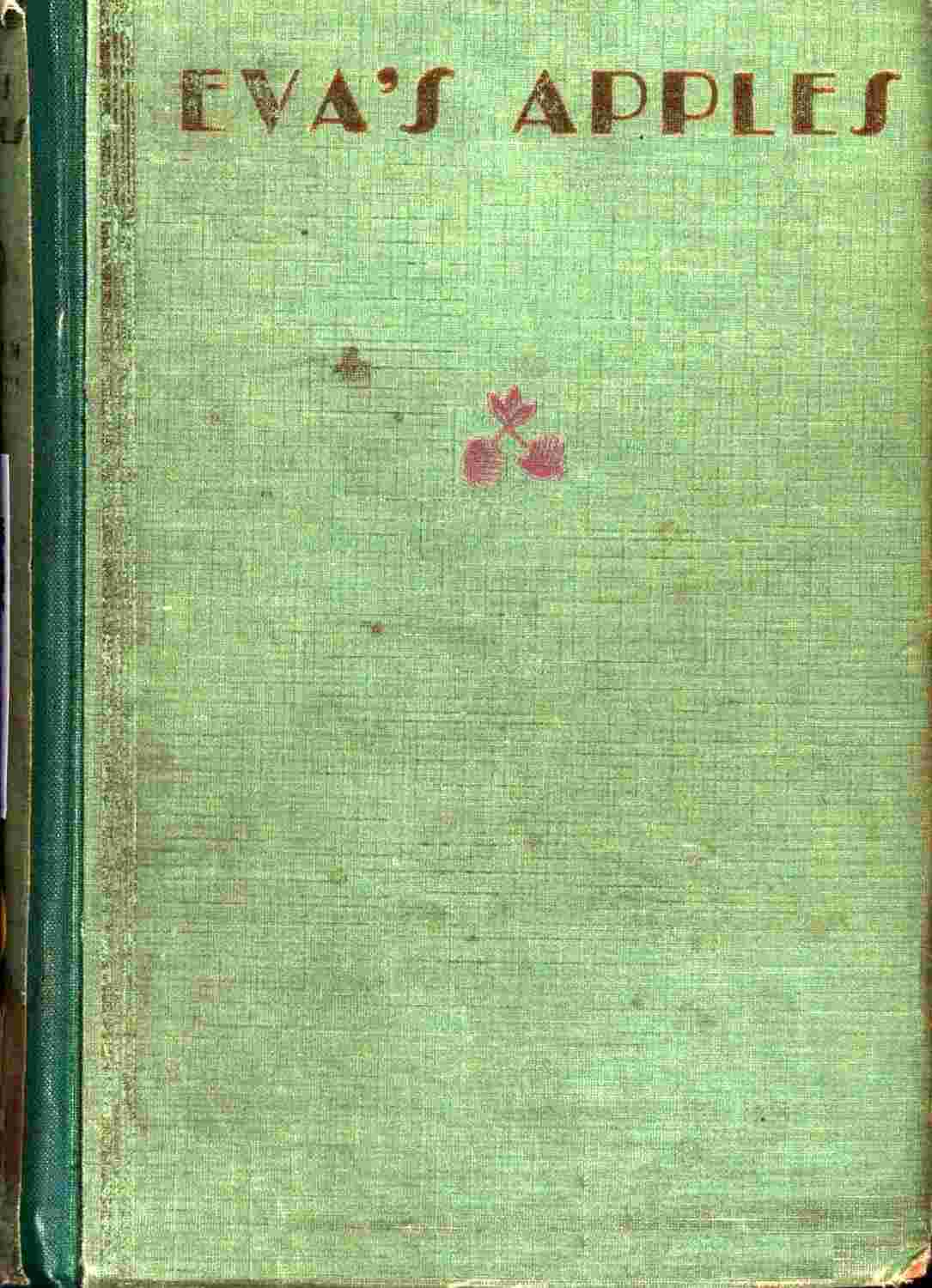
The Project Gutenberg eBook of Eva's apples
Title: Eva's apples
A story of jazz and jasper
Author: William Alexander Gerhardie
Release date: December 1, 2025 [eBook #77377]
Language: English
Original publication: NEW YORK: Duffield and Company, 1928
Credits: Chuck Greif and the Online Distributed Proofreading Team at https://www.pgdp.net (This book was produced from images made available by the HathiTrust Digital Library.)
CONTENTS:
I.,
II.,
III.,
IV.,
V.,
VI.,
VII.,
VIII.,
IX.,
X.,
XI.,
XII.,
XIII.,
XIV.,
XV.,
XVI.,
XVII.,
XVIII.,
XIX.,
XX.,
XXI.,
XXII.,
XXIII.,
XXIV.,
XXV.,
XXVI.,
XXVII.,
XXVIII.,
XXIX.,
XXX.,
XXXI.,
XXXII.,
XXXIII.,
XXXIV.,
XXXV.,
XXXVI.,
XXXVII.,
XXXVIII,
XXXIX.,
XL.,
XLI.,
XLII.,
XLIII.,
XLIV.,
XLV.,
XLVI.,
XLVII.
TRANSCRIBER'S NOTE
Eva’s Apples
EVA’S APPLES
A STORY OF JAZZ AND JASPER
by
William Gerhardi
Duffield and Company
New York - 1928
Copyright, 1928, by
Duffield & Company
Printed in The United States of America
By The Cornwall Press
Second Large Printing
TO THE GENIUS OF H. G. WELLS
IN HOMAGE
——————
PRETTY CREATURES
THE POLYGLOTS
ANTON CHEHOV
FUTILITY
spirit to a great and high mountain,
and her light was like unto a stone
most precious, even like a jasper
stone, clear as crystal.”
—Revelations Ch. 21-10-11.
Eva’s Apples
I.
“No, no, ‘Me-Too,’ you’d better run away now, or sit and wait here in the taxi.”
“But the taxi’s so expensive, darling.” (It was not at all like Eva, he reflected, to object to his expenses.) “I’d better come upstairs with you.”
“But no! I’ve an appointment with Lord Ottercove!”
“But I’d like to see Lord Ottercove myself.”
“But he hasn’t asked to see you.”
“But he might like to—if he knew.”
“He doesn’t know you.”
“He would if I came up with you.”
How she added to his difficulties!
For a young man of his nervous complex, living in the fear of waiters and hall porters and a general expectation that the next man he solicited for information would come up, lower his pants and give him a good hiding, an appointment with Lord Ottercove, though flattering, was arduous enough. Before the porch of a tall Fleet Street building from whose roof an electric sign proclaimed the fiery words Daily Runner, they argued, while the taxi-meter ticked away the aeons, and the aeons added shillings. From the pavement he gazed up at the huge inscrutable building and reflected that, located somewhere in its innermost recesses, like a spider waiting for him, was the great Lord Ottercove, as the black hand of the hall clock moved towards the hour appointed for the interview.
Leaving Eva in the taxi, he made away with a certain unnatural kind of alacrity, a recklessly confident step, to face the braided commissionaire who listened with faint but not unhopeful surprise to the news of the visitor’s claim to an appointment with his lordship. Ever jealous, however, like Peter, of his guardianship of the access to God, he provided the applicant with a form to be filled in with information of a biographical nature and outlining the general character of his business: the form to precede him to the desired destination; the aspirant to await below confirmation of the bona fides of his claim to the exalted interview. The confirmation duly forthcoming, the faithful steward handed the young visitor on to a lift boy who, taking him up several floors, handed him on to a brother lift boy, who presently handed him on to a third brother. Each new lift boy to whom he was handed over looked more exclusive, had a manner at once more solemn and more deferential—the mark of one who dwells in higher altitudes, more immune from the grosser things of the earth. Up and up they went, higher and higher, till the doors of the lift opened again and he was handed out to a page altogether removed from the race of mere lift boys. The page bade him follow him up the few remaining steps—the last golden ladder to heaven—to a landing where the page divested him of his cruder clothes of the street, took him up another three carpeted steps and, bidding him wait, knocked reverently at the door. And opened it before the visitor, who was pulling out his cuffs and, adjusting his tie, was quite ready to step forward. With a jerky suddenness, not unlike that of policemen in American comic films dashing off the ground in pursuit of a criminal, he entered the room, the page shutting the door on him.
In a vast radiant space of yellow and blue, at an octangular table surrounded by chairs, sat a slim middle-sized figure in a dark-blue suit, a negligent lock over the brow. It rose promptly, shook hands, gave the visitor one searching look with its penetrating grey eye, a guarded smile revealing white affable teeth, and sat down again to the octangular table, bidding the visitor to do likewise but taking no further notice of him.
The visitor sat hushed and abashed, slowly taking in the surroundings, and Lord Ottercove went on with his work, going through the small pile of papers before him with record speed, while a trained lady-secretary with a coyly grave manner and a voice attuned to the requisite pitch of awed and concentrated attention received his instructions. From time to time Lord Ottercove would take up the receiver and say, “Give me the Prime Minister,” or “Give me the Duke of Liverpool,” and, incredible as it seemed, the Prime Minister or the Duke of Liverpool was already talking—and not from Liverpool. “Hello, Fred,” from Lord Ottercove. “Oh, very well and full of mischief! What? Oh, I’m bored to hell. I’m going in for a new hobby. Buying race horses. What? Let me know before you start. Good-bye to you.”
The visitor had a feeling of sharing in Lord Ottercove’s multifarious activities and interests, and when he smiled—his eyes were grey and full of mischief—the visitor smiled too, involuntarily. But Lord Ottercove still took no notice of him.
And now his eyes were scanning a batch of typescript. His mouth opened. “Pale Primroses by Frank Dickin,” he said and looked humorously at the visitor. “Anything else?” he asked the secretary.
“Your spectacles.”
He stretched out his hand for them. “Good night to you.”
And while she was gathering her papers, Lord Ottercove leaned back, his preoccupied air having deserted him, a leisurely smile having taken its place. “Well, I am very interested to meet you, Mr. Dickin,” he said (the secretary now having retired). “My serial editor submitted to me the beginning of a proposed novel by you with a synopsis of its general plot, and I am much intrigued by it for a reason that you won’t guess. Your name—you will forgive me for saying so—was completely unknown to me. Frank Dickin did not convey anything to me in itself, you understand.”
“Frank Septimus Dickin.”
“You prefer it like that?”
“To redeem, I suppose, the plainness of the Dickin.”
“Of course, Dickin is not Dickens.” His lordship smiled indulgently.
“No, of course not.”
“Of course. Still, what attracted me—and that is chiefly why I wrote to you—are the people in your book. So real. It seemed to me I knew them.”
“Well, I do try to make them living. I think it is up to a novelist——”
“I don’t mean that. I think I know the family you describe. Or, rather, their connections and appendages. A remarkable coincidence, anyway, about the names.”
Here Dickin smiled.
“So they are ‘copies’?”
“Well, yes, to a considerable extent, I am bound to confess.”
“Have you brought me the continuation as I asked you to do in my letter? If so, I will read it to-night.”
“I am afraid it is very rough manuscript. You would not feel very happy with it.”
“Then you read it to me.”
“But it’s long.”
“Read it! I shall tell you when to stop.” Lord Ottercove pressed the button. The page stood in the doorway. “Don’t let any of them bother me for the next two hours. Keep them out, do you hear, and shut the door behind you!”
“Yes, m’lord.”
To Captains of Industry time is said to be money. But Generals of the Press are artists who express their sensibility in affairs. They have risen to heights beyond time and avarice and avarice in time to a condition of immanent immortality already in this world. Lord Ottercove had suddenly expressed the wish to be relieved of the blazing heat and burden of the day. For what does it profit a man to be rich if he cannot please his own moods? He was interested, satisfied: the hours he devoted to this visitor were of value to him: that was all. “Come and sit down here, Mr. Dickin; you will get a better light.”
Dickin plunged into a delicate-looking armchair—and fell through. He started up with a look as though he thought he was going to be thrashed for it, but Lord Ottercove, with splendid unconcern for the chair, only asked: “Have you hurt yourself?”
“On the contrary....”
“On the contrary what?”
“On the contrary: I have not hurt myself.”
“Thank God for that.”
“But I’ve hurt the chair.”
“Not a bit of it! Come and sit in this chair and read me your manuscript. Now then.”
“It is difficult to relate these things in their proper sequence. Some things stand out, others fade; that is all.”
“Are you talking now or reading?” asked Lord Ottercove.
“Reading.—I remember only a desultory Christmas Eve in the Tyrol. I strolled about lonely, sad, because laden with memories, through the winter streets of Innsbruck when a small group of people emerged from a shop, arguing in Russian as to their next move. I had picked up a fair amount of Russian in captivity during the war, quartered as we were with Russian officers, and improved it later on our ill-starred mission in Archangel, which, in the order of things, left behind memories. Was it that snow called to snow? It was thawing, and the shop windows twinkling in the winter dusk were faintly reminiscent. Memory calling to memory? But I went straight up to them and, with a curt apology, expressed my pleasure at hearing the dear language. In London I would have been brought up at Marlborough Street Police Station next morning and fined £5 for “annoying ladies in the street.” In New York I would have been flung summarily into prison for attempted rape. But the Russian ladies smiled with undisguised pleasure and expectation, and, talking eagerly, we immediately repaired to the Maria-Theresien-Café and exchanged experiences, attracting every one’s attention in the café by our voluble reminiscences. One lady—the fair, small, good-looking one, bubbling over with excitement—had married and divorced an Irishman, a certain Mr. Kerr whom she had met in Russia before the war, and till recently they owned a castle in Meran, but—she hinted at the Revolution, the War, the Italian annexation of South Tyrol, and, well, at their large and careless way of living. There had been debts. In fine, the castle was no more. But there were children. Four of them: two boys, two girls. Zita was the elder of the girls. She was sixteen. And, I perceived, amazingly good-looking in her bright, fair way. The younger, Eva, was at school in England. This little boy was John, the despair of her life! He simply wouldn’t sit still. And, indeed, he was already fiddling with my watch chain. But she had another son, the eldest of her children, who had her eyes and loved her dearly. Raymond, the apple of her eye! He was in England. They wished he might have gone to Oxford or Cambridge. Alas, that was not possible now. He was in the motor trade. It wasn’t quite the thing for him. He was more a poet at heart, melancholy, meditative, interested in bird life. But how good-looking! Raymond and Eva were the two best-looking of the family—her mother’s children. They had her eyes. Now John was made for the motor trade. Let him see a wheel or a piece of wire, and he must go and touch it.
“The other lady, dark and passionate but restrained by Mrs. Kerr’s volubility, was Russian too, but married to a local Austrian tram-driver. She told me her story. The daughter of a landowner, like Mrs. Kerr, she met her future husband when he was a prisoner-of-war in Russia; she a Red Cross nurse. Love at first sight. She married him and helped him to escape, all very romantically. He had told her he was an engineer by education and God-knows-what besides. They came to his native Innsbruck and he resumed his duties as a tram-driver. And everybody tells him he is a fool to have saddled himself with an uncongenial Russian wife and he seems to resent the marriage more than she resents his calling and has pawned the silver things she has managed to smuggle out of Russia and has been unfaithful to her and treats her brutally and she is now divorcing him because she hates him so. And yet is curious about his doings and still goes by the name of Frau König and works at a knitting establishment and is about to start work on her own—if only somebody would provide her with capital. ‘But I can’t,’ immediately says Mrs. Kerr. ‘My husband can’t give me anything. I have great hopes of getting some money from my parents in Russia, but my mother writes that she can’t send us anything. They are starving practically. Life is so hard for us who have come from Russia. And our castle in Meran.... It’s all this awful Revolution.’
“Ah, the good old days in Russia! Did I know her father, the landowner Pàvel Yàkovlevich Sabolenko? I didn’t? And yet everybody who had been in Russia knew him. He owned mines, he owned railways, he owned heaven knows what not. Everybody knew him. You had only to mention the name Pàvel Yàkovlevich Sabolenko for everybody to say: ‘Sabolenko? Pàvel Yàkovlevich? Why, of course!’ And now he said he couldn’t send her a penny. It seemed a shame. But, of course, they have had a revolution. Her father was seized by his own peasants (to whom he’d been a father all his life; they even called him ‘our father’) and was led out into the wood to be hanged, when a passing aeroplane attracted their attention and they forgot about him. ‘But mother was seized by them on their way back, by way of afterthought, and was about to be torn limb from limb, when father butted in and shouted, “What’s the good of wasting your time on an old hag like this? Get on with the Revolution!” and they all shouted, “Hear! hear! Long live the Revolution!” and elected father President of the Local Revolutionary Centre, which he is still.’ But the trouble was that you could never be sure with such erratic people, well-meaning but somehow not very certain of their intellectual premises. Father was a genius, of course. He had graduated at eight different universities and had written a philosophical treatise, a sort of bridge work between Plato and Schopenhauer and had of late much strengthened his position in regard to the Soviets by a work on Socialism entitled “Beyond Lenin,” and was regarded as an authority on mathematics. ‘I am telling you all this because you are a writer. You can make use of it in your books. We Sabolenkos are a most interesting, original family. One of my brothers shot himself; another got drowned....’”
“Look here,” Lord Ottercove interrupted, “will you have a drink before you continue?”
“Thanks awfully.”
“What will you have?”
“Wine. White wine.”
“Will you have champagne?”
“Thanks, I’ll have champagne. I adore it.”
Lord Ottercove rang in a special way. A butler sprang out of the floor. “Give me the wine-list.”
The butler returned with a huge album bound in crocodile leather. “You are looking at the binding, I notice. It is the skin of a crocodile I shot myself on the Nile,” said the host. And he selected a half-bottle of the year 1895. “According to historians,” he added, “a magnificent vintage.”
Dickin drank the champagne and thought—because she too adored champagne—of Eva waiting for him in the taxi. But the great room with the drawn curtains and the electric radiators full on was so snug; and already the champagne was doing its care-transcending work. He hoped that Eva was very comfortable in the taxi.
“Well, go on,” said Lord Ottercove.
“It was arranged between us before we parted that we should spend that Christmas Eve together at Frau König’s rooms. They had arranged to do so before they met me. I arrived shortly before midnight, laden with provisions. The Christmas tree was lit and John fiddling with everything that he could fiddle with, and Zita all in white and somehow marvellously seductive-looking. I marvelled at the lines of that young body. I still marvel when I think of them. It was warm and cosy in Frau König’s room on account of the lit candles. Mrs. Kerr was voluble and took the words out of poor Frau König’s mouth.
“‘Charming!’ I exclaimed. The real Russian Christmas!’
“‘It’s what I wanted!’ cried Mrs. Kerr. ‘And I knew Frau König would be pleased to spend Christmas Eve among Russian friends. And we regard you as a Russian too.’
“‘As a matter of fact, I lived in Russia as a child, while my father was Secretary at the British Embassy in Petersburg, and my earliest reminiscences go back to Russia.’
“‘Well, there you are! I knew Frau König would appreciate a Russian Christmas Eve. And so I said to her: ‘Tamara Leonidovna, you have a larger room than I have; ask us to supper, and we will spend Christmas Eve together.’ And we thought of writing a little story together: A young brunette—Tamara Leonidovna—asked a—a young (I am not old, am I?) blonde to her Christmas tree; and while they were thus together, there looked in to them through the window a third guest—the Moon.’
“And, indeed, the moon looked through the tall blue pine of the forest. ‘Charming,’ I said.
“‘How much will they give us for it?’
“‘How do you mean?’
“‘How many dollars—in an American magazine?’
“‘Well—I don’t know—it depends, of course—’
“‘And in England? How many sterlings?’
“I am the last man to generalise about national characteristics; but there was something perennially irresponsible about Mrs. Kerr’s nature. She had taken part in a £1,000 competition for a General Election forecast to be held in England on the Tuesday and arranged for a holiday tour on the following Saturday on the strength of the £1,000 which she hoped to win.”
“Ha!” laughed Lord Ottercove. “Incredible, isn’t it?”
Dickin, encouraged, continued with warmth, and without reference to the manuscript: “The fate of these people! who had known affluent days in genial surroundings on the accustomed background of Russian life, now cast ashore in a foreign land which looks askance at them and knows them not!”
Was it the champagne which spoke in him, or a look of dissension in his listener’s eyes? But he brought down his fist on the table with a bang. “Dammit, sir! They are too old to be acclimatised, too indolent to start afresh. They have dragged themselves here and cast their living carcasses upon the tide of life at this great turning point in human destiny.”
“Come, come!” said Lord Ottercove. But Dickin, dazed with the wine, was neither coming nor going. His heart was overwhelmed with love for humanity. “They feel they dream. All familiar things by which they had learnt their values had vanished overnight. They hear a tumult outside, but they are at a loss to understand its meaning. They are no longer of the past: it is not there: it has just vanished beneath their feet, and its history is not yet. They are not of the present: they do not know it, and it knows them not. They are silent, alone. They are alive, but the shadow of death has crept over them. They are dead souls with just a flicker of light on them....”
Lord Ottercove, listening, could not make out what this strange note of emotion in Dickin connoted precisely: whether this was poetry, and, if so, whether good or bad poetry. Dickin, conscious of discomfiture, felt the need to excuse himself. “A beginning,” he said, “in the manner of Guy de Maupassant in his more sentimental vein.” He had a feeling that the air had gained that air-proof compartment in him in which alone pure sentiment can thrive, and shrank at this contamination of sentimentality. “I see I bore you.”
“Not a bit of it, my dear fellow. I cannot tell you how it all interests me—for various reasons, of which I will tell you presently.”
“I will read on.”
“Whichever is quicker and more to the point.”
“I must read it all. It is nothing without the atmosphere.”
“I understand—about the atmosphere. Go on in your own way.”
“Both women vied to show me their photographs. Frau König took me aside surreptitiously into her small bedroom—the Christmas tree was in the kitchen—and there showed me photographs of her father, her mother, herself and her brother, and even of the tram-driver. A man with a chin and a moustachio. But when we got back into the kitchen Mrs. Kerr would not let go of me. She had brought all her photographs with her so that she might show them to me: her great genius of a father, her mother, the brother who had shot himself, and the one who was drowned. ‘And this is my husband.’
“From the cardboard in my hand Mr. Kerr gazed at me circumspectly.
“‘A handsome man, but a wicked, impossible temper. He left his people in Ireland because he could not get on with them and bought the castle in Meran and never wanted to go back. And even now, poor fellow, tries to keep up appearances—eats nothing in the day but dines at night with an old friend of his, a Rittmeister, at the station restaurant.’
“‘Daddy’s always very spick and span,’ said Zita.
“‘So he is still about?’
“‘Oh yes! He won’t go back to Ireland while his father is alive, and he loves the Austrians.’
“‘Daddy is awfully stupid about learning languages,’ said Zita. ‘He’s lived here all his life and can hardly speak a word of German.’
“‘But of course he can speak German,’ Mrs. Kerr butted in. ‘He always speaks German with the Rittmeister. I heard him last night.’
“‘Mummy, he can’t, to save his life! When he orders three cups of coffee he holds out three fingers and says: “Zwei.” And in Vienna when he wanted to show us the Rathaus, he stopped a man in the street and said: “Please show me the way to the rat house.’”
“‘He didn’t!’
“‘He did!’
“‘Still, your father is a fine man and if it hadn’t been for his temper I should have never divorced him. But he used to throw things at me—a flower vase, a candelabrum, a great big jug of water. I’d have to hide in the garden all night. He was so insanely jealous!’ She smiled slyly. ‘Perhaps not without cause.’
“‘This, I forgot to show you,’ said Frau König, ‘is the photograph of my fiancé.’
“‘Frau König,’ explained Mrs. Kerr, ‘is engaged to a very charming, intellectual young man. A Russian student in Paris.’
“‘To a youth?’
“‘What age is he, Tamara Leonidovna?’
“‘Thirty-eight or nine. This is an old photo of him, taken about twenty years ago on entering Tiflis University.’
“‘And what does he do now?’
“‘He wants to continue his course at the University in Paris in the Faculty of Philosophy. Then, eventually, he will start a factory.’
“‘What kind of factory?’
“‘A knitting factory. We will direct it together. He is now, while pursuing his course in philosophy at the University, putting aside money for the factory by giving shorthand lessons in Paris.’
“‘A very active and sensible young man,’ commended Mrs. Kerr, ‘and I congratulate you, Tamara Leonidovna, with all my heart.’
“‘Thank you, Vera Pavlovna, I am very proud and happy—’
“‘But wait, I haven’t shown you the photograph of our castle,’ interrupted Mrs. Kerr, ‘our Schloss (she sighed) in Meran.’
“‘Oh, a very lovely old castle.’
“‘Here all my four children were born. Raymond and Zita upstairs; Eva and John here in the room next to the terrace. I changed my bedroom so as to be able to take shelter in the garden.... But when he had calmed down there was no kinder man than my husband. This was my drawing-room—with the Japanese furniture. And they came and took everything, everything....’ Tears rolled down her cheeks. ‘Like in The Cherry Orchard....’
“‘But why? I do not follow. Your husband is a British subject, isn’t he? The Italian annexation of Süd Tirol would not affect his property.’
“She nodded rapidly and sadly. ‘Debts ...’ she said. ‘How we lived! Horses and motor-cars. Bouts. We used to give parties which must have out-rivalled our Grand Duke’s! Spent without counting! My husband—they are like that in Ireland—utterly unbusinesslike ... irresponsible!... And now we are punished.’ She looked at Zita pensively. ‘Yes,’ she said, ‘this Revolution has done a great deal of harm and caused untold suffering to us Russians of the cultured intellectual classes.... But let us drink to Hope and a new and brighter Dawn!’
“We refilled our glasses with cognac, after which all things seemed possible. ‘To the factory!’ I cried. ‘And here is to the future and an even finer, greater castle!’
“‘I believe in what you say,’ chimed in Mrs. Kerr. ‘We shall be repaid for our present suffering. Even the Bible says: And many first shall be last, and many last first.’”
II.
THE YOUNG GIRLS
“They came to my pension the day after, Mrs. Kerr, Zita, and John; and Frau König turned up afterwards and sat there like a silent reproach as Mrs. Kerr poured out her own woes, while John at once went over to my typewriter and began fiddling with the keys, and being chased away opened a box which contained razor-blades. ‘John has been sent into my life as a punishment and thinks nothing of worrying his poor mummy. But Raymond is a saint and angel to me. Raymond has my eyes—the large, sorrowful eyes of the Madonna, you might say, kissing the finger-tips of her Child.’
“They liked the pension and took a room in it. They attracted me chiefly on Zita’s account. She had a wonderful way about her, as if on the brink of revealing much. ‘You know,’ she would say. ‘You know—it’s queer how—how—you know—’ And that sort of thing. And then her face had a sincere and curiously attractive, open, ‘you know’ sort of look. She was sixteen, and wonderfully built. Men were after her, all sorts of dingy barons and counts. I took her out to dances. She seemed indifferent to her success. But I was devilishly attracted by her. I suppose she had the most perfect figure I had ever seen, and she danced adorably. Once, after dinner, when we were alone in the pension dining room and she was standing warming herself against the great white stove in the corner, clasping it, her bosom against it, I ventured to press her from behind. She laughed and called it ‘artificial respiration,’ and I, grateful for a term, continued to interpret it, so to speak, in new and different forms, but calling it by the old name whenever she showed signs of decorous astonishment. And sneering the while at my rival, the young Count Kolberg. ‘Where have you picked him up?’
“‘In a restaurant. He stood by the door. In a tail coat, you know, all men look alike. Mummy called out: “Waiter!” And he came up and introduced himself: “Graf Kolberg.’”
“‘Just like that?’
“‘Yes. Clicked his heels: “Graf Kolberg.’”
“‘Fancy that!’
“‘But he is such a ninny. Twenty-eight, and hangs to his mother’s apron strings. She still holds him by the hand in the street, and each year makes him a Christmas tree.’
“‘Fancy that.’ And I kissed her on the spot where the nape joins the neck.
“‘But Mummy likes the old Gräfin who is nosing everywhere to find out whether I’d be a suitable wife for him, and tries to borrow money from Mummy thinking all English must be rich; and as she’s always expecting something, Mummy’s sent her a box of soap. But the old Gräfin took it in bad part. She thought it was an insinuation. I’m glad. She does look rather filthy.’
“‘She does, darling,’ I said, and kissed her on the brow.
“‘It’s beastly people thinking one has a lot of money when one hasn’t any. I want to go to England and take dancing lessons.’
“‘Whatever for?’
“‘To become a professional dancer. It’s a good thing.’
“She was now sitting on a table and performing a sort of Müller exercise with her legs and trunk, as she spoke. I began to take a tangible interest in her formation, in the shape of her limbs, softening the crudity of my curiosity with remarks like: ‘Fancy this,’ or ‘Fancy that.’ She was in my arms, warm, flexible, enticing. Her lips searched mine. But we had eaten of some horrible cheese at the close of dinner and didn’t dare to consummate the kiss. Nevertheless, getting on splendidly when interrupted by the mother coming in—to talk. Babble! gabble! blabber! twaddle! twattle! and if you please, about her younger girl in England, when this one had been in my arms. The mockery of love!
“‘Zita, go up and bring us Eva’s letter. I should like Ferdinand Feodorovich (she always got my patronymic wrong) to read it.’ The letter was to her sister.
“‘We tell each other everything in our bedroom which is private. I am called Grandmother and give advice on all subjects. Kitty is called the Babe as she has never even believed herself in love. Marion is aged fifteen and one-half, Kitty fifteen. I am by age the youngest, but in everything else I am considered the oldest. We had gym this afternoon. Kitty got a giggling fit and couldn’t stop because Miss Hitchcock’s tummy made awful noises. Marion’s last remark was “Oh! I’m feeling so curly in my tummy, excited like. I’m expecting some more letters to-morrow from Bonzo.” You can guess who Bonzo is, it’s HIM for Marion.’
“And so on in this strain.
“‘An awful imp,’ was Zita’s comment. ‘What I do, she must do too. What I have, she must have too.’
“‘When they were children,’ Mrs. Kerr explained, ‘Eva always said “Me too” to everything Zita did—“Me too.” And so we all nicknamed her “Me-Too.’”
“‘I’d like to meet her when I go to England,’ I said.
“‘She’d want to,’ Zita said, ‘if she knows I’ve met you.’
“‘Well, why not?’ said Mrs. Kerr. ‘I will write to her. Frederick Konstantinovich (again she got my patronymic wrong), a very charming, intellectual young man, a friend of ours. I am sure she’ll be very pleased.’
“‘She will!’ said Zita sardonically.
“When I was in England I wrote to Eva and we engaged in some correspondence, exchanging photographs, before I was able to go down to meet her. She could not understand this long delay and wondered what might be the cause of it; and Marion, it seemed, scrutinised my photo through a magnifying glass to see if perchance I hadn’t spots on my face. And Eva wrote to me:
“‘Even if you have spots on your face, show yourself.’
“We met. She was lovely. Unbelievably so. And she wrote to Marion, who had gone home for the vacation:
“‘He has no spots, is tall, not elegant but clean looking. And says he loves me five times more than before. Am I not a lucky girl?’
“When I went abroad she continued writing to me, mostly about Marion and Kitty. ’ ... Marion, Kitty and I are sleeping together like last term. I like Marion and Kitty. We have arranged that we are going to have a house in Canada together as we are afraid we are going to be old maids. If one of us marries she is going to stay in Canada sometimes. We are also thinking of becoming missionaries. Marion is too funny. She thinks she is in love!! but she still thinks she will be an old maid. Marion, Kitty and I are making rules for a Committee. We are the Members of the Committee. We have agreed that everything is secret, but that I can tell you, and Marion can tell her brother. We have to tell each other everything except our worst sin. It sounds funny, but we are all very wicked and have each done something we couldn’t tell other people. So we have agreed that we haven’t got to tell that. You may know mine, but I’m not shure. There are lots of By-Laws besides. I will give you further perticulers later. All matters must be discussed in privacy. All members are equal in ALL affairs. T. C. (password) must only be used on urgent occasions. Any member wishing to leave the Committee can do so if her word of honour is given to remain silent consuming all matters discussed in the aforesaid Committee. If remaining members agree that a certain Member has broken a rule, that Member must pay a penalty fine of 2d. and also if a Member has lost her rules. Those are the rules. I think it’s a very good Committee, don’t you? I’ve been informed by Miss Hitchcock that I’ve got to go in for Junior Cambridge exam next. I don’t think I will. I think I should get brain fever, my brain being already weak. It’s ever so hot to-day—more so than userlay. I had to undo my coat coming out. In the garden there are lots of snow-drops, crocuses, primroses, tulips and hyasinths out. I hope you apprechiate this lengthy episel.—Your Eva.’
“‘P.S.—Mummy writes that Count Kolberg is still after Zita, who cannot bear his soppiness.’
“In the winter I was in Innsbruck. They were expecting Eva, who had left school as they could not afford to pay for her. We all went to meet her. Even now I can see the long Paris train steaming into Innsbruck Station, and Eva alighting, rather more the young lady than when I had last seen her in England. When Zita that evening showed me her albums with snaps, ‘Me-Too’ insisted on doing the same. Their mother, encouraged by the thought of the economy effected in sparing Eva’s future school fees, deemed it well to celebrate the release in terms of midnight frolics—‘Making a night of it,’ she called it. She got us all to join some dancing class of a certain Fräulein Stube, and Count Kolberg came along too, and brought his cousins and friends. Eva danced with all the counts and barons and smiled into their eyes. And Zita, you could see, hated that smile. She knew her ‘Me-Too’ inside out. But the barons adored it; and Zita, who had not cared for Kolberg and the barons, now that Eva deflected them, grew visibly jealous. ‘I don’t want to be seen about with this lump!’ (Eva’s legs were ripening fast). ‘I’ll make her get up and take exercise,’ and like remarks. And she never called her Eva, but ‘Me-Too,’ with a certain venom of intonation. But Eva, coy, continued smiling at the barons, who were like flies round her.
“New Year’s Eve we spent at the Maria-Theresien Restaurant. A huge brass band from the public park installed in the dining room—— deafening music. The room crowded to overflowing. Men prowling about in the hope of stealing a chair. Some Johnny actually seizing one of ours: ‘May I?’ I open my mouth to say ‘Indeed not!’ but that moment the band crashes into martial vehemence—and my words are lost. Mrs. Kerr happy, her lost château, lost income, debts, all forgotten in the excitement of the moment, sits near me, praises all and everybody: ‘Ah, that dancing mistress Fräulein Stube! A charming, intellectual young woman. So nice! so educated! speaks English like a native!’ Presently I dance with the said Fräulein Stube and ask her in explicit English:
“‘What is this dance?’
“‘Please?’ says Fräulein Stube.
“‘What is this dance? A fox-trot?’
“‘Please?’
“‘Is this a fox-trot?’
“‘No, de Schimmey,’ she replies.
“‘In England we dance differently,’ I say to her after a while.
“‘Please?’
“‘We dance differently in England.’
“‘Please?’
“In the effort, I stepped on to her toe. ‘I beg your pardon,’ I stammered.
“‘Please?’
“‘I beg your pardon.’
“‘Yes, dis de Schimmey,’ she said.
“And then again I am in the midst of Mrs. Kerr’s amazing volubility, praising all and everybody: ‘You dance so gracefully, so elegantly. And Fräulein Stube, such a really nice and cultured, intellectual woman! So pleasant, well brought-up, and educated! Knows languages, talks English like a native.’ Suddenly all rise, holding up mugs of beer. ‘Prosit! Prosit! Prosit!’ And, indeed, the hand of the big clock points midnight. The band crashes on for a full two minutes. And stops. Noise and confusion. Friends and strangers alike are drinking Bruderschaft. From the table next to ours a man rises (he is unshaven, but in a sort of dinner-jacket suit with a reddish velvet waistcoat) and introduces himself: ‘Lieutenant-Colonel von Wiesendorf,’ then introduces his daughter. We rise and introduce ourselves and one another. They drag up their table to ours, and we are one large party. The Colonel says he can speak English, his object in hooking himself on to us being either to show off or to practise our language, which, he says, he picked up in Africa.
“‘In the Foreign Legion?’ I ask.
“‘Pfui Teufel, no!’ he says. ‘Only desperados serve in the Foreign Legion.’
“Evidently a faux pas.
“‘Bruderschaft!—Hoch! Hoch! Hoch!’ And the Colonel and myself are linked in brotherhood and call each other ‘thou.’ Mrs. Kerr and Fräulein von Wiesendorf drink Bruderschaft and become inseparable. Zita and Eva, in their turn, drink Bruderschaft with Fräulein von Wiesendorf. Finally Graf Kolberg with the Colonel. The band now crashes with unheard-of vehemence. All drink.”
Here Frank Dickin stopped reading and helped himself to more champagne; then continued with unction:
“Fräulein von Wiesendorf, whose great virtue, according to herself, is that she is very jolly: ‘I’m so jolly!’ she squeals, and kicks her heels up, becomes a bosom friend of Mrs. Kerr. ‘Ah, Ferdinand Vassilievich,’ she says (getting me wrong again), ‘you have no idea what a sincere, cultured, jolly, well-informed and intellectual girl she is! Her father, in his position of Comptroller of Public Morals, cannot take her out to all the cabarets and night clubs and she hasn’t even been to the Austria-Bar or the Odéon! But I will chaperone her and take her everywhere, and she’s so pleased!’
“And together, they drag us to a cellar-restaurant, the barons like hounds on Eva’s scent—Zita neglected, forgotten. And the Colonel, the Comptroller of Public Morals, scratches his head, says ‘Na! The New Year is not all the year, nor New Year’s Day every day,’ and comes along too, Fräulein von Wiesendorf kicking her heels up with joy. In the cellar-restaurant the goings-on have been going on five or six nights running, ever since Christmas Eve. Shaky waiters with small, red, sleepy eyes. The head waiter—it is the third night he hasn’t closed his eyes—but propped up with drink, sings along with the band and, as a special favour, right into my ear, occasionally spluttering on my cheek and forehead: