
Checklists of Reptiles and Amphibians
More than 50 species of reptiles, including 26 species of snakes and 16 species of turtles, have been found in Everglades National Park. The reptiles include, of course, the alligator, which is the symbol of the Everglades. Less conspicuous than the reptiles are the 18 species of amphibians that live here. Many are nocturnal. These lists represent species found within the park or nearby. Species considered exotic to Everglades National Park are marked with an asterisk (*).
Reptiles
- American crocodile Crocodylus acutus
- American alligator Alligator mississippiensis
- Florida snapping turtle Chelydra serpentina
- Striped mud turtle Kinosternum bauri
- Stinkpot Sternotherus odoratus
- Florida box turtle Terrapene carolina
- Diamondback terrapin Malaclemys terrapin
- Peninsula cooter Chrysemys floridanis
- Florida redbelly turtle Chrysemys nelsoni
- Florida chicken turtle Deirochelys reticularia
- Gopher tortoise Gopherus polyphemus
- Atlantic green turtle Chelonia mydas
- Atlantic hawksbill Eretmochelys imbricata
- Atlantic loggerhead Caretta caretta
- Atlantic ridley Lepidochelys kempi
- Florida softshell Trionyx ferox
- Indopacific gecko Hemidactylus garnoti*
- Florida reef gecko Shpaerodactylus notatus
- Green anole Anolis carolinensis
- Brown anole Anolis sagrai*
- Knight anole Anolis equestris*
- Common iguana Iguana iguana*
- Ground skink Scincella lateralis
- Eastern glass lizard Ophisaurus ventralis
- Island glass lizard Ophisaurus compressus
- Florida green water snake Nerodia cyclopion
- Brown water snake Nerodia taxispilota
- Florida water snake Nerodia fasciata pictiventris
- Mangrove salt marsh snake Nerodia fasciata compressicauda
- South Florida swamp snake Seminatrix pygaea
- Florida brown snake Stoeria dekayi
- Eastern garter snake Thamnophis sirtalis
- Peninsula ribbon snake Thamnophis sauritus
- Striped crayfish snake Regina alleni
- Eastern hognose snake Heterodon platyrhinos
- Southern ringneck snake Diadopis punctatus
- Eastern mud snake Farancia abacura
- Everglades racer Coluber constrictor
- Eastern coachwhip Masticophis flagellum
- Rough green snake Opheodrys aestivus
- Eastern indigo Drymarchon corais
- Corn snake Elaphe guttata
- Everglades rat snake Elaphe obsoleta
- Yellow rat snake Elaphe obsoleta quadrivitatta
- Florida kingsnake Lampropeltis getulus
- Scarlet kingsnake Lampropeltis triangulum
- Florida scarlet snake Cemophora coccinea
- Eastern coral snake Micrurus fulvius
- Florida cottonmouth Agkistrodon piscivorus
- Dusky pygmy rattlesnake Sistrurus miliarius
- Eastern diamondback Crotalus adamanteus
Amphibians
- Two-toed amphiuma Amphiuma means
- Greater siren Siren lacertina
- Everglades dwarf siren Pseudobranchus striatus belli
- Peninsula newt Notophthalmus viridescens
- Eastern spadefoot toad Scaphiophus holbrooki
- Greenhouse frog Eleuthrodactylus planirostris*
- Southern toad Bufo terrestris
- Oak toad Bufo quercicus
- Florida cricket frog Acris gryllus
- Green treefrog Hyla cinerea
- Squirrel treefrog Hyla squirella
- Cuban treefrog Osteopilus septentrionalis*
- Little grass frog Limneaodus ocularis
- Florida chorus frog Pseudacris nigrita
- Eastern narrow-mouth toad Gastrophyne carolinesis
- Pig frog Rana grylio
- Southern leopard frog Rana spenocephala
Checklist of Trees and Tree-like Plants
A tree is defined here as a woody plant at least 12 feet high with a single trunk 2 inches or more in diameter at breast height. A tree-like plant is one with the general shape and size of a tree, but one which is not woody or otherwise fails to meet the definition. The arrangement of families is generally the same as that of Small’s Manual of Southeastern Flora (1933) and Long and Lakela’s A Flora of Tropical Florida (1971). Genera and species are listed alphabetically in each family. Nomenclature follows Avery and Loope, Plants of Everglades National Park: A Preliminary Checklist of Vascular Plants (1983). In the checklist, the introduced species are followed by a symbol, key below, that describes the plants’ success in the Everglades. Native plants list only their name.
| We | Well established. An exotic plant that has become widely naturalized, with a large population. |
| Sl | Slightly naturalized. An exotic plant that has a small foothold, often found near a mature tree that acts as a seed source. |
| Pr | Persistent. An exotic plant that goes on living for a long time after it is planted, and that may appear to be native or naturalized. |
| Sm | Small, rarely tree-sized. A plant that may sometimes become a tree, but that often does not meet the definition. |
| Cu | Cultivated only. Known only as a cultivated species, but which is retained on this list because either Small or Long and Lakela treat it as native or naturalized. |
- PINE FAMILY: PINACEAE
- South Florida Slash Pine Pinus elliottii var. densa
- BALD CYPRESS FAMILY: TAXODIACEAE
- Pond cypress Taxodium ascendens
- Bald cypress Taxodium distichum
- PALM FAMILY: ARECACEAE
- Paurotis palm Acoelorraphe wrightii
- Silver palm Coccothrinax argentata
- Coconut Cocos nucifera Sl
- Royal palm Roystonea elata
- Cabbage palm Sabal palmetto
- Saw palmetto Serenoa repens
- Thatch palm Thrinax radiata
- CENTURY PLANT FAMILY: AGAVACEAE
- False sisal Agave decipiens
- Sisal Agave sisalana We
- Spanish dagger Yucca aloifolia
- BANANA FAMILY: MUSACEAE
- Banana Musaceae musa × paradisiaca
- BEEFWOOD FAMILY: CASUARINACEAE
- Australian-pine Casuarina equisetifolia We
- Suckering Australian-pine Casuarina glauca Pr
- WILLOW FAMILY: SALIACACEAE
- Willow Salix caroliniana
- BAYBERRY FAMILY: MYRICACEAE
- Wax-myrtle Myrica cerifera
- OAK FAMILY: FAGACEAE
- Laurel oak Quercus laurifolia
- Live oak Quercus virginiana
- ELM FAMILY: ULMACEAE
- Hackberry Celtis laevigata
- West Indian trema Trema lamarckianum
- Florida trema Trema micranthum
- MULBERRY FAMILY: MORACEAE
- Strangler fig Ficus aurea
- Shortleaf fig Ficus citrifolia
- Red mulberry Morus rubra
- XIMENIA FAMILY: OLACACEAE
- Graytwig Schoepfia chrysophylloides
- Tallowwood Ximenia americana
- BUCKWHEAT FAMILY: POLYGONACEAE
- Pigeon plum Coccoloba diversifolia
- Sea grape Coccoloba uvifera
- FOUR-O-CLOCK FAMILY: NYCTAGINACEAE
- Blolly Guapira discolor
- Push-and-hold-back Pisonia aculeata
- MAGNOLIA FAMILY: MAGNOLIACEAE
- Sweet bay Magnolia virginiana
- CUSTARD-APPLE FAMILY: ANNONACEAE
- Pond apple Annona glabra
- LAUREL FAMILY: LAURACEAE
- Lancewood Nectandra coriacea
- Red-bay Persea borbonia
- Avocado Persea americana var. americana
- CAPER FAMILY: CAPPARACEAE
- Jamaica caper Capparis cynophallophora
- Limber caper Capparis flexuosa Sm
- ROSE FAMILY: ROSACEAE
- West Indian cherry Prunus myrtifolia
- COCO-PLUM FAMILY: CHRYSOBALANACEAE
- Coco-plum Chrysobalanus icaco
- PEA FAMILY: FABACEAE
- Sweet acacia Acacia farnesiana
- Acacia pinetorum Sm
- Shy leaf Aeschynomene americana var. americana
- Aeschynomene pratensis var. pratensis
- Women’s tongue Albizia lebbeck Sl
- Orchid tree Bauhinia purpurea Sl
- Cassia aspera
- Bahama senna Cassia Chapmanii
- Cassia deeringiana
- Golden shower Cassia fistula Pr
- Cassia ligustrina
- Sickle-pod Cassia obtusifolia
- Dalbergia brownei
- Royal ponciana Delonix regia
- Coral-bean Erythrina herbacea
- Jumbie bean Leucaena leucocephala Sl
- Wild tamarind Lysiloma latisiliquum
- Jamaica dogwood Piscidia piscipula
- Black-bead Pithecellobium guadalupense
- Cat’s claw Pithecellobium unguis-cati
- Necklace pod Sophora tomentosa
- RUE FAMILY: RUTACEAE
- Citrus spp. Pr
- Wild lime Zanthoxylum fagara
- AILANTHUS FAMILY: SIMAROUBACEAE
- Alvaradoa amorphoides
- Paradise-tree Simarouba glauca
- BAY CEDAR FAMILY: SURIANACEAE
- Bay cedar Suriana maritima Sm
- BURSERA FAMILY: BURSERACEAE
- Gumbo-limbo Bursera simaruba
- MAHOGANY FAMILY: MELIACEAE
- Mahogany Swietenia mahagoni
- MALPIGHIA FAMILY: MALPIGHIACEAE
- Locust-berry Brysonima lucida
- SPURGE FAMILY: EUPHORBIACEAE
- Crabwood Ateramnus lucidus
- Bischofia javanica Sl
- Milk Bark Drypetes diversifolia
- Guiana-plum Drypetes lateriflora
- Manchineel Hippomane mancinella
- CASHEW FAMILY: ANACARDIACEAE
- Poisonwood Metopium toxiferum
- Southern sumac Rhus copallina var. leucantha
- Brazilian-pepper Schinus terebinthifolius We
- Hogplum Spondias purpurea
- HOLLY FAMILY: AQUIFOLIACEAE
- Dahoon Ilex cassine
- Tawnyberry holly Ilex krugiana
- BITTERSWEET FAMILY: CELASTRACEAE
- Ground holly Crossopetalum ilicifolium Sm
- Rhacoma Crossopetalum rhacoma Sm
- Guttapercha mayten Maytenus phyllanthoides
- MAPLE FAMILY: ACERACEAE
- Red maple Acer rubum
- SOAPBERRY FAMILY: SAPINDACEAE
- Varnish-leaf Dodonaea viscose var. linearis
- Inkwood Exothea paniculata
- White ironwood Hypelate trifoliata
- Spanish lime Melicoccus bijugatus Pr
- Soapberry Sapindus saponaria
- BUCKTHORN FAMILY: RHAMNACEAE
- Coffee colubrina Colubrina arborescens
- Colubrina asiatica
- Cuban colubrina Colubrina cubensis Sm
- Black ironwood Krugiodendron ferreum
- ELAEOCARPUS FAMILY: ELAEOCARPACEAE
- Strawberry-tree Muntinoia calabura Pr
- MALLOW FAMILY: MALVACEAE
- Wild cotton Gossypium hirsutum
- Hibiscus rosa-sinensis Pr
- Turk’s cap Malvaviscus arboreus var. mexicanus
- Cork tree Thespesia populnea
- CANELLA FAMILY: CANELLACEAE
- Wild-cinnamon Cannela winterana
- PAPAYA FAMILY: CARICACEAE
- Papaya Carica papaya
- CACTUS FAMILY: CACTACEAE
- Prickly apple Cereus gracilus var. simpsonii
- Dildo Cereus pentagonus
- MANGROVE FAMILY: RHIZOPHORACEAE
- Red mangrove Rhizophora mangle
- COMBRETUM FAMILY: COMBRETACEAE
- Black olive Bucida buceras Pr
- Buttonwood Conocarpus erectus
- White mangrove Laguncularia racemosa
- Indian almond Terminalia catappa Pr
- MYRTLE FAMILY: MYRTACEAE
- Bottlebrush Callistemon viminalis Pr
- Spicewood Calyptranthes pallens var. pallens
- Myrtle-of-the-river Calyptranthes zuzygium
- White stopper Eugenia axillaris
- Spanish stopper Eugenia foetida
- Cajeput Melaleuca quinquenervia Sl
- Simpson stopper Myrcianthes fragans var. simpsonii
- Guava Psidium guajava We
- Long-stalked stopper Psidium longipes var. longipes Sm
- MEADOW-BEAUTY FAMILY: MELASTOMATACEAE
- Spanish leather Tetrazygia bicolor
- JOE-WOOD FAMILY: THEOPHRASTACEAE
- Joe-wood Jacquinia keyensis
- MYRSINE FAMILY: MYRSINACEAE
- Marlberry Ardisia escallonioides
- Shoebutton ardisia Ardisia solanacea We
- Myrsine Myrsine floridana
- SAPODILLA FAMILY: SAPOTACEAE
- Saffron-plum Bumelia celastrina
- Bumelia reclinata var. reclinata Sm
- Willow bustic Bumelia salicifolia
- Satin leaf Chrysophyllum oliviforme
- Wild dilly Manilkara bahamensis
- Mastic Mastichodendron foetidissimum
- EBONY FAMILY: EBENACEAE
- Persimmon Diospyros virginiana
- OLIVE FAMILY: OLEACEAE
- Wild-olive Forestiera segregata var. pinetorum Sm
- Florida-privet Forestiera segregata var. segregata Sm
- Pop ash Fraxinus caroliniana
- DOGBANE FAMILY: APOCYNACEAE
- Thevetia peruviana Pr
- Pearl-berry Vallesia antillana
- BORAGE FAMILY: BORAGINACEAE
- Smooth strongbark Bourreria cassinifolia
- Strongbark Bourreria ovata
- Geiger-tree Cordia sebestena
- BLACK MANGROVE FAMILY: AVICENNIACEAE
- Black Mangrove Avicennia germinans
- VERBENA FAMILY: VERBENACEAE
- Fiddlewood Citharexylum fructicosum
- Java Glory-bowers Cleradendrum speciosissimum
- POTATO FAMILY: SOLANACEAE
- Potato tree Solanum erianthum
- MADDER FAMILY: RUBIACEAE
- Seven-year-apple Casasia clusiifolia
- Buttonbush Cephalanthus occidentalis
- Black torch Erithalis fruticosa Sm
- Velvet seed Guettarda elliptica
- Rough velvet-seed Guettarda scabra
- Firebush Hamelia patens
- Indigo-berry Randia aculeata Sm
- HONEYSUCKLE FAMILY: CAPRIFOLIACEAE
- Southern elderberry Sambucus canadensis
- ASTER FAMILY: ASTERACEAE
- Groundsel-tree Baccharis glomeruliflora Sm
- Groundsel-tree Baccharis halimifolia Sm
Handbook 143
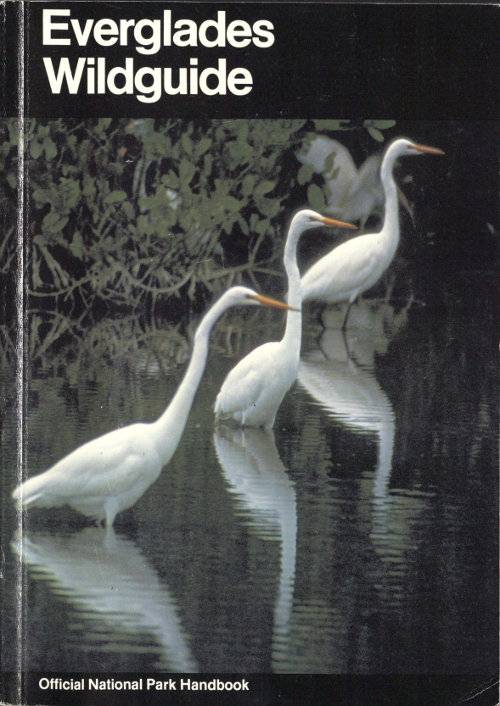
The National Park Service expresses its appreciation to all those persons who made the preparation and production of this handbook possible. Special thanks are extended to Frank Craighead, Sr., Pat Miller, Bill Robertson, and Saul Schiffman, who read the manuscript and provided much useful information. The checklists were compiled over many years by various members of the Everglades National Park staff. The Service also gratefully acknowledges the financial support given this handbook project by the Everglades Natural History Association, a nonprofit group that assists interpretive efforts at the park. The cover photograph is by Glenn van Nimwegen.
National Park Service
U.S. Department of the Interior
As the Nation’s principal conservation agency, the Department of the Interior has responsibility for most of our nationally owned public lands and natural resources. This includes fostering the wisest use of our land and water resources, protecting our fish and wildlife, preserving the environmental and cultural values of our national parks and historical places, and providing for the enjoyment of life through outdoor recreation. The Department assesses our energy and mineral resources and works to assure that their development is in the best interest of all our people. The Department also has a major responsibility for American Indian reservation communities and for people who live in island territories under U.S. administration.
Transcriber’s Notes
- Retained publication information from the printed edition: this eBook is public-domain in the country of publication.
- Relocated all image captions to be immediately under the corresponding images, removing redundant references like ”preceding page”.
- Silently corrected a few palpable typos.
- Added “Glossary” to the Table of Contents
- In the text versions only, text in italics is delimited by _underscores_.