
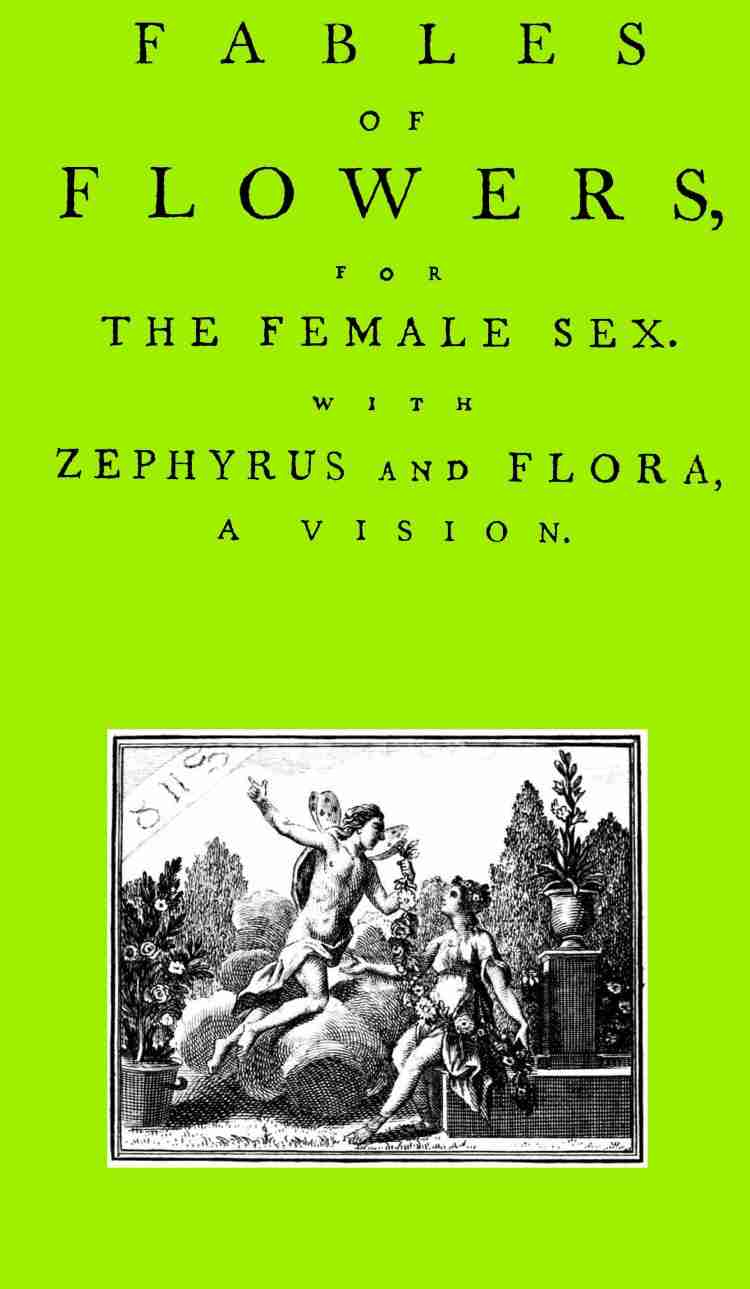
FABLE XII.
The TULIP and the AMARANTH.
I.
WHERE various beauties mingled rise,
All grateful to the view;
With variegated beauties bright,
A gaudy Tulip grew.
II.
Its leaves with flamy splendour shine,
Mix’d with more vivid green;
And all the tints that deck heav’n’s bow
Upon the flow’r are seen.
III.
The gently passing vernal air
The beauteous plant caress’d;
And Zephyr ever pleas’d reclin’d
Upon the charmer’s breast.
IV.
While near at hand the gentle flow’r,
Call’d Amaranth, below
The blooming guest of Jove’s own seats,
Deign’d in her prime to grow.
V.
Yet she with hairs uncouthly deck’d,
Unlike the Tulip race,
Is not among the flowr’ets found,
Whose colours mark their grace.
VI.
This swell’d her rival’s empty pride,
And, vain of empty shew;
The Amaranth askance she ey’d,
And thus contemptuous spoke;
VII.
“Of all the flow’rs that deck the lawn,
“The progeny of Spring;
“And all that of maturer birth
“The later seasons bring:
VIII.
“Of all that for their fairer forms
“May raise the justest claim;
“Of all that men for beauty prize,
“Or from perfection name:
IX.
“Behold me, first and fairest known,
“Still lov’d and valu’d most;
“Soft daughter of the vernal hour,
“The cultur’d garden’s boast.
X.
“Why deign I then so long with these
“To dwell without reserve;
“That scarce, though vulgar eyes they charm,
“The name of Flow’r deserve?”
XI.
The blooming Amaranth, unmov’d,
Repress’d her forward pride;
The boaster’s arrogance despis’d,
And wisely thus reply’d;
XII.
“Yes, gaudy thing; thy various hues
“Are fine indeed and gay;
“Glaring thou glitter’st on the sight,
“And flaunt’st it to the day!
XIII.
“No flow’r around more bright can blow,
“In beauty more mature!
“But tell me, false, frail, giddy thing,
“How long shall that endure?
XIV.
“Me, not the least of Flora’s tribe,
“Me thou hast laugh’d to scorn,
“And deem’d my claim to beauty vain,
“Although cœlestial born.
XV.
“For know, though scarce allow’d by thee
“To rank among the flow’rs;
“From Heav’n I draw my high descent,
“And bloom’d in Eden’s bow’rs.
XVI.
“And still eternal is my race,
“No frail decay I know;
“But, emblem of the first great Spring,
“For ever bloom below.
XVII.
“But thou! the pageant of an hour,
“Too quickly shalt deplore
“Those beauties with’ring all away,
“Which fade, to charm no more.
XVIII.
“Thou, wretch! no second Spring shalt see,
“To renovate thy bloom;
“Whilst I survive the stroke of fate,
“And triumph o’er the tomb.
XIX.
“Cease then thy boast! in Wisdom’s lore
“Go learn thyself to know;
“And by her never-failing rule
“Judge all things here below.
XX.
“A fleeting joy, a fading bloom,
“May charm the ravish’d sight;
“That only which is truly good,
“Is lasting, as ’tis bright.”
Fab. XIII.
The Youth & Honeysuckle
Fab. XIV.
Belinda & the Blue-bell or
Venus’s Looking-Glass