
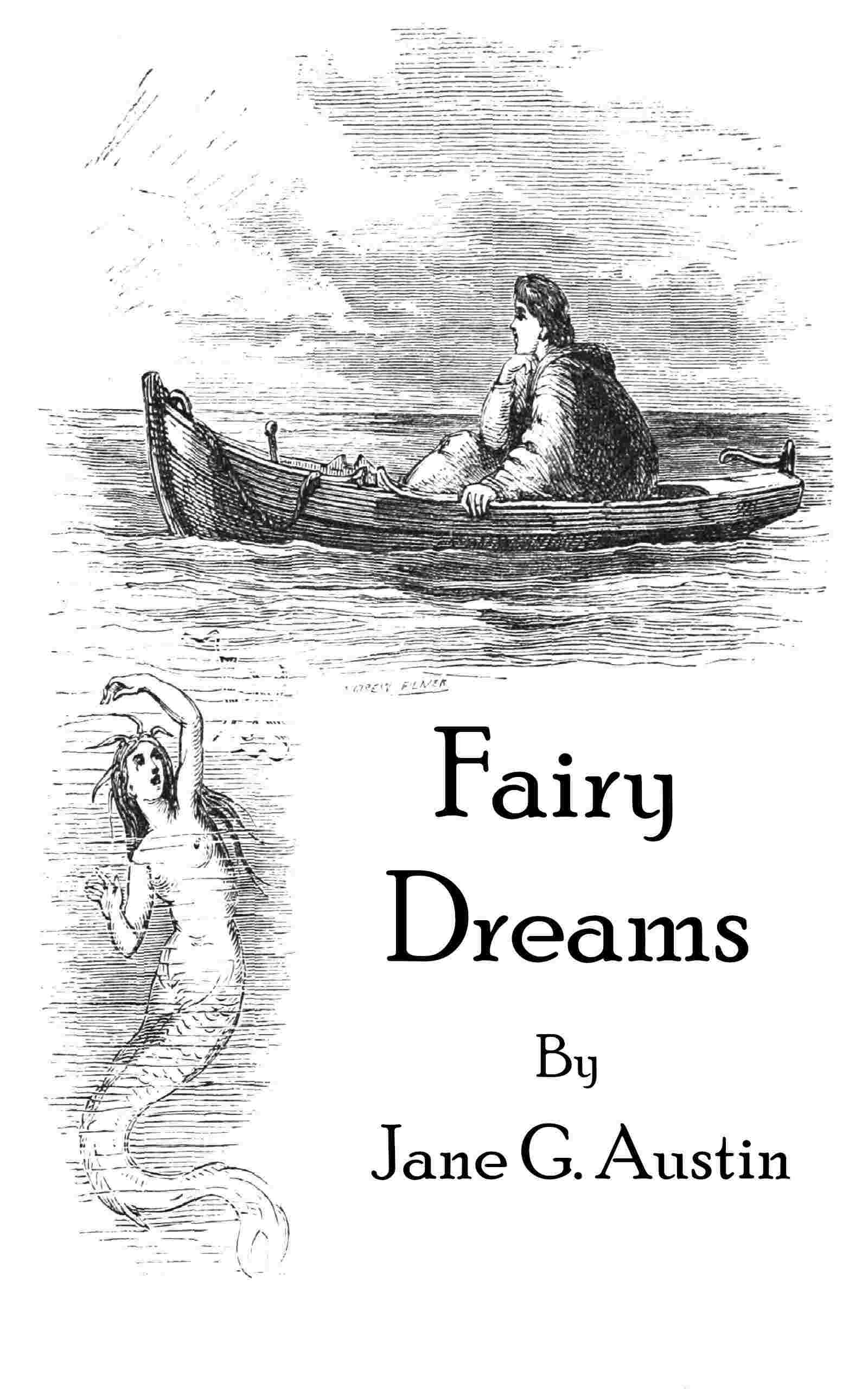
THE GRAY CAT AND THE CAVE OF THE WINDS
Once upon a time there was a young man named Ernest, who lived all alone in a little hut upon the sea-shore. He had lived there ever since he could remember, and always alone, except when, in summer, some wandering traveller would stop at his hut to ask a night’s lodging or a supper or dinner, or when the fierce storms of winter had twice driven a ship upon the rocks which lay between him and the sea, and a few poor half-drowned sailors had been cast upon the beach, where they would soon have perished had it not been for Ernest’s ready aid.
From these and the travellers the youth heard many stories of the great world, its wonders and its pleasures, and several times his visitors had invited him to go with them and see the marvels which they described; but Ernest always shook his head, saying,
“No, no, I have no place in this great world of yours; nobody would know or care for me. Here I have friends on every side; the loons, the gulls, the wild geese, and the ospreys know me and like me. I think even the waves feel acquainted with me, and I know that the fish do. No, I will stay.”
So the tourists and the sailors went their way, and Ernest remained alone.
At last a whole year went by, and brought no visitors. Autumn, winter, spring, and summer passed, and autumn had come again, without a single word having broken the silence which reigned about the little hut. No voice but the solemn ocean murmur.
At first Ernest liked this, and dreaded the arrival of a stranger; but by-and-by he began to wonder why no one came, and then to look longingly up and down the beach and out to sea, in hopes to see some one, but he looked in vain.
At last, when the pleasant summer was quite gone, and the cold and dreary autumn winds began to blow, lashing the sea into foam and whistling drearily down the chimney of the little hut, Ernest grew very sad and discontented. He roamed uneasily up and down the beach, but never could make up his mind to leave it and turn his steps inland, and always at night he found himself back at his little cabin.
One night, when the winds and the waves together were making such a din and commotion that one could hardly have heard a cannon at a quarter of a mile’s distance, Ernest sat gloomily alone brooding over his driftwood fire, which danced and flickered uneasily as the draughts from door or windows fanned it. Ernest had no clock or watch, nor would he have known the use of it if he had; but after sitting quite motionless for a long time staring at the fire, which now was almost out, he began to feel as if it was bedtime, and was wearily rising from his chair to look out once more at the night, when from the window behind him he heard a faint and prolonged
“M-e-w!”
Turning hurriedly about, Ernest ran to the window and threw it open, upon which, with a pleased and grateful purr, a beautiful gray cat stepped upon the table which stood beneath the window, and, looking in the young man’s wondering face, remarked again,
“M-e-w!”
“You said that before, but I don’t know what it means,” said Ernest gayly, who, although he had never seen a real cat, had heard them described and had seen pictures of them, so he at once guessed what his visitor was, and was well pleased that at last he had a companion.
“Let me see; perhaps ‘w’ means fish,” continued he, going to a shelf in the corner, which served him for a pantry, and taking a wooden platter with the remains of a broiled fish upon it. This he set upon the table in front of the gray cat, who, first rubbing herself with a melodious purr against his hand, applied herself to the fish, and daintily eat some of the best pieces, then drank a little water which Ernest offered her with an apology for having no milk to give, which he said he had heard ladies of her degree were very fond of. “But,” as he said, “since I not only have no milk, but never saw it, or even the cows and goats which give it, I am very glad to see that your highness can drink water.”
The cat, having finished her meal, leaped softly to the floor, and, after walking slowly round the room, looking attentively at every thing in it, she sprang gracefully into Ernest’s arm-chair (which was indeed the only chair in the whole house), and, seating herself upright in the middle of the cushion, began to wash her face and paws with her little red tongue.
“That’s right, my queen, don’t be ceremonious,” said Ernest, laughing aloud. “To be sure you have left me nothing to sit on except this log of wood, but then you are company, and should have the best. Pray make yourself entirely at home. I am very sorry I have no fine napkin to offer you to wipe those pretty paws upon now that you have washed them, but perhaps you can dry them by the fire. Let me make it up.”
So Ernest threw some more wood upon the fire; and then, seating himself upon a great block in the opposite chimney corner, leaned his elbows upon his knees and took an attentive survey of his visitor, who, having completed her toilet, sat regarding the fire with half-closed eyes, purring softly a little tune of her own composition, and beating time with her long tail.
She was a very pretty cat, with fur of a rich dark gray, except her paws and face, which were pure white, and a crown or circle about her head, of an indescribable glittering appearance. It was this crown-like circle which had induced Ernest to call her highness and queen.
After looking at her a while, the young man reached across the fire, and, taking the cat gently up, placed her in his lap and began to smoothe her rich fur and fondle her, but in spite of all his endeavors to hold her, Pussy glided from his grasp, and with noiseless leap regained her position in the easy-chair.
“You don’t like familiarity—mustn’t be handled, eh?” said Ernest. “Your majesty is very unkind, I think; but perhaps when we are better acquainted——”
Ernest stopped thunderstruck. It was just twelve o’clock, although he did not know it; and at the moment when the clock, had there been one, would have struck the hour, a cloud of golden sparks rose from the circlet upon the cat’s head and filled the whole room, so that Ernest closed his eyes and covered his face with his hands.
In a moment, however, he looked up and rubbed his eyes. The flaming sparks no longer blinded him, but still he doubted his own sight, for there before him, there where a moment before he had seen the gray cat, he now beheld, seated in his old arm-chair, as if on a throne, a beautiful and majestic woman, in the first bloom of youth and loveliness.
Her long, wide dress, which flowed upon the ground at each side, was a rich, soft velvet of a beautiful silver-gray color, and from its loose sleeves and beneath its hem peeped the smallest and whitest of hands and feet. The beautiful face was surrounded by long, dark hair, and in a circle about the head was the glittering, crown-like appearance which Ernest had noticed on the cat’s head. It did not seem of any substance, like gold, for instance, but merely light and color. The large, light-colored eyes of the beautiful stranger were fixed anxiously upon Ernest, as if waiting for him to speak.
At last he stammered out:
“Are you—can it be—but it was a cat!”
“Yes, it was a cat,” replied the sweetest voice in the world, “but it was also me, Ernest. I am the princess Phelia, only daughter of the king of Catland. All my race have the privilege of assuming at will the human form or the cat form. The nobility and royalty generally appear as men and women, only assuming the cat form in play or as a disguise; but vast numbers of our subjects of the inferior order retain the cat form altogether, and as such live unsuspected among men.
“As for me, I never was degraded from the human form until in an unhappy hour I wandered from my father’s kingdom into that of our neighbor, the Gold King. Here I met his daughter Oriphera, who is an enchantress, and of a very bad disposition. She hated me beside, because she had heard that I was more beautiful than she. So snatching from my head the crown which I always wore as a badge of my rank, she threw some water in my face and said:
“‘Take your cat form, you miserable Pussy, and retain it for the rest of your life, except during the half hour between twelve and one o’clock on Halloween. You never shall be released from this spell unless you can find a young man twenty-five years of age, who has never looked on woman’s face, although free to go wherever he chooses, and who shall be able to take from me this crown, and replace it on your head before two years from this day.’
“As she finished she threw some more water upon me (I never could bear to be wet), and with a mew of grief and anger I ran away as fast as I could go. Of course I could not present myself at my father’s court in such a disguise,—I, who had always taken pride in being as un-cat-like in my demeanor as possible; and so I wandered uneasily about the world, looking for the wonderful youth, who, although at perfect liberty to do so, had never looked upon a woman’s face. Fortunately I was not to be mistaken for a common cat. Oriphera, although she stole my crown, could not deprive me of its light, which is my birthright, and by that I have always been recognized among cats as one of the royal family, although no one knew me as the unhappy Phelia.
“You may be sure I never omitted to ask every cat with whom I met if they had ever heard of a young man such as I described, but every one answered no, and I began to despair, for in one month more, the two years will be gone, and after that all aid is vain. But a few weeks ago I fell in with a seafaring cat, just returned from a whaling voyage, and he, in answer to my inquiries turned two somersets backward (which is equivalent among cats to clapping the hands among men), and said,
“‘I know the very man. My master, who is a sailor, was shipwrecked four years ago, and rescued by the very youth you want to find. I have often heard him speak of him.’
“My friend, the seafaring cat, then proceeded to tell me minutely where to find you; and, not to be tedious, I arrived very tired and discouraged at your window this evening.” Here the princess, overcome by her feelings, covered her face with her hands and made a long pause,—at last looking up and smiling sweetly upon Ernest, she said, “Now tell me, will you recover my crown from that —— Oriphera, and make me the happiest of princesses”
“Can you ask, revered princess? My life is yours; only tell me how and where to find her,” exclaimed Ernest.
“The kingdom of Aura, her father, is in the centre of the earth. You will find the entrance in the forest of Gnomes; but you can never get the crown unless you have the flute from the Cave of the Four Winds, to lull the Gnomes to sleep.”
“And where is the Cave of the Four Winds, most beautiful of princesses?” asked Ernest, eagerly.
“It is on the top of —— m-e-w!” This last word was uttered in a very angry voice, for just as Phelia had said “top of,” her half hour of freedom closed, and she was suddenly retransformed into a cat, without even power to add the one word which would have directed Ernest to the Cave of the Four Winds.
The young man was as much disappointed as the princess, but consoled himself by promising her that he would use so much diligence and make so many inquiries, that he did not doubt to soon meet with some one who could direct him to the cave where the magic flute was to be found.
To this, however, the cat only shook her head with a melancholy air, and Ernest felt quite discouraged again. Suddenly, as he sat thinking of every possible way in which to gain the desired information, a thought flashed into his head which made him clap his hands for joy.
“I have it, dear Phelia,” said he. “The winds themselves shall carry me.” He then went on to narrate that several years before he had been visited by an old man of wise and venerable appearance, who appeared to be very much delighted about something; and at last told him that he had travelled the world over to find the place where the Four Winds meet, for there is where they bring every thing that is lost in the world, and heap all up together, so that any man who can find this place may help himself to whatever he pleases. The old man had taken all he wished, which was a parchment containing the secret of a lost art,—that of making gold; and he was going away content. He advised Ernest to go and search in this wonderful collection, which abounded in wealth, honors, and all that men value. “But,” said he, “you must be careful not to be caught there when the Four Winds meet at midnight, for you would be whirled up and carried away to their cave before you knew it.”
Ernest had never thought much about the old man’s advice till now, as he did not know exactly what he wanted to find, and had never lost any thing; but now he at once determined to go to the place described, and wait till midnight, when the Four Winds should meet to go home together, and would whirl him away with them.
He told his plan to the gray cat, who purred an assent; and then, as morning had broke, he led her out to the sea-shore and showed her a little cove where every evening she would find fish of some kind stranded among the rocks. He advised her to remain in the hut all the time when she was not at the cove, lest something should happen to harm her, and he faithfully promised, that, unless he lost his life in the attempt, she should see him with the missing crown in his hand before many days. Ernest then took leave of the disguised princess, who graciously presented her white paw for him to kiss, and set out upon his lonely travels.
All that day and the next he journeyed among the mountains which lay behind his little hut, but although he followed attentively the directions which the old man had given him, it was not until evening on the second day that he found himself approaching the place where the Four Winds meet.
This was a deep, rocky valley, approached from the north, south, east, and west by a deep, narrow ravine, which was the only means by which the valley was made accessible.
All the surface of the valley was strewn with the lost articles which the winds had swooped up and brought there. It would take a whole book, and a large one too, to tell half the precious things which lay scattered there; so I will only say that every thing which once was possessed, and now is hopelessly lost, was to be seen there, and a wonderful sight it was.
In the middle of the valley, however, was a small space entirely clear of every thing, even of the least particle of dust. It was swept clean every night by the Four Winds when they met. Ernest knew in a moment that this must be the case; and when it grew too dark for him to see the curious things which lay scattered about him, he wrapped himself closely in the great cloak which he wore, and seated himself in the centre of the clean-swept space.
Presently, overcome by fatigue, he fell asleep; nor did he stir till midnight, when he was awakened by a terrific rushing and roaring sound.
It was the Four Winds, each coming down his own ravine, and making for the common centre. As they entered the valley Ernest could hear the lost things which they had brought pattering on the ground all about him, as they were dropped; but in another moment the Winds were upon him, and almost senseless with the rapid motion, he found himself whirled round and round, and up and up, and on and on, till it seemed to him that they had flown beyond the stars. Suddenly he found himself dropped softly to the earth, and heard the Winds entering a cave above him with a hollow, rushing sound. Freeing himself with some difficulty from the cloak, which had been wound about him by the rapid, circular motion till it was almost as tight as his skin, Ernest looked about him.
He found himself upon the top of one of the highest mountains in the whole world, entirely inaccessible to man, bird, or beast. All around lay silence and perpetual snow, and it was owing to the soft bed of the latter, upon which he had fallen, that Ernest found himself unhurt. The cave in which dwelt the Four Winds lay above him, on the very crest of the mountain. Creeping softly up to the mouth of the cavern, he peeped cautiously in, and, finding himself unheeded by the Winds, who were busy unloading themselves of the material for their suppers which they had brought with them, crept through the narrow entrance and crouched in a dark corner among some little Breezes which were sleeping there, and looked curiously about him.
The cave was divided into four quarters by two deep, narrow cracks or chasms, extending through its whole length and breadth. In each division stood a chair and table, and at each table now sat a Wind eating his supper. The reason of their being thus distinct Ernest perceived was because the temperature in which each one delighted would have been very disagreeable to either of his brothers, and so with the food and drink which stood before them.
The North Wind was voraciously eating a great lump composed of narrow strips of meat wound round and round into a ball, and then thoroughly saturated with melted grease. Before him stood a bucket filled with whale-oil, from which every few moments he drank greedily. His dress was the skin of a polar bear, with the fur outside, which he wrapped about him like a mantle. His face was red and full, his eyes, of a bright, clear blue, sparkled frostily, his long, light hair hung about his shoulders, and his bushy, flax-colored beard and moustache were hung full of icicles.
His voice was deep and thunderous; and when he laughed, fragments of the solid rock were shaken off and fell about him.
Next him sat the West Wind, whose name was Zephyrus, and Ernest at once decided that he was by far the most prepossessing of the four brothers. He was as tall as his neighbor the North, but not nearly so heavy, looking strong, but yet graceful. His hair and curling beard were of a dark brown, his eyes a dark gray, his teeth very white and sound, and he had a particularly fresh and healthy glow shining through the tan upon his cheeks. His voice and laugh were hearty and joyous, but not so deep and rough as that of the North Wind. His table was spread with ears of Indian corn, heads of wheat, a wild turkey, and a large ham. He was drinking from a little cask of Catawba wine.
Next came the South Wind, sometimes called Auster, a slight, dark-skinned youth, with straight, purple-black hair and glowing, dark eyes. He looked pale and languid, and reclined in his chair as if he wished it were a bed; his voice was soft and sighing, and he never laughed.
Upon the table before him were bunches of grapes, oranges, melons, bananas, and sugar-cane. For drink he pressed some orange juice into a jar, and then sent one of the Breezes to fill it with snow, remarking at the same time with a sigh, that sherbet was the only luxury which he gained by living in this horribly cold cave with his brothers.
“Ho! ho!” laughed the North Wind. “Nothing could be more comfortable than this cave, if only you will keep at your proper distance, and not be melting me with your hot breath.”
“I have to breathe as fast as I can to keep a little circle of air warm around my table,” murmured the South. “If I did not, you and East would chill me to death.”
“Yes, you always run away when I come,” piped East. “How many times I have whistled with delight at seeing how every thing would change before me when I come stealing along at noon, after you have been making a fine morning on earth. How the people begin to shiver and shut down the windows and put on their shawls—how the flowers wither up, and droop, and hang their heads—Ph-e-w!”
Thus spake Eurus, the East Wind, a thin, sallow, unhappy looking person, with watery blue eyes, a peaked blue nose, and a withered, crooked form. He looked bilious and ill-natured, had a shrill, whining voice, and never laughed, although he whistled a great deal in a very sharp, ill-natured manner. His supper consisted of a little rice, a raw fish, which he had whipped up as he came sweeping over the Atlantic Ocean, and a great bowl of tea which he had brought from China.
Supper ended, the North Wind, whom his brothers addressed as Boreas, stretched himself, and said,—
“Well, I’m off! I have got some ships jammed up there near the Pole, and I’m going to blow ’em out. I wish these navigators, as they call themselves, would stay away. They come creeping along up there, and you always help them, Auster, which I think is very ill-natured of you; and then I have to get ’em out after they’re blocked in, or if I don’t come, the sailors plague my life out whistling for me. Pretty soon, too, I shall have to drive down the snow clouds. I have got a nice flock of them waiting up there at the Pole. I am going to make a tremendous winter of it.”
“Yes, winter is your time, and spring is mine,” said Eurus, the East Wind. “Auster and I, between us, will soon drive you from the field when we set about it. Just now, though, I have got a fine little lot of vessels to attend to on the Atlantic coast. I am going to drive them on the rocks, and then, how I’ll whistle through the ropes—Ph-e-w! They call some of the ropes shrouds,—a capital name when I get hold of ’em. Then I have a good deal to do in China. I suppose they are waiting for me to get their ships out of the river. If I feel good-natured I’ll do it; if not, I’ll leave em just at low tide, and let them pull for themselves. It does me good to plague these mortals.”
“It does you good to plague anybody, I believe, Eurus,” sighed Auster. “I am sure you are always thwarting me. I am going to visit the tropics to-morrow, and shall leave the northern regions to Boreas, Zephyrus, and you, for several months.”
“What route do you take, brother?” asked Zephyrus; “for I don’t wish to interfere with you.”
“I am going through the forest of Gnomes, and then straight down to Quito. I like to see the Gnomes at work, they look so warm. Where are you going, brother?”
“I don’t know,” said Zephyrus. “I have some whalers to help round Cape Horn, and then I think I shall go and see Boreas. He and I do nicely together, when he is not too savage. Let us each take a turn at the flute, to see if our voices are in tune, and then be off.”
So saying, Zephyrus took from a shelf behind him an instrument shaped something like a German flute, and played a piece of spirited martial music upon it, with great taste and execution.
He then passed the flute to the North Wind, who roared through it a stormy Norwegian Berserker song, and then threw it to East, who squealed out a favorite Chinese air, with very high notes and very little variety. Auster, the South, was the next performer, and played a fandango, followed by the tune of a languishing love-song.
The flute was then replaced on its shelf, and as it wanted an hour of sunrise, the usual hour for the brothers to set out upon their day’s journey, each composed himself for a little nap.
As soon as the Four Winds and all the Breezes and Zephyrs were sound asleep, Ernest stole softly from his place of concealment, took the flute, disjointed it, and placed it in his breast; then, creeping carefully under the loose mantle of the South Wind, he tied himself firmly to one of his legs (for all the Winds were four or five times as large as common men), and waited anxiously for sunrise, which he knew would awake all four brothers.
The moment at last arrived; Boreas, Zephyrus, and Eurus, one after the other awoke, and left the cave; and last of all, Auster, who, finding himself belated, rushed through the narrow opening with great velocity, without noticing at all in his hurry the passenger whom he was taking with him.
After traversing with the speed of the “winds” many a mile of sea and land, Ernest found that his conductor was pausing in the tops of some high pine trees in the centre of a vast forest.
Peering cautiously down, the young man perceived some little yellow figures running about among the trees, diving suddenly into the earth, and as suddenly reappearing upon its surface. Ernest at once concluded that this must be the forest of the Gnomes, and, hastily untying the scarf with which he had bound himself to the South Wind, he slipped off into the top of a tree and scrambled down the branches, leaving the Wind languidly sighing and moaning before taking a fresh start.
Having reached the lower branch of the tree which he had selected, Ernest looked attentively about him. The little yellow men were still running about as busily as ever, and did not seem to have heard his approach. They seemed to be employed in bringing little scales and particles of gold from beneath the ground and scattering it upon the earth; and Ernest, noticing that the trees and shrubs grew greener and larger as they did so, concluded that the Gnomes were watering their garden. Presently he noticed that directly at the foot of the tree where he crouched was one of the holes by which the Gnomes continually emerged and reëntered, and, seizing a moment when it was empty, Ernest dropped himself directly into it, and found himself at the top of a long flight of rocky steps. For a moment the Gnomes stood motionless with astonishment at this sudden apparition; but as soon as they perceived the intruder was a man, they rushed toward him, each armed with the little pick-axe which he wore in his belt; and although each Gnome was very small, their numbers made them formidable.
However, the instant he touched ground, Ernest had pulled the flute from his bosom and commenced putting it together. As he did so, he noticed that there were four mouthpieces, each marked with the name of a Wind, and, selecting that of the South as likely to be the most soothing, he began to play as he had seen the Winds do. To his pleasure and surprise—for he knew nothing about music—the flute played the same airs which it had done when the South Wind blew into it, and the Gnomes, dropping their weapons, sunk down upon the ground, and presently fell fast asleep.
As soon as Ernest was sure that they were so, he began to descend the steps, which wound round and round, constantly descending, so that very soon not a ray of light was to be seen. Then he stopped playing, and, indeed, all his breath was no more than sufficient to support him in the close and heavy atmosphere in which he found himself. At last the steps ended in a narrow passage, and Ernest proceeded a long distance through it in total dark and silence, guiding himself by feeling the cold, dripping walls at each side, which seemed hewn out of the solid rock, and was so low and narrow that he was obliged to stoop very low to get through at all.
Suddenly a sound of merry voices broke the silence, and, turning a sharp corner, the young man found himself close to an opening, which appeared to conduct into a grotto or cavern; but the only thing which Ernest could distinguish was a heavy curtain whose rich folds lay upon the ground at his feet. It seemed to be of satin; but on putting out his hand to pull it cautiously away, Ernest found to his astonishment that it was made of gold, so pure in its quality and beaten so thin in substance, that it was flexible and delicate as silk. Creeping cautiously along behind this screen, Ernest presently came to a small opening between his curtain and the next one, through which he could see plainly without being himself discovered.
He found that the opening, as he supposed, led into a small grotto, across whose rocky roof ran in every direction veins of purest gold, which sparkled in the brilliant rays of the immense carbuncle hanging from the centre of the roof, which was thickly studded with twinkling diamond stars.
All around, the walls were draped with curtains like that which concealed Ernest, and the floor was composed of alternate blocks of gold and silver.
At one side of the cavern was a throne of gold and gems, over which hung by way of canopy an immense orange, the lobes divided and spread apart at the bottom, but united at the top. The peel of this orange was of solid gold, roughened to resemble the natural skin; but the interior or pulp was composed of innumerable little cells, each wrought separately in fine gold, and then placed in their natural position; the seeds were represented by very pale topazes, cut in the exact shape of an orange seed.
Upon this throne sat a young woman about the age of Phelia, whom Ernest at once concluded to be her rival Oriphera; for on her head, which was covered with long golden ringlets, was placed a crown, composed entirely of the gems known as cat’s-eyes, held together by gold wire.
This princess was very gorgeously dressed and decorated with a great many jewels, and to most persons would have appeared very beautiful; but, of course, Ernest could not think any thing of the sort, seeing in her as he did, only the enemy and rival of his beloved Phelia.
All around the princess stood her beautiful maids of honor, while behind the throne Ernest perceived a body-guard of Gnomes, each armed, in addition to his pick-axe, with a sling, while in a pouch at his belt he carried a supply of golden bullets. Other Gnomes were constantly appearing from behind the screens and laying at the feet of their princess whatever rare or beautiful gems they had discovered in their mining operations. Some of these Oriphera ordered her treasurer, a little, old, yellow Gnome, to take up and carry away, others she pushed aside with her foot, and they were taken away to be put in the rubbish-pit.
Suddenly, as Ernest was looking with all his eyes, he heard a noise behind him, and, listening attentively, he found that the Gnomes whom he had left above ground had awakened from their sleep and were pursuing him.
Seizing his flute, Ernest blew a hurried strain with all his force; but, not stopping to select his mouthpiece, he took that belonging to Boreas, the North Wind, and the noise which ensued was so loud and sudden that it cracked the golden curtain from top to bottom, caused several of the diamond stars to fall from the roof, set the great carbuncle swinging like a pendulum, and made the princess and all her attendants fall down as if they had been shot.
Ernest stood for a moment, thunderstruck at the mischief he had wrought; but, quickly recovering himself, he darted forward, seized Phelia’s crown from the head of the prostrate Oriphera, filled his pockets with some of the refuse diamonds, rubies, and emeralds, and then, finding the proper mouthpiece, he made the best of his way out of the grotto and up the stairs, playing away as hard as he could at the fandango and love-song of the South Wind. He however found it necessary to go very slowly, not only on account of the darkness, but because on almost every step lay a Gnome stupefied, or rather entranced with the music; and Ernest, who was a very kind-hearted young man, could not bear to hurt one of the little fellows, although they would willingly have killed him.
At length he found himself once more in the open air, and, heaving a great sigh of relief, he hastened on, hoping soon to get out of the wood; but what with constantly losing his way, and what with having to stop every little while to play the Gnomes to sleep (who pursued him furiously), it was many days before he gained the open country, and a great many more before he found himself approaching the beloved hut where he hoped to find Phelia waiting for him. Even then he turned a little out of his way to visit the place where the Four Winds meet, that he might lay the borrowed flute upon the little circle in the centre, where the Winds could not fail to see and reclaim it; for, as Ernest said to himself, if they had not the flute, how could they try their voices to see if they were in tune? and if they were obliged to sing false, what would become of the world then?
Finally, toward evening, on the very last day of the month which had been allowed him for his enterprise, Ernest came in sight of his little hut, where almost the first object that met his view was the Gray Cat perched upon the top of the chimney, and anxiously looking in every direction to see if she could catch sight of her deliverer.
No sooner did she see him than, leaping to the ground, she came bounding to meet him; but before she had quite reached him, her dignity as a princess overcame her delight as a cat, and, pausing at the foot of a low rock, she leaped upon it, and seated herself upright with her tail folded closely about her feet, in a very stately and formal manner.
Ernest approached the presence of this little sovereign with all the respect imaginable, and, kneeling upon one knee, laid the recovered crown at her feet.
The cat purred her thanks and approval, but gracefully intimated, by placing her paw upon the crown and then upon her head, that she would thank her gallant knight to complete her transformation by placing the diadem in its proper place.
Ernest understood the silent request, and immediately complied with it. No sooner had he done so than the Gray Cat forever disappeared, and in her place sat the Princess Phelia, who extended her white hand to the young man, with the same gracious dignity with which she had given him her paw to kiss when he was setting out upon his journey.
“How can I ever thank you,—how can I ever reward you, dearest friend?” said she, softly.
“I will tell you, fairest Phelia,” replied Ernest, blushing far more deeply than the princess, brought up in a court, had done.
“You can reward me by giving me this little hand, which I fear but for me would have been but a cat’s paw to the end of time.”
Phelia, to this proposition—which, perhaps, was not quite unexpected—yielded a gracious assent; and the next day the young couple journeyed together to Catland, where they were immediately married, and, soon succeeding to the throne, lived and reigned many, many happy years; and, for any thing I have ever heard, they do so still.