
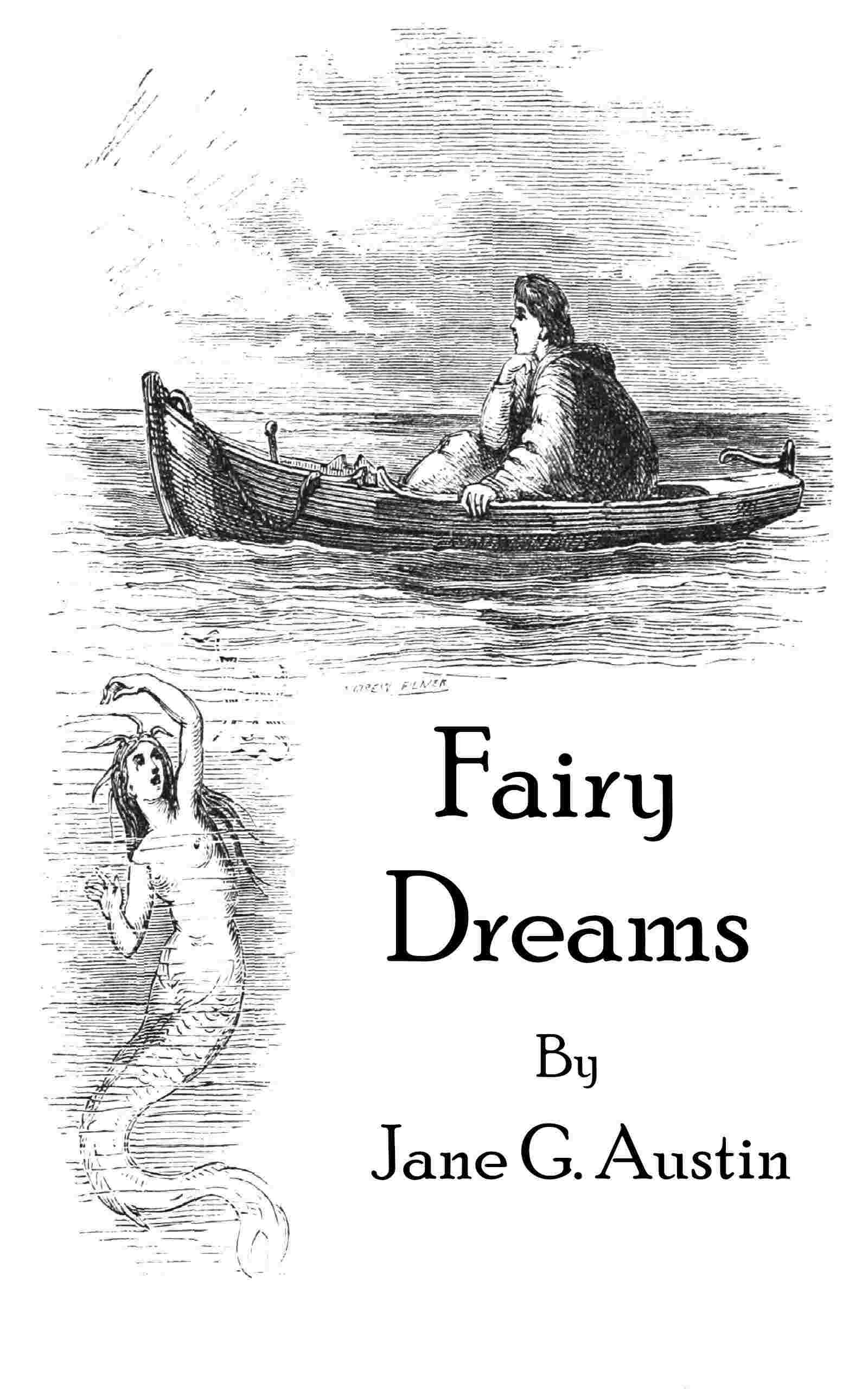
THE FROST-MAIDEN
Once there was a little boy, who more than any thing else loved to look at pictures. He had but few books containing them, nor were his parents able to hang their walls with beautiful paintings and engravings, as rich people can do. Still, little Claude found pictures all about him. In the spring, it was the tender green of the new leaves and the springing grass; in the summer, the thousand different flowers and the beautiful birds; in the autumn, the gorgeous scarlet and golden tints of the changing woods; and in the winter—oh, in the winter—Claude never wanted for pictures!
Every morning there they were, twelve new ones, all different, ready placed to meet his eyes as soon as they should open!
But what do you think these twelve pictures were, and where were they drawn?
Why, on the twelve panes of glass in the window of Claude’s little bedroom.
Every morning was to the boy a new delight; and how sorry he felt, if, by sleeping a little later than usual, he lost a few minutes of the half hour which he usually enjoyed before his mother called him to get up.
The pictures were quite different. Sometimes there was a dense forest covering all one pane, the tree tops crowded together with scarcely any gap between them.
Sometimes there was a grove at one side, and a wide, lawn-like field stretching away out of sight at the other.
Sometimes a few scattered trees, with a brook winding among them, and troops of deer drinking at it.
Sometimes a wild and savage ravine between two precipices, and a crazy waterfall dashing down between them.
Sometimes a flowery plain, with a star-spangled sky overhead, and a flower wreathed May-pole, waiting quietly for a troop of happy children to dance about it in the sunrise.
Sometimes, behind a trim and quiet-looking group of trees, Claude could see the outline of a stately castle, its chimneys and turrets peeping over the tree tops.
Sometimes it was a ruined and deserted tower, standing gloomy and solitary upon a craggy mountain side.
In short, there was no end to the beauty and variety of the pictures in Claude’s gallery.
But who drew them in a single night, while all in the house slept?
This question troubled the boy’s mind constantly. His mother said the frost did it; but how could that be? “Frost has nothing lovely about him,” thought Claude. “He turns all my beautiful flowers to ugly black stalks as soon as he sees them; he makes the ground hard and white, and changes the soft green of the grass to a dull brown; he makes my mother’s pretty face look blue and pinched, and spoils her curls. How can it be the frost who draws my dear pictures?”
His mother could not tell him why,—only she was quite sure it was the frost, because everybody said so.
He asked his father, who laughed, and told him that when he was older he would find out.
So Claude asked no more questions, but wondered all the more.
One morning there was a new picture, one which had never come before; and Claude’s eyes only glanced at the rest, turning again and again to this new one, which seemed to call him to it as if it spoke.
A low, irregular mountain, with a wide plain at its foot,—that was all.
But stop!—was it a mountain? No,—it was a palace; very large, and very fantastic in its shape, but evidently a palace, and a very magnificent one.
What he had at first taken for crags and ice-peaks were in reality graceful minarets and spires; what he had supposed a mass of frozen snow upon the mountain top was the sheeny, silvered roof of the palace; what had been solitary trees upon the mountain side were now gayly floating banners; little clear spots, which he had not noticed at first, now showed as thousands of windows and scores of doors; what, at the first glance, seemed wild bushes about the base of the hill, suddenly became a troop of guards, some mounted, some on foot.
Claude, astonished, raised himself upon his elbow to look more closely at this transformation. Just then his mother entered the room to call him to breakfast.
“See, see, mother!” cried he, “that beautiful palace, in the middle of my window! How I wish I could really go to it!”
“Palace, child!” said his mother, “I see no palace. There is something there which looks like a mountain, but nothing more. You will hurt yourself, dear boy, looking so much at these frost pictures; we shall have you crazy next. Come, now, and eat some nice, warm breakfast.”
“But, mother”—began Claude, and then stopped suddenly. His mother was right, it was nothing but a mountain,—how could he have been so deceived? “And yet,”—
Claude rose, and dressed himself slowly, often glancing at the window, where now the mountain (nothing but a mountain) was fading slowly under the bright rays of the rising sun, which shone full upon it.
Claude paid but little attention to his breakfast, or his dinner either, he was so anxious to have night come and go again, that he might see if the enchanted palace, as he called it, would reappear.
The next morning, as soon as there was light enough to see any thing, his eager eyes started open, and turned at once to the upper centre pane of glass, which was, indeed, the only one bearing any intelligible picture, all the rest being covered with a thick white coat, looking like nothing, unless it was a curtain, to hide what might be behind. But there, where it had stood before, rose clear and sharp the fairy palace; and Claude wondered how he could have taken it for a mountain.
After looking at it for a while, the boy suddenly noticed a new feature in his picture.
This was a large fir-tree, standing in the middle of the plain, quite alone, its lower branches dead and broken, while the top was dense and flourishing. Under the tree was an object which Claude could not make out.
“It must be a little bush,” thought he, and turned his eyes again toward the palace.
The next morning Claude slept late, and when he woke was obliged to jump up directly.
He looked at the window, but saw nothing except a shapeless mark, hardly resembling even a mountain.
All that day Claude was sad and uneasy, feeling as if something were wanting to his happiness which he knew not where to find.
The next morning, however, he waked betimes, and turned eagerly to the window. Clear and splendid rose the palace in the frosty air; stern and sad stood the lonely tree,—but, that shrub at its foot! How blind he had been! It was the perfect and graceful figure of a young girl,—her long hair hanging about her, her gossamer looking robe and scarf fluttering in the morning air. She seemed looking down at something lying at the foot of the old fir, something quite as vague to Claude, however, as the girl herself had been when he first saw her.
Full of delight, he bounded from his bed, and rushed to the window to examine more closely this new figure in the strange frost picture; but, when he reached it, look as he might, he could see nothing but a rugged mountain, a tree, and a bush.
Sad and disappointed, Claude crept back to bed, but comforted himself by thinking,—“Somewhere, somewhere in this world, stands that palace,—lives that maiden. In a few years I shall be a man, and then I will go and find them.”
Again he turned his eyes upon the window, through which the sun’s first rays were streaming. Under their influence the picture began to disappear; but for one moment first, they stood out, clear and distinct as over,—the palace and the maiden.
Many mornings came and went. Often the enchanted palace greeted Claude’s wakening eyes, but there were also long intervals in which he saw nothing, or only the shapeless mountain.
Still the idea grew in his mind, that somewhere he should find the palace, the tree, and the maiden who waited beneath it,—waited, perhaps, for him.
Years rolled away. Claude left his home, and travelled in many countries.
He found himself in glowing southern lands, with pictures all around him,—pictures painted by men, which thrilled his heart as he gazed at them; pictures in the trees and flowers, such as he had known and loved at home; beautiful women and beautiful palaces; but none ever contented him or held him long; still he whispered to himself,—
“Here is not my palace or my maiden,” and then he wandered on.
At last he left this warm and glowing land, and found himself in a frozen, wintry region, where on every side rose steep and snow-clad mountains, upon whose summits the foot of man had never rested.
Here Claude felt more content, and looked eagerly around him for the mountain he had known so many years.
No, it was not here; and still he wandered on.
On, through level, fertile plains, over which he hastened impatiently; on, through cities and over seas, ever looking, ever longing.
At last he reached a frozen country, where people hardly dared breathe the cutting, icy air; and where no trees and flowers grew, except the strongest and bravest of their kind.
On wandered Claude, a wild impatience burning in his heart; a feeling as if what he so long had sought was close at hand,—almost within his grasp.
Late one night he reached a lonely hut, far beyond all towns and farms, where dwelt an old man with his old wife. They welcomed the youth, gave him of their reindeer’s milk and coarse bread, and then spread a couch of lichens in the corner of the hut, where Claude slept soundly till morning light. Then, springing up, he bade the aged couple good-by with many thanks, and was leaving the hut, when the old man said kindly,—
“But, my son, where will you go? Beyond here lies only the country of King Frost; a country in which no man can live a day.”
“Stay with us till summer comes, or else go back from whence you came; you are too young and too beautiful to die in the cold grasp of the frost-king.”
A glad smile came upon Claude’s pale face, and he said suddenly,—
“I know it now. It is to King Frost’s palace that I am going. Farewell, father.”
And before the old man could say another word, the youth was far beyond the sound of his feeble voice.
All day Claude hastened on, although the cold became so terrible that it seemed to fetter his limbs with icy chains.
At last, just at sunset, he found himself upon a wide plain, covered with hard, frozen snow. No shelter was at hand, nothing to protect him from the cutting wind, which began to rise; but stop,—yes, there is one tree, an aged fir, standing in the centre of the plain.
Toward it Claude staggered feebly, hoping to find some slight relief from his suffering by interposing its gnarled trunk between him and the biting wind.
He reached it, and sunk upon the snow, his eyes closing with a sense of drowsiness.
As they did so, Claude half saw before him a low, broad mountain covered with snow, which glittered in the rays of the setting sun.
He started with a sudden thought, opened his eyes, and looked about him.
Yes! The mountain, the tree, the plain! It was, at last, the long-sought picture; but, sinking back, he murmured with a bitter sigh,—
“It was only a mountain, after all!”
Once more he unclosed his eyes, and gazed steadfastly before him.
As he did so, he started upright; the warm blood tingling again in his frozen veins.
It was the palace! The palace of his boyish dreams! The palace of King Frost!
Eagerly he strove to move toward it, but his limbs refused to obey him; he sunk exhausted upon the snow, his eyes fixed upon the fairy palace.
At that moment the great doors were thrown wide open, the guards ranged themselves upon either hand, and between them appeared a light and graceful figure, her white robes floating back as she came swiftly toward him.
The stiffening eyelids fell over Claude’s weary eyes. With an effort he raised them once more, and she stood over him, looking down, as he had seen her in the frost picture; a tall and slender maiden, with eyes blue as the winter sky, and bright as the stars in a frosty night; her long, waving hair, pale as the rays of the setting sun which shone upon her; her brow and cheeks pure and pale as the new-fallen snow.
Lovingly she looked down at him, and earnestly Claude tried to return her gaze; but the heavy lids closed over his eyes in spite of every effort. The frost-maiden knelt beside him and took his hand in hers. A feeling of delicious repose stole over Claude’s senses, and he slept, while in a low, whispering voice, the maiden murmured in his ear,—
“You have come, my darling, you have come! Long have I waited and watched, since the night I first peeped in at your casement, while I drew the pictures that you love; since I showed you my father’s palace, and this tree, and my own image; long have you wandered, long have you sought, my poor Claude! Did you think to find the frost-maiden in that burning south where you have been so long? I should die, my beloved, if I even hovered over that scorching land,—die, and fall in tears, which men call rain. No, here is my home; and here shall you dwell ever with me, my Claude! The walls of my father’s palace are covered with pictures such as mortals never saw; and when we tire of them, the frost-sprites which wait upon us shall draw other and more beautiful ones.
“Then, together we will roam over sea and land, borne upon the broad wings of the north wind, and, passing by the curtained, shuttered windows of the rich, we will draw our fairest pictures on the lowly casement where dwell those who have none save those we give them. We will touch with flying feet the surface of the lake and brook, and spread a glittering roof over the Naiads far below; we will breathe, as we pass by, upon the withering leaves, and clothe their death with beauty; we will fringe the cottage eaves with pendant jewels, such as no queen wears; we will open the chestnut burrs that the squirrels may feast, and kiss the cheeks of merry children till they bloom like winter roses. All this, and more will we do, dear Claude. Come, then, to the home of the frost-maiden,—come, come, come!”
Singing the last words in a low, sighing voice, the frost-maiden breathed upon Claude’s face. Immediately a light vapor rose into the air above where he lay, and rapidly took form and shape; it was Claude, yet not Claude. He was changed to a frost-sprite, and no longer could suffer pain in the kingdom of the Frost King.
He seized the maiden’s hand, together they entered the palace, and the great gates closed slowly behind them.
So now every child who sees in the morning his window covered with pictures, will know that while he slept, Claude and the frost-maiden have been at work.