
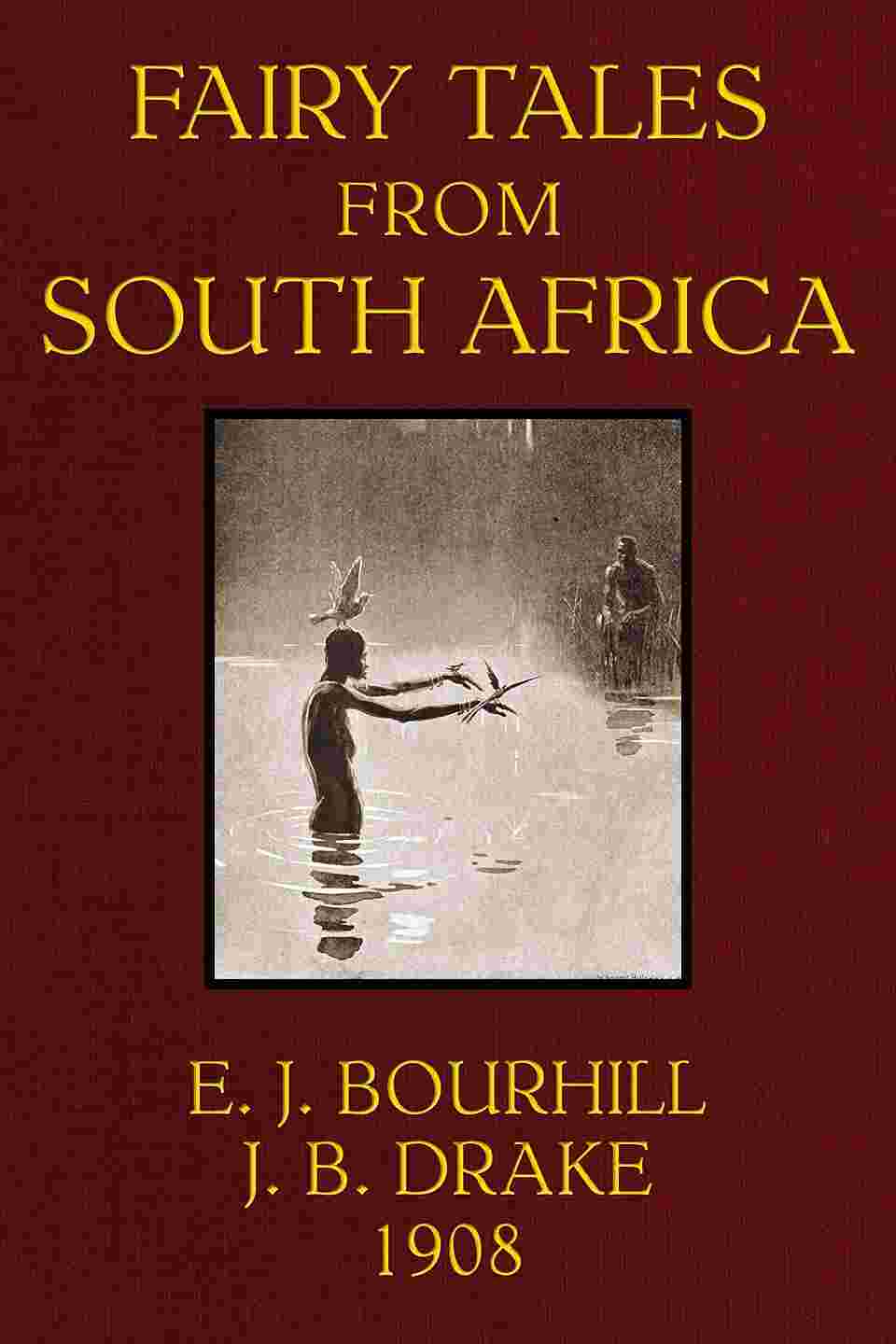
The Project Gutenberg eBook of Fairy tales from South Africa
Title: Fairy tales from South Africa
Author: Sarah F. Bourhill
Beatrice L. Drake
Illustrator: W. Herbert Holloway
Release date: April 11, 2025 [eBook #75833]
Language: English
Original publication: United Kingdom: Macmillan and Co., Limited, 1908
Credits: Jeroen Hellingman and the Online Distributed Proofreading Team at https://www.pgdp.net/ for Project Gutenberg (This file was produced from images generously made available by The Internet Archive/American Libraries.)
FAIRY TALES
FROM SOUTH AFRICA
MACMILLAN AND CO., Limited
LONDON · BOMBAY · CALCUTTA
MELBOURNE
THE MACMILLAN COMPANY
NEW YORK · BOSTON · CHICAGO
ATLANTA · SAN FRANCISCO
THE MACMILLAN CO. OF CANADA, Ltd.
TORONTO
“The old woman continued to gaze at Setuli, and said three times in a loud voice, ‘Speak!’ ”
Frontispiece.
FAIRY TALES
FROM SOUTH AFRICA
ST. MARTIN’S STREET, LONDON
1908
[v]
TO ALL CHILDREN WHO STILL LOVE FAIRY TALES
All the stories in this book are real Fairy Tales, just as much as “Jack the Giant-Killer” or “The Sleeping Beauty.” By this I mean that they are traditional, handed down by word of mouth. Nobody knows how old they are, or who told them first. But little Kafir children sit round the fire at night and hear them from their old grandmother, and sometimes—but very very seldom—white people are allowed to hear them too. You see, the Kafirs are afraid white people would laugh at them, and so they will only begin if they are quite sure you are really interested. Even then they never like to tell the tales by daylight, for they say that if they do so a wicked spirit will cause a horn to grow out of the middle of their forehead, and [vi]they will become as ugly as an Imbula.1 Sometimes they can be persuaded, but then they always take a piece of grass and place it in their hair to ward off evil lest they be bewitched. But the best time to hear the tales is in the evening when all the work is done. Then a huge fire is made, and when all the children have played till they are tired, and sung and danced till they can remember no more songs to sing, they gather in a circle and lie upon the ground where they can best see the story-teller. And if the Kafir people were quite sure you would be interested and wouldn’t laugh, they would give you the best seat of all and let you hear the finest tales. All the Kafir children know the tales as we know ours, but not all can tell them well. When many people are there the best story-teller will be asked to come forward. Most often it is a woman with children and grandchildren of her own, whom everybody knows well. She sits in the firelight, and begins quite quietly. But soon she gets excited, and before long she acts the whole story [vii]before you. She does it so well that if I were to tell you just the name of the story you could follow it without knowing a word of the language. One favourite tale is that which we have called “The Beauty and the Beast,” and there are ever so many different versions of this story. Other well-known ones are “Nya-nya Bulembu,” “The Fairy Frog,” and “The Fairy Bird.”
The little black children all open their eyes with horror when the monster appears, and you cannot think how glad they are to remember there are no ogres nowadays who have long red hair and kill and eat little girls. I don’t think such people ever really existed anywhere, not even in Kafir-land. They are just like our fairies and ogres; nobody knows who first thought of them.
But there used to be many bad Kings, like Semai-mai, who made their subjects unhappy, and much fighting took place in former days. For all these stories come from the olden times, when there were no white settlers in the country, and when the Kafirs lived alone and [viii]followed their own customs. They did not have one great King over all, but were broken up into tribes, and each tribe had its Chief, who was sometimes called its King. That is why there are so many Kings and Princes and Princesses in the tales. They were much commoner then than in our days.
These tribes often fought against one another. The great aim of every Chief was to have plenty of men to do his bidding, and plenty of cattle in his kraal; and if his neighbour were better off, he often tried to steal from him. You will notice that the Princes in these tales did not think of conquering new lands to occupy, as we should, but they all wanted men to fight for them. It seems as if, in South Africa, there was always plenty of land, but never enough men and women to occupy it. There was no money then, but a man’s riches were counted by the number of his cattle and his wives.
In peaceful times the Kafir men do very little except look after the cattle. This the women have nothing to do with; they must not so [ix]much as touch the bowls in which milk has been placed. In the old times fighting was very frequent, so that a Kafir Chief was not so lazy as many people seem to think. Still, to fight, to look after cattle, and now and then to set the foundations of a hut, were the only occupations he had. His women-folk tilled the land, fetched water and wood, and saw to the cooking. They also thatched the huts, and made the most beautiful fences of woven reeds. You see, they were often left alone for weeks and months while the men were away hunting or fighting, so they had to be able to help themselves.
A Kafir Chief usually had many wives; this was considered due to his position, but the wife he married first remained the chief lady in his kraal and ruled the others. They each had their own hut and managed their own affairs, but of course there were often many quarrels. Poorer men had one or two wives only. You see, it was expensive to have many; for every woman had to be paid for with a certain number of cattle. This payment was called the “lobola,” and no marriage was legal without it. This does not [x]sound a very good custom, but it worked well in practice. Savage people are often very unkind to baby girls because they cannot fight, but among the Kafirs they were always well treated. The daughters were valuable to their father because of the dowry they would bring him, and the husbands thought all the more of their wives because they had cost them something.
Most of these stories were told by Swazis, others by Zulus, and two by the tribes which live on the Portuguese border in the low, wooded country. “The Shining Princess” came from the Mapoch Kafirs, who formerly lived in the north. None of the people who tell them lived on what is called the high veld. A Kafir loves country with plenty of wood and water, and he likes to build his hut in some green valley on a well-drained slope facing the morning sun. Such country is found in Natal and the eastern parts of Cape Colony, and again in Swaziland and the Eastern Transvaal. In summer there are marvellous wild flowers and abundant green grass, and in every mountain valley there are clear streams bordered with luxuriant ferns and overshadowed [xi]with beautiful evergreen trees. All the rain falls in summer amidst continuous thunderstorms, and it is often very hot. In winter no rain falls for four or five months; the sky is clear and shining and the nights are cold, but by day the sun makes everything pleasantly warm.
The Kafir people still live and flourish in this country. They no longer make war on one another, for the white people oblige them to dwell in peace. So now their customs are slowly changing. The women are gradually ceasing to hoe the lands in the old fashion, and the men are beginning to plough with oxen; it seems as if in time they will become tillers of the soil like men in other lands. These stories may soon be forgotten; so we have written them down for your amusement before it is too late and no one tells them any more.
Barberton, Transvaal,
April 1908.
[xiii]
CONTENTS
| PAGE | ||
| I. | Setuli; or, the King of the Birds | 1 |
| II. | The Story of the King’s Son and the Magic Song | 18 |
| III. | The Story of the Little Birds who lived in a Cave | 28 |
| IV. | The Story of the Shining Princess | 32 |
| V. | The Rabbit Prince | 43 |
| VI. | The Unnatural Mother | 58 |
| VII. | The Three Little Eggs | 66 |
| VIII. | The Serpent’s Bride—Part I. | 78 |
| IX. | The Serpent’s Bride—Part II. | 99 |
| X. | The Fairy Bird | 115 |
| XI. | The Cock’s Kraal | 132 |
| XII. | Baboon-Skins | 139 |
| XIII. | The Reward of Industry | 151 |
| XIV. | The Story of Semai-mai—Part I. | 160 |
| XV. | The Story of Semai-mai—Part II. [xiv] | 171 |
| XVI. | The Fairy Frog | 187 |
| XVII. | Nya-nya Bulembu; or, the Moss-green Princess | 198 |
| XVIII. | The Enchanted Buck | 212 |
| XIX. | The Beauty and the Beast | 224 |
| XX. | The White Dove | 237 |
[xv]
ILLUSTRATIONS
[1]