
| At the table. | A la Table. | At dé tabel. |
| THe maister. The Mistresse. |
LE maistre. La Maistresse. |
Dé mêster. Dé mistres. |
| The neighbour. | Le voisin. | Dé nêbeur. |
| The schoolemaister. | Le maistre d'Escole. | Dé scoùlmêster. |
| The sonne. | Le filz. | Dé son. |
| The daughter. | La fille, | Dé dààter. |
| The man seruaunt. | Le seruiteur. | Dé man seruant. |
| The mayde seruaunt. | La seruante. | Dé mêd seruant. |
The Maister. |
Le maistre. |
Dé mêster. |
| Dicke. | Richard. | Dik. |
Richard. |
Richard. |
Rithard. |
| Anone forsoth. What is your pleasure. | Tantost pour vray: Quel est vostre plaisir? | Anen for sòùs. Houat is yor plêsur? |
The Maist. |
Le mais. |
Dé mêst. |
| Goe tell my neighbour roper, that I pray him to come to morow to dine with me: And from thence. Go thou desire my sonnes schoolemaister, to beare vs compaignie. | va dire à mon voisin le cordier que ie le prie de venir demain disner auec moy, & de-là, t'en va prier le Maistre d'escole de mon filz de nous faire compagnye. | Go tel mey nêèbeur roper, dat ey prê him tou com tou màro tou deìn ouis my: and from dèns, Gò dau deseìr mey sons scoùl mêster, tou bêr vs company. |
Richard. |
Rich. |
Ri. |
| Well Syr. | Bien Monsieur. | Ouel Sér. |
| Good euen maister roper. | Bon soir Monsieur le cordier. | Goud ìuin mêster Ròper. |
The neigh. |
Le voisin. |
Dé néèb. |
| Good euen my frend. | Bon soir mon amy. | Goud ìuin mey frìnd. |
Rich. |
Richard. |
Ri. |
| My maister deisireth you to beare him company to morow at dyner. | Mon maistre vous prie de luy faire compagnie, demain à disner. | Mey mêster deseires you to bêr him company tou màro at diner. |
The neigh. |
Le voisin. |
Dé nèèb. |
| How doth your maister, and your mistresse. | Comment se portent vostre maistre, & vostre maitresse. | Haù dous yor mèster, and yor méstris? |
Rich. |
Ric. |
Ri. |
| They be in good health, thankes be to God. | Ilz sont en bonne santé Dieu mercy. | Dê by in goud hels, tànks by tou God. |
The neigh. |
Le voisin. |
Dé nèèb. |
| Where be them? | Où sont-ilz? | Houèr by dem? |
Rich. |
Ric. |
Rich. |
| They be at home. | Ils sont au logis. | Dey by at hòm. |
The neigh. |
Le voisin. |
Dé nèèb. |
| Haue me recommaunded | Recommandez moy | Hàf my recommanded |
| To him. | à luy. | To him. |
| To her. | à elle. | To hèr. |
| To them. | à eux. | Tou dem. |
| And tell them, that I will not misse. | Et leur dittes, que ie n'y failliray pas. | And tel dem, dat ey ouil not mis. |
Rich. |
Rich. |
Ri. |
| I will tell them so: God saue you Syr. | Ie le leur diray Dieu vous gard Monsieur. | Ey ouil tem dem so: God sàf y Ser. |
The school. |
Le M. d'E. |
Dé scoùlmè. |
| And you also my frend: | Et vous aussi mon amy. | And you also mey frìnd. |
| What newes? | Quelles nouuelles? | Houat nùùs? |
Rich. |
Richart. |
Ri. |
| My maister, and my mistresse desire you, to dine to morow with them. | Mon maistre & ma maitresse vous prient de disner demain auec eux. | Mey mêster, and mey mistres deseir you, tou dein tou màro, ouis dem. |
The school. |
Le Mai. d'Ec. |
Dé schoùl. |
| I trouble them euery foote: But sence they will haue it so: | Ie les trouble tousiours, mais puis qu'ilz le veullent ainsi, | Ey troubel dem eury fout: Bout Sìns dê ouil hàf it so: |
| I will come. | I'yray. | Ey ouil com. |
Rich. |
Rich. |
Ri. |
| Fare you well Syr. | A Dieu Monsieur. | Far y ouel Ser. |
The school. |
Le M. d'E. |
Dé scoùl. |
| God be wy my frend Dicke. | A Dieu Richard mon amy | God bouey mey frìnd Dik. |
| Haue me recommanded to your maister, and to your mistresse also. | Recommandez moy à vostre maistre, & à vostre maistresse aussy. | Hàf my recommanded tou yor mêster, and tou yor mestris àlso. |
Ri. |
Rich. |
Ri. |
| I will tell them so. | Ie leur diray ainsi. | Ey ouil tel dem so. |
The maist. |
Le mai. |
Dé maist. |
| Will they come? | Viendront ilz. | Ouil dé com? |
Ri. |
Rich. |
Ri. |
| I Syr. | Ouy Monsieur, | Ey Ser. |
| They promised so. | ilz ont ainsi promis. | Dê promised so. |
The neigh. |
Le voisin |
Dé nèèb. |
| God be here. | Dieu soit ceans. | God by hiér. |
The mistresse. |
La Maistr. |
Dé mestr. |
| Good morow neighbour. | Bon iour mon voisin | Goud màro nèèbeur. |
| Here well come. | Vous estés le bien venu. | Hiér ouel com. |
The neigh. |
Le voisin. |
Dé nèèb. |
| I thanke ye mistresse. | Ie vous remercye, Madmoyselle. | Ey tànk y mestris. |
The school. |
Le M. D'Es. |
Dé scoùl. |
| God saue all the company. | Dieu gard toute la compagnye. | God sàf àl dé company. |
The maist. |
Le maist. |
Dé mèst. |
| Well come Syr. | Bien venu, Monsieur. | Ouel com Ser. |
The school. |
Le Maistre. |
Dé scoùl. |
| I thanke you Syr. | Ie vous remercye Monsieur. | Ey tànk y Ser. |
The maist. |
La Maitresse. |
Dé mestris. |
| Why is not come my gossip your wife? | Que n'est venue ma commere vostre femme. | Houey is not com mey gassip yor oueif? |
The school. |
Le M. d'Es. |
Dé scoùl. |
| She is very busie at home. | Elle est fort empeschée au logis, | Chy is very busé at hòm. |
| She is gone forth. | elle est allée dehors, | Chy is gon fors. |
| Shee is gone to the market. | elle est allée au marché | Chy is gon tou dé market. |
The mist. |
La maistresse. |
Dé mest. |
| What to doe? | Que faire. | Houat tou dou. |
The school. |
Le M. d'Es. |
Dé Scoùl. |
| She is gone thether to buy sone egges. | Elle y est allée achetter des oeufs. | Chy is gon déder tou beì som égues. |
| A pigge. | Vn cochon. | A pigge. |
| Some nuttes. | Des noix. | Som nuts. |
| Some peasen. | Des poix. | Som péésen. |
| Som beanes. | Des feues. | Som bééns. |
| Some aotte meale. | Du gruau | Som oatmèl. |
| Some pudinges. | Des boudins. | Som poudings. |
| som saucerlings. | Des saucisses. | Som sàcerlings |
| Some apples. | Des pommes. | Some appels. |
| Some peares. | Des poires. | som pèèrs. |
| Some pease cottes. | Des poix en gousse | som péés cots. |
| Som cherises. | Des cerises. | som tcherises. |
| Some raisins. | Du raisin. | som rèsins. |
| Some figges. | Des figues. | som figues. |
| Some butter. | Du beurre. | som bouter. |
| Some rise. | Du ris. | som reis. |
| Some milke. | Du laict. | som milk. |
| Some plummes. | Des prunes. | som plommes. |
| Some prunes. | Des pruneaux. | som prùnes. |
| Some almondes | Des amandes. | som àlmonds. |
| Some turneps. | Des naueaux. | som turneps. |
| A pye, or a pasty. | Vn pasté. | a pei, or a pasté. |
| A caeke. | Vn gasteau. | a kêk. |
| A custarde. | Vn flan. | a costard. |
| Some oringes. | Des orenges. | som oringes. |
| Some lymones. | Des citrons. | som leimons. |
| A cabushe. | Vn chou à pomme. | a cabuch. |
| A henne. | Vne poulle. | a hen. |
The mistr. |
La maistresse |
Dé mest. |
| Be her affaires so great that she may not come? | Sont ses affaires si grandes qu'elle ne puisse venir | By hêr affêres so grét, dat chy mê not com? |
The school. |
Le M. d'Es. |
Dé scoùl. |
| I, in deede. | Ouy en verité. | Ey, in did. |
The mist. |
La maist. |
Dé mést. |
| It shalbe then for an other tyme. | Ce sera donc pour vne autre fois. | It chàl by den for an oder teìm. |
The neigh. |
Le voisin. |
Dé nêèb. |
| Be it so. | Il soit ainsi. | Be it so. |
The maist. |
Le Maistre. |
Dé mést. |
| You be all well come. | Vous estés tous les bien venuz: | You by àl ouel come: |
| Much good may it do to you. | Bon prou vous face. | Mitch gréty. |
| You see your fare. | Vous voiez vostre chere. | You sìi yor fêr. |
The mist. |
Le Mai. |
Dé mést. |
| Pore here some drinke. | Versez icy à boire. | Pòr hiér som drink. |
| To you Syr. I recommaunde you my sonne. | A vous Monsieur, ie vous recommande mon Filz. | Tou you Sèr. Ey recommànd you mey sonne. |
The school. |
Le M. d'Es. |
Dé scoùl. |
| I thanke your mistresse: | Ie vous remercye, Madamoyselle. | Ey tànk y mestris: |
| your some is altogether recommanded vnto me: He is a very prety child. | Vostre filz m'est tout recommandé. C'est vn tres-gentil enfant. | Yor son is àltougueder recommanded ontou my: He is a very prety tcheild. |
The mist. |
la Maistresse. |
Dé mést. |
| But a very shroude boy. | Mais vn tres-mauuais garçon. | Bout a very cheraùd bouê. |
The neigh. |
Le voisin. |
Dé nêèb. |
| He is the mothers sonne. | C'est le filz de la Mere. | Hy is dé moders son. |
The mist. |
La més. |
Dé mèst. |
| I loue him in deede. | Ie l'aime voirement. | Ey lof him did. |
The maist. |
Le Maistre. |
Dê mêst. |
| What newes? | Quelles nouuelles? | Houat nùùs? |
The neigh. |
Le voisin. |
Dé nêèb. |
| There is no other newes, but of the sickenesse and the dearth, which be now a dayes almost throughout all Fraunce. | Il n'y a nulles nouuelles, autres que de la maladie & de la cherté, qui sont auiourd'huy presque par toute la France. | Der is not oder nùùs, bout of dé siknes, and dé dêrs, houitch by nàu a dês àlmost teràut àl Fràns. |
The maist. |
Le Maistre. |
Dé mèst. |
| It is Gods hand which reuengeth the iniurie done to his Church. | C'est la main de Dieu, qui venge l'iniure faite à son Eglise. | It is Gods hand, houitch reuengés dé iniurie don tou his Tchéurtch. |
The neigh. |
Le voisin. |
Dé nêèb. |
| you say true. | Vous dites vray. | you sê tru. |
The maist. |
Le Maistre. |
Dé mêst. |
| I beleue, that there scappes alwayes some of them. | Ie croy qu'il en eschappe tousiours quelques vns. | Ey bilìf, dat dêr skêps alouès som of dem. |
The neigh. |
Le voi. |
Dé nègh. |
| Few, or none at all. | Peu ou point du tout. | Feù, or non at àl. |
The maist. |
Le Mais. |
Dé mèst. |
| Is the number of them great, that are come ouer into this countrey? | Le nombre en est-il grand, de ceux qui sont passez en ce païs | Is dé nomber of dem grét, dat àr com òuer into dis contré. |
The neigh. |
Le voi. |
Dé nèèb. |
| Very great: and there be many of them whiche doe liue very hard, so great is their pouertie. | Fort grand & y en a beaucoup qui viuent bien à peine, tant leur pauureté est grande. | Very grêt: and dêr by many of dem houich dou lif very hard, so grét is dêr pouerté. |
The maist. |
Le Mai. |
Dé mèst. |
| Truely, I take great pitie of their miserable estate: But I hope that God will remember them: for he neuer forsaketh them which doe thrust in him. | vrayement i'ay grant pitié de leur miserable estat: Mais i'espere que Dieu aura memoire d'eux, Car il n'abandonne iamais, ceux qui esperent en luy. | Trùlé ey tàk grêt pity of dèr miserable estêt: Bout ey hòp, dat God ouil remember dem: For he néuer forsékes dem houitch dou trust in him. |
The maist. |
Le maist. |
Dé mèst. |
| Commen Syrs, let euery one take rowme. | Ça messieurs, que chacun prenne place. | Commen Sers, let eury ouon tàk roùm. |
| Iames pray God. | Iaques priez Dieu. | Iéms, prê God. |
Iames, sonne. |
Iaques, filz. |
Iémes son. |
| The eyes of all thinges do looke vp, and thrust in thee, O Lord, thou geuest them meate in due season: Thou openest thy hand and fillest with thy blessing euery liuyng thing: | Toutes choses regardent à toy, Seigneur, tu leur donnes viande en duë saison: Tu ouures ta main, & remplis de tes benedictions, toute chose viuante | Dé eìs of al tings dou louk op, and trust in dy, O Lord, dau giuest dem mét in dùù sééson: dau openest dey hand and filest ouis dey blessing eury liuing ting: |
| Good Lord Blesse vs, and all thy giftes, which we do receaue of thy bounteous liberality through Iesu Christ our Lord. | Bon Seigneur beny nous, & tous les dons lesquelz nous receuons de ta large liberalité, par Iesus Christ nostre Seigneur. | Goud Lord bles vs, and àl dey gifts, houitch ouy dou recéf of dej bontieus libéralité, terau IESV Chreist aouor Lord. |
The maist. |
Le maist. |
Dé mêst. |
| So be it. | Ainsi soit il. | So be it. |
Mary daugh. |
Marye fille. |
Mary dààht. |
| Let vs eate, and drinke, acknowledging, that all goodnesse doe come of God. | Mangeons, Buuons, recognoissans, que tous biens, sont de Dieu venans. | Let vs éét, and drink, alknoledging, dat àl goudnes dou com of God. |
| In the name of the Father, and of the sonne, and of the holy ghost. | Au nom du pere, & du filz & du sainct Esprit. | In dé nêm of dé fàder, and of dè son, and of dé holy gòst. |
The school. |
Le M. d'Es. |
Dé scoùl. |
| It is a most true saying. | C'est vn dit tres ueritable. | It is a most tru sêing. |
The maist. |
Le maist. |
Dé mèst. |
| You spend the tyme in talking, and you eate nothing. | Vous passez le temps en deuis & ne mangez point. | You spend dé teìm in tàlking and you éét nòting. |
| Geue vs some whitte bread. | Donnez nous du pain blanc: | Gif vs som houeit bréd. |
| Some manchet. | Du pain de bouche. | som haùsòld bréd: |
| Bring the second course. | Apportez le second seruice. | Bring dé second couòrs. |
| Goe fetche the fruite: | Allez querir le dessert. | Go fetch dé frut. |
| Geue here a tarte, and a custarde. | Baillez icy vne tarte, & vne dariole. | Gif hiér a tàrt, and a costard. |
| My frend, haue we not a cake. | M'amye auons nous pas vn gasteau? | Mey frìnd, hàf ouy not a kêk? |
The mist. |
La maist. |
Dé mest. |
| Here is one. | En voy-cy vn. | Hiér is ouon. |
The maist. |
Le maist. |
Dé mést. |
| you be very litle eaters: | Vous estes fort-petits mangeurs. | You by very litle ééters. |
| Take away, and pore vs some wine: | Ostez d'icy, & nous versez du vin. | Tàk aouê, and pouòr vs som oueìn. |
| My sonne come say graces. | Mon filz, venez dire graces. | Mey son, com sê graces. |
Iames. |
Iaques. |
Iéms. |
| The kyng of eternall glory, make vs partakers of his heauenly table. | Le Roy de gloire eternelle, nous face participans de sa celeste table. | Dé king of eternal glory, mêk vs partàkers of his héuinlé tàble. |
The school. |
Le M. d'Es. |
Dé scoùl. |
| So be it. | Ainsi soit-il. | So by it. |
Mary. |
Marie. |
Mêry. |
| God saue his vniuersal Church our Queene and the Realme, and graunt vs peace, and truth in Christ Iesus. | Dieu sauue son Eglise vniuerselle, nostre Royne, & royaume & nous doint paix, & verité en Iesus Christ. | God sàf his vniuersal tchurch aouor Kuìn, and dé réélme, and grànt vs péés and trus in Chreist Iesus. |
The neigh. |
Le voisin. |
Dé nèèb. |
| So be it. | Ainsi soit-il. | So by it. |
The maist. |
Le maist. |
Dé mèst. |
| God blesse you my children: | Dieu vous benye mes enfans: | God bles you mey tchildren: |
| Syrs, come nere the fier. | Messieurs, approchez du feu. | Sers, com niér dé feier: |
| There ayre of the fire is alwayes good. | l'air du feu est tousiours bon. | dé èèr of dé feier is àlouês goud. |
| Make vs a good fire. | Faites nous vn bon feu. | Mêk vs a goud feier. |
| Bring a byllet, or twayne. | Apportez vne busche, ou deux | Bring a bylet or tou. |
| Now goe fetch a Fagot and some coales. | Maintenant allez querir vn fagot & du cherbon. | Naù go fetch a faguet and som còles. |
The school. |
Le M. d'Es. |
Dé scoùl. |
| Syr, it is tyme to goe. | Monsieur, il est temps de se retirer. | Ser, It is teìm tou go. |
The maist. |
Le maist. |
Dé mèst. |
| What hast haue you? | Quelle haste auez vous. | Houat hàst, hàf you? |
The school. |
Le M. d'Es. |
Dé scoùl. |
| I must goe to my schollers, to the end they leese no tyme. | Il faut que i'aille à mes escoliers, afin qu'ilz ne perdent point le temps. | Ey must go tou mey scolers tou dé énd dê lìjs no teìm. |
The maist. |
Le maist. |
Dé mèst. |
| You haue yet tyme enough. | Vous auez encores temps assez. | You hàf yet teìm enof. |
The school. |
Le M. d'Es. |
Dé scoùl. |
| I pray you to geue me leaue this once, an other tyme you shall commaund me. | Ie vous prye me donner congé ceste fois, vne autre fois vous me commanderez. | Ey prê you tou gif my lééf, dis ouons, an oder teìm you chàl commaund my. |
The maist. |
Le maist. |
Dé mêst. |
| Syr, you shalbe alwayes, well come to me: | Monsieur, vous me serez tousiours bien venu: | Ser, you chàlby àlouès, ouel com tou my: |
| I would be loth to let you from your good worke. | Ie serois bien marry de vous empescher de vostre bonne oeuure. | Ey ould by làs tou let you from yor goud ouork. |
The school. |
Le M. d'Es. |
Dé scoùl. |
| I thanke you sir: Good euen mistresse. | Grand mercy Monsieur: Bon soir Madamoiselle. | Ey tànk you ser: Goud ìuin méstris. |
The neigh. |
Le voisin. |
Dé nèèb. |
| God be wy sir, and you also mistresse. | A Dieu Monsieur, & vous aussi Madamoiselle. | God boey ser, and you also méstris. |
| I thanke you for your good chere. | Ie vous remercie de vostre bonne chere. | Ey tànk y for yor goud tchiér. |
The maist. |
Le maist. |
Dé mèst. |
| It is not worth thankes, good euen neighbour, you are well come. | El' ne vaut pas le remercier, Bon soir voisin, Vous estes le bien venu. | It is not ouors tànks: Goud ìuin nèèbeur: you àr ouel com. |
The mistres. |
La maist. |
Dé mést. |
| Fare ye well Syrs: We doe thanke you for your good company. | A Dieu Messieurs, nous vous remercions de vostre bonne compagnye. | Far ouel sers: Oui dou tànk y for yor goud company. |
| Iames, Goe to schoole, with your maister. | Iaques allez à l'Escole quand & vostre maistre. | Iéms, Go tou scoùl ouis yor mèster. |
Iames. |
Iaques. |
Iéms. |
| Well mother, I goe. | Bien ma mere i'y vay. | Ouel moder ey go. |
About This Book
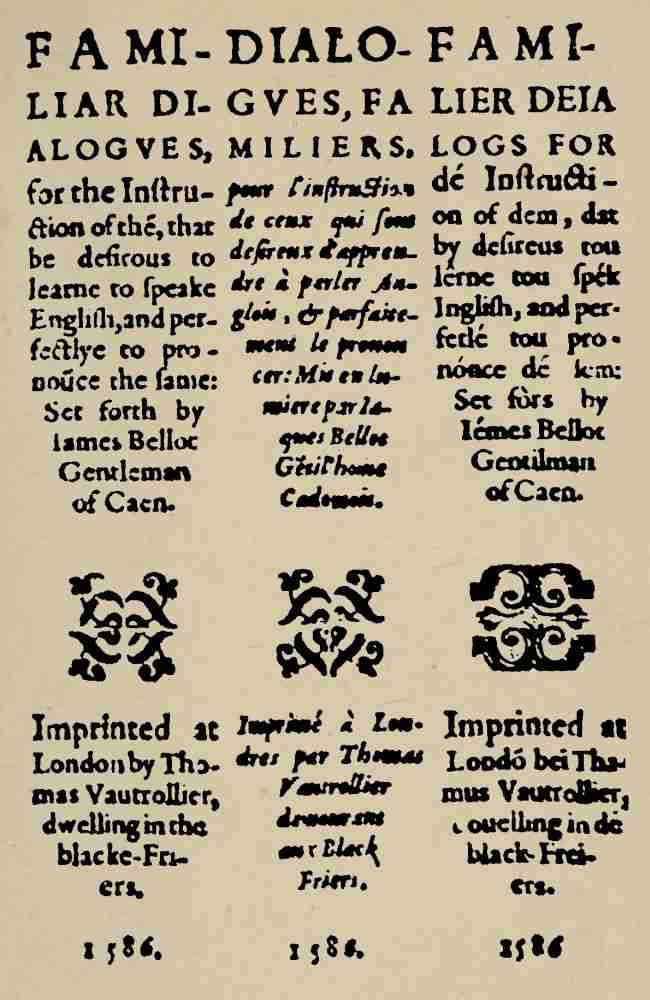
A collection of short bilingual dialogues presenting French and English side by side, with phonetic respellings and explicit pronunciation guidance. Intended to help speakers unfamiliar with local speech, it offers practical conversational exchanges and devotional formulas for daily life, accompanied by notes on stressed vowels, long and short sounds, and diphthongs. The material emphasizes spoken accuracy and mutual intelligibility through repetitive examples and annotated translations for learners adapting to a new linguistic environment.