
| Vpon the way. | Sur le chemin | Oppon dé ouê. |
| THe Gentelman. The marchaunt man. |
LE Gentilhomme. Le Marchand. |
Dé Gentilman. Dé martchandman. |
| The seruing man. | Le seruiteur. | Dé seruyng man |
| The plowman. | Le Laboureur. | Dé plaùmann. |
| The Inne keeper | L'hostelier. | Dé ìn kìper. |
The Gentel. |
Le Gen. |
Dé gent. |
| Neadd, bring hether my horse, It is great tyme to be goyng. | Edouard amene icy mon cheual. Il est grand temps de partir. | Néd, bring héder mey hors. It is grét teìm tou by going. |
The seruing. |
Le ser. |
Dé seruyng. |
| When you please: sir here is your horse. | Quand il vous plaira, Monsieur voicy vostre cheual. | Houen you pléés: ser hiér is yor hors. |
The gentel. |
Le gent. |
Dé gent. |
| Let vs ride a a good passe, to ouertake that man, which doth ride there afore vs: God saue you sir. | Allons bon pas pour atteindre c'est homme qui cheuauche là deuant nous. Dieu gard. Sire. | Let vs reìd a goud pàs, tou ouertàk dat man, houitch dous reìd dêr afòr vs: God sàf y ser. |
The march. |
Le mar. |
Dé march. |
| God blesse you Syr. | Dieu vous benie Monsieur. | God bles you Ser. |
The gentel. |
Le gent. |
Dé gent. |
| Whether go you sir. | Où allez vous Sire. | Houéder go you Ser? |
The march. |
Le march. |
Dé march. |
| I would fayne be in Fraunce. | Ie voudrois estre en France. | Ey oùld feìn by in Frans. |
The gentl. |
Le Gen. |
Dé gent. |
| And I also. | Et moy aussi. | And ey also, |
| But where about do you mynde to take shipping? | Mais où vous pensez vous embarquer? | Bout houêr abaut dou you meind tou tàk chippìng? |
The march. |
Le Mar. |
Dé march. |
| At Rye, God willing. | A la Rye, Dieu aidant. | At Rey, God ouiling. |
The gentel. |
Le Gen. |
Dé gent. |
| I would we were there. | Ie voudrois que nous y fussions. | Ey oùld ouy ouêr dêr. |
The march. |
Le Mar. |
Dé march. |
| I hope we shalbe there to morow betymes. | I'espere que nous y serons demain de bonne heure. | Ey hòp ouy chàl by dêr tou màro byteìms. |
The gentel. |
Le Gent. |
Dé gent. |
| Nedde, geue me a waund: For I will not spurre my horse | Edouard donné moy vne houssine car ie ne veux point ésperonner mon cheual. | Nêd, gif my a ouan: For ey ouil not speur mey hors. |
The ser. |
Le seru. |
Dé ser. |
| Here is one sir. | En voyla vne Monsieur. | Hiér is ouon Ser. |
The gent. |
Le Gentle. |
Dé gent. |
| Is is a hasell wanne? | Est-ce vne houssine de coudre. | Is it a hàsel ouan. |
Dé ser. |
Le ser. |
Dé ser. |
| No Syr: It is a holly wanne. | Non Monsieur: C'en est vne de hous. | Nò Ser: It is a hòly ouan. |
The march. |
Le march. |
Dé march. |
| But I pray you Syr: | Mais ie vous prie Monsieur: | Bout ey prê you Ser. |
| Be we not out of our way? | Sommes nous point hors de nostre chemin. | By ouy not aut of aouor ouê. |
The gentl. |
Le gent. |
Dé gentle. |
| I can not tell in deede: | Ie ne sçay vrayement. | Ey can not tel in did: |
| This plowman, which tilleth his grounde, will set vs againe on our way, if we be out of the same. | Ce laboureur qui laboure sa terre, nous remettra en nostre chemin: si nous en sommes hors. | Dis ploùman houitch tilés his grànd, ouil set vs again on aouor ouê, if ouy by aut of dé sêm. |
| Here ye my frend: | Escoutez mon amy: | Hiér y mey frìnd: |
| Is this the ready way to goe to Rye? | Est ce cy le droit chemin pour aller à la Rie. | Is dis dé red ouê tou go tou Reì? |
The plow. |
Le labou. |
Dé plaù. |
| Yes Syr: | Ouy Monsieur: | ys Ser: |
| Keepe still on the right hand. | Tenez tousiours à la main droite. | Kìjp stil on dé reict hand. |
The gentle. |
Le gent. |
Dé gent. |
| Is there neuer a house here by, wherein we may lodge. | Y à il point de lieu icy pres où nous puissions loger. | Is dêr neuer a haùs hiér bey houêrin ouy mê lodge? |
The plow. |
Le labou. |
Dé plaù. |
| Yes forsoth: | Ouy Monsieur: | ys farsoùs: |
| you haue two milles hence, a very good Inne. | vous auez à deux milles d'icy, vne fort bonne hostellerie. | you hàf toù meils héns, a very goud ìn. |
The gentl. |
Le gent. |
Dé gent. |
| I thanke ye my frend. | Grand mercy mon amy. | Ey tànk y mey frìnd. |
| God be here: | Dieu soit ceans: | God by hiér: |
| Shall we lodge with you, this night? | Logerons nous ceans, pour meshuy? | Chàl ouy lodge ouy dis neict? |
| Haue you any beadyng? | Auez vous de bons lits. | Hàf you any goud béding. |
| Good stables? | Bonnes estables. | Goud stèbles? |
| Good hay? and good oates. | Bon foin. Bonne auoyne. | Goud hê, and goud òòtes. |
The inkeeper. |
l'Hostellier. |
Dé ìnkìjper. |
| You be very well come Syrs. | Vous estes les tres bien venuz Messieurs. | You by very ouell com Sèrs. |
The gent. |
Le gent. |
Dé gent. |
| I pray rubbe well our horses and geue them good litter: | Ie vous prie frottes bien noz cheuaulx: & leur faites bonne littiere: | Ey prê, roub ouel aouor horses: and gif dem goud litter. |
| Bring some hay, and some oates. | Apportez du foin, & de l'auoyne. | Bring som hê, and som òòtes. |
The in. |
l'Host. |
Dé ìn. |
| How much will you haue. | Combien en voulez vous. | Haù mutch ouil y hàf? |
The ser. |
Le seruit. |
Dé ser. |
| Bring halfe a bushell of oates for our three horses and full the manger of hay. | Apportez, demy boisseau d'auoine pour noz trois cheuaux, & du foin plain le rastelier. | Bring hàlf a bouchel of òòtes, for aouor trij horses, and ful dé menger of hè. |
The in. |
l'Host. |
Dé ìn. |
| You shal haue it. | Vous l'aurez. | You chàl hàf it. |
The gent. |
Le gent. |
Dé gent. |
| Nedd, pull of our bootes, and make them cleane and our spurres also: | Edouard, tire noz botes, & les fay nettes, & nos eperons aussi. | Ned, poul of aouor bouts, and mèk dem clìn & aouor speurs àlso: |
| Let the bridle of my horse be hunged on the pommel of his sadle. | Qu'on pende la bride de mon cheual, au pommeau de sa selle. | Let dé breidel of mey hors by hangd on dé pommel of his saddel. |
The ser. |
Le ser. |
Dé ser. |
| It hangeth there already? But there is one of your styruppes broken: and one of the gyrtes ready to breake. | Elle y pend desia: Mais il y a vn de vos estriefz rompu, & l'vne des sengles, qui se rompt. | It hangs dêr àlrédy: Bout dèr is ouon of you sterops bròkin, and ouon of dé guerts rédy tou bréék. |
The gent. |
Le gent. |
Dé gent. |
| Goe buy others, and bring me a new gyrdle: For myne is worne. | Allez en achetter d'autres, & m'apportez vne ceinture neuue: car la mienne est vsée. | Go beì oders, and bring my a nù guerdel: For mein is ouorne. |
| Goe fetche | Aller querir | Go fetch |
| A saddler. | Vn sellier | A sadeler. |
| A spurrier. | Vn eperonnier. | A spurrier. |
| A taylor. | Vn tailleur. | A têler. |
| A shoemaker. | Vn cordonnier. | A choùmèker. |
| A cabeller. | Vn sauatier. | A càbler. |
| A hattemaker. | Vn chappelier. | A hatmèker. |
| A capper. | Vn bonnetier. | A capper. |
| A seamester. | Vne lingere. | A sémster. |
| A habredasher. | Vn mercier. | A habredacher. |
| A mercer. | Vn grossier. | A mèrcer. |
| A grosser. | vn epissier. | A gròsser. |
| An armourer. | vn armeurier. | An armurer. |
| A cutteller. | vn coutellier. | A coutler. |
| A chandeler. | vn chandelier. | A tchandler. |
| A grinder. | vn forbisseur. | A greìnder. |
| A carier. | vn voiturier. | A carier. |
| A vintener. | vn vinnotier. | A vintner. |
| A brewer. | vn brasseur. | A brùer. |
| A cooke. | vn cuisinier. | A couk. |
| A cooper. | vn tonnelier. | A coùper. |
| A fishmonger. | vn poissonnier. | A fichmonguer. |
| A butcher. | vn boucher. | A boutcher. |
| A baker. | vn drapier. | A dràper. |
| A draper. | vn boulenger. | A bèker. |
| A pewterer. | vn etamier. | A peauterer. |
| A peinter. | vn peintre. | A peinter. |
| A smith. | vn mareschal. | A smit. |
| A locksmith. | vn serreurier. | A loksmit. |
| An yronmonger. | vn feron. | A yeynmonguer. |
| A broker. | vn courtier. | A bròker. |
| A poulterer. | vn poullallier. | A paùlterer. |
| A goldsmith. | vn orfeure. | A gaùldsmit. |
| A carpendore. | vn charpentier. | A kerpendor. |
| A ioygner. | vn menuisier. | A ioeìner. |
| A fruiterer. | vn fruitier. | A frùterer. |
| A woodmonger. | vn marchand de bois. | A oudmonguer. |
| A gyrdler. | vn ceinturier. | A guerdeler. |
| A clockmaker. | vn horloger. | A clomêker. |
| A coalier. | vn cherbonnier. | A còlier. |
| A thinker. | vn maignen. | A tìnker. |
| A glouer. | vn gantier. | A glouer. |
| A ieweller. | vn biblotier. | A ioueller. |
The march. |
Le march. |
Dé march. |
| Syr. | Monsieur. | Ser. |
| Is it not tyme to goe to bed: | Est-il point temps d'aller au lit. | Is it not teìm tou go tou béd: |
| We must be on horse backe to morow very earely. | Il nous faut estre à cheual demain de grand matin. | Ouy must by on hors bak to màro very êrlé. |
The gent. |
Le gent. |
Dé gent. |
| You say true. | Vous dites verité. | You sê trù. |
| Myne host, let our beds be made, and let vs haue a fire made, & cleane shittes. | Mon hoste, qu'on nous face noz lits: Et que nous ayons du feu, & des linceux netz. | Meìn òòst, let aouor beds by mèd and let vs hàf a feir mèd, and clìn shìts. |
The host. |
l'Host. |
Dé òòst. |
| It shalbe done. | Il sera fait. | It chàl by don. |
| Syrs, your beds be made: | Messieurs, voz lits sont faitz: | Sèrs, yor beds by mêd: |
| When it please you, you may go to bed. | quand il vous plaira aller au lit. | Houen it pléés you, you mê go tou bed. |
The gent. |
Le gent. |
Dé gent. |
| Nedd, take thou the candell, and showe me light to the priuyes. | Edouard, pren la chandelle, & m'esclaire aux priuées. | Ned, tàk dau dé kàndel, and chaù my leict tou dé priués. |
The ser. |
Le ser. |
Dé ser. |
| When it please you Syr. | Quand il vous plaira Monsieur. | Houen it pléés you Sèr. |
The march. |
Le march. |
Dé march. |
| Good euen Syr. | Bonsoir Monsieur. | Goud ìuin Sèr. |
THe gent. |
Le gent. |
Dé gent. |
| God geue you good night: | Dieu vous doint bonne nuit: | God gif you goud neict: |
| But it were good for vs to pray before we go to bed. | Mais il seroit bon que nous priassions Dieu auant que d'aller au lit. | Bout it ouèr goud for vs tou prê God bifòr ouy go tou béd. |
The march. |
Le march. |
Dé march. |
| Let vs pray when you please. | Prions, quand il vous plaira. | Let vs prè houen you pléés. |
The gent. |
Le gent. |
Dé gent. |
| O Lord whiche art onely good, true and gracious and mercyfull, which commaundeth them that loue thy name, to cast all feare, and care from them, and to cast it on thee promising most mercyfully thy selfe to be their protector against all their enemies, and their refuge in daungers: their gouernour in the way: their light in darkenesse, and their watchman also on the night: Neuer to slip, but to watch continually for the preseruyng of the faythfull: We beseeche thee of thy bounteous goodnesse, O Lord, to gorgiue vs, wherein we haue offended thee this day, & to receaue vs in thy protection this night, what we may rest in quietnesse both of body, & soule: Graunt our eyes sleepe: But let our hartes watch perpetuallye vnto thee that the weknes of the flesh, cause vs not to offend thee: Lord, let vs at all times feele thy goodnes toward vs, that we be at all tymes styrred to prayse thee & that late, early and at midday thy praise be in our own mouthes and at midnight: Lord instruct vs in thy iudgments, that al the dayes of our life beyng lead in holines, & puritie, we may be abducted at late into the euerlastyng rest, which thou hast promised by thy mercy to them that obey thy word: To thee O Lord, be honor, prayse & glory for euer. | Seigneur qui es seul bon veritable gratieux & misericordieux, qui commaunde à ceux qui ayment ton nom, de mettre arriere d'eux toute crainte & sollicitude, & de s'en demettre sur toy, promettant leur estre misericordieusement protecteur contre tous leurs enemis, & leur refuge aux daungers: leur gouuerneur de iour, leur lumiere en obscurité, & mesme, leur garde durant la nuit: Non pas pour dormir, ains à fin de veiller tousiours pour la preseruation des fideles. Nous te supplions par ta bonté infinie, Seigneur, nous pardonner en ce que t'auons offencé ce iourd'huy, & de nous receuoir c'este nuit en ta protection, à fin que nous reposions en paix, tant corporellement que spirituellement. Octroye le dormir à noz yeux mais fay que noz coeurs veillent perpetuellement à toy, à fin que l'infirmité de nostre chair ne nous cause de t'offencer fay Seigneur que nous sentions tousiours ta bonté enuers nous, àfin que nous soyons tousiours esmeuz à te louer, & que tes louanges soyent en noz bouches soir, & matin, & au millieu de la iournée, & à minuict: Seigneur instruy nous en tes iugemens àfin que tous les iours de nostre vie estans guidez en sainteté & pureté, nous soyons finalement conduis en ton perdurable repos, lequel tu as par ta misericorde promis à ceux qui obeyssent à ta parolle: A toy Seigneur, soit honneur, louange & gloire à iamais. | O Lord houitch art ònlé goud, trù, gracious and mercyfull, houitch commandés dem dat lof dey nêm, tou cast àl fêr, and kèr from dem and tou cast it on dy promising most mercyfullé dey self tou by dêr protecteur against àl dêr enemis and dêr refuge in dangers, dêr gouerneur in dé dê, dêr leict in darknes, and dêr ouatcheman àlso on dé neict: Neuer tou slip, bout tou ouatch continualé for dé preseruyng of dé fêsful: ouy bisìtch dy of dey bontieus goundnés, O Lord, tou forgif vs, houêrin ouy hàf offended dy dis dê, and tou recéef vs in dey protection dis neict, dat ouy mê rest in koueietnes bòs of body and saùl: Graùnt aouor eìjs slip: Bout let aouor harts ouatch perpetuallé ontou dy, dat dé ouêknes of dé flech càs vs not tou offend dy: Lord, let vs at àl teims fìjl dey goudnes taoùoard vs dat ouy by at àl teims stired tou prês dy, and dat lèèt, êrlé & at middê dey prêses by in aouor mausses and at midneict: Lord instruct vs in dey iudgements dat àl dé dês of aouor leif bying léd in holines, & purité ouy mê by conducted at lêt, intou dé euerlastyng rest houitch dau hast promised bey dey mercy, tou dem dat obê dey ouord: Tou dy O Lord, by honor, prês and glory for euer. |
The march. |
Le mar. |
Dé march. |
| So be it. | Ainsy soit il. | So be it. |
The gent. |
Le Gen. |
Dé gent. |
| The peace of God, which passeth all vnderstandyng, keepe our hartes, and myndes, in the knowledge and loue of God, and of his sonne Iesus Christ our Lord: and the blessing of God all mightie: The father, the Sonne, and the holy Ghost, be amongest vs, and remayne with vs alwayes. | La paix de Dieu, qui passe tout entendement, garde noz cueurs & noz pensées, en la cognoissance & amour de Dieu & de son Filz Iesus Christ nostre Seigneur. Et la benediction de Dieu tout puissant, Le Pere le Filz & le Sainct esprit, soit entre nous & demeure tousiours auec nous. | Dé prês of God, houitch passés àl onderstandyng kìjp aouor harts, and meinds, in dé knòledge and lof of God, and of his son Iesus Chreist aouor Lord: and dé blessing of God àlmeicty, dé fàder, dé son, and dé holy Gost, by amongst vs, and remeìn ouis vs àlouês. |
The march. |
Le mar. |
Dé march. |
| So be it. | Ainsi soit-il. | So by it. |
| Now Syr, I byde you the good night. | Maintenant Monsieur ie vous donne bonne nuit. | Naù Syr, ey beid you dé goud neict. |
The gent. |
Le Gen. |
Dé gent. |
| He that mayd the good nights Graunt to geue you foureten in stead of foure. | Celuy qui feist les bonnes nuits vous en doint quatorze pour quatre. | Hì dat mèd dé goud neicts Grànt tou gif you faòrtin in stéd of faòr. |
The ser. |
Le serui. |
Dé ser. |
| Syr, Is it not yet tyme to goe? | Monsieur est-il point encor temps de partir. | Sèr, Is it not yet teim tou go? |
The gent. |
Le Gent. |
Dé gent. |
| What is it of the clocke. | Qu'elle heure est-il? | Houat ist a clak. |
The ser. |
Le ser. |
Dé ser. |
| It is almost fiue of the clocke. | Il est pres de cinq heures. | It is àlmost feìf a clak. |
The gent. |
Le Gen. |
Dé gent. |
| Is it a fayre weather. | Le temps est-il beau. | Is it a fêr ouêder? |
The ser. |
Le ser. |
Dé ser. |
| Very fayre Syr. | Fort beau, Monsieur. | Very fêr Sèr. |
The gent. |
Le gent. |
Dé gent. |
| Are you ready Syr? Let vs pray God? | Estes vous prest Sire? Prions Dieu. | àr you rédy Sèr? Let vs prê God. |
The mar. |
Le mar. |
Dé mar. |
| When you please Syr. | Quand il vous plaira Monsieur. | Houen you pléés Sèr. |
The gent. |
Le Gen. |
Dé gent. |
| O LORD good God, eternall and almightie Father, whiche hast by thy grace, guided and conducted vs vnder thy holy protection to the begynnyng of this day, we most humbly beseeche thee, to keepe, and susteine vs alwayes by thy vertue, that in the same we may fall into no sinne: But direct vs rather to obey and serue thee accordyng to thy holy will: Let all our thoughtes be wholly lifted vp vnto thee, and guide so our wordes, and our deedes, that we may say, nor thinke, nor doe any thyng contrary to thy holy will: Here vs our GOD, and Father, and so replenishe vs with thy graces, and mercy, that we employ all this day in ioye, and that we may delue in singing of thy prayses, through Iesus Christ thy sonne our Lord. | Seigneur bon Dieu, Pere Eternel, & tout puissant qui nous as fait la grace de nous guider & conduire souz ta sainte sauuegarde iusques au commencement de ce iour Nous te supplions treshumblement nous garder & soustenir tousiours par ta vertu à ce qu'en iceluy nous ne tombions en peché ains au contraire, nous dirige à t'Obeyr & seruir selon ta sainte volonté soient toutes noz pensées du iour esleuées à toy, & conduy tellement noz parolles & opperations que nous ne disions ne pensions n'y facions chose contraire à t'a sainte volonté: Exauce nous nostre Dieu, nostre Pere, & nous remply tellement de tes graces & misericordes, que nous emploions tout ce iour en ioye & que nous prenions plaisir à chanter tes louanges par Iesus Christ ton Filz nostre Seigneur. | O Lord goud GOD eternal, and àlmeicty fàder, houitch hast bey dey gràs, geided and conducted vs onder dey holy protection tou dé biguinning of dis dê, ouy most humblé bisiitch dy, tou kijp, and sustein vs àlouês bey dey vertu, dat in dé sêm ouy mè fàl intou no sin, Bout direct vs ràder tou obè, and sèrf dy, according tou dey holy ouil: Let àl aouor tàuts by hòlé lifted op ontou dy, and geìd so aouor dìds, dat ouy mè sê, nor tìnk, nor dou any ting contrary tou dey holy ouil: Hiér vs aouor GOD, and Fàder, and so replenich vs ouis dey gràs, and mercy, dat ouy imploey àl dis dê in ioè, & dat ouy mê deleict in singuing of dey prèses, terauh Iesus Chreist dey son aouor Lord. |
The mar. |
Le Mar. |
Dé mar. |
| So be it. | Ainsy soit-il. | So by it. |
| Now it is tyme to goe. | Maintenant il est temps de partir. | Naù it is teìm tou go. |
The gent. |
Le Gen. |
Dé gent. |
| When you will, I am ready: | Quand vous voudrez ie suis prest. | Houen you ouil, Ey am rédy. |
| I hope we shall haue a fayre weather to day. | I'espere que nous aurons beau temps auiourd'huy. | Ey hòp ouy chàl hàf, a fèr ouèder tou dê. |
The mar. |
Le Mar. |
Dé mar. |
| God graunt it. | Dieu le vueille. | God grànt it. |
The gent. |
Le Gen. |
Dé gent. |
| Nedd, bring my sword, my dagge, | Edouard, apporte mon espée. Ma pistolle. | Néd, bring mey souord mey dag. |
| My harkebuse. | Ma harquebuze, | Mey harkebus. |
| Bring heather our horses. | Ameine icy noz cheuaux, | Bring héder aouor horses. |
| My mowile. | Ma mule. | Mey moueìl. |
| Mine asse. | Mon asne. | mein às. |
| Mine oxe. | Mon beuf. | Mein ox. |
| My hogge. | Mon pourceau. | Mey hog. |
| My dogge. | Mon chien. | Mey dog. |
| My grayhunde. | Mon leurier. | Mey grèhond. |
The ser. |
Le Ser. |
Dé ser. |
| Syr, here be your horses and all that you commaunded me. | Monsieur voycy voz cheuaux & tout ce que m'auez commandé | Sèr, hiér by yor horses, and àl dat you commanded my. |
The gent. |
Le Gen. |
Dé gent. |
| Thou diddest forget my head peece. | Tu as oublié mon morrion. | Dau didst forguet mey héd pìjs. |
The ser. |
Le ser. |
Dé ser. |
| I goe for it, Syr. | Ie le vay querir, Monsieur. | Ey go for it, Sèr. |
The gent. |
Le Gen. |
Dé gent. |
| Myne host, let vs haue a reakenyng. | Mon hoste ayons vn conte. | Mein òòst, let vs hàf a rékening. |
| Let vs reaken. | Contons. | Let vs réken. |
| Reaken with vs. And come for your monney. | Contez auec nous, & venez receuoir vostre argent. | Réken ouis vs. And com for yor monné. |
The inkeeper. |
L'host. |
Dé ìnki. |
| God saue you Syrs. | Dieu vous gard Messieurs. | God sàf y Sèrs. |
The gent. |
Le gent. |
Dé gent. |
| And you also myne host. | Et vous aussi mon hoste. | And you àlso mein hòòst. |
The in. |
L'host. |
Dé ìnk. |
| Syrs, you doe owe, for you and for your men, and horses, foure shillings and six pence: And you be well come. | Messieurs vous deuez pour vous & pour voz gents & cheuaux quatre soudz & six deniers, & vous estés les bien venuz. | Sèrs, you dou aù, for yor men, and horses, faòr chelins and six pens: And you by ouel com. |
The gent. |
Le gent. |
Dé gent. |
| It is to much. | C'est trop. | It is tou mutch. |
The in. |
l'Host. |
Dé ìn. |
| Truely Syr, all is very deare now a dayes. | Vrayement Monsieur tout est fort cher maintenant. | Trùlé Sèr, àl is very diér nau a dès. |
The gent. |
Le gent. |
Dé gent. |
| Hold you monney. | Tenez vostre argent. | Haùld yor monné. |
The mar. |
Le mar. |
Dé mar. |
| Are you pleased myne host. | Estes vous content mon hoste. | àr you pléésd mein òòst. |
The in. |
l'Host. |
Dé ìn. |
| Yea, forsooth: I thanke you. | Ouy, Monsieur, ie vous remercie. | yé, fresoùs: Ey tànk y. |
The gent. |
Le gent. |
Dé gent. |
| I pray you myne host let vs on our right way to Rye. | Ie vous prie mon hoste mettez nous en nostre droit chemin de la Rye. | Ey prê you mein òòst, sét vs on aouor reict ouê tou Reì. |
The in. |
l'Host. |
Dé ìn. |
| Folow on this path till you come to the high way. Then keepe alwayes on the left hand, leauyng on the right hand, a high hedge the whiche you shall finde, about a myle hence: | Suyuez ce sentier iusques à ce que veniez au grand chemin: Puis tenez tousiours la main gauche, laissant à main droite, vne haute haye que vous trouuerez enuiron à vn mille d'icy: | Folò on dis pats til you com tou dé heì ouê: Den kìjp àlouês on dé léft hand, léuing on dé reict hand, a heì hedge dé houitch you chàl feìnd, abaut a meìl hens: |
| Doubtlesse that way will bryng you straight to Rye. | Sans doute, ce chemin la vous conduira droit à la Rye. | Daùtles, dat ouê ouil bring you strèct tou Rie. |
The gent. |
Le gent. |
Dé gent. |
| How farre is to Rye? | Combien y a il d'icy à la Rye. | Haù far is tou Rìe? |
The in. |
l'Host. |
Dé ìn. |
| There is about twenty myles. | Il y a enuiron vint milles. | Dêr is abaut touenty meils. |
The gent. |
Le gent. |
Dé gent. |
| Is it a fayre way? | Le chemin est il beau? | Is it a fêr ouê? |
The in. |
L'Host. |
Dé ìn. |
| Yea Syr very fayre. | Ouy, fort beau Monsieur. | Yé Sèr, very fêr. |
The gent. |
Le gent. |
Dé gent. |
| I thanke you myne host: | Grand mercy mon hoste: | Ey tànk y mein òòst: |
| I commit you to God. | Ie vous recommandes à Dieu. | Ey commit you tou God. |
The in. |
l'Host. |
Dé ìn. |
| God be your speede Syrs: | Dieu vous conduye Messieurs | God by yor spìjd Sêrs: |
| Fare you well, at your commaundement. | A Dieu, à vostre commandement. | Far yé ouel, at yor commandement. |
About This Book
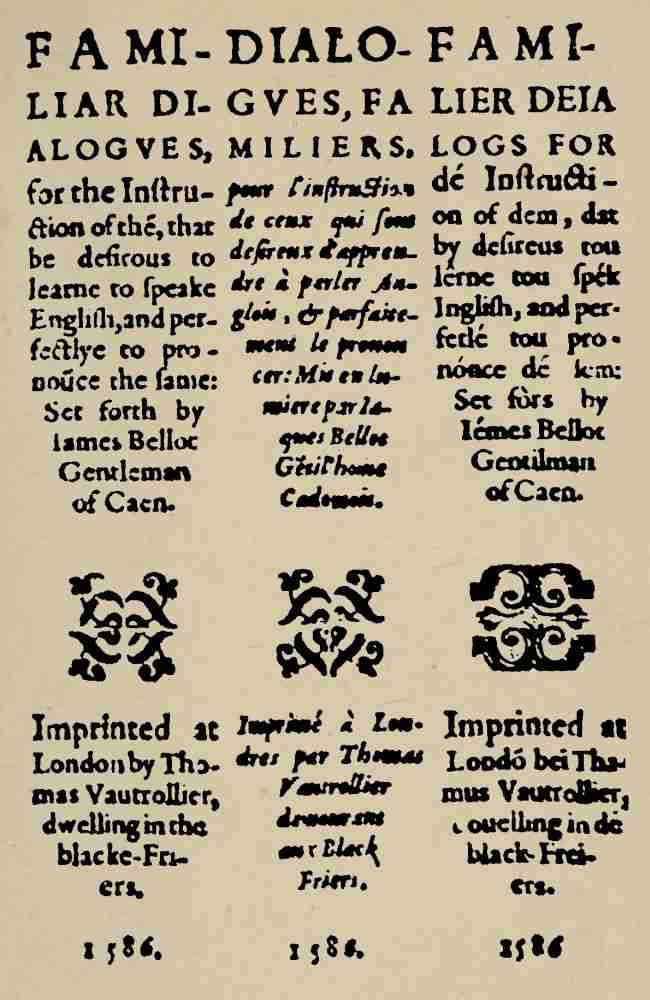
A collection of short bilingual dialogues presenting French and English side by side, with phonetic respellings and explicit pronunciation guidance. Intended to help speakers unfamiliar with local speech, it offers practical conversational exchanges and devotional formulas for daily life, accompanied by notes on stressed vowels, long and short sounds, and diphthongs. The material emphasizes spoken accuracy and mutual intelligibility through repetitive examples and annotated translations for learners adapting to a new linguistic environment.