
| The rising in the morning | Le leuer du matin. | Dé reising in dé màrning. |
| BArbara, Peter, Stephen, Iames. | BBarbe, Pierre, Estienne, Iaques. | BArbara, Pìter, Stìuin, Iémes. |
| The Father. | Le Pere. | Dé Fàder. |
| The Mother. | La Mere. | Dé Moder. |
Barbara. |
Barbe. |
Barbara. |
| How now children, will you not rise to day? | Comment enfans, voulez vous point vous leuer auiourd'huy? | Haù nau tchildren, ouil you not reis tou dê? |
Peter. |
Pierre. |
Pìter. |
| What ist a clock? | Quelle heure est il? | Houat ist a clak? |
Bar. |
Barbe. |
Bar. |
| It is seuen a clock. | Il est vij heures | It is séuin a clak. |
Stephen. |
Estiene. |
Stìuin. |
| I beleue you not. | Ie ne vous croy point? | Ey bilìf you not. |
Bar. |
Barbe. |
Bar. |
| Why do you not beleue me? | Pourquoy ne me croiez vous point? | Houey dou you bilìf my? |
Steuen. |
Estienne. |
Stìuin. |
| Because I am yet all sleepye and that I am accustomed to awake alwayes at fiue of the clocke. | Parce que ie suis encor' tout endormy stumé de m'esueiller tousiours à cinq heures. | Bycàs ey am yet àl slìpé, and dat ey am acostuméd tou aouêk àl ouês at feif of dé clak. |
Iames |
Iaques. |
Iéms. |
| Beleue this bearer: he is scant well awake at eight of the clocke, how then could he be awaket at fiue? | Croiez ce porteur: à grand peine est-il bien eueillé à huict heures, comment donc s'éueuilleroit-il à cinq? | Bilìf dis bêrer: hy is scant ouel aouêkt at êct of dé clak, haù den could hy by aouêkt at feìf? |
Barbara. |
Barbe. |
Bar. |
| You say true. | Vous dites vray | You sè tru. |
Stephen. |
Estienne. |
Stìuin. |
| You will iest. | Vous voulez rire. | You ouil iest. |
Barbara. |
Barbe. |
Bar. |
| Rise quickely: it is tyme to go to schoole: your maister will ierke you, if you can not say your lessons. | Leuez vous tost Il est temps d'aller à l'escole Vostre maistre vous batra, sy vous ne scauez dire voz lessons. | Reis kouiklé: It is teim tou goe tou scoùl: yor mêster ouil ierk you, if you can not sè your lessons. |
Peter. |
Pierre. |
Pìter. |
| Oure maister hath no roddes. | Nostre Maistre n'a point de verges. | Aour mêster has no rads. |
Barbara. |
Barbe. |
Bar. |
| I will carye him som. | Ie luy en porteray. | Ey ouil caré him some. |
Iames. |
Iaques. |
Iéms. |
| It is needelesse for we will study well. | Il n'en est ià besoin, car nous estudirons bien. | It is nìdles: for oui ouil studi ouel. |
Stephen. |
Estienne. |
Stìuin. |
| Geue me my hosen. | Donnez moy mes chausses. | Gif my mey hosen. |
Barbara. |
Barbe. |
Bar. |
| Which of them? | Lesquelles? | Houitch of dem? |
Stephen. |
Estienne. |
Stìuin. |
| My redd hoses. | Mes chausses rouges. | My red hoses. |
Peter. |
Pierre. |
Pìter. |
| And to me my blacke ones. | Et à moy mes chausses noires. | And tou my mey blak ouones. |
Iames. |
Iaques. |
Iéms. |
| Bring me my whit hoses, and a cleane shyrt: Or els, bring me my graye hoses, my greene dwblet and a handkercher. | Apportez moy mes chausses blanches, & vne chemise nette: ou bien m'apportez mes chausses grises, mon pourpoint verd, & vn mouchoir. | Bring my mey houeit hoses, and a clìn chert: Or els, bring my mey grê hoses, mey grìn doublet, and a handkêrtcher. |
Barbara. |
Barbe. |
Bar. |
| Holde, here be your hosen. | Tenez, voi-là voz chausses. | Haùld, hiér by yor hòsin. |
Iames. |
Iaques. |
Iéms. |
| Here lacke some pointes. | Il y faut des esguillettes. | Hiér lak som poeints. |
Barbara. |
Barbe. |
Bar. |
| You played them. | Vous les auez iouées. | You plêd dem. |
Iames. |
Iaques. |
Iéms. |
| I haue not, they be broken. | Non ay, elles sont rompues. | Ey haf not: dê by bròkin. |
Barbara. |
Barbe. |
Bar. |
| Button your ierkin Peter: where be your garters? | Boutonnez vostre colet: Pierre Où sont voz iartieres? | Botton you ierkin Pìter houêr by yor guerters? |
Peter. |
Pierre. |
Pìter. |
| I lost them. | Ie les aye perdues. | Ey làst dem. |
Barbara. |
Barbe. |
Bar. |
| You deserue to be beaten: But you feare nothing, why doe you not gyrt you Stephen? | Vous meritez d'estre batu: mais vous ne craignez rien. Que ne vous iartez vous? | You desêrf tou by béétin: Bout you féér nòting: houey dou you not guert you? |
Stephen. |
Estienne. |
Stìuin. |
| I can not bowe downe. | Ie ne me peux baisser. | Ey can not baù daon. |
Barbara. |
Bar. |
Bar. |
| Truely you are but a wagge, whiche lookes but for the death of the day. | Vrayement vous n'estes qu'vn poste qui ne demandez que la mort au iour. | Trùlé you àr bout a ouag houitch loukes bout for dé dêts of dé dê. |
Peter. |
Pierre. |
Pìter. |
| Geue me my doublesoulshoes. | Baillez moy mes souliers à double semelle. | Gif my mey double sòòl chous. |
Barbara. |
Bar. |
Bar. |
| Here be them. | Les voila. | Hièr by dem. |
Iames. |
Iaques. |
Iéms. |
| Where is the showing horne? | Où est le chause-pied? | Houêr is dé chouing horn? |
Barbara. |
Bar. |
Bar. |
| Take it vpon the table. | Prenez-le sur la table | Tàk it opon dé tabel. |
Stephen. |
Estienne. |
Stìuin. |
| Geue me my pantables, and my pompes: But where be my sockes? | Donnez moy mes mulles, & mes escarpins: Mais où sont mes chaussons? | Gif me mey pantables, and mey pamps: Bout ouêr by mey sakes? |
Barbara. |
Bar. |
Bar. |
| Here be them, | Les voy la. | Hiér by dem, |
| Iames, put on your hatte: make cleane your cap: | Iaques, mettez vostre chapeau, nettoyez vostre | Iéms, Pout en yor hat, mêk clìn yor cêp. |
| Peter, where layde you your night cap? | bonnet de nuit. | Pìter, houêr lêd yor you neict kêp? |
Peter. |
Pier. |
Pìter. |
| I left it vpon the bedde. | Ie l'ay laissé sur le lict. | Ey left it oppon dé béd. |
Barbara. |
Barbe. |
Bar. |
| Are you ready? | Estes-vous prestz? | àr you rédy? |
Peter. |
Pierre. |
Pìter. |
| How should I be ready? You brought me a smock, in steade of my shirt. | Comment seroy-ie prest? vous m'auez apporté vne chemise à femme, au lieu de ma chemise. | Haù choùld ey by redy? you brààt my a smok, in stéd of mey shert. |
Barbara. |
Barbe. |
Bar. |
| I forgat my selfe: holde, here is your shirt. | Ie me suis oubliée: Tenez voila vostre chemise. | Ey forgat mey self: haùld, hiér is yor shert. |
Peter. |
Pierre. |
Pìter. |
| Now you are a good wenche. | Vous estés maintenant vne bonne fille. | Naù you àr a goud ouentch. |
Barbara. |
Barbe. |
Bar. |
| Why doe you not put on your showes? you goe alwayes sleepe-shotte. | Que ne vous chaussez vous? vous allez tousiours les souliers en pantoufle. | Houey dou you not pout en your choùs? you go alouês slip-chat. |
Peter. |
Pierre. |
Pìter |
| My showes be naught. | Mes souliers ne vallent rien. | Mey choùs by nààt. |
Barbara. |
Barbe. |
Bar. |
| Better is to haue a bad excuse, then not at all. | Il vaut mieux auoir vne mauuaise excuse que point du tout | Beter is tou hàf a bad excùs, den not at àl. |
Peter. |
Pierre. |
Pìter. |
| Now, we be ready: Geue us our breakefast, that we may goe to schoole. | Maintenant, nous sommes prests: donnez nous nostre desieuner que nous allions à l'escole. | Naù, ouy by redy: Gif vs aour breakefast, dat ouy mê go to scoùl. |
Barbara. |
Barbe. |
Bar. |
| Did you say your prayers? | Auez-vous dit voz prieres? | Did you sê yor prêrs? |
Iames. |
Iaques. |
Iéms. |
| Not yet. | Non pas encor' | Not yet. |
Barbara. |
Bar. |
|
| It is not well done: Pray God, then you shall haue your breakfast. | Ce n'est pas bien fait. Priez Dieu, puis vous aurez à desieuner. | It is not ouel don: Prê God, den you chàl haf yor brekfast. |
Iames. |
Iaques. |
Iéms. |
| Brother, it is for you to day to pray God: and my cosen shall pray GOD to morowe: Then, it shalbe my turne to pray. | mon frere c'est à vous auiourd'huy à prier Dieu: Et mon cousin priera Dieu demain: puis ce sera à moy à prier | Broder, it is for you tou dê tou prê GOD: and mey cosin chàl prê GOD tou màro: Den it shàl by mey torne tou prê. |
| Sonneday | Dimenche | Sondê |
| Monneday | Lundy | Mondê |
| Twesday | Mardy | Tùsdê |
| Weddenesday | Mecredy | Ouednesd |
| Thursday | Ieudy | Tursdê |
| Friday | Vendredy | Freidê |
| Sathurday. | Samedy. | Saterdê. |
Barbara. |
Barbe. |
Bar. |
| Kneele downe all. | Agenouillez vous tous. | Knìl daòn àl. |
Stephen. |
Estienne |
Stìuin |
| Our helpe be in the name of GOD, whiche hath made heauen and earth. So be it. | Nostre aide soit au Nom de Dieu, qui a fait le Ciel & la Terre. Ainsi soit il. | Aouor help by in dé nêm of GOD, houitch hàs mêd héuin, and yérs. So by it. |
| OVr Father whiche art in heauen, halowed be thy name. Thy kingdoms come. Thy will be done, in earth, as it is in heauen. Geue us this day our dayly bread, and forgeue vs our offences, as we forgeue them that trespasse agaynst vs: And let vs not be led into temptation: but deliuer vs from euill: For thine is, the kingdome, the power, and the glory for euer and euer. | Nostre Pere qui es és Cieux. Ton Nom soit sanctifié, ton regne aduienne Ta volunté soit faite en la terre, comme au ciel. Donne nous auiourd'huy nostre pain quotidien, & nous pardonne noz offences, comme nous pardonnons à ceux qui nous offencent: Et ne nous induy point en tentation, mais nous deliure du malin: Car à toy est le regne, la puissance, & la gloire és siecles des siecles. | AOuor Fàder houitch art in héuin, haloued by dey nêm, dey kingdom com. Dey ouil by don, in yêrs, as it is in hèuin: Gif vs dis dê aouor dêlé bred, and forgif vs aouor offences, as ouy forgif dem dat trespas against vs: and let vs not by led intou temptacion: Bout deleiuer vs from ìuil: For dein is dé kingdom, dé pauér, and dé glory for euer and euer. |
Iames. |
Iaques. |
Iém. |
| So be it. | Ainsi soit il. | So by it. |
Peter. |
Pierre. |
Pìter. |
| Let vs eate, and drinke, acknowledging, that all goodnesse doe come from God, In the name of the Father, and of the Sonne, and of the holy Ghost. | Mangeons, buuons recognoissans, que tous biens sont de Dieu venans, Au nom du Pere & du Filz, & du Saint Esprit. | Let vs éét, and drink, acknòledging dat àl goudnes dou com from God, In dé nêm of dé Fàder, and of dé son, and of dé holy gost. |
Iames. |
Iaques. |
Iém. |
| So be it. | Ainsi soit-il. | So by it. |
Barbara. |
Barbe. |
Bar. |
| Now breake your fast, then go aske your fathers, and mothers blessing. | Desieunez maintenant, puis alléz demander benediction à voz parens. | Naù bréék yor fast, den go ask yor Fàders and moders blessing. |
Iames. |
Iaques |
Iéms. |
| I pray you Father, pray to GOD to blesse me. | Ie vous prie mon pere, priez Dieu qu'il me benye. | Ey prê you Fàder, prê tou GOD tou bles my. |
The Father |
Le pere. |
Dé Fàder. |
| God blesse you you my sonne. | Dieu vous benye mon filz. | GOD bles you mey son. |
Stephen. |
Estienne. |
Stìuin. |
| I pray you mother, geue me your blessing. | Ie vous prie ma Mere donnez moy vostre benediction. | Ey prê you moder, gif my yor blessing. |
The Mother. |
La Mere. |
Dé Moder. |
| God blesse you all, my children. | Dieu vous benye tous mes enfans. | God bles you àl mey tchildren. |
Barbara. |
Barbe. |
Bar. |
| Go to children. take your books and gos you to schoole: But play not by the way. | Or sus enfans prenez voz liures, & vous en allez à l'Escolle: mais ne iouez pas en chemin. | Go tou tchildren. tàk yor bouks and go you tou scoùl: Bout plê not bey dé ouê. |
| Go you in peace and learne well, then you shalbe called the children of God. | Allez en paix, & apprenez bien, lors vous serez appelez enfans de Dieu | Go you in péés, and lêrn ouel, den you chàl by càled dé tchildren of God. |
Stephen. |
Estienne. |
Stìuin. |
| Where is my booke? | Où est mon liure. | Houêr is mey bouk? |
Barbara. |
Barbe. |
Bar. |
| Where did you put it? | Où l'auez vous mis. | Houêr did you pout it? |
Stephen. |
Estienne |
Stìuin. |
| I layde it ysterday vppon the window. | Ie le laissay hier sur la fenestre. | Ey lêd it ysterdê oppon dè oueindo. |
Barbara. |
Barbe. |
Bar. |
| Take it then. | Prenez l'y donc. | Tàk it den. |
James. |
Iaques. |
Iém. |
| Geue me my paper booke. | Donnez moy mon liure. | Gif my mey pàper bouk. |
Barbara. |
Barbe. |
Bar. |
| Hold, here is your paper, and your inkehorne also. | Tenez voy-la vostre papier & vostre Escritoire aussi. | Haùld, hiér is yor pàper, and yor ìnkhorne àlso. |
Iames. |
Iaques. |
Iém. |
| There is neither pennes, nor ink. | Il n'y à ny plumes ny encre. | Dêr is nêder péns, nor ìnk. |
Barbara. |
Barbe. |
Bar. |
| What did you with all? | Qu'en auez vous fait? | Houat did you ouis àl? |
Peter. |
Pierre. |
Pìter. |
| He lost them, and he sold his penneknife. | Il les à vendues, & à vendu son trencheplume. | Hé làst dem and hé saùld his penkneif. |
Barbara. |
Barbe. |
Bar. |
| Truely, I will tell it to your mother. | Vrayment, ie le diray à vostre mere. | Trùlé, Ey ouil tél it tou yor moder. |
Iames. |
Iaques. |
Iém. |
| I pray doe not tell her, and I will loue you well. | Ie vous prie ne luy dites point & ie vous aymeray bien. | Ey prê dou not têl hêr, and ey ouil lof you ouel. |
Barbara. |
Barbe. |
Bar. |
| Will ye doe so? Goe to, I will not tell her: | Ferez-vous? Allez, ie ne luy diray point | Ouìll y dou so, Go tou, Ey ouil not têl hér: |
| Here is a peny to buy you some quilles. | Voy-la vn denier pour vous achetter des casses. | Hiér is a peny tou bei you som quiles. |
Iames. |
Iaques. |
Iém. |
| I thanke ye, I will buy some as I go to schoole. | Grand-mercy, i'en achetteray en allant à l'écolle. | Ey tànk y, ey ouil beì som, as ey go tou scoùle. |
Barbara. |
Barbe. |
Bar. |
| Well sayd, Goe in Gods name. | Vous dites bien, Allez au nom de Dieu. | Ouel sèd, Go in Gods nêm. |
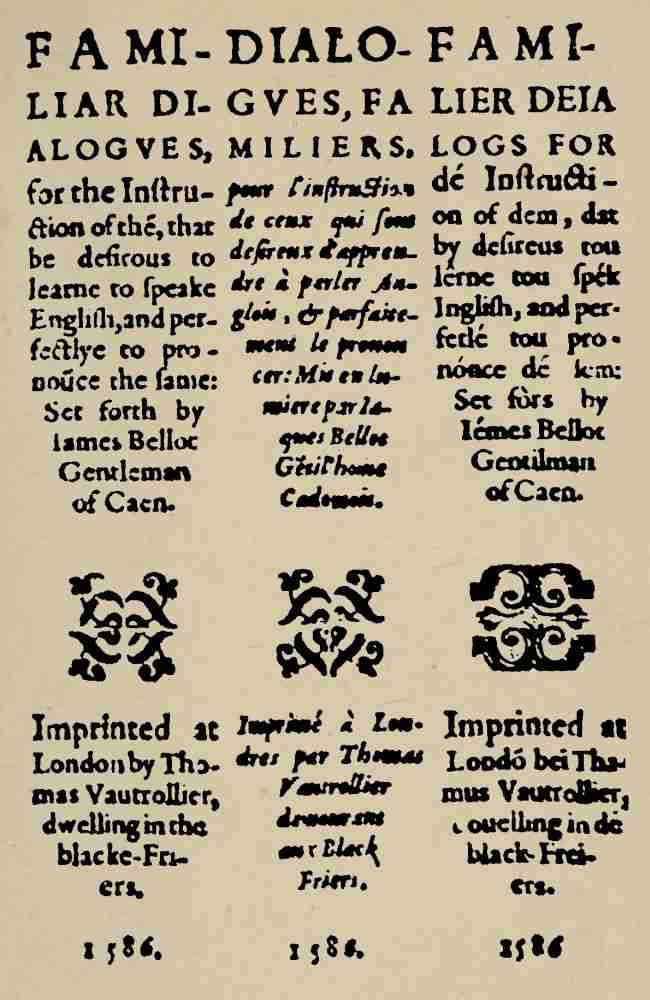
About This Book
A collection of short bilingual dialogues presenting French and English side by side, with phonetic respellings and explicit pronunciation guidance. Intended to help speakers unfamiliar with local speech, it offers practical conversational exchanges and devotional formulas for daily life, accompanied by notes on stressed vowels, long and short sounds, and diphthongs. The material emphasizes spoken accuracy and mutual intelligibility through repetitive examples and annotated translations for learners adapting to a new linguistic environment.