
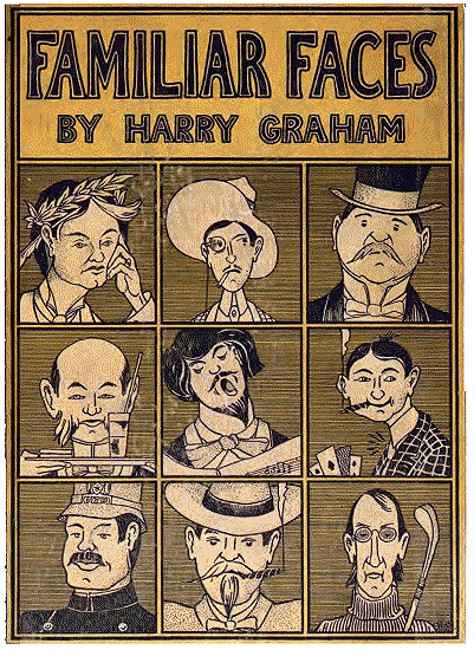
The Project Gutenberg eBook of Familiar Faces
Title: Familiar Faces
Author: Harry Graham
Release date: January 24, 2011 [eBook #35059]
Language: English
Credits: Produced by Mark C. Orton, Josephine Paolucci and the
Online Distributed Proofreading Team at http://www.pgdp.net.
(This book was produced from scanned images of public
domain material from the Google Print project.)
FAMILIAR FACES
By the Same Author
FAMILIAR FACES
BY
HARRY GRAHAM
Author of "Ruthless Rhymes for Heartless Homes," "Misrepresentative
Men," "Misrepresentative Women," etc., etc.
Illustrated by Tom Hall
New York
DUFFIELD & COMPANY
1907
Copyright, 1907, by
DUFFIELD & COMPANY
Published August, 1907
THE PREMIER PRESS, NEW YORK.
CONTENTS
PAGE
The Cry of the Publisher 7
The Cry of the Author 9
The Fumbler 11
The Baritone 15
The Actor Manager 20
The Gilded Youth 25
The Gourmand 29
The Dentist 36
The Man Who Knows 38
The Faddist 44
The Colonel 47
The Waiter 50
The Policeman 54
The Music Hall Comedian 58
The Conversational Reformer 63
King Leopold 67
"Bart's" Club 71
The Reviewer 74
L'Envoi 77
LIST OF ILLUSTRATIONS
| The Man Who Knows it All | Frontispiece | ||
| The Baritone | Facing Page | 16 | |
| The Actor Manager | " | " | 22 |
| The Gilded Youth | " | " | 28 |
| The Faddist | " | " | 44 |
| The Comedian | " | " | 58 |
| King Leopold | " | " | 68 |
| The Reviewer | " | " | 74 |
THE CRY OF THE PUBLISHER
Does its message fail to reach you in your den,
Where the ink that once so sluggishly was crawling
Courses swiftly through your stylographic pen?
'Tis the season when the editor grows active,
When the office-boy looks longingly to you.
Won't you give him something novel and attractive
To review?
If you only can be striking and unique,
The reviewers will concede you half a column
In their literary journals, any week.
And 'twill always be your publisher's ambition
To provide for the demand that you create,
And dispose of a gigantic first edition,
While you wait.
Try to expiate the failures of the past,
And just ask yourself dispassionately whether
You can't give us something better than your last?
If you really—if you truly—are a poet,
As you fancy—pray forgive my being terse—
Don't you think you might occasionally show it
In your verse?
THE CRY OF THE AUTHOR
Of your censure I am frankly growing tired.
With your diatribes eternally before me,
How on earth can I expect to feel inspired?
You are orderly, no doubt, and systematic,
In that office where recumbent you recline;
You would modify your methods in an attic
Such as mine.
(Where the mouth found less employment than the hand);
If your rhymes would lend your humour no assistance,
And your wit assumed a form that never scann'd;
If you sat and waited vainly at your table
While Calliope declined to give her cues,
You would realise how very far from stable
Was the Mews!
With the patient perseverance of a drone,
While some tactless but enthusiastic neighbour
Played a cake walk on a wheezy gramophone,
While your peace was so disturbed by constant clatter,
That at length you grew accustomed—nay, resigned,
To the never-ending victory of Matter
Over Mind.
In the shelter of some fashionable club,
I am starving, very likely, in a garret,
Off the street so incorrectly labelled Grub,
Where the vintage smacks distinctly of the ink-butt,
And the atmosphere is redolent of toil,
And there's nothing for the journalist to drink but
Midnight oil!
When one isn't in the true poetic mood,
When one contemplates the prospect of starvation,
And one's little ones are clamouring for food.
When one's tongue remains ingloriously tacit,
One is forced with some reluctance to admit
That, alas! (as Virgil said) Poeta nascit-
-Ur, non fit!
Do not treat him with the harshness he deserves,
For, in fact, altho' you little seem to know it,
You are gradually getting on his nerves.
Kindly dam the foaming torrent of your curses,
While I ask you,—yes, and pause for a reply,—
Are you writing this immortal book of verses,
Or am I?
I
THE FUMBLER
With anæmic lemonade!
Let us toast our fellow-fumbler,
Who was surely born, not made.
None of all our friends is "dearer"
(Costs us more—to be jocose—);
No relation could be nearer,
More intensely "close"!
"Oh, I say, do let me pay!"
Watch him in his pocket fumbling,
In a dilatory way;
Plumbing the unmeasured deeps there,
With some muttered vague excuse,
For the coinage that he keeps there,
But will not produce.
You alone provide the fare;
Not for all a monarch's ransom
Would he pay his modest share.
He may fumble with his collar,
He may turn his pockets out,
He can never find that dollar
Which he spoke about!
With a sort of old-world grace,
But, when you accept them, proffers
With surprise, an empty case.
Your cigars, instead, he'll snatch, and,
With the cunning of the fox,
Ask you firmly for a match, and
Pocket half your box!
You'll discover, when you've dined,
That your friend has taken care to
Leave his frugal purse behind.
"We must sup together later,"
He remarks, with right good-will,
"Pass the Heidsieck, please; and, waiter,
Bring my friend the bill!"
He comes running up to you,
And exclaims with agitation,
"Take my ticket, will you, too?"
Though his pow'rs of conversation
In the train require no spur,
To this trifling obligation
He will not refer!
Do not think it odd or strange
If he says, "It's very funny,
But I find I've got no change!
Do remind me what I owe you,
When you see me in the street."
Mr. Fumbler, if I know you,
We shall never meet!
In a pocket with thy thumb,
Never by good fortune stumbling
On the necessary sum,
Cease to make polite pretences,
Suited to thy niggard ends,
Of dividing the expenses
With confiding friends!
With the fumbler's well-earned wreath,
Who would'st rob thine aged mother
Of her artificial teeth!
We at length are slowly learning
That some friendships cost too dear.
"Longest worms must have a turning,"
And our turn is near!
Thou a lonely way must wend;
Henceforth, when for food thou achest,
Thou must dine without a friend.
Thine excuses thou shalt mumble
Down some public telephone,
And if thou perforce must fumble,
Fumble all alone!
II
THE BARITONE
The baritone's decolleté throat
Produces weird unearthly lays,
Like some dyspeptic goat
Deprived but lately of her young
(But not, alas! of either lung).
The contours of his manly chest,
Since that has fallen far below
His "fancy evening vest."
Here, too, in picturesque relief,
Nestles his crimson handkerchief.
Such doleful melancholy lays,
Of withered summers, ruined springs,
Of happier bygone days,
And kindred topics, more or less
Designed to harass or depress?
Is of the old familiar blend:—
A faded flow'r, a maiden, and
A "brave kiss" at the end!
(The kind of kiss that, for a bet,
A man might give a Suffragette.)
(THE BARITONE'S BOUDOIR BALLAD)
With a longing that seemed to say
Is it too late, dear heart, to wait
For the dawn of a brighter day?
Is it too late to laugh at fate?
See how the teardrops start!
Can we not weather the tempest together,
Dear Heart, Dear Heart?
As I gazed at her yielding form,—
Turned with a groan, and then hastened alone
Into the teeth of the Storm!
Long, long ago! Still the winds blow!
Far have we drifted apart!
You live with Mother, and I love—another!
Dear Heart, Dear Heart!
Our hero to a vocal burst,
Until his audience, too, acquires
The most prodigious thirst.
And nobody would ever think
That milk was his peculiar drink!
When each monastic brotherhood
Could brew, within its private walls,
A vintage just as good
As that which restaurants purvey
As "rare old Tawny Port" to-day!
(THE BARITONE'S DRINKING SONG)
With a bottle at either knee,
And he smacks his lips as he slowly sips
At his beaker of Malvoisie.
Sing Ho! Ho! Ho!
Let the red wine flow!
Let the sack flow fast and free!
His heart it grows merry on negus and sherry,
And never a care has he!
Ho! Ho!
(Ora pro nobis!)
Sing Ho! for the Malvoisie!
The Friar he sits him down,
With the door tight shut, and an unbroached butt
Where the ale flows clear and brown.
Sing Ha! Sing Hi!
Till the cask runs dry,
His spirits shall never fail!
For no one is dryer than Francis the Friar,
When getting "outside the pail!"
Ho! Ho!
(Benedicimus!)
Sing Ho! for the nutbrown ale!
And he lowers his tonsured head,
As he lifts the lid of the tankard hid
'Neath the straw of his trestle bed.
Sing Ho! Sink Hey!
From the break of day
Till the vesper-bell rings clear,
Of grave he makes merry and hastens to bury
His cares in the butt'ry bier!
Ho! Ho!
(Pax Omnibuscum!)
Sing Ho! for the buttery beer!
Some Paradise for stricken souls,
Where amateurs no longer bleat
Their feeble baracoles,
From lungs that are so oddly placed
Where other people keep their waist;
The faculty for being bored
By each anæmic baritone
Who murders "The Lost Chord,"
And singers, as a body, are
Cursed with a permanent catarrh!
III
THE ACTOR MANAGER
Ranked with rogues and vagabonds;
They were jailed as malefactors,
They were ducked in village ponds.
In the stocks the beadle shut them,
While the friends they chanced to meet
Would invariably cut them
In the street.
Ev'ry country-squire would feel
That his fallow-deer supplied them
With the makings of a meal.
They annexed the parson's rabbits,
Poached the pheasants of the peer,
And had other little habits
Just as queer!
As a poacher stands confest,
And altho', of course, cleanshaven,
Was as barefaced as the rest.
He, a player by vocation,
Practised, like his buckskin'd pals,
Indiscriminate flirtation
With the gals!
For romance are orthodox;
Nowadays he puts his savings,
Not his ankles, into "stocks."
Nobody to-day is doubting
That a halo round him clings;
One can see his shoulders sprouting
Into wings.
Centre of a rev'rent group;
Note with what an air imperial
He controls his timid troupe.
Deadheads scrape and bow before him,
To his doors the public flocks;
Even duchesses implore him
For a box.
(What we should not ever guess)
That he is absurdly jealous
Of subordinates' success.
Minor mimes who score a hit or
Threaten to advance too fast,
Are advised to curb their wit or
Leave the cast!
Managers are free of speech,
And unduly prone to curse all
Those who come within their reach.
With some tiny dams (or damlets)
They exhort each "walking gent—"
Language that potential Hamlets
Much resent.
All who lead successful lives,
Swear repeatedly at waiters,
Curse consistently at wives?
Shall the heads of the Profession,
Histrionic argonauts,
Be denied the frank expression
Of their thoughts?
Execrate with righteous rage
Player knaves who would defraud them
Of their centre of the stage?
Do we grudge these godlike creatures
Picture-cards that advertise—
Calcium lights that flood their features
From the flies?
Who produces problem plays,
Is a most important factor
In the world of modern days.
Kings occasionally knight him,
Titled ladies take him up;
Even millionaires invite him
Out to sup.
Clouds of limelight from afar,
(Diffidence is not the failing
Of the true dramatic "star").
What cares he for rank or fashion,
Politics or place or pelf?
He whose one prevailing passion
Is himself?
Managers, whose heads are twirled,
Think (to paraphrase the poet)
That the stage is all the world.
Other men discuss the summer,
Or the poor potato crop,
Nothing can prevent the mummer
Talking "shop."
Of his intellectual pow'rs,
He (as usual, introspective)
Talks about himself for hours.
While his friends, who never dream of
Interrupting, stand agog,
He decants a ceaseless stream of
Monologue.
By a long and arduous climb
To the crest, the crown, the summit
Of the Thespian tree—a lime!
There he chatters like a starling,
There, like Jove, he sometimes nods;
But he still remains the "darling
Of the gods!"
IV
THE GILDED YOUTH
Safe screwed within his dexter eye;
His mouth stands open wide, and snares
The too intrusive fly.
Were he to close his jaws, no doubt,
The eyeglass would at once fall out.
His jacket, short, and negligée,
Is slit behind, as tho' he feared
A tail might sprout some day.
One's eye must be inured to shocks
To stand the tartan of his socks.
Betrays its owner's florid taste;
A three-inch collar grips his neck,
A cummerbund his waist;
The trousers that his legs enshroud
Speak for themselves, they are so loud.
Are all of a cerulean hue,
And advertise that Norman blood,—
The bluest of the blue,—
Which, as a brief inspection shows,
Seems to have centred in his nose.
Back from a vacant brow he scrapes;
From so compact a head of hair
No filament escapes.
(This surface-polish, friends complain,
Does not descend into the brain.)
Nothing at all, to be exact!
Yet he performs this tedious task
With quite consummate tact.
(No cause for wonder this, in truth,
Since he has practised it from youth.)
And gazes out with torpid eyes;
Then yawns politely through his nose,
Looks at his watch, and sighs;
Regards his boots with dumb regret,
And lights another cigarette.
And now, his daily labours done,
Feels far too comatose and frail
To give the dog a run;
Besides, as he reflects with shame,
He can't recall the creature's name!
Where lyric comedy is played;
And, after, to some local Ritz,
Escorts a chorus-maid.
The jeunesse dorée of to-day
Is called the jeunesse stage-doorée!
(That to his fellows fly so fast),
To one who in a waking-dream
Awaits the next repast!
How tiresome and how long they feel,
Those hours dividing meal from meal!
His "occupation gone," poor soul,
Who can but wander in his mind
When he requires a stroll;
A mental sphere, one may surmise,
Too cramped for healthy exercise.
That "nothing walks with aimless feet,"
To ask why such a type is spared
To grace the public street,
Would be most curiously misplaced,
And in the very worst of taste.
V
THE GOURMAND
(A Ballad of Reading Grill)
But a simple dinner-coat;
For once his spirits seemed to fail,
And his fund of anecdote.
His brow was drawn and damp and pale,
And a lump stood in his throat.
With looks so dour and blue,
Upon the square of bill-of-fare
We waiters call the "M'noo,"
And at ev'ry dainty mentioned there,
From entrée to ragout.
He viewed the groaning board,
For he wondered if the chef would show
The treasures of his hoard,
When a voice behind him whispered low,
"Sherry or 'ock, my lord?"
As, with a frightful oath,
He seized the waiter by the hair
And cursed him for his sloth;
Then, grumbling like some stricken bear,
Angrily answered "Both!"
As tonic, dram or drug;
Some do it standing, in their gloves,
Some seated, from a jug;
The upper class from slim-stemmed glass,
The masses from a mug.
But when the meal was through,
His wild remorse at ev'ry course
Each moment wilder grew.
For he who thinks to mix his drinks
Must mix his symptoms too.
And the tougher tournedos,
The oysters dry, and the game so high,
And the soufflé flat and low,
Which the chef had planned with a heavy hand,
And the waiters served so slow?
From caviare to pork;
Some guzzle cheese or new-grown peas,
Like a cormorant or stork;
The poor man's wife employs a knife,
The rich man's mate a fork.
Some wait till they are old;
Some take their fare from earthenware,
And some from polished gold.
The gourmand gnaws in haste because
The plates so soon grow cold.
In restaurant or grill;
Some, when their weak insides go wrong,
Try a postprandial pill.
For each man eats his fav'rite meats,
Yet each man is not ill.
Through a night of wild unrest,
With a snow-white bandage round his head,
And a poultice on his breast,
'Neath the nightmare weight of the things he ate
And omitted to digest.
Or whether meals be long;
All that we know of this resort
Proves that there's something wrong,
That the soup is weak and tastes of port,
And the fish is far too strong.
The butter full of hair;
Defunct sardines and flaccid "greens"
Are all they give us there.
Such cooking has been known to make
A common person swear.
At eve or afternoon,
Their harassed ears are never freed
From the fiddle and bassoon,
Which sow dyspepsia's subtlest seed,
With a most evil spoon.
Is a pastime rare and grand;
But to eat of fish or fowl or fruits
To a Blue Hungarian Band
Is a thing that suits nor men nor brutes,
As the world should understand.
And gags each genial guest;
A grillroom orchestra can baulk
All efforts to digest,
Till the chops will not lie still, but walk
All night upon one's chest.
Six times he sat and scann'd
The list of dishes, badly cooked
By the chef's unskilful hand;
And I never saw a man who looked
So wistfully at the band.
But ordered wine galore,
As though it were some vintage rare
From an old Falernian store;
With open mouth he slaked his drouth,
And loudly called for more.
Who simply lives to feed,
Who little cares what food they show
If it be food indeed,
Who, when his appetite is low,
Falls back upon his greed.
(Provided by his wife);
Or cheese or chalk, or peas or pork,
(For such, alas! is life!)
The rich man eats them with a fork,
The poor man with a knife.