
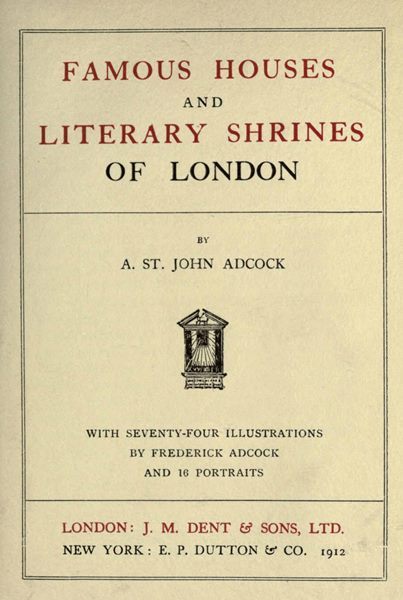
The Project Gutenberg eBook of Famous Houses and Literary Shrines of London
Title: Famous Houses and Literary Shrines of London
Author: Arthur St. John Adcock
Illustrator: Frederick Adcock
Release date: November 24, 2013 [eBook #44269]
Most recently updated: October 23, 2024
Language: English
Credits: Produced by The Online Distributed Proofreading Team at
http://www.pgdp.net (This file was produced from images
generously made available by The Internet Archive.)
FAMOUS HOUSES
AND
LITERARY SHRINES OF LONDON
FAMOUS HOUSES
AND
LITERARY SHRINES
OF LONDON
BY
A. ST. JOHN ADCOCK
WITH SEVENTY-FOUR ILLUSTRATIONS
BY FREDERICK ADCOCK
AND 16 PORTRAITS
LONDON: J. M. DENT & SONS, LTD.
NEW YORK: E. P. DUTTON & CO. 1912
All rights reserved
Printed by Ballantyne, Hanson & Co.
At the Ballantyne Press, Edinburgh
PREFATORY NOTE
Nothing could well be deader or emptier than an unoccupied house of whose former inhabitants we have no knowledge; and it is impossible to take a real interest in a house now occupied by strangers, even though it was aforetime the residence of some famous man, unless we are acquainted with that man’s personality, and know what he thought and did and said whilst he was living there. I have attempted to do little more than supply that information here as the complement of my brother’s drawings, and to this end have been less concerned to give my own descriptions and opinions than to bring together opinions and descriptions that were written by such famous residents themselves or by guests and visitors who saw and knew them. As far as possible I have quoted from contemporary Diaries and Memoirs, especially from letters that were written in or to these houses, or from Journals that their tenants kept whilst they dwelt there, supplementing all this with a narrative of incidents and events that might help to recreate the life and recapture the atmosphere that belonged to such places in the days that have made them memorable. Whenever I have adventured into any general biography, or expressed any personal opinion, it has been merely with the object of adding so much of history and character as would serve to fill in the outline of a man’s portrait, give it a sufficient fulness and colour of life, and throw into clear relief the space of time that he passed in some particular house that can still be seen in a London street.
I think I have throughout made due acknowledgment to the authors of various volumes of Recollections and Table Talk from which I have drawn anecdotes and pen-portraits, and I should like to mention at the outset that for biographical facts and much else I have been particularly indebted to such books as Elwin and Courthope’s edition of the Poems and Letters of Pope; Austin Dobson’s William Hogarth, and H. B. Wheatley’s Hogarth’s London; Boswell’s Johnson, of course, and Forster’s Lives of Goldsmith and of Dickens; Gilchrist’s Life of Blake; Leslie’s and Holmes’s Lives of Constable; Arthur B. Chamberlain’s George Romney; Lord Houghton’s Life and Letters of Keats, and Buxton Forman’s Complete Works of John Keats; Leigh Hunt’s Autobiography; De Quincey’s English Opium Eater; Hogg’s and Peacock’s Memoirs of Shelley; Carew Hazlitt’s Memoirs of Hazlitt; Blackman’s Life of Day; Byron’s Journals and Letters, and Lewis Bettany’s useful compilation from them, The Confessions of Lord Byron; Lockhart’s Life of Scott, and Scott’s Journal; Talfourd’s and Ainger’s Lives of Lamb, and Lamb’s Letters; Walter Jerrold’s Life of Thomas Hood; Cross’s Life of George Eliot; Sir William Armstrong’s Life of Turner, and Lewis Hind’s Turner’s Golden Visions; Joseph Knight’s Rossetti; Froude’s Thomas Carlyle, and W. H. Wylie’s Carlyle, The Man and His Books; Allingham’s Diary; E. R. and J. Pennell’s Life of Whistler; Trollope’s Thackeray, and Lady Thackeray Ritchie’s prefaces to the Centenary Edition of Thackeray’s works.
A. St. J. A.
CONTENTS
| CHAP. | PAGE | |
| I. | Some Celebrated Cockneys | 1 |
| II. | Shakespeare in London | 10 |
| III. | Where Pope stayed at Battersea | 26 |
| IV. | Hogarth | 36 |
| V. | Goldsmith, Reynolds, and some of their Circle | 52 |
| VI. | Homes and Haunts of Johnson and Boswell | 89 |
| VII. | Blake and Flaxman | 118 |
| VIII. | A Hampstead Group | 140 |
| IX. | Round about Soho again | 167 |
| X. | A Philosopher, Two Poets, and a Novelist | 187 |
| XI. | Charles Lamb | 207 |
| XII. | St. John’s Wood and Wimbledon | 233 |
| XIII. | Chelsea Memories | 255 |
| XIV. | Thackeray | 296 |
| XV. | Dickens | 314 |
| XVI. | Conclusion | 328 |
PORTRAITS
| Dr. Johnson | Frontispiece | |
| From an engraving by T. Trotter after a drawing from life | ||
| John Milton | Facing p. | 4 |
| From a miniature by Faithorne | ||
| William Shakespeare | " | 16 |
| From an engraving by Scriven after the Chandos portrait | ||
| Alexander Pope | " | 33 |
| From an engraving by J. Posselwhite after the picture by Hudson | ||
| Oliver Goldsmith | " | 81 |
| After a drawing by Sir Joshua Reynolds | ||
| Sir Joshua Reynolds | " | 96 |
| From an engraving after his own portrait | ||
| James Boswell | " | 102 |
| From an engraving by W. Hall after a sketch by Lawrence | ||
| John Keats | " | 144 |
| From a drawing by W. Hilton | ||
| Thomas de Quincey | " | 176 |
| From an engraving by W. H. Moore | ||
| Lord Byron | " | 193 |
| From a painting by Thomas Phillips, R.A. | ||
| Charles Lamb | " | 224 |
| From the painting by William Hazlitt | ||
| Thomas Hood | " | 241 |
| From an engraving by W. H. Smith | ||
| Thomas Carlyle | " | 280 |
| From a painting by Sir John Millais | ||
| W. M. Thackeray | " | 305 |
| From a pencil sketch by Count D’Orsay | ||
| Charles Dickens | " | 320 |
| From a black and white drawing by Baughiet, 1858 | ||
| Robert Browning | " | 338 |
| From a photograph | ||
ILLUSTRATIONS
| PAGE | |
| St. Saviour’s, Southwark Cathedral | xvi |
| The Gateway, Middle Temple | 6 |
| Chaucer’s Tomb, Westminster Abbey | 8 |
| Jerusalem Chamber, Westminster Abbey | 11 |
| St. Olave’s Churchyard, Silver Street | 17 |
| Bartholomew Close, Smithfield | 21 |
| The Last Bulk Shop, Clare Market | 25 |
| Pope’s House, Battersea | 29 |
| Pope, Mawson’s Row, Chiswick | 37 |
| Sir James Thornhill, 75 Dean Street | 42 |
| Hogarth’s House, Chiswick | 45 |
| The Bay Window, Hogarth’s House | 49 |
| Sir Isaac Newton’s House, St. Martin’s Street, W.C. | 53 |
| Sir Joshua Reynolds’s House, Great Newport Street | 57 |
| The Staircase, 47 Leicester Square | 59 |
| Sir Benjamin West’s House, Newman Street | 61 |
| Gainsborough’s House, Pall Mall | 65 |
| Sheridan’s House, Savile Row | 69 |
| Pump Court, Temple | 73 |
| Richardson’s House, North End, Fulham | 75 |
| Goldsmith’s House, Canonbury | 77 |
| 2 Brick Court, The Temple | 83 |
| Stairs up to Second Floor, 2 Brick Court | 85 |
| Goldsmith’s Grave | 87 |
| Entrance to Staple Inn | 91 |
| Dr. Johnson’s House, Gough Square | 99 |
| Johnson’s Corner, “The Cheshire Cheese” | 107 |
| Where Boswell first met Johnson | 111 |
| Boswell’s House, Great Queen Street | 115 |
| Blake’s House, Soho | 121 |
| Blake, 23 Hercules Road | 125 |
| Blake’s House, South Moulton Street | 127 |
| Flaxman’s House, Buckingham Street, Euston Road | 137 |
| Romney’s House, Hampstead | 141 |
| Constable, Charlotte Street | 145 |
| Joanna Baillie, Windmill Hill, Hampstead | 147 |
| Stanfield’s House, Hampstead | 151 |
| “The Upper Flask,” from the Bowling Green | 153 |
| Keats’ House, Hampstead | 157 |
| Constable’s House, Hampstead | 161 |
| George du Maurier’s Grave, Hampstead | 165 |
| De Quincey’s House, Soho | 171 |
| Shelley’s House, Poland Street, W. | 175 |
| Shelley, Marchmont Street | 179 |
| Hazlitt’s House, Frith Street | 183 |
| Thomas Day, 36 Wellclose Square | 189 |
| Byron, 4 Bennet Street, St. James’s | 195 |
| Coleridge, Addison Bridge Place | 201 |
| Will’s Coffee House, Russell Street | 217 |
| Lamb, Colebrooke Row | 219 |
| Lamb’s Cottage, Edmonton | 229 |
| Tom Hood’s House, St. John’s Wood | 237 |
| Charles Dibdin, 34 Arlington Road | 243 |
| George Eliot, Wimbledon Park | 247 |
| George Eliot’s House, Chelsea | 251 |
| Queen’s House, Cheyne Walk | 257 |
| Whistler, 96 Cheyne Walk | 263 |
| Turner’s House, Cheyne Walk | 269 |
| Carlyle, Ampton Street | 277 |
| Carlyle’s House, Cheyne Row | 283 |
| Leigh Hunt’s House, Chelsea | 289 |
| Leigh Hunt, 16 Rowan Road, Hammersmith | 295 |
| The Charterhouse, from the Square | 297 |
| Thackeray’s House, Kensington | 301 |
| Lamb Building, Temple, from the Cloisters | 307 |
| Dickens, Johnson Street, Camden Town | 315 |
| Dickens’s House, Doughty Street | 319 |
| Thurloe’s Lodgings, 24 Old Square, Lincoln’s Inn | 329 |
| Captain Marryat, Duke Street, St. James’s | 333 |
| Benjamin Franklin’s House, Craven Street | 335 |
| Cruikshank, 263 Hampstead Road | 337 |
| George Morland, “The Bull Inn,” Highgate | 339 |
| Rogers, St. James’s Place, from Green Park | 341 |
| Borrow’s House, Hereford Square | 345 |
ST. SAVIOUR’S. SOUTHWARK CATHEDRAL.
FAMOUS LONDON HOUSES
CHAPTER I
SOME CELEBRATED COCKNEYS
You cannot stir the ground of London anywhere but straightway it flowers into romance. Read the inscriptions on the crumbling tombs of our early merchant princes and adventurers in some of the old City churches, and it glimmers upon you that if ever the history of London’s commercial rise and progress gets adequately written it will read like a series of stories out of the Arabian Nights. Think what dashing and magnificent figures, what tales of dark plottings, fierce warfare, and glorious heroisms must brighten and darken the pages of any political history of London; and even more glamorous, more intensely and humanly alive, would be a social history of London, beginning perhaps in those days of the fourteenth century when Langland was living in Cornhill and writing his Vision of Piers Plowman, or farther back still, in Richard the First’s time, when that fine spirit, the first of English demagogues, William Fitzosbert, was haranguing the folkmoot in St. Paul’s Churchyard, urging them to resist the tyrannic taxations of the Lord Mayor and his Court of wealthy Aldermen—a passion for justice that brought him into such danger that he and certain of his friends had to seek sanctuary, and barricaded themselves in Bow Church. The church was fired by order of a bishop who had no sympathy with reformers, and Fitzosbert and his friends, breaking out through the flames, were stabbed and struck down in Cheapside, hustled to the Tower, hastily tried and sentenced, dragged out by the heels through the streets, and hanged at Smithfield. I have always thought this would make a good, live starting-point, and had I but world enough and time I would sooner write that history than anything else.
No need to hunt after topics when you are writing about London; they come to you. The air is full of them. The very names of the streets are cabalistic words. Once you know London, myriads of great spirits may be called from the vasty deep by sight or sound of such names as Fleet Street, Strand, Whitehall, Drury Lane, The Temple, Newgate Street, Aldersgate, Lombard Street, Cloth Fair, Paternoster Row, Holborn, Bishopsgate, and a hundred others. You have only to walk into Whitefriars Street and see “Hanging-sword Alley” inscribed on the wall of a court at the top of a narrow flight of steps, and all Alsatia rises again around you, as Ilion rose like a mist to the music of Apollo’s playing. Loiter along Cornhill in the right mood and Thomas Archer’s house shall rebuild itself for you at the corner of Pope’s Head Alley, where he started the first English newspaper in 1603, and you will wonder why nobody writes a full history of London journalism.
As for literary London—every other street you traverse is haunted with memories of poets, novelists, and men of letters, and it is some of the obscurest of these associations that are the most curiously fascinating. I have a vivid, youthful remembrance of a tumble-down, red-tiled shop near the end of Leathersellers’ Buildings which I satisfied myself was the identical place in which Robert Bloomfield worked as a shoemaker’s assistant; Devereux Court still retains something of the Grecian Coffee-house that used to be frequented by Addison and Steele, but I knew the Court first, and am still drawn to it most, as the site of that vanished Tom’s Coffee-house where Akenside often spent his winter evenings; and if I had my choice of bringing visibly back out of nothingness one of the old Charing Cross houses, it would be the butcher’s shop that was kept by the uncle who adopted Prior in his boyhood.
Plenty of unpleasant things have been said about London, but never by her own children, or such children of her adoption as Johnson and Dickens. Says Hobbes, who was born at Malmesbury, “London has a great belly, but no palate,” and Bishop Stubbs (a native of Knaresborough) more recently described it as “always the purse, seldom the head, and never the heart of England.” Later still an eminent speaker, quoting this fantastic dictum of Stubbs’s, went a step further and informed his audience that “not many men eminent in literature have been born in London”; a statement so demonstrably inaccurate that one may safely undertake to show that at least as many men eminent in literature, to say nothing of art and science, have been born in London as in any other half-dozen towns of the kingdom put together.
To begin with, the morning star of our literature, Geoffrey Chaucer, was born in Thames Street, not far from the wharf where, after he was married and had leased a home for himself in Aldgate, he held office as a Comptroller of Customs, and the pen that was presently to write the Canterbury Tales “moved over bills of lading.” The “poets’ poet,” Spenser, was born in East Smithfield, by the Tower, and in his Prothalamion speaks of his birthplace affectionately as—
“Merry London, my most kindly nurse,
That to me gave this life’s first native source,
Though from another place I take my name.”
Ben Jonson was born in Hartshorn Lane, Charing Cross; four of his contemporary dramatists, Fletcher, Webster, Shirley and Middleton, were also Londoners by birth; Sir Thomas Browne, author of the Religio Medici, was born in the parish of St. Michael-le-Quern, in the very heart of the city; and Bread Street, Cheapside, is hallowed by the fact that Milton had his birth there.
Dr. Donne, the son of a London merchant, was also born within a stone’s throw of Cheapside; and his disciple, Cowley, came into the world in Fleet Street, at the corner of Chancery Lane. But Cowley was a renegade; he acquired an unnatural preference for the country, and not only held that “God the first garden made, and the first city Cain,” but ended a poem in praise of nature and a quiet life with—
“Methinks I see
The monster London laugh at me;
I should at thee too, foolish city,
If it were fit to laugh at misery;
But thy estate I pity.
Let but thy wicked men from out thee go,
And all the fools that crowd thee so,
Even thou, who dost thy millions boast,
A village less than Islington wilt grow,
A solitude almost.”
JOHN MILTON
The daintiest of our lyrists, Herrick, was born over his father’s shop in Cheapside, and you may take it he was only playing with poetical fancies when, in some lines to his friend Endymion Porter, he praised the country with its “nut-brown mirth and russet wit,” and again when, in a set of verses on “The Country Life,” he assured his brother he was “thrice and above blest,” because he could—
“Leave the city, for exchange, to see
The country’s sweet simplicity.”
If you want to find him in earnest, turn to that enraptured outburst of his on “His Return to London”—
“Ravished in spirit I come, nay more I fly
To thee, blessed place of my nativity!...
O place! O people! manners framed to please
All nations, customs, kindreds, languages!
I am a free-born Roman; suffer then
That I amongst you live a citizen.
London my home is, though by hard fate sent
Into a long and irksome banishment;
Yet since called back, henceforward let me be,
O native country! repossessed by thee;
For rather than I’ll to the West return,
I’ll beg of thee first here to have mine urn.”
There speaks the true Cockney; he would sooner be dead in London than alive in the West of England. Even Lamb’s love of London was scarcely greater than that.
THE GATEWAY. MIDDLE TEMPLE.
It was fitting that Pope, essentially a town poet, should be born in Lombard Street. In the next thoroughfare, Cornhill, Gray was born; and, son of a butcher, Defoe began life in the parish of St. Giles’s, Cripplegate. Shakespeare was an alien, but Bacon was born at York House, in the Strand; which, to my thinking, is the strongest argument in favour of the theory that he wrote the plays. Churchill was born at Vine Street, Westminster; Keats in Moorfields; and, staunchest and one of the most incorrigible Londoners of them all, Charles Lamb in Crown Office Row, Temple. He refers, in one of his essays, to Hare Court, in the Temple, and says: “It was a gloomy, churchyard-like court, with three trees and a pump in it. I was born near it, and used to drink at that pump when I was a Rechabite of six years old.” The pump is no longer there, only one half of Hare Court remains as it was in Lamb’s day, and Crown Office Row has been rebuilt. His homes in Mitre Court Buildings and Inner Temple Lane have vanished also; but the Temple is still rich in reminiscences of him. Paper Buildings, King’s Bench Walk, Harcourt Buildings, the fountain near Garden Court, the old Elizabethan Hall, in which tradition says Shakespeare read one of his plays to Queen Elizabeth—these and the church, the gardens, the winding lanes and quaint byways of the Temple, made up, as he said, his earliest recollections. “I repeat to this day,” he writes, “no verses to myself more frequently, or with kindlier emotion, than those of Spenser, where he speaks of this spot—
‘There when they came whereas those bricky towers
The which on Themmes broad aged back doth ride,
Where now the studious lawyers have their bowers,
There whylome wont the Templar knights to bide,
Till they decayed through pride.’”
And, “indeed,” he adds, “it is the most elegant spot in the metropolis.”
CHAUCER’S TOMB. WESTMINSTER ABBEY.
But his letters and essays are full of his love of London. “I don’t care much,” he wrote to Wordsworth, “if I never see a mountain. I have passed all my days in London, until I have formed as many and intense local attachments as any of your mountaineers can have done with dead Nature.... I often shed tears in the motley Strand from fulness of joy in so much life.” Again, “Fleet Street and the Strand,” he writes to Manning, “are better places to live in for good and all than amidst Skiddaw.” After he had removed to Edmonton, on account of his sister’s health, it was to Wordsworth he wrote, saying how he pined to be back again in London: “In dreams I am in Fleet Market, but I wake and cry to sleep again.... Oh, never let the lying poets be believed who ’tice men from the cheerful haunts of streets.... A garden was the primitive prison, till man, with Promethean felicity and boldness, luckily sinned himself out of it. Thence followed Babylon, Nineveh, Venice, London.... I would live in London shirtless, bookless.”
But to get back to our catalogue of birthplaces—Blake was born in Broad Street, near Golden Square; Byron in Holles Street; Hood in the Poultry, within sight of the Mansion House; Dante and Christina Rossetti were Londoners born; so were Swinburne, Browning, Philip Bourke Marston, John Stuart Mill, Ruskin, Turner, Holman Hunt, Sir Arthur Sullivan—but if we go outside literary Londoners this chapter will end only with the book. Moreover, my purpose is not so much to talk of authors and artists who were born in London, as to give some record of the still surviving houses in which many of them lived; whether they had their birth here or not, the majority of them came here to live and work, for, so far as England is concerned, there is more than a grain of truth in Lamb’s enthusiastic boast that “London is the only fostering soil of genius.”
CHAPTER II
SHAKESPEARE IN LONDON
The London that Shakespeare knew has vanished like a dream. The Great Fire swept most of it out of existence in a few days of 1666, and the two and a half centuries of time since then have made away with nearly all the rest of it. The Tower still remains; there are parts of the Temple; a stray relic or so, such as the London Stone in Cannon Street, by which Shakespeare lays one of the Jack Cade scenes of his Henry VI. There are the stately water-gates along the Embankment, too; here and there an old house or so, such as that above the Inner Temple gateway, those of Staple Inn, those in Cloth Fair, and over in the Borough High Street; a few ancient Inns, like the Mitre off Ely Place, the Dick Whittington in Cloth Fair, the George in Southwark; some dozen of churches, including Westminster Abbey (in whose Jerusalem Chamber the translators of the Bible held their meetings), St. Saviour’s, Southwark, St. Bartholomew the Great in Smithfield, St. Andrew Undershaft, St. Ethelburga’s and St. Helen’s, Bishopsgate, in which latter parish it seems probable that Shakespeare was for a while a householder; otherwise Elizabethan London has dwindled to little but remembered sites of once-famous buildings and streets that have changed in everything but their names.
JERUSALEM CHAMBER. WESTMINSTER ABBEY.
Until quite recently none of us knew of any address in London that had ever been Shakespeare’s; we knew of no house, of no street even, which had once numbered him among its tenants, though we know that he passed at least twenty of the busiest and most momentous years of his life in the metropolis. There is a plausible but vague tradition that during some part of that period he had lodgings in Southwark near the Globe Theatre, in which he acted, for which he wrote plays, and of which he was one of the proprietors. There used to be an inscription: “Here lived William Shakespeare,” on the face of an old gabled house in Aldersgate Street, but there was never a rag of evidence to support the statement. We have no letters of Shakespeare, but we have one or two that refer to him, and one written to him by Richard Quiney, and I think we may infer from this latter that Shakespeare occasionally visited Quiney, who was a vintner, dwelling at the sign of the Bell in Carter Lane. Otherwise, except for a handful of small-beer chronicles about him that were picked up in theatrical circles two or three generations after his death, we had no record of any incident in his London life that brought us into actual personal touch with him until little more than two years ago. Then an American professor, Mr. Charles William Wallace, came over and did what our English students do not appear to have had the energy or enterprise to do for themselves—he toiled carefully through the dusty piles of documents preserved in the Record Office, and succeeded in unearthing one of the most interesting Shakespearean discoveries that have ever been made—a discovery that gives us vividly intimate glimpses of Shakespeare’s life in London, and establishes beyond question his place of residence here in the years when he was writing some of the greatest of his dramas.
In 1587 the company of the “Queen’s Players” made their first appearance in Stratford-on-Avon, and it was about this date, so far as can be traced, that Shakespeare ran away from home; so you may reasonably play with a fancy that he joined this company in some very minor capacity and travelled with them to London. At this time, Burbage, who was by profession an actor and by trade a carpenter and joiner, was owner and manager of “The Theatre,” which stood in Shoreditch near the site of the present Standard Theatre, and close by was a rival house, “The Curtain” (commemorated nowadays by Curtain Road); and according to the legend, which has developed into a legend of exact detail, yet rests on nothing but the airiest rumour, it was outside one or both of these theatres Shakespeare picked up a living on his arrival in London by minding horses whilst their owners were inside witnessing a performance.
By 1593 Shakespeare had become known as an actor and as a dramatist. He had revised and tinkered at various plays for Burbage’s company, and as a consequence had been charged with plagiarism by poor Greene, whose Groatsworth of Wit (published after he had died miserably in Dowgate) pours scorn on the “upstart crow, beautified with our feathers, that with his Tygers heart wrapt in a players hide supposes he is as well able to bumbast out a blank verse as the best of you; and being an absolute Johannes fac totum, is in his own conceit the only Shake-scene in a countrie.” For his acting, Shakespeare appears for the first time in the Lord Chamberlain’s accounts of 1594 as having taken equal shares with William Kemp and Richard Burbage in a sum of twenty pounds “for two severall Comedies or Interludes shewed by them” before Queen Elizabeth at Christmas 1593.
After the Theatre of Shoreditch was pulled down in 1598, Burbage built the Globe Theatre on Bankside, Southwark, on the ground of which part of Barclay & Perkins’s brewery now stands; and Shakespeare, “being a deserveing man,” was taken as one of the partners and received a “chief-actor’s share” of the profits. And it is to this prosperous period of his London career that Professor Wallace’s recent discoveries belong.
In 1598 there lived in a shop at the corner of Silver Street and Monkwell Street a certain Christopher Mountjoy, a maker of wigs and fashionable headdresses. He was a Frenchman, born at Cressy, and probably a refugee Huguenot. His household consisted of a wife and daughter, an apprentice named Stephen Bellott, and one lodger, and this lodger was William Shakespeare. Being out of his apprenticeship in 1604, Stephen had six pounds from his master and, with this and his own savings, went travelling into Spain, but returned towards the end of the year and resumed work again at Mountjoy’s shop. In his ’prentice days Stephen seems to have formed some shy attachment to his master’s daughter, Mary, but because of his lack of means and prospects, or because he was naturally reticent, he had made no attempt to press his suit, and Madame Mountjoy, seeing how the young people were affected to each other, followed the fashion of the time and persuaded Shakespeare, who had then been living under the same roof with them for six years, to act as match-maker between her and the hesitating lover. She one day laid the case before Shakespeare and asked his good offices, as Professor Wallace has it; she told him that “if he could bring the young man to make a proposal of marriage, a dower fitting to their station should be settled upon them at marriage. This was the sum of fifty pounds in money of that time, or approximately four hundred pounds in money of to-day.” Shakespeare consented to undertake this delicate duty; he spoke with young Bellott, and the outcome of his negotiations was that Stephen and Mary were married, as the entry in the church register shows, at St. Olave, Silver Street, on the 19th November 1604.
On the death of Madame Mountjoy in 1606, Stephen and his wife went back to live with the father and help him in his business, but they soon fell out with him, and became on such bad terms that some six months later they left him and took lodgings with George Wilkins, a victualler, who kept an inn in the parish of St. Sepulchre’s. The quarrel between them culminated in Stephen Bellott bringing an action in the Court of Requests in 1612, to recover from his father-in-law a promised dower of sixty pounds and to ensure that Mountjoy carried out an alleged arrangement to bequeath a sum of two hundred pounds to him by his will. At the Record Office Professor Wallace found all the legal documents relating to these proceedings, and amongst them are the depositions of Shakespeare setting forth to the best of his recollection his own share in the arranging of the marriage. From these depositions, and from those of other witnesses who make reference to him, one gets the first clear and authentic revelation of Shakespeare’s home life in London.
He lived with the Mountjoys over that shop at the corner of Monkwell Street for at least six years, down to the date of the wedding, and there is little doubt that he stayed on with them after that. It is more than likely, indeed, that he was still boarding there when he appeared as a witness in the 1612 lawsuit and stated that he had been intimate with the family some “ten years, more or less.” Throughout the later of those years he was absent on occasional visits to Stratford, and hitherto it has been generally assumed (on the negative evidence that no trace of him could be found after this date) that he returned and settled down in Stratford permanently about 1609.
Taking only the six years we are certain of, however, he wrote between 1598 and 1604 Henry V., The Merry Wives of Windsor, Much Ado About Nothing, As You Like It, Twelfth Night, All’s Well that Ends Well, Julius Cæsar, Hamlet, Measure for Measure, and Othello. In the two years following, whilst it is pretty sure he was still dwelling with the Mountjoys, he wrote Macbeth and King Lear, and the fact that he had his home here during the period in which he was writing ten of his plays—three of them amongst the greatest he or any man ever wrote—makes this corner of Monkwell Street the most glorious literary landmark in the world.
WILLIAM SHAKESPEARE
The house in which he lodged was destroyed by the Great Fire, and the site is occupied now by an old tavern, “The Cooper’s Arms.” Almost facing it, just the other side of Silver Street, is a fragment of the churchyard of St. Olave’s. The church, in which the apprentice Stephen was married to Mary Mountjoy, vanished also in the Great Fire and was not rebuilt, and this weedy remnant of the churchyard with its three or four crumbling tombs is all that survives of the street as Shakespeare knew it; his glance must have rested on that forlorn garden of the dead as often as he looked from the windows opposite or came out at Mountjoy’s door.
ST. OLAVE’S CHURCHYARD. SILVER STREET.
Turning to the right when he came out at that door, half a minute’s walk up Falcon Street would have brought him into Aldersgate Street, so the announcement on one of the shops there that he had lived in it may have been nothing worse than a perfectly honest mistake; it was known as a fact that he lived thereabouts, and tradition settled on the wrong house instead of on the right one, that was a hundred yards or so away from it. But when Shakespeare issued from Mountjoy’s shop you may depend that his feet more frequently trod the ground in the opposite direction; he would go to the left, along Silver Street, into Wood Street, and down the length of that to Cheapside, where, almost fronting the end of Wood Street, stood the Mermaid Tavern, and he must needs pass to the right or left of it, by way of Friday Street, or Bread Street, across Cannon Street and then down Huggin Lane or Little Bread Street Hill to Thames Street, whence, from Queenhithe, Puddle Wharf, or Paul’s Wharf, he could take boat over the Thames to the Globe Theatre on Bankside.
There has been no theatre on Bankside these many years; there is nothing there or in that vicinity now that belongs to Shakespeare’s age except some scattered, ancient, inglorious houses that he may or may not have known and the stately cathedral of St. Saviour. This holds still the span of ground that has belonged to it since before Chaucer’s day. You may enter and see there the quaint effigy of Chaucer’s contemporary, Gower, sleeping on his five-century-old tomb; and here and there about the aisles and in the nave are memorials of remembered or forgotten men and women who died while Shakespeare was living, and somewhere in it were buried men, too, who were intimate with him, though no evidence of their burial there remains except in the parish register. In the “monthly accounts” of St. Saviour’s you come upon these entries concerning two of his contemporary dramatists:—