
The Project Gutenberg eBook of Famous Men and Great Events of the Nineteenth Century
Title: Famous Men and Great Events of the Nineteenth Century
Author: Charles Morris
Release date: May 23, 2014 [eBook #45733]
Most recently updated: October 24, 2024
Language: English
Credits: E-text prepared by KD Weeks, David Garcia, Marilynda Fraser-Cunliffe, and the Online Distributed Proofreading Team (http://www.pgdp.net) from page images generously made available by Internet Archive (https://archive.org)
The Project Gutenberg eBook, Famous Men and Great Events of the Nineteenth Century, by Charles Morris
| Note: | Images of the original pages are available through Internet Archive. See https://archive.org/details/famousmengreatev00morr |
Transcriber’s Note
The many illustrations have been moved to fall on paragraph breaks. As a result, on occasion, the pagination will be locally disrupted. Between the Introduction and Chapter I there are two full-page illustrations, but the pagination skips four pages. On the other hand the illustrations between pp. 94 and 95 were not included in the pagination. The occasional blank pages have been omitted. In any case, the page numbers provided here reflect those which were printed.
Footnotes were relocated from the end of page to the end of the text and linked for easy reference.
Please see the transcriber’s notes at the end of this text for a more complete account of any other textual issues and their resolution.
The above symbolic picture, after the master painting of Paul Sinibaldi, explains the secret of the wonderful progress of the past 100 years. The genius of Industry stands in the centre. To her right sits Chemistry; to the left the geniuses of Electricity with the battery, the telephone, the electric light; there also are the geniuses of Navigation with the propeller, and of Literature and Art, all bringing their products to Industry who passes them through the hands of Labor in the foreground to be fashioned for the use of mankind.
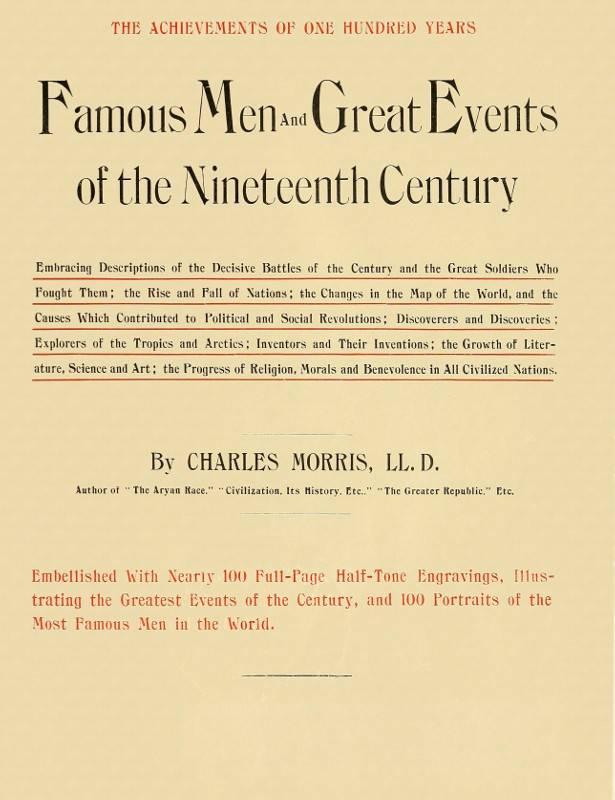
THE ACHIEVEMENTS OF ONE HUNDRED YEARS
Famous Men And Great Events
of the Nineteenth Century
Embracing Descriptions of the Decisive Battles of the Century and the Great Soldiers Who Fought Them; the Rise and Fall of Nations; the Changes in the Map of the World, and the Causes Which Contributed to Political and Social Revolutions; Discoverers and Discoveries; Explorers of the Tropics and Arctics; Inventors and Their Inventions; the Growth of Literature, Science and Art; the Progress of Religion, Morals and Benevolence in All Civilized Nations.
By CHARLES MORRIS, LL. D.
Author of “The Aryan Race,” “Civilization, Its History, Etc.,” “The Greater Republic,” Etc.
Embellished With Nearly 100 Full-Page Half-Tone Engravings, Illustrating the Greatest Events of the Century, and 100 Portraits of the Most Famous Men in the World.
Entered according to Act of Congress in the year 1899, by
W. E. SCULL,
in the office of the Librarian of Congress, at Washington.
ALL RIGHTS RESERVED.
LIST OF CHAPTERS AND SUBJECTS
| Introduction | PAGE |
| A Bird’s-eye View—Tyranny and Oppression in the Eighteenth Century—Government and the Rights of Man in 1900—Prisons and Punishment in 1900—The Factory System and Oppression of the Workingman—Suffrage and Human Freedom—Criminal Law and Prison Discipline in 1800—The Era of Wonderful Inventions—The Fate of the Horse and the Sail—Education, Discovery and Commerce | 23 |
| CHAPTER I | |
| The Threshold of the Century | |
| The Age We Live in and its Great Events—True History and the Things Which Make It—Two of the World’s Greatest Events—The Feudal System and Its Abuses—The Climax of Feudalism in France—The States General is Convened—The Fall of the Bastille—King and Queen Under the Guillotine—The Reign of Terror—The Wars of the French Revolution—Napoleon in Italy and Egypt—England as a Centre of Industry and Commerce—The Condition of the German States—Dissension in Italy and Decay in Spain—The Partition of Poland by the Robber Nations—Russia and Turkey | 33 |
| CHAPTER II | |
| Napoleon Bonaparte; The Man of Destiny | |
| A Remarkable and Wonderful Career—The Enemies and Friends of France—Movements of the Armies in Germany and Italy—Napoleon Crosses the Alps at St. Bernard Pass—The Situation in Italy—The Famous Field of Marengo—A Great Battle Lost and Won—The Result of the Victory of Marengo—Napoleon Returns to France—Moreau and the Great Battle of Hohenlinden—The Peace of Luneville—The Peace of Amiens—The Punishment of the Conspirators and the Assassination of the Duke d’Enghien—Napoleon Crowned Emperor of the French—The Great Works Devised By the New Emperor | 44 |
| CHAPTER III | |
| Europe in the Grasp of the Iron Hand | |
| Great Preparations for the Invasion of England—Rapid March on Austria—The Surrender of General Mack—The Eve Before Austerlitz—The Dreadful Lake Horror—Treaty of Peace With Austria—Prussian Armies in the Field—Defeat of the Prussians at Jena and Auerstadt—Napoleon Divides the Spoils of Victory—The Frightful Struggle at Eylau—The Cost of Victory—The Total Defeat of the Russians—The Emperors at Tilsit and the Fate of Prussia—The Pope a Captive at Fontainebleau—Andreas Hofer and the War in Tyrol—Napoleon Marches Upon Austria—The Battle of Eckmuhl and the Capture of Ratisbon—The Campaign in Italy—The Great Struggle of Essling and Aspern—Napoleon Forced to His First Retreat—The Second Crossing of the Danube—The Victory at Wagram—The Peace of Vienna—The Divorce of Josephine and Marriage of Maria Louisa | 57 |
| CHAPTER IV | |
| The Decline and Fall of Napoleon’s Empire | |
| The Causes of the Rise and Decline of Napoleon’s Power—Aims and Intrigues in Portugal and Spain—Spain’s Brilliant Victory and King Joseph’s Flight—The Heroic Defence of Saragossa—Wellington’s Career in Portugal and Spain—The Invasion of Russia by the Grand Army—Smolensk Captured and in Flames—The Battle of Borodino—The Grand Army in the Old Russian Capital—The Burning of the Great City of Moscow—The Grand Army Begins its Retreat—The Dreadful Crossing of the Beresina—Europe in Arms Against Napoleon—The Battle of Dresden, Napoleon’s Last Great Victory—The Fatal Meeting of the Armies at Leipzig—The Break-up of Napoleon’s Empire—The War in France and the Abdication of the Emperor—Napoleon Returns From Elba—The Terrible Defeat at Waterloo—Napoleon Meets His Fate | 83 |
| CHAPTER V | |
| Nelson and Wellington, the Champions of England | |
| England and France on Land and Sea—Nelson Discovers the French Fleet in Aboukir Bay—The Glorious Battle of the Nile—The Fleet Sails for Copenhagen—The Danish Line of Defence—The Attack on the Danish Fleet—How Nelson Answered the Signal to Cease Action—Nelson in Chase of the French Fleet—The Allied Fleet Leaves Cadiz—Off Cape Trafalgar—The “Victory” and Her Brilliant Fight—The Great Battle and its Sad Disaster—Victory for England and Death for Her Famous Admiral—The British in Portugal—The Death of Sir John Moore—The Gallant Crossing of the Douro—The Victory at Talavera and the Victor’s Reward—Wellington’s Impregnable Lines at Torres Vedras—The Siege and Capture of the Portuguese Fortresses—Wellington Wins at Salamanca and Enters Madrid—Vittoria and the Pyrenees—The Gathering of the Forces at Brussels—The Battlefield of Waterloo—The Desperate Charges of the French—Blücher’s Prussians and the Charge of Napoleon’s Old Guard | 101 |
| CHAPTER VI | |
| From the Napoleonic Wars to the Revolution 1830 | |
| A Quarter Century of Revolution—Europe After Napoleon’s Fall—The Work of the Congress—Italy, France and Spain—The Rights of Man—The Holy Alliance—Revolution in Spain and Naples—Metternich and His Congresses—How Order Was Restored in Spain—The Revolution in Greece—The Powers Come to the Rescue of Greece—The Spirit of Revolution—Charles X. and His Attempt at Despotism—The Revolution in Paris—Louis Phillippe Chosen as King—Effect in Europe of the Revolution—The Belgian Uprising and its Result—The Movements in Germany—The Condition of Poland—The Revolt of the Poles—A Fatal Lack of Unity—The Fate of Poland | 116 |
| CHAPTER VII | |
| Bolivar, the Liberator of Spanish America | |
| How Spain Treated Her Colonies—The Oppression of the People—Bolivar the Revolutionary Leader—An Attempt at Assassination—Bolivar Returns to Venezuela—The Savage Cruelty of the Spaniards—The Methods of General Morillo—Paez the Guerilla and His Exploits—British Soldiers Join the Insurgents—Bolivar’s Plan to Invade New Granada—The Crossing of the Andes—The Terror of the Mountains—Bolivar’s Methods of Fighting—The Victory at Boyaca—Bolivar and the Peruvians—The Freeing of the Other Colonies | 128 |
| CHAPTER VIII | |
| Great Britain as a World Empire | |
| Napoleonic Wars’ Influence—Great Awakening in Commerce— Developments of the Arts—Growth of the Sciences—A Nation Noted for Patriotism—National Pride—Conscious Strength— Political Changes and Their Influence—Great Statesmen of England | 141 |
| CHAPTER IX | |
| The Great Reform Bill and the Corn Laws | |
| Causes of Unrest—Demands of the People—The Struggle for Reform in 1830—The Corn Laws—Free Trade in Great Britain—Cobden the Apostle of Free Trade—Other Promoters of Reform—England’s Enlarged Commerce | 147 |
| CHAPTER X | |
| Turkey the “Sick Man” of Europe | |
| The Sultan’s Empire in 1800—Revolts in Her Dependencies—Greece Gains Her Freedom—The Sympathy of the Christian World—Russian Threats—The Crimean War and its Heroes—The War of 1877—The Armenian Massacres—The Nations Warn off Russia—War in Crete and Greece in 1897—The Tottering Nation of to-day—The “Sick Man” | 156 |
| CHAPTER XI | |
| The European Revolution of 1848 | |
| Corrupt Courts and Rulers—The Spirit of Liberty Among the People—Bourbonism—Revolutionary Outbreak in France—Spreads to Other Countries—The Struggle in Italy—In Germany—The Revolt in Hungary—The Career of Kossuth the Patriot, Statesman and Orator—His Visit to America—Defeat of the Patriots by Austria and Hungary—General Haynau the Cruel Tyrant—Later History of Hungary | 167 |
| CHAPTER XII | |
| Louis Napoleon and the Second French Empire | |
| The Power of a Great Name—The French People Love the Name Napoleon—Louis Napoleon’s Personality—Elected President—The Tricks of His Illustrious Ancestor Imitated—Makes Himself Emperor—The War With Austria—Sends an Army to Mexico—Attempt to Establish an Empire in America—Maximilian Made Emperor in the New World—His Sad Fate—War With Germany—Louis Napoleon Dethroned | 178 |
| CHAPTER XIII | |
| Garibaldi and the Unification of Italy | |
| The Many Little States of Italy—Secret Movements for Union—Mazzini the Revolutionist—Tyranny of Austria and Naples—War in Sardinia—Victor Emanuel and Count Cavour—Garibaldi in Arms—The French in Rome—Fall of the Papal City—Rise of the New Italy—Naval War With Austria | 194 |
| CHAPTER XIV | |
| Bismarck and the New Empire of Germany | |
| The State of Prussia—Sudden Rise to Power—Bismarck Prime Minister—War With Denmark—With Austria—With France—Metz and Sedan—Von Moltke—The Fall of Paris—William I. Crowned Emperor—United Germany—Bismarck and the Young Kaiser—Peculiarities of William II.—Germany of To-Day | 207 |
| CHAPTER XV | |
| Gladstone the Apostle of Liberalism in England | |
| Sterling Character of the Man—His Steady Progress to Power—Becomes Prime Minister—Home and Foreign Affairs Under His Administration—His Long Contest With Disraeli—Early Conservatism Later Liberalism—Home Rule Champion—Result of Gladstone’s Labors | 243 |
| CHAPTER XVI | |
| Ireland the Downtrodden | |
| Ancient Ireland—English Domination—Oppression—Patriotic Struggles Against English Rule—Robert Emmet and His Sad Fate—Daniel O’Connell—Grattan, Curran and Other Patriots—The Fenians—Gladstone’s Work for Ireland—Parnell, the Irish Leader in Parliament—Ireland of the Present | 259 |
| CHAPTER XVII | |
| England and Her Indian Empire | |
| Why England Went to India—Lord Clive and the East India Company—Sir Arthur Wellesley—Trouble With the Natives—Subjugation of Indian States—The Great Mutiny—Havelock—Relief of Lucknow—Repulse From Afghanistan—Conquest of Burmah—Queen Victoria Crowned Empress of India—What English Rule Has Done for the Orient—A Vast Country Teeming With Population—Its Resources and Its Prospects | 268 |
| CHAPTER XVIII | |
| Thiers, Gambetta and the Rise of the New French Republic | |
| French Instability of Character—Modern Statesmen of France—Thiers—MacMahon—Gambetta—The New Republic—Leaders in Politics—Dangerous Powers of the Army—Moral and Religious Decline—Law and Justice—The Dreyfus Case as an Index to France’s National Character and the Perils Which Beset the Republic | 277 |
| CHAPTER XIX | |
| Paul Kruger and South Africa | |
| Review of the Boers—Their Establishment in Cape Colony—The Rise and Progress of the Transvaal Republic—Diamond Mines and Gold Discoveries—England’s Aggressiveness—The Career of Cecil Rhodes—Attempt to Overthrow the Republic—The Zulus and Neighboring Peoples—The Uitlanders—Political Struggle of England and Paul Kruger—Chamberlain’s Demands—The Boers’ Firm Stand—War of 1899 | 295 |
| CHAPTER XX | |
| The Rise of Japan and the Decline of China | |
| Former Cloud of Mystery Surrounding These Two Nations—Ancient Civilizations—Closed Territory to the Outside World—Their Ignorance of Other Nations—The Breaking Down of the Walls in the Nineteenth Century—Japan’s Sudden Rise to Power—Aptness to Learn—The Yankees of the East—Conditions of Conservatism Holds on in China—Li Hung Chang Rises into Prominence—The Corean Trouble—War Between China and Japan—The Battle of Yalu River—Admiral Ito’s Victory—Japanese Army Invades the Celestial Empire—China Surrenders—European Nations Demand Open Commerce—Threatened Partition | 309 |
| CHAPTER XXI | |
| The Era of Colonies | |
| Commerce the Promoter of Colonization—England’s Wise Policy—The Growth of Her Colonies Under Liberal Treatment—India—Australia—Africa—Colonies of France and Germany—Partition of Africa—Progress of Russia in Asia—Aggressiveness of the Czar’s Government—The United States Becomes a Colonizing Power—The Colonial Powers and Their Colonies at the Close of the Century | 323 |
| CHAPTER XXII | |
| How the United States Entered the Century | |
| A Newly Formed Country—Washington, the National Capital—Peace With France—Nations of State Sovereignty—State Legislatures and the National Congress—The Influence of Washington—The Supreme Court and its Powers—Population of Less Than Four Millions—No City of 50,000 Inhabitants in America—Sparsely Settled Country—Savages—Trouble With Algiers—War Declared by Tripoli—Thomas Jefferson Elected President | 343 |
| CHAPTER XXIII | |
| Expansion of the United States From Dwarf to Giant | |
| Ohio Admitted in 1802—Louisiana Purchased From French 1803—Admission of the States—Florida Transferred to the United States 1819—The First Railway in 1826—Indians Cede Their Illinois Lands in 1830—Invention of Telegraph 1832—Fremont’s Expeditions to the Pacific Slope—Conquest of Mexico—Our Domain Established From Ocean to Ocean 1848—The Purchase of Alaska From Russia 1867—Rapid Internal Growth—Cities Spring up on the Plains—A Marvelous Era of Peace—Through the Spanish-American War Comes the Acquisition of First Tropical Territory—From East to West America’s Domain Reaches Half-way Around the World—Three Cities Each With Over 1,000,000 Inhabitants | 351 |
| CHAPTER XXIV | |
| The Development of Democratic Institutions In America | |
| Colonization and its Results—Religious Influences—Popular Rights—Limitations—Colonial Legislatures—The Money Question—Taxation—Confederation—The Franchise—Property Qualifications—Growth of Western Ideas—Contrast Between Institutions at the Beginning and Close of the Century | 361 |
| CHAPTER XXV | |
| America’s Answer to British Doctrine of Right of Search | |
| Why the War of 1812 Was Fought—The Principles Involved—Impressing American Sailors—Insults and Outrages Resented—The “Chesapeake” and “Leopard”—Injury to Commerce—Blockades—Embargo as Retaliation—Naval Glory—Failure of Canadian Campaign—“Constitution” and the “Guerriere”—The “Wasp” and the “Frolic”—Other Sea Duels—Privateers—Perry’s Great Victory—Land Operations—The “Shannon” and the “Chesapeake”—Lundy’s Lane and Plattsburg—The Burning of Washington—Baltimore Saved—Jackson’s Victory at New Orleans—Treaty of Peace | 369 |
| CHAPTER XXVI | |
| The United States Sustains Its Dignity Abroad | |
| First Foreign Difficulty—The Barbary States—Buying Peace—Uncle Sam Aroused—Thrashes the Algerian Pirates—A Splendid Victory—King Bomba Brought to Terms—Austria and the Koszta Case—Captain Ingraham—His Bravery—“Deliver or I’ll Sink You”—Austria Yields—The Paraguayan Trouble—Lopez Comes to Terms—The Chilian Imbroglio—Balmaceda—The Insult to the United States—American Seamen Attacked—Matta’s Impudent Letter—Backdown—Peace—All’s Well That Ends Well, Etc. | 382 |
| CHAPTER XXVII | |
| Webster and Clay—The Preservation of the Union | |
| The Great Questions in American Politics in the First Half of the Century—The Great Orators to Which They Gave Rise—Daniel Webster—Henry Clay—John C. Calhoun —Clay’s Compromise Measure on the Tariff Question—On Slavery Extension—Webster and Calhoun and the Tariff Question—Webster’s Reply to Hayne—The Union Must and Shall be Preserved | 398 |
| CHAPTER XXVIII | |
| The Annexation of Texas and the War With Mexico | |
| Texas as a Province of Mexico—Rebellion and War—The Alamo Massacre—Rout of Mexicans at San Jacinto—Freedom of Mexico—Annexation to the United States—The War With Mexico—Taylor and Buena Vista—Scott and Vera Cruz—Advance on and Capture of Mexico—Results of the War | 413 |
| CHAPTER XXIX | |
| The Negro In America and the Slavery Conflict | |
| The Negro in America—The First Cargo—Beginning of the Slave Traffic—As a Laborer—Increase in Numbers—Slavery; its Different Character in Different States—Political Disturbances—Agitation and Agitators—John Brown—War and How it Emancipated the Slave—The Free Negro—His Rapid Progress | 425 |
| CHAPTER XXX | |
| Abraham Lincoln and the Work of Emancipation | |
| Lincoln’s Increasing Fame—Comparison With Washington—The Slave Auction at New Orleans—“If I Ever Get a Chance to Hit Slavery, I Will Hit it Hard”—The Young Politician—Elected Representative to Congress—His Opposition to Slavery—His Famous Debates With Douglas—The Cooper Institute Speech—The Campaign of 1860—The Surprise of Lincoln’s Nomination—His Triumphant Election—Threats of Secession—Firing on Sumter—The Dark Days of the War—The Emancipation Question—The Great Proclamation—End of the War—The Great Tragedy—The Beauty and Greatness of His Character | 436 |
| CHAPTER XXXI | |
| Grant and Lee and The Civil War | |
| Grant a Man for the Occasion—Lincoln’s Opinion—“Wherever Grant is Things Move”—“Unconditional Surrender”—“Not a Retreating Man”—Lee a Man of Acknowledged Greatness—His Devotion to Virginia—Great Influence—Simplicity of Habits—Shares the Fare of His Soldiers—Lee’s Superior Skill—Gratitude and Affection of the South—Great Influence in Restoring Good Feeling—The War—Secession Not Exclusively a Southern Idea—An Irrepressible Conflict—Coming Events—Lincoln—A Nation in Arms— Sumter—Anderson—McClellan—Victory and Defeat—“Monitor” and “Merrimac”—Antietam—Shiloh—Buell—Grant—George H. Thomas—Rosecrans—Porter—Sherman—Sheridan—Lee— Gettysburg—A Great Fight—Sherman’s March—The Confederates Weakening—More Victories—Appomattox—Lee’s Surrender—From War to Peace | 449 |
| CHAPTER XXXII | |
| The Indian in the Nineteenth Century | |
| Our Relations and Obligations to the Indian—Conflict between Two Civilizations—Indian Bureau—Government Policy—Treaties—Reservation Plan—Removals Under It—Indian Wars—Plan of Concentration—Disturbance and Fighting—Plan of Education and Absorption—Its Commencement—Present Condition of Indians—Nature of Education and Results—Land in Severalty Law—Missionary Effort—Necessity and Duty of Absorption | 468 |
| CHAPTER XXXIII | |
| The Development of the American Navy | |
| The Origin of the American Navy—Sights on Guns and What They Did—Opening Japan—Port Royal—Passing the Forts—The “Monitor” and “Merrimac”—In Mobile Bay—The “Kearsarge” and the “Alabama”—Naval Architecture Revolutionized—The Samoan Hurricane—Building a New Navy—Great Ships of the Spanish American War—The Modern Floating Iron Fortresses—New “Alabama” and “Kearsarge” | 482 |
| CHAPTER XXXIV | |
| America’s Conflict With Spain | |
| A War of Humanity—Bombardment of Matanzas—Dewey’s Wonderful Victory at Manila—Disaster to the “Winslow” at Cardenas Bay—The First American Loss of Life—Bombardment of San Juan, Porto Rico—The Elusive Spanish Fleet—Bottled-up in Santiago Harbor—Lieutenant Hobson’s Daring Exploit—Second Bombardment of Santiago and Arrival of the Army—Gallant Work of the Rough Riders and the Regulars—Battles of San Juan and El Caney—Destruction of Cervera’s Fleet—General Shafter Reinforced in Front of Santiago—Surrender of the City—General Miles in Porto Rico—An Easy Conquest—Conquest of the Philippines—Peace Negotiations and Signing of the Protocol—Its Terms—Members of the National Peace Commission—Return of the Troops from Cuba and Porto Rico—The Peace Commission in Paris—Conclusion of its Work—Terms of the Treaty—Ratified by the Senate | 496 |
| CHAPTER XXXV | |
| The Dominion of Canada | |
| The Area and Population of Canada—Canada’s Early History—Upper and Lower Canada—The War of 1812—John Strachan and the Family Compact—A Religious Quarrel—French Supremacy in Lower Canada—The Revolt of 1837—Mackenzie’s Rebellion—Growth of Population and Industry—Organization of the Dominion of Canada—The Riel Revolts—The Canadian Pacific Railway—The Fishery Difficulties—The Fur-Seal Question—The Gold of the Klondike—A Boundary Question—An International Commission—The Questions at Issue—The Failure of the Commission—Commerce of Canada with the United States—Railway Progress in Canada—Manufacturing Enterprise—Yield of Precious Metals—Extent and Resources of the Dominion—The Character of the Canadian Population | 509 |
| CHAPTER XXXVI | |
| Livingstone, Stanley, Peary, Nansen and other Great Discoverers and Explorers | |
| Ignorance of the Earth’s Surface at the Beginning of the Century—Notable Fields of Nineteenth Century Travel—Famous African Travelers—Dr. Livingstone’s Missionary Labors—Discovery of Lake Ngami—Livingstone’s Journey from the Zambesi to the West Coast—The Great Victoria Falls—First Crossing of the Continent—Livingstone discovers Lake Nyassa—Stanley in Search of Livingstone—Other African Travelers—Stanley’s Journeys—Stanley Rescues Emin Pasha—The Exploration of the Arctic Zone—The Greely Party—The Fatal “Jeanette” Expedition—Expeditions of Professor Nordenskjöld—Peary Crosses North Greenland—Nansen and his Enterprise—Andrée’s Fatal Balloon Venture | 523 |
| CHAPTER XXXVII | |
| Robert Fulton, George Stephenson, and the Triumphs of Invention | |
| Anglo-Saxon Activity in Invention—James Watt and the Steam Engine—Labor-Saving Machinery of the Eighteenth Century—The Steamboat and the Locomotive—The First Steamboat Trip up the Hudson—Development of Ocean Steamers—George Stephenson and the Locomotive—First American Railroads—Development of the Railroad—Great Railroad Bridges—The Electric Steel Railway—The Bicycle and the Automobile—Marvels in Iron and Woodworking—Progress in Illumination and Heating—Howe and the Sewing Machine—Vulcanization of Rubber—Morse and the Telegraph—The Inventions of Edison—Marconi and Wireless Telegraphy—Increase of Working Power of the Farmer—The American Reapers and Mowers—Commerce of the United States | 535 |
| CHAPTER XXXVIII | |
| The Evolution in Industry and the Revolt Against Capital | |
| Mediæval Industry—Cause of Revolution in the Labor System—Present Aspect of the Labor Question—The Trade Union—The International Workingmen’s Association—The System of the Strike—Arbitration and Profit Sharing—Experiments and Theories in Economies—Co-operative Associations—The Theories of Socialism and Anarchism—Secular Communistic Experiments—Development of Socialism—Growth of the Socialist Party—The Development of the Trust—An Industrial Revolution | 554 |
| CHAPTER XXXIX | |
| Charles Darwin and the Development of Science | |
| Scientific Activity of the Nineteenth Century—Wallace’s “Wonderful Century”—Useful and Scientific Steps of Progress—Foster’s Views of Recent Progress—Discoveries in Astronomy—The Spectroscope—The Advance of Chemistry—Light and its Phenomena—Heat as a Mode of Motion—Applications of Electricity—The Principles of Magnetism—Progress in Geology—The Nebular and Meteoric Hypotheses—Biological Sciences—Discoveries in Physiology—Pasteur and His Discoveries—Koch and the Comma Bacillus—The Science of Hygiene—Darwin and Natural Selection | 569 |
| CHAPTER XL | |
| Literature and Art in the Nineteenth Century | |
| Literary Giants of Former Times—The Standing of the Fine Arts in the Past and the Present—Early American Writers—The Poets of the United States—American Novelists—American Historians and Orators—The Poets of Great Britain—British Novelists and Historians—Other British Writers—French Novelists and Historians—German Poets and Novelists—The Literature of Russia—The Authors of Sweden, Norway and Denmark—Writers of Italy—Other Celebrated Authors—The Novel and its Development—The Text-Book and Progress of Education—Wide-spread use of Books and Newspapers | 591 |
| CHAPTER XLI | |
| The American Church and the Spirit of Human Brotherhood | |
| Division of Labor—American Type of Christianity—Distinguishing Feature of American Life—The Sunday-school System—The Value of Religion in Politics—Missionary Activity—New Religious Movements—The Movement in Ethics—Child Labor in Factories—Prevention of Cruelty to Animals—Prison Reform—Public Executions—The Spirit of Sympathy—The Growth of Charity—An Advanced Spirit of Benevolence | 605 |
| CHAPTER XLII | |
| The Dawn of the Twentieth Century | |
| The Century’s Wonderful Stages—Progress in Education—The Education of Women—Occupation and Suffrage for Women—Peace Proposition of the Emperor of Russia—The Peace Conference at The Hague—Progress in Science—Political Evolution—Territorial Progress of the Nations—Probable Future of English Speech—A Telephone Newspaper—Among the Dull-Minded Peoples—Limitations to Progress—Probable Lines of Future Activity—Industry in the Twentieth Century—The King, the Priest and the Cash Box—The New Psychology | 617 |
LIST OF FULL-PAGE ILLUSTRATIONS
| PAGE | |
| Progress of the Nineteenth Century | Frontispiece |
| Duke of Chartres at the Battle of Jemappes | 21 |
| Battle of Chateau-Gontier | 22 |
| Death of Marat | 31 |
| Last Victims of the Reign of Terror | 32 |
| Marie Antoinette Led to Execution | 37 |
| The Battle of Rivoli | 38 |
| Napoleon Crossing the Alps | 47 |
| Napoleon and the Mummy of Pharaoh | 48 |
| Napoleon Bonaparte | 53 |
| The Meeting of Two Sovereign | 54 |
| The Death of Admiral Nelson | 59 |
| Murat at the Battle of Jena | 60 |
| The Battle of Eylau | 69 |
| The Battle of Friedland | 70 |
| The Order to Charge at Friedland | 79 |
| Napoleon and the Queen of Prussia at Tilsit | 80 |
| Marshal Ney Retreating from Russia | 89 |
| General Blücher’s Fall at Ligny | 90 |
| The Battle of Dresden, August 26 and 27, 1813 | 94 |
| Famous English Novelists | 95 |
| The Eve of Waterloo | 99 |
| Wellington at Waterloo Giving the Word to Advance | 100 |
| Retreat of Napoleon from Waterloo | 109 |
| The Remnant of an Army | 110 |
| Illustrious Leaders of England’s Navy and Army | 119 |
| James Watt, the Father of the Steam Engine | 120 |
| Great English Historians and Prose Writers | 129 |
| Famous Popes of the Century | 130 |
| Great English Statesmen (Plate I) | 139 |
| Britain’s Sovereign and Heir Apparent to the Throne | 140 |
| Popular Writers of Fiction In England | 149 |
| Great English Statesmen (Plate II) | 150 |
| Potentates of the East | 159 |
| Landing in the Crimea and the Battle of Alma | 160 |
| The Congress at Berlin, June 13, 1878 | 169 |
| The Wounding of General Bosquet | 170 |
| The Battle of Champigny | 179 |
| Noble Sons of Poland and Hungary | 180 |
| Noted French Authors | 189 |
| Napoleon III. at the Battle of Solferino | 190 |
| Great Italian Patriots | 199 |
| The Zouaves Charging the Barricades at Mentana | 200 |
| Noted German Emperors | 209 |
| Renowned Sons of Germany | 210 |
| The Storming of Garsbergschlosschen | 219 |
| Crown Prince Frederick at the Battle of Froschwiller | 220 |
| Present Kings of Four Countries | 229 |
| Great Men of Modern France | 230 |
| Russia’s Royal Family and Her Literary Leader | 257 |
| Four Champions of Ireland’s Cause | 258 |
| Dreyfus, His Accusers and Defenders | 281 |
| The Dreyfus Trial | 282 |
| The Bombardment of Alexandria | 291 |
| Battle Between England and the Zulus, South Africa | 292 |
| The Battle of Majuba Hill, South Africa | 301 |
| Two Opponents in the Transvaal War | 302 |
| Typical American Novelists | 307 |
| Two Powerful Men of the Orient | 308 |
| Four American Presidents | 409 |
| Great American Orators and Statesmen | 410 |
| The Battle of Resaca de la Palma | 419 |
| Great American Historians and Biographers | 420 |
| Great Men of the Civil War in America | 445 |
| The Attack on Fort Donelson | 446 |
| General Lee’s Invasion of the North | 455 |
| The Sinking of the Alabama, etc. | 456 |
| The Surrender of General Lee | 465 |
| The Electoral Commission Which Decided Upon Election of President Hayes | 466 |
| Prominent American Political Leaders | 475 |
| Noted American Journalists and Magazine Contributors | 476 |
| The U.S. Battleship “Oregon” | 483 |
| In the War-Room at Washington | 484 |
| Leading Commanders of the American Navy, Spanish-American War | 487 |
| Leading Commanders of the American Army | 488 |
| Prominent Spaniards in 1898 | 497 |
| Popular Heroes of the Spanish-American War | 498 |
| The Surrender of Santiago | 501 |
| United States Peace Commissioners of the Spanish-American War | 502 |
| Illustrious Sons of Canada | 521 |
| Great Explorers in the Tropics and Arctics | 522 |
| Inventors of the Locomotive and the Electric Telegraph | 539 |
| Edison Perfecting the First Phonograph | 540 |
| The Hero of the Strike, Coal Creek, Tenn. | 557 |
| Arbitration | 558 |
| Illustrious Men of Science in the Nineteenth Century | 575 |
| Pasteur in His Laboratory | 576 |
| Great Poets of England | 589 |
| Great American Poets | 590 |
| Count Tolstoi at Literary Work | 603 |
| New Congressional Library at Washington, D. C. | 604 |
| Famous Cardinals of the Century | 615 |
| Noted Preachers and Writers of Religious Classics | 616 |
| Greater New York | 629 |
| Delegates to the Universal Peace Conference at The Hague, 1899 | 630 |
| Key to above | 631 |
ALPHABETICAL LIST OF PORTRAITS
| PAGE | |
| Abbott, Lyman | 476 |
| Adams, John Quincy | 409 |
| Agassiz, Louis | 575 |
| Aguinaldo, Emilio | 308 |
| Albert Edward, (Prince of Wales) | 140 |
| Austin, Alfred | 589 |
| Balfour, A. J. | 150 |
| Bancroft, George | 420 |
| Barrie, James M. | 149 |
| Beecher, Henry Ward | 410 |
| Besant, Walter | 149 |
| Bismarck, Karl Otto Von | 210 |
| Black, William | 149 |
| Blaine, James G. | 475 |
| Blanco, Ramon | 497 |
| Bright, John | 139 |
| Browning, Robert | 589 |
| Bryan, William Jennings | 475 |
| Bryant, William Cullen | 590 |
| Bryce, James | 150 |
| Caine, T. Hall | 149 |
| Carlyle, Thomas | 129 |
| Cervera, (Admiral) | 497 |
| Chamberlain, Joseph | 302 |
| Christian IX, (King of Denmark) | 229 |
| Clay, Henry | 410 |
| Cleveland, Grover | 475 |
| Cooper, James Fenimore | 307 |
| Dana, Charles A. | 476 |
| Darwin, Charles | 575 |
| Davis, Cushman K. | 502 |
| Davis, Richard Harding | 476 |
| Davitt, Michael | 258 |
| Day, William R. | 502 |
| DeLesseps, Ferdinand | 230 |
| Depew, Chauncey M. | 410 |
| Dewey, George | 487 |
| Dickens, Charles | 95 |
| Disraeli, Benjamin | 139 |
| Dreyfus, (Captain), Alfred | 281 |
| Doyle, A. Conan | 149 |
| Drummond, Henry | 616 |
| Dumas, Alexander | 189 |
| DuMaurier, George | 149 |
| Eggleston, Edward | 307 |
| Emerson, Ralph Waldo | 590 |
| Esterhazy, Count Ferdinand W. | 281 |
| Everett, Edward | 410 |
| Farrar, Frederick W., (Canon) | 616 |
| Francis Joseph, (Emperor of Austria) | 229 |
| Froude, Richard H. | 129 |
| Frye, William P. | 502 |
| Gambetta, Leon | 230 |
| Garibaldi, Guiseppe | 199 |
| Gibbon, Edward | 129 |
| Gladstone, William Ewart | 139 |
| Gough, John B. | 410 |
| Grady, Henry W. | 410 |
| Grant, Ulysses S. | 445 |
| Gray, George | 502 |
| Greeley, Horace | 476 |
| Hale, Edward Everett | 307 |
| Halstead, Murat | 476 |
| Hawthorne, Nathaniel | 307 |
| Hawthorne, Julian | 476 |
| Healy, T. M. | 258 |
| Henry, Patrick | 410 |
| Henry, Lieutenant-Colonel | 281 |
| Hobson, Richmond Pearson | 498 |
| Holmes, Oliver Wendell | 590 |
| Howells, William Dean | 307 |
| Hugo, Victor | 189 |
| Humbert, (King of Italy) | 229 |
| Humboldt, F. H. Alexander von | 575 |
| Huxley, Thomas H. | 575 |
| Jackson, Andrew | 409 |
| Jefferson, Thomas | 409 |
| Kipling, Rudyard | 149 |
| Kosciusko, Thaddeus | 180 |
| Kossuth, Louis | 180 |
| Kruger, Paul | 302 |
| Labori, Maitre | 281 |
| Laurier, Sir Wilfrid | 521 |
| Lee, Robert E. | 445 |
| Lee, Fitzhugh | 488 |
| Leo XIII., (Pope) | 130 |
| Li Hung Chang | 308 |
| Lincoln, Abraham | 445 |
| Livingstone, David | 522 |
| Longfellow, Henry W. | 590 |
| Loubet (President of France) | 230 |
| Lowell, James Russell | 590 |
| Lytton, (Lord) Bulwer | 95 |
| McCarthy, Justin | 150 |
| Macaulay, Thomas B. | 129 |
| MacDonald, Sir John A. | 521 |
| MacDonald, George | 149 |
| McKinley, William | 475 |
| McMaster, John B. | 420 |
| Manning, Henry Edward (Cardinal) | 615 |
| Mercier, (General of French Army) | 281 |
| Merritt, Wesley | 488 |
| Miles, Nelson A. | 488 |
| Moltke, H. Karl B. von | 210 |
| Morley, John | 150 |
| Morse, Samuel F. B. | 539 |
| Motley, John L. | 420 |
| Nansen, (Dr.) Frithiof | 522 |
| Napoleon Bonaparte | 53 |
| Nelson, (Lord) Horatio | 119 |
| Newman, John Henry (Cardinal) | 615 |
| Nicholas II. and Family, (Czar of Russia) | 257 |
| O’Brien, William | 258 |
| Oscar II., (King of Sweden and Norway) | 229 |
| Otis, Elwell S. | 498 |
| Parnell, Charles Stewart | 258 |
| Parton, James | 420 |
| Pasteur, Louis, in his Laboratory | 576 |
| Peary, Lieutenant R. E. | 522 |
| Phillips, Wendell | 410 |
| Pitt, William, (Earl of Chatham) | 139 |
| Pius IX., (Pope) | 130 |
| Prescott, William H. | 420 |
| Reid, Whitelaw | 476 |
| Rios, Montero | 497 |
| Roosevelt, Theodore | 498 |
| Ruskin, John | 129 |
| Sagasta, Praxedes Mateo | 497 |
| Sampson, William T. | 487 |
| Schley, Winfield Scott | 487 |
| Scott, Sir Walter | 95 |
| Shafter, William R. | 488 |
| Shah of Persia | 150 |
| Shaw, Albert W. | 476 |
| Shelley, Percy B. | 589 |
| Sherman, William T. | 445 |
| Spurgeon, Charles H. | 616 |
| Stanley, Henry M. | 522 |
| Stephenson, George | 539 |
| Stevenson, Robert Louis | 149 |
| Sultan of Turkey | 159 |
| Taylor, Zachary | 409 |
| Tennyson, Alfred | 589 |
| Thackeray, William Makepeace | 95 |
| Thiers, Louis Adolphe | 230 |
| Thompson, Hon. J. S. D. | 521 |
| Tolstoi, Count Lyof Nikolaievitch | 603 |
| Trollope, Anthony | 95 |
| Tupper, Sir Charles | 521 |
| Victor Emmanuel (King of Italy) | 199 |
| Victoria (Queen of England) | 140 |
| Wallace, General Lew | 307 |
| Watson, John (Ian Maclaren) | 616 |
| Watson, John Crittenden | 487 |
| Watt, James | 120 |
| Watterson, Henry W. | 476 |
| Webster, Daniel | 410 |
| Wellington, Arthur Wellesley, (Duke) | 119 |
| Wheeler, Joseph | 498 |
| Whittier, John G. | 590 |
| William I., Emperor of Germany | 209 |
| William II., Emperor of Germany | 209 |
| Wordsworth, William | 589 |