
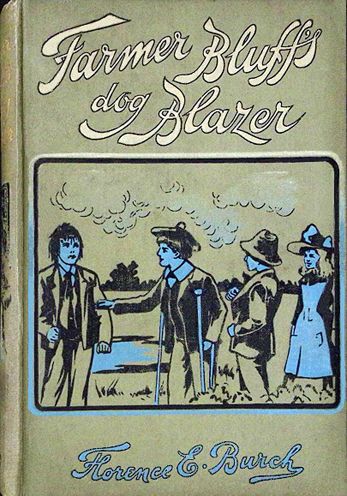
The Project Gutenberg eBook of Farmer Bluff's dog Blazer
Title: Farmer Bluff's dog Blazer
or, At the eleventh hour
Author: Florence E. Burch
Illustrator: Gordon Browne
Release date: July 20, 2024 [eBook #74082]
Language: English
Original publication: London: The Religious Tract Society, 1889
Transcriber's note: Unusual and inconsistent spelling is as printed.
THE GOOSE DUCKED HER HEAD, OPENED HER WINGS,
AND RUSHED FORWARD WITH A SCREAM.
FARMER BLUFF'S
DOG BLAZER
OR
AT THE ELEVENTH HOUR
BY
FLORENCE E. BURCH
AUTHOR OF "JOSH JOBSON," "RAGGED SIMON," ETC.
WITH ILLUSTRATIONS BY GORDON BROWNE
LONDON
THE RELIGIOUS TRACT SOCIETY
56 PATERNOSTER ROW AND 65 ST. PAUL'S CHURCHYARD
CONTENTS.
CHAP.
VIII. "CONSCIENCE MAKES COWARDS OF US ALL"
XIII. THE YOUNG SQUIRE ASSUMES A NEW CHARACTER
FARMER BLUFF'S DOG BLAZER.
CHAPTER I.
IN SEARCH OF A COMPANION.
"I CAN'T see why I shouldn't use my own common sense," said Dick Crozier to himself one fine morning, as he sauntered along the lane. "What else was it given to me for, I should like to know?"
It was a holiday, and Dick had a mind to enjoy himself. Now it happened that Dick's idea of enjoyment on this particular morning did not quite agree with his father's. Before leaving home, Mr. Crozier had given him particular injunctions not to extend his walk beyond the common, and not to go near the river.
"Another time," said he, "I shall have leisure to teach you how to manage a boat. Then I shall not be afraid to trust you; but until then I would rather you kept away."
Dick ventured to argue the point. "Another time," he mightn't have a holiday. His parents had only recently removed into the neighbourhood; and he felt pretty certain that his father would put him to school as soon as ever they got settled in the new place.
"No time like the present," said Dick to himself, as he tried to shake his father's determination. "To-day is my own; no knowing whose to-morrow may be."
But when a wise father has really made up his mind, his determination is not to be shaken.
"You must be content to let me judge what is best for the present," said Mr. Crozier. "When you are older, you will see that I was right."
So Dick had to submit—outwardly, at any rate; and as soon as he had watched his father disappear round the corner towards the railway, away he walked in the opposite direction, grumbling to himself as he went.
It was not a morning for grumbling. The time of year was the end of March. The wind, having made the discovery that all its roar and bluster could not stop the trees and flowers from coming out to meet the spring, had gone to sleep, and left them to enjoy the sunshine till the April showers came on. Birds were singing blithely on the boughs, and even a few humble-bees were to be seen riding through the air with an important buzz, as if they felt that they had got things their own way at last; whilst their working relatives flew hither and thither in quest of honey, with a sharp-toned hum that plainly said—"We must be busy."
Dick heard them, and stopped grumbling. It was too bad to be in an ill-humour whilst everything else—from the kingcups in the hedge to the larks in the sky—was so full of enjoyment. It was not even as if all the ill-humour in the world could alter what his father had said. So he just gave one or two cuts at the hedge with the stick in his hand as a final protest, and began to whistle. A few minutes later he was climbing along a grassy bank, holding by the wooden palings at the top.
There was a plantation on the other side of these palings, and just then a clock in a little tower, with a golden weathercock, struck nine. Dick had heard his father speak of this house as the residence of the Lord of the Manor, so he stopped to have a peep at it through the trees.
It was a large, white stone building, with balconies to the upper windows, supported on twisted pillars, so as to form a shady verandah in front of the lower rooms. A smooth lawn, green as emerald and soft as velvet, sloped up to the gravelled terrace; and behind the house, the grass slanted away to an iron hurdle-fence, within which deer were grazing. Beyond was a little copse, where pines and Scotch firs showed dark against the pale green mist of leaf-buds on the other trees. A gate leading into this copse was painted red; and Dick now noticed that all the gates and railings about the place were of the same unusual colour—which formed a very pretty contrast with the grass.
As he clung to the fence, making these observations, a French window at one end of the verandah opened, and three boys trooped out, followed by a lady, whom Dick took to be their mother. She was young, and very beautiful—or so Dick thought, as she stepped into the sunlight, shading her eyes with one hand, to watch them off; so beautiful that, for the moment, his eyes seem riveted. But only for a moment. The boys no sooner reached the steps than Dick's eyes left her for them. The foremost two bounded down, three or four steps at a time, leaving the third one far behind; and Dick now perceived that the poor fellow went upon crutches, and that upon one sole he wore an iron stand, which raised it full two inches from the ground, whilst the other barely reached so low. In spite of this, he was considerably shorter than his brothers; and Dick immediately concluded that he was the youngest of the three.
"Poor fellow!" said he to himself. "I shouldn't care to be like that. I daresay, though, they're good to him,"' he added, as the others pulled up short and waited for the cripple, who swung himself carefully down, step by step.
But Dick little guessed how hard it is to "be good" to a boy who has to go at a snail's pace, when you yourself have the strength to run and jump. He didn't even notice how the others continually walked a step ahead, nor how the cripple laboured to keep up with them. Neither did he guess how tiring it was to get along so fast. Presently, however, something attracted the attention of the three boys—an early butterfly it must have been. The cripple saw it first, and nodded towards it, and forthwith off the others raced, and left him resting on his crutches watching them. Then Dick understood a little more clearly how hard it was for him; for his brothers entirely forgot him in their wild, mad chase, and he was left alone.
He followed them a minute with his eyes, then turned and looked towards the terrace; but his mother was not even there to wave her hand. She had gone in.
It came into Dick's head to wonder whether the poor fellow could see him there above the fence. He had half a mind to whistle. Dick—with nothing else to do—could very well spare time for half an hour's chat to cheer his loneliness. But just then he remembered who this cripple was, and how presumptuous it might be thought to dream of showing pity for a son of the great man to whom all the land about belonged. And as the other boys, panting and puffing, cap in hand, returned just then, the question was decided once for all. Dick watched them out of sight behind the avenue of trees that led to the lodge, then he jumped down from the bank and went his way, turning now and then to see if they were following.
CHAPTER II.
GRIP AND BLAZER.
A LITTLE further on, the road emerged upon a green; and at the back of this green there was a farm. The house stood back behind the yard, which was hidden from view by tall bushes; and half inside the yard, half outside upon the green, was a pond, where ducks were swimming about in search of dainty bits.
This was the Manor Farm. The man who held it was the Squire's bailiff, Dick had heard his father say. He went up to the gate to look, rather wondering what sort of a thing it was to be bailiff to so great a man, and whether he had any boys.
A shaggy-looking dog, dozing in the sun before his kennel, sprang to his feet with a loud bark as Dick approached, rattling his chain and growling, as if to warn him not to come too near. Finding Dick paid no heed, he jumped up on his kennel and set, up barking so vociferously that another dog behind the house took up the cause. Next minute a servant, wondering what could be amiss, and probably suspecting tramps, opened a side door and came round the corner of the house to look. At the same instant, a man with a pitchfork in his hand appeared from the other corner of the house.
"Hey! Grip, old boy," called he; "what's up? You'll upset the firmament with your row."
Exactly what he meant by this it would be hard to say. He had caught the word up from the Bible, as something made "in the beginning," and therefore very "firm;" so probably it seemed to him the most that any one could do in the upsetting line.
Anyhow, the dog seemed to understand the rebuke. He gave one or two more barks, then jumped down off his kennel with an injured air; and: his colleague of the back premises, finding he was pacified, gave in too, and so the hubbub ceased.
"What was up wi' him?" said the man, coming a pace or two nearer, and resting on his pitchfork. "There's now't amiss, so fur's I can see." For Dick had left the gate, and gone to watch the ducks.
The servant shook her head. "Like his master," returned she; "always kicking up a fuss for nothing in the world. Some folks seem as if they can't be happy else; and quadrupeds is much the same, I s'pose."
"Belike," answered the man, with a laugh. "But if that's so, why, Blazer's the master's dog! My word! I wouldn't like to try his fangs; he'd tear the firmament to shreds."
With this characteristic remark, he shouldered his fork, and, turning on his heel, went back to his work in the rick-yard.
The servant stood a minute at the door looking about her; then she, too, turned and went inside, shutting to the door, but throwing up the window, as if this taste of sunshine had made her long for the free air.
Meanwhile Dick had reached the other gate; for the farmyard had an entrance at each side of the pond, so that carts could come in either way. Here he stopped again; but this time Grip took no notice beyond raising his nose off his paws a second or two and blinking, to show that he was awake; then he composed himself again, or pretended to—just to give the enemy a chance of showing his weak side. But Dick was not to be deceived that way, nor had he any thoughts of invading Master Grip's territory.
After standing still a few minutes, taking observations of the picturesque old house, with its latticed windows and its long, red-tiled, gabled roof, he was just about to go his way, when he was suddenly startled by a most unearthly whoop.
Before he had time to look round, a boy about his own size came full tear into the road a yard or two ahead. "Hullo!" cried he, perceiving Dick.
"Hullo!" responded Dick.
Then they stared at one another.
"Who are you?" asked Dick.
The other burst out laughing. "Who are you?" retorted he.
"Oh! It doesn't matter," answered Dick, a trifle proudly; "only—my father has just moved into the neighbourhood, and I suppose I shall have to get to know the boys; so I thought I might as well begin with you."
The other looked him over well from head to foot. Dick's father was a gentleman, and Dick was dressed accordingly. The other's father was a labourer upon the Manor Farm.
"My name's Dick Crozier," added Dick.
"And mine is Bill the Kicker," returned his new acquaintance.
"That is, your nickname," added Dick.
"Call it what you like; that's all the name I want," said Bill the Kicker in such a final manner that Dick said no more.
"Where do you live?" next asked he.
"Up yonder," answered Bill the Kicker, pointing backward with his thumb. "My father works for Farmer Bluff."
"And mine goes up to town every morning," rejoined Dick. "We live beyond the Manor House, up the hill."
This interchange of confidences was a pretty good basis for an acquaintance, and the two boys were soon engaged in a lively conversation.
"There's a hornets' nest up there," said Bill presently, jerking his thumb in the direction of the field. "I see one goin' in just now. I mean to sell it to the Squire's grandsons," added he, nodding to himself.
"What for?" asked Dick, who was a town-bred boy.
"For sport, of course," answered Bill promptly. "Squires always go in for sport. I reckon we shall have a game."
"Hornets are dangerous, aren't they?" said Dick doubtfully.
"It don't do to get stung," returned Bill; "but then you don't if you can help; and that's what makes the sport. I wonder," added Bill the Kicker, struck with an original thought, "who'd care to storm a flies' nest!—Supposin' that they made 'em, which they don't. And there again, you see," he added further, "flies don't make nests, because they haven't got to keep out of the way—" Which remark contained a wholesome moral, if he had but possessed the wit to see it.
Knowing nothing of such country matters, Dick naturally felt some respect for Bill the Kicker, who talked as if he had it all on good authority.
"Look here," proposed he presently; "tell me when the sport's to be."
Bill shook his head with a doubtful air.
"Why not?" asked Dick.
Bill the Kicker drew his mouth tight, stretching it almost from ear to ear, and shook his head again.
Dick held out a bait.
"I've got a goodish big-sized boat at home," said he persuasively. "I mayn't go near the river yet, but so soon as ever I get leave, I'll let you know."
Bill expressed considerable contempt for the idea of "getting leave;" however, he went so far as to say that when the sport was all arranged, he might see fit to make it known to Dick. "It's the Squire's grandsons, you see," said he importantly. "'Tisn't every one as I could introduce to them."
Dick rather wondered what it mattered whom Bill introduced, so long as it was somebody no lower than himself. But he promised to be in the way as often as he could; and Bill the Kicker, having duly warned him not to drop a word to any one, went off to find the Squire's grandsons and "sell the nest."
CHAPTER III.
FARMER BLUFF.
WHILST Dick was making acquaintance with Bill the Kicker, the Squire's bailiff, Farmer Bluff, was sitting in his parlour, with his leg upon a cushion and a pint mug on the table by his side, swearing inwardly—if not aloud—at the fate which had cursed him with the gout.
Now this fate was none other than the blustering old farmer's own stupidity; for time after time the doctor had warned him that as long as he made that mug his boon companion, so long exactly would his enemy pursue him with its twinging pains.
But Farmer Bluff was obstinate as well as blustering—to every one except the Squire, of course, in whose presence he was like the latter end of March—a lion transformed into a lamb. The excuse he made to himself turned upon the mug, of which he was naturally proud, it being solid silver, an heirloom that his grandfather had left to him. He liked to have it on the table by his side; and if upon the table, why, it must have something in it. And that something must of course be beer, and must be drunk. And so the stupid fellow's gout grew angrier year by year, until at length it got so bad that if he did not swear aloud, it was for no better reason than because nobody was by to hear.
As he sat there by the hearth, looking across his shoulder out of the window at the bright March sunshine that used to call him up and abroad at six o'clock, until this gout got hold of him, he heard Grip set up the furious bark that fetched the servant out to look. Then he heard Blazer take up the challenge; and shortly afterwards the voices of the servant and the man fell on his ear.
Now it was a peculiarity of the old bailiff to resent not being able to hear what passed between other people; so after chafing and fretting for some minutes, he reached out for the handbell that stood beside the silver mug, and rang it lustily. Then he took another pull at the mug, and having poked the fire to a roaring blaze, impatiently awaited the answer to his summons.
This happened exactly at the moment when the servant threw up the kitchen window to let in the air.
"Always kicking up a fuss for nothing in the world," said she again, flouncing back to her washing up, with a strong determination to let him ring a second time. After a minute or two, however, she let drop her dish-clout in the tub, and drying her hands on her apron as she went, hurried off to the parlour.
Farmer Bluff was known to be a bit of a miser, and had few near relatives to leave his money to; and Elspeth had her eye upon a handsome legacy.
"He's over sixty-five," she used to tell herself, by way of comfort when he swore at her; "and gout don't make old bones. I can put up with it a bit longer, on the chance of being mentioned in his will."
But, as it happened, just as Elspeth reached the parlour, there was another ring, this time at the outer door; not so lusty as her master's, though, for all that the bell itself was twice the size.
Filling up a waste space in the hall, there was a cunning china closet, with a narrow window looking through into the porch. A step or two aside and one quick glance revealed who stood without. Going swiftly to the door, Elspeth threw it open with a deferential curtsey. It was the Squire who had given that modest ring; and she never kept the Squire waiting, for he always had a civil word, in spite of his high rank. Then having answered his inquiry as to whether her master was up, she stepped briskly back towards the parlour.
Farmer Bluff was in the act of ringing his handbell a second time.
"A man might die in a fit, for all the haste you make!" exclaimed he with an oath, banging down the bell so violently that the clapper uttered a "twang" of protest. "An indolent, slow-footed hussy!" He was going on with a regular string of abuse, but just as he was in the midst of some words that no proper thinking man had any business to lay his tongue to, the door flew open, and to his great dismay, his eyes met those of no less a personage than the Lord of the Manor.
Farmer Bluff's tirade came to an abrupt termination, and Elspeth having announced, "The Squire, sir," withdrew, leaving her master to put the best face on it.
What with beer, and rage, and shame, the old sinner's countenance was nearly as red as the live coals in the grate. He made desperate efforts to rise as the Squire approached, bearing like a man the torture that would have made him swear like a trooper if Elspeth had been by instead.
The Squire, however, hastened to stop him.
"Keep your seat, Mr. Bluff," said he good-naturedly, as the bailiff blurted out an apology. "Pray don't put yourself to any pain on my account. No; not so near the hearth, thank you," as Farmer Bluff tried to reach a chair. "I'll sit here. The air is mild this morning, and I can see you've been serving your fire to the same sort of rousing as you treat your woman servant to."
The old farmer reddened still more, and mumbled something about "your blood being chilly when you had the gout."
"And you find that swearing makes it circulate," remarked the Squire sarcastically. "Dependence upon others is a very unfortunate condition to come to," added he; "and you have apparently a very inattentive attendant too."
The Squire's caustic tone did not escape Farmer Bluff. He blurted out a few words about "not so bad," only she needed "keeping up to the mark."
"You've chosen a somewhat unscriptural way of setting about it," observed the Squire; "and my experience—the experience of fourscore years—is that whatever is unscriptural is unprofitable, and altogether wrong. Therefore, Mr. Bluff, if I were you I should give it up."
Having uttered this straightforward piece of advice, the Squire dropped the subject, and went on to speak of his bailiff's health.
It was wonderful the contrast there was between the two men. The Squire, brought up all his lifetime in the midst of luxury—had he chosen to live softly—had as elastic a tread as many a man of forty, and looked as hale and hearty as if he had been accustomed to weather wind and storm out in the fields with his own shepherds. His bailiff, nearly twenty years his junior, looked bloated and unhealthy, in spite of his invigorating out-door life about the farm and woods; and half his days, at least, were spent in this arm-chair, with one foot or the other upon a cushion.
There was good reason for the difference; there is for most things, if men only had the sense to find it out. The Squire, from his youth up, had been temperate, using the good gifts of God wisely, not abusing them. His bailiff had never got beyond regarding these gifts as the wages which it was his good fortune to earn from the Squire; and he had gone to work with the intention of getting the greatest possible amount of enjoyment out of this little bite off the great man's luxury. Thus, grasping all, he had come pretty near losing all; for, ask anybody who has made close acquaintance with gout, and they will tell you that there is next to no enjoyment in life for those who have made it their companion.
The moral is,—avoid intemperance, remembering always that beer is not the only thing that may be abused, and that gout is not the only punishment; for, sad to say, there are as many sins as there are weeds in this fair world, and a punishment to each. As the Bible has it—in a form that no one need forget—"Whatsoever a man soweth, that shall he also reap."
Sow sins, and you shall reap punishment as surely as did Farmer Bluff.
This was the sum and substance of the Squire's thoughts as he sat down on the window-seat. "I'm thankful I shall go down to my grave without gout," said he to himself, as he watched the contortions of his bailiff's features; for it was vain for Farmer Bluff to think of not making faces. He had put his foot to unusual inconvenience in his attempts to show respect; and it cost effort enough to refrain from bellowing aloud at the pain.
"I hoped to find you better than this, Mr. Bluff," began the Squire after a pause, putting his gold-headed cane between his knees, and crossing his hands over it. "This has been a long attack."
"It has, sir; a—very long attack."
Farmer Bluff usually hesitated a good deal in talking to the Squire; otherwise he might have let slip unsuitable expressions, such as he was in the habit of using to Elspeth.
"The longest you ever had, eh?"
The Squire did not want to be unkind, but he had called in with the intention of saying something rather disagreeable; and it had got to be said, in spite of his natural inclination to say pleasant things.
"By far the longest," repeated he.
Farmer Bluff declared himself heartily tired of it, adding in an injured way that no one knew what suffering was until they had tried gout.
The Squire shook his head. A man has no right to feel hardly done by when he deliberately chooses to bring pain upon himself. "I'm heartily tired of it, too," said he; "and the fact is, Bluff, I'm getting too far into years to be my own bailiff—and that's what it comes to nowadays. For these keepers and labourers of yours—well! I've no doubt you give your orders. A man might give his orders in the other hemisphere by telegram. But if I didn't go round and see to things for myself, they would be in a pretty muddle. Why! I was in the saddle at half-past six this morning to do your work. A glorious morning it was too; as glorious as God ever made. Time Was when I'd as soon have been out myself as trouble you—except for the sense that a man with abundance of this world's goods is bound to broadcast some of his money amongst dependants. But an octogenarian begins to need a little indulgence, or he will do very shortly, for the time must come to all of us, Mr. Bluff."
"Ay, that it must, sir," acquiesced the bailiff meekly, feeling rather as if his time had come; for he could see pretty plainly what the Squire was driving at.
"I should not like," continued the old gentleman after a pause, "to leave the estate out of working gear when I go. It is not as if I left a grown man in my place. My grandson is such a mere child that I can hardly hope even to see him attain his majority; and that is what I came to speak to you about. You have served me many years, Bluff; but the fact is, you are not what you were, and I feel that I ought to see a competent man in your place, whilst I myself am still competent."
Farmer Bluff began to whine. Long service deserved indulgence, he hinted. "A man must take what the Lord sends him," said he.
But the Squire stopped him. "Men often make mistakes about the source of their misfortunes, Bluff," said he. "I don't believe that your complaint is often of the Lord's sending."
The bailiff's eyes reverted uncomfortably to the silver mug. He knew very well what his patron referred to.
"I might very easily have put myself in the way of it," continued the Squire. "My father left me a well-stocked cellar, and I have had to dispense hospitality; but I have mostly contented myself with listening to other people's praises of my wines, remembering an old saying that those who constantly seek their own reflections at the bottom of their tankards are likely oftenest to see an ass. The saying certainly holds good of a man who, in immediate opposition to his doctor's orders, feeds his gout on beer. No, Bluff: if the Almighty were responsible for your gout, I should feel very differently about the matter. As it is, although I shall consider myself bound to see that your old age does not come to want, you must certainly understand that you will have to make way, within due notice, for a man who can put his beer mug on one side in favour of duty."
Farmer Bluff tried hard to obtain a commutation of this sentence.
But the Squire was a man who knew his own mind, once it was made up, and who did not make it up hastily either. He had for some years past been much disgusted with his bailiff conduct; and the experience of the last few months had finally decided him. He was determined to leave upon the estate a thoroughly efficient bailiff. To this intent, having given due notice to the gouty old rascal who at present held the office, he now rose and took his leave, Farmer Bluff ringing his handbell— though not so roughly as before—for Elspeth to show the Squire out.
CHAPTER IV.
THE SQUIRE'S GRANDSONS.
WHILST the Squire had been giving old Bluff his deserts in the farm parlour, his three grandsons—none other than the boys whose mother Dick had thought so beautiful—had left the grounds by a winding path that skirted the plantation and emerged on to a fieldway leading into the road a few hundred yards above the farm. Turning to the left hand of the farm, this road ran round the foot of a piece of rising ground. Probably the man who first made a cart-track there, found it pay better to go a little way round than to make his beasts drag their burdens over the hill. But there was a shorter cut for pedestrians almost opposite the pathway from the Manor House; and for this the boys were bound.
Just as they were in the act of crossing the stile, who should come round the bend but the Squire, whose next business took him up that very road. The boys saw him at once. Two of them—the two taller ones—ran forward to meet him, the other following at his quickest pace. The Squire was a favourite with his grandsons. He was such a boy amongst them, although he had been born over eighty years before them; and yet withal he was so grand and courtly.
Will and Sigismund dashed forward, but the Squire looked beyond them to the cripple, who was exerting himself manfully to show equal appreciation of his aged relative.
"Bravo, Hal, bravo!" cried he, applauding with his gold-headed cane.
Will and Sigismund faced about, looking half-ashamed, as if they felt it was almost mean to have taken such an advantage of their afflicted brother. But the Squire did not exactly intend that. It would have been altogether too hard for boys with strong legs to give up using them because their brother limped on irons. It was rather that the Squire had a very tender spot in his heart for Hal, and that he saw in the boy's brave, invincible spirit an earnest of what the man would be.
"God grant that he may grow to be a man!" he often uttered in his heart. And it really seemed that Hal was growing stronger year by year.
Meanwhile Hal, flushed and out of breath, was up with them.
"Where are you going, grandfather?" asked he eagerly, as he swung himself round to walk by the Squire's side, Sigismund making way for him.
"Up to the cottages by the wood gate," replied his grandfather, laying one hand on his shoulder. "Almost out of bounds for you, eh?"
But Hal shook his head. "Why, I've been right into the wood, you know; last autumn, nutting."
"Ah, to be sure!" acquiesced the old gentleman.
"But what are you going there for, grandfather?" questioned Hal, who was noted for his inquisitive spirit. Impertinent, some good people would have said; but not so his grandfather.
"How can a boy learn what he doesn't know, if he may not ask a question?" he would say. "A spirit of inquiry is one of the first requisites to learning." So now he answered without reserve.
"To see about having one put in repair for Farmer Bluff," said he.
"For Farmer Bluff?"
The question was from all three at once.
The Squire nodded gravely. "For Farmer Bluff," repeated he. "He has to leave the Manor Farm."
"To leave?"
"Why, grandfather?"
This was Hal's question. Hal always came straight to the point, as if he had a right to know; and his grandfather seldom, if ever, put him off.
"Because," answered he, "the time has arrived when he must make way for a better man."
"But surely, grandfather," said Hal, "you won't turn him away, after all the years he has been bailiff. Why! Ever since mother first brought us to live with you."
"Ay, and before that," broke in the Squire regretfully. "When I thought your poor father would have been Squire after me. Twenty-seven years Farmer Bluff has lived on that farm; but—"
"But it isn't fair to turn him out because he's getting old, grandfather," interrupted Hal, with a bold familiarity that no one else would have dared to use towards the old gentleman.
"Tut, tut, lad," rejoined the Squire. "Who said was because he was too old?"
"Well, grandfather," put in Sigismund, who according to size would be the next youngest to Hal, "you said 'a better man.'"
"Better doesn't always mean younger," said Hal eagerly; "does it, grandfather?"
"Nor does younger mean better," returned the Squire. "I always like to think of my eighty-four years as a token of God's favour."
"Good people generally live to be old, don't they?" suggested Sigismund, straying from the point at issue. "In the Bible they did."
"Steady living is conducive to longevity;" replied the old man. "That is to say, those who live sober, temperate lives give their constitutions the fairest chance of withstanding natural decay, and of escaping the ravages of disease by which so many are prematurely cut off."
"Is that why Farmer Bluff has the gout?" queried Hal. "Because he has been intemperate?"
"Very likely," replied the Squire. "It is quite certain that at the present time he is aggravating the complaint and forfeiting my esteem by the childish obstinacy with which he persists in drinking beer, when he knows it is as good as drinking so many pains and twinges. But you mustn't run away with the notion that God always rewards virtue with long life; for that is not His greatest gift."
Hal asked no more questions just then. They had crossed the stile during this conversation, and were climbing the pathway up the hill towards the wood, where there was plenty to claim the attention of boys.
Larks were rising from the tussocks; finches darted in and out the hedge; and as they got nearer to the wood, wild rabbits, all tail, frisked about their burrows. Once or twice a grey rat ran out of his hole, and sat upon his haunches in the track, staring stupidly before him until they were quite close; then doubling suddenly, and disappearing in the ditch.
Will and Sigismund were full of excitement, running and jumping and leaping; but Hal kept by his grandfather, swinging himself along at an even pace that agreed very well with the old gentleman's step; and so they reached the gate of the wood, and the cottages in one of which the Squire intended his bailiff to live rent free.
There was already a noise of carpenters at work, and a cheery sound of men talking over their saws and planes. Hal followed his grandfather inside, and went round, listening with great interest to all that passed between him and the workmen. But the other boys stayed outside, overrunning the garden, and talking to the gamekeeper, who lived next door. Finally they strayed into the wood, which was only separated from the garden by a ditch, dry summer and winter alike. By the time the Squire had finished giving his orders, they were quite out of sight and hearing.
At length, the Squire sent the keeper down the clearing after them. Hal was standing by his side, resting on his crutches. The Squire, looking down at him, saw that his face wore a thoughtful look, and fancied he was tired.
"Better go inside and sit down on Champion's sawstool," suggested he kindly; "it's a long way back, and you and I aren't so young as those two madcaps. Eh?"
At that instant, however, Will and Sigismund appeared, talking gaily to the man as they advanced.
The Squire beckoned, and they set forward at a run, giving the stout old Velveteens a good view of their soles, and leaving him to follow at his sober pleasure. But Hal had already seized his opportunity.
"Grandfather," said he, moving nearer.
The old man faced about.
"Grandfather, I was wondering if I could make Farmer Bluff see how silly it is to keep on having gout?"
"To keep on drinking beer?—Hardly," quoth the Squire, "since his doctor fails. People usually believe their medical man, if anybody, when they are in pain."
"And I mean," added Hal, anxious to gain his point before the others came up, "if he left off having gout, should you still be obliged to turn him out of the Manor Farm?"
"Why, no," answered the Squire; "not if he showed himself capable of doing his duty as bailiff of the estate. But the fact is, I can't be Squire and bailiff too at my age; and if I could, I shouldn't long be able to, because—things don't go on for ever and a day, Hal."
Just then the other two boys cleared the ditch, and bounded up, with a ready apology for having kept their grandfather waiting; then, passing in at the back door, they all went through to the road again.
On reaching the front door, the Squire suddenly remembered something he had meant to say, and stepped back again. Hal waited with him, but Will and Sigismund ran straight out.
In the middle of the road a boy was standing, looking this way and that, as if undecided in which direction to go. Seeing two lads his own age, he at once advanced.
"Can you tell me where I am?" asked he.
"By the gate of the wood," answered Will, pointing past the cottages to the red-painted gate.
"Is this beyond the common?" asked the boy.
"Most certainly," was Will's reply.
"Then I'm where I've no business," rejoined the boy, who was none other than Dick Crozier. On leaving his new acquaintance, Bill the Kicker, he had wandered on by the right-hand road, until his way had met that of the Squire and his grandsons by the cottages.
Apart from Hal, Dick did not recognise them as the Manor House boys. Hal no sooner appeared in the doorway, however, than their identity flashed upon him. The next minute, the Squire himself emerged, tapping the ground briskly with his cane as he walked, as an indication that time was short and they must get forward without delay.
Perceiving Will in conversation with a strange boy, he stopped short; whereupon Will explain that Dick had lost his way.
The Squire inquired where he came from, but this Will had not yet asked; so the Squire turned to Dick himself.
"Your name, my boy?" asked he.
Dick had no sooner recognised Hal than it flashed upon him that the grand old gentleman with the gold-headed cane was none other than the Squire himself; and although not more troubled with bashfulness than most boys of his age, he was just a trifle flustered at the discovery. Nevertheless, he answered straightforwardly enough,—
"Crozier, sir."
"Crozier; a son of my new tenant, surely?" said the Squire in his courtly way. "I am always pleased to make the acquaintance of a tenant, Master—"
"Dick, sir."
"Master Dick; and as we're all going one way, we will proceed together, if you please."
So they set off, Dick and Hal walking on either side of the Squire, the other two a pace or two in front.