
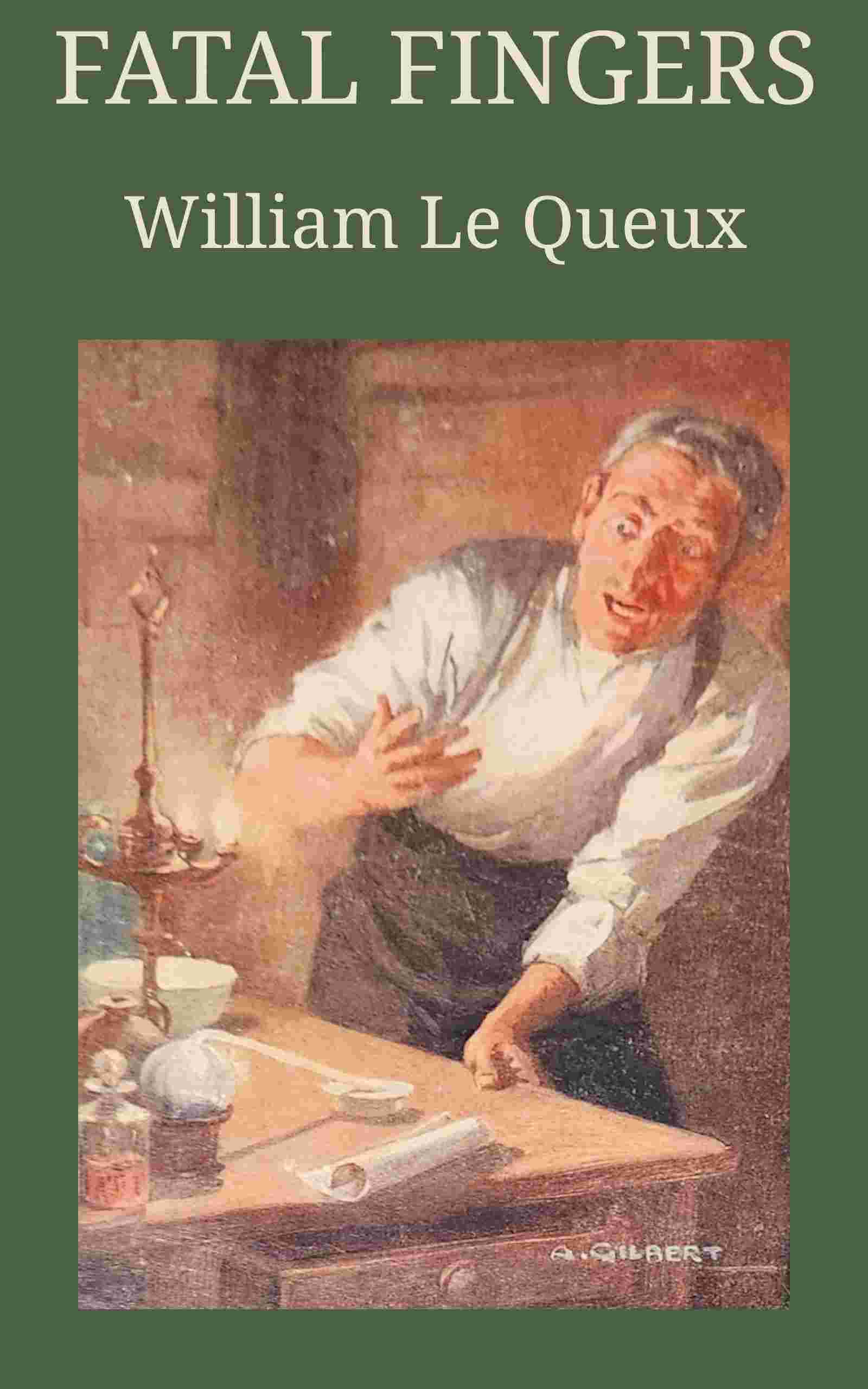
The Project Gutenberg eBook of Fatal fingers
Title: Fatal fingers
A mystery
Author: William Le Queux
Illustrator: A. Gilbert
Release date: November 24, 2025 [eBook #77320]
Language: English
Original publication: London: Cassell and Company, Ltd, 1914
Credits: an anonymous Project Gutenberg volunteer
FATAL FINGERS
A MYSTERY
BY
WILLIAM LE QUEUX
CASSELL AND COMPANY, LTD
London, New York, Toronto and Melbourne
1914
ALL RIGHTS RESERVED
CONTENTS
1. Is mainly about Richard Goodrick
2. The Night of the Seventeenth
3. The Affair at Charlwood Street
11. Concerns Love and a Mystery
26. The Festa of Corpus Domini
30. What Occurred on the Seventeenth
FATAL FINGERS
CHAPTER I.
IS MAINLY ABOUT RICHARD GOODRICK
“No; keep your money, my dear sir.”
“Then you refuse?”
“I do—absolutely.”
“Remember, I am making you a very substantial offer. Fifty thousand pounds is not to be gained every day.”
“Not if you offered me one hundred times the amount. I have never been open to bribery.”
“No, no; you can hardly call it bribery, Mr. Goodrick. I think——”
“I don’t know what you call it but bribery,” growled the thin, white-bearded old man seated in the easy chair by the fireplace. “I’ve really got nothing more to say to you. I wish you’d go—go away and leave me in peace.”
The other, a rather stout, red-faced, well-dressed man of about fifty, with a distinctly business-like air, made a quick gesture of impatience as he stood upon the shabby hearthrug opposite the old man.
“You’ve surely been left in peace long enough. For eighteen years you’ve lived in this stuffy little hole, hidden away from everybody. Everyone believes you to be dead—that you died, and carried your secret to the grave.”
“And if I did, what, in the name of Fate, does it matter to you—eh?” croaked old Mr. Goodrick.
“Well—are you acting honestly and fairly towards Gordon—or Maidee, and the rest?” queried his visitor.
“Fairly!” echoed the other, laughing. “That’s really capital—you, George Ravenscourt, talking of fairness and honesty! You offer me fifty thousand if I will—well, act in such a manner as will give a distinct advantage to your friends—eh? Ah! my dear sir, your reputation for honesty is well known—to me, at least, if not to some others.”
“It seems you are in a somewhat insulting mood to-day,” exclaimed the other hastily. “Some dealer has got the better of you, perhaps—sold you a bit of faked silver or spurious china.”
“Dealers, I think, know me a little too well to attempt fraud upon me,” snapped the old man in a thin, hoarse voice.
“But will nothing soften your heart towards those who have suffered by this long self-effacement of yours?” asked his visitor, appealing to him in a changed tone.
“No,” replied the yellow-faced, keen-eyed old fellow. “I dropped out of life purposely. I’ve lived here all these years in the back streets of Pimlico, because I had a motive.”
“What was your motive?”
“That’s my own affair,” was the sharp response; and the old man spread out his thin hands to warm them by the fickle flame of the meagre fire. “By a silly error, because I thought myself safe from recognition, I betrayed my continued existence. But even you, Ravenscourt, shall not tempt me to return to life—to face the past.”
“My dear Mr. Goodrick, after eighteen years the whole affair is forgotten. The public have very short memories. Try to recall the cause célèbre of the year before last, and you’ll have difficulty in recollecting the names of the parties concerned. You’re just a little too sensitive. Think, if you returned—what a difference in your position!”
“Yes,” croaked the old man; “here in Pimlico I’m known as Nosey Goodrick, of Charlwood Street. The boys in the street call after me, and the neighbours regard me, I think, as a harmless crank. What would they say if they knew—if they knew the truth?”
“What would the world say if they knew that you, whose great talents are perpetuated by that marble statue in Westminster, and whom thousands followed to the grave; you, for whom the whole country mourned, are here, still alive and active!”
“Hush!” cried the old fellow, glancing apprehensively at the closed door. “Mrs. Ayres may overhear! Please do not recall the past, Ravenscourt. It is all too painful. I’ve long ago forgotten it. Nowadays I am plain Richard Goodrick, and soon I shall die and be buried in some suburban cemetery in the name under which I have chosen so long to live.”
“No,” declared his visitor; “you don’t mean that. You’ll return. It is your duty to the nation. An excuse can easily be made.”
“Return—never, I tell you!” cried the old man fiercely, starting to his feet, exhibiting the fact that he was unusually tall and straight for his age. His white face was bony and narrow, with an exceptionally prominent nose, a shock of white hair, and long white whiskers. He was dressed in a loosely made suit of shabby grey whip-cord tweed, with a narrow stand-up collar and a seedy black cravat.
The room was a small back one on the ground floor, but so filled with curios of all descriptions that it had an appearance more like the shop of a dealer in antiques than a living-room. Dusty pictures, priceless china, ivories, miniatures, a piece or two of genuine Chippendale, bundles of rare prints, some savage weapons, an ancient bronze torso from Greece, a quantity of rusty mediæval damascened armour, a big case of stuffed birds, and other curios were heaped about the place, until there seemed only barely room to move in the centre.
Opposite the fire was a square table covered with a piece of old green serge in lieu of a cloth; the carpet was so threadbare that all pattern had, years ago, disappeared, while on the frayed horsehair sofa beneath the window lay piles of old newspapers.
The day was the seventeenth of January, 1908. The faint grey light of the short wintry afternoon struggling in increased the depressing cheerlessness of the place, for the outlook was upon a high blank wall.
The visitor gazed around, and shuddered at the miserable abode. For eighteen years that man before him, the bearer of one of the most honoured and renowned names in Great Britain—the man whose reputation was known in many corners of the globe—had lived there, silent, alone, and unsuspected; absorbed in various studies, reading his own obituary notices, and sneering at the fulsome praise which those who were his enemies in life bestowed upon him when they believed him dead and out of the way.
He had had the unusual experience of being able to judge impartially his own popularity. Aloof from the world he had known and wherein he had been a power, he had looked on and laughed in triumph at his own obsequies. As Richard Goodrick, a retired schoolmaster, he had lived there in the house of the worthy Mrs. Ayres and her husband, paying his weekly rent punctually, and pursuing a life clock-like in its regularity.
As an art collector he had once been world-famed, and was, of course, known personally to all the great dealers in London and Paris. So, after his “death,” he dare no longer visit them, being compelled to pursue his hobby of curio-collecting among the smaller shops and obscure dealers. For eighteen years he had lived alone in Charlwood Street, and it was said by the women who gossiped over their garden walls that for eighteen years he had never been known to smile.
As he stood before his visitor he betrayed the fact that he was a man of iron will, quick to decide, and very resolute. In his dark, piercing eyes, which age had not dimmed, shone a fire of anger at the suggestion his visitor had made.
“I tell you,” he repeated firmly, “that I shall never reveal my existence. I died—they have buried me, fools that they are, and put up a statue to perpetuate my memory. American tourists go and gaze upon it, and say: ‘Wal, he was a grand man, anyhow.’ And I’ve fooled them—fooled the world—for I’m still alive.”
“That’s just it! You have withheld your aid, which, if given, would—if you will pardon my remark—bring happiness to many.”
“Why should I bring happiness to many?” snapped the quick-tempered old fellow. “I am the odd man out of the game. I am dead, remember—dead, unless you betray me, Ravenscourt,” he added, looking his visitor straight and unflinchingly in the face.
“I shall not betray you. Surely you know me better than that!” said the other reproachfully.
“If you offer me fifty thousand, then it would be worth an equal sum to you to betray me,” said the old man, speaking very slowly and distinctly. “You are not so well off as you once were. The money would be useful to you.”
“It would,” admitted his visitor. “But not for double the sum would I betray my old chief—the man to whom I owe everything.”
“I believe you, Ravenscourt,” the old recluse said, after a pause. “I used to trust you long ago—and I’ll trust you now.”
“And you will take my advice, and accept the sum offered?”
“No, no!” he cried quickly. “Never that. You can never bribe me. As I have lived, so will I die—in silence.”
“Leave this wretched place,” urged his visitor. “It is unfitted to you—you who have lived the life of the great. It is a marvel how you have existed here all these years.”
“It satisfies all my requirements,” was the man’s calm reply. “I am friendless, it is true, but I have my books and my collection,” and he waved his thin hand across the narrow, stuffy little room. “What more can I desire in this the evening of my life? Do you know,” he added, “I would not exchange this quiet, uneventful existence in a back street in London for all the society gatherings, the yachting, the racing, the Riviera, and the grouse moors in Christendom. When I ‘died’ I gladly finished with it all.”
“Who knew the real secret of your death?” asked his visitor, interested.
“Finnimore.”
“Finnimore, your old valet? And he died ten years ago!”
“Yes. And only you, Ravenscourt, are now aware of the fact that I did not die. And you I trust to maintain the strictest silence.”
“You place me in a very difficult position,” the other said in dissatisfaction. “That night, a week ago, when, as I passed you in Whitehall, something in your face struck me as familiar—what it was I can’t tell—you knew that I had recognised you, and you cleverly evaded me. It was not until I employed Jewell, the private inquiry agent, that I was able to track you here to your hiding-place, and meet you face to face in daylight. Then I convinced myself of the astounding truth that you, for whom the whole country had mourned, were not dead, but actually lived!”
“Well, and have not other men, tired of life or crushed by some great sorrow or misfortune, done exactly the same thing as myself? I am not alone.”
“But—permit me to say so—you are not now acting with that high feeling of honesty and humanity with which you always acted throughout your brilliant career.”
“Because I do not return to my proper station!” exclaimed the old man angrily. “I am the proper judge of that. Ravenscourt! I am inexorable; I shall never leave here. Keep your fifty thousand pounds—and I will keep my secret.”
“And bring ruin upon us?”
“I regret, but I cannot depart from the course I laid down eighteen years ago.”
“You were not usually so cruel.”
“Not before the great blow fell upon me, George. It wrecked your life, ended my career, and hardened my heart,” he said slowly in a changed voice. “But don’t let us discuss it further. I’m glad to have seen you, though I’ve passed you often and often when you have failed to recognise me. But now please leave me—and forget that you have spoken with one who is ‘dead.’ ”
A deep shadow of pain crossed the face of his visitor. The men, standing together, seemed to fill the narrow, musty-smelling little apartment. From the smoke-blackened wall opposite an ugly Japanese mask grinned down upon them.
There was a movement outside the door, and Ravenscourt noticed how the old man started nervously and grew pale as his eyes turned apprehensively towards the door.
“I cannot forget that I have spoken with you,” said his visitor. “The hour I have spent here is the strangest one of my whole life—speaking with one whom the world has lost. True, I owe much to you, and it is in repayment of that I am here, offering you the sum of fifty thousand pounds if you will only consent to return and resume your place in society and in the world of London.”
Goodrick smiled bitterly and stroked his white beard.
“What do I want with fifty thousand pounds?” he asked. “Before I left the world I made long and careful preparation. I carried with me twenty thousand pounds, much of it in gold, because notes might have given me away. With some of that I have speculated in curios. The contents of this room”—and he waved his thin hand—“would fetch forty thousand if put up to auction. See!”—and he took out a small, ancient, leather-bound, illuminated manuscript in parchment—“this thirteenth-century volume from the Borghese collection would alone fetch fifteen hundred to two thousand at Sotheby’s any day. No; I do not want money. When I do—I have it here.”
“Aren’t you afraid of being robbed of your treasures?” queried his visitor, gazing around at the miscellaneous collection of antiques.
“Robbed? No. Who would dream that here, in this back room in Pimlico, are stored some of the best curios that have been in the market during the past fifteen years? Look at this Caxton,” and he opened a small, thin, black-letter book, “it is unique. No other copy of this work exists. The British Museum would gladly purchase it for almost any sum to-morrow—if they only knew of it!”
“And you actually refuse to act as I suggest?”
“I do!” cried the old man, the fire of resentment again in his eyes. “Go, Ravenscourt, guard my secret—and forget that you have seen or spoken with me. I am dead, remember—dead to all, even to you. And,” he added, looking at him meaningly, “you dare not betray me—remember!”
“But I——”
“There are no buts. Leave me. Farewell,” he said in a firm, authoritative tone as he stood erect, holding forth his long, bony hand.
For a moment his visitor hesitated. Then, seeing determination in the old man’s eyes, he took the proffered hand and bent over it with courtly gesture, accepting his dismissal with a sigh.
“If you reconsider your decision, remember that I am at any moment at your service,” he said.
“I shall never do that, Ravenscourt. Adieu—for always.”
And then the other, his voice choked by emotion, opened the door and passed down the narrow little hall and out into the street.
The old man listened till the front door slammed, then casting himself back into his arm-chair, held out his hands to the cheerless fire, and, nodding his head slowly in self-satisfaction, croaked aloud in a weak, thin voice:
“That man is my enemy. He knows the identity of Richard Goodrick! But he does not know his secret! Oh, no! no! He will never know that—never—never! He will die before that.”
CHAPTER II.
THE NIGHT OF THE SEVENTEENTH
As Ravenscourt stood at the corner of Denbigh Street he hailed a passing taxi and drove to the Carlton Club, where he sat in a corner of the smoking-room, pretending to read, but pondering deeply.
If the truth were known regarding that man in concealment in Pimlico, what a sensation it would cause! The whole world would be amazed.
There, hanging at the farther end of the great room, was a fine portrait of the man now known as Richard Goodrick, painted by a celebrated R.A. a year before his death.
He turned and gazed upon it. Yes, there could be no mistaking the general outline of the features, though eighteen years of the life of a studious recluse had effected some marked changes. The portrait was that of one in the prime of manhood. To-day Goodrick was thin, wasted, white-haired and careworn.
“I wonder whether he will ever relent,” thought the grave-faced man seated by the club fire, heedless of his friends who came and went. “Why did he so cleverly disappear? Ah! that is a mystery. He admitted that he was a long time preparing for it. And yet his doctors, just before his ‘death,’ had declared him to be suffering from an incurable disease which must inevitably prove fatal. Did they lie? Were they also in the conspiracy?”
He recollected their names, and, rising, crossed the room and took down the “Medical Directory.” Then, after a search, he found that both were, alas! dead.
“Perhaps he paid them to make that alarming diagnosis!” he reflected, re-seating himself in his arm-chair. “He was a shrewd and clever man—one of the keenest, most far-seeing of our time. Yet he died at the very height of his popularity—at a moment when England could ill afford to spare him. He deceived us all—even his Sovereign, who sent a representative to place a wreath upon his coffin. And to-day I have seen and spoken with him—the man to whom I owe my fame, my fortune, my baronetcy—everything. I wonder—I wonder if I was mistaken a fortnight ago when I thought I passed that Italian priest, Don Mario, in the bustle of Oxford Street? The man, though he did not wear his clerical clothes, strangely resembled him. I wonder whether Goodrick and he are still friends—whether—but no! it would be impossible after what occurred. And yet,” he whispered aloud, “supposing Don Mario is still in London—supposing he thought fit to retaliate!”
He held his breath for a moment, pursed his lips, and the colour left his face.
“Don Mario! Padre Mario Mellini!” he repeated to himself.
Then, with a long sigh, he sat with his hands thrust deep into his trousers pockets, his eyes fixed immovably upon the fire, recalling strange incidents of the past.
A spare, wiry, clean-shaven man in black coat and grey trousers entered the room, and, noticing him, nodded, exclaiming: “How-do, Ravenscourt!”
It was Lord Llanarth, who had taken the place of the dead man, and who had risen to a pinnacle of fame almost as high as that occupied by his talented predecessor.
Ravenscourt started at sight of him. What would Llanarth think if he dared to rise and say that not two hours ago he had sat with the man whose tomb was in Westminster Abbey? But the seal of secrecy was upon his lips.
Llanarth crossed to him, and standing with his hands behind his back, asked him a question—his opinion upon a point which had arisen in Parliament on the previous night—to which he replied mechanically, without knowing what he said.
Then, finding Llanarth to be in a talkative mood, and eager to escape, he rose and declared that he must be going.
“See you at the Foreign Office reception to-night?” asked his lordship.
“Suppose so,” laughed the other, who, passing out, got his hat and coat and walked down Pall Mall to his house in Carlton House Terrace.
In the silence of his own fine library, the windows of which looked out upon the Mall, now bright with its long double row of lamps, he sat before the fire pondering—recalling every word which had fallen from the lips of Richard Goodrick.
The latter, too, was seated before his meagre fire in Pimlico, warming his hands and croaking in triumph.
Mrs. Ayres, a kindly, grey-haired person whose husband was employed in a wholesale drapery warehouse in St. Paul’s Churchyard, entered, bearing a tray with her lodger’s tea and toast. She found him staring straight before him, absorbed in his own thoughts. That day he had scarcely uttered a word to her.
He was a man of moods. His manner was sometimes strange. She thought she had of late detected a queer, unusual expression in his face, and had told her neighbours so. Nosey Goodrick was eccentric, and as such his odd fits of moroseness usually passed unnoticed.
If he did not speak, then she never addressed him, for well she knew the snappy, ill-natured reply she would obtain.
So she put down the tray upon the littered table, lit the gas, drew the blinds, and left him to his ruminations.
“The old fool!” growled her lodger as soon as his landlady had gone, and he turned and ate his tea with a relish.
Afterwards, he carefully slipped the small bolt which he had placed on the door for use when he wished to study undisturbed, and diving beneath the table—a genuine example of Chippendale worth a hundred pounds if a penny—he produced part of an old Sheffield-plate candelabrum, the base of which he carefully unscrewed, disclosing the cylindrical stem to be hollow. And from it he shook out a small roll of closely written manuscript.
He re-seated himself and slowly, with evident self-satisfaction, read the document, now and then scribbling some marginal notes with a stubby pencil.
“Perfectly in order!” he laughed to himself. “Ravenscourt would bribe me with fifty thousand pounds. No doubt he would. Here is written one of the reasons why I ‘died.’ The world will never know the other.”
Then he was again silent for a long time.
“Ravenscourt spoke of little Maidee, and of Gordon and the rest,” he sighed aloud at last, passing his thin hand across his brow. “Ah! he doesn’t know—he little dreams the amazing truth—neither does Don Mario. The world would stand astounded if my identity became revealed; but it would be staggered if the real and actual truth—my secret—were disclosed. And”—he paused, a bitter smile crossing his worn, sharply cut features—“and yet am I not, perhaps, deceiving myself, as I have deceived them? After all, I may be acting a little injudiciously.”
At that moment the old brass-faced grandfather clock, an antique affair with only one hand, struck six upon its mellow bell.
“Ah!” he ejaculated, starting up. “It’s time I went. I quite forgot the danger! I must go at once.” And rising, he carefully put back the document into the stem of the old candelabrum, struggled into a rusty old brown overcoat, and taking up his frayed hat and heavy cherry-wood stick, unbolted the door and went forth into the wet and darkness.
At the corner he halted for a moment as though uncertain in which direction to proceed, but with sudden resolve he continued up Denbigh Street and along Wilton Road to Victoria Station. Entering the Brighton line terminus, he met a tall, thin, grey-haired Roman Catholic priest—a man with a long face, a hook nose, a dark complexion, and deep-set eyes, who, dressed in a shabby, black coat of unmistakably foreign cut, a narrow white collar sadly soiled, and a shabby clerical hat, had been anxiously awaiting him for the past half-hour.
The pair exchanged some rapid words in Italian, old Goodrick glancing with quick, suspicious eyes furtively around as though in fear that they might be observed.
The priest seemed nervous, too, for next moment they hurried across the platform together and became absorbed in the rushing, home-going crowd of business men.
Seven hours later, at half-past one in the morning, Burgess, the fat and rather pompous butler of Sir George Ravenscourt, Baronet, K.C.V.O., heard the front door close, and knowing that his master—who had been out to the Foreign Office reception—had returned, ascended the stairs to the ground floor, and approaching the door of the library, tapped lightly.
There was no response.
He tapped again discreetly, but louder. Then he turned the handle and entered.
The green-shaded lamp was burning upon the writing-table, but the room was empty.
The man was about to ascend to his master’s room to inquire if he wanted anything before retiring, when suddenly his eye caught something unusual—a small blue-and-white Chinese vase lay upon the floor broken.
He advanced into the room when he heard a slight noise, and peering across, saw to his dismay his master lying upon the carpet, half concealed by a big saddle-bag chair. In a flash the faithful servant was kneeling by his side, supporting his head.
“Burgess!” gasped the Baronet faintly, “I—I’m dying—a—a doctor! That paper—burn it. Don’t let anyone see it—promise!”
“What paper, Sir George?” asked the bewildered man breathlessly.
“On my table. I—I was writing it when—when he—— Burn it. Promise?”
“I promise, Sir George. But what’s the matter, sir? Tell me, sir. Quick!” cried the butler, who knew instinctively that his master’s life was fast ebbing.
“I—I came in half an hour ago, and—and I was writing when—when——”
He gasped and drew a long breath. His white lips moved, but no further sound came from them.
“Speak, Sir George!” cried the man. “Tell me who attacked you.”
But all the response was another long-drawn sigh, as the muscles of his face slowly relaxed, and the heart was still—still for ever.
Sir George Ravenscourt was dead—struck down by an unknown hand.
Burgess, a servant of many years’ standing, raised himself and stood horrified. Upon the hand which had supported his master’s head was a tiny smear of blood, so small as to be almost imperceptible. Then his first thought was of his promise to his master, and he crossed to the writing-table whereon lay several sheets of ruled paper, upon one of which he saw some writing in the Baronet’s hand. It ended abruptly, the pen lay upon the floor, showing that he had been in the act of writing when struck, and rising from his chair had staggered towards the bell, but had fallen ere he could reach it.
Quickly the butler, bending to the table, took up the paper, and, with a rapid glance at it, folded it and crushed it into his pocket in order to destroy it afterwards.
Then he went out into the hall, and, raising the alarm, awakened the household, after which he ran back to the telephone and sent a message to the police.
Lady Ravenscourt, who had retired, rushed down in her dressing-gown and prostrated herself beside her dead husband, to whom she had been so devoted, while Miss Irene Lambton knelt beside her, overcome with grief.
The scene in that fine room was, indeed, a tragic one, for the servants, all white and scared, crowded in to gaze upon their master in crumpled evening dress, and wearing the ribbons of the Bath, the Victorian and other Orders, lying white-faced and dead. There were sounds of weeping, and hushed expressions of horror everywhere.
A loud ring at the door, and the police entered—an inspector with a man in plain clothes and two constables in dripping waterproof capes and water streaming from their helmets.
All was bustle and interrogation.
Quickly, but tenderly, the weeping widow was led away with the dark-haired girl, sweet faced and dainty in her pink silk kimono, and the inspector at once made a cursory examination, followed almost instantly by the police divisional surgeon, who bent beside the prostrate man and at once made the formal pronouncement that life was extinct.
Burgess was closely questioned as to hearing the front door close; the room was carefully examined, but no weapon of any kind could be discovered. Then, in response to a telephone message sent by the inspector to New Scotland Yard, three expert officers promptly arrived in a taxi-cab.
The room was thoroughly re-examined for finger-prints, and a number were found upon various articles of furniture by dusting them over lightly with the pale green chalk used by officers of the finger-print department.
As far as the police could discover, the crime was entirely devoid of motive. Whoever had entered there, however, had evidently come with murderous intent.
“The murderer probably accompanied Sir George home,” declared Detective-Inspector Medland, the well-known officer of the Criminal Investigation Department. “A quarrel may have arisen.”
“No,” said the doctor, who himself took great interest in the investigation of crime; “the victim was seated at his writing-table when the assassin crept up stealthily and touched him in the nape of the neck with a long, thin needle. It was poisoned. See the tiny punctured wound it made, half hidden by the hair. Sir George rose to face his assassin, and staggered across the room. Here, you see his actions plainly visible. He tried to get at the bell in order to rouse the household, but stumbled before he could reach it.”
Burgess stood by in silence, a grave, dark-faced, stout man of forty-five, portly in his sombre black. He said nothing because he felt that his master held some secret which the police ought not to learn. He wished first to read the paper he had secured before making any statement.
Throughout the greater part of the night the keenest activity was displayed by the police in that fine house in Carlton House Terrace. Men came and went mysteriously, and the whole room in which the murder had taken place was thoroughly investigated.
As far as could be ascertained, the assassin had left no clue to his identity. The three expert detectives, after examining the latch upon the front door, agreed that the murderer must have entered there in company with his victim. Yet Burgess, the only servant remaining up, had heard no sound until the front door had slammed.
Lady Ravenscourt and Miss Maidee—as Irene was always called—had accompanied Sir George to the Foreign Office, where a brilliant reception had been held in honour of the visit of a foreign prince, and leaving at eleven, had taken him in his motor to the Travellers’, where they had dropped him, proceeding home and retiring to their rooms.
The whole affair was a complete mystery. Somehow the papers had already got wind of it, for by three o’clock reporters arrived hot-foot, thirsting for information, which the shrewd Burgess, at the instigation of the detectives, strenuously withheld.
They knew that a tragedy had happened, but of its exact details they were being kept in ignorance.
Burgess, as soon as he could slip away for a moment, entered his pantry, and locking the door, took from his pocket the crumpled manuscript which his master had been in the act of writing when struck down.
Spreading it out with trembling fingers, he read it from end to end.
“That’s strange!” he gasped astounded. “Why did Sir George so earnestly desire this to be burned? Perhaps, after all, I ought to have told the police everything. I have not said that my poor master was still conscious when I found him. He evidently wished to preserve this secret which he has put upon record. But, in the interests of justice, ought I not to place this in the hands of the police?”
He stood motionless, gazing upon the floor of the narrow pantry, the strange document in his hand. Faithful servant that he was, he was now divided in his duty towards his master and his duty to assist the ends of justice. He was entirely at a loss to know how to act.
To give the paper to the detectives would be to disclose a fact which, at all hazards, his dead master wished suppressed. Yet, if he burned it, he might be destroying a very valuable clue to the assassin!
Burgess, though discretion personified, suddenly resolved to disobey the promise he had given to the dying man, and consult her ladyship; and, ascending the stairs, he tapped softly at the door of her room.
Miss Maidee gave permission to enter, and the old servant found the pair plunged in the deepest grief.
“Excuse me, your ladyship, but—well, may I speak to you for one moment alone? I would not disturb you at this hour of grief were it not absolutely imperative.”
“Lady Ravenscourt can see no one, Burgess,” replied the tearful girl quickly. “You ought surely to know that!”
“But I deeply regret, miss, I must speak with her—alone.”
The widow raised her tear-stained face and motioned the girl to go out of the room. Then, when the door had closed, the butler advanced to the grief-stricken woman, and in a few brief sentences explained how he had discovered Sir George, and what the dying man had said, afterwards handing her the paper which her husband had penned.
Swiftly she read it through, then, staring straight before her, her white hands trembling, her eyes filled with tears, she cried:
“What can all this mean, Burgess? Why did my husband so eagerly desire to conceal the facts? This must be given to the police, by all means. They should not remain in ignorance of this another moment.”
“If that is your ladyship’s decision, I will carry it out,” replied the grave-faced man. “And—and may I, as poor Sir George’s servant, be permitted to express my deepest sympathy with you in your sad bereavement, m’lady,” he added in a low, hoarse voice as he turned, and, bowing respectfully, retired, closing the door softly after him.
Big Ben slowly boomed forth the hour of five as he descended the stairs and called Detective-Inspector Medland into the long dining-room.
To him he made a full statement descriptive of his discovery and the dying words of his unfortunate master, afterwards producing the crumpled manuscript which Sir George had been so anxious should be destroyed.
The quick-eyed, dark-haired detective looked suspiciously for a second into the butler’s round face, then, taking the sheet of paper, read the lines of crabbed writing from end to end.
“That’s most extraordinary!” he declared when he had finished. “Why didn’t you produce this before—eh?”
“Because of the promise I had made to my dying master. I was compelled to consult my mistress first.”
Grunting in evident dissatisfaction, the inspector returned to the library and held secret counsel with the two officers accompanying him. Very shortly, both the latter came out hurriedly and put on their hats and coats.
“You’ll not have much difficulty in finding Charlwood Street,” Medland said briskly. “It’s a short turning running between Denbigh Street and Lupus Street—number seventy-eight. Be as quick as you can, and ’phone me anything fresh you discover. What’s your number here, butler?”
Burgess told them, and one of the men noted it upon his shirt-cuff.
Then the pair went eagerly along the hall, and out towards Pall Mall, running the gauntlet of a knot of eager but disappointed reporters outside.
The chief of the Criminal Investigation Department arrived in a motor-car some twenty minutes later, and Medland, standing in the library, was engaged in explaining the principal points of the mysterious affair to his chief when, of a sudden, the telephone bell rang sharply, and the inspector crossed to the instrument.
“Yes,” he answered into the transmitter; “Medland speaking. Is that you, Wagner? Well?”
And then the inspector listened.
“What? Is that so? You’ve found the individual Richard Goodrick murdered—killed in exactly the same manner as Sir George! This is most extraordinary!” Then, turning quickly to his chief, he said: “Perhaps, sir, you’d like to listen to this amazing report of Sergeant Wagner!”
And he handed him the receiver, telling his assistant to repeat the facts to his chief.
“Well, Medland,” exclaimed the gentlemanly-looking official, gazing at the inspector with a bewildered expression, when he had heard all the detective had to say and had himself asked one or two questions; “this certainly is a most remarkable and complicated piece of business! Why, I wonder, did Sir George want to burn that record he had written? We had, I think, better both go over to Charlwood Street at once.”
The faithful Burgess, who was present and overheard the conversation, turned away.
His quick, dark eyes narrowed, his shaven mouth hardened for a second; and he bit his lip.
CHAPTER III.
THE AFFAIR AT CHARLWOOD STREET
As the chief drove Inspector Medland along in the landaulette which had been waiting, the detective again took from his pocket the document which Sir George had been so anxious to destroy before his death. He read, by the little light in the car, as follows:
“I, George Ravenscourt, Baronet, desire, on this seventeenth day of January, 1908, to place upon record a most strange and amazing circumstance which has occurred here in the city of Westminster. Eighteen years ago the nation, and indeed all political parties, suffered an irreparable loss by the death of one who was a great Imperialist. Without one showy accomplishment, without wit to amuse or eloquence to persuade, with a voice unmelodious and a manner ungraceful, and barely able to speak plain sense in still plainer language, he nevertheless exercised in the House of Commons an influence and even a dominion greater than Pitt the father, Pitt the son, Canning, or Castlereagh. He was the very model and type of an English gentleman. Modest without diffidence, confident without vanity, ardently desiring the good of his country without the slightest personal ambition, high minded, unaffected, sensible, well educated, in his political principles he was consistent, liberal, and enlightened, and he did more to extend the Empire beyond the seas than any statesman of the century.
“Suddenly, while at the zenith of his power, he became attacked by a virulent disease, which within a week proved fatal. His burial was a public one, and even until to-day no man who has occupied his place has shown such tact, forethought, and eminent statecraft. England still mourns his death, and will continue to do so for a long time to come. Had he lived, there would not now have been that deplorably small margin between the strength of the German and British fleets. While he lived he upheld the ‘two-Power standard’ as a reality. By his death the strong man for the Navy was taken from us, and alas! his mantle has not fallen on the shoulders of any of his successors.
“And to-day, in the afternoon of the day mentioned in this record of fact, I have, by merest chance, discovered a most romantic and remarkable circumstance—one that has held me completely astounded and staggers belief.
“Sworn to secrecy, I am penning this record to be attached to my will, in order that you, my executors, alone shall learn the remarkable truth which I desire and direct shall remain undisclosed for at least ten years after my death, when it may be published in whatever manner you may think most fitting.
“My bewildering discovery was made in the following circumstances. This afternoon, at three o’clock, I called at a house, number 78 Charlwood Street, Pimlico, there to consult a certain gentleman named Richard Goodrick, a retired schoolmaster, whose hobby is the collection of curios. I was, unfortunately, by no means a welcome guest, though we had been friends through many years. I went there with a distinct yet most unusual object, for I carried with me negotiable securities to the extent of fifty thousand pounds, ready to hand to him in exchange for a certain secret which he held. I had learnt one amazing fact, and desired to learn yet another. My negotiations were, alas! unsuccessful. The old gentleman’s anger was aroused, and…”
There the uneven manuscript ended. That was all. In the act of penning that last sentence he had been struck down by a stealthy, unknown hand.
The chief, who had been looking over the detective’s shoulder as he read, exclaimed:
“That’s really very curious, Medland. I wonder what secret could this man in Charlwood Street possess that was worth fifty thousand pounds to Sir George? It was unfortunate that he did not live to conclude his statement.”
“Yes,” replied the other, scanning the unfinished document. “But I can’t see what the mention of a dead statesman refers to. He seems to have commenced by eulogising some dead friend.”
“It is a mysterious and tantalising record, to say the least,” declared his chief. “And the more extraordinary now that the man he visited to-day—the man with the secret—has also been assassinated.”
“Well, the statesman, whoever he was, who died eighteen years ago could have had no hand in the affair—that’s very clear. He can’t concern us,” declared Medland. “Somebody else wanted to learn the secret of this old man Goodrick, that’s very evident.”
It was still dark as the car approached Victoria Station, whence a stream of early workmen were emerging, and, turning up Vauxhall Bridge Road, soon pulled up before the house in Charlwood Street, a house of the typical London type with area, one window beside the neat front door, and two windows above leading out upon a rickety iron balcony.
Wagner opened the door, and as the inspector entered said in a low voice of suppressed excitement:
“There’s a very strange mystery here, sir. We knocked the people up—a Mr. and Mrs. Ayres, who are the occupiers—and they told us that their lodger, an old gentleman named Goodrick, had gone out about six o’clock last night and had not returned. In face of your orders we were not satisfied, so we asked to see his rooms—and we found him dead in the sitting-room yonder.”
The trio passed along the narrow passage where, at the foot of the stairs, stood the frightened landlady and her husband.
“We ’ad no idea ’e’d come in!” exclaimed the white-faced woman. “We didn’t ’ear ’im, though we left the door on the latch at ’alf-past twelve, in case ’e came in. My ’usband and I listened—but we ’eard nothing.”
“No sound at all?” asked Medland quickly.
“None—till the police banged at the front door and woke us up with a start. They gave us a terrible turn, I can tell you.”
Medland grunted and followed Wagner into the small, stuffy little room heaped with curios, where the flaring gas-jet revealed the body of Richard Goodrick lying near the fireplace, crouched with his knees to his chin, quite dead.
“We’ve found no weapon—only this,” exclaimed Wagner, handing his chief an old flint-lock horse-pistol, “and it hasn’t been fired for years.”
“Didn’t you hear any sound?” asked Medland of Mrs. Ayres, for it seemed incredible.
“Well, sir, I did ’ear a sound in the night—a sharp, dull sound, but I thought it were somethink out in the street. It must ’ave been the street door. I ’ad no idea poor old Mr. Goodrick ’ad been murdered.”
“What time was it, do you think?”
“Well, as far as I can guess, it must ’ave been nearly three o’clock. I recollect a-’earing Big Ben a-chiming the three-quarters past two. It was soon after that.”
“This is a queer sort of abode,” remarked the chief, glancing around. “He must have been a rather quaint character, I should think.”
“Yes, he was—according to all accounts, sir,” interposed Wagner. “He was a very snappy old chap of a rather quarrelsome disposition. His movements were often mysterious.”
“Much known about him?” inquired Medland.
“Nothing, except that he’s lodged here for years, and was a retired schoolmaster. He was once second master at Dulwich College, it appears. He was sometimes eccentric in his habits, but usually went to bed early and rose early. He was a very studious man, always immersed in his books.”
“Mrs. Ayres,” exclaimed Medland, “did your lodger have a visitor yesterday afternoon—a well-dressed man, with a rather red, pimply face?”
“Yes, sir. ’E stayed about an hour and a ’alf, and they were shut in together a-talkin’ business.”
“Had you ever seen that gentleman before?”
“Never, sir, to my knowledge. Mr. Goodrick seldom, if ever, had any visitors.”
“Who were the persons who visited him?”
“Well, sir, there was my brother-in-law, Tom Macquire, who lives out at Ealin’, and old Mr. Mellini, the Italian priest, who lives up Denbigh Street. They were ’is two closest friends. ’E was a very reserved man, as you might say. ’E never spoke of ’is business or affairs to anybody. But oh! it’s terrible,” she broke forth, “terrible to think that ’e should be murdered like this!”
“Yes, Mrs. Ayres,” replied the detective calmly. “It’s quite plain that your lodger has been murdered. Somebody crept behind him and struck him with some sharp instrument which had been poisoned.”
“But who could have done it?” asked her bewildered husband, an insignificant little man with a large grey moustache.
“Somebody who had a grudge against him, I should fancy,” replied Medland. “You say he was a rather quarrelsome man. Did he keep any money here? If so, robbery might have been a motive,” he added, recollecting the fifty thousand pounds admitted by Sir George that he had conveyed there.
“I don’t think ’e ever kept much ’ere,” was the good woman’s reply. “ ’E always paid ’is bill regularly, but ’e wasn’t too flush o’ funds. ’E spent it all on ’is curiosities. Sometimes ’e went away for days an’ days.”
“He bought all these antiques,” remarked the detective. “He must have had money to do so. We’ll have to search the place,” he added, gazing around in bewilderment upon the hopeless chaos. A marine-store dealer’s could not have contained a greater variety of articles than did that narrow little back sitting-room.
The doctor—the same divisional surgeon who had earlier in the night been called to Carlton House Terrace—summoned by telephone, arrived and made an examination of the dead man. Life had been extinct about three hours, as far as he could judge. In the nape of the neck, just among the short hair, was a tiny puncture, exactly as in the case of Sir George Ravenscourt.
“The manner in which the deceased has been done to death is certainly peculiar,” declared the doctor. “To me it seems as though the victim had been seated in this arm-chair and fallen asleep, when the murderer, entering, had with fiendish triumph crept up and struck the blow. See!” he added, pointing to the mark, “there is every evidence that death was caused in that way.”
Medland searched the dead man’s pockets. In them he found nothing but an old-fashioned red handkerchief, a couple of newspaper cuttings regarding an electoral contest in Dorset, four and sixpence in silver, and an old envelope addressed to Goodrick.
“This Mr. Mellini! Did he visit him frequently?” asked Medland of Mrs. Ayres.
“Not very often, sir. ’E was ’ere about three days ago,” was the woman’s reply. “Mr. Goodrick called ’im Don Mario.”
The detectives examined the lock of the front door, but found no trace of it having been tampered with.
“The assassin must have entered with a key,” said Medland.
“Or perhaps the guilty person might have been in here when the victim came in,” remarked the doctor.
“Possibly,” said Medland. “Yet the chief mystery is the connecting link between this tragedy and the death of Sir George Ravenscourt. Was the assassin one and the same person?”
“I’m inclined to suspect so,” remarked the chief. “Why should Sir George desire that record to be destroyed, unless he feared some evil result?”
“What evil result could he fear?” asked Medland, “save that, in the terror of his dying moments, he did not recollect how much he had written, or the extent of the truth which the record contained.”
“There was evidently some great mystery surrounding this man,” the chief said, pointing to the rigid body. “When you have cleared that up, Medland, the rest should not be difficult. The priest Don Mario should be seen.”
“I quite agree,” replied the eminent detective, his eyes searching around the narrow, overcrowded room. “There’s some very remarkable connection between the two crimes. If we are to be successful, no word of what has really happened must become known by the Press. We must give them a bogus story, and then pursue our inquiries unhampered by Press comments, or the publication of ‘latest details.’ ”
“Exactly. You must arrange that at the coroner’s court it must appear a case of suicide. Understand,” the other said, turning to the landlady and her husband, “Mr. Goodrick swallowed poison. That is the report we shall give to the world. If the reporters ask you anything, just tell them that it was a clear case of suicide. Then leave the rest to us.”
“Very well, sir,” was Mrs. Ayres’s response. “We’ll do exactly as you say, sir. But it wasn’t suicide at all.”
“Of course not. But in order to evade our inquisitive friends of the Press that is the verdict which must be given before the coroner. It will clear the ground for Inspector Medland and his officers. We must find the assassin at all costs. The whole affair is most remarkable, for the mystery seems to have increased rather than diminished.”
CHAPTER IV.
YET ANOTHER PROBLEM
Marks of several finger-prints were found upon the front door, while a quantity of tinder found in the fireplace was carefully collected for subsequent examination.
Expert detectives that they were, they went to work quietly and methodically, Medland taking charge of the inquiry and directing operations.
The body of the unfortunate Goodrick was conveyed upstairs to the narrow back bedroom and laid upon the bed covered with a sheet, a grim object in the cold grey dawn.
The room, though clean, was of meagre dimensions, the walls adorned with prints cut from the illustrated papers, while on the mantelshelf was a collection of valuable bronzes, some of them exquisite works of art and undeniably “museum pieces.” Over the bed hung a beautiful Madonna of the Tuscan school in a carved frame of tarnished gilt.
Below, the police officers rummaged the littered sitting-room to see if there were any papers which might reveal anything concerning the dead man’s friends.
“I don’t think ’e ’ad many friends,” declared the worthy landlady, as she watched the detectives methodically turning over the old man’s priceless collection of “old rubbish,” as she termed it. “ ’E never wrote a letter above once or twice all the time we’ve knowed ’im. Sometimes, as I’ve said to my ’usband, I fancy ’e was a-concealing ’imself from ’is relations. ’E never spoke of kith nor kin, and ’e ’ad no great love for strangers either—except the old priest. I once took in a young man lodger, and oh! it annoyed ’im awful. ’E was a funny old sort, I can tell you. When Mr. Mellini came they always talked in Italian.”
“Curious that you didn’t hear any sound, Mrs. Ayres,” Medland remarked.
“We ’eard the door shut, no doubt, but we didn’t know what it wor.”
Wagner and his colleague were busy turning over the miscellaneous pile of antiques of all sorts, from bits of moth-eaten tapestry to fine but tarnished objects in old silver, chalices, cups, reliquaries, and the rest. Coloured prints of value, parchment rolls with big seals attached, old maps, and other documents lay about, while upon antique furniture, moth-eaten and shabby, were piled pictures, china, and bric-à-brac of all descriptions, sufficient to stock a fair-sized shop.
“ ’E never went out but what ’e brought ’ome somethink for me to clean up and polish,” Mrs. Ayres declared. “ ’E used to give ridiculous prices for them bits of old cracked china and rusty swords an’ daggers an’ things. Why, ’e’d think nothink of givin’ ten or fifteen pounds for one o’ them old books over there. Sheer madness, I call it!”
The dust raised by the officers was suffocating as they turned out every corner in their hasty search for any of the old man’s secreted correspondence. Medland felt that there must be something there which would throw light upon the dead man’s friends.
Wagner remarked that the old fellow seemed to buy anything, whether complete or not, as he held up the centre of the old Sheffield-plate candelabrum. Then, ignorant that within its fluted column reposed one of Richard Goodrick’s greatest treasures, he cast it aside as rubbish.
Detectives are not usually connoisseurs, yet Medland, who had a few “old things” at his home at Brixton, saw that, whoever the dead man was, he must have been an educated person and in possession of considerable means.
Just after half-past eight there came a sharp ring at the hall door, and a telegraph-boy handed in a reply-paid message addressed to the dead man.
Medland opened it eagerly and found that it had been dispatched from the Charing Cross office at seven-twenty-five, and read:
“Appeal to you most earnestly to reconsider your decision. When and where can you meet me this evening. I do not wish to re-visit Charlwood Street.—Ravenscourt.”
“Why!” cried the inspector, “here is Sir George, who is dead, telegraphing to his dead friend! I must go at once to the telegraph office and see the original of this message. A dead man has asked for a reply from the dead!”
Entering the car again with the chief, he drove rapidly along Victoria Street and Whitehall, and was quickly in conversation with the clerk who had received the mysterious message.
It was, he saw, written in a rapid, educated hand.
“A youth about nineteen handed it in,” said the clerk. “He was a tall, slim, clean-shaven young man in a dark blue suit.”
That was all the information the inspector could gather. Therefore, re-entering the car, he called at the house of mourning in Carlton House Terrace, and showed the original of the telegram to Lady Ravenscourt, who, terribly broken down, was undecided whether it was in her husband’s handwriting.
The only explanation was that Sir George had written the message over-night and had given it to someone to take to the Charing Cross office. The person in question had failed to do so until this morning.
After consultation with the two police officers on duty at the house, the inspector returned to Scotland Yard, where he dropped his chief, and then went to Don Mario’s address in Denbigh Street, only to find that he had left his lodgings about ten days before. Mr. Goodrick had called one morning, and soon afterwards the lodger had paid his bill and left.
Wagner, his face and hands dirty and his clothes covered with the dust of years, was still busy turning over the miscellaneous collection of odds and ends.
“He was a bit of a miser, sir,” exclaimed the detective-sergeant as the inspector entered the room in Charlwood Street. “See this!” And he exhibited an old leather bag filled with sovereigns, which he had found locked in the bottom cupboard of a Sheraton sideboard.
Medland was much puzzled. He could see no connection between the tragedy in society and the one out of it. And yet there was, he felt, some strange and remarkable connection. It seemed as though the assassin, having killed Sir George, had walked boldly and deliberately out of the house, slamming the door after him, and had then gone to Charlwood Street and there committed the second crime.
The police surgeon had, during Medland’s absence, made a further examination of the body upstairs, and now, on his return, descended and, in an eager voice, called the detective aside.
“There’s some great mystery surrounding the deceased,” he said excitedly. “While I was making an examination I discovered a very significant fact—his beard is a false one!”
Medland’s lips became compressed.
“Then he was disguised—eh?”
“No doubt,” declared the doctor. “That beautiful beard, which has been so much admired here in Charlwood Street, was not his own.”
Medland went upstairs and gazed upon the dead white face, now devoid of beard. Then, with the mystery increased by the discovery, he sought Mrs. Ayres, who was in the regions below.
“Lor’ bless yer, sir, we knowed that,” she laughed. “Mr. Goodrick wore a false beard these past six years. ’E was very proud of ’is beard, but one day, when ’e wor reading with a lamp, ’e upset it, an’ all ’is whiskers got singed off. So ’e went to a wig maker’s an’ got a new ’un. ’E didn’t like to be seen without ’is beard, for ’e was very peculiar like. Sometimes ’e’d alter ’is features with paint and things.”
“Then he always wore his false beard?”
“Always, sir. I never saw ’im without it.”
The woman’s husband was a retiring, inoffensive man, and left all the talking to his wife. Dazed and puzzled, he hardly spoke.
Mrs. Ayres declared that she now recollected how her eccentric lodger on the previous evening, when she brought in his tea, seemed very fidgety and nervous.
“ ’E turned ’is face from me as if ’e wished to avoid me. I wonder what ’e ’ad on ’is mind?”
In response to further inquiry the gossiping woman said that he looked white and anxious, with a strange, haunted expression upon his face. But the detectives disregarded her statement as mere imagination.
Medland was a very experienced officer who had successfully conducted many very intricate cases; but none, he admitted within himself, had been so full of curious features as the present.
He noted many small points which his assistant had overlooked.
But what was the motive? Why should Sir George, feeling himself dying, seek to remove all traces of his secret visit to Charlwood Street? The affair was a complete enigma, and the only chance of a solution lay in keeping the actual facts out of the papers.
Already most of the London journals contained a brief paragraph recording the sudden death of Sir George Ravenscourt and hinting at suicide; but of the death of the obscure recluse in Pimlico there was no mention.
Throughout the day many inquiries were set afoot by Scotland Yard. At noon a council of the heads of the various branches of the Criminal Investigation Department had been held, as is usual in important cases, when all the known facts were thoroughly discussed and dissected. Then the whole machinery of the higher branch of the Metropolitan Police was set in motion, and the most searching investigation was being made into the recent movements and correspondence of the Baronet.
At Carlton House Terrace the big house with the wide portico and drawn blinds was plunged into mourning. Poor Lady Ravenscourt remained inconsolable, while Maidee sat with her hour after hour, weeping in sympathy.
Telegrams of condolence were showered upon the widow in hundreds, and there was a constant stream of callers.
Towards eight o’clock, tired out with crying, her ladyship lay down and slept upon the sofa in her pretty boudoir upstairs, whereupon Maidee rose and, leaving her on tiptoe, went to her own room, where she hastily put on a black walking-frock and a hat with a black fall.
As she stood before her big mirror, removing the traces of tears from her eyes, she presented a handsome picture. Hair black as raven’s wing, dressed low, formed a frame to a pensive face full of energy and expression. Her large eyes were dark and penetrating; her eyebrows, strongly marked and almost straight, would perhaps have imparted too decided a character to her young head if a charming expression of candour and naïveté had not given her the countenance of a child rather than that of a woman.
Maidee was just twenty, sweet-faced, graceful, charming, and accomplished. A splendid linguist, speaking Italian, German, and French with fluency, she sang sweetly, played tennis well, was a good partner at bridge, and was highly popular in the smart political set in which Lady Ravenscourt moved.
She glanced at the little silver clock upon her dressing-table and saw that it was already half-past eight.
“I must not be late,” she murmured aloud, “or he will think I’m detained, and will not wait.”
Hurriedly she tied her veil, and, drawing on a pair of black gloves, put on her long fur coat, and descended the stairs.
“I shan’t be very long, Burgess,” she said as she passed him. “Lady Ravenscourt is sleeping just now.”
“Very well, miss,” replied the stout butler, as he let her out and watched her turn the corner in the darkness by the statue towards the Athenæum Club.
Believing that she had gone upon some errand for her ladyship, it did not strike him at all curious that she should walk out at that hour. Yet, had he followed her, his curiosity would certainly have been aroused.
She was aware, of course, that some man named Goodrick, whom her uncle had visited a few hours before his death, had also been found dead, but no details of the curious affair had been told the ladies by the police, while the evening papers were still silent upon the subject.
She crossed Waterloo Place and ascended Regent Street as far as Piccadilly Circus, where she hailed a passing taxi, and, giving the man an address, entered the conveyance.