
The Project Gutenberg eBook of Faust: A Lyric Drama in Five Acts
Title: Faust: A Lyric Drama in Five Acts
Author: Charles Gounod
Jules Barbier
Michel Carré
Contributor: Johann Wolfgang von Goethe
Release date: May 28, 2014 [eBook #45806]
Language: English
Credits: Produced by Colin Bell, Paul Marshall, Joseph Cooper and
the Online Distributed Proofreading Team at
http://www.pgdp.net
Transcriber Notes:
1. The original text is dual column, with English on the LHS and French on the RHS. In this version, the complete English text is presented first, followed by the complete French text.
2. The page numbering is, of necessity, quite different from the original text. Each scene and score simply has its own page number.
3. The Table of Contents below was created specifically for this version, there was no Table of Contents in the original version.
CONTENTS
| PREFATORY NOTE | ||
| THE STORY | ||
English |
ACT I. |
|
| SCENE I. | SCENE II. | |
| ACT II. | ||
| SCENE I. | SCENE II. | |
| SCENE III. | SCENE IV. | |
| SCENE V. | ||
| ACT III. | ||
| SCENE I. | SCENE II. | |
| SCENE III. | SCENE IV. | |
| SCENE V. | SCENE VI. | |
| SCENE VII. | SCENE VIII. | |
| SCENE IX. | SCENE X. | |
| SCENE XI. | SCENE XII. | |
| ACT IV. | ||
| SCENE I. | SCENE II. | |
| SCENE III. | SCENE IV. | |
| SCENE V. | SCENE VI. | |
| SCENE VII. | ||
| ACT V. | ||
| SCENE I. | SCENE II. | |
French |
ACTE PREMIER. |
|
| SCÈNE PREMIERE. | SCÈNE II. | |
| ACTE DEUXIÈME. | ||
| SCÈNE PREMIERE. | SCÈNE II. | |
| SCÈNE III. | SCÈNE IV. | |
| SCÈNE V. | ||
| ACTE TROISIÈME. | ||
| SCÈNE PREMIERE. | SCÈNE II. | |
| SCÈNE III. | SCÈNE IV. | |
| SCÈNE V. | SCÈNE VI. | |
| SCÈNE VII.. | SCÈNE VIII. | |
| SCÈNE IX. | SCÈNE X. | |
| SCÈNE XI. | SCÈNE XII. | |
| ACTE QUATRIEME. | ||
| SCÈNE PREMIERE. | SCÈNE II. | |
| SCÈNE III. | SCÈNE IV. | |
| SCÈNE V. | SCÈNE VI. | |
| SCÈNE VII.. | ||
| ACTE CINQUIÈME. | ||
| SCÈNE PREMIERE. | SCÈNE II. |
| SELECTED ARIAS. |
| A MOI LES PLAISIRS (OH, I WOULD HAVE PLEASURE) |
| WALTZ AND CHORUS |
| O NUIT D'AMOUR (O NIGHT OF LOVE) |
| SOLDIER'S CHORUS |
| ANGES PUR, ANGES RADIEUX (HOLY ANGELS, IN HEAVEN BLEST) |
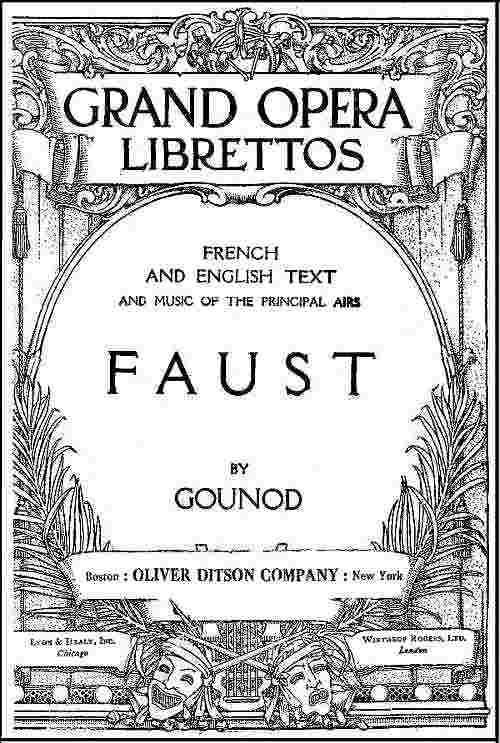
GRAND OPERA
LIBRETTOS
FRENCH
AND ENGLISH TEXT
AND MUSIC OF THE PRINCIPAL AIRS
FAUST
BY
GOUNOD
Boston : OLIVER DITSON COMPANY : New York
| Lyon & Healy, Inc. | Winthrop Rogers, Ltd. | |
| Chicago | London |
OPERA SCORES
All the vocal scores have English text together with the foreign text mentioned below. Unless otherwise specified, these books are bound in paper.
| GRAND | OPERAS | |
| AÏDA | Giuseppe Verdi | 2.50 |
| In four acts. Italian text | ||
| BOHEMIAN GIRL | Michael W. Balfe | 2.00 |
| In three acts | ||
| CARMEN | Georges Bizet | 2.50 |
| In four acts. French text | ||
| CAVALLERIA RUSTICANA | Pietro Mascagni | 2.00 |
| In one act. Italian text | ||
| FAUST | Charles Gounod | 2.00 |
| In five acts. French text | ||
| LAKMÉ | Léo Delibes | 3.00 |
| In three acts | ||
| MARITANA | William Vincent Wallace | 2.50 |
| In three acts | ||
| MIGNON | Ambroise Thomas | 2.50 |
| In three acts. Italian text | ||
| SAMSON AND DELILAH | Camille Saint-Saëns | 2.50 |
| In three acts | ||
| TROVATORE, IL | Giuseppe Verdi | 2.00 |
| In four acts. Italian text | ||
| LIGHT | OPERAS | |
| BELLS OF CORNEVILLE, THE; | ||
| or, THE CHIMES OF NORMANDY | Robert Planquette | 2.50 |
| In three acts | ||
| BILLEE TAYLOR; | ||
| or, THE REWARD OF VIRTUE | Edward Solomon | 1.50 |
| In two acts | ||
| BOCCACCIO; | ||
| or, THE PRINCE OF PALERMO | Franz von Suppé | 2.50 |
| In three acts | ||
| DOCTOR OF ALCANTARA, THE | Julius Eichberg | 1.50 |
| In two acts | ||
| FATINITZA | Franz von Suppé | 2.50 |
| In three acts. German and Italian text | ||
| MARTHA | Friedrich von Flotow | 2.50 |
| In four acts. German and Italian text | ||
| MASCOT, THE | Edmond Audran | 2.50 |
| In three acts | ||
| OLIVETTE | Edmond Audran | 2.00 |
| In three acts | ||
| PINAFORE, H. M. S.; or, | ||
| THE LASS THAT LOVED A SAILOR | Sir Arthur Sullivan | 1.50 |
| In two acts | ||
| SORCERER, THE | Sir Arthur Sullivan | 1.75 |
| In two acts | ||
| STRADELLA | Friedrich von Flotow | 2.00 |
| In three acts |
Send for Descriptive Circular P—Oratorios, Cantatas, Operas and Operettas.
OLIVER DITSON COMPANY
FAUST
A LYRIC DRAMA IN FIVE ACTS
BOOK BY
J. BARBIER AND M. CARRÉ
MUSIC BY
CHARLES GOUNOD
30
BOSTON: OLIVER DITSON COMPANY: NEW YORK
CHICAGO: LYON & HEALY, INC. LONDON: WINTHROP ROGERS, LTD.
Copyright MCMVI by Oliver Ditson Company
CHARACTERS
Faust |
Tenor |
| Mephistopheles | Bass-Baritone |
| Valentine, Marguerite's Brother | Baritone |
| Wagner, a Student | Baritone |
| Marguerite | Soprano |
| Siebel, a Youth | Soprano |
| Martha, Friend of Marguerite | Mezzo-Soprano |
Peasants, Townspeople, Soldiers, Students, Priests, Boys, Etc.
The scene is in Germany in the sixteenth century.
PREFATORY NOTE
The legend of the magician Faust and his compact with the Devil comes from remote antiquity. At first in the form of folk tales in many lands, through ballads and the primitive drama it found its way into literature. It remained for the master-poet, Goethe, to fuse all the elements of the legend into an imaginative drama of unequaled ethical and poetic interest, to give the story the form in which it appeals most strongly to the modern mind.
Innumerable musical works of every form have drawn inspiration from the story of Faust. Wagner's concert-overture, Liszt's symphony, and the beautiful fragments by Schumann are among the noblest of such works. Stage versions of the legend have been numerous, but the first really poetic creation was Spohr's opera of "Faust," composed in 1813. Since its appearance there has been an abundance of Faust operas by English, German, French and Italian composers down to the imaginative but fragmentary "Mefistofele" of Boito (1868). But of all the stage versions that have claimed the public attention, that of Barbier and Carré, made after Goethe's drama and set to music by Charles Gounod, is far and away the most popular, and may be regarded, in its lyric dress, as the most successful also. There exists scarcely a single rival to the popularity of Gounod's "Faust" among opera-goers.
The love story with which the French librettists concerned themselves exclusively is wholly Goethe's conception, and finds no place in the old legends concerning the magician Faust. With true Gallic instinct they seized this pathetic episode as being best adapted for a lyric setting, and making the most potent appeal to the emotions of the spectators. But to the composer himself is due the credit of suggesting the story of Faust as a suitable subject for musical treatment.
THE STORY OF THE ACTION
Act I. —Faust, an aged philosopher, who has grown weary of life, and of the vain search for the source of all knowledge, decides, after a nightlong vigil, to end his existence by taking poison. In the act of raising the cup to his lips his hand is arrested by the sound of merry voices of maidens singing in the early morning of the joy of living. Again he essays to drink, but pauses to listen to the song of the reapers on their way to the fields, voicing their gratitude to God. Excited to a frenzy of rage, Faust curses all that is good and calls upon the Evil One to aid him. Mephistopheles appears, and offers gold, glory, boundless power; but the aged doctor craves youth, its passions and delights. The fiend agrees that all shall be his if he but sign a compact, by which the devil serves Faust on earth, but in the hereafter below the relation is to be reversed. Faust wavers at first, but a vision of Marguerite appears, which inflames his ardor and dispels his hesitation; he drinks the potion and is transformed into a young and handsome man.
Act —A Kermesse or town fair. Groups of students, soldiers, old men, maids and matrons fill the scene. Valentine, the brother of Marguerite, about to leave for the wars, commends his sister to the care of Siebel, who timidly adores her. While Wagner, a student, is attempting a song, he is interrupted by Mephistopheles who volunteers to sing him a better one (the mocking "Calf of Gold"). Then the fiend causes a fiery liquor to flow miraculously from the tavern sign, and proposes the health of Marguerite. Valentine resents the insult, but his sword is broken in his hand, and Mephistopheles draws a magic circle around himself and bids defiance to the rapiers of the soldiers. These, now suspecting his evil nature, hold their cruciform sword-hilts toward Mephistopheles, who cowers away at the holy symbol. The fête is resumed; in the midst of the revelry Marguerite enters, returning home from church. Faust offers to escort her home, but she timidly declines his assistance, and leaves him enamoured of her beauty. The act closes with a merry dance of the townspeople.
Act I —The scene shows the garden of Marguerite's dwelling. Siebel enters to leave a nosegay on the doorstep of his charmer. The flowers he plucks wither at his touch, due to an evil spell cast upon him by the fiend, which he, however, breaks by dipping his hand in holy water. Faust and Mephistopheles conceal themselves in the garden after having left a casket of jewels on the doorstep near Siebel's modest offering. Marguerite returns home and seats herself at the spinning-wheel, singing the while a song of the "King of Thule." But she interrupts the song to dream of the handsome stranger who had spoken to her at the fête. Upon discovering the jewels, she cannot forbear to adorn herself. While thus occupied, Faust and his evil ally appear. The latter engages the girl's flighty neighbor, Martha, in conversation, while Faust pleads his passion's cause successfully with Marguerite.
Act IV. —Betrayed and deserted by her lover, Marguerite must bear the scorn of her former companions. Siebel alone is faithful, and speaks comforting words. She goes to the church to pray; but her supplications are interrupted by the mocking fiend at her elbow, by the accusing cries of demons, and by the stern chants of the worshipers. Finally Mephistopheles appears to the sight of the wretched girl, who swoons with terror.
The return of the victorious soldiers brings back Valentine, who hears evil stories of his sister's condition. Aroused by an insulting serenade which Mephistopheles, accompanied by Faust, sings beneath Marguerite's window, Valentine engages in a duel with the latter and is wounded to the death. Dying, he curses Marguerite, who comes from the church to his side, and accuses her of bringing him to his end.
Act V. —Marguerite, her reason shaken by her misfortunes, has killed her child, and for this crime she is thrown into prison, and condemned to die. Faust, aided by Mephistopheles, obtains access to her cell and urges her to fly with him; but her poor mind cannot grasp the situation, and recurs only to the scenes of their love. When she sees Faust's companion, she turns from him in horror, falls upon her knees, and implores the mercy of heaven. As she sinks in death, Mephistopheles pronounces her damned, but a heavenly voice proclaims her pardoned; and while a celestial choir chants the Easter hymn the soul of Marguerite is seen borne up to heaven by angels. Faust falls to his knees, and the devil crouches beneath the shining sword of an archangel.
First performed at the Théâtre Lyrique, Paris, March 19, 1859, with the following cast:
| Le Docteur Faust | MM. Barbot |
| Méphistophélès | Balanqué |
| Valentin | Reynald |
| Wagner | Cibot |
| Marguerite | Mmes. Miolan-Carvalho |
| Siebel | Faivre |
| Martha | Duclos |
ACT I.
SCENE I.
Faust's Study.
(Night. Faust discovered, alone. He is seated at a table covered with books and parchments; an open book lies before him. His lamp is flickering in the socket.)
(Pours liquid from the flask into a crystal goblet. Just as he is about to raise it to his lips, the following chorus is heard, without.)
SCENE II.
Faust and Mephistopheles.
ACT II.
SCENE I.
The Kermesse.
(One of the city gates. To the left, an Inn, bearing the sign of the god Bacchus.)
Wagner, Students, Burghers, Soldiers, Maidens, and Matrons.
SCENE II.
Wagner, Siebel, Valentine, Students, and afterwards Mephistopheles.