
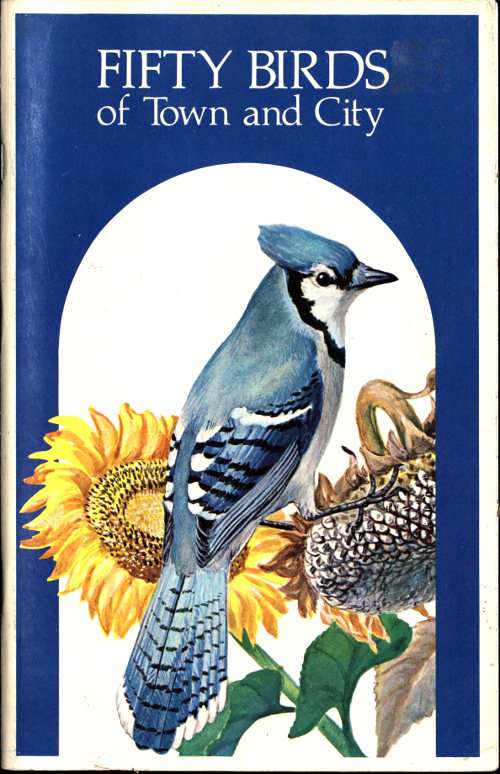
The Project Gutenberg eBook of Fifty Birds of Town and City
Title: Fifty Birds of Town and City
Author: Bob Hines
Peter A. Anastasi
Release date: October 27, 2015 [eBook #50321]
Most recently updated: October 22, 2024
Language: English
Credits: Produced by Stephen Hutcheson, Dave Morgan and the Online
Distributed Proofreading Team at http://www.pgdp.net
U.S. DEPARTMENT OF THE INTERIOR
As the Nation’s principal conservation agency, the Department of the Interior has basic responsibilities for water, fish, wildlife, mineral, land, park, and recreational resources. Indian and Territorial affairs are other major concerns of America’s “Department of Natural Resources.” The Department works to assure the wisest choice in managing all our resources so each will make its full contribution to a better United States—now and in the future.
- For sale by the Superintendent of Documents,
- U.S. Government Printing Office
- Washington, D.C. 20402
- Price $4 cloth; $1.05 paper
- Stock Number 2410-0332
FIFTY BIRDS
of Town and City
by
BOB HINES
Illustrator-Editor
and
PETER A. ANASTASI
Associate Editor
U. S. DEPARTMENT OF THE INTERIOR
Fish and Wildlife Service
Bureau of Sport Fisheries and Wildlife
Foreword
Early in this century, the old Bureau of Biological Survey put out a booklet called “Fifty Common Birds of Farm and Orchard,” with paintings by Louis Agassiz Fuertes.
In 1962, a former Fish and Wildlife Service staffer named Rachael Carson wrote “Silent Spring,” a book that changed American thinking about birds—and pesticides.
That first volume is out of date because of our great population shifts in six decades. And I hope that “Silent Spring” will be out of date some day; that our birds will live with us in an unpoisoned environment of cities and towns that are cleaner, healthier, greener.
So here is a new “bird book” from the Department of the Interior, geared to the 50 birds you might see in your city, with paintings done by a man who picked up the fallen Fuertes brush, Bob Hines. These are not endangered birds, except as all living things are endangered; some of them are living in or passing through your backyard or city park right now. Look well at Bob’s art; he is not commemorating the passenger pigeon but trying to open your eyes to the world about you.
And he is trying to suggest that these birds can live in our towns and cities so long as you help provide the healthy habitat they need, habitat that is healthy not just for them but for you.
Enjoy this little book, learn from it, and take a vow that our springs will not be silent of bird calls—and will be more silent of human clatter.
Secretary of the Interior
Contents
- Page
- 1 Baltimore Oriole
- 2 Barn Swallow
- 3 Black-capped Chickadee
- 4 Bluebird
- 5 Blue Jay
- 6 Bobwhite
- 7 Brown Creeper
- 8 Brown Thrasher
- 9 Canada Goose
- 10 Cardinal
- 11 Catbird
- 12 Cedar Waxwing
- 13 Chimney Swift
- 14 Chipping Sparrow
- 15 Cowbird
- 16 Crow
- 17 Downy Woodpecker
- 18 Flicker
- 19 Goldfinch
- 20 Grackle
- 21 Green Heron
- 22 Herring Gull
- 23 House Sparrow
- 24 House Wren
- 25 Junco
- 26 Killdeer
- 27 Mallard
- 28 Mockingbird
- 29 Mourning Dove
- 30 Myrtle Warbler
- 31 Nighthawk
- 32 Pigeon
- 33 Purple Martin
- 34 Red-eyed Vireo
- 35 Red-headed Woodpecker
- 36 Red-winged Blackbird
- 37 Robin
- 38 Ruby-throated Hummingbird
- 39 Song Sparrow
- 40 Sparrow Hawk
- 41 Starling
- 42 Towhee
- 43 Tufted Titmouse
- 44 Turkey Vulture
- 45 White-breasted Nuthatch
- 46 White-crowned Sparrow
- 47 Wood Pewee
- 48 Wood Thrush
- 49 Yellowthroat
- 50 Yellow Warbler
BALTIMORE ORIOLE
(Icterus galbula)
Look for this bird in groves and shade trees in residential areas of towns and suburbs. Smaller than a robin, the male’s fiery orange and black is easy to spot. As he wings by, his bright colors add a flick of glory to the urban scene.
The song is a rich series of whistled notes. Wintering to South America, the oriole’s summer breeding range stretches from Nova Scotia to north Texas. This is the architect of the graceful pendulent nests usually seen only after the leaves have fallen, and the birds have gone.
BARN SWALLOW
(Hirundo rustica)
Length about 7 inches; distinguished among our swallows by deeply forked tail. While they breed throughout the United States, they winter to South America.
This is one of the most familiar farm birds and a great insect destroyer, seeking prey from daylight to dark on tireless wings. Its favorite nesting site was barn rafters, upon which it stuck mud baskets to hold its eggs. But modern barns are fewer and so tightly constructed that swallows can not gain entrance, and in much of this country they have turned to boat docks, commercial buildings, summer homes, and the out buildings of rural suburbs to keep the species going. Like other rural birds, they have to adjust to changing land-use patterns.
CHICKADEE
(Parus sp.)
Length about 5 inches. Resident in most of North America.
Because of its delightful notes, its flitting ways, and its fearlessness, the chickadee is one of our best known birds. It responds to human encouragement, and by hanging a constant supply of suet this black-capped visitor can be made a regular feeder in suburban gardens or city yards. Though small in size, these cousins of the titmice are highly useful against insects, gleaned mostly from the twigs and branches of trees. The chickadee’s food is made up of insects and seeds, largely seeds of pines, with a few of the poison ivy, some weeds, and sunflowers.
BLUEBIRD
(Sialia sp.)
About 6 inches long, bluebirds breed in the United States, southern Canada, Mexico, and Guatemala, wintering in the southern half of the Eastern United States and south to Guatemala.
The bluebird was once a familiar tenant of towns, hailed as the herald of a new vernal season, and decidedly domestic in its habits. About the time that starlings became so very numerous, it declined in numbers. No one is sure why its numbers fell but competition for nest sites by starlings and house sparrows is certainly partly responsible. Recently it has begun to reappear in many places.
Its favorite nesting sites are natural cavities in old trees, boxes made for its use or crannies in buildings. Nesting boxes may be restoring the species, whose occupants pay rent by destroying insects. The bluebird’s diet consists of 68 percent insects and 32 percent vegetable matter. The commonest items of insect food are grasshoppers first and beetles next, while caterpillars stand third. Small flocks sometime invade yards for the red fruits of flowering dogwood trees.
BLUE JAY
(Cyanocitta cristata)
You either admire or hate this arrogant, foot-long hustler, easily identified by its brilliant colors. The blue jay is resident in the eastern United States and southern Canada, west into the Dakotas, Colorado, and Texas.
Like most insolent creatures, this jay has a dual nature. Cautious and silent in the vicinity of its nest, it is bold and noisy away from it. Sly in the commission of mischief, it is ever ready to scream “thief” at anything poaching on its domain. As usual in such cases, its epithet is applicable to none more than itself, as neighboring nest holders know to their sorrow; for during the breeding season the jay lays heavy toll upon the eggs and young of other birds. But with all its sins of pride and lust, back yards are enlivened by the presence of blue jays.
BOBWHITE
(Colinus virginianus)
This quail, about 10 inches long, is known by the clear call that suggests its name. It is native in the United States east of the Rockies and has been introduced many places in the West.
The bobwhite, and its call, is loved by every countryside visitor. It is one of the most popular game birds and appreciated as a gourmet’s delight. Quail have moved into our suburbs, although its numbers have diminished in many States through loss of habitat. About half the food of bobwhites consists of weed seeds, a tenth of wild fruits, and a fourth grain. Most of the grain it consumes is picked up from stubble. Fifteen percent of the bobwhite’s food is composed of insects, including several of the most serious pests, but its greatest value is aesthetic.
BROWN CREEPER
(Certhia familiaris)
Length 5 inches. Breeds from Alaska and Canada south to the Great Lakes States and Connecticut; also in the mountains south to Nicaragua; winters over most of its range.
Rarely indeed is the creeper seen at rest. It appears to spend its life in an incessant scramble over the trunks and branches of trees, gleaning its insect food. It is so protectively colored as to be practically invisible to its enemies and though delicately built possesses strong feet and claws. Its tiny eyes are sharp enough to detect insects so small that most other species pass them by. The creeper fills a unique place in the ranks of our insect destroyers: minute insects, their eggs and larvae, moths, caterpillars, small wasps, scales and plant lice are items of its diet.
It does not appear in flocks. Single birds or pairs will feed infrequently on beef suet at bird stations, but it’s seldom a regular visitor.
BROWN THRASHER
(Toxostoma rufum)
About 11 inches. Breeds from the Gulf to southern Canada and west to Colorado, Wyoming, and Montana; winters in the southern half of the eastern United States.
The brown thrasher is more retiring than either the mockingbird or catbird, but like them is a splendid singer. Not frequently, indeed, its song is taken for that of its more famed cousin, the mockingbird. It is partial to thickets and gets much of its food from the ground. Its search for this is usually accompanied by much scratching and scattering of leaves; whence its common name. Its call note is a sharp sound like the smacking of lips, useful in identifying this long-tailed, thicket-haunting bird, which does not relish close scrutiny. The brown thrasher is not so fond of wild fruit as the catbird and mocker, but devours a much larger percentage of animal food.
CANADA GOOSE
(Branta canadensis)
This most familiar and most common of the wild geese is best known in urban areas as a visitor in spring and fall.
Sizes vary, but the head and neck markings make this goose easily identifiable. The Canadas breed on lake shores and coastal marshes, primarily in Canada, and migrate in organized units utilizing the well known V-formation, although sometimes flying in long strings of birds. Flying by day and night, Canadas have set down in flocks on city squares, apparently mistaking a pool of light for a water surface. They seldom live in cities or towns, although visiting urban parks on occasions. Their honking cries in migration have stirred the blood of many an urbanite on a fall night when traffic noises let the wild cry from the skies leak through.
CARDINAL
(Richmondena cardinalis)
Color alone would make cardinals favored birds. Their striking plumage is easily seen and long remembered. Though mild mannered, they will sometimes chase each other from a feeding station in early winter, but by late winter and spring they eat side by side.
Preferring vines, shrubbery, and thickets, they will live comfortably in city yards and parks. Since cardinals do not migrate, they will remain in one yard the year round, as long as food is available. Often nesting in bushes beside busy sidewalks, or near enough to homes that their every move can be watched, they often have several broods a year.
Their usual song is a clear and ringing whistle. While no two birds seem identical in sound, their songs are distinctive, and once learned, will always bring pleasure.
These fine birds are now found in most states, and range north as far as southern Canada.
CATBIRD
(Dumetella carolinensis)
Length about 9 inches; the slaty gray plumage and black cap and tail are distinctive. Breeds throughout the United States west to New Mexico, Utah, Oregon, and Washington, and in southern Canada; winters from the Gulf States to Panama.
In some localities the catbird is fairly common. Tangled growths are its favorite nesting places and retreats, and ornamental shrubbery around houses will attract and keep them inside a town. The bird has a fine song, frequently broken by mewing like a cat. Its habits are somewhat similar to those of its cousin, the mockingbird, with song almost as varied, but it is more secretive and usually sings while hidden in the bushes. It feeds on fruit and insects, and can be lured to shelves and windows by raisins, cherries, or chopped apples.
CEDAR WAXWING
(Bombycilla cedrorum)
Found in open or bushy woodlands or along the margins of agricultural and residential areas, this sleek, crested brown bird is between the size of a sparrow and a robin. The broad yellow band at the tip of the tail is conspicuous and its voice is a high, thin lisp or zeee. It is the only sleek brown bird with a long crest.
Breeding from Canada to north Georgia and west to Kansas, its nests can be fairly common in suburban areas, and it winters in irregular patterns throughout the United States.
CHIMNEY SWIFT
(Chaetura pelagica)
It’s hard to figure out how these birds ever existed without urban areas, since they literally earn their first name by nesting and roosting in chimneys, propping themselves against the inside surface with short, spiny tails.
This swift is normally found only east of the great plains. Small birds at about 5 inches long, they are aloft all day long, and almost always in groups. They migrate in large flocks and nest from Canada to the Gulf of Mexico. Watching a flock of swifts flow funnel-like into a chimney is a startling evening experience. The birds express themselves with a chatter of chipping cries, one of the easiest identifications of the species. Their only food is insects, and they are highly beneficial.
CHIPPING SPARROW
(Spizella passerina)
This slim bird is only about 5 inches long. You can spot it by a chestnut brown crown, black line through the eye, and a black bill. Chippies nest throughout the United States; they even breed as far south as Nicaragua and as far north as southern Canada, and winter in the southern United States and Mexico.
Chipping sparrows are domestic birds that show little fear of humans. They often build nests in gardens, cemeteries or golf courses, where mowed lawns provide feeding areas. Among the most insectivorous of all sparrows, their diet consists mainly of insects, supplemented by weed seeds.
Adjectives are dangerous in describing wildlife, but chippies are just plain lovable.
COWBIRD
(Molothrus ater)
Cowbirds are the only native American birds to always lay their eggs in nests of other species, and have the young raised by foster parents. Warblers, finches, and sparrows, all smaller than cowbirds, are the chief victims of this practice, the fast growing foster chick monopolizing food and space to the detriment of the legitimate offspring.
This is the smallest blackbird, flocking in small groups, or mixing with grackles and red-wings. They are usually quiet, their only song a faint whistle. They range north into Canada and winter in the southeastern States. Grasshoppers, beetles, and a number of insects are eaten, and like other blackbirds, they do some damage to grain.
CROW
(Corvus sp.)
Smart enough to adapt quickly to urban life, crows nest in such unlikely places as alongside the Pentagon, and feed in the White House grounds in Washington.
Typically, they feed in the early hours before many people are out, retreating to parks or fields when disturbed. Their nest-robbing, crop destroying habits are often exaggerated, and less attention paid to their diet of grubs, beetles, mice, and other pests.
Grackles, martins, flycatchers, and other smaller birds, recognizing them as marauders, will chase crows in the spring and summer. Watching the little feathered dive-bombers attack the lumbering crow is quite a show, the larger bird always retreating as best he can, sometimes losing a few feathers, but seldom his dignity.
DOWNY WOODPECKER
(Dendrocopos pubescens)
Our smallest woodpecker at 6 inches; spotted with black and white. Dark bars on the outer tail feathers distinguish it from the similar but larger hairy woodpecker. Resident in the United States and the forested parts of Canada and Alaska.
This woodpecker is widely distributed, living in woodlands, orchards and gardens. Like the hairy woodpecker, it beats a tattoo on a dry resonant tree branch. To appreciative ears it has the quality of forest music. In a hole excavated in a dead branch the downy woodpecker lays four to six eggs. This and the hairy woodpecker are valuable human allies, their food consisting of some of the worst insect foes of orchard and shade trees. Beef suet, fastened too high for dogs to pirate, will attract Downies to a feeding station.
FLICKER
(Colaptes auratus)
Length 13 inches; the yellow (salmon in western birds) under surfaces of the wing and tail, and white rump are characteristic. It breeds throughout the United States and in forested parts of Canada; winters in most of the southern United States.
The flicker inhabits open country and delights in parklike regions where trees are numerous but well-spaced. It is possible to insure the presence of this useful bird about the home and to increase its numbers. It nests in any large cavity in a tree and readily appropriates an artificial nesting box. The most terrestrial of our woodpeckers, it procures much of its food from the ground. The largest item of animal food is ants, of which it eats more than any other common bird. The flicker is more adapted to suburbs than to the larger cities.
GOLDFINCH
(Spinus sp.)
The male is the only small, yellow bird with black wings and tail, with flight that is extremely undulating. In winter the species concentrate in areas where seed-laden plants are common.
They breed from Canada to Mexico and winter in the same range, nesting in July and August, after most birds have finished. The song is long-sustained, clear, light, and canary-like. In its flight, each dip is often punctuated by a simple cry of ti-dee-di-di.
Goldfinches are found along hedgerows, wood margins, brushy fields, and flower gardens, especially where cosmos are growing.
GRACKLE
(Quiscalus quiscula)
Length 12 inches. It breeds throughout the United States west to Texas, Colorado, and Montana and in southern Canada and winters in the southern half of its breeding range.
This is a beautiful blackbird that is well known from its habit of congregating in city parks and nesting there year after year. Like other species which habitually assemble in large flocks, it is capable of inflicting damage on farm crops. It shares with crows and blue jays a habit of pillaging the nests of small birds, but it does much good by destroying garden pests, especially white grubs, weevils, grasshoppers, and caterpillars.
GREEN HERON
(Butorides virescens)
A small, dark heron common to all water areas, breeding in a combination of wooded or brush habitats and marshes. It is also found along the wooded margins of lakes and ponds. It often shows more blue than green and is easily confused with the little blue heron. Its flight appears crowlike at a distance, moving with slow, arched wing beats.
The most generously distributed of small herons, its series of “kucks” or its loud skyow can often be heard in areas near urban settlements.
It breeds from the Gulf of Mexico north to southern Canada and winters from Florida south.
HERRING GULL
(Larus argentatus)
This is the common large sea gull of much of our interior and coasts and a familiar urban bird; a gray mantled, black wing tipped gull seen in garbage dumps and harbors in all U.S. coastal cities. Oceans, bays, estuaries, beaches, fields, inland lakes, reservoirs and large streams ... all provide habitat for this inspirer of “Jonathan Livingstone Seagull.”
His free wheeling grace in the sky and his raucous yet lonely kee-ow, ke-ow manage to bring beauty to even the most odoriferous city dump.
It breeds from the Arctic to the northern states and winters from the Great Lakes to the Gulf of Mexico.
HOUSE SPARROW
(Passer domesticus)
Perhaps the most citified of birds, this import’s incessant chattering, quarrelsome disposition, and abundance about human habitations distinguish it from our native sparrows. Actually, it is not a sparrow at all, but a weaver finch.
Almost universally condemned after its introduction into the United States, the house sparrow not only held its own, but increased in numbers and extended its range. It now occupies its own niche and is regarded with amusement and considerable affection in our inner cities.
In rural areas it does some damage to fruit, vegetables, and grain. On the other hand, it also eats a number of insects that damage those same crops.
HOUSE WREN
(Troglodytes aedon)
Less than 5 inches long, this tiny bird seems to live right at home with a man-made house. It breeds throughout the United States, except for the South Atlantic and Gulf areas, and also nests in southern Canada. It winters in the southern United States and Mexico.
The rich, bubbling song of the familiar little house wren is one of the sweetest associations connected with town or suburban life. Its tiny body allows it to creep into all sorts of nooks and crannies for its insect food. A cavity in a fence post or porch roof, a wren box, a hole in a tree, will be welcomed as a nesting site. Their food is grasshoppers, beetles, bugs, spiders, cutworms, ticks, and plant lice.
Recognized universally as Johnny and Jenny wren, welcome neighbors, they still show peculiarities in their behavior. Jealous of their home areas, wrens sometimes puncture the eggs of other small species nesting nearby, and Johnny may have two, possibly three mates at one time.
JUNCO
(Junco hyemalis)
A dark, slate-gray sparrow with conspicuous white outer tail feathers and a white belly. An abundant species, it breeds in brushy, cutover forests and is usually seen by urban dwellers when transient or wintering flocks come into residential areas. Juncos often winter at feeding stations in cities, suburbs, or towns.
It breeds from the tree line south to the northern states, farther south in the mountains. It winters in most of the U.S.
KILLDEER
(Charadrius vociferus)
These birds are commonplace in appearance and not very large at a length of 10 inches, but are distinguished by piercing and oft-repeated cries of “kildee.” They breed throughout the United States and most of Canada, and winter from the central United States to South America.
The killdeer is probably the best known of the shorebirds, perhaps because of its contrasting colors and startling cry. It is noisy and restless, like people, but most of its activities are beneficial to man. Its food is harmful insects, particularly weevils and beetles, flies, ticks, and wondrously enough, mosquitoes and their larvae.
The four pointed eggs are marked like pebbles, and laid in an unlined depression on the ground. Such dangerous sites as gravel roads, quarries, or even potato patches have been used.
MALLARD
(Anas platyrhynchos)
One of the largest ducks, mallards range across the entire northern hemisphere, and are probably the best known of all waterfowl, likely to set down in migration on small pools in city parks. It has also been widely domesticated or semidomesticated.
Its coloration makes identification easy, and the loud quack helps identify it. The birds breed in prairie waterholes in Canada, the Dakotas, Minnesota, and, to a minor extent, in other northern States. They move with the great spring and fall migrations and, adjusting easily to the presence of man, are likely to be seen in town or city. Add the domesticated mallards that swim about in so many parks and you have the most urbanized of the ducks that can still claim a wild heritage. They are most abundant in the Mississippi Valley.
MOCKINGBIRD
(Mimus polyglottos)
Ten inches long and neatly but soberly feathered, this was the bird of the Old South, but it is resident now from southern Mexico north to Michigan, Maine, even up to Wyoming, and seems to be spreading farther.
Because of its incomparable medleys and ability to mimic other birds, whistles, clocks, and bells, the mockingbird is the most renowned singer of the Western Hemisphere. Even in confinement it is a masterly performer, and in the nineteenth century, many were trapped and sold for cage birds. This practice ceased long ago, under law and close scrutiny. Mockers will feed on cultivated fruits, but they have so won human affection that this is rarely charged against them—principally because of that reputation as a songster and the fact that they eat a variety of destructive insects.
Raisins, oranges, or apples will bring them to a feeding station. To prevent them driving all other birds away from your tray, it helps to put the mocker’s rations at a distance, preferably across the yard, or on the opposite side of the house.
MOURNING DOVE
(Zenaida macroura)
A dark spot on the side of the neck distinguishes this bird from other native doves and pigeons except for the white-wing of the southwest. Also known as turtle dove, the “mourner” frequently nests in suburban and city shrubbery throughout the United States, Mexico, and southern Canada; it winters from the central United States to Panama—and is part of folklore in all those countries.
Mourning doves eat the seeds of plants, including grain, plus berries and the small wild fruits of any region through which they pass. Despite that melancholy but peaceful “coo,” they are restless migratory creatures. Doves live in the large cities, small towns, villages, and countryside; songs are sung and poems written about them; they are esteemed game birds that may nest in trees in your yard.