
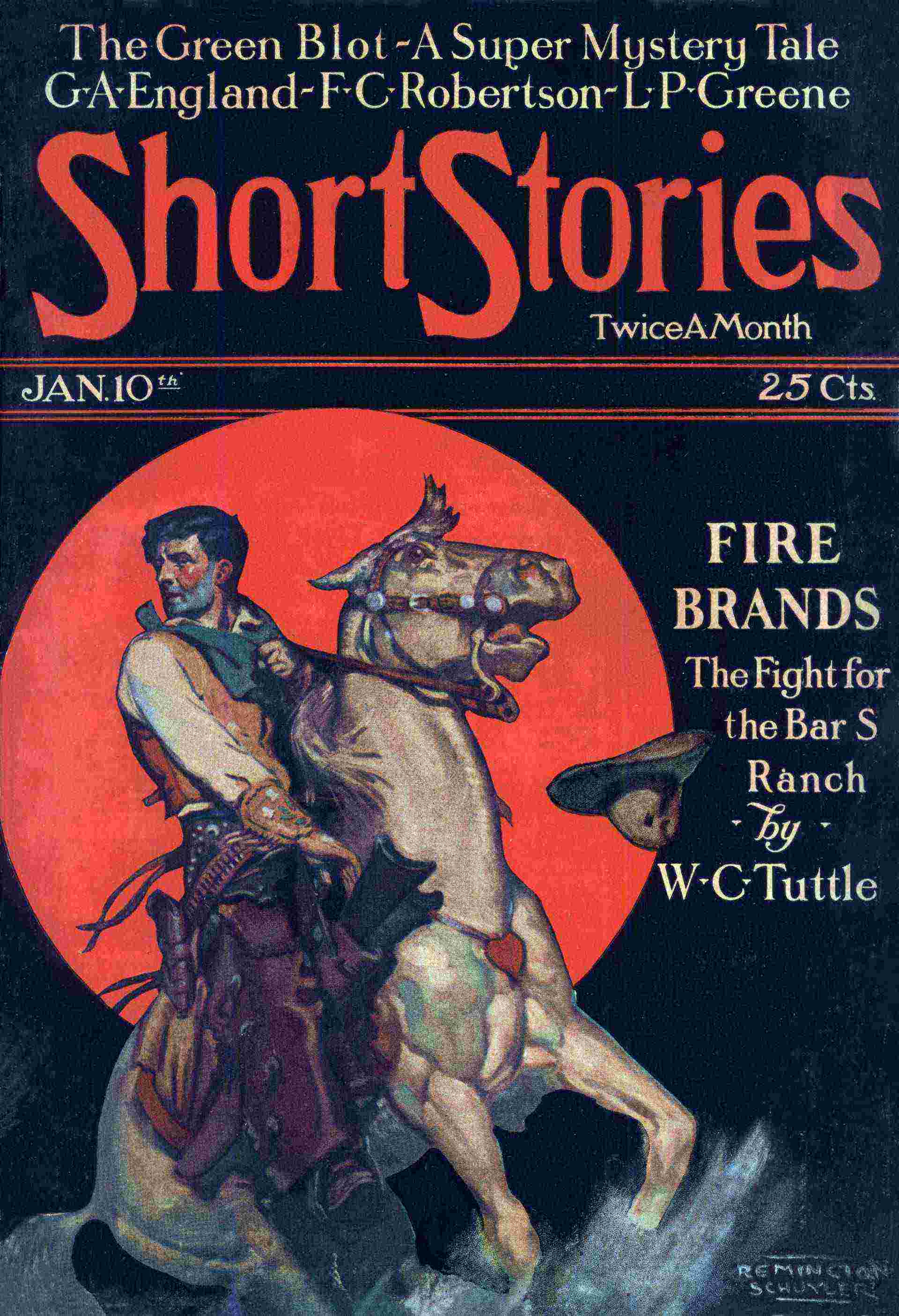
The Project Gutenberg eBook of Fire brands
Title: Fire brands
Author: W. C. Tuttle
Release date: December 1, 2025 [eBook #77373]
Language: English
Original publication: Garden City, NY: Doubleday, Page & Co, 1925
Credits: Roger Frank and Sue Clark
Fire Brands
Fire Brands
By W. C. Tuttle
Author of “Masked Law,” “Straight Shooting,” etc.
THERE WAS SOMETHING QUEER ABOUT THE SALE OF THE BAR S RANCH; THOSE ENTERPRISING COWMEN, SAD SONTAG AND SWEDE HARRIGAN, SENSED IT AT ONCE. BUT NOT UNTIL THEIR INTEREST WAS AROUSED BY SPECK, THE YOUNGSTER WHOSE INHERITANCE THE RANCH SHOULD HAVE BEEN, DID THEY DRAW CARDS IN A GAME WHICH PROMISED—AND DELIVERED—EXCITEMENT
I
“I’ll kill him, if it’s the last thing I ever do!” yelped “Sad” Sontag. “I tell yuh, I’m goin’ to kill him!”
“Quit it, I tell yuh!” wailed the bartender. “Don’t do that!”
Swish! Crash!
“Aw-w-w-w, you danged fool!” The bartender’s voice was raised in a wailing crescendo. “Look what yuh went and done.”
Sad Sontag’s face came up from behind the bar and he looked around solemnly. His serious gray eyes considered the redfaced bartender, shifted to “Swede” Harrigan, his partner, and then considered other occupants of the saloon, who were interested.
“Your darned heels knocked some of my glasses down,” complained the bartender. “I told yuh not to do it, didn’t I? Didn’t I tell yuh not to git up on my bar like that?”
“Uh-huh,” nodded Sad. “I s’pose yuh did mention it.”
“Mention, hell!” The bartender appealed to the crowd. “I’ll leave to any of you.”
“You kinda overreached yourself, cowboy,” observed Swede.
“Uh-huh,” Sad squinted around, felt the back of his neck and shrugged his thin shoulders.
“Well, I s’pose I missed him,” he said ruefully, coming from behind the bar. “That’s the first darned horsefly that ever bit me from behind and got away with it.”
“Gittin’ up on my bar and tryin’ to hit a fly with a hat!” The bartender was justly indignant. “Where in hell do you fellers think this place is, anyway? Balancin’ on your knees on top of my bar and——”
“Wait a minute,” interrupted Sad. “If you think that anybody is intensely interested in yore recital, hire a hall. I’ll betcha you’ve got a silv’ry voice, and all that, but not when yo’re mad. Right now yuh kinda creak yore words.”
“I’ve got a right to kick, ain’t I?”
Sad leaned against the bar, his old sombrero pulled down over his left eye, his shirt collar hiked up around his ears, and squinted reflectively at the irate bartender.
“All right,” he nodded. “Go ahead. But, brother, let not yore oration become personal. Use all the ‘I’s’ yuh want to, but keep from sayin’ ‘you’ as much as possible. Proceed.”
But the bartender’s vocabulary seemed to have oozed away; so he contented himself with picking up what few glasses Sad’s heels had smashed when he fell off the bar in his efforts to swat a horsefly.
Sad Sontag was as lean as a grayhound, bronzed as an Indian. His hair was sort of a washed-out sandy color, with one long lock extending down his forehead and joining one of his arched eyebrows, which gave him an habitual astonished expression.
Sad’s shirt was of neutral shade; the color having long since faded from the sun and strong soap, his chaps worn and scarred, and his boot heels badly run over on the outer edges, which proved that Sad was bow-legged.
His cartridge belt was of extra width, molded by use to fit the curve of his hip and thigh, and from a scarred holster protruded the plain, black wood butt of a heavy Colt revolver.
Swede Harrigan, his partner, was a composite of Gaelic and Norse; a six foot six inch blond cowboy, with an Irish mouth and nose. His eyes were round and very blue; patient-looking eyes, which belied the nose and mouth below them. His raiment was on a par with that worn by Sad, except that his boot heels were slightly run over on the inner side, which proved that Swede was a little knock-kneed in spite of the fact that he had spent most of his life in a saddle.
They were a nondescript pair, these two cowpunchers; neither handsome nor gaudy. An experienced cattleman would probably pick them out of a crowd as being tophand cowboys; but as far as appearances went they were merely two ordinary cowhands, no better nor worse than the average run.
Nor were they, except that they were joint owners of the TJ cattle outfit in the Sundown country, a hundred miles north of this town of Oreana. Oreana City, they called it, a cow town of a hundred and fifty inhabitants, and the county seat of Pipestone County.
The bartender cooled down considerably when he found that the damage was small, and offered to set up the drinks.
“Gimme a see-gar,” said Sad seriously.
“I’ll burn m’ tongue, too,” nodded Swede.
The bartender dug beneath the bar top and drew out a cigar box, which he dusted off and opened.
“Them,” he said, tipping the box for a better view, “them is what I call cigars. They costs me three dollars per hundred. Ain’t much call for cigars here.”
“Hadn’t ort to be,” agreed Swede. “Prob’ly be less after this.”
“It don’t do no good to wet ’em that-away,” declared the bartender. “I’ve done it a lot of times, but they won’t stick.”
Sad’s cigar slipped from his fingers onto the floor, while Swede stumbled and broke his against the bar.
“I’ll buy a drink of liquor,” declared Sad, and added meaningly, “I hope yuh didn’t try to make that stick.”
“Aw-w-w-w, I didn’t mean them cigars,” protested the bartender. “I meant that I’d tried it with the ones I smoked.”
“Yuh shore get lucid too late,” said Swede sadly. “I never did see a bartender that wasn’t about forty minutes late.”
“Yeah? Well, I wasn’t always a bartender.”
“Yore work shows it,” grinned Sad. “Well, here’s how.”
Swede grimaced and coughed.
“My gosh!” he gasped. “That’s the first time I ever made a test-tube out of my insides. Hooh! I’ll betcha that inside of fifteen minutes there won’t be nothin’ left of me except my ring and the case of my watch. Nitric acid!”
“Twenty years in the wood,” declared the bartender.
“Ah-h-h-h-h!” Sad clung to the bar, gasping like a drowning man, his eyes closed painfully. The bartender had not yet taken his drink, and now he slid it beneath the bar and dumped it into the slacktub, where he washed his glasses.
He sniffed at the bottles. It seemed to smell all right.
“It seems to be all right,” he said.
“Yeah, it’s all right, but it’s got kind of a whisky taste,” said Sad.
“My gosh, it is whisky!”
“It is?” Sad’s eyebrows lifted incredulously. “Do you mean to tell me—ah, no, it cannot be!”
“He says it straight enough,” said Swede seriously. He and Sad stared at each other wonderingly, turned together, stared at the bartender and went slowly out into the street; while the bartender rubbed his chin and wondered what on earth it was all about anyway.
Sad and Swede walked up the narrow sidewalk, their faces very solemn until they looked at each other and burst into laughter.
“Now that poor bartender’ll wonder whether we’re crazy or he is,” chuckled Sad. “Didja see him ditch his drink, Swede?”
“Did I? Ha, ha, ha, ha! It’s got a whisky taste!” Swede went into paroxisms of unholy glee.
They stopped near the entrance of a hall which led up to the county offices, and began perusing the assorted notices tacked to the wall. Sad seemed interested in one particular notice which concerned a sheriff’s sale.
“What day is this, Swede?” he asked.
“This is Monday, the seventh of August.”
“Thasso? Huh! Say, when did that feller tell us that this here sale was to be pulled off?”
“On the ninth.”
“Well, he lied several days,” complained Sad. “Here’s the notice, which says it’ll be pulled off on the twelfth.”
Swede moved over and squinted at the notice, which declared that on the twelfth day of August the sheriff of Pipestone county would sell at public auction everything belonging to the Bar S ranch. The sheriff had even gone to the trouble of drawing a pen design of the brand, which was a letter S, with a straight bar over the top.
“I reckon some of these Oreana folks can’t read; so he has to draw a pitcher of it,” grinned Swede. “Dang it, that makes it kinda bad for us, Sad. What’ll we do?”
Sad scratched his head and squinted dismally.
“I dunno. I don’t care to hive up in this place for very long, but we came here to see what we could buy at that sale; so we might as well stay here and see it through. What do yuh think?”
“I don’t care. It’s all right with me, if we can find somethin’ to do around this town.”
“All right, we’ll stay, Swede. The first thing we better do is to put them broncs in a stable and find us a place to stay.”
As they turned away from the bulletin board a yellow dog shot around the corner, yelping as only a yellow dog can yelp, while behind it, tied securely to its tail, bounded a tin can.
For a fraction of a second the yellow dog hesitated as it turned the corner, and then it headed straight for Sad and Swede. The word “headed” is hardly descriptive of its speed. Afterward Swede swore that something drew a yellow streak from his feet to the corner, and then rubbed it out.
At any rate, the dog, running blindly, attempted to go between Swede’s legs, which were slightly knock-kneed, and Swede flipped upside down, while the tin can whipped around his ankle, snapping the twine cord, and the yellow dog streaked away up the street, leaving Swede on his hands and knees, swearing just enough.
Immediately following the dog came a boy of about twelve, his freckled face streaked with dusty tears, his rusty hair rumpled belligerently. He stopped and looked at Swede, who was untangling the cord from around his boot. Sad grinned at the youngster, who came closer, crooking his neck to look past them.
“Where’d Boze go?” he drawled.
“Was that Boze?” asked Sad.
“Yeah.” The kid scratched one of his bare feet and looked back.
“Yuh hadn’t ort to tie cans on yore dog,” said Swede.
“Aw-w-w, hell!” The youngster spat dryly and hitched up his ragged overalls. “I never done it. It was some of them dad-durned square-heads from the Box 8. By grab, if I ever git big enough I’ll shore tie off to one of them pelicans and yank real hard.”
“Aw, shucks!” Sad grew sympathetic. “Somebody pickin’ on yuh, Bud?”
“Yeah—but my name ain’t Bud. I’m Percival Cadwallader Steeb. Mostly everybody calls me ‘Speck’ Steeb. And,” Speck sighed dismally and wiped his cheeks, “I ain’t havin’ good luck.”
“Ain’t yuh, Speck?” queried Swede.
“Nope. Me and Boze ran away from that derned Box 8 outfit.”
“Are you livin’ there, or jist punchin’ cows for ’em?” asked Sad.
“Aw, I ain’t big enough to be a ‘hand’ yet. They thought I was livin’ there, but I ain’t. And by the busted tail of a longhorn steer, I ain’t goin’ to live there neither. I’m through.”
“A feller like you ort to pick and choose,” nodded Swede.
An old man drove up and got out of his wagon in front of a store. His equipage consisted of a rickety buckboard and a pair of mismated horses. He was little short of seventy years of age, with a long, white beard and white hair. His face was seamed deeply and colored like an old parchment, which only accentuated the white of his beard and hair.
Three cowpunchers rounded the corner beyond the store and went inside, while the old man followed them in. Speck scowled at the three punchers.
“Them punchers is the jiggers from the Box 8 that tin canned Boze,” he informed them. “Took all three of ’em to hawg-tie me, y’betcha. That old man in the wagon is Eph Wyatt. He c’n whip his weight in anythin’ yuh want to mention.”
“Pretty old to be fightin’, ain’t he?” ventured Sad.
“Well, I dunno. Paw said that old Eph got fightener every year.”
Sad laughed and patted the youngster on the shoulder.
“Some folks are that way, Speck,” he said. “Where is yore father?”
Speck’s eyes suddenly filled with tears and he shoved both hands down deep in his pockets.
Sad and Swede exchanged a quick glance, as Speck looked up at them and said, “Well, yuh see, he—he’s dead now.”
“Aw, gosh!” exploded Sad mournfully. “Yuh see, Speck, we didn’t know about that.”
“Thasall right,” Speck smiled through his tears. “Folks never learn nothin’ unless they ask questions. My dad owned the Bar S ranch.”
“Oh, yeah,” Sad nodded thoughtfully. “Well, ain’t yuh got no relations, Speck? Nobody to look after yuh?”
“No-o-o,” Speck sighed deeply. “Anyway, I dunno any. Pa wasn’t much fer relations. Lot of these folks around here got to tryin’ to figure out what to do with me, and I’ll betcha some of ’em won’t git the cramps out of their brains for a year.
“Bill Wyatt says he can use a boy about my size out at the Box 8; so they sends me out there. Bill’s that old man’s nephew, but he’s owner of the Box 8. I stayed two days, and I’ll tell a man I worked. Whooee! Bill hates Boze. Bill hates everythin’, I reckon. Anyway, he run Boze off the ranch twice, but Boze comes back every time. Then Bill tells me to run the dog off the ranch and keep him off; so I run Boze plumb down here where,” Speck grinned wisely, “where I can keep us both off.”
“And then they come down here and tin can the dog, eh?” said Swede.
“Shore did. But Boze’ll come back.”
“That part’s all right, but what about you?” asked Sad.
“Don’t nobody need to worry about me,” assured Speck.
“Uh-huh,” Sad scratched his head thoughtfully. He admired the independent attitude of the youngster.
“I’ll git along,” remarked Speck. “All I ask is that they leave me and Boze alone. There’s the little son-of-a-gun now.”
Boze had ventured back to the corner beyond the store, and was peering around into the street. Speck whistled to the dog, which ran to meet him. Sad and Swede grinned at each other and walked to the store entrance, while the boy and dog romped farther up the street.
“Somebody’s hot under the collar,” observed Swede, as sounds of an argument from within the store greeted their entrance.
“I tell yuh, I don’t want him around!” It was Bill Wyatt, a thin-faced, bucktoothed cowboy, speaking. He rowled his spurs savagely against the counter and spat accurately at a sawdust-filled box.
“That’s all right.”
This remark came ponderously from Al Weller, the big storekeeper.
“It was your own idea, Bill.”
“Yeah, that’s right,” nodded Bill. “But I thought he’d be worth somethin’. Hell, he won’t work!”
Old Eph Wyatt turned his head and squinted at his nephew.
“You wasn’t payin’ him no wages, was yuh, Bill?”
“Not so yuh could notice it.”
“I didn’t think yuh was, Bill. Yuh can hire men for forty a month, and yuh might stop long enough to remember that the kid ain’t more’n twelve years old.”
“I was givin’ him a home,” retorted Bill.
“You wasn’t givin him nothin’—he had to earn one.”
“There’s no use quarrelin’,” said the storekeeper quickly.
“I’m not quarrelin’,” said the old man. “The poor kid got a tough deal all the way around. I liked Jim Steeb. He was a damn fool to drink himself to death, lose everythin’ and throw the kid into a community that’s got more kids than they know what to do with.
“Bill had an idea that he could git some cheap labor, I reckon. No, I ain’t sayin’ that a little work will hurt any kid, but a youngster like him hadn’t ort to have to work twelve hours per day for his bed and three meals.”
“I dunno yet jist why yo’re hornin’ into this,” declared Bill.
His uncle squinted at Bill closely; so intently that the younger man shifted uneasily.
“You didn’t think that I cared to explain, did yuh?” asked the old man slowly. “I ain’t never been in the habit to apologizin’ for hornin’ into an argument, have I?”
“Thasall right, Eph.” The storekeeper was a trifle anxious.
“Well, I don’t care what yuh do.” Bill shrugged his shoulders and threw some silver on the counter.
“Gimme some smokin’ and papers, Al.”
As he pocketed the desired articles, Speck and Boze came in. The dog slouched at the boy’s heels, recognizing its enemies, but Speck was unafraid. All conversation ceased, as the boy and dog came up to the group. Some of the men had noticed Sad and Swede, but the argument had been too interesting for them to pay much attention to a pair of strange cowboys.
“That dog don’t know when to git insulted,” laughed Bill.
“You let that dog alone,” said Speck firmly. “He ain’t never done nothin’ to you, Bill Wyatt.”
Bill laughed at Speck and started for Boze, who darted back toward the door, barking snappily.
“You let that dog alone!” shrilled Speck, blocking Bill. “By golly, some day I’ll be big enough——”
But Speck’s prophecy was not finished when Bill’s open palm splatted against his ear, sending him sideways into the counter, and Bill started toward the frightened dog.
“You hadn’t ought to do that.” Sad Sontag stepped around the end of a display table between Bill and the dog. There was no threat in Sad’s voice nor actions. He was smiling with his mouth, but his eyes were serious.
“Hadn’t, eh?” Bill stopped and looked Sad over curiously. It was the first time he had ever seen this strange cowpuncher. Then he turned his head and looked at Swede, who was lounging easily against a counter, paying no attention to what Sad was doing, because his entire attention centered on the two men who had come in with Bill Wyatt.
Bill’s eyes came back to Sad.
“What’s the idea of you hornin’ into this?” he demanded.
“I ain’t hornin’ in,” smiled Sad. “I was just tellin’ yuh.”
Boze seemed to realize that the immediate danger was over, so he came over and sniffed at Sad’s boots. Speck had regained his feet, and was busily rubbing a very red ear. Bill looked back at his two men and found them centering their attention on Swede.
“And,” said Sad softly, “any man that would slap kids and tie cans on a pup’s tail is a low bred coyote.”
The storekeeper ducked low behind the counter, and the old man edged slowly out of line with the two men. They knew that Bill Wyatt was deadly with a six-shooter, and that there could be but one answer to that insult.
Still Bill Wyatt did not move. His half-closed eyes looked into the wide open gray ones of Sad Sontag, which seemed to hypnotize him. Neither of them had made any motion toward a gun.
“A feller that would hit a kid ain’t got the guts to fight.” Sad’s voice was pitched low, but carried clearly. “You might fight, if yuh was in a corner—but I doubt it.”
But Bill Wyatt did not move. Sad inched toward him, coming closer and closer. One of Bill’s men swore softly, wonderingly. They could not see Bill’s face.
Suddenly Sad’s left hand shot out, grasped the brim of Bill’s sombrero and yanked it down over Bill’s eyes. It was done so quickly that Bill did not have time to jerk away, and he stumbled forward from the pull.
But the hypnotic spell was broken. Bill ripped out a foul oath, as he flung back the hat and flipped out his gun; but the barrel of Sad’s struck him across the right wrist, forcing him to drop his gun, and the next instant he measured his full length under the table from a left swing which caught him full in the ear.
“Glory to gosh!” whooped Speck. “Right in the ear!”
Bill’s two men had not moved during the fight, for the simple reason that the blond-headed Swede still leaned against the counter, dangling a big six-shooter in his right hand; his lips puckered in a whistle, while his round blue eyes never wavered.
Sad kicked Bill’s gun aside and waited for him to get up; but Bill was in no great hurry. He slid from under the table, rubbing his swelling ear and seemed inclined to wonder what it was all about.
“You know now how it feels to get hit in the ear, don’tcha?” chuckled Speck. “Mebbe next time you’ll have a little sense.”
Bill got slowly to his feet and walked out of the store, while Abe Snow and “Snipe” Lee, his two men, followed him out. They gave Swede a wide berth in passing.
“And thus endeth that chapter,” smiled Sad.
“Mebbe not,” said old Eph Wyatt dubiously. “My nephew Bill won’t forget it for a mighty long time, stranger.”
“Memories has caused a lot of folks to lose their minds,” grinned Sad, rumpling Speck’s hair and feeling of his ear.
“Aw, it don’t hurt now,” protested Speck. “The wallop you gave Bill Wyatt cured me. Whooee, I’ll betcha he’s sore!”
A man was coming into the store, but turned to look across at the hitchrack, where the three men from the Box 8 were mounting. It was Buck Rainey, the sheriff, a short, heavy-set individual, with a yellow mustache and squinty eyes.
He came on in, glanced casually at Sad and Swede and spoke to the others.
“You missed a circus, Buck,” said Eph Wyatt, whose feelings in regard to his nephew were well known. “Bill jist got knocked cold.”
“Yeah?” The sheriff elevated his eyebrows. “How come, Eph?”
The old man laughed and detailed the story, while the sheriff stroked his mustache and considered Sad and Swede.
“And he popped him right in the ear,” added Speck jubilantly.
“Uh-huh.” The sheriff scratched his nose thoughtfully. “It’s a wonder that Bill didn’t start shootin’.’’
“It’s got me beat,” said the storekeeper. “He jist stood and took it. I don’t sabe Bill.”
“Is he supposed to be a bad man?” asked Sad.
“Well,” drawled the sheriff, “a feller don’t have to be so awful darned bad to reach for a gun at a time like that.”
“I don’t think he’s got brains enough to know when he’s been insulted,” laughed Swede.
“Mebbe not,” the sheriff grinned. “But Bill is usually the one to start trouble.”
“Mebbe I packed it to him too fast,” grinned Sad. “You’re the sheriff, ain’t yuh?”
“Yeah.”
“I’m Sontag. My pardner’s name is Harrigan. We own a ranch in the Sundown country, and we’re down here to see what we can buy at that Bar S sale.”
“Oh, yeah. Pleased to meetcha. Bar S sale, eh? Uh-hu-u-uh. What didja figure on buyin’?”
“Mebbe a few head of stock. We heard that there was quite a bunch of cattle and horses.”
“Yeah? Well, it won’t be held until the twelfth.”
“That’s all right. We got some wrong information and come down too soon.”
The sheriff turned to Eph Wyatt and the storekeeper.
“I’ve been wonderin’ what we’re goin’ to do with this kid.” He pointed at Speck, who was perched on a counter. “Bill said he’d take care of him, but that’s all off now, I suppose. Makes it bad for the kid.”
“I wish you’d quit worryin’ about me,” said Speck. “I ain’t askin’ for nothin’ but a job. I c’n work my way along.”
“You ain’t big enough to work,” declared the sheriff. “Your place is in school.”
“How’d yuh like to work for me?” asked the old man.
“Huh! I dunno,” Speck wriggled his toes. “Me and you’d prob’ly get along fine, Mr. Wyatt. Dad said you was the fightenest son-of-a-gun he ever seen—and I like to fight, too.”
The old man laughed softly and walked over to Speck.
“Fightin’ don’t git yuh much, Speck. I’m all alone on that old ranch out there, and I sure need somebody to help me. Suppose yuh come out and live with me.”
“Well—” Speck hesitated. “Well, I’ll do it.”
“He ain’t big enough to do much work,” said the sheriff.
“No, and he won’t have much to do.” Eph Wyatt turned to the sheriff. “I’ll take him out there with me jist the same. If me and him gits along all right. I’ll—I’ll adopt him accordin’ to law.”
“You’ll adopt him?”
“I shore will. Ain’t no law ag’in it, is there, Buck?”
“Sure ain’t, Eph.”
“What does adoptin’ mean?” asked Speck.
“Takin’ out papers to make yuh the same as my son,” explained the old man.
“Yea-a-a-ah?” Speck’s eyes widened. “What about Boze?”
“Well, he comes along,” laughed the old man. “We won’t need no papers for the pup. C’mon.”
The old man started for the door, with the boy and the pup close behind him. At the doorway Speck turned and came back to Sad, holding out his hand.
“Much obliged, Mr. Sontag,” he said. “Hope to meetcha ag’in.”
“Yo’re shore welcome, Speck,” laughed Sad as they shook hands. “I hope yore luck has turned.”
“She’s beginnin’ to bend a little,” grinned Speck. “S’long.”
They watched Speck climb up on the seat beside the old man, while Boze danced around in the rear of the buckboard and barked his approval of the equipage.
“Well, I hope it works out all right,” said the sheriff. “It sure was hard to find out what to do with that kid.”
“What killed his father?” asked Swede.
“Liquor. He spent most of his time at the Oreana saloon. It was too danged bad. Jim Steeb wasn’t a bad sort of a feller. His wife died a year ago, and it kinda ruined him. This ain’t exactly a sheriff’s sale. Yuh see, ‘Bunty’ O’Neil, who owns the Oreana saloon, has enough of Steeb’s notes to probably cover everythin’ on the Bar S.”
“Steeb just drank up his ranch, eh?” queried Sad.
“Uh-huh. There may be a little over, after O’Neil gets paid, but I doubt it. I’ve got three men in the hills now, roundin’ up the Bar S stock.”
“What sort of a person is Bill Wyatt?”
“Bill Wyatt? Well, he’s all right, I reckon. Bill’s kinda touchy, and ain’t noways honey-flavored, yuh know. He owns the Box 8 outfit and runs quite a lot of stock. That old Eph Wyatt is his uncle. Old Eph is a cantankerous old reptile, but he’s good-hearted. I dunno how him and the kid will hit it off together.”
“Is Bill Wyatt married?”
“Naw.”
“Owned the Box 8 very long?”
“Couple of years.”
“Buy out a brand, or register his own?”
“Registered his own. Used to be the 8 outfit; so he changed it to the Box 8. Say, what’s the idea of all these questions?”
“Curiosity, thasall, Sheriff,” laughed Sad. “Nice weather we’re havin’.”
“Uh-hu-u-uh.” The sheriff walked down the street toward his office, where three men were dismounting, while Sad and Swede went in the opposite direction, looking for a place to call home for a few days.
II
Bunty O’Neil of the Oreana saloon was not what you would call a lovable character. He was of medium height, thick of neck and broad of shoulder. His face was blocky, expressionless, swarthy; a hard-headed individual, whose bunting practice in a fight had given him his nickname. He would grasp an opponent with his huge hands, yank him forward and butt him with his head. Only in rare cases did Bunty fail to put his opponent hors de combat. It was an unlooked for move, except where Bunty’s system was well known.
Bunty had once worked it successfully on Bill Wyatt. Bill had wakened up about fifteen minutes later and found that both of his eyes were of a purple tint and did not admit much light. He had waited for the swelling to go down, had walked up behind Bunty in the Oreana saloon and crowned him with the barrel of a six-shooter.
Bunty had had six stitches taken in his scalp, and had sent word to Bill Wyatt to keep out of the Oreana. Bill did. This had happened six months prior to Sad and Swede’s coming to Oreana, but Bill had never been in the place since. Yet Bill had known Bunty in the northern part of the state, and it was Bill who had induced Bunty to come to Oreana and buy out the Oreana saloon and gambling house.
Just now Bunty and the sheriff were standing on the porch of the saloon, talking seriously. It was the day after Sad and Swede had come to Oreana.
“You say they brought in three hundred and ten head?” asked Bunty. The sheriff nodded.
“Yeah. They’re in the old pasture at the Bar S. The boys have gone down into the lower ranges now, but they won’t be able to round up everythin’ for a couple days. There’s enough feed in the pasture for a few days.”
“That’s good.” Bunty smiled contentedly. “Three hundred and ten head, eh? Mebbe I’ll get my money after all, Buck.”
“I reckon yuh will, Bunty. For gosh sake, how much money did Jim Steeb owe yuh, anyway?”
Bunty grinned widely and shook his head.
“Jim plunged quite a lot, Buck. His whisky bill ain’t more than a few hundred, but his faro and poker playin’ sure cost money. I reckon the notes he gave me will come close to ten thousand.”
The sheriff whistled his amazement.
“As much as that, Bunty? Huh! Yuh know,” the sheriff squinted thoughtfully. “Yuh know, it seems too darned bad Jim went through all that money and didn’t leave a darned thing for the kid. Old Eph Wyatt is goin’ to adopt him, I think.”
“Old Eph?” Bunty laughed. “Goin’ to adopt him, eh? Well, well!”
Just then Sad and Swede came out of the hotel and sauntered toward the general store.
“They tell me that one of them fellers took a fall out of Bill Wyatt,” said Bunty thoughtfully.
“The skinny one. They’re down here to buy some stock at the sale. The skinny one’s name is Sontag and the other is Harrigan. Seem like a salty pair of fellers. Sontag tells me that they own a ranch in the Sundown country.”
“Well, all I care about it is to get my money out of the deal, Buck.”
They went into the saloon, as Sad and Swede crossed the street, following them inside. The sheriff greeted them warmly and introduced them to Bunty as the owner of the Oreana. There was little activity in the place and the day was warm.
“You interested in the Bar S sale?” asked Bunty.
Sad nodded. “Kinda. We’re lookin’ for some stock, and thought this might be a chance to buy some reasonable. Course we don’t want a lot of runts.”
“We might take a ride out to the Bar S this evenin’,” suggested the sheriff. “The boys threw three hundred and ten head into the pasture last night, and it might help yuh some to look ’em over.”
“We’d sure appreciate the chance,” agreed Sad.
They spent the rest of the day, loafing in the shade, and did not start for the Bar S until late in the afternoon. It was five miles to the ranch, located northeast of Oreana. The ranch buildings were badly in need of repair, but it was easy to see that at one time the Bar S had been considerable of a ranch.
There was no one at the place, and the sheriff explained that there had been no one in charge since the death of Steeb. They rode out past the corrals and on to a knoll that furnished a view of the Bar S pasture, which contained about a hundred acres.
But there were no cattle in sight. The sheriff gnawed his mustache and squinted around wonderingly.
“’S funny,” he muttered. “They were here last night.”
“Are yuh sure this is the place?” asked Swede.
“Am I sure? I’m jist as sure as anythin’,” replied the sheriff and spurred his horse off the knoll.
They rode to the lower end of the pasture, and it did not take them long to find where the barb-wires had been cut, and about a hundred feet of them ripped off the posts.
“They knowed how to do it,” observed Sad. “They cut the wires, bunched the ends, tied ’em to a rope and jist rode ’em loose.”
“And let the whole herd drift,” observed the sheriff. “Well, that’s jist plumb meanness, I’d say.”
Sad looked at the sheriff and grinned softly.
“Sheriff, do you think that they just turned them cows loose?”
“Eh?” The sheriff’s eyebrows lifted slightly. “Yuh don’t think that anybody would try to rustle a herd like that, do yuh?”
“Why not?”
“Well, I dunno. Yuh can’t git away with that many. Anybody would be a fool to try and steal a herd like that.”
“All right,” Sad grinned widely and turned his horse. “You know the morals of this country better than we do.”
They rode back to Oreana and stabled their horses. The sheriff was very thoughtful during the ride, but could hardly bring himself to believe that anyone would try and steal three hundred and ten head of cattle in one herd.
“I think that someone is jist doin’ it to be mean,” he declared.
“And I think they’re doin’ it for profit,” laughed Sad.
It did not take the sheriff long to impart the story to Bunty O’Neil, who swore under his breath and questioned them closely. The sheriff told Bunty what he thought about it, but Bunty did not agree.
“They’ve had about twenty-four hours start,” observed Bunty. “And yuh can move a big herd a long ways in that length of time. It’s so dry in the hills that yuh couldn’t trail a herd; so the best yuh can do is to trust to luck.”
“It kinda looks like we might as well go home,” observed Swede. “No use of us stayin’ here, if there ain’t no cows for sale.”
Bunty’s eyes grew hard as he leaned on the bar and toyed with his glass. The sheriff cleared his throat and sent his glass spinning down the bar.
“Bunty has got a lot of notes against the Bar S,” he explained. “And if there ain’t no cows—Bunty loses.”
“That’s the how of it, eh?” said Sad.
“Yeah, that’s the how of it,” said Bunty angrily. “And I’ll get them cows—or get somethin’.”
“You’ve got sort of an idea who took ’em, ain’t yuh?” asked Sad.
“How would I?” snapped Bunty.
“I dunno how yuh would—I’m no mindreader,” and Sad walked away from the bar and grew interested in a poker game.
Bunty looked after him, an angry glint in his eyes, but said nothing until Swede walked away.
“What did he mean, Buck?” he then asked.
The sheriff shook his head. “I dunno. I hope the boys show up tomorrow, but I’m scared they won’t. We’ve got to try and find them missin’ cattle, that’s a cinch. I don’t believe yet that anybody had the nerve to try and steal a herd that big.”
The sheriff left the saloon, but Bunty remained at the bar, drinking his own liquor. It was not often that Bunty drank heavily. Liquor made him quarrelsome. Several patrons steered clear of the bar and had their drinks served at a table, when they realized that Bunty was on a spree.
Bunty leaned across the bar and motioned the bartender closer.
“What did that skinny puncher mean?” he demanded.
“The skinny one? I dunno what he said, Bunty. Personally, I think he’s crazy. The damn fool fell off the bar yesterday, tryin’ to hit a horsefly with his hat. And they said that there was whisky in the drinks we served here. What are they—e-vangelists?”
Bunty grunted an oath and reached for the bottle. Sad and Swede were coming toward the bar, heading for the door. Bunty stepped in front of Sad and motioned them to stop and drink with him.
“Yuh ain’t in no hurry, are yuh?” he growled.
“Not a bit,” grinned Sad.
“I’m glad yuh ain’t—’cause you’d stop anyway.”
Sad glanced keenly at Bunty. He realized that the other was angry over something, and that he might be a hard man to handle.
“I’m not buyin’ yuh any drinks,” Bunty informed them harshly. “I only buy drinks for my friends.”
“Then have a drink on me,” grinned Sad.
“No, I won’t do that, either.” Bunty moved in closer to Sad.
“I want to know what wuh mean by that remark a while ago—about yuh not bein’ a mind reader.”
“Oh!” Sad squinted thoughtfully. “Well, I’m not, Bunty. I’ll leave it to Swede if I am.”
“You’ll leave nothin’ to nobody! C’mere!”
Bunty grasped Sad by the shoulders, sinking his powerful fingers deeply into the flesh. It was the prelude to crashing the top of his head into Sad’s face—and Sad realized it.
But Bunty did not work fast enough. With a sudden shift of his feet, Sad kicked Bunty in the shins so hard that the hotelman forgot everything except the excruciating pain. His hands jerked loose and he reached for his shins just in time to get Sad’s fist square in his nose, with the full swinging weight of the wiry cowpuncher behind it.
The blow straightened Bunty back onto his heels, and before he could catch his balance Sad was into him, smashing with both hands to the head, and Bunty went reeling across the room to crash into the back of a poker player’s chair and go flat on his back.
At least a dozen men had seen the whole affair. They had expected Bunty to butt the face almost off this thin cowpuncher and end the fight to suit himself. But they had reckoned without Sad Sontag, who now was standing against the bar, blowing on his sore knuckles and grinning widely.
There was little commotion. A couple of men picked Bunty up and half-dragged him to the rear of the room, where they could wash him off, the poker player adjusted his chair and the games went on.
Sad and Swede went back to the hotel, where Sad procured some hot water in which to bathe his swollen right hand. Swede became pessimistic.
“Aw, let’s go home,” he argued dismally. “You’ve whipped both of their best fighters. This here town kinda palls upon me, Sad, and I’d crave to ride home.”
“I’ve had a pretty fair time,” said Sad seriously, examining his knuckles. “I s’pose Bunty was aimin’ to butt me in the face, wasn’t he?”
“That’s his style,” agreed Swede wearily. “There ain’t no cows to be bought; so we might as well start home t’morrow.”
“It’s a funny thing about them stolen cows,” observed Sad, as he stretched out on the bed and began rolling a cigarette. “I’ll betcha anythin’ that Bunty knows who stole ’em. Somebody knows that Bunty has notes against the Bar S; so they crimped his chances to collect by stealin’ the whole danged herd.
“There’s somebody who hates Bunty quite a lot, Swede. It ain’t no little job to steal three hundred head of cattle. Mebbe they just done it to aggravate the sheriff, or Bunty.”
“Then yuh think they’ll have enough stock for us to wait for the sale?”
“Yuh never can tell.” Sad blew smoke rings at the dingy ceiling. “I’ve got a hunch that they won’t. Tomorrow we’ll find out more about it, and if it don’t look more promisin’ we’ll rattle our hocks out of Oreana. I’ve had all the fightin’ I want, y’betcha.”
“We might ride out past old Eph Wyatt’s place,” suggester Swede. “I’m kinda curious to know how the old man and the kid are comin’ along.”
“Yeah, we’ll do that, Swede. I’m curious about that kid myself. Somehow I’ve got a hunch that the kid ain’t had a square deal.”
“Just how do yuh mean, Sad?”
“Aw, just kinda mind readin’, I reckon.”
III
It was the following morning at Eph Wyatt’s ranch-house that Speck Steeb, the freckle-faced boy, leaned against the doorway and rubbed a sore jaw. Sitting on the edge of the step was old Eph Wyatt, busily engaged in cleaning a Winchester rifle; while the dog, Boze, chased a rooster across the yard, his mouth filled with feathers.
The old man stuffed cartridges into the loading gate, levered a shell into the chamber of the rifle and handed it to Speck, who took it gingerly and squatted down on the step.
“Pull a little finer, son,” advised the old man. “Them last two shots went six inches high.”
Speck cuddled the stock against his shoulder, resting the heavy barrel between his knees. The old man’s eyes squinted closely at Speck’s trigger finger, which tightened slowly, surely; and the big caliber rifle shook Speck from head to heels.
From down back of the stable, a tin can flipped off a corral post and went spinning into the brush. Speck blinked painfully, but a grin wreathed his lips, when he noted that the can was not on the post.
“Pretty good!” chuckled the old man. “Pretty good!”
“Pretty good, hell!” snorted Speck indignantly. “That’s perfect.”
“Yeah, I’ll betcha it is,” agreed the old man. “Any old time a little kid can hit a tin can at a hundred yards with a 45-90, it’s jist a little better than perfect. How’s the shoulder?”
“Jist’ like a blamed boil. Geemighty, I never knowed a rifle could kick thataway.”
“And yuh squeezed the trigger, too,” applauded the old man. “Yuh knowed it was goin’ to kick, but yuh had the nerve to pull slow. Speck, me and you are goin’ to git along, y’betcha. Well, that ends the first lesson.”
The old man put the gun in the house and came back to the porch.
“We’re goin’ to town,” he decided. “We’ll hook onto a lawyer feller and have him fix up the papers—if yuh don’t mind, Speck.”
Speck rubbed his shoulder reflectively.
“Yuh mean the papers that make me your son?”
“Yeah.”
Speck squinted up at the old man thoughtfully.
“Why are yuh doin’ this, Mr. Wyatt? I ain’t nothin’ to you.”
“Why?” The old man looked out across the hills, shading his eyes from the sun. “Well, mebbe it’s ’cause I kinda like yuh, son. I’m gittin’ old, I s’pose. And livin’ alone don’t make yuh stay young. I ain’t got no livin’ relation, except Bill Wyatt, and,” he hesitated for a moment before he looked down at Speck, “I’ve allus been quite a hand for relatives.”
“And that’s all the reasons yuh got, Mr. Wyatt?”
“Well, that’s all I care to speak about.”
“Uh-huh.” Speck bobbed his head wisely. “Well, I can stand it, if you can.” He got to his feet and held out his hand. “Shake, pardner.”
They shook hands gravely. It was a solemn pact between two old men; two of the fightenest sons-of-guns in the Oreana country.
They went to the stable, harnessed the mismated horses to the old buckboard and drove up to the house, where the old man got the rifle and leaned it against the seat between them.
As they drove away the old man looked back at the house and said, “Speck, I reckon we’ll have to fix up the old place a little now. I’ve kinda let her drift for the last few years ’cause there wasn’t no object in havin’ it handled right. I’ve got a right smart of cows in them hills. It ain’t took much for my keep. When I needed money I’d sell a handful of critters.
“This here Diamond W has got the best water-holes in this country, and it shore could be made into a fine ranch. The old house needs fixin’ a lot, and the barn’s swaybacked. Some day a wind will come along and blow the corral away, I s’pose. But we’ll fix her all up now.”
The old man chuckled and slapped Speck on the back.
“By golly, son, we’ll show ’em, eh?”
“Danged right,” nodded Speck.