
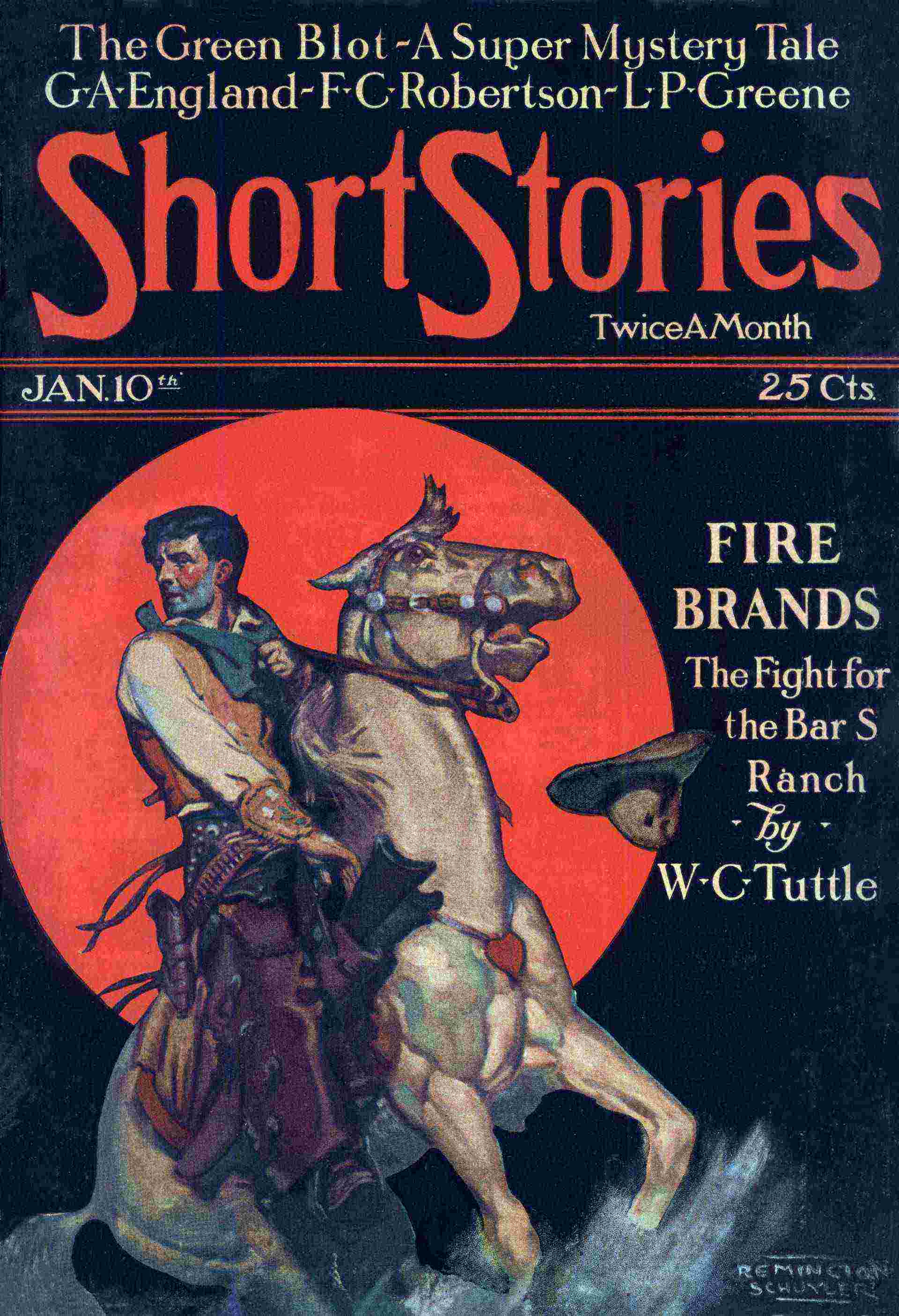
They drove down through a brushy swale and around the point of a ridge, where a long line of cottonwoods angled up through a narrow canyon. The road was rutty and the horses were traveling at a slow walk, when the larger of the two beasts lurched sideways and went down in a tangle.
Almost at the same moment the report of a rifle broke the stillness. The other horse reared wildly, swung over the body of its mate and fell back against the buckboard, squealing and kicking. The shock of it all caused Speck to stand up, clinging to the back of the seat, and the next moment he was picked up by the old man and hurled bodily into a clump of brush beside the road.
And while Speck was still in the air the old man grasped the rifle and started to jump, but a bullet shocked him heavily and he went down sideways, falling just outside the wheels. Boze had jumped from the rear of the buckboard and scuttled into the brush, as though he knew what was taking place.
Speck landed in the brush head-first, but managed to extricate himself quickly and crawl back to the old man, whose hair and beard were already dyed with crimson. Speck’s eyes were wide with fright, but his jaw was clenched tightly, as he clawed the rifle from between the wheels and ducked back into the brush.
“Gosh a’mighty!” he panted. “Bushwhacked, by jing!”
He remained quiet long enough to calm his breathing. One horse was dead, the other down in a tangle of harness, unable to get up. Speck rubbed his nose and considered his predicament. From where he squatted he was unable to see anything of the surrounding country, so he crawled back through the brush until he could get on higher ground.
He felt reasonably sure that the shooter had been hidden in that line of cottonwoods, and that they, or he, would try and get a close view of the buckboard to see just what they had accomplished.
Working further up the side of the swale, he found a good spot to wait. It gave him a fairly good view of the surrounding country, although he could not see the buckboard. He could see Boze far down the road, hunting for gophers.
Suddenly he saw two riders emerge from a thicket on the right-hand side of the cottonwoods. They were going cautiously, and it seemed to Speck that they were intent on seeing what was down the road. The brush was horse-high; so he was unable to identify their horses.
They were about three hundred yards away, when Speck raised the sights on his rifle and rested it across a limb. It did not occur to him that he was about to shoot at a human being. They were the ones who had shot his benefactor, and he was going to repay them in kind. He flinched from the pressure of the rifle butt against his sore shoulder, but he gritted his teeth and muttered, “Squeeze, dang yuh—don’t yank!”
The big rifle crashed the silence and the black powder fumes drifted back into Speck’s wide open mouth. He coughed slightly and dropped lower, his lips grimacing disgustedly.
“Yuh yanked!” he said aloud in self accusation. “Yuh darned fool, yuh yanked. Why didn’t yuh squeeze? Yanked, and jerked the sight plumb off to the right.”
He could not see the two riders now, but he felt sure that the smoke from his shot had disclosed his hiding place; so he began crawling further up the canyon, going toward where he had seen the two riders.
Speck was wise enough to feel that they would not expect him to come toward them. He gained the cottonwoods and waited. There was not a sound, except the rustling of the trees. Far up the canyon a magpie squawked, sounding almost human.
Speck ducked low and followed the trees, stopping every few yards to listen. Then he left the cottonwoods and made his way around through the brush. He, too, wanted to get a view of what might be down at the buckboard.
Suddenly he stopped short, his mouth open in amazement. He had found the two horses. They had been left in a choke-cherry thicket, almost in the same spot where they had been when Speck shot at the riders. He spoke softly to the horses, worked his way past them, but was unable to get a glimpse of the road.
“Ding dang such luck!” he grumbled. “Feller never knows what will happen next in this Western country.” He had heard his father use that expression many times, and it seemed applicable to his present predicament.
“Well,” he decided philosophically, “the least I can do is to git help.”
He went back to the horses, selected the smaller of the two, a blaze-faced roan, and managed to get into the saddle, but lost his rifle in the attempt. Cautiously he worked the horse back through the brush, swung along the side of the hill for about a quarter of a mile before turning back toward the road.
He managed to get his feet hooked in above the stirrups, which gave him a secure seat in the saddle, and in this manner, with his rusty hair standing almost on end and his skinny elbows beating a tattoo on his ribs, he headed swiftly toward Oreana.
Meanwhile down at the buckboard stood Sad and Swede, looking down at old Eph Wyatt, propped against a wheel. The old man’s face and beard were well streaked with gore, which he mopped away with Sad’s handkerchief.
“Think it’s deep enough to amount to anythin’?” asked Swede.
“Don’t hurt much,” said the old man. “I feel kinda numb, that’s all. By gosh, that shore was a close call, gents. It bumped me so darned hard I never even knowed when it hit.”
“Where do yuh reckon the kid went?” queried Sad.
“I dunno. I throwed him into the brush after the team went down.”
“Prob’ly high-tailed it for parts unknown,” laughed Swede.
“Not that kid.” The old man spoke with conviction. “Speck ain’t the runnin’ kind. And he took the rifle. Say, I don’t think I’m hurt much.” He got to his feet and clung to the wheel. “Kinda dizzy and m’ head aches a little. Gittin’ too old to stand many tunks on the head like that.”
“Got any idea who shot yuh?” asked Sad.
“Nope.”
“Uh-huh,” Sad nodded seriously. “We can start by eliminatin’ yore friends. Who hates yuh the worst?”
“The worst?” Old Eph squinted painfully. “Well, I dunno. Yuh see, I ain’t got no friends; so yuh don’t need to eliminate anybody. I wish I knowed where that kid went. If anybody hurts him I’ll shore make ’em run fast and jump high.”
“You’ve got two good little assistants, old timer,” grinned Sad. “We kinda like Speck, too. Do yuh want to find out who shot yuh?”
“Do I?” The old man laughed wearily. “Yo’re danged right I do.”
“All right,” grinned Sad. “Mebbe we can find out, if we work real fast. Swede, you go and collect the horses.”
And while Swede went after the horses Sad untangled the uninjured horse and helped it to its feet. But he did not unhitch it from the buckboard. In a few minutes Swede came back, riding Sad’s bay horse, and carrying Eph Wyatt’s rifle.
“My bronc was gone,” he told them, “and they left this here rifle in its place.”
Sad grinned and rubbed his nose violently.
“Looks like the work of a pack-rat, Swede. They always trade somethin’.” He turned to the old man. “Speck’s all right. He just out-smarted us, thasall, and swiped a horse. We’ve got to hurry before Oreana descends upon us in a gob, and we’ve only got one piece of rollin’ stock; so you get aboard, old timer.”
“Shucks, I can walk,” protested the old man.
“Yo’re supposed to be dead,” grinned Sad. “And the dead don’t walk. Climb on.”
IV
Speck Steeb’s entrance into Oreana was unceremonious. He drew up at the door of the Oreana saloon and fairly fell from his saddle.
Buck Rainey, the sheriff, and “Wheezer” Wilson, his deputy, were crossing the street, and it was to them that Speck blurted his news.
“Git yore breath, boy,” advised the sheriff, taking Speck by the arm. “C’mon inside and tell it.”
He led Speck inside the Oreana, where he had an interested audience. It did not take Speck long to give them the details.
“Well, whose horse did yuh ride?” asked Wheezer.
They ran outside and inspected the panting horse.
“She’s a TJ brand,” declared Wheezer. “Belongs to that feller named Swede Harrigan,” remarked the livery-stable keeper excitedly. “They took their horses out early this mornin’.”
“And one of them fellers shot old Eph Wyatt, eh?” Bunty O’Neil seemed pleased.
“Was the old man dead?” questioned the sheriff.
“Shot through the head,” declared Speck. “Blood was runnin’ all over him. I took a shot at them two jiggers, and—say, are them the two—one of ’em that busted Bill Wyatt?”
“They’re the little vi’lets,” stated Snipe Lee, who was the only one of Bill Wyatt’s men in town. “I said to Bill——”
“Write it out and mail it to us,” snapped the sheriff. “Get yore horses, boys. We’ll find out more about this deal. C’mon, Wheezer. Anybody that ain’t got guns can get one at my office.”
Speck sat down on the saloon steps and rested his head in his hands, realizing that he had incriminated those two men who had befriended him. In the novelty of living at the Diamond W ranch with the old man he had forgotten these two strange cowboys. He wondered dully if they had killed Eph Wyatt, and why. Men were mounting at the hitch-racks, and a few moments later the sheriff and deputy rode out through a narrow alley and joined the others.
Speck got wearily to his feet and went back to the TJ horse. He would go along and show them where the thing had happened, and in some way he might be of assistance to those two strange cowboys. Anyway, he decided that he would not show them where he had found the horses.
He mounted and rode along with the others, who questioned him closely; but Speck was close-mouthed now.
“Yuh say yuh took a shot at ’em?” queried Snipe.
“I took a shot at somebody,” qualified Speck. “I never named no names, did I?”
“But yuh saw ’em both, didn’t yuh?” asked Bunty.
“I seen two men,” stated Speck. “I dunno how they was dressed nor what they looked like.”
“And that was one of their horses, eh?”
“I never said it was. My gosh, you fellers talk like I had said who killed Eph Wyatt. I found this horse, thasall.”
“You found two horses,” corrected the sheriff.
“Did I?” Speck grew indignant. “Who found this horse—me or you?”
“All right, kid,” laughed the sheriff. “We ain’t askin’ yuh no more questions. I reckon this won’t be hard to figure out.”
“Not if yuh can find out why,” said Speck gloomily.
Buck Rainey lifted his head and looked intently at Speck.
“That’s about the most intelligent thing I’ve heard said since the kid told his story. There’s usually a reason.”
They rode around the point of a hill and down into the big swale, where they drew rein beside the buckboard. One of the horses was on its feet, trying to crop all the grass within reach, but there was no sign of the dead man.
They dismounted and examined the surroundings. Beside the left front wheel of the buckboard was a puddle of blood, and there were streaks of blood on the spokes of the wheel.
“That’s danged queer,” observed the sheriff. “Kinda looks like the old man had e-vaporated.”
They separated and searched both sides of the road, but there was no sign of the corpse One of the men unharnessed the horse and turned it loose.
“Mebbe the old man was only hurt, and went home,” suggested one of the men.
“Ain’t no boot tracks,” objected Wheezer, who had already investigated. “Of course he might ’a’ cut across the hills.”
“And fought brush all the way?” The sheriff was not in favor of that theory. “Well, he ain’t here,” he went on. “Ask the kid where he found that horse.”
But Speck was rather vague. He studied the country seriously.
“I think I was over there,” pointing across the swale. “No, I don’t think I was either. Them horses were somewhere over by them cottonwoods, I think. Hanged if I can be sure of anythin’.”
“Kinda got buck-fever, eh?” laughed Snipe.
“Put yourself in his place,” said the sheriff. “He’s just a kid. I’d probably get rattled, too. Well, I dunno what to do. Suppose we ride over to the Diamond W?”
“If he got there, he flew,” said Wheezer.
“Flyin’ ain’t hard, if yuh know how,” said the sheriff.
“Well, he didn’t know how, that’s a cinch,” declared Wheezer.
“Didja ever ask him, Wheezer?”
“No-o-o, I never.”
“Then don’t jump at conclusions. Let’s go.”
They mounted and rode to the Diamond W, scanning the country closely for any sign of the old man. The dusty road would have showed imprints of boots, if anyone had walked thereon, but there was nothing but the tracks of four-footed animals and wagon-wheels.
The posse rode in at the Diamond W ranch and lost no time in searching the place, but to no avail. It did not take them long to convince themselves that Eph Wyatt had not come home.
“Well, the next thing is to find Sontag and Harrigan,” said the sheriff. “If that is one of their horses, and if the kid did find it where he said he did, they ought to know somethin’ about this deal.”
“I’ve just been thinkin’,” said Wheezer. “Don’t the law say that you’ve got to produce the body before yuh can make out a case of murder against anybody?”
“It sure does,” agreed the sheriff.
“And if these two fellers did kill him, and was afraid that they’d get caught—couldn’t they hide the body?” went on the deputy.
The sheriff removed his hat and scratched his head thoughtfully. “Wheezer, yore head is somethin’ besides a hat-rack. Huh!” he said, turning to gaze across the miles of brushy hills. “Yore theory is a dinger, I like the idea fine, but yuh didn’t go far enough with it. I could hide a dozen corpses out in them hills. We might arrest ’em on suspicion, feed ’em a week or so and turn ’em loose again.”
So they rode back to Oreana, with Speck trailing behind, and found Sad and Swede sitting on the sidewalk in front of the Oreana saloon, talking with two of the sheriff’s men, who had been on the lower ranges looking for Bar S cattle.
The posse dismounted before the arrival of Speck, who paled slightly at sight of the two men he had incriminated. Neither Sad nor Swede had paid any attention to the group of riders, but both got to their feet as Speck rode up.
Swede grinned at Speck and looked the horse over.
“I was wonderin’ who got my bronc,” he said smiling up at the youngster. “Pretty good ridin’ horse, ain’t he, Speck?”
“Jist fine,” replied Speck hoarsely. “The stirrups was too long, that’s all.”
“Uh-huh. You must ’a’ made a hit with Blaze. Ordinarily he don’t care for everybody.”
“When did yuh lose this horse?” asked the sheriff.
“Today,” Swede smiled widely.
“Where?”
“I dunno,” Swede scratched his head thoughtfully. “Yuh see, we ain’t familiar with this country, sheriff. Me and Sad was taking a little ride through the hills, and we hears somebody bangin’ away. Yuh see, we sabe that the deer season ain’t open yet; so we opines that it might be a personal matter.
“We’re goin’ along kinda easy-like, tryin’ to see what it means, when a bullet buzzes past my nose. It shore looks like we’ve horned into somethin’; so we dismounts, leads the horses into a patch of brush, and goes on a hunt for the jigger that shot at us.
“Anyway, we don’t find him. We goes back to the horses and finds one of ’em gone. And whoever took my bronc left a good Winchester rifle in its place—kinda like a pack-rat would—so we took the rifle, doubled up on Sad’s bronc and came to town to find the sheriff.”
The posse shuffled its feet and looked at one another, while Speck heaved a deep sigh of relief.
“That’s a pretty good story,” observed Snipe Lee, Bill Wyatt’s hand.
Swede squinted closely at Snipe, a grin on his lips.
“I thought it was,” he said slowly. “Anyway, it’ll have to do until we can think of a better one.”
The sheriff chewed at the corner of his mustache and wondered what to do next. Swede’s story sounded plausible. It tallied with the one Speck had told.
“Mr. Wyatt, the old man, got shot today,” volunteered Speck.
“The old man who was goin’ to adopt you?” asked Sad.
“Uh-huh!”
“F’r gosh sake! Wasn’t killed, was he, Speck?” Sad’s surprise seemed genuine.
“We don’t know,” the sheriff answered the question. “If he was, somebody swiped the corpse.”
“Swiped the corpse!” Sad seemed shocked. “What would anybody swipe a corpse for, sheriff?”
“Yuh might as well tell ’em all about it,” said Snipe sarcastically. “They prob’ly know more about it than you do.”
Sad walked up to Snipe, who began to wish he had kept still, and studied him at close range.
“I don’t reckon I’ve met you,” said Sad easily. “What did yuh say yore name was?”
“I never said.”
“That’s right. You’re one of the Box 8 boys, ain’tcha?”
“Yeah, I work there.”
“You sabe this range pretty well, don’tcha?”
Snipe licked his lips and squinted at Sad. He wondered what these questions were leading to. Finally he nodded affirmatively.
“Uh-huh,” Sad grew thoughtful. “You know quite a lot about cattle and range work, don’tcha?”
“I ort to,” said Snipe. “I’ve been punchin’ cows for——”
“Yo’re what I’d call an observin’ person,” interrupted Sad. “Some folks think I’m a mind-reader,” Sad shot a glance at Bunty, whose face reddened quickly. “Mebbe I am—who knows? Anyway, I picked you out for this test.”
“What in hell do yuh mean?” blurted Snipe nervously.
“In all yore experience on the range—” Sad propounded, the question seriously. “In all of yore experience, mind yuh; did yuh ever know that yuh could tell a cattle rustler by the color of his fingernails?”
Almost before Sad had finished his question Snipe Lee jerked up his right hand and shot a searching glance at his nails. It was a trap which would catch nearly anyone, whether guilty or innocent—an old joke of the cattle country. It is likely that every man present caught himself in the act, except Sad and Swede.
In a flash Snipe Lee realized what he had done, and his hand flashed down to his gun; too late. Sad was into him, cramping his gun arm, making it impossible for Snipe to draw the gun from its holster.
“Leggo me, damn yuh!” snarled Snipe. “You can’t pin nothin’ like that onto me!”
Sad laughed, gave the arm an extra twist, swinging Snipe almost off his feet, and appropriated Snipe’s six-shooter. Then he shoved Snipe aside and stepped back, while the luckless Box 8 man rubbed his aching muscles and cursed witheringly.
“That don’t mean nothin’,” laughed the sheriff. “I looked at my nails, too.”
“So did I,” confessed Wheezer.
“Some folks can’t take a joke,” laughed Sad. “Our friends over there is too thin-minded to fool with. Here’s yore gun.” He tossed it to Snipe, who caught it in his left hand and shoved it into his holster. His right arm was almost helpless.
“Now,” Sad turned to the sheriff, “yuh mind tellin’ me what this shootin’ scrape was all about? I may be a mind reader, but I can’t cover all the territory.”
The sheriff did not mind. In fact, he seemed perfectly willing to tell all he knew. Sad and Swede listened patiently, nodding now and then, as though to confirm what Speck had told. The sheriff admitted that the posse had been looking for them.
“I don’t blame yuh,” said Sad. “It shore looked like we might ’a’ had a hand in it.”
“Ain’t nothin’ been proved yet,” said Snipe painfully.
“Aw, go look at yore nails!” snapped the sheriff. “You’ve talked almost too much, Snipe. Go put up the horses, Wheezer. If anybody can prove to me that old Eph Wyatt has been killed, I’ll look for his body, but I’m no damned bloodhound.”
The posse took their horses back to the hitch-racks, and the sheriff’s two cowpunchers drew him aside and imparted the news that they had only been able to round up fifteen head in the lower ranges.
“Didja put ’em in the Bar S pasture?” asked the sheriff.
The cowboys had.
“That’s all right,” said the sheriff. “Somebody cut the fence and got away with the three hundred and ten head; so they might as well get the other fifteen.”
“What do yuh mean?” asked “Slim” Wray, one of the cowboys. He had not heard about the loss. Art Alberts, the other cowboy, listened with open mouth, while the sheriff explained.
“Aw, they must ’a’ jist turned ’em loose,” said Slim. “We’ll round ’em up ag’in, Buck.”
“Go to it, Slim,” said the sheriff. “I hope yo’re right.”
Speck sat down on the sidewalk with Sad and Swede, and the sheriff came over to him.
“Kid, you don’t have much luck, do yuh?” he said thoughtfully. “I wish I had a home to take yuh to, but I ain’t. I’ve got an extra cot in my office, where yuh can sleep—and Oreana won’t see yuh go hungry.”
“That’s all right,” grinned Speck. “I’ll git along. Much obliged for the cot, sheriff. Mebbe I can help yuh some way, doin’ somethin’ around the office. I’ve got to find my dog before I do anythin’ much. He sure rattled his hocks when that shootin’ started, and the last I seen of him he was runnin’ a sandy on a gopher.”
The sheriff laughed and turned toward his office. “Come on, Speck, and I’ll show yuh that cot.”
“All right,” said Speck gladly. He started after the sheriff, but ran back to Sad and Swede.
“I’m sorry I had to steal that horse,” he whispered, “but I’m sure glad I yanked instead of squeezed.”
He turned and ran after the sheriff, leaving Sad and Swede looking curiously at each other.
“Glad he yanked instead of squeezin’,” said Swede blankly. “Now, what do yuh make of that, Sad?”
Sad Sontag laughed softly and looked across the street where Buck Rainey and Speck were at the sheriff’s office door.
“He must ’a’ meant that rifle, Swede. He flinched on the pull. By golly, that kid sure is a dinger. Yanked on the trigger and pulled the muzzle far enough to the right to miss us. He’s got nerve to burn, and by golly”—Sad stopped and reached for his cigarette makings—“he deserves a better deal than he’s been gettin’.”
“Uh-huh,” yawned Swede. “I reckon we better eat. Here comes Bill Wyatt and his man, Friday.”
Wyatt and Abe Snow, a tall, dark complexioned cowboy, rode up to the Cactus saloon hitch-rack and dismounted. Snipe Lee met them, talking earnestly, and the three went into the saloon.
“I reckon we better eat,” agreed Sad. “Snipe Lee is tellin’ ’em all about it, and it won’t be sweet news to Bill’s ears. I hate to fight on an empty stomach; so we’ll fold the old insides around a flock of food before trouble starts.”
They walked past the Cactus saloon and up the street to a restaurant, where they proceeded to sit down facing the door and ordered a big meal.
“Well, our alibi sure got past with the sheriff,” laughed Swede.
“Sure,” Sad laughed joyfully. “You are one of the best liars I ever heard. I’ll betcha Snipe Lee is still wonderin’ if his nails show that he’s a rustler.”
“I wonder if he is?” grinned Swede. “He sure took it to heart.”
Sad grinned thoughtfully and leaned back in his chair to allow the waiter to place a platter of food before him. The waiter was a pasty-faced, stoop-shouldered person, with a crooked nose and a missing front tooth. Sad looked at the platter and up at the waiter.
“Three eggs apiece, waiter?”
“Yeah.” The waiter grinned, exposing the incomplete set of upper teeth. “Thought yuh might be hungry. It won’t cost yuh any more than two would.”
“Gosh, this is a reg’lar place to eat,” grinned Sad. “Do yuh size up yore customers and feed ’em accordin’ly?”
“No-o-o. Them extra eggs are for whippin’ Bunty O’Neil.”
“Oh, yeah!” Sad looked curiously at the waiter. “Kinda like gettin’ a medal for bravery, eh?”
“I dunno about that. See that crooked nose and that missin’ tooth? Well, I never thought about kickin’ Bunty’s shins.”
“He got you, did he?”
“He sure did. I was out for fifteen minutes. Never knew what hit me.”
“Bunty’s sure a character,” observed Swede, attacking his ham and eggs.
The waiter spat dryly. “Character, hell; he’s a dirty fighter. Somebody will kill him some day, and then he’ll wish he’d been square.”
“Most all dead men kinda repent,” nodded Sad. “What do yuh know about Bill Wyatt?”
The waiter grinned. “You whipped him, too, they tell me. I don’t know much about him. Bunty butted Bill, and Bill petted him with the barrel of a gun. They was thick as thieves before that. Bill got Bunty to come down here and buy out the Oreana. Folks used to say that Bill owned an interest in the Oreana, but I don’t guess there was any truth in it.
“Bunty poured liquor into poor Jim Steeb and killed him. They tell me that Bunty’s got Steeb’s notes for a lot of money. Steeb practically lived there at the Oreana. Bunty got him to drinkin’ absence. Didja ever see an absence drinker? It shore is awful stuff. Make a man kick his grandmother.”
“Did Steeb kick his grandmother?” asked Swede seriously.
“I don’t guess he had one.”
“Made it kinda bad,” observed Swede. “Feller ought to kinda check up on his relation before he starts drinkin’ that stuff.”
“Must be an awful relief to kick the old lady,” said Sad, balancing an egg on his knife-blade. “I never had one. Still, yuh never have everythin’ in this life. Can we have some coffee?”
“Yuh sure can. I’ll bring yuh in the whole pot.”
“We’re prominent citizens,” grinned Sad, as the waiter hurried away. “If somebody kills us, they’ll prob’ly put up a big monument in the middle of the street for us.”
“Yeah,” reflected Swede seriously, “and they’ll carve on it, ‘All fools ain’t dead yet, but we got two big ones cinched.’”
While Sad and Swede appeased their hunger, Bill Wyatt and his men, Abe Snow and Snipe Lee, stood at the Cactus bar and drank liberally. Snipe had told Bill and Abe all about the affair in no uncertain terms, and bitterly censured the sheriff for not arresting Sad and Swede for murder. Of course, Snipe was still smarting from his encounter with Sad and was inclined to be vindictive.
“He accused me of bein’ a rustler,” complained Snipe. “Yuh know, he can’t git away with a thing like that, Bill.”
“He got away with it, didn’t he?” demanded Bill. “You talk too much, Snipe. But where do yuh suppose the old man is?”
Snipe shook his head and felt of his twisted arm muscles.
“I can’t even start to suppose, Bill. Jist like I said, he wasn’t at the buckboard, nor at the ranch. There was the dead horse and the live one. Everthin’ was jist like that kid said, except we couldn’t find old Eph.”
“What did the sheriff think?” asked Bill.
“Well, he didn’t know. We had an idea that them two strangers had killed him, but when we couldn’t find the body, we didn’t know what to think. Wheezer Wilson figured that they had shot the old man and got scared that somebody might find it out; so they hid the body.”
“What good would that do?” demanded Bill.
“Yuh got to prove a murder,” said Snipe wisely. “If there ain’t no corpse yuh can’t prove nothin’. A man ain’t noways dead until he’s proved dead, and yuh can’t prove nothin’ without yuh can identify the corpse. If they don’t never find old Eph, the law won’t never figure him to be dead.”
“But if he don’t never show up, he must be dead,” argued Bill.
“He must be,” agreed Snipe, “but the law don’t look at it like me and you would. Mebbe old Eph wandered off in the brush and died; mebbe somebody took the corpse and hid it.”
“But why would they hide it?” Bill poured out a fresh drink and drank it raw. “I don’t sabe it, Snipe.”
“To protect themselves,” explained Snipe. “Jist like I said, the law don’t know that anybody got killed yet.”
Slim Wray and Art Alberts, the sheriff’s two cowhands, came in, so the argument was dropped for a while. Bill invited them to partake of his hospitality, which they accepted with alacrity, and the talk drifted to the fact that the Bar S herd was missing.
“Bunty O’Neil is sure fussin’ about that,” declared Slim. “If we can’t find them cows Bunty won’t get the money that’s comin’ to him. I heard him say that he’d have them cows or somebody would be darned sorry.”
“He talks big,” grunted Bill Wyatt. “I ain’t got no love for that Sontag person, but I’m sure glad he piled Bunty.”
“Who are them two fellers, anyway?” asked Abe Snow, squinting through his glass of liquor at the light. “Look like a couple of cow detectives to me, if anybody asks yuh.”
“What would they be doin’ over here?” demanded Snipe.
“Yuh know they made yuh look at yore fingernails,” smiled Slim Wray meaningly. Snipe growled and reached for his glass.
“They ain’t got nothin’ on me.”
“Well, they ain’t been here long,” grinned Slim.
“What about lookin’ at fingernails?” queried Bill.
“Didn’t you hear about it? Sontag asked Snipe if he knew that you could tell a cattle rustler by lookin’ at his fingernails.”
Bill turned his hand sideways and glanced at his nails while Slim snorted with laughter.
“There yuh go!” he chuckled. “That’s what Snipe done.”
“That’s a hell of a joke!” growled Bill, glowering at Slim. “All fingernails are the same color.”
“You looked!” choked Slim.
“You don’t mean to insinuate that I’m a rustler, do yuh?” Bill grew suddenly belligerent. He shoved away from the bar and glared at Slim.
“Aw, cool off,” advised Slim. “Nobody’s accusin’ yuh, Bill. Yo’re jist like Snipe. He got mad, too.”
“Well, I’m no rustler, Slim,” declared Bill coldly. “I’ll accept yore apology, but don’t say anythin’ like that again. I’m honest, I am.”
“Sure, we all know it,” agreed Slim. “Let’s have another drink.”
“I’m hones’, too,” blurbled Snipe, who was looking owlishly at himself in the back-bar mirror. “Almos’ too honesht.”
“Almost,” said Bill savagely.
It was not often that the Box 8 outfit drank too much liquor, but that night was one time when they threw all reserve to the winds. Whisky seemed to have little effect on Bill Wyatt, except to make him more savage.
But he kept out of the Oreana saloon. Several times he met Sad and Swede during the evening, but avoided direct contact with them.
“Look out for Bill Wyatt,” Slim Wray cautioned Sad and Swede.
“What’s achin’ him tonight?” asked Sad.
“Liquor and a bad disposition. Yuh see, old Eph Wyatt was his uncle.”
“Was his uncle?” queried Sad. “Ain’t he still his uncle?”
“Well—sure,” hesitated Slim. “They’re sayin’ that the old man is dead, yuh know. I suppose Bill is workin’ up a little war medicine for himself. Of course the sheriff don’t believe yuh had any hand in shootin’ the old man, but the sheriff ain’t everybody.”
“Much obliged,” grinned Sad. “We’ll look out for Bill. He prob’ly thinks he owes me somethin’.”
“And he’ll pay yuh, if he gets a safe chance.”
“And he’ll get a receipt,” said Sad meaningly. “Anyway, I’m sure obliged to yuh, Slim.”
But Bill Wyatt was too wise to start trouble with them. For once in his life he decided to let discretion be the better part of valor. He got his men, Snipe and Abe, away from the Cactus bar and walked them up and down the street. They sobered considerably, and Bill outlined his scheme.
“They hid the body of the old man, that’s a cinch. Fightin’ ’em won’t tell us where it’s hid; sabe? They’ve got a room at the Oreana hotel, and them partitions ain’t very thick. Here’s the scheme. Abe, me and you will see if we can git the room next to them. They’ll probably talk enough to let us know a few things. Snipe, you take our horses to the livery-stable, and you stay there. If they decide to leave town, you come a-runnin’; sabe? Leave our horses all saddled, so we won’t lose no time.
“And from now on, we don’t take no more liquor. We’ve got to find out a few things. You better go to the stable now, Snipe. Me and Abe will get the room, and find out which room Sontag rented. If we can’t get the next one without seemin’ to want it, mebbe it’s empty and we can take it anyway.”
Snipe grumbled profanely, but went to the hitch-rack after the horses. The stable-keeper showed him which stalls to use, asked Snipe if he wanted to take off the saddles, accepted the two-bits per head and went back to his gear-room.
He thought that Snipe went out, which Snipe did not. Later the stable-keeper went out, shut the big doors and went up to the Oreana saloon. Snipe stretched out on the grain-bin and went to sleep. He had a pint of liquor on his hip, which assisted in his departure to the land of dreams.
Sad and Swede were at the Oreana saloon when the stable-keeper ran into them and accepted of their hospitality.
“Kinda quiet tonight,” observed Sad.
“Yeah, it is.” The stable-keeper squinted around the room. “It always is this early. Mebbe it’ll pick up. The Box 8 must figure on makin’ a night of it, ’cause they’ve stabled their horses. It ain’t often they do that. Usually leave their broncs at the rack until they’re ready to go home.”
Sad squinted at himself in the back-bar mirror and wondered why Bill Wyatt and his outfit intended to make a night of it. He drew Swede out of the Oreana and they made the rounds, looking for Bill and his gang, who were not in evidence.
“You think they’re layin’ for us?” asked Swede.
“I dunno,” Sad grinned thoughtfully. “Mebbe they are. Let’s look a little further.”
They went down the street to the hotel and entered the dingy little office, which was little more than a wide hall, lighted by a hanging lamp. The rooms were all on the second floor. Behind the little counter sat the proprietor, tilted back against the wall, reading a year-old magazine.
“Goin’ to bed early, ain’t yuh?” he asked.
“It is a little early,” agreed Sad.
“Sober, too,” observed the proprietor, and laughed at his own wit. “They don’t usually go to bed sober on Sat’day night here. Bill Wyatt and Abe Snow got too much under their belts, and bought a room a while ago. They sure must ’a’ punished a lot of hooch.”
“Yeah, I reckon they did,” laughed Sad. “They’ll prob’ly snore all night and keep us awake.”
“By jing, I never thought about that when I put ’em in number five. That’s right beside you fellers. Say,” he tilted forward and got to his feet, “I’ll git ’em out of there.”
“No, don’t do that,” said Sad quickly. “They’re likely asleep right now. Shucks, we don’t mind.”
“Well, if yuh don’t mind. By golly, I never thought about it when I got ’em the room. I’ll change, if yuh say so.”
“No, that’s all right,” assured Sad.
They sauntered outside and crossed to the Cactus hitch-rack, where Sad appropriated a lariat rope, which he concealed under his coat. Then they went back to the hotel and climbed up the stairs. Sad cautioned Swede to let him do the work; so both of them staggered visibly down the hall.
Sad carried a narrow loop of rope in his hands, as he blundered drunkenly into the door of number five and quickly slipped the loop around the door-knob.
“Hey!” chuckled Swede drunkenly. “Tha’s the wrong door, Sad. We sleep in thish room.”
“Tha’s right,” muttered Sad. “Excuse me, everybody.” He staggered across the hall and against the other door, where he quickly drew the rope tight and threw several half-hitches around the other doorknob.
“What’s the matter—can’tcha fin’ the key-hole, Swede?”
“Thish is wrong key,” declared Swede. “Too small, I tell yuh. C’mon.”
They went down the hall, reviling the proprietor for giving them the wrong key, which he had not. In fact, they had no key.
“That was a maguey rope,” chuckled Sad. “Them things ain’t got no stretch in ’em. Bill Wyatt is smart enough to want to know more, which ain’t nothin’ against him.”
“Now, what do we pull off next?” asked Swede, chuckling with laughter.
“Find Snipe Lee. I’ve got a hunch.”
And they faded down the dark street toward the livery-stable, while Bill Wyatt and Abe Snow sat on a bed and waited for them to come back with the right key.
It was a long, long wait.
Finally Bill Wyatt swore disgustedly and decided to go out and see what had become of them, but the door would not open. It would slip past the lock, which proved that it was fastened from the outside, and which proved that Sad and Swede had out-smarted them.
It was dark outside and the two-story drop was too much for Bill to risk, because he was not sure just what might be down there for him to fall into.
“They’ve roped us in,” declared Bill, punctuating his declaration with oaths. “They wasn’t drunk, Abe.”
But Abe did not care. He had stretched out on the bed again and was snoring blissfully. Bill pried the door open as far as possible with the barrel of his gun, cut a notch with his pocket-knife and managed to tie his knife to the barrel of Abe’s gun strongly enough to enable him to cut the rope.
Then he left Abe sleeping audibly and went downstairs, where he accosted the sleepy proprietor.
“Has Sontag and Harrigan come in yet?” he demanded.
“No,” replied the proprietor. “They was in here a couple hours ago, but ain’t been in since.”
“Came upstairs, didn’t they?”
“Nope. Said they was afraid you’d keep ’em awake snorin’.”
“Oh, yeah!” Bill snorted and went outside.
He made the rounds of the saloons, but could not find Sad and Swede; so he headed for the livery-stable, where he found the stable-man in the gear-room, getting ready for bed.
“Hyah, Bill,” greeted the stable-man. “Want yore bronc?”
“No,” said Bill shortly. He thought for several moments. Then, “I’m kinda lookin’ for Sontag and Harrigan, and I wondered if they went away tonight.”
The stable-man picked up his lantern and walked out to the stalls.
“Their horses and saddles are gone,” he said. “They must ’a’ rode out while I was uptown.”
“Uh-huh,” Ed squinted reflectively. “Seen anythin’ of Snipe Lee?”
“Not since he brought yore horses down here.”
“All right.” Bill turned and started for the door.
“Say, do yuh want me to grain yore broncs?”
Bill turned at the door, “Yuh might as well.”
“More work,” grumbled the stable-man, as Bill went out. “I can always think of somethin’ that’ll make me extra work.”
He walked over to the oat-bin, hung up his lantern and unfastened the staple which held down the lid. Swinging up the long lid, he leaned over to scoop up a pail of oats, when Snipe Lee sat up and looked him in the face.