
L.
LÁDU: A sweet ball.
LAGHURUDRA: A rite in honour of the god Shiva.
LÁHYA: Parched rice.
LAKSHACHANDI: A recitation in honour of the goddess Párvati.
LAKSHAMANA: Brother of Ráma.
LAKSHMI: The goddess of wealth.
LÁLA HARDEV: Name of a minor local deity.
LÁLO: Name of a field deity.
LÁLO BHAGAT: Name of a saint.
LÁMANDIVO: An iron lamp.
LAMLAN: A branch of black magic.
LANKA: Ceylon.
LÁPSI: Coarse wheat flour fried in ghi and sweetened with molasses or sugar.
LAVENG: Clove.
LÁVANI: A kind of ballad: plantation.
LÁWANI: Plantation.
LÁVO: A Parasite.
LÁVSANT: A ghost of a widow.
LIMDO: A tree, Alantas excelsa.
LIMBO: Poisonous.
LINGA: Phallus.
LINGAM: See Linga.
LINGÁYAT: An individual of the Lingáyat religion whose chief object of worship is Shiva.
LOBÁN: Olibanum.
LOBHÁN: Incense powder.
LOTA: A water pot.
LUVÁNA: A caste of traders.
LUXMI: See Lakshmi.
M.
MACHCHENDRA NÁTH: Name of a saint.
MACHHI: Name of a water nymph.
MÁCHHO: Name of a goddess.
MACHHU: See Máchho.
MADALIUN: A hollow bracelet.
MADAN: Cupid.
MADHAVI: A village headman.
MADHU: Name of a demon.
MADHU PAVANTI: An order of ghosts.
MADHWÁCHÁRYA: Name of a great saint who founded a sect of Vaishnavism.
MAFAT: Useless.
MAFATIO: Useless.
MAG: A grain, Phaseolus mungo.
MÁGH: The eleventh month of the Deccani Hindu and the fourth month of the Gujarát Hindu calendar year.
MAGHA: Name of a constellation.
MAGHALO: A lamp of mud covered with leaves to represent the god of rain.
MAHÁBHÁRAT: Name of an epic of the Hindus.
MAHÁDEVA: A name of Shiva.
MAHA GIRA: Name of a minor deity.
MAHÁKÁLI: Name of a goddess.
MAHÁKÁLI NIRVÁN TANTRA: Name of a work on Tantric philosophy.
MAHÁLAKSHMI: Name of a goddess; Name of a ceremony in which the goddess is worshipped on the eighth day of the bright half of Ashvin.
MAHÁLAYA SHRÁDDHA: A shráddha performed in the dark half of Bhádrapad in propitiation of ancestors.
MAHÁMÁRI: Cholera goddess.
MAHANT: A saint.
MAHÁPURUSH: An order of civil spirits.
MAHÁR: An unclean caste of Hindus.
MAHÁR PURUSHA: A kind of stone.
MAHÁRÁJA: A term of respectful compellation applied to kings, religious heads, saints, etc.
MAHÁRÁKSHASA: A class of demons.
MAHÁRUDRA: A sacrifice in honour of Shiva.
MAHÁRAURAVA: A kind of hell.
MAHÁSHIVARÁTRI: The fourteenth day of the dark half of Mágh, a fast day in honour of Shiva.
MAHÁTMA: A saint.
MAHÁTMYA: Greatness.
MAHESHA: A name of Shiva.
MAHESHVAR: A name of Shiva.
MAHI: Name of a demon.
MAHIKÁWATI: Name of a goddess.
MAHODAYA: Name of a festival.
MAIDAN: A plain.
MAKARA: Capricornus.
MAKARI: Name of a water nymph.
MAKHAR: A gaily dressed up wooden frame.
MAKI: Maize.
MÁLÁR: A musical mode.
MALHÁRI: A name of Kandoba.
MALI: Red lead.
MÁLI: A caste of gardeners or an individual of it.
MALINDA: A sweet preparation of wheat flour fried in ghi.
MALIN: Unclean.
MALLÁRI: A name of Khandoba.
MÁLO: A bower.
MAMIKULA: An order of ghosts.
MÁMO: An order of ghosts; a maternal uncle.
MANAYA: Name of a deity.
MANDAL: A group.
MANDALU: A circle.
MANDAN MISHRA: Name of an ancient scholar.
MANDAP: A bower.
MÁNDA BHARANE: Filling in a magic circle as a protection from spirits.
MÁNEK-STAMBHA: The auspicious post of the marriage bower.
MÁNG: An unclean caste of the Hindus.
MÁNGÁI: Name of a goddess.
MANGAL: Mars.
MANGALÁ-GOURI: A ceremony performed by married girls for five successive years on every Tuesday of the month of Shrávan.
MANGALÁRATI: Moving a lighted lamp round an idol.
MANGALSUTRA: The lucky thread worn by married women.
MANI: A jewel; name of a deity.
MANIDHAR: A snake.
MANI MALLA: Name of a demon.
MÁNKARI: The person entitled to certain honours and presents at village assemblies.
MANKODA: A black ant.
MÁNSA KHAVANTI: An order of ghosts.
MANTRA: An incantation; a magic spell.
MANTRA-SHÁSTRA: The science of incantations.
MANTRI: An exorcist.
MÁNTRIK: An exorcist.
MANUSHYACHAR: An order of ghosts moving among men.
MÁRAN: A branch of black magic.
MÁRGA: A path; course.
MARGÁI: Name of a goddess.
MÁRGASHIRSHA: The ninth month of the Deccani Hindu and the second month of the Gujarát Hindu calendar year.
MARGI: A sect of Hindus.
MARGI PANTHI: A follower of the Margi sect.
MARI: Name of a goddess.
MARICHI: Name of a sage.
MARIYUN: A ceremony for driving away insects.
MARVO: Marjoram.
MASUR: Lentil.
MASIDA: An order of ghosts.
MÁTA: A goddess.
MÁTÁJI: See Máta.
MÁTA ASHTAMI: The eighth day of the navarátra.
MÁTARI: Name of a goddess.
MÁTHBHÁJI: A kind of green vegetable.
MÁTI: Earth.
MÁTRIKA: A mother; an order of semi-divine beings.
MÁULI: Name of a goddess.
MAUNYA VRATA: A vow of silence.
MÁVADI: Ghost of a woman dying with certain desires unfulfilled.
MÁYA: Illusion.
MÁYÁKA: Name of a goddess.
MEDA: Marrow.
MEDINI: The earth.
MEGH: A cloud.
MEGHARÁJA: The god of rains.
MEGHLADDU: A sweet ball of wheat flour fried in ghi.
MEHULO: See Maghalo.
MEKAIL: Name of an angel.
MELADI: An order of ghosts.
MELDI: See Meladi.
MELI VIDYA: Sacrilegious art.
MENA: A kind of bird.
MERU: Name of a mythological mountain.
MESHA: Aries.
MHÁLSA: Name of a goddess.
MHÁRJÁI: Name of a goddess.
MHARLOBA: Name of a deity.
MHASHYA: A species of water spirits.
MHASOBA: Name of a village deity; lord of ghosts.
MIANA: A class of Musalmáns.
MINA: Pisces.
MINDHAL: A kind of fruit.
MIRI: Particle.
MITHUN: Gemini.
MIYALI: An order of ghosts.
MOBHARA: A hollow stone used for threshing corn.
MOCHI: A caste of shoe-makers.
MOCHINI: An order of ghosts.
MOGRI: Rat-tailed raddish.
MOHAN: A branch of black magic.
MOHINI: A fascinating woman.
MOHARO: The stone found in the head of the snake.
MOHOR: See Moharo.
MOKSHA: Salvation.
MOLANI: An order of ghosts.
MOTÁKAT: Name of a vow.
MOR: A peacock.
MORIA: An earthen bowl.
MOT MÁVALI: Mother Mary.
MOTUDUKH: A kind of cattle disease.
MOVA KHARAVA: Name of a cattle disease.
MRIG: A deer; name of a constellation.
MRIGÁNKA: The moon.
MRIGA TONCHANA: The moon.
MRITYUNJAYA: Name of an incantation.
MUCHKUND: Name of a sage.
MUJÁVAR: A sweeper of a mosque devoutly or piously fixed to it.
MUKTI: Salvation.
MUL: Name of a star.
MULO: Raddish.
MUNDA: A kind of wind.
MUNGESHWAR MAHÁDEV: A name of Shiva.
MUNGI MÁTA: Name of a goddess; dumb mother.
MUNJA: Spirit of Bráhman boy who dies immediately after his thread ceremony.
MURALI: A flute.
MURDUNGA: Tabour.
MURLI: See Murali.
MUSAL: A rice pounder.
MUTH: The fist.
MUTH MÁRANE: Throwing of a handful of rice over which incantations have been repeated; sending a bewitched lemon to a person to whom a disease is to be transferred or who is to be killed.
MUVA-KESHIBI: A kind of cattle disease.
N.
NÁCHANI: A kind of grain.
NÁDÁPUDI: A coloured cord with a small parcel containing incense, red powder, etc.
NÁDÁSÁDI: A cord and a robe.
NÁG: A snake; a species of semi-divine beings half men half serpents in form.
NÁGA: See Nág.
NÁGABALI: A propitiatory offering to snakes.
NÁGAR: A caste of Bráhmans found in Gujarát.
NÁGCHÁMFA: A flower tree, Alpinia mutans.
NÁGDEV: The snake god.
NÁGKANYA: A snake girl.
NÁG KESAR: Messua Ferrea.
NÁGMAGA: A class of beggars who worship the snake.
NÁGNÁTH: Name of a snake deity.
NÁG PANCHAMI: The fifth day of the bright half Shrávan, a holiday in honour of the snake deity.
NÁGO: Shameless.
NÁGOBA: The snake deity.
NÁGVEL: A kind of creeper.
NAIVEDYA: An offering of some eatable to an idol.
NAKSHATRA: A star; a constellation.
NALA: Name of a mythological king.
NÁLPIR: Name of a pir or Mahomedan saint.
NÁL SÁHEB: A familiar name for the bearer, in the Muharam, of the Tabut-pole which terminates at the top in a nál or horse-shoe member.
NAMAN: Oil poured over the image of Hanumán.
NAMASKÁR: Reverential or respectful address or salutation.
NANDA: the adoptive father of Krishna.
NANDARÁJ: Name of a mythological king.
NANDI: A bull.
NÁNDI SHRÁDDHA: A Shráddha to the manes, preliminary to any joyous occasion.
NÁNO: Small.
NAO NARASING: An order of ghosts.
NARA: Name of a sage.
NÁRAD MUNI: Name of a divine sage.
NARAK: Hell.
NARAK-CHATURDASHI: The fourteenth day of the dark half of Ashvin.
NÁRALI PAURNIMA: The cocoanut holiday, the fifteenth day of the bright half of Shrávan.
NARASIMHA: An incarnation of Vishnu in the form of half lion half man.
NÁRÁYAN: Name of a sage.
NÁRÁYANA BALI: A sacrifice in propitiation of evil spirits.
NÁRÁYAN KAVACH: A hymn in honour of Vishnu.
NÁRÁYAN NÁGABALI: A kind of offering.
NÁREL-PURNIMA: See Nárali Paurnima.
NARGUDIKALPA: A kind of medicinal preparation.
NARKYA UDA: A kind of incense.
NARSINHA: See Narasimha.
NARSINHA MEHTA: a celebrated saint of Gujarát.
NÁTAK: A drama.
NATHU: Tied.
NAVACHANDI: Name of a sacrifice.
NAVAGRAHA: The nine planets.
NAVAGRAHASHÁNTI: A ceremony in propitiation of the nine planets.
NAVAKÁDÁN: Gift of a ship.
NAVALÁ-DEVI: Name of a goddess.
NAVAMUTHIUM: A preparation of nine handfuls of wheat.
NAVARÁTRA: The first nine days of the month of Ashvin held sacred to Durga.
NAVATERI: A game of nine and thirteen.
NEHADO: A hamlet of Bharváds or shepherds.
NIAR: A kind of rice grown without ploughing.
NILOTSARGA: A kind of Shráddha.
NILOTSAVA: See Nilparván.
NILPARVÁN: A ceremony in propitiation of the spirits of deceased ancestors.
NIRGUDI: A kind of plant.
NIRMALA: Name of a goddess.
NOL VEL: A kind of creeper.
NRISINHA MANTRA: An incantation in honour of Nrisinha.
NYÁSA: Gesture.
O.
OGHAD: A fool.
OKARINU: Vomitting; a kind of sheep disease.
OLO: A species of birds.
OMKÁR MANDHÁTA: Name of a god.
P.
PÁDO: A he-buffalo.
PÁDUKA: Impressions of feet on stones.
PADVAL: Snake-gourd.
PADWAL: See Padval.
PAJUSAN: A holiday of Jains.
PALAS: A tree, Butea frondosa.
PALEJATRA: A ceremony performed at the sowing season.
PALE MARAD: An order of ghosts.
PÁLIO: A pillar. A tomb erected on the grave of a person who dies on a field of battle.
PALUS: See palas.
PÁN: A betel leaf.
PANCHAK: Grouping of constellations lasting for five days.
PANCHÁKSHARI: An exorcist.
PANCHÁMRITA: A mixture of milk, curds, sugar, ghi and honey.
PANCHARATNA: Five kinds of precious things, viz., gold, silver, copper, coral and pearls.
PANCHÁYATAN: The five deities, Shiva, Vishnu, Surya, Ganpati and Devi.
PANCHGAVYA: A mixture of the five products of the cow.
PANCHOPACHÁR: The presenting in oblation to an idol of five articles.
PÁNDAVA: A term applied to the five sons of Pandu.
PANDHAR: Name of a goddess.
PANDIT: A scholar.
PÁNDHRI: A kind of tree.
PÁNGALÁ-DEVI: Name of a goddess.
PANOTI: Certain peculiar conjunctions of planets; name of a goddess.
PÁPAD: Wafer biscuits.
PARADI: A disease-scaring basket; a basket.
PARAKÁYÁPRAVESH: Entering the body of another.
PARASHU: An axe.
PARDESHI: A term applied to men from Upper India, usually low caste.
PARJANYA: Rain.
PARJANYA-SHÁNTI: A ceremony performed to secure rainfall.
PARMÁR: A clan of Rajputs.
PÁRO: A kind of stone.
PÁRSHAD VAIKUNTHA: Name of a heavenly region.
PÁRTHISHWAR: Lord of the earth; a god.
PÁRVATI: The consort of Shiva.
PARWANI: A festival.
PASHUCHAR: An order of ghosts moving among beasts.
PASHUPATÁKA: A weapon of Shiva.
PASTANA: The being disposed for use—vessels, etc. for idol worship.
PÁT: A low wooden stool; marriage with a widow.
PÁTÁL: The nether world.
PÁTHA: Recitation.
PÁTIL: A village headman.
PATIT-PÁVAN: Purifier of the fallen.
PATKA: A head scarf.
PÁTLA: A low wooden stool.
PÁT LÁVANE: To marry a widow.
PAURÁNIC: As prescribed in the puránas.
PAUSH: The tenth month of the Deccani Hindu and the third month of the Gujarát Hindu calendar year.
PÁVAIYA: A sect of goddess worshippers.
PÁVTE: A kind of grain.
PEDHE: A kind of sweets.
PEDI: A small heap or lápsi.
PEESA: An order of ghosts.
PENDA: A kind of sweets.
PETTOD: A kind of cattle disease.
PHÁLGUN: The twelfth month of the Deccani Hindu and the fifth month of the Gujarát Hindu calendar year.
PHANAS: The jack fruit.
PIDHÁN ÁRATI: The ceremony of substituting night ornaments on an idol for the costly ornaments of the day.
PILUDI: A kind of tree.
PIND: A rice ball.
PINDA: See Pind.
PINGLA: A species of birds.
PINJAR: Red powder.
PIPAL: A tree, Ficus religiosa.
PIPALESHWAR MAHÁDEV: A name of Shiva.
PIR: A Muhammadan name for a saint.
PIRAS PIPALO: Thespesia populwa.
PISHÁCHA: An evil spirit.
PITAR: A spirit of a deceased ancestor.
PITHI: Turmeric powder.
PITPÁPDO: Glossocardi Boswellia.
PITRA: Manes.
PITRI: An ancestral spirit.
PITRI SHRÁDDHA: A Shráddha in propitiation of the ancestral spirits.
PITRRIYA: A deceased ancestor.
PITRU PAKSHA: Manes’ fortnight, the dark half of the month of Bhádrapad.
POHOR: A measure of time equal to three hours.
POLIO: Hollow.
POLO: Hollow.
PONDHAR: Name of a goddess.
POPAT: A parrot.
POSHI: A class of chudels, an order of ghosts.
POTHIA: An exorcist; the bull of Shiva.
POTHIO: A bull.
PRÁCHETAS: A patronymic of Manu.
PRADAKSHINA: Circumambulation.
PRADOSHA: The thirteenth day of the dark half of a month.
PRALHÁD: The son of the demon Hiranyakashipu. He was a great devotee of Vishnu.
PRALAMBÁSUR: Name of a demon.
PRÁNA: Life.
PRÁNA-POKA: Death wail.
PRASÁD: Consecrated food.
PRASTHÁNA: See Pastana.
PRATÁB: An order of ghosts.
PRÁYASCHITTA: Penance.
PRAYOGA: Performance; experiment.
PRETA: A goblin; spirit of a person dying a sudden or accidental death.
PUDINA: Mentha Sativa.
PUJA: Worship.
PUJÁRI: A worshipper.
PUJYA: Deserving to be worshipped.
PULAP: Name of a sage.
PULASTYA: Name of a sage.
PUNARVASU: Name of a constellation.
PUNDARIK: Name of a mythological snake.
PUNEMA: The full moon day of a month.
PUNJI: Refuse.
PUNJO: Refuse.
PUNYÁHA WACHAN: A particular ceremony performed on festive occasions.
PUNYA STHÁNA: A holy place.
PUNYA TITHI: The death anniversary of a Sanyási or saint.
PURÁN: The name of a certain class of sacred books ascribed to Vyása and containing the whole body of Hindu mythology.
PURBHAYA: A term applied to persons from Upper India.
PURNÁHUTI: An offering into the fire of a handful of rice, ghi, cocoanuts and some other articles.
PURNIMA: See Paurnima.
PURNA TITHI: A complete day.
PURUSHOTTAM: Intercalary month.
PURVÁBHÁDRAPADA: Name of a constellation.
PURVÁ-FÁLGUNI: Name of a constellation.
PURVAJA: An ancestor.
PURVÁSHÁDHA: Name of a constellation.
PUSHKAR: Name of a snake.
PUSHYA: Name of a constellation.
R.
RABÁRI: A caste of shepherds.
RÁDHA: A man dressed in woman’s clothes as a dancer; name of a sweetheart of Krishna.
RADIO: Crying.
RÁFDA: A kind of jujube tree.
RAGATIO: An order of ghosts.
RÁHU: A demon with the tail of a dragon whose head was severed from his body by Vishnu. The head and tail, retaining their separate existence, were transferred to the planetary heavens, and became, the first, the eighth planet, and the second (Ketu) the ninth.
RAINÁDEVI: Name of a goddess.
RÁJÁH: A king.
RÁJAYAJNA: A kind of sacrifice.
RÁJBÁI MÁTA: Name of a goddess.
RÁJBHOG ARATI: The ceremony of offering dainties and cooked food to the gods.
RAJPUTÁNI: Wife of a Rajput; a Rajput woman.
RÁKHADI: A piece of silk thread.
RAKHEVÁLIO: An order of ghosts.
RÁKSHASA: A demon.
RÁLA: Panic seed.
RÁLE: Panic seed.
RAMALASHÁSTRA: The science of divining by means of figures or lines and dice.
RÁMANAVAMI: The ninth day of the bright half of Chaitra celebrated as the birth day of Ráma.
RÁMÁNUJA: Name of a great saint and philosopher who founded a sect of Vaishnavism.
RÁMÁYANA: An epic poem by Válmiki describing the exploits and adventures of Ráma.
RÁMCHANDRA: A name of Ráma.
RÁMESHWAR: A name of Shiva.
RÁMNÁTH: Name of a deity.
RÁNDAL: Name of a goddess who presides over child-birth.
RÁNDHAN CHHETHA: The cooking sixth, the sixth day of the dark half of Shráwan.
RANGPANCHAMI: The fifth day of the dark half of Phálgun on which coloured water is thrown.
RÁNJANI: A kind of tree.
RANNA DEVI: Name of a goddess who presides over child-birth.
RÁNO: A Lord.
RÁSHI: Signs of the Zodiac.
RATANVO PÁRO: A kind of stone.
RATANWA: A kind of skin disease.
RATH: A charriot.
RATHA SAPTAMI: The seventh day of the bright half of Mágh.
RATNA: A jewel.
RATNESHWAR MAHÁDEVA: A name of Shiva.
RÁUL: A caste of Hindus or an individual of it.
RÁVAL: See Rául.
RAVALNÁTH: Name of a spirit; name of a village deity.
RÁVAN: Name of the demon king of Lanka or Ceylon.
RAVI: The sun.
RAWALNÁTH: See Ravalnáth.
RÁYAN: A tree, Mimusops hexandra.
RELA: A stream.
REVATI: Name of a constellation.
REWADI: A preparation of sesamum and sugar.
RIKTA: Unfruitful, inauspicious.
RISHI PUNCHAMI: The fifth day of the bright half of Bhádrapad.
RITU: A season.
ROHINI: Name of a constellation.
ROPANI: Transplanting.
ROT: A loaf prepared from eight kinds of grain.
ROTAL: Womanish.
RUDRA: An order of semi-divine beings.
RUDRÁBHISHEKA: The ceremony of pouring water in a constant stream over the image of Shiva for eleven consecutive days and nights.
RUDRÁKSHA: A tree sacred to Shiva. Eleocarpus ganitrus.
RUDRÁKSHA MÁLA: A rosary of 108 beads of the rudráksha wood.
RUDRAYÁG: A sacrifice in honour of the god Shiva.
RUI: A tree, calotropis gigantea.
RUPO: Handsome.
RUTU: Name of a sage.
RUTUSHÁNTI: The marriage consummation ceremony.
S.
SABHA: A meeting.
SÁDÁSÁTI PANOTI: A panoti extending over seven years and a half.
SÁDHAN: Accomplishment.
SÁDHU: A saint.
SAGAR: A king of the Solar race, an ancestor of Ráma.
SAHÁN: A levigating slab.
SAHASRABHOJAN: Feeding a thousand Bráhmans.
SAITÁN: An order of ghosts.
SAIYED: A name for Musalmáns directly descended from the Prophet.
SAKHARADO: A kind of disease.
SAKHOTIA: Name of a tree.
SAKINI: An order of ghosts.
SÁKSHI: Witness.
SALÁM: The word used in salutation by and to Muhammadans and other people not Hindu.
SALBAYA: Name of a deity.
SAMÁCHARI: The death anniversary.
SAMÁDH: The edifice which is erected over the burial-place of a Sanyási or saint; deep and devout meditation.
SAMÁDHI: See Samádh.
SAMAI: A brass lamp.
SÁMÁNYA PUJA: Ordinary worship.
SAMBANDHA: Spirit of a Bráhman who dies without an heir and whose funeral rites have not been performed.
SÁMELU: A log of wood.
SÁMISHYA: Entering the divine order.
SAMPAT SHANIWÁR: Wealth-giving Shaniwár, a Saturday in the month of Shrávan.
SAMUDRA: The sea.
SAMVAT: A year.
SAMVATSAR: A year; A period of three cycles of twenty years each, that is sixty years.
SAMVATSARI: Death anniversary.
SÁMVATSARIK SHRÁDDHA: The yearly Shráddha.
SANATKUMAR: One of the four sons of Brahma.
SANCHAL: A kind of salt.
SANDHYA: The morning, noon or evening prayers of a Bráhman.
SANDHYA ÁRATI: Offerings of Milk, sugar and cakes to the gods in the evening.
SANIPÁT: Delirium.
SÁNKAL: A chain.
SANKAR: A stone.
SANKASTI CHATURTHI: The fourth lunar day of every dark fortnight.
SANKRÁNT: Transit or passage of the sun or a planet from one sign of the zodiac into another.
SANKRÁNTI: See Sankránt.
SANYÁSI: The Bráhman of the fourth order, the religious mendicant.
SAPINDI: The offering of a ball of rice, etc., to the spirit of a deceased relative, commonly on the twelfth day after his decease.
SAPTÁHA: A perusal or reading through of a purán or other sacred book in seven consecutive days.
SAPTÁHA-PÁRÁYAN: See Saptáha.
SAPTA-RISHI: Ursa Major (the seven stars of which are supposed to be the seven great saints Marichi, Atri, Angiras, Pulastya. Pulaha, Kratu and Vasishtha.)
SAPTA SANI: Name of an incarnation.
SÁRANGDHA: A kind of fruit.
SARASVATI: The goddess of learning.
SÁRI: A robe.
SARPA BÁNDHANE: A process by which a snake can be prevented from entering or leaving a particular area.
SARVASÁKSHI: The observer of all things.
SATÁP: A kind of tree.
SATARSINGO: Name of a goblin.
SÁTEM: The seventh day of the bright or dark half of a month.
SÁTERI: Name of a goddess.
SÁTHARA: The place in the house where a corpse is placed.
SATHIA: An auspicious figure drawn on the floor.
SATSANG: Contract with the righteous.
SATVÁI: Name of a goddess; the ghost of a woman.
SATYA NÁRÁYAN: Name of a deity; a vow of that name.
SATYAWÁN: Name of a mythological king.
SAUDÁMINI: The lightning.
SAUNDAD: The Shami tree, Prosopis spicigera.
SÁVAJ: A wild animal.
SAVAPÁTI: Weighing about six pounds and a quarter.
SAVITA: The sun.
SÁVITRI: A mythological woman celebrated for her devotion to her husband.
SAWANEKARIN: Name of a goddess.
SÁWAR: A kind of tree.
SÁWKÁR: A money-lender.
SÁVO: Sewed.
SÁYUJJA: Merging into the divine form.
SER: A measure of weight.
SERAJA: A kind of gift.
SEVA: Vermicelli.
SEVAK: A disciple, a follower.
SEVAKA: See Sevak.
SHADÁNADA: Name of a goddess.
SHAKARIO: Name of a cattle disease.
SHÁKTA MÁTA: Name of a goddess.
SHAKTI: The energy or active power of a deity personified as his wife; as Párvati of Shiva.
SHAKTIMÁTA: Name of a goddess.
SHAKTI-PANTHI: A follower of the Shakti or Shákta sect that is those who worship a divine energy under its feminine personification.
SHAKTIYÁG: A sacrifice in honour of Shakti.
SHÁLIGRÁM: A sacred stone supposed to represent Vishnu.
SHÁLUNKI: A species of singing birds.
SHANI: Saturn.
SHANGÁR ARATI: The ceremony of taking off the idols night garments and putting on others for the day.
SHANKARÁCHÁRYA: The designation of the celebrated teacher of the Vedánt philosophy.
SHANKÁSUR: Name of a demon.
SHANKHÁSUR: Name of a demon.
SHANKHINI: An order of ghosts.
SHÁNTANU: A king of the lunar race who married Ganga and Satyavati.
SHARÁDIAN: The dark half of the month of Bhádrapad.
SHÁRANG: The bow of Vishnu.
SHARAD PUNEMA: The full-moon day of Ashvin.
SHARAD-RITU: The Autumn.
SHÁSTRA: Scripture.
SHATACHANDI: An incantation in honour of the goddess.
SHATANJIVA: Live for a hundred years.
SHATATÁRAKA: Name of a constellation.
SHATCHANDI: An incantation in honour of the goddess Chandi.
SHES BHARANE: Name of a ceremony.
SHENDUR: Red lead.
SHESH NÁG: The snake of one thousand hoods who supports the earth.
SHEVARI: A kind of tree.
SHIKHANDI: Amba born as the daughter of Drupada. She was given out to be, and brought up as, a male child.
SHIKHAR: Top.
SHIKOTAR: Name of a goddess.
SHILI: Stale.
SHILI SÁTEM: The stale seventh, the seventh day of the dark half of Shrávan.
SHIRÁLSHET: Name of an ancient Váni or trader who became a king, and reigned three and a half ghatika (a measure of time).
SHISHIR-RITU: The cold season.
SHIT: The fowl tied to the top of the bamboo planted in the pit of the Holi fire.
SHITALA ASHTAKA: A hymn in praise of the goddess Shitala.
SHITALÁI-PUJAN: A holiday observed by women.
SHITALÁDEVI: The small-pox goddess.
SHITALA MÁTA: See Shitaládevi.
SHITAL-SAPTAMI: See Shili Sátem.
SHIVA: The third god of the Hindu Trinity.
SHIVALANGI: Name of a plant.
SHIVÁ-MUTHA: A vow in which handfuls of corn are offered by married girls to the god Vishnu on every Monday in the month of Shrávan.
SHIVARÁTRA: The fourteenth day of the dark half of every month sacred for the worship of Shiva.
SHIVARÁTRI: See Shivarátra.
SHIWANI: A kind of tree.
SHIWAR: An offering of boiled rice mixed with curds; an offering of a goat or fowl.
SHLOKA: A stanza, a verse.
SHODASHOPACHÁR: The sixteen ways of doing homage.
SHOKA-PAGLÁN: Morning foot prints.
SHRÁVAD: A kind of shrub.
SHRÁVAK: A term applied to the members of the Jain religion.
SHRÁVAN: The fifth month of the Deccani and the tenth month of the Gujarát Hindu calendar year.
SHRÁVANI: The ceremony of renewing the sacred thread.
SHRAWANA: Name of a constellation.
SHRI DUTTA: Name of a deity.
SHRINGÁR ÁRATI: See Shangár árati.
SHRINGHI: Name of a sage.
SHRI SATYA NÁRÁYAN: Name of a deity.
SHUDDHA: Pure; the bright half of a month.
SHUDRA: The last of the four-fold divisions of Manu.
SHUKAMUNI: Name of a sage.
SHUKRA: Venus.
SIDDHA: An order of semi-divine beings.
SIDDHA PURUSHA: A magician.
SIDDHI: Accomplishment; the acquisition of supernatural powers; name of a wife of Ganpati.
SIDDHI KARAN: Name of a book in which Dharmarája keeps an account of the good and bad actions of men.
SIDHA: Uncooked articles of food.
SIDIO: Nigro-like.
SIKAN: A sling.
SIKE: A sling.
SIKOTARU: See Sikoturu.
SIKOTURU: Ghost of a woman dying with certain desires unfulfilled.
SIMÁNT: The first pregnancy ceremony.
SINDHÁVÁR: Name of a goddess.
SINDUR: Red lead.
SINHA: A lion; Leo.
SINHIKA: The mother of Ráhu.
SITA: The consort of Ráma.
SIWA BÁNDHANE: Binding the boundary-name of a ceremony.
SIWO: Sewn.
SMÁRTA AGNI: The fire which is kept constantly burning and worshipped during the Cháturmás.
SOD-MUNJ: The ceremony of loosening the munja (string) from the loins of a Bráhman.
SOLANKI: Name of a clan of Rajputs.
SOLA SOMVÁR-VRATA: A vow observed on sixteen successive Mondays.
SOMAPA: Name of a water nymph.
SOMAVATI-AMÁVÁSYA: The fifteenth day of the dark half of a month falling on Monday.
SOMAGA: Name of a religious ceremony.
SONI: A caste of goldsmiths or an individual of it.
SORRO: Sulphuret of antimony.
SOSHI: Name of a class of chudels.
SOVALEN: A silk garment.
SPHATIKA MANI: A crystal stone.
STAMBHAN: A branch of black magic.
STHÁNA: Locality.
STHÁNA-DEVA: A local deity.
STHÁNADEVATA: See Sthána-deva.
STHÁPAN: Installation.
SUD: The bright half of a month.
SUDARSHAN: See Sudarshan chakra.
SUDARSHAN CHAKRA: The discus of Vishnu.
SUDHA: Nectar.
SUDHÁKAR: The moon.
SUDYAMAN: Name of a mythological king.
SUGAD: A little earthen vessel.
SUKÁL: A plentiful harvest.
SULIO: An order of ghosts.
SULEIMÁNI PÁRO: A kind of stone.
SUMARIA GANESH: A name of Ganpati.
SUNA: Unoccupied.
SUNAKU: A kind of cattle disease.
SUNKÁI: Name of a goddess.
SUNTH: Dry ginger.
SUPADUN: A winnowing fan.
SURA: Liquor.
SURAKANO: Twisted iron wire.
SURAN: A morphophallus campalatus (elephant foot).
SURANG: A kind of tree.
SURDHAN: Ghost of a male member dying with certain of his desires unfulfilled.
SURMO: See Sorro.
SUROPURO: A spirit of one who meets death on a field of battle.
SURYA: The sun.
SURYA KAVACH: A hymn in honour of the Sun.
SURYA-VRAT: A vow in honour of the Sun.
SUTAKI: One ceremonially impure on account of the death of a relative.
SUTÁR: A caste of carpenters or an individual of it.
SUTI: An order of ghosts.
SUTTEE: A woman who burns herself on the funeral pyre of her husband.
SUVA: An ingredient used in preparing spices.
SUWARN: Gold.
SUWÁSINI: An unwidowed woman.
SWÁMI: A lord, a term applied to saints.
SWÁMI MAHÁRÁJ: An epithet of Dattátraya or Shri Dutta.
SWÁMINÁRÁYAN: A sect of Hindus.
SWAPNA: A dream.
SWARGA: Heaven.
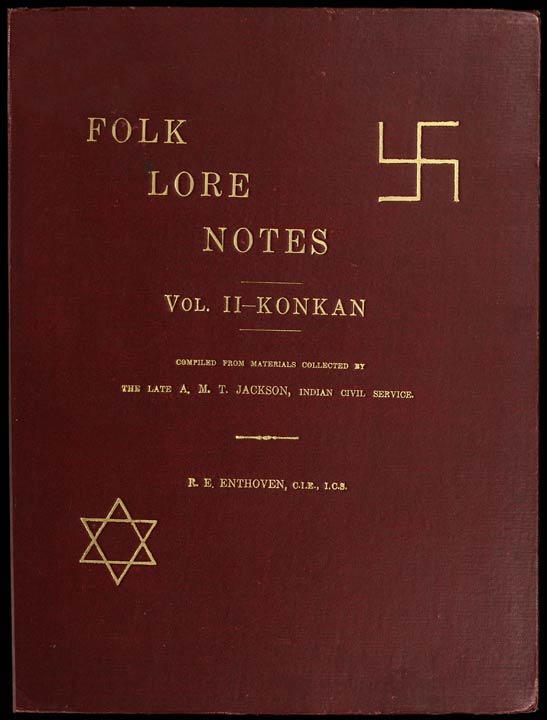
SWASTIKA: A kind of mystical figure.
SWÁTI: Name of constellation.
SWAYAMBHU: Self-existent.
SWAYAMVAR: A maiden’s choice marriage.
T.
TÁDIA: A fruit of the fan-palm.
TADULI: The full moon day of Ashádh.
TAKSHAK: Name of a snake.
TÁL: A kind of cymbal.
TALABDIA KOLI: A sub-division of the Koli tribe.
TALKHÁMBA: A ghost of an unmarried Shudra.
TÁLI: A plate.
TALI BHARANE: A rite performed in honour of the god Khandoba.
TALO BHAGAT: Name of a great saint.
TAMÁSHA: A diverting exhibition; a show, play, farce, mock-fight, etc.
TÁMHAN: A flat saucer-like metal plate.
TAMJÁI: Name of a goddess.
TAPAKESHWAR: A name of Mahádev.
TÁRÁ-BÁRAS: The star twelfth, the twelfth day after the death of a person.
TARIA TÁV: Periodical fever.
TARPAN: An offering of water.
TÁV: A sheet of paper.
TAVA: A cake fried in oil in a pan.
TAVO: Flat unleavened loaves.
TAXAMI: The ghost of a woman dying in child-bed or menses.
THÁKORJI: A name for the Deity.
THÁL: A dish.
THÁNA: A station.
THÁNAK: Locality.
THOR: A tree. Euphoria nerifolia.
TID: A locust.
TIL: Sesamum.
TILA: The sectarial mark made with coloured earths or unguents upon the forehead.
TILAD: A singing sparrow.
TINDOTÁN: A kind of creeper.
TIRTHA: Water used in bathing an idol; a holy place.
TOLA: A weight amounting to 210 grains.
TOND BHUT: An order of evil spirits.
TOSHI: A class of chudels.
TRAVENI: A confluence of three rivers.
TRETÁYUGA: The second yuga or age according to the Hindu scriptures.
TRIJ: The third day of the bright or dark half of a month.
TRIPINDI: A kind of Shráddha.
TRIPURÁSUR: Name of a demon.
TRIPURI-PAURNIMA: The full moon-day of Kártik.
TRISHANKU: Name of a king of the Solar race.
TRISHUL: A trident.
TUCHAKA: A mystical method.
TULA: Libra.
TULSI-VRAT: A vow in honour of the Tulsi or sweet basil plant.
TULSI: The sweet basil.
TUNGJÁI: Name of a goddess.
TURABAT: A tomb.
U.
UBHI: Standing; an order of ghosts.
UCHÁTAN: A branch of black magic.
UCHCHÁTAN: See Uchátan.
UDA: A species of water spirits.
UDAK SHÁNTI: Propitiation by water.
UJANI: A ceremony in propitiation of the village gods.
UJJANI; A festival in honour of the god Indra.
UKARDI: Earth with which the marriage altar is built.
UKO: A dung-hill.
UMA MAHESH: The god Mahádev and his wife Párvati; name of a vow in honour of them.
UMBAR: The Indian fig tree.
UMPI: Name of a Nág girl.
UNÁI MÁTA: Name of a goddess.
UNDAR: A mouse.
UNT: A camel.
UPÁKARMA: The ceremony of renewing the sacred thread.
URAS: A fair held in honour of a Mahomedan saint.
UTÁR: A sacrificial offering.
UTTÁNAPÁD: Name of a mythological king.
UTTARÁ-BHÁDRAPADA: Name of a constellation.
UTTARÁ-FÁLGUNI: Name of a constellation.
UTTARÁSHÁDHA: Name of a constellation.
V.
VÁCCHADO: The spirit supposed to cure hydrophobia.
VÁCCHARO: See Vácchado.
VACHO: Even.
VAD: The banyan tree; the dark half of a month.
VADÁN: Fried cakes.
VADHÁVO: Odd.
VADYÁJÁI: Name of a goddess.
VAGÁDNAR: One who beats musical instruments like drums.
VAGGAYA: Name of a deity.
VÁGH: A tiger.
VÁGHÁMBARI: Name of a goddess.
VÁGHARAN: A woman of the Vághri caste.
VÁGHESHWARI MÁTA: Name of a goddess.
VÁGHRI: A caste of Hindus.
VÁGHUR DEVI: Name of a goddess.
VÁGHVIR: The spirit of a person killed by a tiger.
VÁGHYA: A male child offered to the god Khandoba.
VAIRÁGI: A recluse.
VAISHÁKHA: The second month of the Deccani Hindu and the seventh month of the Gujarát Hindu calendar year.
VAISHNAVA: The sect of Hindus devoted to Vishnu.
VAISHVADEV: An oblation of boiled rice into the fire.
VAISHYA: A trader, the third of the four-fold divisions of Manu.
VAITÁL: An order of demi-gods.
VAITÁLIKA: An attendant of the god Shiva.
VAIVASWAT MANU: Name of the seventh Manu now reigning.
VAJRA: Adamant.
VAJRÁBÁI: Name of a goddess.
VAJRABATTU: A kind of bead.
VAJRAMAYA: Adamantine.
VAJRESHWARI: Name of a goddess.
VAJRESWARI: See Vajreshvari.
VALAM: A mock bridegroom in the Holi festival.
VALAMA VALAMI: A procession of a mock marriage in the Holi festival.
VALAMI: A mock bride in the Holi festival.
VÁLAND: A caste of barbers or an individual of it.
VALGO SAMACHARI: Death anniversary.
VALLABHÁCHÁRYA: A great saint and scholar who founded a sect of Vaishnavism.
VALO: A kind of cattle disease.
VALU: Eccentric.
VÁMA-MÁRGI: A follower of the Váma-márga that is a mode of worship in which the idol is worshipped by the left hand, liquor drunk, etc., etc.
VÁMAN: A dwarf; name of the fifth incarnation of Vishnu.
VANA-SHASTHI: Name of a Holiday.
VÁNZIÁPANA: Barrenness.
VARADANI: Name of a goddess.
VARADHAN: Name of a deity.
VARÁH: A boar.
VARÁHA-SANHITA: Name of a book.
VARSHÁ-RITU: The rainy season.
VÁRUL: The white ant-hill.
VÁSANA: Desire.
VASANTAPANCHAMI: The fifth day of the bright half of Mágh.
VASANT-RITU: The spring.
VÁSH: An oblation of rice and sweets offered to crows.
VASHIKARAN: A branch of black magic.
VASHISHTHA: Name of a sage.
VÁSTU: A religious rite performed on entering a new house.
VÁSTDEVATA: The guardian spirit of dwelling places.
VÁSTUN: See Vástu.
VÁSTUPUJAN: See Vástu.
VASU: A bull-calf or bull branded and set at liberty.
VASUBÁRAS: The twelfth day of the bright half of Ashvin.
VASUDEVA: Name of the father of Krishna.
VASU-DWÁDASI: See Vasubáras.
VÁSUKI: Name of a snake.
VÁSTU SHÁNTI: See Vástu.
VATA-SÁVITRI VRAT: Name of a vow observed by women on the full moon day of Jyeshtha.
VÁTI: A small metal cup.
VÁTKI: See Váti.
VÁV: A reservoir of water; a tank.
VÁYALI: Eccentric.
VÁYU: Wind; the deity presiding over the wind.
VÁYUSUTA: A name of Máruti.
VEDA: Name of the scriptures of the Hindus.
VEDATRAYI: The three vedas, Rik, Yajus and Sáma.
VEDHA: Malign influence.
VEDIC: Relating to the Vedas; as enjoined in the Vedas.
VEHALA: A tree, Beleric Myrobalan.
VELAN: A stick.
VELO: A creeper.
VETÁL: The lord of ghosts; name of a village deity.
VETRASARPA: A cane stick with an image of a snake at its end.
VIDÁ-SUPÁRI: Betel nut and leaves.
VIDYUT: Lightning.
VAJAYÁDASHAMI: The tenth day of the bright half of Ashvin.
VIJLI: Lightning.
VIKRAM: Name of a king.
VIMÁN: A celestial car.
VINÁYAK-CHATURTHI: The fourth day of the bright half of every month.
VINCHI: A female scorpion.
VIR: A male fiend; ghost of an unmarried Kshatriya.
VIRA: An order of ghosts; name of a village deity.
VISHA: Poison.
VISHÁKHA: Name of a constellation
VISHESHA PUJA: Special worship.
VISHI: A cycle of twenty years.
VISHNU: The second god of the Hindu Trinity.
VISHNUSAHASRANÁMA: A book containing the thousand names of Vishnu.
VISHNUYÁGA: A sacrifice in honour of Vishnu.
VISHOTAK: Name of a disease.
VISHVÁMITRA: Name of a sage.
VISHWARUPA: That exists in all forms, an epithet of Vishnu.
VISHWESHWAR: A name of Shiva.
VISWÁTI: An order of ghosts.
VITHOBA: Name of a god.
VISUCHIKA: Name of a cholera goddess.
VIVÁNCHARA: An order of ghosts.
VRAT: A vow.
VRIKODARA: Wolf-bellied, an epithet of Bhima.
VRINDA: Name of the wife of Jalendhar, a demon.
VRISCHIKA: Scorpion.
VRISHABHA: Taurus.
VRITRASÁR: Name of a demon.
VRUNDA: See Vrinda.
VYATIPÁT: The seventeenth of the Astrological Yoga (the twenty-seventh part of a circle measured on the plane of the Ecliptic).
W.
WAD: The banyan tree.
WÁDI: An enclosed piece of meadow-field or garden ground.
WÁGH-BÁRAS: The twelfth day of Ashvin.
WÁGHE: Male children offered to the god Khandoba.
WÁGHESHWARI: Name of a village goddess.
WÁGHJÁI: Name of a deity.
WÁGHOBA: An order of ghosts.
WÁJRESHWARI: Name of a village goddess.
WÁGHYA: Name of a deity; a male child offered to the god Khandoba.
WÁMAN-DWÁDASHI: The twelfth day of the bright half of Bhádrapad.
WÁNI: A trader; a, general name for all castes of traders i.e., banyas.
WÁNPRASTA: A Bráhman in the third order of his life; a hermit in general.
WÁRUL: An ant-hill.
WATA: The Banyan tree.
WATA-PAURNIMA: The fall moon day of Jyeshtha.
WUDA: Incense.
Y.
YADNA: See Yajna.
YADNOPAVIT: The sacred thread worn by Bráhmans.
YADNYA: See Yajna.
YAJAMÁN: A host; a person performing a sacrifice.
YAJNA: A sacrifice.
YAKSHA: A class of demi-gods, attendant on Kubera and employed in guarding his treasures.
YAKSHINI: A female Yaksha; a fairy.
YALLAMMA: Name of a goddess.
YAMA: The God of death.
YAMADUTA: A messenger of the god of death.
YAMAGHANTA: A Yog or conjunction of times, viz., a Sunday falling upon the second day of the bright or dark half of a month; a Friday falling upon the third lunar day, etc., etc.
YAMALOKA: The region of Yama.
YAMAPURI: The city of the god of death.
YANTRA: A mystical formula or diagram.
YOGA: Religious and abstract meditation.
YOGA MÁRGA: The path of meditation.
YOGA-SUTRA: Name of a work by Pátanjali containing aphorisms of the science of Yoga.
YOGAVÁSHISTHA: Name of a work on philosophy.
YOJAN: A measure of distance equal to eight miles.
YUDHISHTHIR: An epithet of Dharma, the eldest of the Pándava brothers.