
BOOKS BY
Charles Carleton Coffin
Author of
"Boys of '76"
"Boys of '61"
C HARLES CARLETON COFFIN'S specialty is books pertaining to the War. His celebrated writings with reference to the Great Rebellion have been read by thousands. We have popularized him by publishing his best works at reduced prices.
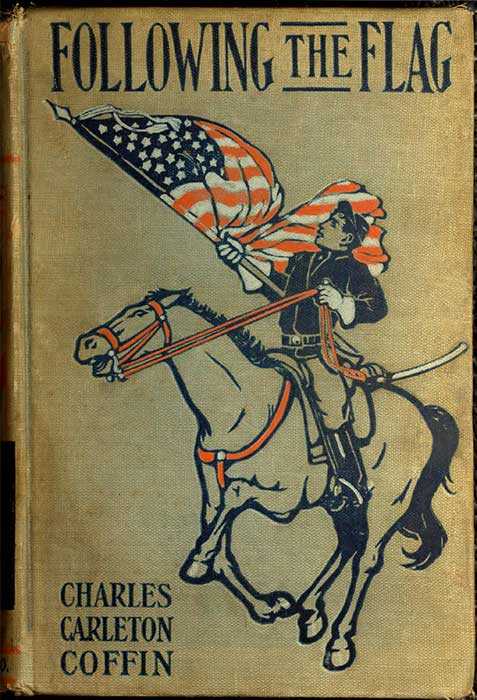
| Following the Flag. | Charles Carleton Coffin |
| My Days and Nights on the Battlefield. | Charles Carleton Coffin |
| Winning His Way. | Charles Carleton Coffin |
| Six Nights in a Block House. | Henry C. Watson |
Be sure to get one of each. Price, postpaid, Fifty Cents.
Obtain our latest complete catalogue.
HURST & CO., Publishers, NEW YORK
FOOTNOTES:
1 Ohio State Journal.
2 General McClellan's Report, p. 4.
3 Testimony before Committee of Congress.
4 Norfolk Day-Book.
5 Peninsular Campaign. Rev. Dr. Marks.
6 General McClellan's Report, p. 66.
7 General Heintzelman's testimony.
8 Maine Adjutant-General's Report, 1862, p. 142. Captain B. M. Smith.
9 Campaign from Texas to Maryland, by Rev. Nicholas A. Davis, Chaplain Fourth Texas. Richmond, 1863.
10 Stephens's speech.
11 Notes on Virginia.
12 McClellan's Report, p. 79.
14 President Lincoln's letter,—Testimony, p. 321.
15 Adjutant-General's Report,—Testimony, p. 315.
16 McClellan's Report, p. 79.
17 Confederate Reports, Official, p. 516.
18 Battle-Fields of the South, by an English Officer in the Confederate Army. London.
19 Southern History of the War, Vol. II. p. 31.
20 Southern History, Vol. II. p. 31.
21 Estvan's War Pictures from the South, p. 271.
22 Battle-Fields of the South.
23 The diagram represents the position of the troops at the beginning of the battle.
24 Battle-Fields of the South, Vol. II. p. 4
25 Keyes's Report.
26 Adjutant-General's Report, Maine, 1862.
27 Adjutant-General's Report.
28 Battle-Fields of the South.
29 Chaplain Marks.
30 Testimony, p. 352.
31 Testimony, p. 609.
32 Army of the Potomac, p. 79.
33 Chaplain Marks.
34 Campaign from Texas to Maryland.
35 McClellan's Despatch. Testimony, p. 338.
36 Pollard's Southern History, p. 329.
37 Confederate Narrative, Rebellion Record, Vol. V. p. 250.
38 Battle-Fields of the South.
39 Campaign from Texas to Maryland, p. 46.
40 Richmond Whig, June 29, 1862.
41 Peninsular Campaign.
42 Battle-Fields of the South, p. 170.
43 Cologne Gazette account.
44 Hooker's Report.
45 Pollard, Southern Hist.
46 Campaign from Texas to Maryland.
47 Battle-Fields of the South.
48 Report, p. 140.
49 Peninsular Campaign, p. 294.
50 See "My Days and Nights on the Battle-Field."
51 Pope's Report.
52 Pope's Report.
53 Sigel's Report.
54 Southern History, Second Year, p. 113.
55 General McClellan's Report, p. 213.
56 McClellan's Report.
57 Life of Stonewall Jackson, p. 197.
58 The Church and the Rebellion, p. 196.
59 Pollard, Vol. II. p. 137.
60 Upon the map accompanying General McClellan's Report there are several residences marked Poffenberger; also several marked D. Miller. But the residence here described was the one around which the severest fighting occurred on the right,—Joseph Poffenberger's.
61 Pollard, Vol. II. p. 125.
62 Jackson's Report, Southern History, Vol. II. p. 132.
63 Southern Hist., Vol. II. p. 132.
64 Jackson's Report, Southern History, Vol. II. p. 133.
65 Campaign from Texas to Maryland, p. 89.
66 Ibid, p. 90.
67 Major Hyde's Report.
68 Maine Adjutant General's Report, 1862.
69 McClellan's Report, p. 208.
70 Charleston Courier's account of the battle.
71 Burnside's Testimony.
72 McClellan's Report, p. 207.
73 McClellan's Report, p. 201.
74 Statement of a Rebel officer after the battle,—a prisoner.
75 Campaign from Texas to Maryland, and Charleston Courier.
76 See McClellan's statement of the number of troops present, p. 214, Report.
77 Lieutenant-Colonel Kimball's Report.
78 Report, p. 212.
79 Burnside's Testimony, p. 642.
80 Vol. II., p. 142.
81 President's Letter.
82 Adjutant-General's Report.
83 Report Christian Commission.
84 Speech at Ellicott's Mills, 1864.
85 In General McClellan's report of the battle of Fair Oaks, he calls this brigade "Abercrombie's,"—evidently a mistake.
86 Kearny was appointed division commander of the Third Corps (Heintzelman's) at the commencement of the Peninsular campaign.
Transcriber's Note
Footnotes have been moved to the end of the book. Illustrations have been moved near the relevant section of the text.
Inconsistencies have been retained in spelling, hyphenation, punctuation, and grammar, except where indicated in the list below:
- Quote added before "WINNING" on Page 1
- Comma changed to a period after "heart" on Page 15
- Comma removed after "positions" on Page 20
- "states men" changed to "statesmen" on Page 35
- Period changed to a comma after "people" on Page 38
- Quote added before "Our" on Page 48
- "magnificient" changed to "magnificent" on Page 66
- "were" changed to "where" on Page 96
- "2" changed to "3" on Page 116
- "sieze" changed to "seize" on Page 119
- Comma changed to a period after "1862" in Footnote 40
- "imposible" changed to "impossible" on Page 128
- Period added after "Dr" on Page 131
- "mutitudinous" changed to "multitudinous" on Page 136
- Double quote changed to a single quote before "I" on Page 138
- Single quote added after "treason." on Page 138
- "ermitting" changed to "permitting" on Page 152
- "sucessful" changed to "successful" on Page 153
- Comma changed to a period after "213" in Footnote 55
- "breatbes" changed to "breathes" on Page 159
- Illegible word on Page 199 changed to "dear" based on other printings of this book
- Period added after "ground" on Page 207
- "Lieutenant Colonel-Kimball's" changed to "Lieutenant-Colonel Kimball's" in Footnote 77
- Quote added after "more?" on Page 238
- Comma changed to a period after "142" in Footnote 80
- "Washinton" changed to "Washington" on Page 246
- Quote removed after "track." on Page 248
- "perfrom" changed to "perform" on Page 253
- Quote added before "Never" on Page 256
- Quote removed after "slavery." on Page 257
- Period changed to a comma after "war" on Page 258
- Quote added after "Dominion." on Page 262
- "McLELLAN" changed to "McCLELLAN" on Page 269
- Period added after "Brigade" on Page 279
- Period added after "Brigade" on Page 279
- Comma removed after "I." on Page 279
- Period added after "Brig" on Page 281
- "Hanccok's" changed to "Hancock's" on Page 281
- "guns" removed after "6-pds." on Page 284
- Period removed after "1st" on Page 284
- Comma changed to a period after "Y" on Page 285
- Period added after "Legion" on Page 286