
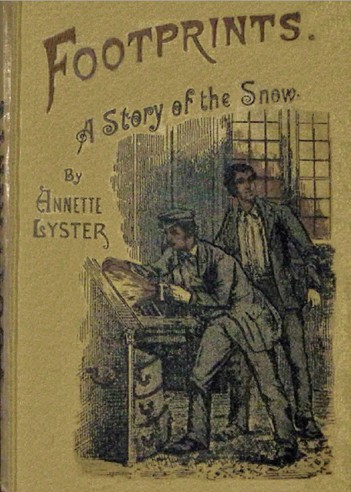
The Project Gutenberg eBook of Footprints
Title: Footprints
A story of the snow
Author: Annette Lyster
Illustrator: J. Nash
Release date: May 28, 2025 [eBook #76173]
Language: English
Original publication: London: Society for Promoting Christian Knowledge, 1889
Transcriber's note: Unusual and inconsistent spelling is as printed.
"I POINTED OUT THE DRAWER, AND HARPER TOOK THE GOLD."
FOOTPRINTS.
A STORY OF THE SNOW.
BY
ANNETTE LYSTER
AUTHOR OF "THE WHITE GIPSY," "A LEAL, LIGHT HEART,"
"FAN'S SILKEN STRING," "ETC."
ILLUSTRATED BY J. NASH.
—————————————
PUBLISHED UNDER THE DIRECTION OF THE COMMITTEE
OF GENERAL LITERATURE AND EDUCATION APPOINTED BY THE
SOCIETY FOR PROMOTING CHRISTIAN KNOWLEDGE.
—————————————
LONDON:
SOCIETY FOR PROMOTING CHRISTIAN KNOWLEDGE
NORTHUMBERLAND AVENUE. W.C.;
43, QUEEN VICTORIA STREET. E.C.
BRIGHTON: 129, NORTH STREET.
NEW YORK: E. & J. B. YOUNG AND CO.
CONTENTS.
CHAPTER
FOOTPRINTS.
CHAPTER I.
SNOW AND SNOW-MEN.
VERY early in the reign of Queen Victoria there lived near a large town in Devonshire a farmer named Marlowe, a prosperous, well-to-do man, with a thrifty, good-tempered wife and half a dozen children. Mr. Marlowe owned his farm, which was a large one; and in those good old times farmers could live comfortably, and lay by a little money for their children—a state of things which has well-nigh passed away.
In Devonshire, as perhaps most people know, a heavy fall of snow is a most unusual thing. The mild, damp climate forbids the snow to lie long; indeed, it generally melts in the act of falling. But one year, early in the queen's reign, there was a snowstorm in Devon which would have been considered heavy in Scotland or Yorkshire; and with the snow came a hard frost.
Farmer Marlowe's five sons and one daughter were in strange glee. There was a large grammar-school not far off, which the three elder lads attended, and some of the boarders who came from colder regions had often described to them the delights of snow and frost—snow-balling, sliding, and even skating; but never had the young Marlowes partaken of those joys. Now they were determined to make the most of them.
In the school playground a large snow-man was built up by the boys during the play-hours "between schools," and Harry, Hugh, and Frank Marlowe thought themselves very kind and considerate for their sister Lucy and the two little boys at home, in that they refused to remain in the playground in the afternoon to assist in finishing the snow-giant, and perchance in demolishing him, should the popular fancy turn in that direction. As they trudged off, Hugh looked back, saying—
"Oh, boys, I can see his head—the snow-man, I mean. I see it over the wall, and that wall is ten feet high at least. Why, he must be fifteen or sixteen feet high!"
"Not he," said Harry, the eldest; "not more than ten, if so much. You forget that we are going uphill."
"No, we are not," said Hugh, who was somewhat famous for contradicting; "and if we were," he added hastily, "what difference would that make?"
But Harry was not going to be entrapped into an argument with Hugh, whom their father declared was born half a lawyer, so he only answered—
"Well, if you can't see for yourself, Hugh, 'I' can't make you."
"He sees well enough," said Frank; "only he must be talking. I'm half sorry, Harry, that we didn't stay, for if Uncle Jasper is as queer as he was yesterday, ten to one Lucy won't get out at all, and Jim and Polly are no good."
Polly, I must explain, was a pet name for the youngest boy, whose name was Paul.
"Well, that may be," Harry answered; "but it would be hard on the little chaps to get no fun out of the snow. Why, I'm fifteen, and I never saw a snow like this before. Uncle Jasper may have come all right again."
"'I' couldn't see a bit of change in him," said Hugh; "only Lucy and mother made a fuss."
Harry turned sharply, and caught the speaker by the collar of his jacket.
"Say that again," said he.
"No, I shan't," replied Hugh promptly, and the elder's brief anger ended in a laugh.
"Well, you 'are' a funny chap, Hugh. Don't you let me hear you saying anything saucy about mother, mind."
"I shall just turn round and go back to the playground," said Hugh as soon as he was released. "Because you are big and strong, that's no reason why you should be a bully. A bully is a disgusting character. I don't care if Lucy and the two young ones never see snow-balls. What matter about a girl and a couple of babies? I shan't lose all my fun for them. I'm going back."
"All right," said Harry composedly; "off you go;" and he trudged along the beaten track by the side of the road, followed by Frank, who, however, kept looking back as if divided in his mind.
"Why must we go home, Harry? It was such good fun in the playground."
"So 'twas, Frankie, and we had it for a good long time, and shall have more to-morrow. But we must not think of no one but ourselves, you know."
"And Hugh will be sorry by-and-by," said Frank.
"Do you know Hugh no better than that?" Harry asked, with a laugh. "Come, let us run down this hill. No, Frank; take care—it's too steep. We couldn't run. I wonder which will be at home first—Hugh or ourselves?"
They presently turned off the high-road into a lane with high banks on either side, and great ferns growing all the way from the ground to the top. These ferns looked so wonderfully beautiful that even a couple of schoolboys could not pass them without remark. The high banks had partially sheltered them, and they were not smothered in snow—only turned into white ferns, every bit of the brown and yellow of their winter coats being covered.
"Don't they look as if they were cut out in white stone?" said Frank admiringly. "Well, snow is very pretty! Still, I think I like colours best, for always."
Harry had reached the gate which shut in his father's house and garden—a large, formal garden, with one broad walk leading straight from the gate to the house. He stopped, and made a sign to the other boy to come on quietly.
"Look there!" said he. "What did I tell you?"
And there, in the middle of the broad walk, was the humble commencement of a snow-man, and hard at work collecting snow were the two little boys, Jem and Polly, aged respectively six and four, while busy about the formation of a pair of shapeless feet was no less a person than Hugh himself.
"Well, if he isn't a queer fellow!" cried Frank, with his eyes wide open.
They raised the latch of the gate, and at the sound Jem called out, "Here's the other two, Hughie."
"At last!" said Hugh. "Never thought of taking a short cut through the wood, of course! Lucy will be out in a minute or two. I say, Harry, Uncle Jasper's queerer than ever."
"He's ill, I'm afraid," said Harry. "Here, Frank, give me your books. I'll carry them in. I'll be back directly; but I want to see about Lucy."
He went on to the house—a square brick house, with a very pretty old wooden porch all overgrown with ivy, jasmine, and roses, now looking like delicate tracery cut in fine white marble. This picturesque, many-pointed porch was the only pretty thing about the house. The building was square, with smallish square windows, one on each side of the hall door, and others above them, for the upper rooms. Over the porch there was a third window in the upper row. But there was an air of solid comfort and respectability about the place, and the Marlowes saw no faults in it.
Harry entered, stamping the snow off his feet in the porch. Passing through a rather darker hall, he went into a large, comfortable room on the left side of the hall. Here a fire blazed cheerfully, and here he found his sister Lucy, a pleasant-faced, blue-eyed girl of sixteen. She held up her hand in warning, and whispered—
"Don't wake him, Harry dear."
Harry sat down near the door, and pulled off his heavy shoes; then, coming forward, he looked curiously at an old, old man, who was lying back in a great armchair placed before the fire; fast asleep, he seemed to be.
"What is the matter with him, Lucy?"
"I don't know. It seems to me as if the snow frightens him, only that is absurd, for he is not a bit silly, though he has grown so silent. But I'm sure it has something to do with the snow, and that he is always so when snow comes; for I heard father say, 'I wish the poor old chap could sleep till the thaw.'"
"He looks very weak; don't you think so?—All grey and pinched-up like. Lucy, can't you come out at all?"
"Oh yes; mother has just got through her work in the kitchen, and then she'll sit here, and let me go."
"Very good. Go you and get ready, then; I will sit by Uncle Jasper till mother comes. Put on lots of things, Lucy, for it's stinging cold."
Lucy laid by her needlework and ran lightly off, and for a few moments all was very quiet. But probably the soft buzz of the young voices had broken the old man's slumbers, for he soon moved uneasily, and presently sat up, looking round in a dazed kind of way.
"Where's Harry?" said he.
"Here I am, uncle. Do you mean me or father?"
"Is this Harry? Why—have I been dreaming? Harry was like this once. Oh, I know. I remember now. You're not 'my' Harry; but you are a good boy. Mind you always keep so, Harry. Never wander from the right way; never forget that God sees you always. You don't know what you may come to. We never know what sin we may commit, if once we go into the wrong way. Harry, is the snow gone?"
"No, sir," said Harry, a little surprised both at the long warning and the abrupt question; "no fear of that. We are going to build a snow-man. You can see a bit of him already from the window."
"Ay, ay—the window. That was the window," Jasper added, pointing to one at the end of the room, from which, of course, the broad walk and the snow-man could not be seen.
"No, not that—the front one," said Harry, a good deal puzzled.
"No! Do you think 'I' can forget?" old Jasper said, half-angrily. "It was the end window. That's the same bureau. It stood near the fireplace in those days, and old Rover was lying on the sheepskin rug. Ah me—it's a long, long time ago! When I get to heaven, I may forget, but not here, and the snow wakes it all to life. I know I am forgiven, but I never can forget. Uncle Hugh said just the same—he never could forget—and what was his sin to mine?"
"What is it that you cannot forget—and who was Uncle Hugh?" said Harry.
Old Jasper considered for a moment.
"Katie was his daughter, and she was your grandmother—so he was your great-grandfather. Oh, how long I have lived—they are all gone but me. Uncle Hugh—Harry—young Hugh—all gone. He was not really my uncle, only a cousin, but we called him uncle, Harry and I did."
"Harry—that's my father?" questioned the boy.
But he got no answer, for old Jasper had risen and gone to the front window.
"All white and pure," he said, "but treacherous too. Hiding things sometimes, and then—But the fault was not in the snow, it was all my own. Well, well! I'm forgiven, I know that. 'I have blotted out as a cloud'—eh, what's the rest of that, now? My head's going I doubt—I can't remember even that."
Harry came over to him and repeated the verse,—
"'I have blotted out, as a thick cloud, thy transgressions, and, as a
cloud, thy sins.'
"But, 'indeed,' Uncle Jasper, I don't think you ever did anything very bad. You've always been so good, as long as I can remember anything."
Jasper took a long look at the dazzling whiteness—made more dazzling just then by a sudden burst of sunshine. He shivered and said in a low voice—
"When the snow melts you will know all about it."
"Oh, he's going crazy!" muttered the boy, sincerely frightened—so frightened that it was a great relief to hear his mother's step in the hall.
"Mother!" he said, running to the door. "Come to Uncle Jasper—I don't think he is quite well."
"Why, Lucy said he was asleep! What is it, Jasper? What's making you shiver? Are you cold?"
"Cold at heart—a coward, Mary, always a coward. When the snow melts—and look at the sun now!—then all the world will know what I am. And I cannot bear it; I always said so. I can't bear it!"
"Run away, Harry; Lucy is ready now. Now, Jasper, dear heart, listen to me. Don't be gazing out at the snow, but turn this way and look at me, and put your mind to what I'm going to say."
She took his hand, and whenever his eyes began to wander from her face she pressed his poor old withered hand gently, and recalled him to attention.
"Jasper," she said, "whatever misery comes back to you with the snow, there is no one living who knows aught about it. My good-man himself only knows that you are always ill and unhappy whenever snow comes; I'm thankful that it does not often happen here. I suppose something was done when there was snow long ago; but all that knew it have passed away: and when this snow melts we shall know no more than we do now, unless you tell us yourself."
"I am always afraid I shall tell when there is snow," he said.
"And, in my opinion, you would be happier if you did tell," Mary Marlowe answered. "I don't mean, tell me, or tell every one; but my husband is a good, wise man, and, if you have a burden on your mind, he'd give you help and comfort."
Old Jasper was attentive enough now. His face was quite changed; all the look of vacant, anxious unrest had left it, and he looked many years younger and more like his former self.
"Tell the whole story!" he cried. "Why, Mary, Heaven forgive me! I remember feeling a little bit of comfort when those I truly loved were taken from us, because I could not help saying, 'Now no one living knows of my sin.'"
"Well, and has it made you happy, Jasper? Sure, I know it hasn't."
"But," he answered anxiously, "I've repented, Mary, long ago—bitterly repented! I am forgiven! Oh, surely, Mary, you think I am forgiven—and when I meet them again there will be no cloud between us."
"And what was the cloud, Jasper? I know enough of the Marlowes—open-hearted, kindly souls—to know that if they forgave, they did it heartily. So what was the cloud between you?"
"Shame," he answered.
Mary shook her head.
"Well," he went on, "if it was not that, what was it?"
"If you ask my opinion, Jasper, I'd say it was pride. When we've done wrong, and been forgiven, it is my mind that we should just make no concealments and keepings back, but stand fair out in the sight of man as we stand in the sight of God. I am sure of this—a concealed sin does our own lives more injury than any shame or any sorrow. Being hidden, it lives and gnaws at us; drag it out into the light of day, and you will kill it. All your life, ever since I came home to Marlowe Hay, you've been a gentle, loving-hearted, good man, a good friend to my children, as you were to their father before them, and to his father, as I have often been told. And yet you are not a happy man; though I know you are a true Christian, yet you are never happy. I have wanted to say this to you ever since a talk we had last summer—that there 'must' be some reason for this in yourself, for well you know there is no religious reason. He forgives freely, and puts the sin away; but you keep it to think about and grieve over—while all the time you care more that no one should know it than for anything else."
"Oh, Mary, you are hard upon me!"
"I don't mean to be hard, indeed; but I am all for being above-board and true. And don't I know that half your misery is, 'If they knew what I once did, they would never love me'? And I am very sure that that is a mistake. You are a real self-tormentor, Jasper, and always were."
"Why, that's what Harry—'my' Harry, as I call him—said to me when he was dying. He said,—
"'We never told the little lad, Jasper; and when I am gone there will be no one but poor Katie who knows a word about it, and you know she will keep your secret. This was your wish, and we have done so; but you'd be a better and a happier man if you could make up your mind to have no concealments. You will only torment yourself all your life, as you have done these many years; and though I cannot bear to vex you, I must say, once for all, that I think God means us to bear the shame of our deeds.'
"But I never had the courage to do it."
"And what a deal of sorrow and fretting you've made for yourself by it," Mary said gently.
"He added, 'And God will bring you to see it before you die,'" the old man went on thoughtfully.
He spoke no more, and Mary led him over to his chair, and made him comfortable in it. Then she took out her needlework, and a long time passed in silence, during which her mind had gone off to other matters, when suddenly the old man spoke again.
"This is 1840, is it not? Then am I ninety-five years old. And my Harry died at fifty, and his son died young, and there's no one living now that I knew when I was young. Why am I left, I wonder? Maybe, I am spared so long just to give me another chance to do what I ought. 'Tis pride. I thought it was shame and humility, but I see now 'tis just pride. And to think of such as I being proud! Well, I will give it up; I will tell it all. They'll shrink from me—the lads that I love, because they are so like my Harry. And Lucy, when she laughs, she minds me so much of Katie. She'll hardly bear the sight of me again. But I deserve it all. And when it's done, maybe God will take me home. Maybe, this is the last thing I have to do in this world. I'll do it, Lord. This very evening, if I live to see it, I will do it."
He got up slowly, took up a crutch-handle stick that lay near him, and left the room. Mary heard him cross the hall and enter his own room. She looked after him pityingly; he had a deformed foot, and walked very feebly.
"Poor old man!" she said. "I wonder will he remember? He'll be twice as easy in his mind if he keeps to his resolution; and I dare say 'twas nothing so very dreadful, after all."
CHAPTER II.
KATIE.
THE young Marlowes built up not only a snow-man, but a house of snow. Not that they finished it that day, but they began it in an empty corner of the rick-yard. When it grew too dark for even Hugh to declare that it was still quite light, and that they were all very lazy to talk of going in, the party ran off, warm with hard work and hungry as hunters. Frank and Hugh reached the porch first, and there waited for the two elders, who came ploughing through the snow, Lucy carrying little Paul, and Jem mounted on Harry's back.
"There 'll be more snow to-night," said Frank gleefully. "Look how grey and low the sky is."
"That's for a thaw," said Hugh. "We shall never finish the house, you'll see. Well, I never was so hungry in my life! Polly, if you trot into the parlour with your boots in that state, mother will be glad to see you, no doubt!"
Polly turned and scampered upstairs, followed by the rest with shouts and calls, and presently they all came down again with well-brushed hair, clean hands, clean shoes, and splendid appetites. Bread-and-cheese disappeared before them almost as if they had been made of snow, and the rosy young faces were so many suns.
Mr. Marlowe—the master, as he was usually called—sat at one end of the big table, and his pleasant-looking wife at the other. Beside her sat old Jasper, for whom a nice bowl of good soup was provided; but he did not take much of it this evening, and looked very grave and thoughtful. For a long time a kind of quiet indifference had been growing on the old man, but to-night every trace of this had disappeared, and he looked at the children from time to time with somewhat sad affection. They had been cautioned not to speak before him of the snow, or of their games in the garden and rick-yard, but he began the subject himself.
"You've been making a snow-man, boys. I saw him from my window."
"Yes, and a house, too," cried little Jem—"such a lovely house as it will be, with a window and a roof; only Hugh says it is going to thaw. Will it thaw to-night, Uncle Jasper?"
The elders looked a little anxious, but Jasper answered calmly—
"Not to-night, I hope, Jemmy. Now, if you've all had your supper, come and sit by the fire. I've a story to tell you—a story of the snow."
"A story!" said Lucy. "Why, that's nice, uncle. It will be like old times again. I always loved your stories."
"Old times?" Jasper repeated. "No, Lucy, it may never be like old times any more."
Mr. and Mrs. Marlowe glanced at each other, and the master said—
"You must not put yourself about, Uncle Jasper. You'll maybe do yourself harm."
"My mind is made up to it," the old man said. "I've been wrong this long time. I'll lay down my pride now, God helping me."
He rose, and Lucy ran to help him to his warm corner by the fire.
"Ah, little Lucy!" he muttered. "Maybe this is the last time."
The girl looked startled, but said nothing.
Uncle Jasper had until lately been a wonderful "story-teller," so the young people were not surprised, though much pleased, at his offering to tell them one now. The table was cleared, and then each took his favourite seat—Paul perched on his father's knee, Jem nestled close to his mother on a low stool, Harry and Frank together on an old-fashioned settle, and Hugh lying on his back on the rug. Lucy and her mother had their needlework, and the master had a book; but he did not open it, for he was somewhat curious, as well as anxious, wondering whether Jasper's long-kept secret were really about to be told, and wondering, too, if it were well for the children to hear it.
"Uncle Jasper," said he, "shall I send the boys to bed? Would you rather I did?"
"Why, he promised us a story!" cried little Paul, looking up.
"No; I wish them to hear. 'Twill be a lesson for them."
"Now I know 'twill be a stupid story," muttered Hugh. "Stories to do you good I hate! I shall go to sleep," and he closed his eyes.
"It's a long story," said old Jasper; "I shall hardly get through it to-night; but, if I'm spared, I'll tell it all—before the thaw. It happened when I was fifteen, and that is eighty years ago."
"My stars!" exclaimed Hugh, who was not asleep just yet.
"But I must begin even earlier than that, if I am to make my story plain—and I want to tell it all, plain and true. Well, this house and farm of Marlowe Hay belonged to Hugh Marlowe, whose name you've all seen on the monument over our pew in church. He was the last of the old Marlowes to whom this place had belonged for many generations. He married young, and his wife never had a child until they had been years and years married, and then she had a little girl, and died soon afterwards. He never married again, and so he got on in life; and being by nature a masterful man, and rough in his ways, he got to be more so, of course, with only farm-servants about him, and a child whom he spoiled a good bit. Well, at last he had a bad illness—a kind of rheumatic-fever—and he never was quite the same man again. And constant pain makes even good-tempered people crusty sometimes.
"However, he began to think that he ought to settle his worldly affairs. He was very rich, for his station in life; he could leave his daughter a good portion, even if he left Marlowe Hay away from her; and he bethought himself that he would like to adopt an heir who could take his name, and in due time marry Katie, if all went well. He had two cousins, and they were both married and had families: one was Mrs. Franks, and the other was Mrs. Helps. Mrs. Helps was my mother; she was a widow, and I was the only boy, and the youngest of the family. I remember the day his letter came as if it had been only yesterday—ay, maybe better."
"Why, Uncle Jasper! Your name is Marlowe," cried Frank.
"I've always borne that name—but my own right name was Helps. The letter was welcome enough, to my mother. I had been a sickly child, and, with my bad foot, would never be fit for much; and she was poor. She read me the letter. I was then twelve, and had never done a day's work in my life—I had been too often bad with my foot. But now my foot was well—it has never troubled me since, indeed—and I was running idle about the streets, making friends and learning habits that were not good for me. I got a taste for bad company, which you will see led me into harm afterwards."
"Were you lame then, Uncle Jasper?" inquired little Jemmy.
"Yes, even lamer than I am now; though, of course, I was stronger too. The letter said that Hugh Marlowe meant to adopt two boys. Harry Franks was to be one, and, if my mother liked, I should be the other. He said he knew that I had been a sickly child, but was better now, and the country life would make a man of me. He would provide for both boys; one should be his heir, and the other take place as a younger son; but both should be fairly provided for, even if he did not like either of them enough to leave Marlowe Hay to him.
"Says my poor mother, 'You're a handsome boy, Jasper, far handsomer than Ellen Franks's boy; but, then, he's an active, strong fellow, you know. Still, you're twice as clever as he, and if you use your brains, you'll be the heir. You'll have to be cautious, though, and make everybody fond of you; but I trust to you to use your brains and oust that big yellow-haired lad before long.'
"Now, I'm very sure my mother would never have said all this if she had known how I would take it all up, quite seriously,—I am sure of that. I knew Harry Franks a little. I had met him more than once, and liked him. And if I had been let alone, maybe Harry would have led me right—I might have been a different boy, and never had this story to tell at all."
"But who was Harry Franks?" asked young Harry Marlowe. "Were there three boys? You know I have heard about Hugh Marlowe adopting my grandfather before—but surely he was Harry Marlowe?"
"Mr. Marlowe said in his letter that both boys—if he liked them—were to take his name, and be in all respects as his own sons."
"So our name is really Franks," cried the boys. "How 'very' queer!"
"No, no; your name is Marlowe," said the old man testily. "Mr. Marlowe gave Harry his name. Well, where was I? Oh ay—I was sent off from Rochdale, where we lived, to Devonshire, and my mother took great pains to get me ready quickly, because she wished me to be 'first in the field,' she said. Not a word did Hugh Marlowe say in his letter about his daughter. So when I arrived here—it was in May, and the orchard was a sight the like of which I had never seen before—I was finely surprised when in the porch I met a little lass, with her hair hanging over her eyes and her lap full of flowers—such a pretty little lass! She stood in the porch with the house door open behind her—and says she,—
"'Are you one of my new brothers?'
"'I don't know,' said I. 'Who are you?'
"'I'm Katie Marlowe, of course—what a fool you must be! I shan't like 'you,' at all events. Why do you walk lame?'
"By this time the old man who had met me at the end of the lane—I came by coach, you know—had come into the porch, and he said,—
"'That's bad manners, Miss Kate. Take the lad to your father.'
"'Take him yourself,' says she, with a toss of her head that set her wild curls flying till her head looked something like my mother's mop when she twirled it; and she ran off into the house.
"'I mun take the powny round,' said old Jacob. 'You follow after she, lad; the master's in the parlour.'
"So I went in. I heard Katie's voice saying,—
"'He's lame, father—he has a crooked foot.'
"And then I pushed the door open and went in. Old Hugh Marlowe—I thought him wondrous old then, but I might have a son older than he was, at my present age—he was sitting in this very chair, over by the window yonder.
"And he said, 'Come here, boy.'
"So I went up to him.
"'A cripple!' says he. 'I ought to have been told of it. Which are you, now—Harry Franks or Jasper Helps?'
"Jasper Helps, sir,' said I; 'and I am not a cripple, indeed. I had something the matter with my foot, and it grew crooked; but I am well of it this long time.'
"'Ah, well!' said he. 'The deed is done now, and it was not your fault, so you shall have your chance fairly. Dost thou like him, Katie?'
"'No,' says Katie, 'I don't! I didn't ask you to catch any brothers for me—I did very well without any, and I don't like this one a bit.'
"'You'll have to put up with him,' he answered, with a laugh; 'and mind now, lassie, none of your tantrums before him. He'd think thee a wild savage if he saw thee dancing with rage as I saw thee this morning!'
"Well, we were soon friendly enough, the child and I. Ah, if I had only come here with no hidden thought in my mind, how happy I might have been! For Mr. Marlowe was not unkind, though rough in his manner, and if I hadn't been in such a hurry to please him, he'd have liked me better. I think he partly saw through me, but he never allowed it to make him unkind to me. And the little lass was one that any one must have loved, in spite of her wild ways and her bit of a temper. For she had a temper—many a red cheek and hot ear did her little hand give me, and she must be obeyed in all things. Well, a boy should be ready to give up to a girl, particularly a big boy to a little girl, and if I had done it without any secret plan, it would have been all right enough. But my whole aim was to make her so fond of me before Harry came, that she should think nothing of him.
"It was a fortnight, I think, before Harry came, and I believe he had been waiting to know when I was to go, that we might travel together. Katie and I were here, in this parlour, at our supper, when the door opened and in came Harry. And if you want to know what he looked like, just look at Frank; he's the most like him of any of you—more like him than his own son ever was. Only Harry looked grave and a trifle shy.
"'I am Harry Franks, sir,' said he to Mr. Marlowe, 'and my mother desires her best respects.'
"'Oh ho! So you're Harry, are you? Harry Marlowe from this time, mind you, boy. You're like your mother, and she was as honest-faced a lass as I ever saw. Show us your feet—ah! All right. You're welcome, Harry. Katie, you little goose, don't frown so—here's another playfellow for you.'
"But Katie had seen me turn red when her father said that about Harry's feet, and she only puckered her pretty forehead into a frown more than before, and made answer—
"'I shan't play with him. I don't like him. I like Jasper—I like his foot! I hate that great, big, yellow-haired boy! Send him away, father.'
"I felt full of triumph and satisfaction; but Mr. Marlowe only laughed and said—
"'All right, lassie; we'll see if you're of the same mind ten years hence. Never mind her, Harry; she said she hated Jasper when he first came, and she soon couldn't get on without him—she'll take to you soon enough.'
"With that, Katie got up and walked round the table to where Harry had taken a seat, and gave him a hearty box on the ear.
"'That's the way I shall take to him,' said she.
"Harry looked surprised, and then laughed and said, 'It is well for me that you have but a small hand, Cousin Katie.'
"'Don't call me cousin!' said Katie. 'Jasper may; but you must call me "Miss" Katie.'
"'Nonsense, girl!' said Mr. Marlowe. 'I'll have nothing of that kind here. Let me hear no more folly of this sort.'
"Katie knew better than to be saucy when her father spoke like that, so we finished our supper in silence; and then Mr. Marlowe sent Harry and me to our room, for Harry was falling asleep, he was so tired, and I might as well go too. Sleepy as he was, I saw Harry kneel down and say his prayers before he undressed, and when he was in bed, (we had the room over the porch), he said, 'Good night, Jasper. I hope we shall be good friends.'
"'We can't!' said I. 'We are rivals.'
"Harry stared at me. 'I don't understand,' said he; 'but maybe I shall when I am not so sleepy.' And he was sound asleep in a minute.
"I lay thinking, 'I was a fool to say that! I must keep friendly with him, for it is plain enough that Mr. Marlowe will be on his side.' Ah, dear! how plain it all comes back to me!"
"Indeed," said the master, "it's simply wonderful how you remember so well; and hearing it here, where it all happened, makes it better than a printed book. But, for all that, sir, we must not sit up all night—Jem and Paul are asleep, and it is getting late. You must go on with it to-morrow night, Uncle Jasper—that is, if you're inclined to do so; for you must remember that not one of us wants to hear another word, unless you wish to say it."
"Go to the door," said old Jasper, "and tell me is it freezing."
The master looked surprised; but, laying Paul on his mother's lap, he went out into the hall. Coming back, he said—
"Snowing hard and freezing too, uncle."
"Very good—then I can wait. I need not finish till the thaw comes."
The boys were looking at him in great surprise, for his strange manner almost frightened them.
He looked at them, and seemed to wake up.
"Go to bed, lads," he said, "and think over what I've told you, for I want you to remember this story as long as you live. Now answer me, boys. So far as we have gone, what was my fault, do you think? Speak out, mind—I want to hear your real thoughts."
"I don't think you had 'done' anything wrong," said Frank; "only thought it."
"And you, Hugh?"
"I couldn't say," answered Hugh gruffly.
"Was it that you were selfish, uncle?" said young Harry. "Was it wrong to want all for yourself?"
"What do you say, Lucy?" said old Jasper, turning to his favourite.
"It was very long ago," Lucy said, "and you are so different now that I can't quite believe that this boy ever was really you. But—was it that he was not quite true and honest?"
"I think it was," he said. "I think Lucy is right. Good night, children—I am tired with so much talking."
He left the room, leaning on the master, who always helped him to undress.
"Mother," said Harry, "is it all true?"
"I am sure it is; but I never heard the whole story before. I declare it is like a story in a book."
"Only, when a story is in a book one can read the whole of it," said Hugh, "and I know we shall never hear any more of this. He'll forget it, or he'll change his mind; and it's too bad, for, in spite of being for our good, I like the story—though I think he was a young sneak. And Katie was our grandmother, wasn't she?"
"Great-grandmother, to you. Your father's grandmother—he remembers her well. Off to bed now, boys, and mind you get up when the bell rings in the morning."
CHAPTER III.
GROWING UP.
ALL that night the snow fell thick and fast, and by the time the boys got up, on the ringing of the usual bell, every trace of walk and flower-bed was covered up deep in the garden, where even large bushes showed only as low hillocks of pure whiteness. The snow had drifted up to the level of the broad window-seats of the parlour; and, what was still more interesting, their father said that the roads were not safe, the snow lying in great drifts, and so the boys must have a holiday.
To keep them out of mischief he provided them with shovels and brush, desiring them to clear a path down the broad walk and a space round the gate, to enable it to open. This, however, did not take very long, and then the snow-man was rescued from destruction—heaps of new-fallen snow having covered his head and shoulders, while his legs were covered to the knees, or where his knees would have been if he had had any; but, to tell the truth, he was as Hugh declared, "all made in one piece." However, such as he was, they restored him to his pristine beauty, repairing him wherever little bits were knocked off in the process.
By this time Lucy and the two little ones joined the party, and they all went to the rick-yard to finish their house. It proved so delightful an occupation that it was difficult to get them in for their meals; though, once in, I cannot say that anxiety to be out again destroyed their appetites. The walls rose to a respectable height, and were of more than respectable thickness. Some long branches were placed over the top to form a foundation for the roof; and then a step-ladder and some stable-buckets were procured, and they proceeded to fling bucketsful of snow on the top of the branches—a piece of work which they found very fatiguing. Presently Hugh flung away his bucket with a clatter, and cried aloud—
"What a pack of donkeys we are!"
"What do you mean?" inquired Harry from the top of the ladder.
"Why, look at the sky! It's sure to snow again soon, and then the roof will make itself—nice and smooth, too, not like 'that,' all anyhow."
"Well, I never thought of that!" cried Harry. "But you are quite right, Hugh. Besides, I declare I am tired out—my bones ache with all the work we've done. It's getting dark, too; let us put everything back in its place, and go in. Lucy, I wonder could you and mother have supper a little earlier, that we may hear more of Uncle Jasper's story?"
"Well, I dare say she would not mind; but Uncle Jasper has been very strange all day. When I read him his chapter in the morning he seemed hardly to listen, and he kept muttering, 'Ay, that's how 'twas,' or, 'I remember that well,' and things like that. And he asked me every moment if the thaw had come."
"We shall never hear the end of that story," said Hugh doggedly. "You'll see, now—he will be ill, or he'll forget it, or something."
However, as soon as supper was over, old Jasper looked over at the master and said—
"I'm ready to go on, Harry, if you all wish it."
And in a few minutes they were all seated by the fire, and the old man began at once.
"I could not tell every little thing that happened, as I did last night, for my memory would not always serve me; and, besides, it would take too long. It is only some things—a day here and a day there—that are burned into my heart, so that I seem to hear the words said by myself or others, just in the old voices.
"I did my very best to keep Katie from making friends with Harry, and I succeeded for a time. He had a dull time enough, and, coming from a happy home, he must have felt it; but he never complained, let us do or say what we might. And Katie was very saucy to him, and I was cold and unfriendly.
"But one day Katie and I had been out in the lanes after flowers, and we were nearing home, when we met a tipsy man—a sailor who had lost a leg in one of our sea-fights, and who stumped about the country on a wooden leg, begging mostly, though he sometimes did odd jobs very handily. He was often at Marlowe Hay, and Katie was partial to him—he told such fine stories about storms and battles, and strange things he had seen. But this day he was very drunk, and not a bit like himself. Katie, poor little maid, did not understand, and stopped as usual to talk to him, and he began telling her a long story, swearing in a frightful way—almost every second word an oath. Then, too, he sang scraps of songs that I didn't half understand; but I knew very well he ought not to sing the like before the child. And Katie herself got frightened, and bid him 'go away—she didn't like him at all to-day.'
"'Not like me!' he roared out. 'Oh, that's all my eye! Every lassie loves a sailor. Come, little one, give me a kiss, for I must be jogging on.'
"And he caught her and pulled her over to him, though she struggled hard, kicking and resisting with all her might.
"'Jasper, Jasper!' she cried. 'Help me—pull me away—don't let him kiss me—don't let him!'
"For I must tell you she was a queer, shy little soul, and not ready with a kiss for every one, as some children are. But Jack was a strong man—a great big fellow; and I was not a very brave boy. I was—to my shame I say it—as afraid of getting hurt as any girl. So I tried to laugh, and said, 'Never mind, Katie! He'll do you no harm,' And then I said to Jack, 'Let the child go, you are frightening her.'
"' I'm not frightened!' she cried. 'I'm angry!'
"And she closed her little hand and pummelled Jack's red face as hard as she could, he laughing and she screaming. I heard some one running up the lane fast, and in a moment I saw that it was Harry. He had not seen Jack before, and he fancied that the man was wanting to carry Katie off. He ran up, with a stick in his hand; he gave Jack a stinging blow on the face, and dragged Katie away from him.
"'Run away, Katie,' he said; 'I'll keep him back as long as I can.'
"Katie ran, and so did I, for Jack was half mad with anger; but when I had got some way off—you know I could not go very fast—I turned and saw Harry knocked down, and Jack beating him with his crutch. Katie found her father near the gate, and brought him with me, and he soon made Jack behave himself.
"Harry was bruised and stiff, but he had done more to make Katie fond of him by that one act than I had done in all the weeks when I thought I had everything my own way. She said—
"'Harry came to save me, though I had been very bad to him; but I'm afraid, Jasper, that you're a coward.'
"And in my perversity, I thought that Harry had said this to her—a thing he never did, for he had a good word for most, and if he could say no good, he held his tongue."
"But," burst in Hugh, "you were 'not' a coward, Uncle Jasper?"
"Well—I don't know, Hugh. You must remember, I was very lame, and I had suffered a cruel deal of pain with my foot. And I think that somehow took the pluck out of me. I would not say I was a regular coward, when I had time to think, but I often did cowardly things if you took me by surprise.
"Time went on, and we went to school, just as you do; and we grew taller, and Katie grew prettier, every day. Mr. Marlowe was stern in his manner to both of us boys, yet kind in his own way—yet I knew well that Harry was his favourite. And Katie was fond of us both; but she, too, was fonder of Harry. I thought this very unfair. I never asked myself why every one liked Harry best, as every man and maid about the place did—ay, and every dog too, for old Rover, the cross old sheep-dog, who would never let me touch him, would wag his tail and lift his head when Harry stooped to pet him. I never let myself see that all loved Harry because he was a fine, open-hearted, kindly-tempered lad, and only half liked me because I was envious and selfish.
"Boys! When you find out, if you ever do, that people don't like you, don't go thinking how unkind and unfair they are. Just look at home, and ask yourself why they should like you."
Jasper stopped short, and looked puzzled.
"Where was I?" he said. "I have forgotten."
"Ah! I knew he would," muttered Hugh.
But Lucy said—
"You were saying that old Rover loved Harry."
"Ay, ay; and Rover was a great favourite with Mr. Marlowe. His wife had reared the creature from a little blind pup, that the mother deserted. She nursed the little beast through the distemper, and he grew up a fine dog; and when she died, Rover laid himself down on her grave, and would not leave it for days. So Hugh Marlowe loved him, and, now that he was old and past his work, he was allowed to lie on the rug in this room. But he always growled at me, and I did not like it.
"When I look back upon those days, and see how happy we might have been, we three young people, and how little happiness we really had—and how it was all my fault—Ah, well! They forgave me heartily. But I used to say things against Harry to Katie: tell her he said he didn't like her rough ways, or that he said she had a terrible temper; and then she would run off to him and ask him if he thought so and so; and he could not quite deny it, for she had been left to run wild, and she was rough sometimes, and she 'had' a hot temper; but Harry never said a word of all this to any one, unless to herself. But she fancied he had, and sometimes for days together she would not speak to him, and I was triumphant in those days. But she had too much good sense not to know that Harry was a true friend to her, and it always ended in her crying and begging his pardon.
"So things went on until we were fifteen, and Katie ten, or thereabouts. Then Mr. Marlowe took us boys from school, and began to make us useful on the farm, that we might learn our business. We had always helped him a little, but now we were to be regularly under him; and he was a hard master in some ways, for his temper was hard with every one except Katie. Still, I knew well that he loved Harry dearly, and only liked me after a fashion; but he was kind in most things, and fair to us in all. I did not think then that he was fair, but now I know that he was. I was lazy, and hated the rough work: I always tried to do as little as I could, and he saw this, and was often down upon me. Harry liked the open-air life, and loved every creature about the place, so he got on well. And I began to think that life was very dull, and that every one was unfair—determined to make much of Harry and little of me; and so it came about that I began to make friends elsewhere. Nice friends I chose, too!
"Not being able to do much hard work, it often fell to me to ride into T— to buy anything that was wanted, or to go to the bank with money for Mr. Marlowe. I used to gallop along the roads, get my business done as soon as possible, and then I was off to a tavern in the suburbs, where I had made acquaintances, and there I would play cards, smoke, and drink, and spend every penny I had. I never had much money, of course; and so as time went on I lost more than I could manage to pay, and had to ask the men to wait, and then I lived in continual fear lest some of them should keep their word and come to speak to Uncle Hugh about it—not that they really meant to do so, for they must have known that they would make nothing by it, and that I should be kept at home if Mr. Marlowe knew how I was going on. But I did not understand this so well then, and I fretted and fretted about it. And often when I was very low, the mistress of the house would ask me to 'Have a drop of something to put heart in me,' and, as I had no money, I ran in debt for that too.
"But the worst thing I did was that I used Harry's name. I always gave my name as Harry Franks. I had no bad intention in so doing beyond this: that if my frequenting the tavern came to be talked of, I wished Harry to get the credit of it. I had no plan for anything worse—but the devil had! And you will see how he used that very thing afterwards. If once we begin to do his work, he'll take care that we do more than we intended at first.
"This went on for what seemed to me a long time, but I believe it was really about six months; and at the end of that time I owed nine or ten pounds, lost at cards, and two or three more at the bar of the tavern. Not that I had drunk so much myself, but others persuaded me to treat them when they found that I could get credit."
He paused for a few moments, and then said, "I'm coming to the snow. Boys, is it thawing yet?"
"No, uncle, freezing lovely hard!" said Frank.
"It will last out my story, then. It was spring, much later than it is now—the lambing-season had begun. It was not like this snow. It would be all white one day and nearly gone the next, and then snow again, and thaw a little when the sun came out, and freeze again in the evening; so that it got very slippery everywhere. It was a bad season for the lambs, they died in great numbers, and even some of the sheep died too. Mr. Marlowe tired himself out toiling through the snow after them, and at last he got a heavy fall down in the Long Pasture, and was a good deal bruised and shaken. Nor was that the worst of it, for he lay there unable to get up for some time, until Katie found him, and then his rheumatism came on very badly, so that he was confined to his bed for some days, and to the house for a long time. And still the snow went on, lying thick to-day, and melted to-morrow—such weather no one in these parts remembered.
"We young ones had a hard enough time of it, for Mr. Marlowe was very ill to please. Katie nursed him tenderly; indeed, it was a wonder to see how the wild little thing, used to have her own way with all of us, grew gentle and tender and forbearing in her love for her father. Harry worked like a grown man to keep things going straight, and I did mighty little but sit by the fire and shiver! But when Mr. Marlowe came downstairs, he soon put an end to all that! It seemed to me that he took a special delight in finding hard things for me to do.
"Katie saw how this angered me, and she spoke to me and said that I must try to forget it all. 'Tis his illness, not himself, Jasper,' she said, 'for you know he is not like this always. Don't brood over it; I hate to see you look at him as you do sometimes.'
"Harry was present, and he said that she was mistaken, surely. 'No one could take offence at what a man said or did when he was beside himself with pain. Jasper's not such a baby,' said he.
"And I, as usual, did not believe that the poor fellow spoke in the honest kindliness of his heart, but thought that he knew what I really felt, and said this to vex me. So I laid up that offence in my heart, along with a whole lot of others just as real.
"Now I am coming to the part of my story that is of consequence, and you must listen very attentively, for if you do not, you will not understand it."
"Well, then, uncle," said the master, "suppose we have it to-morrow night? For these young ones are tired, and I see heads beginning to nod."
The boys all sat up in positions of extreme alertness, each asserting that he never in his life felt less sleepy. Hugh begged hard for the rest of the story, whispering to his father—
"Only suppose he forgets the end, father."
But, to his amazement, old Jasper heard him.
"Forget the end!" he cried. "Ah, Hugh there's no danger of that. The part I'm coming to now is burnt in. There has never been a moment since it happened that I couldn't have told it every word, and so it will be till God takes me home. Much of what I have told you I had partly forgotten, until I began to think it over, but what is to come I have never been able to leave off thinking of all my life."
"Oh, that sounds dreadful!" cried Hugh, rather frightened.
"It 'is' so. Maybe if I had made no secret of it all, but lived my life in the light of day—Your mother thinks so. But the light is coming. It will come with the thaw."
The boys stole off to bed, Hugh undressing in dead silence. When he had said his prayers, he looked at the other two boys and said—
"Do you know, I almost wish Uncle Jasper 'would' forget the rest of the story? I don't like it—not this part of it. I don't feel as if things will be the same again, after we've heard it."
"Oh, nonsense! I'm longing to know what he really did," cried Harry; "and I'm very sure it was nothing so dreadful, after all."
"Then I don't agree with you!" said Hugh.
But, as he was seldom known to agree with any one, this remark failed to impress his brothers as much as it ought to have done.