
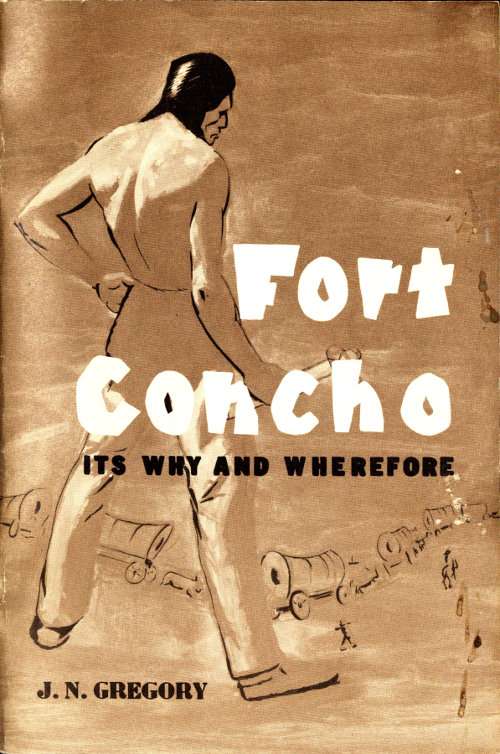
The Project Gutenberg eBook of Fort Concho: Its Why and Wherefore
Title: Fort Concho: Its Why and Wherefore
Author: James N. Gregory
Release date: April 7, 2017 [eBook #54497]
Most recently updated: October 23, 2024
Language: English
Credits: Produced by Stephen Hutcheson and the Online Distributed
Proofreading Team at http://www.pgdp.net
FORT CONCHO MUSEUM
San Angelo, Texas
A people who take no pride in the noble achievements of remote ancestry will never achieve anything worthy to be remembered with pride by remote descendants.—Macaulay
The Department of the Interior on October 7, 1961 designated this Fort as a National Historic Landmark.
Fort Concho
1867-1889
Fort Concho
ITS WHY AND WHEREFORE
J. N. Gregory
Cover by A. J. Redd
First Printing 1957
Second Printing 1962
Third Printing 1970
NEWSFOTO YEARBOOKS
San Angelo, Texas
Dedicated
to the pioneer
men and women
of our Southwest.
FOREWORD
Many people who visit the Fort Concho Museum and look over the parade ground and buildings of old Fort Concho, naturally ask the question, “Why did the United States Government build a fort in this place, and what did the fort accomplish?”
The object of this pamphlet is to answer that question, and to present the answer to the inquiring visitor at as small a cost as the printer makes possible.
Two maps of Texas will be found in the envelope at the back of the pamphlet. The smaller is a reproduction of one published in 1856, not too accurate from a geographic standpoint, but as accurate as the knowledge of the times allowed. The other map, accurate from the geographic point of view, endeavors to show the locations of some thirty-four forts and camps that were established and built by our War Department on the Texas Frontier during the Indian days.
The treaty of Guadalupe Hidalgo that brought to a close the war between the United States and Mexico, February 2, 1848, and the subsequent Gadsden Purchase of 1853, set the plan for the present boundaries between the two countries. A vast area of plains, deserts and mountains, an unmapped and untraveled wilderness was now owned by the Northern Republic. It was inhabited mostly by Comanche, Apache, Kiowa and other warlike Indian tribes, and it stretched from the settlements of South and East Texas, and from the lower Missouri River area to the new American settlements on the Pacific Coast.
Great events were in the making when in California in 1848, gold nuggets were found in the tailrace of Sutter’s Mill. The word passed around quickly, and the first modern international gold rush was on. It put the first sizeable amounts of precious metals into the coffers of the nations of the world since the Spanish Conquistadores ransacked the treasure houses of Peru and Mexico. It brought about modern mining practices, and before the end of the century, the search for gold was so international and intense that comparable strikes had been made in South Africa, Australia, Canada and Alaska, resulting in fresh redistribution of populations, not only in the United States but also in other portions of the world. The problems accompanying such redistribution were plentiful, and they are still plaguing us to this day.
But the lure that led men to our West was not gold alone. The El Dorado of man’s dreams, be it a gold vein, oil patch, store on Main Street, cattle ranch, or farm in Peaceful Valley, can very well lie in any new and unexplored lands. So it was then. Few men could afford for themselves, families and belongings the cost of passage by sailing ship, around the Horn or by portage at the Isthmus of Panama, from Boston, New York, Charleston, New Orleans, Galveston or Indianola, to San Francisco. Besides that, a fellow who was bent on making a trip liked to look over the country lying between home and his proposed destination. So, many found their El Dorado, not on the Pacific Coast but along the trails between the Great River and the Pacific Ocean.
The inhabitants of the crowded East and the folks of the South felt their race-old urge to get on the move towards more freedom and opportunity. Old windy Horace Greeley was soon to advise, “Go West, Young Man.” So go West they did, young and old, first by small companies on horseback or in buckboards, then later by trains of covered wagons which carried their families and all earthly possessions, grouped together for companionship as well as for protection against the Indians.
Population movements in the United States have generally gone from East to West in parallel lines, once the Atlantic seaboard was settled. And so this great gold movement from East to West brought settlement of the intermediate lands between the Mississippi River and the Pacific Ocean by the natural contrasting types of North-South peoples.
The great Oregon and Santa Fe Trails serviced the people of the more northerly parts of our country, but for those in the southern parts a newer trail had to be found and by simple geography it had to cross Texas. You could enter the State from the sea at Galveston, Indianola or Corpus Christi, or by way of the land through Fort Smith in Arkansas, thence across the Indian Territory to the Red River; or directly from Louisiana through the fairly well settled and organized counties of East Texas. But no matter how you entered, there was only one way to get out, and so all trails converged on the Paso del Norte (present El Paso). To get out of Texas south of El Paso would land you in Mexico. To get out north of El Paso would take you across the Llano Estacado which in those days was considered a vast treeless plain, unbroken by any topographic changes, and completely devoid of water holes.
The accompanying map, published in 1856 in Yoakum’s History of Texas, shows clearly the political subdivisions and settlements of Texas in those times. A substantial part of the State, from the Panhandle to the upper Rio Grande, appears to be completely uninhabited and, therefore, politically unorganized. In a vague manner, this vast area might be assumed to be an unannexed portion of the counties of Bexar, El Paso, Presidio and Travis. This map does not speak approvingly of the Llano Estacado. Staked Plains, some called it.
From 1848 on to the recent past, various trail drivers, army officers and railroaders laid out trails from the settled parts of Texas to the Paso del Norte, always taking advantage of springs and water holes and avoiding the Llano Estacado and the great limestone canyons of the Rio Grande and its tributaries. That is, all did but the builders of the Southern Pacific Railroad. They came later, but yet too early to have the know-how of an Arthur Edward Stilwell. But that is another story.
A North-South trade route had existed for some two hundred years connecting Spanish Santa Fe, far north toward the headwaters of the Rio Grande, south through the Paso del Norte to the settlements in the mother country of Mexico. The Santa Fe Trail extended to California, would cross this trade route at Santa Fe, well up in the Rocky Mountains, while the route through Texas would cross it at El Paso. And so these two places became the supply dumps where the great wagon trains took on horses, mules, beef and other supplies that would see them across the final leg of the journey west. It was a great opportunity for traders who had the supplies to sell, and the procuring middle man, the one who contacted both producer and merchant, was a man with great savvy and ability known as the Comanche Indian.
The Comanche despised walking; it was not adaptable to his method of making a living. He was a plains Indian, and somewhere back in the sixteenth or seventeenth century had somehow accumulated his first mustangs from offsprings of those horses lost by the Conquistadores from Spain. Prior to the arrival of the Spaniards in America, there were no horses, as we recognize them now, on either of the American continents. Now the Comanche as a mounted man probably roamed the great plains from present Wyoming to Durango, Mexico. It was easy to make a living on such a range. It abounded in buffalo; and the wise Comanche knew all the water holes. He drove the wily Apaches to the south until they crossed the Rio Grande and settled in a quasi-peaceful manner in Mexico, or later chose Arizona and New Mexico and preyed on the settlers, immigrants and prospectors.
From the records, the Comanche does not appear to have been a breeder of horses, cattle or sheep. But as a procurer of such livestock, he had no peer. Many years before Lewis and Clark were sent to evaluate the Northwestern part of the Louisiana Purchase lands that Mr. Jefferson had bought from Napoleon Bonaparte in 1803, the Comanche had learned to find his greatest pleasure and profit during his daring raids into the settlements of Mexico, raiding in great force as far south as the cities of Chihuahua and Durango.
The emotional inspiration for such forays on peaceful people was regarded as pure cussedness, but a more profound study shows that the trophies of such raids, excepting the scalps taken, were horses, cattle, sheep and slaves. Many of the stolen horses were for the Comanche’s personal use, because it took many animals to make the great raid during the Mexican Moon. The balance of the trophies was used for barter.
G. Catlin
Comanches Capturing Wild Horses
From “The North American Indians,” Vol. II, by George Catlin, London, 1841. The place: the Red River; the time: 1834.
Years before the purchase of 1803, he was trading his stolen stock, and possibly his slaves, to the French traders from the Spanish-French border near old Natchitoches (pronounced Nacotish) on the lower Red River. Or in later times, upon return from a successful raid, he roared out of Mexico and across the Rio Grande into Texas south of the Chisos Mountains. If short of war paint, he replenished his favorite red color from the outcroppings of cinnebar near Terlingua Creek, then headed through the badlands and out upon the range country by way of Persimmon Gap. From the Gap, he went to Comanche Springs (present Fort Stockton), crossed the Pecos River at Horsehead Crossing, then rode north to the Sand Dunes to water a famishing flock, after which he headed east to the Sulphur and the Big Spring. Then he turned northward around the Cap Rock that marks the eastern extremity of the terrible Llano Estacado, to proceed on north till he actually scrambled out upon that plateau. Then he proceeded towards Santa Fe to meet somewhere, possibly at Casas Amarillas, in that then desolate region, the Comancheros, or middle men between himself and the Mexican settlers of the upper Rio Grande Valley near Santa Fe.[1] He traded his trophies to the Comancheros for guns, ammunition or other less practical adjuncts that might suit his fancy of the moment. His Mexican Moon was then over and he returned to his portable village which he had left in some watered canyon that cut down eastward from the Llano Estacado.
The route as followed by these Indians was a well marked trail, and during the time of our westward migrations, it was well known and appears on the maps of the times. Another route into Mexico broke off the Western Trail at the Big Spring and ran down the valley of the North Concho River, across the Edwards Plateau, then through the passes of the Balcones Escarpment to cross the Rio Grande into Mexico near the present city of Eagle Pass. Mr. Evetts Haley refers to these trails as the Great Comanche War Trail, and gives a wonderful description of the activity on them in his recent book, Fort Concho and the Texas Frontier. An old map from the Army files in the National Archives calls the western branch the Grand Comanche War Trail. But call the trails what you may, they were still a stiff pain in the neck to anyone crossing them, and for the wagon trains and cattle herds going west, crossing was inevitable.
The greater raids into Mexico appear to have occurred rather regularly in September when the weather was most favorable, and the chief objectives could be struck during the light of a full moon. Thus, to the unhappy but fully expectant Mexicans, the September full moon was known as the Comanche Moon. At this time Mars, the red God of War, hangs low and molten in the late summer night’s sky and reflects a light that is as red as the sand and clay soils of the Indian Territory.
Another favorite trick of these versatile middle men was to raid the settlements down the Rio Grande Valley south from Santa Fe and drive off the stock to a rendezvous with the Comancheros, who in turn traded them to unknowing Mexican settlers at other points on the river. During such raids it was deemed ethical but unprofitable to kill the settlers, since without them there would be no stock to drive off in a later raid. Besides, these Mexican settlers did not seriously molest the buffalo.
Such business sagacity however, did not apply in later times to the Republic of Texas, where each succeeding year saw new settlers break ground and homestead farther up the river valleys, whose streams had their origins in the motherland plains of the Comanche and Kiowa.
After its establishment in 1836, the infant republic found itself fighting a hot war on two fronts. The settlers near the Rio Grande, from Del Rio to the mouth of that river near Brownsville, suffered from raids out of Mexico by both Mexicans and Indians, while the northern prongs of the new settlements were exposed to the Comanches and Kiowas. It was a bitter struggle, fought generally in small isolated settlements where the determined Anglo-Saxon fought for his new home against an equally determined Indian fighting to preserve his ancient homeland and range. A Saxon’s scalp decorating a Comanche’s war shield might be avenged by an Indian’s entire skin decorating a rude barn door.
Matters were better controlled after the annexation of Texas by the United States and after the close of the Mexican War. But it took manpower and supplies to do it, something the new republic had been slow in acquiring. The treaty of Guadalupe Hidalgo provided, among other things, that the United States would make every effort to keep the Indians from raiding into Mexico; so in about 1849, the United States Army, mostly cavalry and mounted infantrymen (Dragoons), moved into Texas. They proceeded to establish a string of forts and camps from previously established Brown near the mouth of the Rio Grande to Duncan near Eagle Pass. For the upper Rio Grande in Texas, they set up what was later to be Fort Bliss (El Paso). As a northern line of defense for the settlers, they established, starting with Fort Duncan, the forts of Lincoln (D’Hanis), Martin Scott (Fredericksburg), Croghan (Burnet), Gates (Gatesville), Graham (Hillsboro) and Worth (Fort Worth). Only a few of the forts were ever protected by stockades. The war was one of movement. The places were supposed to be strategically located and manned by several companies of cavalry and some infantry; places from where punitive expeditions could set out, establish supply bases, then try to run down the Indian raiders.
The standing army of the United States during the 1850’s was numbered at about fifteen thousand men and the personnel of the Texas forts accounted for about from one-fifth to one-third of that number. Many of the officers and men were veterans of the Mexican War, the forts usually being named in honor of American soldiers who lost their lives in that war. Many Civil War leaders, both Confederate and Union, received much field training from 1849 to the outbreak of that war in 1861, building and manning the forts, chasing, but seldom catching, the Indians, guarding the wagon trains and mail bags and exploring the wilderness for better trails and water holes.
There is a record, one of many left by the famous Captain Jack Hays of the Texas Rangers. It tells how he was hired by certain merchants of San Antonio who were anxious to trade with the merchants of Chihuahua, Mexico. His assignment was to find in 1848, a route from San Antonio to privately owned Fort Leaton where the Conchos River of Mexico meets the Rio Grande, and from which point to Chihuahua the going would be reasonably good. Hays and his mounted company of frontiersmen managed to make it to Leaton and back to San Antonio, but they found the going so rough that the journey took them three and one-half months. (Present Southern Pacific Railway west to Alpine). There were too many deep canyons along the tributaries of the Rio Grande.
The decade following 1849 was most active. The army detachments under capable officers explored to find routes from East Texas and from San Antonio to El Paso. But the wagon trains did not wait for their findings; they often made their own way and did their well-known creditable job. Mr. Jefferson Davis, Secretary of War, and himself a distinguished veteran of the Mexican War, did about all in his power to aid the new state of Texas, the Mexican settlements and the immigrant trains. He made treaties with the Indians and arranged reservations for them. This latter deal was not too successful. Friendly East Texas Indians almost starved on the reservations, and the more warlike plains tribes had no idea of staying there even when they agreed to move in. The old men’s tales of conquest and horse stealing were more than the young bucks could take.
Mr. Davis built new forts and, recognizing the great problems of communications that existed between such far flung positions, sought to remedy those by importing in 1856, through the seaport of Indianola, camels and their Arabian drivers.
G. Catlin
Comanche Village
From “The North American Indians,” Vol. II. by George Catlin, London 1841. Picture by Catlin, 1834, escorted by General
Henry Leavenworth and regiment of U.S. Dragoons.
The camels were concentrated at Camp Verde in Southern Kerr County, and breeding and testing immediately proceeded at a good pace. Tests for their strength and endurance carried the caravans across the Continental Divide and back, and the results were very gratifying. The Civil War put an end to the experiments. The last camel herd, before final sellouts to the carnivals, was privately owned near Austin in the early 1880’s.
By the time the Civil War broke out in 1861, the War Department had finally followed the advice of such able soldiers as Joe Johnston and Chase Whiting. The forts received a new alignment and were manned mostly by cavalry. Supplies were sent in as before, from bases like San Antonio. The wagons, pulled by oxen or mules, were well guarded in most instances by soldiers. The contracts for furnishing the supplies and their transportation were let to civilians.
The new alignment caused the abandonment of some interior forts and camps. The line on the lower Rio Grande was extended up the river by building Fort Hudson near the Devil’s River, about thirty miles north of San Felipe. Out in far Western Texas, they built Fort Quitman, down the river from El Paso.
Several things were done to discourage the Comanche and Kiowa whose depredations along the Grand War Trail had been greatly stepped up. The War Department flanked the trail on the west by the building of a sizeable establishment in a beautiful and romantic spot in the Davis Mountains and named it Fort Davis in honor of the secretary. Near this spot, more than three hundred years before, had passed the shipwrecked, unhorsed and enslaved, but still valiant Spaniard, Cabeza de Vaca. He would later write, in his report to his Viceroy describing his journey after leaving the great arid plains to the north, of a valley through which flowed “limpid waters.”[2]
After Fort Davis, the Department unveiled Fort Lancaster (western Crockett County) as a flanker to the east of the trail. It was cozily situated in the mesas not far from the Pecos River and beside Live Oak Creek that flows delightful spring water.
Then the War Department built Fort Stockton (Pecos County), smack in the middle of the Grand Trail and right beside the best spring of water on its entire route.
Now to further protect immigrants and mail bags on the route west and to protect settlers of central and northern Texas who were still moving higher up the river valleys, it set up Fort Chadbourne as a pivot between the new western line and the new lower Rio Grande Valley line. From Fort Chadbourne on northeasterly to the Indian Territory were Forts Phantom Hill (Abilene) and Belknap (New Castle). But Chadbourne was a near miss, because it was not well located and its water supply was not adequate. However, not until the Civil War was over was it finally abandoned in 1867 and a new site chosen for its replacement at the confluence of the North, South and Middle Concho Rivers. This new position would be called Fort Concho, and here eventually would be built the city of San Angelo.
As the decade preceding the outbreak of the Civil War was closing, the great wagon trails from San Antonio and East Texas to El Paso must have been a sight to behold. Most of them converged on Castle Gap and the Horsehead Crossing of the Pecos River, from where they had a choice of two routes to El Paso. The California Overland Mail (Butterfield Overland Mail), 2,795 miles from St. Louis to San Francisco, entered Texas by way of Fort Smith, Arkansas, followed the line of forts southwesterly to the middle Concho River then turned westerly up that valley, then through Castle Gap to Horsehead Crossing. From here the early route followed up the Pecos River to Pope’s Crossing near the present Red Bluff Reservoir, thence westward to El Paso, by way of Delaware Creek and the Hueco Tanks. A more southerly route from Horsehead Crossing was probably a better choice. It went from the Crossing direct to Fort Stockton, Leon Springs, Toyahvale, Fort Davis, thence to Van Horn’s well and El Paso. It also had the advantage of servicing the westerly line of forts.
The original run over this new mail trail to California was made in 1858 and the New York Herald sent a special news correspondent, one W. L. Ormsby, to be a through passenger on the mule-drawn coach so that he could report the trip. The poor fellow was only twenty-three years old, but age being in his favor, he lived through it all. His description of the trail from between the upper water holes of the Middle Concho River (near present Stiles) to Castle Gap and the Horsehead Crossing is most illuminating.
“Strewn along the load, and far as the eye could reach along the plain—decayed and decaying animals, the bones of cattle and sometimes of men (the hide drying on the skin in the arid atmosphere), all told a fearful story of anguish and terrific death from the pangs of thirst. For miles and miles these bones strew the plain....”
It appears from this on the spot observation, that the trails across level plains country were very wide. The wagon trains did not move in single file. That would expose them too much to Indian attacks, and besides, the longer the line, the worse the dust. The old wagon wheel ruts, still noticeable to this day along the route described above by Ormsby, cover a wide area on the plains east of Castle Gap, before they converge at that narrow pass. These can be seen west of the China Ponds where they move westerly about three miles south of the land grants known as the alphabet blocks, given later by the State of Texas to the Corpus Christi, San Diego and Rio Grande Narrow Gauge Rail Road. (Try painting that one on a narrow gauge box car!)
During 1858 and 1859, Captain Earl Van Dorn, soon to be a member of the Confederate High Command, vigorously carried the war to the Indians and pushed them north, back across the Red River. They didn’t remain there long. Texas seceded from the Union in 1861 and the Federal soldiers marched out of the forts and left them to the Confederate forces. Again the proper manpower was lacking. Some forts were abandoned so as to shorten the defense line and some of these, as at Lancaster, were burned by the Indians. The Indians, now spurred on by Union agents, carried on a still more bloody and aggressive warfare on the Texas frontier. Confederates, and Ranger Companies, coupled with frontiersmen reacted promptly and vigorously, but it was a long line of defense from the Red River to the Rio Grande. Defend it they did, against the Indians, and against lawless elements such as deserters and others renegades, hostile Union sympathizers and border ruffians from without the state.
The Negro slave was emancipated by proclamation in Texas on June 19, 1865 (June’teenth), about two months after General Lee surrendered the Army of Northern Virginia at Appomattox Court House.[3] The last land battle of the Civil War was fought on May 13, 1865, in Cameron County, Texas when invading Federal forces were routed near Brownsville. That engagement is known as the Battle of Palmito Ranch.
From the end of the war until 1867, the frontier settlements had no organized military forces to protect them from the Indians, and it was against the law for Texans to carry guns. Added to this were the turmoils of Reconstruction which were about as bitter in the populated parts of the state as they were in other parts of the South.
The occupying United States Army under General Phil Sheridan was now mostly recruited from among the Negroes, and the army was not used against the Indians until 1867, when orders went out to get busy and put the forts and camps in order.[4] General Sheridan’s name was about as popular in Virginia and Texas as General W. T. Sherman’s was in Georgia and Mississippi.
Action West of Horsehead Crossing.
(Castle Gap is at the upper left.)
But both Sherman and Sheridan came to Texas, and Sherman, after narrowly escaping the loss of his scalp on the Texas frontier, finally realized the necessity of a last organized military effort to either rid the country of the Indians or give it back to them. That was in 1871. However, in 1869, a new alignment of the forts had been seen as necessary. Never again reoccupied were certain of the interior ones such as Worth, Graham, Gates, Croghan, Martin Scott, Lincoln, Chadbourne and Ewell (La Salle County). Fort Belknap, on the Salt Fork of the Brazos River in Young County, had been the largest military post in North Texas prior to the Civil War. In 1867, the 6th Cavalry was ordered to prepare it for reoccupation. They worked for five months, but then this fort was ordered evacuated and its place was taken by a new one, Fort Griffin, some thirty-seven miles up the Clear Fork of the Brazos from Belknap.
Now to extend the northeasterly trending line of forts closer to the Indian Territory, the Army built Fort Richardson near the present town of Jacksboro.
The site chosen as the replacement for Fort Chadbourne, to be called Fort Concho, was at the confluence of the North Concho River with the combined waters of the Middle Concho, Spring Creek, Dove Creek and the South Concho, the last three named streams being fed by bountiful springs. This abundance of water and the geographically central location marked the spot as the natural convergence of trails from East, Northeast and South Texas before they headed westward for Horsehead Crossing and El Paso. Nature had been kind to this oasis in an otherwise desolate region. The fishing was extremely good and the clear waters of the streams supported mussels, the variety that produces gem pearls, hence the Spanish name of Concho. Herds of buffalo grazed within sight of the new fort. Quail and turkey were plentiful.
These three new positions, Concho, Griffin and Richardson, located on a line 220 miles long, as yet unconnected by either telegraph or rail, would soon be the centers of men, supplies and animals for the campaigns that finally broke the concerted powers of the Indians. These campaigns carried the soldiers from the Indian Territory and the New Mexico Territory on the North, to the actual interior of Old Mexico on the South.
From the times in 1866 and 1867 when Richardson and Concho were ordered built until 1871, the troops undertook no organized campaigns against the Indians. The settlers suffered constantly and the Indians learned new tricks. Many more learned how to live off government bounty on the reservations in Indian Territory, then hit the war path along with their wild brethren from the Texas Panhandle. They were amply protected on their return to the reservations by the Indian agents in charge, who believed their wards could do no wrong. Why, they would ask, would an Indian steal cattle when he had all the buffalo meat he wanted?
A cavalry expedition out of Fort Concho working the edges of the Llano Estacado in 1872, captured a Comanchero who told how he and his companions traded the Indian arms, ammunition and supplies for cattle, horses and sheep that they had stolen during their raids. He even showed the soldiers the well worn trails across the Llano Estacado towards Santa Fe and the valley of the Rio Grande. Thus the secret was finally revealed to the Army. It seems unbelievable at this time that such ignorance could prevail over the cries and protests of the Texas ranchmen who were losing cattle by the tens of thousands.[5] But such was the case, and in 1867, the Comanches even stole horses from the post herd at Fort Concho. We must remember that in that same year the mild policies of President Andrew Johnson in Washington were overruled by the radicals in the United States Congress, and the bitter years of reconstruction followed for the Southern States. All former Confederate soldiers were deprived of the vote, and radicals, carpetbaggers, scalawags from the South and freed Negroes ruled the State. The Army was used, not to fight Indians, but to guard the new social system.
The prospect appeared brighter for the settlers when in the Fall of 1869, one hundred soldiers from Fort Concho managed to engage an Indian force on the Salt Fork of the Brazos River. It was a drawn fight, but immediately thereafter a larger force from the same fort engaged and defeated the Indians in the same area. Texans were cheered by the news of this new tone of aggressiveness shown by the Army. It was the only way. The war had to be carried to the Indians the same way Earl Van Dorn had carried the fight to them on the eve of the Civil War.
But the time for real action had not arrived even as late as 1869. On February 18, 1870, a citizen was killed and scalped within one-quarter of a mile of the post limits at Fort Concho. In January of the same year, eighteen mules were stolen from the Q.M. corral at that same post. The same year, 1870, while Colonel Grierson was building Fort Sill in the Indian Territory, Chief Kicking Bird, a Kiowa, defeated the Command of Captain C. B. McClellan near the present town of Seymour. As late as March of 1872, a wagon train was waylaid near Grierson Springs in Reagan County and the teamsters killed by the Indians. Two companies of the 9th Cavalry came upon the scene by accident, engaged the Indians but withdrew before a decision was reached.[6]
The lamentations of the border people were finally heard in Washington and in April, 1871, General W. T. Sherman came to San Antonio. The next month, accompanied by General Randolph B. Marcy and an escort of seventeen men, he left for an inspection of the frontier. General Marcy was the same officer (then, Captain Marcy) who, in 1849 and later, had played such an important part in exploring and reporting to Congress on trails through Texas. The great explorer was still an outdoor man of action.
The little expedition proceeded by way of Boerne, Fredericksburg, the old Spanish Fort on the San Saba which had withstood a great Comanche Indian siege in 1758, Fort McKavett, Kickapoo Springs and Fort Concho. From Fort Concho it followed the military trail on northeasterly by the remains of Fort Chadbourne and Phantom Hill and on towards Belknap.
General Marcy’s journal is of great interest. He relates:
“We crossed immense herds of cattle today, which are allowed to run wild upon the prairies, and they multiply very rapidly. The only attention the owners give them is to brand the calves and occasionally go out to see where they range. The remains of several ranches were observed, the occupants of which have either been killed or driven off to the more dense settlements, by the Indians. Indeed, this rich and beautiful section does not contain, today (May 17, 1871), as many white people as it did when I visited it eighteen years ago, and if the Indian marauders are not punished, the whole country seems to be in a fair way of being totally depopulated.” He continues:
“May 18th, 1871—This morning five teamsters, who, with seven others, had been with a mule wagon train en route to Fort Griffin (Captain Henry Warren’s) with corn for the post, were attacked on the open prairie, about ten miles east of Salt Creek, by 100 Indians, and seven of the teamsters were killed and one wounded. General Sherman immediately ordered Colonel Mackenzie to take a force of 150 cavalry, with thirty days’ rations on pack mules, and pursue and chastise the marauders.”
An interesting angle to this affair was that Sherman’s party had been observed by the same Indians who murdered the teamsters, but were unmolested by them because they were waiting for the wagon train which they considered nearer top priority. Sherman realized later that he had nearly lost his scalp.[7]
This Colonel Mackenzie had reported in at Fort Concho as commanding officer on September 6, 1869. Born in New York, July 27, 1840, and christened RANALD SLIDELL, he had graduated first in his class at West Point in 1862. He served in the Union Army during the Civil War, received several wounds in action, and was a brigadier general when that war closed. The remainder of his professional life was devoted to active high command in the Indian wars. At various times he served at Forts Brown, Clark, McKavett, Concho and Richardson, engaging in his last Indian fight at Willow Creek, Wyoming in 1876. He was retired from the Army for disability in 1884 and died a bachelor at New Brighton, New York in 1889.
Along with Mackenzie, Colonel William Rufus Shafter who arrived to command at Fort Concho in January, 1870, the War Department had its two best young officers serving in the West Texas theatre.
Shafter had no West Point training. Born in Michigan on October 16, 1835, he entered the Union Army in the Civil War as a first lieutenant and by the end of that war had been breveted brigadier general of volunteers. He was later awarded The Congressional Medal of Honor for service during that war. He was commissioned lieutenant colonel of regulars in 1869 and first saw service in West Texas with the 24th Infantry at Fort McKavett. Later in life he was to command the American armies in Cuba during the Spanish American War.
During the summer of 1871, while commanding forces at Fort Davis, he set out with cavalry from both Forts Davis and Stockton and pursued a large raiding party of Indians from the Fort Davis area northeasterly until the trail moved into the great sand dune country near where the city of Monahans now stands. He spent fourteen days in this pursuit but as was usual in such matters, could never force an engagement. However, he learned that the heretofore dreaded sand dunes contained fresh water a few feet below the surface in several places, and that the area was a great refuge for Indians and was one of those rendezvous where horse-and-cattle stealing Indians met the Comanchero traders from New Mexico.
The command at Fort Concho, as at the other forts, rotated in a perpetual manner. After service elsewhere, Mackenzie returned to Concho to organize five companies of the 4th Cavalry and a headquarters company for service at Fort Richardson, nearer the Indian Territory. His column moved out March 27, 1871, cavalry, pack mules and wagons. The bachelor commander even allowed wives of the men to accompany the expedition as far as the new headquarters at Fort Richardson.
The weather was crisp and cold as they forded the North Concho and soon passed Mt. Margaret, named after “the most accomplished, loving and devoted wife of one of our favorite captains, E. B. Beaumont”—(Beaumont-Beautiful Mountain), so wrote Captain Robert G. Carter, historian and winner of The Congressional Medal of Honor in the Indian Wars, who was a member of the expedition. (Mt. Margaret is the outstanding hill at Tennison.) They pitched camp the first night at old Fort Chadbourne, from where they followed the military trail passing en route huge herds of buffalo, as they went on by old Forts Phantom Hill, Belknap and on into Richardson.
Two months later, in May, Colonel Mackenzie roused his 4th Cavalry at Fort Richardson and set out to obey General Sherman’s orders issued after the killing of the teamsters at Salt Creek. But it began to rain. After a futile chase Colonel Mackenzie headed for Fort Sill, commanded by Colonel Benjamin H. Grierson. There he learned that Sherman had left but not before the Chiefs Satank (Sitting Bear), Big Tree and Satanta (White Bear) had returned to the reservation at Sill and boasted of murdering the teamsters. Mackenzie arrested and escorted the three Indians to Jacksboro for trial in the Texas court. Satank purposely got himself killed by a guard on the march, but Satanta and Big Tree were later sentenced to prison in the state penitentiary at Huntsville. The duplicity of these reservation Indians should now have been apparent to even Grierson and the Indian lovers in Washington and Austin, but it was not.
A good insight into the Indian problem of the times, and of which we have a written record, appeared at the trial of the two Indian chiefs during July of 1871 in the little log courthouse on the public square of Jacksboro. Charles Soward was the presiding judge. Samuel W. T. Lanham, later to be a two term Governor of Texas, was the district attorney. The court appointed Thomas Fall and Joe Woolfork of the Weatherford Bar to represent the defendants.
Thomas Williams, the foreman of the Jury, was a frontier citizen and a brother of the Governor of Indiana.
The principal witnesses against the defendants were Colonel Mackenzie, Lawrie (or Lowerie) Tatum, the Indian Agent who had heard their statements at Fort Sill and Thomas Brazeal, the teamster who had escaped from the Salt Creek massacre.
Our Captain Carter wrote:
“Under a strong guard accompanied by his counsel and an interpreter, the Chief, clanking his chain, walked to the little log courthouse on the public square. The jury had been impaneled and the District Attorney bustled and flourished around. The whole country armed to the teeth crowded the courthouse and stood outside listening through the open windows. The Chief’s attorneys made a plea for him, and referred to the wrongs the red man had suffered. How he had been cheated and dispoiled of his lands and driven westward until it seemed there was no limit to the greed of the white man. They excused his crime as just retaliation for centuries of wrong. The jurors sat on long benches, each in his shirt sleeves and with shooting irons strapped to his hip.”
Satanta got up to defend himself before his accusers. Over six feet tall, the perfect figure of an athlete and well known as the orator of the plains who could sway councils of both whites and Indians, he could well have influenced the jury by mute silence, but instead he lied and dissembled to save his life. He never mentioned the wrongs done his people by the whites. Instead, speaking through the interpreter, he proceeded as follows:
... “I have never been so near the Tehannas (Texans) before. I look around me and see your braves, squaws and papooses, and I have said in my heart, if I ever get back to my people, I will never make war upon you. I have always been the friend of the white man, ever since I was so high (indicating by sign the height of a boy). My tribe have taunted me and called me a squaw because I have been the friend of the Tehannas. I am suffering now for the crimes of bad Indians—of Satank and Lone Wolf and Kicking Bird and Big Bow and Fast Bear and Eagle Heart, and if you will let me go, I will kill the three latter with my own hand....”
The evidence against the two Chiefs was debated by the jury and both were sentenced to death. This sentence was later commuted to life imprisonment.
Now, a few statements from the court record as to what the District Attorney had to say point to some of the misunderstandings of the times when it came to the Indian problems on the western frontiers.
The following excerpts from his plea before the court show clearly, not only the feelings of the frontiersmen towards the uncontrolled Indians, but also the contempt in which they, both frontiersmen and Indians, held the people who by appeasement, crookedness and ignorance tried to manage the Indian affairs of the nation from a far away city:
“Satanta, the veteran council chief of the Kiowas—the orator—the diplomat—the counselor of his tribe—the pulse of his race; Big Tree, the young war chief, who leads in the thickest of the fight, and follows no one in the chase—the mighty warrior, with the speed of the deer and the eye of the eagle, are before this bar in the charge of the law! So they would be described by Indian admirers, who live in more secured and favored lands, remote from the frontier—where ‘distance lends enchantment’ to the imagination—where the story of Pocohantas and the speech of Logan, the Mingo, are read, and the dread sound of the warwhoop is not heard. We who see them today, disrobed of all their fancied graces exposed in the light of reality, behold them through far different lenses. We recognize in Satanta the arch fiend of treachery and blood, the cunning Cataline—the promoter of strife—the breaker of treaties signed by his own hand—the inciter of his fellows to rapine and murder, as well as the most canting and double-tongued hypocrite where detected and overcome! In Big Tree, we perceive the tiger-demon who tasted blood and loved it as his own food—who stops at no crime how black soever—who is swift at every species of ferocity and pities not at any sight of agony or death—he can scalp, burn, torture, mangle and deface his victims, with all the superlatives of cruelty, and have no feeling of sympathy or remorse. We look in vain to see, in them, anything to be admired or even endured. Powerful legislative influences have been brought to bear to procure for them annuities, reservations and supplies. Federal munificence has fostered and nourished them, fed and clothed them; from their strongholds of protection they have come down upon us ‘like wolves on the fold’; treaties have been solemnly made with them, wherein they have been considered with all the formalities of quasi nationalities; immense financial ‘rings’ have had their origin in, and draw their vitality from, the ‘Indian question’; unblushing corruption has stalked abroad, created and kept alive through