
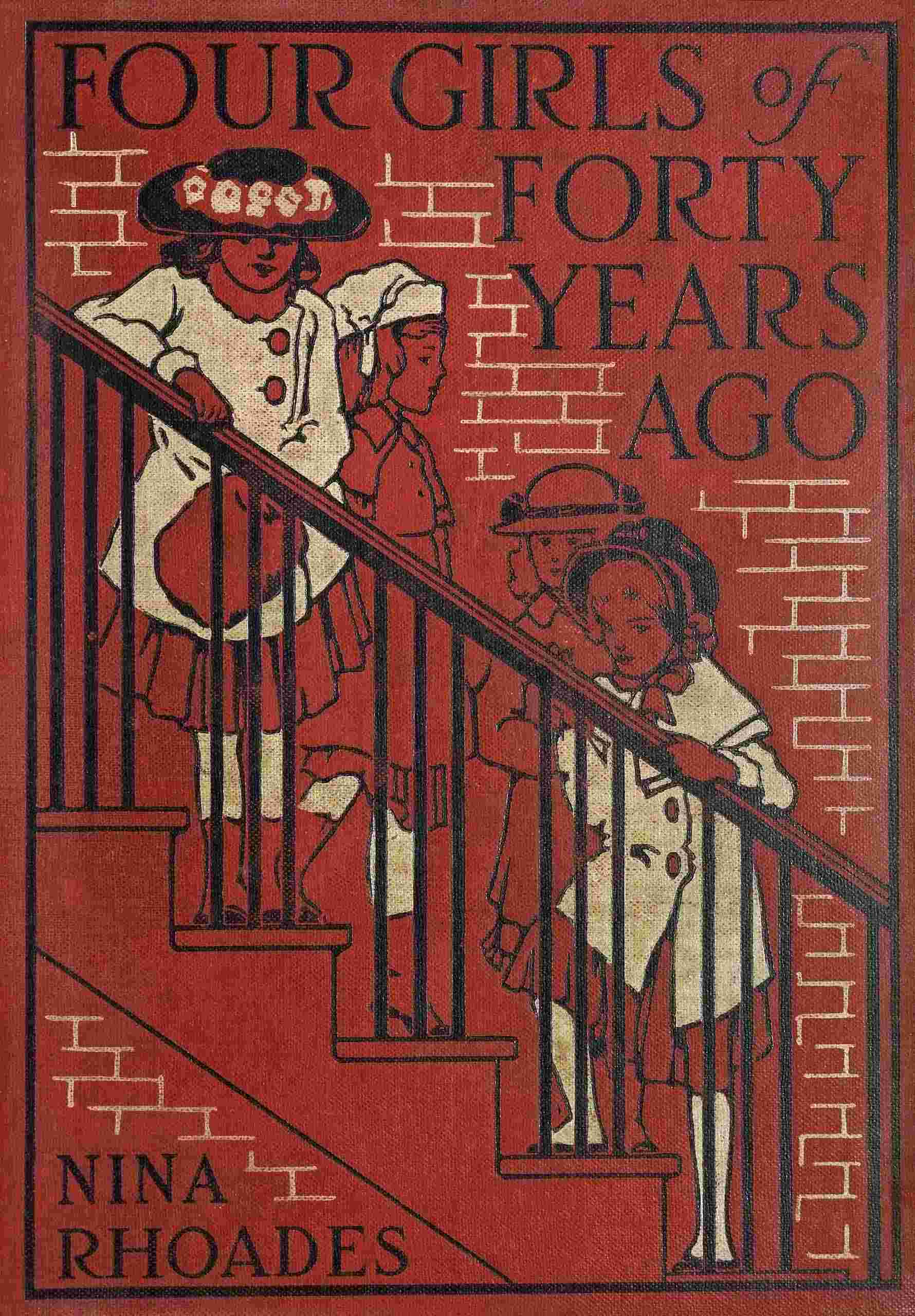
Four Girls of Forty Years Ago
CHAPTER I
THE FOUR LITTLE WINSLOWS
THEY all lived in the big front room on the top floor of Grandpa Winslow’s old-fashioned house near Washington Square. They had lived there for so long that Molly and Maud—who were only nine and seven—could not remember ever having lived anywhere else. But Dulcie—who was nearly twelve—and Daisy—who was ten and a half—had dim memories of a very different home—a home that was always bright and happy, and in which the grim figures of Grandma Winslow and her daughter, Aunt Kate, played no part.
It was more than five years since their father had brought his four little motherless girls from the Western town where they were born, to the stately, gloomy old house near Washington Square. It had seemed to Mr. Winslow the wisest thing to do, for he was young and inexperienced, and the death of his pretty young wife had almost broken his heart. With the exception of his father, who was very old and infirm, and his stepmother, whom he had never loved very much, he had no near relatives, and so when his father had written in his trembling old hand, offering a home to him and his four little girls, he had accepted the offer, and they had left the Western home, where they had been so happy, and taken the long journey to New York, accompanied by Lizzie, the faithful servant, who had formerly been maid-of-all-work, but now acted as the children’s nurse.
That was five years ago, and many things had happened since then. In the first place, their father had been in China for more than a year. Young Jim Winslow, as every one called him, had not found it easy to make a living in New York, and he had ended by accepting the offer of a friend in China, who promised him a good position in his business. And one sad day, he had kissed his little girls good-bye and gone away. How they had all cried, for though Papa tried to be very cheerful, they felt quite sure that this going away was different from any other.
“When Papa went to The Centennial in Philadelphia, he only stayed away a week,” Daisy had reminded them, with a great effort to be cheerful, “and he brought us all home something. I suppose China is a great deal farther away than Philadelphia.”
“Of course it is,” said Dulcie, with difficulty suppressing a sob; “it’s away the other side of the world. But he says we must all be good till he comes back, so we’ll have to try very hard.”
“We’ve got Lizzie, anyhow,” chimed in Molly. “She won’t ever go away; she promised Papa she wouldn’t leave us till he came back.”
That was a comforting thought, and as Lizzie had come into the nursery at that moment, they had all run to her, and she soon had Molly and Maud in her lap, while Dulcie and Daisy sat on the arms of her chair, for next to their father, they all loved Lizzie better than any one in the world.
But alas! When Lizzie had promised not to leave the children, she had not counted on her temper. She loved the little girls dearly, but she had never learned to control her quick temper, and in less than a month from the day of Mr. Winslow’s departure, she had been dismissed by Grandma for having used what that lady called “outrageously impertinent language.” That was a dreadful day for the children, even more dreadful than the one on which their father left for China. Their father had occasionally left them for a short time before, but never, never since their mother’s death, had Lizzie been absent for a single night.
“Who’ll put us to bed?” wailed Maud, “and give us our baths, and hear us say our prayers? Oh! oh! I want to go away with Lizzie. I don’t want to stay here any more—I don’t, I don’t!”
“Hush, Maudie, don’t cry so,” soothed Dulcie, who was crying herself. “I’ll hear your prayers. I’m ’most twelve, so I guess it will be all right, and Daisy and I can take our own baths, so I guess we can teach you and Molly to do it, too. But, oh, Lizzie, Lizzie, I do want you so much!” And poor Dulcie broke down utterly, and sobbed as if her heart would break.
The next important event was Grandpa’s death. This, though sad, was not the heart-break to the children that Lizzie’s departure had been. Grandpa was very feeble, and for several years had taken small notice of them, except to nod and smile kindly at them, when they came into his room, and ask them their names, which he never seemed able to remember from one day to another. Lizzie had once told them that Grandpa was losing his mind, and that they must always be very kind and polite to him, and they had looked upon the old gentleman with a kind of awe, which had been greatly increased when, one morning, Mary, the chambermaid, had come into the nursery to tell them in a whisper that “their dear grandpa” had died suddenly during the night.
But all these things had happened nearly a year before the rainy January afternoon on which this story begins. It had been a very stormy day, and as Miss Hammond, the prim daily governess, who came for three hours every morning, was laid up with a bad cold, there had not even been lessons to break the monotony, and time had hung rather heavily on the children’s hands. Even the usual diversion of luncheon with their elders had been denied them, for Aunt Kate had given a luncheon party, and, according to the Winslow code, little girls were expected to keep out of the way on all such occasions. So Mary had brought them each a bowl of bread and milk, that being less trouble than anything else, and although bread and milk is nourishing, it is not what Dulcie called “exciting,” and by four o’clock they were all feeling decidedly bored, and more than a little hungry.
Dulcie had read till her eyes ached; Daisy had completed a whole spring outfit for Maud’s doll, and Molly and Maud had played so many games of lotto that Molly declared crossly she was sure she could play lotto in her sleep.
“If only it didn’t pour so, I’d go round to the library for another book,” remarked Dulcie, with a yawn.
Dulcie cared more about reading than about almost anything else in the world. She read everything she could lay her hands on, and when her father went away to China, he had given her a ticket to the circulating library, which was only three blocks away.
“I wish things happened to real people the way they do to people in books,” said Molly. “If we were in a book, something interesting would be sure to happen to us this afternoon. We’ve been in the house all day, and only had bread and milk for lunch.”
“Something rather interesting is going to happen now,” said Daisy, who had been looking out of the window for the past five minutes. “The Van Arsdales across the street are going to have a party. There’s an awning, and the ice-cream wagon has just stopped there. We can watch the carriages come, and if they happen to leave one of the parlor shades up, the way they did that other time, we can see them dance.”
Mollie and Maud looked interested, but Dulcie sighed.
“I don’t see much fun in watching a party you can’t go to yourself,” she said, discontentedly. “If Grandma would only let us know some of the neighbors, we might be invited to places sometimes. I wonder how it would feel to have a party.”
“I don’t think I should like it much,” said Daisy. “Things might go wrong, and that would be so embarrassing. You remember the time those Leroy children came to see us, and Grandma called out we were making too much noise. I think I’d rather go to other people’s parties, especially while we have to live with Grandma and Aunt Kate.”
Dulcie sighed again.
“If only Papa would come home,” she said. “Things weren’t half so bad when he was here.”
“He is coming home next year,” put in Daisy, cheerfully. Daisy always looked on the bright side of things. “You know what he said in his last letter, about our all having a nice little home together. Perhaps Lizzie will come back then, too. Wouldn’t that be lovely?”
“Mary told the butcher-man that Lizzie is going to be married,” announced Maud. “I heard her yesterday when I was in the kitchen, playing with the kitty.”
“I don’t believe it,” declared Molly, indignantly. “Lizzie never told Mary things; she said she was an old gossip.”
“Well, Mary said it, anyhow,” persisted Maud. “She told the butcher-man, and he said——”
“Oh, children, don’t argue,” interrupted peace-loving Daisy. “Come here and watch for the party. I guess the carriages will begin to come pretty soon.”
“They had ice-cream for lunch down-stairs,” exclaimed Molly, with a sudden recollection. “I wonder if there’s any left!”
“If there were we wouldn’t get any,” said Dulcie. “Mary and Bridget would be sure to eat it all up.”
“If Grandma were like a grandmother in a book, she’d see that we had ice-cream, and lots of other nice things,” remarked Molly, reflectively. “Book grandmothers are always so nice. I wonder why real ones aren’t?”
“I guess real ones are, too,” said Daisy. “That’s just the trouble with us. Grandma isn’t our real grandmother; she’s only a step, and steps are never any good. Even Aunt Kate isn’t our real aunt, because Grandpa was only her stepfather.”
“Steps are pretty bad,” remarked Dulcie, “but the worst of all is a stepmother, and, thank goodness, we haven’t got that. If I thought we were ever going to have a stepmother, I’d—I’d do something awful.”
“What would you do?” inquired Molly, eagerly.
“I don’t know, I haven’t made up my mind yet, but I’ve often thought about it. I’m sure it won’t happen, though; Papa is much too kind to do anything so dreadful, but if it did, well—don’t let’s talk about it.” Dulcie’s dark little face had grown suddenly very stern and determined, and her sisters regarded her with something like awe. Although only a little more than a year older than Daisy, Dulcie had always been looked up to by the younger children as a superior being. In the first place, she was the only one of them who could remember Mamma, and then she was so very clever. Dulcie always knew her lessons, and moreover, she really liked to study. Even Miss Hammond, strictest of teachers, never had any complaints to make against Dulcie; and Daisy had once overheard Aunt Kate telling a visitor that “the eldest child was really remarkably bright, and took after her dear grandfather.” Now, the children all knew that Grandpa Winslow had been a great man in his day, and to hear that one of them was supposed to resemble him was a most wonderful compliment, especially from Aunt Kate, who seldom said pleasant things about any one. So perhaps Dulcie may be pardoned for being a trifle conceited, and conscious of her own importance.
“Here comes the first carriage,” announced Daisy, from her post at the window.
All the others hurried to get a glimpse of the first arrivals at the party. The carriage door was opened by a man in livery, and several figures were hustled up the Van Arsdales’ front steps, under the awning. Another and another carriage followed, and the next ten minutes were—according to Daisy—“really quite exciting.” But watching the arrival of guests at a party to which one has not been invited, is not, after all, a very thrilling amusement, and by the time the sixth carriage had deposited its freight, and rolled away, even Daisy’s enthusiasm had begun to cool.
“How hard it rains,” said Molly, flattening her nose against the window-pane. “I wonder if the stolen child is out in all this storm.”
“Of course she is,” said Dulcie in a tone of conviction. “She’s been out all day with her basket, and she’s wet through and so cold and hungry. But her basket isn’t full yet, and she doesn’t dare go home, for fear that dreadful woman will beat her.”
Dulcie gave a little shiver, and glanced from the window back to the warm, comfortable room.
“It’s terribly sad,” said Daisy, with a sigh. “I do wish we could help her find her family. If we could only get acquainted with her, we might be able to find out how she was stolen. They always remember something, you know, even if it’s happened when they were very little.”
“Let’s make up some more about her,” said Molly. “Come and sit close to the register, it’s so nice and warm. It’s nicer to talk about things like that when you’re very comfortable.”
“All right,” agreed Dulcie, and they all four gathered round the register, where the hot air from the furnace puffed in their faces.
“You begin, Dulcie,” commanded Daisy. “You make up so much better than we do. Tell what’s going to happen when she gets home to-night.”
“Well,” began Dulcie, her eyes growing big and dreamy, as they always did when she “made up things.” “It will be quite dark before she dares to go home, and she will be so tired that she can hardly drag herself up the long flight of stairs, to that dirty garret. There won’t be any fire because the wicked old woman will be drunk again. She’ll be asleep on a pile of rags, snoring very loud, and the stolen child will be afraid to wake her. So she’ll put down her basket, and creep away into a corner, and sit there shivering, and trying to keep her teeth from chattering. But by and by she’ll remember the little prayer her mother taught her, and after that she won’t be quite so unhappy, and—— Why, Maud, what is the matter—whatever are you crying about?”
“I—I don’t like it,” sobbed Maud, the tender-hearted, flinging herself upon Dulcie’s lap. “I don’t want the poor little girl to be so cold and hungry.” And the sobs changed to a wail.
“Oh, hush, lovey, don’t cry like that,” pleaded Daisy, soothing and petting her little sister, while Dulcie added in hasty explanation:
“Don’t be such a baby, Maud. It’s only a story I’m making up. We don’t really know anything about the little girl at all.”
“But you said—you said she was so cold and so hungry,” wailed Maud, “and I don’t like to hear about people being cold and hungry.”
“Oh, Maud, do stop,” protested Molly. “If you cry so loud, Grandma will hear, and think how she’ll scold.”
But Maud’s feelings were not so easily soothed, and she continued to sob, and to declare over and over again that she didn’t like sad stories—she didn’t want to hear about the stolen child—until the other three were at their wits’ end.
“I’ll tell you what I’ll do, Maud,” exclaimed Daisy, with a sudden inspiration. “If you’ll stop crying, I’ll go down to the kitchen and see if there isn’t some ice-cream left. If there is, I’ll coax Bridget to let me have some, and you shall eat every bit of it, because you’re the youngest.”
Maud stopped short in the middle of a wail.
“Will you really?” she inquired doubtfully.
“Yes, I will,” promised Daisy. “Now wipe your eyes, like a good girl. Where’s your handkerchief? Oh, you haven’t got one. Well, never mind, here’s mine. There, that’s all right. You won’t cry any more, will you?”
“Suppose there isn’t any ice-cream left?” suggested Maud, still doubtfully.
“Well, there’s sure to be some cake left, anyhow, and I’m sure Bridget will give me a piece for you. Now keep still, and I’ll be back just as quick as I can.”
Maud was mollified and Daisy ran quickly down the four flights of stairs to the basement without meeting any one by the way. She tiptoed past Grandma’s door, which was fortunately closed, or she would probably have been stopped and questioned. Arrived at the kitchen, she found Bridget and Mary both taking afternoon tea. They were sitting at the kitchen table, and between them was a dish containing several tempting little frosted cakes. At Daisy’s entrance they both looked up, and Mary inquired rather sharply:
“Now what in the world are you after down here at this time of day? Did your grandma send you?”
“No,” said Daisy, pausing in the doorway, “nobody sent me. I just came to ask if there was any ice-cream left. I don’t want much, only a little for Maud. Dulcie told a story that made her cry, and I promised to bring her something to eat if I could. She loves ice-cream, and I thought perhaps——” Daisy paused in some embarrassment.
Both the maids laughed, and Bridget—who was generally good-natured—pushed back her chair from the table.
“There isn’t very much left,” she said. “I was keeping it for our supper, but I suppose you may as well have it.”
“Oh, thank you,” cried Daisy, gratefully; “you’re very kind. I’m sorry to take it away from you and Mary, but Maud is so unhappy. I’m sure the ice-cream will make her feel cheerful again.”
Bridget retired to the ice-box, from whence she presently returned with a well-filled saucer of pink ice-cream.
“It’s too bad there isn’t enough for you all,” she said, kindly, “but the madame’s that stingy, she never will order more than just enough to go round. You can have a couple of these cakes, anyhow, and that’ll be better than nothing.”
Daisy’s heart beat very fast, as she stole softly up-stairs again with her precious burden. She reached the second floor in safety, and was just beginning to breathe more freely, when there came an interruption. Grandma’s door opened suddenly, and a sharp, querulous voice demanded:
“Who’s that?”
Daisy’s heart gave a big jump, but she tried to speak quite naturally.
“It’s only I, Grandma,” she faltered, and try as she might, she could not keep the tremor altogether out of her voice.
Mrs. Winslow stepped out into the hall.
“What is that you are carrying so carefully?” she inquired, suspiciously.
“It’s—it’s just a little ice-cream, and some cakes that were left from the lunch party. Bridget gave them to me for Maud. Maud was crying over a story Dulcie told, and——”
“Never mind about explanations,” interrupted Grandma, frowning. “You all know perfectly well that you are not allowed to eat between meals, or to bring food up-stairs. Take those things directly back to the kitchen. I shall speak to Bridget about this to-morrow morning.”
The tears started to Daisy’s blue eyes.
“Oh, Grandma,” she pleaded, “please do let us have it, just this once. Maud loves ice-cream so much, and she hardly ever has any. You see, it was this way: Maud made up a story about a little beggar girl we see sometimes. We think she must be a stolen child, because she has blue eyes and golden hair; stolen children always have in books, and we like to make up things about her. This was a very sad story, but we didn’t think Maud——”
“I am not interested in all that nonsense,” interrupted Grandma, impatiently. “Do as I tell you, and never let me hear of your bringing food up-stairs again without permission.”
Daisy’s lip quivered, but she dared not disobey, and with a sigh that was half a sob, she turned away, and went slowly down-stairs again. When she returned to the nursery, five minutes later, she was relieved to find that Maud had stopped crying, and was standing with Molly, eagerly looking out of the window.
“They’re beginning to dance,” announced Maud. “The gas is lit in the parlor, and they haven’t pulled down one shade.”
“I suppose there wasn’t any cream left,” said Dulcie in a low voice. In their interest in the Van Arsdales’ party, the two younger ones had apparently forgotten the subject of food.
“There was a little,” Daisy admitted, “and Bridget let me have it for Maud, and some cakes, too; but on the way up-stairs I met Grandma, and she made me take the things back to the kitchen. She said we were forbidden to bring food up here, or to eat between meals.”
Dulcie’s eyes flashed. For a moment she did not speak, and then she said, slowly:
“I hate Grandma, and some day I’m going to tell her so.”
“Oh, Dulcie,” gasped Daisy, in horrified reproach, “you mustn’t say such things. It’s terribly wicked to hate people.”
“I know it is,” said Dulcie, “and I suppose I must be a very wicked person. Perhaps I shall never go to heaven, but I do hate Grandma just the same, and there isn’t any use in pretending I don’t.”