
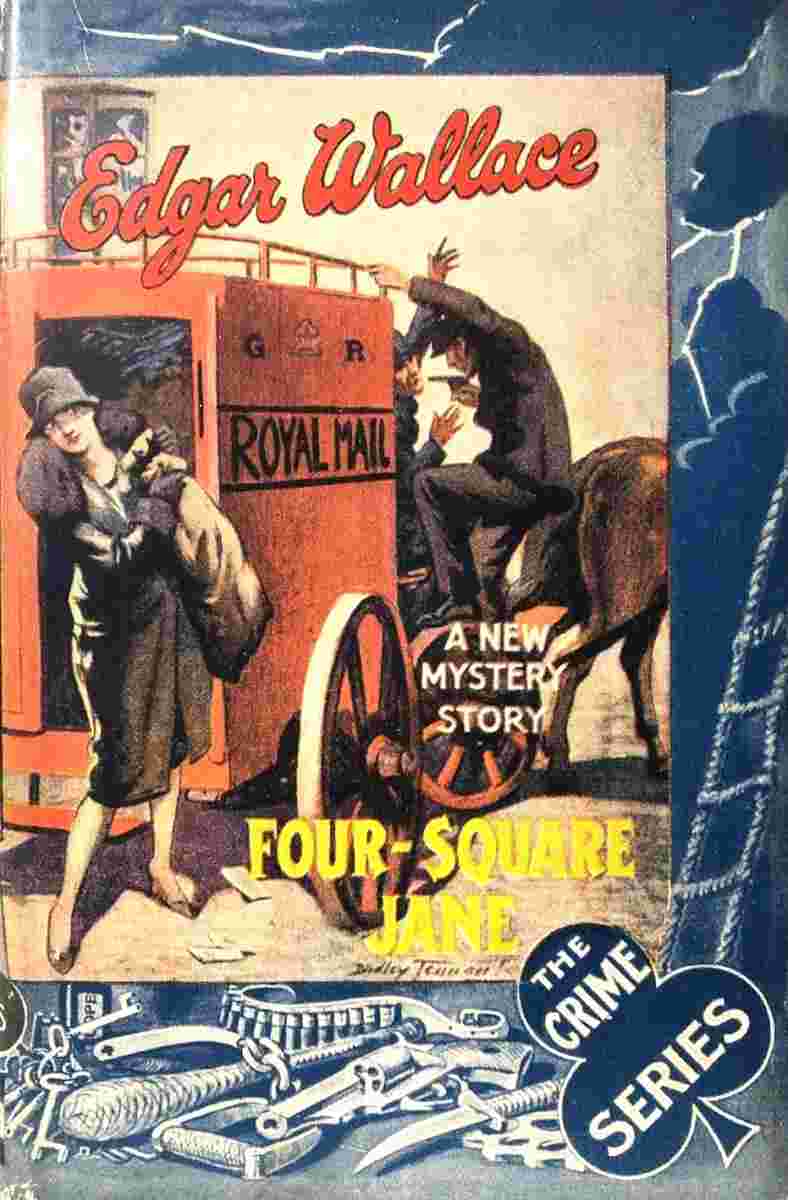
The Project Gutenberg eBook of Four square Jane
Title: Four square Jane
Author: Edgar Wallace
Illustrator: C. Dudley Tennant
Release date: April 7, 2025 [eBook #75808]
Most recently updated: July 19, 2025
Language: English
Original publication: London: The Readers Library Publishing Company Ltd, 1929
Credits: an anonymous Project Gutenberg volunteer
FOUR SQUARE
JANE
BY
EDGAR WALLACE
Author of “Angel Esquire,” “The Melody of Death,”
“The Thief in the Night,” “Elegant Edward,” etc.
CRIME SERIES
THE READERS LIBRARY
PUBLISHING COMPANY LTD.
66-66A, GREAT QUEEN STREET
KINGSWAY, LONDON, W.C. 2
Copyright Edition
(All Rights Reserved)
EDITOR’S NOTE
The Readers Library has recently published a large number of the best “crook” stories of the day. Amongst famous mystery story writers whose books have been included in the Library are Edgar Wallace, Sydney Horler, Mrs. Belloc Lowndes, Thea von Harbou, Earl Derr Biggers, and many others. Moreover, there is scarcely a first-class thriller produced on the films but an excellent novelised version of it appears in the Readers Library. Experience has shown that there are scores of thousands of readers who cannot be supplied with too much of this ingenious and absorbing type of fiction. The Readers Library intends to go on selecting as many as possible of the best of these stories, and with the present volume starts a policy of producing them in a series of their own, with a specially designed paper wrapper by which they can be distinguished. “Crook” story devotees will thus be able to recognize good “crook” stories at sight. The Crime Series will contain nothing that is second-class. It makes an auspicious start with an entirely new book by Mr. Edgar Wallace—“Four Square Jane.”
No publisher who has recently had the fortune to produce an Edgar Wallace book can doubt that at the present time Mr. Wallace is easily the best seller in the world. The sales of the Readers Library volumes probably surpass those of any other books on earth. And amongst Readers Library books the four Edgar Wallace volumes which we have already published multiply their sales most phenomenally and quickly. It is a pleasure, therefore, to follow them with yet another of the celebrated writer’s stories, which has never appeared in volume form before, and which cannot be procured in any other edition. It can be said sincerely that “Four Square Jane” is amongst his best stories. It is concerned with a most ladylike crook. She is an uncannily clever criminal, all her female cunning being concentrated on her nefarious work. She makes the mere male detectives and policemen who endeavour to be on her tracks look foolish; and she and Mr. Edgar Wallace between them will successfully baffle readers of both sexes as to her identity. Mr. Wallace is most happy in his knack of getting his readers interested within the first two or three pages of a story in the particular character whom he does not intend to reveal to them until the close of the story. He is especially successful in this volume. Four Square Jane remains an enigmatic person until the end of the book, though in the meantime she is responsible for a series of risky crimes performed with a neatness and cleverness which cannot but evoke admiration. The expression with regard to Mr. Wallace may be becoming hackneyed, but it is undoubtedly true that he has written another masterly mystery story in this case.
Other volumes will follow quickly in The Crime Series, until it is a regular show gallery of clever criminals and clever detectives. Meanwhile, it is a pleasure to introduce (though the actual formal introduction is postponed until almost the last page of the book) the reader to Exhibit No. 1, than whom there will be none more interesting or charming—Four Square Jane!
The Editor.
THE CRIME SERIES
What is The Crime Series? It is a collection of many of the best “crook,” detective and mystery stories of the day, published in handy volumes which will look pleasant and uniform on the library shelves of devotees of this class of fiction. They are a series within the Readers Library, which, for a long time past, has published some of the best “crook” fiction of the times. Famous writers whose books have appeared in the Library include Edgar Wallace, Mrs. Belloc Lowndes, Sydney Horler, Thea von Harbou, Earl Derr Biggers and many others. The popularity of “crook” stories apparently never dies. In order that readers may be able to recognize particularly good volumes coming within this category at sight, the Readers Library proposes to make a careful selection from amongst “crook” stories and to produce a set of the best of them in the Crime Series, which will have a specially designed paper wrapper by which they can be known. The Series will not only include original stories by the most celebrated authors of detective stories, it will also contain the novelised versions of many of the first-class “crook” plays and films which are produced from time to time. The Crime Series therefore promises to be a unique collection of ingenious and thrilling stories.
Look out for volumes in The Crime Series!
CONTENTS
FOUR SQUARE JANE
I
Mr. Joe Lewinstein slouched to one of the long windows which gave light to his magnificent drawing-room and stared gloomily across the lawn.
The beds of geraniums and lobelias were half-obscured by a driving mist of rain, and the well-kept lawns that were the pride of his many gardeners were sodden and, in places, under water.
“Of course it had to rain to-day,” he said bitterly.
His large and comfortable wife looked up over her glasses.
“Why, Joe,” she said, “what’s the good of grousing? They haven’t come down for an al fresco fête; they’ve come down for the dance and the shooting, and anything else they can get out of us.”
“Oh, shut up, Miriam,” said Mr. Lewinstein irritably; “what does it matter what they’re coming for? It’s what I want them for myself. You don’t suppose I’ve risen from what I was to my present position without learning anything, do you?” Mr. Lewinstein was fond of referring to his almost meteoric rise in the world of high finance, if not in the corresponding world of society. And, to do him justice, it must be added that such companies as he had promoted, and they were many, had been run on the most straightforward lines, nor had he, to use his own words, risked the money of the “widows and orphans.” At least, not unnecessarily.
“It’s knowing the right kind of people,” he continued, “and doing them the right kind of turns that counts. It’s easier to make your second million than your first, and I’m going to make it, Miriam,” he added, with grim determination. “I’m going to make it, and I’m not sticking at a few thousands in the way of expenses!”
A housewifely fear lest their entertainment that night was going to cost them thousands floated through Mrs. Lewinstein’s mind, but she said nothing.
“I’ll bet they’ve never seen a ball like ours is to-night,” her husband continued with satisfaction, as he turned his back on the window and came slowly towards his partner, “and the company will be worth it, Miriam, you believe me. Everybody who’s anybody in the city is coming. There’ll be more jewels here to-night than even I could buy.”
His wife put down her paper with an impatient gesture.
“That’s what I’m thinking about,” she said. “I hope you know what you’re doing. It’s a big responsibility.”
“What do you mean by responsibility?” asked Joe Lewinstein.
“All this loose money lying about,” said his wife. “Don’t you read the paper? Don’t any of your friends tell you?”
Mr. Lewinstein burst into a peal of husky laughter.
“Oh, I know what’s biting you,” he said. “You’re thinking of Four Square Jane.”
“Four Square Jane!” said the acid Mrs. Lewinstein. “I’d give her Four Square Jane if I had her in this house!”
“She’s no common burglar,” said Mr. Lewinstein shaking his head, whether in admonition or admiration it was difficult to say. “My friend, Lord Belchester—my friend, Lord Belchester, told me it was an absolute mystery how his wife lost those emeralds of hers. He was very worried about it, was Belchester. He took about half the money he made out of Consolidated Grains to buy those emeralds, and they were lost about a month after he bought them. He thinks that the thief was one of his guests.”
“Why do they call her Four Square Jane?” asked Mrs. Lewinstein curiously.
Her husband shrugged his shoulders.
“She always leaves a certain mark behind her, a sort of printed label with four squares, and the letter J in the middle,” he said. “It was the police who called her Jane, and somehow the name has stuck.”
His wife picked up the paper and put it down again, looking thoughtfully into the fire.
“And you’re bringing all these people down here to stop the night, and you’re talking about them being loaded up with jewellery! You’ve got a nerve, Joe.”
Mr. Lewinstein chuckled.
“I’ve got a detective, too,” he said. “I’ve asked Ross, who has the biggest private detective agency in London, to send me his best woman.”
“Goodness gracious,” said the dismayed Mrs. Lewinstein, “you’re not having a woman here?”
“Yes, I am. She’s a lady, apparently one of the best girls Ross has got. He told me that in cases like this it’s much less noticeable to have a lady detective among the guests than a man. I told her to be here at seven.”
Undoubtedly the Lewinstein’s house-party was the most impressive affair that the county had seen. His guests were to arrive by a special train from London and were to be met at the station by a small fleet of motor cars, which he had pressed to his service from all available sources. His own car was waiting at the door ready to take him to the station to meet his “special” when a servant brought him a card.
“Miss Caroline Smith,” he read. On the corner was the name of the Ross Detective Agency.
“Tell the young lady I’ll see her in the library.”
He found her waiting for him. A personable, pretty girl, with remarkably shrewd and clever eyes that beamed behind rimless glasses and a veil, she met him with an elusive smile that came and went like sunshine on a wintry day.
“So you’re a lady detective, eh?” said Lewinstein with ponderous good humour; “you look young.”
“Why, yes,” said the girl, “even way home, where youth isn’t any handicap, I’m looked upon as being a trifle under the limit.”
“Oh, you’re from America, are you?” said Mr. Lewinstein interested.
The girl nodded.
“This is my first work in England, and naturally I am rather nervous.”
She had a pleasant voice, a soft drawl, which suggested to Mr. Lewinstein, who had spent some years on the other side, that she came from one of the Southern States.
“Well, I suppose you pretty well know your duties in the game to suppress this Four Square woman.”
She nodded.
“That may be a pretty tough proposition. You’ll give me leave to go where I like, and do practically what I like, won’t you? That is essential.”
“Certainly,” said Mr. Lewinstein; “you will dine with us as our guest?”
“No, that doesn’t work,” she replied. “The time I ought to be looking round and taking notice, my attention is wholly absorbed by the man who is taking me down to dinner and wants my views on prohibition.
“So, if you please, I’d like the whole run of your house. I can be your young cousin, Miranda, from the high mountains of New Jersey. What about your servants?”
“I can trust them with my life,” said Mr. Lewinstein.
She looked at him with a half-twinkle in her eyes.
“Can you tell me anything about this she-Raffles?” she asked.
“Nothing,” said her host, “except that she is one of these society swells who frequent such—well, such parties as I am giving to-night. There will be a lot of ladies here—some of the best in the land—that is what makes it so difficult. As likely as not she will be one of them.”
“Would you trust them all with your life?” she asked mischievously, and then going on: “I think I know your Four Square woman. Mind,” she raised her hand, “I’m not going to say that I shall discover her here.”
“I hope to goodness you don’t,” said Joe heartily.
“Or if I do find her I’m going to denounce her. Perhaps you can tell me something else about her.”
Mr. Lewinstein shook his head.
“The only thing I know is that when she’s made a haul, she usually leaves behind a mark.”
“That I know,” said the girl nodding. “She does that in order that suspicion shall not fall upon the servants.”
The girl thought a moment, tapping her teeth with a pencil, then she said:
“Whatever I do, Mr. Lewinstein, you must not regard as remarkable. I have set my mind on capturing Four Square Jane, and starting my career in England with a big flourish of silver trumpets.” She smiled so charmingly that Mrs. Lewinstein in the doorway raised her eyebrows.
“It is time you were going, Joseph,” she said severely. “What am I to do with this young woman?”
“Let somebody show her her room,” said the temporarily flustered Mr. Lewinstein, and hurried out to the waiting car.
Mrs. Lewinstein rang the bell. She had no interest in detectives, especially pretty detectives of twenty-three.
Adchester Manor House was a large establishment, but it was packed to its utmost capacity to accommodate the guests who arrived that night.
All Mrs. Lewinstein had said—that these pretty women and amusing men had been lured into Buckinghamshire with a lively hope of favours to come—might be true. Joe Lewinstein was not only a power in the City, with the control of four great corporations, but the Lewinstein interests stretched from Colorado to Vladivostock.
It was a particularly brilliant party which sat down to dinner that night, and if Mr. Lewinstein swelled a little with pride, that pride was certainly justified. On his right sat Lady Ovingham, a thin woman with the prettiness that consists chiefly in huge appealing eyes and an almost alarming pallor of skin. Her appearance greatly belied her character, for she was an unusually able business woman, and had partnered Mr. Lewinstein in some of his safer speculations. An arm covered from wrist to elbow with diamond bracelets testified to the success of these ventures in finance, for Lady Ovingham had a way of investing her money in diamonds, for she knew that these stones would not suddenly depreciate in value.
The conversation was animated and, in many cases, hilarious, for Mr. Lewinstein had mixed his guests as carefully as his butler had mixed the cocktails, and both things helped materially towards the success of the evening.
It was towards the end of the dinner that the first disagreeable incident occurred. His butler leant over him, ostensibly to pour out a glass of wine, and whispered:
“That young lady that came this afternoon, sir, has been taken ill.”
“Ill!” said Mr. Lewinstein in dismay. “What happened?”
“She complained of a bad headache, was seized with tremblings, and had to be taken up to her room,” said the butler in a low voice.
“Send into the village for the doctor.”
“I did, sir,” said the man, “but the doctor had been called away to London on an important consultation.”
Mr. Lewinstein frowned. Then a little gleam of relief came to him. The detective had asked him not to be alarmed at anything that might happen. Possibly this was a ruse for her own purpose. She ought to have told him though, he complained to himself.
“Very good, wait till dinner is over,” he said.
When that function was finished, and the guests had reached the coffee and cigarette stage before entering the big ballroom or retiring to their cards, Mr. Lewinstein climbed to the third floor to the tiny bedroom which had been allocated by his lady wife as being adequate for a lady detective.
He knocked at the door.
“Come in,” said a faint voice.
The girl was lying on the bed, covered with an eiderdown quilt, and she was shivering.
“Don’t touch me,” she said. “I don’t know what’s the matter with me even.”
“Good Lord!” said Mr. Lewinstein in dismay, “you’re not really ill, are you?”
“I’m afraid so; I’m awfully sorry. I don’t know what has happened to me, and I have a feeling that my illness is not wholly accidental. I was feeling well until I had a cup of tea, which was brought to my room, when suddenly I was taken with these shivers. Can you get me a doctor?”
“I’ll do my best,” said Mr. Lewinstein, for he had a kindly heart.
He went downstairs a somewhat anxious man. If, as the girl seemed to suggest, she had been doped, that presupposed the presence in the house either of Four Square Jane or one of her working partners. He reached the hall to find the butler waiting.
“Excuse me, sir,” said the butler, “but rather a fortunate thing has happened. A gentleman who has run short of petrol came up to the house to borrow a supply——”
“Well?” said Mr. Lewinstein.
“Well, sir, he happens to be a doctor,” said the butler. “I asked him to see you, sir.”
“Fine,” said Mr. Lewinstein enthusiastically, “that’s a good idea of yours. Bring him into the library.”
The stranded motorist, a tall young man, came in full of apologies.
“I say, it’s awfully good of you to let me have this juice,” he said. “The fact is, my silly ass of a man packed me two empty tins.”
“Delighted to help you, doctor,” said Mr. Lewinstein genially; “and now perhaps you can help me.”
The young man looked at the other suspiciously.
“You haven’t anybody ill, have you?” he asked, “I promised my partner I wouldn’t look at a patient for three months. You see,” he explained, “I’ve had rather a heavy time lately, and I’m a bit run down.”
“You’d be doing us a real kindness if you’d look at this young lady,” said Mr. Lewinstein earnestly. “I don’t know what to make of her, doctor.”
“Setheridge is my name,” said the doctor. “All right, I’ll look at your patient. It was ungracious of me to pull a face I suppose. Where is she? Is she one of your guests by the way? I seem to have butted in on a party.”
“Not exactly,” Mr. Lewinstein hesitated, “she is—er—a visitor.”
He led the way up to the room, and the young man walked in and looked at the shivering girl with the easy confident smile of the experienced practitioner.
“Hullo,” he said, “what’s the matter with you?”
He took her wrist in his hand and looked at his watch, and Mr. Lewinstein, standing in the open doorway, saw him frown. He bent down and examined the eyes, then pulled up the sleeve of his patient’s dress and whistled.
“Is it serious?” she asked anxiously.
“Not very, if you are taken care of; though you may lose some of that hair,” he said, with a smile at the brown mop on the pillow.
“What is it?” she asked.
“Scarlet fever, my young friend.”
“Scarlet fever!” It was Mr. Lewinstein who gasped the words. “You don’t mean that?”
The doctor walked out and joined him on the landing, closing the door behind him.
“It’s scarlet fever, all right. Have you any idea where she was infected?”
“Scarlet fever,” moaned Mr. Lewinstein; “and I’ve got the house full of aristocracy!”
“Well, the best thing you can do is to keep the aristocracy in ignorance of the fact. Get the girl out of the house.”
“But how? How?” wailed Mr. Lewinstein.
The doctor scratched his head.
“Of course, I don’t want to do it,” he said slowly; “but I can’t very well leave a girl in a mess like this. May I use your telephone?”
“Certainly, use anything you like; but, for goodness’ sake, get the girl away!”
Mr. Lewinstein showed him the library, where the young man called up a number and gave some instructions. Apparently his telephone interview was satisfactory, for he came back to the hall, where Mr. Lewinstein was nervously drumming his fingers on the polished surface of a table, with a smile.
“I can get an ambulance out here, but not before three in the morning,” he said; “anyway, that will suit us, because your guests will be abed and asleep by then, and most of the servants also, I suppose. And we can get her out without anybody being the wiser.”
“I’m awfully obliged to you, doctor,” said Mr. Lewinstein, “anything you like to charge me——”
The doctor waved fees out of consideration.
Then a thought occurred to Mr. Lewinstein.
“Doctor, could that disease be communicated to the girl by means of a drug, or anything?”
“Why do you ask?” said the other quickly.
“Well, because she was all right till she had a cup of tea. I must take you into my confidence,” he said, lowering his voice. “She is a detective, brought down here to look after my guests. There have been a number of robberies committed lately by a woman who calls herself ‘Four Square Jane,’ and, to be on the safe side, I had this girl down to protect the property of my friends. When I saw her before dinner she was as well as you or I; then a cup of tea was given to her, and immediately she had these shiverings.”
The doctor nodded thoughtfully.
“It is curious you should say that,” he said; “for though she has the symptoms of scarlet fever, she has others which are not usually to be found in scarlet fever cases. Do you suggest that this woman, this Four Square person, is in the house?”
“Either she or her agent,” said Mr. Lewinstein. “She has several people who work with her by all accounts.”
“And you believe that she has given this girl a drug to put her out of the way?”
“That’s my idea.”
“By jove!” said the young man, “that’s rather a scheme. Well, anyway, there will be plenty of people knocking about to-night, so your guests will be safe for to-night.”
The girl had been housed in the servants’ wing, but fortunately in a room isolated from all the others. Mr. Lewinstein made several trips upstairs during the course of the evening, saw through the open door the doctor sitting by the side of the bed, and was content. His guests retired towards one o’clock and the agitated Mrs. Lewinstein, to whom the news of the catastrophe had been imparted, having been successfully induced to go to bed, Mr. Lewinstein breathed more freely.
At half-past one he made his third visit to the door of the sick room, for he, himself, was not without dread of infection, and saw through the open door the doctor sitting reading a book near the head of the bed.
He stole quietly down, so quietly that he almost surprised a slim figure that was stealing along the darkened corridor whence opened the bedrooms of the principal guests.
She flattened herself into a recess, and he passed her so closely that she could have touched him. She waited until he had disappeared, and then crossed to one of the doors and felt gingerly at the key-hole. The occupant had made the mistake of locking the door and taking out the key, and in a second she had inserted one of her own, and softly turning it, had tip-toed into the room.
She stood listening; there was a steady breathing, and she made her way to the dressing-table, where her deft fingers began a rapid but silent search. Presently she found what she wanted, a smooth leather case, and shook it gently. She was not a minute in the room before she was out again, closing the door softly behind her.
She had half-opened the next door before she saw that there was a light in the room and she stood motionless in the shadow of the doorway. On the far side of the bed the little table-lamp was still burning, and it would, she reflected, have helped her a great deal, if only she could have been sure that the person who was lying among the frilled pillows of the bed was really asleep. She waited rigid, and with all her senses alert for five minutes, till the sound of regular breathing from the bed reassured her. Then she slipped forward to the dressing-table. Here, her task was easy. No less than a dozen little velvet and leather cases lay strewn on the silk cover. She opened them noiselessly one by one, and put their glittering contents into her pocket, leaving the cases as they had been.
As she was handling the last of the jewels a thought struck her, and she peered more closely at the sleeping figure. A thin pretty woman, it seemed in the half-light. So this was the businesslike Lady Ovingham. She left the room as noiselessly as she had entered it, and more quickly, and tried the next door in the passage.
This one had not been locked.
It was Mrs. Lewinstein’s own room, but she was not sleeping quietly. The door had been left open for her lord, who had made a promise to see his wife to make arrangements for the morrow. This promise he had quite forgotten in his perturbation. There was a little safe let into the wall, and the keys were hanging in the lock; for Mr. Lewinstein, who, being a prudent, careful man, was in the habit of depositing his diamond studs every night.
The girl’s fingers went into the interior of the safe, and presently she found what she wanted. Mrs. Lewinstein stopped breathing heavily, grunted, and turned, and the girl stood stock-still. Presently the snoring recommenced, and she stole out into the corridor.
As she closed each door she stopped only long enough to press a small label against the surface of the handle before she passed on to the next room.
Downstairs in the library, Mr. Lewinstein heard the soft purr of a motor car, and rose with a sigh of relief. Only his butler had been let into the secret, and that sleepy retainer, who was dozing in one of the hall chairs, heard the sound with as great relief as his employer. He opened the big front door.
Outside was a motor-ambulance from which two men had descended. They pulled out a stretcher and a bundle of blankets, and made their way into the hall.
“I will show you the way,” said Mr. Lewinstein. “You will make as little noise as possible, please.”
He led the procession up the carpeted stairs, and came at last to the girl’s room.
“Oh, here you are,” said the doctor, yawning. “Set the stretcher by the side of the bed. You had better stand away some distance, Mr. Lewinstein,” he said, and that gentleman obeyed with alacrity.
Presently the door opened and the stretcher came out, bearing the blanket-enveloped figure of the girl, her face just visible, and she favoured Mr. Lewinstein with a pathetic smile as she passed.
The stairs were negotiated without any difficulty by the attendants, and carefully the stretcher was pushed into the interior of the ambulance.
“That’s all right,” said the doctor; “if I were you I would have that bedroom locked up and fumigated to-morrow.”
“I’m awfully obliged to you, doctor. If you will give me your address I would like to send you a cheque.”
“Oh, rubbish,” said the other cheerfully, “I am only too happy to serve you. I will go into the village to pick up my car and get back to town myself.”
“Where will you take this young woman?” asked Mr. Lewinstein.
“To the County Fever Hospital,” replied the other carelessly. “That’s where you’re taking her, isn’t it?”
“Yes, sir,” said one of the attendants.
Mr. Lewinstein waited on the steps until the red lights of the car had disappeared, then stepped inside with the sense of having managed a very difficult situation rather well.
“That will do for the night,” he said to the butler. “Thank you for waiting up.”
He found himself walking, with a little smile on his lips, along the corridor to his own room.
As he was passing his wife’s door he stumbled over something. Stooping, he picked up a case. There was an electric switch close by, and he flooded the corridor with light.
“Jumping Moses!” he gasped, for the thing he held in his hand was his wife’s jewel case.
He made a run for her door, and was just gripping the handle, when the label there caught his eye, and he stared in hopeless bewilderment at the sign of Four Square Jane.
* * * * *
An ambulance stopped at a cross-road, where a big car was waiting, and the patient, who had long since thrown off her blankets, came out. She pulled after her a heavy bag, which one of the two attendants lifted for her and placed in the car. The doctor was sitting at the wheel.
“I was afraid I was going to keep you waiting,” he said. “I only just got here in time.”
He turned to the attendant.
“I shall see you to-morrow, Jack.”
“Yes, doctor,” replied the other.
He touched his hat to Four Square Jane, and walked back to the ambulance, waiting only to change the number plates before he drove away in the opposite direction to London.
“Are you ready?” asked the doctor.
“Quite ready,” said the girl, dropping in by his side. “You were late, Jim. I nearly pulled a real fit when I heard they’d sent for the local sawbones.”
“You needn’t have worried,” said the man at the wheel, as he started the car forward. “I got a pal to wire calling him to London. Did you get the stuff?”
“Yards of it,” said Four Square Jane laconically. “There will be some sad hearts in Lewinstein’s house to-morrow.”
He smiled.
“By the way,” she said, “that lady detective Ross sent, how far did she get?”
“As far as the station,” said the doctor, “which reminds me that I forgot to let her out of the garage where I locked her.”
“Let her stay,” said Four Square Jane. “I hate the idea of she-detectives, anyway—it’s so unwomanly.”
II
The chairman of the Bloxley Road Hospital for Women took his seat at the head of the table, with a grim nod of recognition for his colleagues, and a more respectful inclination of his head for that eminent surgeon, Sir John Denham, who was attending this momentous meeting of the Governors by special invitation.
Doctor Parsons, the chairman, pushed aside a little brown paper parcel which lay on his blotting pad, and which he saw, after a cursory glance, was addressed to himself. Presumably this contained the new vaccine tubes which he had ordered from the research laboratory. He cast a swift glance from left to right, smiling a little bitterly at the glum faces of the staff.
“Well, gentlemen,” he said, “Bloxley Road Hospital looks like closing.”
“Is it as bad as that, sir?” asked one of the surgeons with a troubled face, and Dr. Parsons nodded.
“I suppose you didn’t have any luck, Sir John?”
Sir John Denham shook his head.
“I have been to everybody in London who is likely to help. It is little short of a crime that the hospital should have to close down, and that’s just how it stands, doesn’t it, Parsons?”
The doctor nodded his head.
“I’ve already shut two wards out of four,” he said. “We ourselves have had no salaries for a fortnight, but that, of course, does not matter. And the devil of it is that women are clamouring to get into this hospital—I’ve got a waiting list of nearly eighty.”
Sir John nodded gravely.
“It’s a terrible state of affairs,” he said. “Do you know Lewinstein?”
“Slightly,” said the doctor with a faint smile. “I know him well enough to cadge from him; but it was no go. Mr. Lewinstein would get no credit from having his name on our subscription list, and he is rather out for credit. As a matter of fact, he did subscribe once before. By the way, talking of Lewinstein reminds me that Lord Claythorpe, a close friend of his, has bought his niece a £50,000 pearl necklace as a wedding present. It was in all the morning papers.”
“I saw it,” said Sir John.
“Really, I sometimes feel that I would like to turn burglar,” said the exasperated chairman, “and join the gang of that—what do you call the lady?—the person who stole that Venetian armlet that is being advertised for so industriously. She went down in the guise of a detective to Lewinstein’s house. Apparently she cleared out all the guests and bolted in the night, and amongst the things she took was an armlet belonging to one of the Doges of Venice, worth a fortune. At any rate, they are advertising for its return.”
“Whose is it?”
“Lord Claythorpe’s. His wife was wearing it. Like a fool she took it down to Lewinstein’s place. Claythorpe is a bit of a connoisseur, and they say he has been off his head since his wife came back and reported the loss.”
At that moment the telephone bell rang, and the doctor pulled the instrument towards him with a little frown.
“I told those people in the office not to put anybody through,” he said and lifted the receiver.
“Who’s that?” he said sharply, and the soft pleasant voice of a girl replied:
“Is that Dr. Parsons?”
“Yes, it is I,” said the doctor.
“Oh, I just wanted to tell you that I read your moving appeal for funds in the Morning Post to-day.”
The doctor’s face brightened. This little hospital was his life’s work, and the very hint of a promise that help was coming, however meagre that help might be, cheered him.
“I’m glad you were moved by it,” he said, half in humour and half in earnest; “and I trust that you will be moved to some purpose. Am I wrong in suspecting you to be a possible subscriber?”
There was a little laugh at the other end of the wire.
“You are appealing for £8,000 to carry on the hospital for another six months,” said the girl.
“That’s right,” nodded the doctor.
“Well, I’ve sent you £10,000,” was the surprising reply, and the doctor gasped.
“You’ve sent me £10,000!” he said hollowly. “You’re joking, I suppose.”
“Well, I haven’t exactly sent you £10,000,” said the voice—“that is to say, in money. I have sent you the money’s worth. I sent a parcel to you last night. Have you got it?”
The doctor looked round.
“Yes,” he said, “there is a parcel here, posted at Clapham. Is that from you?”
“That’s from me,” said the girl’s voice. “I am relieved to know that you have found it.”
“What’s in it?” demanded the man curiously.
“A very interesting armlet which was, and probably is still, the property of Lord Claythorpe.”
“What do you mean?” asked the doctor sharply.
“It is the armlet I stole from him,” said the voice; “and there is a reward of £10,000 for its return. I want you to return it, and apply the money to your hospital.”
“To whom am I speaking?” asked Dr. Parsons huskily.
“To Four Square Jane!” was the reply and there was a “click!” as the receiver was hung up.
With trembling fingers the doctor tore the tape which bound the little parcel, pulled the brown-paper cover aside, disclosing a small wooden box with a sliding lid. This he pushed back, and there, in its bed of cotton wool, glittered and flashed the famous Venetian Armlet.
It was a nine days’ wonder. The daily Press, which for the past weeks had had to satisfy itself with extravagant weather reports and uninteresting divorce cases, fell upon this latest sensation with enthusiasm, and there was not a Sunday paper in the country that did not “feature” it in the largest of black type. For it was the greatest story that had been printed for years.
The securing of the reward was not to be so simple a matter as the Press and Dr. Parsons imagined. A telephone message had acquainted Lord Claythorpe with the recovery of his jewel, and the doctor himself carried it to Belgrave Square. Lord Claythorpe was a thin little man, bald of head, and yellow of face. He suffered from some sort of chronic jaundice, which not only tinged his skin, but gave a certain yellowy hue to his temper. He received the doctor in his beautiful library, one wall of which, as Dr. Parsons noticed, was covered with the doors of small safes which had been let into the wall itself. For Lord Claythorpe was a great connoisseur of precious stones, and argued that it was just as absurd to keep your gems all behind one door as it was to keep all your eggs in one basket.
“Yes, yes,” he said a little testily; “that is the jewel. I wouldn’t have lost it for anything. If my fool of a—if her ladyship hadn’t taken it down with her I shouldn’t have had all this bother and worry. This is one of the rarest ornaments in the kingdom.”
He descanted upon the peculiar artistic value and historical interest of this precious armlet for the greater part of a quarter of an hour, during which time Dr. Parsons shifted uneasily from foot to foot, for no mention of the reward had been made. At last Parsons managed to murmur a hint.
“Reward—er—reward,” said his lordship uncomfortably, “there was some talk of a reward. But surely, Dr. Parsons, you do not intend to benefit your—er—charitable institution at the expense of a law-abiding citizen? Or, might I say, receive a subscription at the hands of a malicious and wicked criminal?”
“I am wholly uninterested in the moral character of any person who donates money to my hospital,” said Parsons boldly. “The only thing that troubles me is the lack of funds.”
“Perhaps,” said his lordship hopefully, “if I put my name down as an annual subscriber for——”
The doctor waited.
“Say ten guineas a year,” suggested Lord Claythorpe.
“You offered a £10,000 reward,” said the doctor, his anger rising. “Either your lordship is going to pay that reward or you are not. If you refuse to pay I shall go to the Press and tell them.”
“The reward was for the conviction of the thief,” said his lordship in triumph. “You don’t deny that. Now, you haven’t brought the thief along to be convicted.”
“It was for any information that would lead to the recovery of the jewel,” said the angry doctor; “and that is what I have brought you—not only information, but the jewel itself. There was some talk of conviction; but that, I am informed, is the usual thing to put into an advertisement of this character.”
For half an hour they haggled, and the doctor was in despair. He knew that it might mean ruin to take this curmudgeon into court, and so after a painful argument he accepted, with a sense of despair, the £4,000 which Lord Claythorpe most reluctantly paid.
That night his lordship gave a dinner party in honour of his niece, whose wedding was to take place two days later. Only one person spoke at that dinner party, and that person was Lord Claythorpe. For not only had he to tell his guests what were his sensations when he learnt the jewel was lost, but he had to describe vividly and graphically his emotions on its restoration. But the choicest morsel he retained to the last.
“This doctor fellow wanted £10,000—the impertinence of it! I knew very well I was offering too large a reward, and I told those police people so. Of course, the armlet is worth three times that amount, but that is nothing to do with it. But I beat him down! I beat him down!”
“So I saw,” said the easy-going Mr. Lewinstein.
“So you saw?” said Lord Claythorpe suspiciously. “Where did you see it? I thought nobody knew but myself. Has that infernal doctor been talking?”
“I expect so,” said Lewinstein. “I read it in the evening papers to-night. They’ve got quite a story about it. I’m afraid it’s not going to do you any good, Claythorpe. If Jane hears about it——”
“Jane!” scoffed his lordship. “What the deuce do I care for Jane?”
Lewinstein nodded, and catching his wife’s eye, smiled.
“I didn’t care for Jane—until Jane came and bit me,” he said philosophically. “Until I saw her four little squares labelled on my door, and missed the contents of my private safe. I tell you that girl is no ordinary crook. She returned the armlet to you because she wanted to benefit the hospital, and if she hasn’t benefited the hospital as much as she hoped I’d like to bet a thousand pounds to a penny that she’s going to get the balance from you.”
“Let her try!” Lord Claythorpe snapped his fingers. “For years the best burglars in Europe have been making a study of my methods, and three of them have got as far as the safe doors. But you know my system, Lewinstein,” he chuckled, “ten safes, and seven of them empty. That baffles ’em! Why, Lew Smith, who is the cleverest burglar—according to Scotland Yard—who ever went into or came out of prison, worked all night on two empty safes in my cupboard.”
“Doesn’t anybody know which safes you use?”
“Nobody,” replied the other promptly; “and only one of the three contains jewellery worth taking. No; it’s nine to one against the burglar ever finding the safe.”
“What do you do?” asked the interested Lewinstein. “Change the contents of the safe every night?”
Lord Claythorpe grinned and nodded.
“In the daytime,” he said, “I keep most of my valuables in the big safe in the corner of my study. That is where I put such things as the Doges’ armlet. At night, before the servants retire, I take all the valuable cases out of my big safe and put them on the library table. My butler and my footman stand outside the door—outside, you understand—and then I switch out all the lights, open the safe in the darkness, put in the jewellery, lock the safe, pocket my keys, and there you are!”
Lewinstein grunted, though the rest of the table had some word of applause for the genius and prescience of the little man.
“I think that’s rather unnecessary,” said Lewinstein, his practical mind revolting from anything which had a touch of the theatrical; “but I suppose you know your own business best.”
“You suppose rightly,” snapped Claythorpe, who was not used to having his judgment or his wisdom questioned.
“I can only warn you,” said the persistent Lewinstein, “that in Four Square Jane you are dealing with a person who wouldn’t be stopped if you had fifty safes, and a policeman sitting on top of every one of them.”
“Four Square Jane!” scoffed his lordship, “don’t worry about her! I have a detective here——”
Mr. Lewinstein laughed a bitter little laugh.
“So had I,” he said shortly. “A female detective, may I ask?”
“Of course not. I’ve got the best man from Scotland Yard,” said Lord Claythorpe.
“What I should like to know is this,” said the other lowering his voice, “have you any kind of suspicious woman in the house?”
“What do you mean, sir?” demanded Lord Claythorpe bridling.
“Can you account for all your lady guests? There are a dozen here to-night. Do you know them all?”
“Every one of them,” said his lordship promptly. “Of course, I wouldn’t have strangers in the house at this moment. I have dear Joyce’s wedding presents——”
“That’s what I’m thinking about,” said Mr. Lewinstein. “Would you mind if I had a little look round myself?”
There was a sneer on Lord Claythorpe’s thin lips.
“Turning detective, Joe?” he asked.
“Something like that,” said Lewinstein. “I’ve been bitten myself, and I know just where it hurts.”
Lewinstein was given the run of the big house in Belgrave Square, and that evening he made one or two important discoveries.
The first was that “the best detective from Scotland Yard” was a private detective, and although not a Headquarters’ officer, still a man of unquestionable honesty and experience, who had been employed by his lordship before.
“It’s not much of a job,” admitted the detective. “I have to sit with my back to the door of his study all night long. His lordship doesn’t like anybody in the study itself—what’s that?” he asked suddenly.
They were standing within half a dozen paces of the library door, and the detective’s sensitive ears had caught a sound.
“I heard nothing,” said Lewinstein.
“I swear I heard a sound inside that room. Do you mind staying here while I go for his lordship?”
“Why don’t you go in?” asked the other.
“Because his lordship keeps the library door locked,” grinned the detective. “I won’t keep you waiting long, sir.”
He found Lord Claythorpe playing bridge, and brought that nobleman along, an agitated and alarmed figure. With shaking hands he inserted the key in the lock of the heavy door and swung it open.
“You go in first, officer,” he said nervously. “You’ll find the switch on the right-hand side.”
The room was flooded with light, but it was empty. At one end of the apartment was a long window, heavily barred. The blind was drawn, and this the detective pulled up, only to discover that the window was closed and had apparently not been opened.
“That’s rum,” he said. “It was the noise of a blind I heard.”
“The wind?” suggested Lewinstein.
“It couldn’t have been the wind, sir, the windows are hermetically closed.”
“Well nobody could get in that window anyway, through the bars,” said his lordship; but the detective shook his head.
“An ordinary man couldn’t, sir. I’m not so sure that a young girl couldn’t slip through there as easily as you slip through the door.”
“Bah!” said his lordship, “you’re nervous. Just take a look round, my good fellow.”
There were no cupboards, and practically no places where anybody could hide, so the examination of the room was of a perfunctory character.
“Are you satisfied?” asked his lordship.
“Perfectly,” said the detective, and they went out, closing the door which Lord Claythorpe locked behind them.
By half-past eleven the guests had departed, all except Lewinstein, who was hoping that he would be admitted to the curious ceremonial which Claythorpe had described. But in this he was disappointed. His lordship entered the library alone, locked the door behind him and switched out the lights, lest any prying eyes should see where he deposited the jewel cases he took from the great safe in the corner of the room. Presently they heard the soft thud of closing doors, and he emerged.
“That’s all right,” he said with satisfaction, as he pocketed the keys. “Now come along and have a drink before you go. You’ll stay here, Johnson, won’t you?” he said to the private detective.
“Yes, my lord,” said the man.
On the way to the smoking-room where drinks had been served, Lord Claythorpe explained that he did not rely entirely upon the detective agency, that he had indeed notified Scotland Yard.
“The house is being watched, or will be watched, night and day until after the wedding,” he said.
“I think you’re wise,” responded Mr. Lewinstein.
He tossed down a stiff whisky and soda, and, accompanied by his host, went into the hall where he was helped on with his coat. He was on the point of saying “Good night,” when there was a thunderous knock at the front door, and the butler opened it. Two men stood on the doorstep gripping between them a frail and slender figure.
“It’s all right, sir,” said one, with a note of exultation, “we’ve got her! Can we come in?”
“Got her?” gasped his lordship, “who is it?”
And yet there was no need for him to ask.
The prisoner was a girl dressed from head to foot in black. A heavy veil covered her face, being secured apparently under the tightly-fitting little felt hat on her head.
“Caught her under your library window,” said one of the men with satisfaction, and there was a grunt from Johnson the private detective.
“Who are you?” asked his lordship.
“Sergeant Felton, from Scotland Yard, sir. Are you Lord Claythorpe?”
“Yes,” said his lordship.
“We’ve been watching the house,” said the man, “and we saw her dodging down the side passage which leads to your stables. Now then, young woman, let’s have a look at your face.”
“No, no, no,” said the girl struggling, “there are reasons. The Chief Commissioner knows the reason.”
Her captor hesitated and looked at his companion.
“I think we’d better get the superintendent in charge of the case before we go any further, my lord,” he said.
He took a pair of handcuffs from his pocket.
“Hold out your hands,” he said, and snapped the glittering bracelets on her wrists.
“Have you got a strong room, my lord, where I can keep her till the superintendent comes?”
“In my library,” said his lordship.
“Has it got a good door?”
Lord Claythorpe smiled.
He himself unlocked the library door and switched on the lights, and the girl was pushed into the room and on to a chair. The detective took a strap from his pocket and secured her ankles together.
“I’m not taking any risks with you, my lady,” he said. “I don’t know who you are, but I shall know in a very short time. Now I want to telephone. Have you a telephone here?”
“There is one in the hall.”
The detective looked at the girl, and scratched his chin.
“I don’t like leaving her alone, Robinson. You had better stay with her. Remember, you’re not to take your eyes off her, see?”
They went out together, his lordship closing and locking the door behind them, whilst the man went in search of a telephone number.
“By the way, you can hear my man if he shouts, can’t you?” he asked.
“No,” said his lordship promptly. “You can hear nothing through that door. But surely your man is capable of looking after a girl?”
Lewinstein, a silent spectator of these happenings, smiled. He had no illusions as to the resources of that girl, and was anxious to see the end of this adventure. In the meantime, behind the locked doors of the library the girl held out her hands and the “detective” with her unlocked the handcuffs. She bent and loosened the strap, then moved quickly to the wall where the ten safes were embedded. Each she examined quickly.
“These are the three, Jimmy,” she said, and her companion nodded.
“I won’t ask you how you know,” he said admiringly.
“It was easy,” she said. “As soon as I got in here I gummed some thin black silk over the edges of each door. These three have been broken, so these three safes have been opened. We’ll take a chance on this one. Give me the key.”
The “detective” opened a little leather case which he had taken from his pocket, and revealed some queerly shaped instruments. Three times the girl tried, each time withdrawing the tool from the keyhole to readjust the mechanism of her skeleton key, and at the third time the lock snapped back, and the door swung open. “Got it first time,” she said in triumph.
She pulled out a case, opened it and took one fleeting look, then thrust the jewel case into a long pocket on one side of her dress. In twenty seconds the safe was emptied, and the girl nodded to her companion.
“Get the window open. Put the light out first. You’ll find it a squeeze, Jimmy. It’s easy enough for me.”
Outside the “detective-sergeant” was having trouble with the ’phone. He put it down and turned despairingly to his lordship.
“If you don’t mind, sir, I’ll run down to Scotland Yard. I’ve got a motor-bicycle waiting. I don’t seem able to get into touch with the superintendent. Perhaps you wouldn’t mind going into the room and keeping my man company for a little while.”
“Surely,” said his lordship indignantly, “your man is perfectly capable of carrying out his instructions without my assistance? I am scarcely accustomed——” He paused for breath.
“Very good, sir,” said the “sergeant” respectfully.
A little later they heard the “pop-pop” of his motor-bicycle as it left.
“We had better do what the sergeant suggests,” said Lewinstein, “we can’t do any harm by going in, at any rate.”
“My dear fellow,” repeated his lordship testily, “that police officer is quite capable of looking after the girl. Don’t you agree, Johnson?”
Johnson, the private detective, did not immediately reply.
“Well, sir,” he said, “I don’t mind telling you that I feel a bit uneasy about the lady being in the same room as the jewels.”
“Good lord!” gasped his lordship, “I didn’t think of that. Pooh! Pooh! There’s a policeman with her. You know these officers, I suppose, Johnson?”
“No, sir,” said Mr. Johnson frankly, “I don’t. I’m not brought much into touch with Scotland Yard men, and they’re constantly changing from one division to another, so it’s difficult to keep up with them.”
His lordship pondered, a horrible fear growing within him.
“Yes, perhaps you’re right, Lewinstein,” he said, “we’ll go in.”
He put the key in the door and turned it. The room was in darkness.
“Are you there?” squeaked his lordship in such a tone of consternation that Lewinstein could have laughed.
There was a click and the lights went on, but the room was empty.
Lord Claythorpe’s first glance was to the safes. Apparently they were closed, but on three of them was a square label, and Lewinstein was the first to see and understand the significance of that sign.
“What is it? What is it?” said Lord Claythorpe in a shrill tremolo, pointing with shaking fingers to the labels.
“The visiting card of Four Square Jane!” said Lewinstein.
III
Chief Superintendent Dawes, of Scotland Yard, was a comparatively young man, considering the important position he held. It was the boast of his department—Peter himself did very little talking about his achievements—that never once, after he had picked up a trail, was Peter ever baffled.
A clean-shaven, youngish looking man, with grey hair at his temples, Peter took a philosophical view of crime and criminals, holding neither horror towards the former, nor malice towards the latter.
If he had a passion at all it was for the crime which contained within itself a problem. Anything out of the ordinary, or anything bizarre fascinated him, and it was one of the main regrets of his life that it had never once fallen to his lot to conduct an investigation into the many Four Square mysteries which came to the Metropolitan police.
It was after the affair at Lord Claythorpe’s that Peter Dawes was turned loose to discover and apprehend this girl criminal, and he welcomed the opportunity to take charge of a case which had always interested him. To the almost hysterical telephone message Scotland Yard had received from Lord Claythorpe Peter did not pay too much attention. He realized that it was of the greatest importance that he should keep his mind unhampered and unprejudiced by the many and often contradictory “clues” which everyone who had been affected by Four Square Jane’s robberies insisted on discussing with him.
He interviewed an agitated man at four o’clock in the morning, and Lord Claythorpe was frantic.
“It’s terrible, terrible,” he wailed, “what are you people at Scotland Yard doing that you allow these villainies to continue? It is monstrous!”
Peter Dawes, who was not unused to outbursts on the part of the victimized, listened to the squeal with equanimity.
“As I understand it, this woman came here with two men who pretended to have her in custody?”
“Two detectives!” moaned his lordship.
“If they called themselves detectives, then you were deceived,” said Peter with a smile. “They persuaded you to allow the prisoner and one of her captors to spend ten minutes in the library where your jewels are kept. Now tell me, when the crime occurred had your guests left?”
Lord Claythorpe nodded wearily.
“They had all gone,” he said, “except my friend Lewinstein.”
Peter made an examination of the room, and a gleam of interest came into his eyes when he saw the curious labels. He examined the floor and the window-bars, and made as careful a search of the floor as possible.
“I can’t do much at this hour,” he said. “At daylight I will come back and have a good look through this room. Don’t allow anybody in to dust or to sweep it.”
He returned at nine o’clock, and to his surprise, Lord Claythorpe, whom he had expected would be in bed and asleep, was waiting for him in the library, and wearing a dressing-gown over his pyjamas.
“Look at this,” exclaimed the old man, and waved a letter wildly.
Dawes took the document and read:
“You are very mean, old man! When you lost your Venetian armlet you offered a reward of ten thousand pounds. I sent that armlet to a hospital greatly in need of funds, and the doctor who presented my gift to the hospital was entitled to the full reward. I have taken your pearls because you swindled the hospital out of six thousand pounds. This time you will not get your property back.”
There was no signature, but the familiar mark, roughly drawn, the four squares and the centred “J.”
“This was written on a Yost,” said Peter Dawes, looking at the document critically. “The paper is the common stuff you buy in penny packages—so is the envelope. How did it come?”
“It came by district messenger,” said Lord Claythorpe. “Now what do you think, officer? Is there any chance of my getting those pearls back?”
“There is a chance, but it is a pretty faint one,” said Peter.
He went back to Scotland Yard, and reported to his chief.
“So far as I can understand, the operations of this woman began about twelve months ago. She has been constantly robbing, not the ordinary people who are subjected to this kind of victimization, but people with bloated bank balances, and so far as my investigations go, bank balances accumulated as a direct consequence of shady exploitation companies.”
“What does she do with the money?” asked the Commissioner curiously.
“That’s the weird thing about it,” replied Dawes. “I’m fairly certain that she donates very large sums to all kinds of charities. For example, after the Lewinstein burglary a big crêche in the East End of London received from an anonymous donor the sum of four thousand pounds. Simultaneously, another sum of four thousand was given to one of the West End hospitals. After the Talbot burglary three thousand pounds, which represented nearly the whole of the amount stolen, was left by some unknown person to the West End Maternity Hospital. I have an idea that we shall discover she is somebody who is in close touch with hospital work, and that behind these crimes there is some quixotic notion of helping the poor at the expense of the grossly rich.”
“Very beautiful,” said the Chief drily, “but unfortunately her admirable intentions do not interest us. In our eyes she is a common thief.”
“She is something more than that,” said Peter quietly; “she is the cleverest criminal that has come my way since I have been associated with Scotland Yard. This is the one thing one has dreaded, and yet one has hoped to meet—a criminal with a brain.”
“Has anybody seen this woman?” said the Commissioner interested.
“They have, and they haven’t,” replied Peter Dawes. “That sounds cryptic, but it only means that she has been seen by people who could not recognize her again. Lewinstein saw her, Claythorpe saw her, but she was veiled and unrecognizable. My difficulty, of course, is to discover where she is going to strike next. Even if she is only hitting at the grossly rich she has forty thousand people to strike at. Obviously, it is impossible to protect them all. But somehow——” he hesitated.
“Yes?” said the Chief.
“Well, a careful study of her methods helps me a little,” replied Dawes. “I have been looking round to discover who the next victim will be. He must be somebody very wealthy, and somebody who makes a parade of his wealth, and I have fined down the issue to about four men. Gregory Smith, Carl Sweiss, Mr. Thomas Scott, and John Tresser. I am inclined to believe it is Tresser she is after. You see, Tresser has made a great fortune, not by the straightest means in the world, and he hasn’t forgotten to advertise his riches. He is the fellow who bought the Duke of Haslemere’s house, and his collection of pictures—you will remember the stuff that has been written about.”
The Chief nodded.
“There is a wonderful Romney, isn’t there?”
“That’s the picture,” replied Dawes. “Tresser, of course, doesn’t know a picture from a gas-stove. He knows that the Romney is wonderful, but only because he has been told so. Moreover, he is the fellow who has been giving the newspapers his views on charity—told them that he never spent a penny on public institutions, and never gave away a cent that he didn’t get a cent’s worth of value for. A thing like that would excite Jane’s mind; and then, in addition, the actual artistic and monetary value of the Romney is largely advertised—why, I should imagine that the attraction is almost irresistible!”