
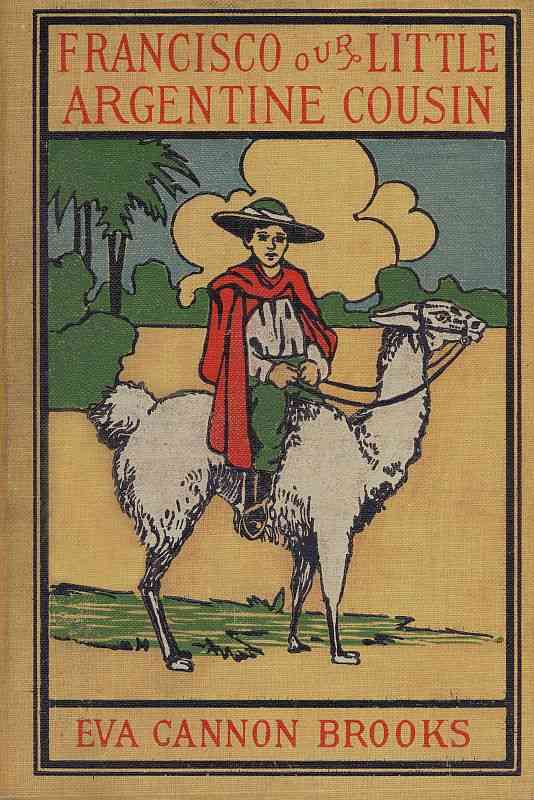
The Project Gutenberg eBook of Francisco, Our Little Argentine Cousin
Title: Francisco, Our Little Argentine Cousin
Author: Eva Cannon Brooks
Illustrator: John Goss
Release date: August 9, 2013 [eBook #43424]
Most recently updated: October 23, 2024
Language: English
Credits: Produced by Emmy, Beth Baran, Google Print and the Online
Distributed Proofreading Team at http://www.pgdp.net (This
book was produced from images made available by the
HathiTrust Digital Library.)
Our Little Argentine Cousin
Little Cousin Series
Each volume illustrated with six or more full-page plates in
tint. Cloth, 12mo, with decorative cover,
per volume, 60 cents
LIST OF TITLES
By Mary Hazelton Wade
(unless otherwise indicated)
| Our Little African Cousin |
| Our Little Alaskan Cousin |
| By Mary F. Nixon-Roulet |
| Our Little Arabian Cousin |
| By Blanche McManus |
| Our Little Armenian Cousin |
| Our Little Australian Cousin |
| By Mary F. Nixon-Roulet |
| Our Little Brazilian Cousin |
| By Mary F. Nixon-Roulet |
| Our Little Brown Cousin |
| Our Little Canadian Cousin |
| By Elizabeth R. MacDonald |
| Our Little Chinese Cousin |
| By Isaac Taylor Headland |
| Our Little Cuban Cousin |
| Our Little Dutch Cousin |
| By Blanche McManus |
| Our Little Egyptian Cousin |
| By Blanche McManus |
| Our Little English Cousin |
| By Blanche McManus |
| Our Little Eskimo Cousin |
| Our Little French Cousin |
| By Blanche McManus |
| Our Little German Cousin |
| Our Little Greek Cousin |
| By Mary F. Nixon-Roulet |
| Our Little Hawaiian Cousin |
| Our Little Hindu Cousin |
| By Blanche McManus |
| Our Little Hungarian Cousin |
| By Mary F. Nixon-Roulet |
| Our Little Indian Cousin |
| Our Little Irish Cousin |
| Our Little Italian Cousin |
| Our Little Japanese Cousin |
| Our Little Jewish Cousin |
| Our Little Korean Cousin |
| By H. Lee M. Pike |
| Our Little Mexican Cousin |
| By Edward C. Butler |
| Our Little Norwegian Cousin |
| Our Little Panama Cousin |
| By H. Lee M. Pike |
| Our Little Persian Cousin |
| By E. C. Shedd |
| Our Little Philippine Cousin |
| Our Little Porto Rican Cousin |
| Our Little Russian Cousin |
| Our Little Scotch Cousin |
| By Blanche McManus |
| Our Little Siamese Cousin |
| Our Little Spanish Cousin |
| By Mary F. Nixon-Roulet |
| Our Little Swedish Cousin |
| By Claire M. Coburn |
| Our Little Swiss Cousin |
| Our Little Turkish Cousin |
L. C. PAGE & COMPANY
New England Building, Boston, Mass.
FRANCISCO
|
||
By L. C. Page & Company
(INCORPORATED)
All rights reserved
First Impression, June, 1910
Katharine and Elizabeth Brooks
Preface
If you take a steamer in New York whose destination is the eastern coast of South America, and remain on it a little over four weeks, you will reach the great metropolis of our twin continent, Buenos Aires.
In all probability they will be weeks of infinite content and delight, for the southern half of the Atlantic Ocean is milder in her moods than the northern half, and there will be a sufficient number of stops en route to relieve the journey of monotony.
First comes the Barbadoes, then Pernambuco, Bahia, Rio-de-Janeiro, and Santos in Brazil, and then Montevideo, the capital of the Republic of Uruguay.
At Montevideo the steamer leaves the ocean and enters the mouth of the River Plata, which is several hundred miles wide at this point, and in ten hours the beautiful city of Buenos Aires, the gate-way to the Pampas, is spread out before the eye.
It is more like a city of North America than any of the South American metropolises, both in its appearance and its remarkable spirit of modernization.
Beyond, and about this attractive port, lie great tracts of level country known as the campo, and here you will find conditions not unlike those existing in some parts of our own western territory. Large ranches predominate, although the industries are varied.
The people are of mixed nationalities, but the greater proportion is of Spanish extraction and a new race, or type, is being welded with a sufficient infusion of Anglo-Saxon blood to counteract the inherent tendency of all Latin races towards procrastination. Because of this, and aided by an unequalled climate, a fertile soil, and definite aims, they are already achieving a part of their manifest destiny.
This, the year of 1910, the publication date of this small volume, marks the one hundredth anniversary of Argentina's independence; may it mark also the beginning of an era of even greater harmony and more splendid achievement.
Contents
| CHAPTER | PAGE | |
| Preface | vii | |
| I. | Francisco's Home | 1 |
| II. | A Wonderful Day | 15 |
| III. | A Lesson in History | 29 |
| IV. | Curious Sights | 47 |
| V. | Great Surprises | 60 |
| VI. | New Experiences | 75 |
| VII. | On the Ranch | 92 |
| VIII. | Cattle Branding | 104 |
| IX. | A Successful Search | 122 |
| X. | The Carnival | 142 |
List of Illustrations
| PAGE | |
| Frontispiece | |
| "He permitted Francisco to take a ride on the tame llama" | 24 |
| "'Did you ever see such glorious blue eyes!'" | 67 |
| "Soon after his eager question they passed a group of them" | 100 |
| "Blazed the lines of the Tres Arroyas on its hip" | 106 |
| "Elena and Francisco were dressed and ready" | 147 |
Our Little Argentine Cousin
CHAPTER I
Francisco sat crosslegged in one corner of the patio under the shade of a small pomegranate tree which grew in a tub. He had moved halfway around the patio since morning, trying to keep out of the sun. Just after café he had started out under the shade of the east wall, where wistaria vines and jasmine grew in a dense mass of purple, yellow and green; then he had gone from one tubbed shelter to another as the sun mounted higher, until now only the heavy foliage of the pomegranate offered protection from the hot rays. All of the long varnished blinds at the doors of the rooms opening upon this central, stone-paved courtyard, had long since been closed securely, for it was middle December and the house must be sealed early against the noon heat of midsummer.
Francisco might have gone inside, where the darkened rooms furnished some relief, but he chose to sit crosslegged on the red and white square stones of the patio, with his back to the main part of the house, so that the mother and sisters could not see what occupied his busy hands.
Francisco's father was dead, and he, with his mother, La Señora Anita Maria Lacevera de Gonzalez, and his two sisters, Elena Maria, who was six, and Guillerma Maria, who was eighteen and very beautiful, lived in the Calle[1] Cerrito, in the city of Buenos Aires, Argentine Republic, South America.
Francisco, himself, was nine, and his uncle who was a colonel in the army and who supported his widowed sister and her family, expected him to be a soldier also. His great-grandfather had been a general, and because of his services during the revolution that had brought Argentina her liberty nearly one hundred years ago, his family was one of the most distinguished in the Republic. Francisco's own grandfather had given his life for his patria during the ten years' blockade of Buenos Aires, when the French and English forces combined to overcome General Rosas, who then commanded the city. His mother and his uncle, the Colonel Juan Carlos Lacevera, were then little children, but they were fired with a patriotism that comes only to those who have given of their own flesh and blood for native land.
"El Coronel Lacevera" was now retired, and with his wife and six daughters lived in a spacious, palatial home in the Calle San Martin facing the beautiful plaza, or park, where the statue of General San Martin on his rearing charger stands, a constant reminder to the hundreds of little Argentine boys and girls who daily play in the pebbled space around it, of the wonderful man, who, like George Washington, was first in war, first in peace, and is still first in the hearts of his countrymen.
The monthly allowance bestowed by Colonel Lacevera upon his sister was enough to keep them in comfort, but not sufficient to allow them to live in luxury, and to-day, because Francisco had not enough money to buy his Christmas pesebre at the toyshop, he was doing what many little boys of that country do,—he was making his own.
Now, you must know right here, that Christmas in these South American countries is not the greatest festival of the entire year, as it is with us; it is simply one of the many that are celebrated at frequent intervals, for Argentina is a land of fiestas; there is scarcely a month that does not allow three or four holidays from school because of some fiesta, either of church or state. Although they do not celebrate this great holiday as we do with Christmas trees and visits from Santa Claus, they have something in their places, and it is the "Coming of the Three Kings." In anticipation of this, all over the Republic, children erect pesebres or mangers.
A pesebre consists of a miniature open shed, or merely a roof of straw or bark, underneath which, in a tiny box, lies a porcelain baby doll to represent the infant Christ. Bending in adoration at the head of the wee box that holds this image kneels the mother, Mary, and at the foot, with folded hands, stands Joseph, the father. About them, placed in sand or moss, that forms the floor of the stable or yard, are figures to represent the worshipful neighbours, also the farm-yard fowls and animals; cows and donkeys predominating. They look like Noah's Ark people, stiff-legged and prim. Now all of this remains unmoved, a spot of reverent adoration, throughout Christmas week, New Year's day, and until "twelfth night," or the fifth of January. It is awaiting the great event for which it was erected, the "Coming of the Three Kings."
On that auspicious night, through the same magical means that aid Santa Claus to enter the homes of North American children while their eyes are closed in sleep, come the three richly decorated and delicately carved kings on miniature camels with costly trappings and bags of spices on their little brown backs.
On the morning of the sixth of January the children awake, all eagerness to see the arrivals of the night. Rushing to the pesebre they find the three little wooden kings kneeling beside the manger, the faithful camels standing in the grass without, and all about on the floor are the wonderful gifts that the kings have brought to their pesebre. Indeed, as you can see, it was erected for just this purpose, exactly as the fir tree with its glittering ornaments forms the nucleus in other lands for Christmas gifts.
It was these wooden people and animals that Francisco's small fingers were fashioning. He had cut himself several times, and one finger was bound up in an old handkerchief, but his enthusiasm was not lessened because of it. He knew exactly how they should be carved, and how many there should be, for in the toyshop windows there had been sets of them on display for weeks, and Francisco had studied each necessary bit carefully.
In a box beside him were the finished product of his penknife. Joseph and Mary were completed even to the paint; Mary's red and blue gown and Joseph's yellow robe were not quite dry, and the cows were too vividly red, but that would not matter; Elena was no severe critic, and it was mainly for her that he was carving them. Elena had been ill and this was to be her "getting well" gift. The flashing light in her great brown eyes when she should see them would be sufficient reward for cut fingers and weary back. Besides, this was the summer vacation and there was nothing else to do.
In all countries on the other side of the Equator the seasons are the reverse of those on this side. In Argentina the children are having their summer holidays in December, January, and February, when the children of the Northern hemisphere are busy in school, or skating and sleighing; and they are having their winter when the Northern children are dressed in their thinnest clothing and are going away to the seashore or mountains.
Francisco had just completed a wonderful set of bent pin horns for one of the red cows when he was called to breakfast, and it was half-past eleven. But you see their meal hours, like their seasons, are different from ours. At eight o'clock he had had his cafe con leche, or coffee with hot milk, and a roll; at half-past eleven he was accustomed to having his breakfast; at four he would have máte or tea; and at seven dinner would be served.
Francisco gathered his treasures into the tin box, and hurried to the bath-room to make himself ready for almuerzo. When he entered the dining-room his mother and Guillerma, the elder sister, were seated, and the little Indian serving-maid was arranging a tray to carry to Elena in the bed-room.
The meal consisted of beef broth and rice, called caldo and the usual beginning to every hearty meal in that country; then came fried fish with garlic, followed by a stew of mutton, carrots, cabbage, potatoes, and large pieces of yellow pumpkin, this being the native dish of the Argentines and commonly known as puchero. After that came fruit and coffee.
Guillerma chatted continuously of the wonderful new gowns which she had seen being packed at the great house in Calle San Martin, where she had been the day before, to bid her aunt and six cousins good-bye, before their departure for Mar-de-la-Plata, the fashionable watering place on the Atlantic Ocean, a day's ride by rail from Buenos Aires.
Meanwhile, as they sat thus, eating and talking, over in the great house of the Coronel[2] the master sat at his massive library table playing solitaire. He always ended his meals thus with his after-dinner coffee-cup beside him. The walls were lined with well-filled bookcases, for the Colonel was a scholar.
Indeed, he cared little for the gay life that ebbed and flowed about him because of his high social position, and because of the six comely daughters, ranging from fourteen to twenty-four; the eldest ones of whom were favourites in exclusive Buenos Aires society. He suffered it because of his love for them, but his natural fondness for quiet and study led him to think longingly of the large estate in the Province of Santa Fé, where he could spend the remaining years of his life in the free open air, enjoying the quiet and solitude he so loved. But the daughters must be educated and their mother did not like the country, so the Colonel was forced to live through the winter months in the noise and roar of the great city; contenting himself with a few months each summer at the estate, when he rode at will over the wide prairies on his swift Argentine horse, or read for hours under the shade of the wide spreading ombú trees which surrounded the country house. This estáncia, as they term a very large farm or ranch, was really his wife's; in fact, so was the city house, for no retired colonel's pay, nor general's pay, for that matter, could have met the expenses of his large family, accustomed to every luxury; indeed, it was just enough to cover his own personal expenses, and provide a living for his widowed sister, who had been left penniless, but dared not earn her own living, since the custom of the country forbids women of class to do work of any kind.
His matronly wife with her six daughters (large families are the rule among these Latin Americans) had left the evening before, with several French maids, for Mar-de-la-Plata to spend the entire summer; he would be detained in the city for two weeks, and then—for freedom and the life he loved.
But he was strangely lonely; the house echoed his and the servants' footfalls with an intensity that made him nervous; the pillared corridors rang with no merry girlish laughter, and the luxuriantly furnished patio with its marble floors, and softly pattering fountains, seemed to mock him of his loneliness. Always before, he had left for the estáncia before his family had gone to Europe or the seashore for their summer outing, and he never would have believed that he—an old soldier—could be so overcome by sentiment.
He was minded to take up his abode for the next two weeks, previous to his leaving for the country, in his widowed sister's humble home, when the splendid thought came to him;—he would bring Francisco, his nephew, there with him to the lonely house.
For some time he had been drawn towards the little fellow, partly because his heart was desolate that he had no son of his own, partly because the boy was developing so many manly traits, and reminded him frequently, when he turned his round brown eyes towards him, of his own long since fallen soldier father.
He desired to know him better, to get closer to the lad—and now this was his opportunity; he would ask Anita to let him have Francisco for the summer, and the boy would keep the empty house lively for the few days until they should both leave for his Tres Arroyas ranch. He clapped his hands sharply, and a servant appeared.
"Have Enrique bring the motor car at four, when the afternoon is cooler," he ordered, and turned to his bed-room for the siesta, or rest, that all tropical and semitropical climates demand of their residents.
CHAPTER II
Promptly at four, the huge red machine puffed up to the front curbing. The Colonel was walking up and down in the Plaza opposite, smoking a cigarette; for when not eating or asleep, an Argentine gentleman is seldom seen without the thin, white cigarrillo between his lips. He looked most distinguished in his scarlet and green uniform.
It took but a few moments to reach his sister's casa,[3] and the maid who answered his ring in the narrow vestibule that opened directly onto the street told him the family were having máte in the patio, which was partly shaded in the late afternoon. He was welcomed heartily, and was kissed by each one twice, after the foreign fashion, once on either cheek.
The máte cup, an egg-shaped gourd, was passed from hand to hand as they sat talking, each one in turn sucking the fragrant tea through the same silver tube; the little Indian maid refilling the gourd again and again with hot water.
This is the universal custom in South American countries below the Equator, and aside from the benefits derived from the drinking of the pungent herb itself, it has a significance akin to the "loving cup" idea, and is a symbolization of family love and domestic ties.
A guest is always asked to partake of máte with the family, and if he is unaccustomed to the manner of its usage, the fact that he is expected to obtain his share by means of the one, universal tube, is at first disconcerting, but he dare not refuse under penalty of offending his host.
This herb is called "Paraguayian tea," or "Jesuits' tea," as it was used extensively by the early Jesuit Fathers, who were one of the most important factors in the civilization of the lower half of South America. It is grown mostly in Brazil and Paraguay and its cultivation has become quite an industry.
The dried leaves are placed in a small gourd, hot water is poured into it, and it is then sucked into the mouth through the long silver tube, which has a bulbous end, perforated with small holes so that the tea is strained. At the first taste it is exceedingly bitter, but one soon grows very fond of it. It is very stimulating and a gaucho, or cowboy, will sometimes, under stress of circumstances, ride all day with only his morning gourd of máte to sustain him, and then eat his first meal of the day at sundown.
The Colonel soon made known his errand, and Francisco was beside himself with joy. He danced about the patio clapping his hands, and then ran indoors to sick Elena to smother her with kisses, and to tell her of his good fortune.
"Oh, Elena, just think of it! Two whole weeks in the big casa with servants, horses and automobiles—and then two whole months in the campo[4] with uncle to ride with me, and teach me something new every day!"
"But Elena mia, you will miss me," and a note of sadness crept into his voice.
"Yes, Francisco, I shall miss you, but I shall enjoy myself every day thinking of what you are doing, and you will write to me; Mamá will read me your letters, and then there will be so much to talk about when you return,"—and Francisco embraced her another time.
Half an hour later, clean and shining in his best suit of clothes, exchanged for the long linen duster that all Argentine schoolboys wear to play in, he was spinning along the asphalt streets, sitting beside the man who stood, to his young mind, for every virtue assigned to his patron saint.
At first he was slightly shy, for this wonderful soldier uncle had never paid any particular attention to him, so engrossed was he always with his books and his family; but as they threaded their way in and out the traffic-crowded streets, among the heavy carts, the noisily clanging electric tram-cars, and low, open victorias filled with elaborately dressed women, and fleet wheeled automobiles of every size and class, Francisco began to ask questions, and forgot his timidity. They were soon chatting interestedly.
"How would you like a spin out to Palermo?" his uncle asked, as they reached the central part of the city.
"Better than I could say," replied the happy lad; his heart meanwhile bounding, for he seldom saw the trees and flowers of the vast park that is one of the city's most picturesque attractions.
"Then, Enrique—to the park, via the Avenida[5] Alvear," said Colonel Lacevera to the chauffeur.
It was late afternoon now, and being Thursday, the broad avenues were filled with hundreds of vehicles; since Thursday and Sunday are the afternoons chosen by fashionable Buenos Aires for the diversion of riding or driving to the great Prado to hear the military band, and to mingle in the long lines of carriages and motor cars.
The Avenida Alvear, broad and smoothly paved, with its magnificent residences on either side, makes a desirable avenue from which to approach the park. As they rode along, the odour of jasmine and roses hung heavy about them, coming from the beautiful gardens surrounding the palatial homes. Long arbours of American Beauty roses, looking like crimson lined tunnels; majestic palm trees, over which trailed Marechal Niel roses and cypress vines; bulky shrubs, with sweet scents; all these lent their charm to the scene, and Francisco, ever alive to the beauties of nature, felt this to be a foretaste of Paradise.
Soon they were in the palm bordered drives of the park; but they crept along at a snail's pace, as the speed on crowded afternoons is limited to a funeral pace, in order that the lines of carriages both coming and going may avoid confusion.
Through the trees and shrubbery Francisco caught glimpses of cool running streams, crossed by rustic bridges; clear, limpid lakes with swans and boats, and here and there, pavilions where ices and refrescos were being enjoyed by the gay crowd. At intervals, on splendid black horses, were stationed picturesque looking mounted policemen, their long horsehair plumes trailing over their shoulders, from which hung scarlet lined capes. It was their duty to keep the half dozen columns of vehicles in proper line.
The Colonel's car had entered the wide area of the Avenue Sarmiento when he leaned towards the chauffeur and said, "Turn towards the Zoological Gardens, Enrique." And then, to the boy beside him, he said, "How could you stand half an hour in the Zoological Gardens, Niño?"[6]
"I would try to bear up under it, Uncle," replied Francisco, as his eyes twinkled an answer to the merriment in the older man's. They alighted at the curbing, and entered the immense iron gates into that Mecca of all Argentine boyish hearts.
All of this seemed as a dream to Francisco for although his mother had frequently brought him here, she knew little of the animals and birds; and now with Uncle Juan he could ask questions innumerable without getting the reply: Yo no se.[7]
They paused first at the great cage, fifty feet in height and covering an area of half a city block, built over a small artificial mountain where hundreds of eagles and condors wheeled, fought and chattered.
"See the pavilion that looks like a Hindoo temple, Francisco; let us see what animal makes that its home."
"Elephants, Uncle Juan, and perhaps we can see the baby elephant that was born here a few weeks ago." Sure enough, in a park all their own, surrounding the Hindoo temple house, was a family of elephants and the baby elephant stood beside its mother, who was rubbing it affectionately with her long trunk.
The alpacas, llamas, deer, bison, guanacos and vicuñas came next, and Uncle Juan could answer every question that the eager boy put to him, for, during his active service in the army, he had spent much time on the frontier, and on the Cordilleras of the Andes, where these animals are found.
He permitted Francisco to take a ride on the tame llama, who rivalled the Lilliputian steam engine in its popularity as a mode of progression around the garden. As it did not trot, but walked sleepily along with Francisco, having served all day, no doubt, as a vehicle for children visiting the "Zoo," Uncle Juan walked beside him, and, as they proceeded, he told him much about the small camel-like animal upon whose back he rode.
"You see, Niño, a llama is almost like a camel, but its size and strength are inferior. It has no hump on its back, but as you saw when you mounted it, it kneels like one. They thrive best at a high elevation where they browse on reeds, lichens, mosses and grass. If the grass is succulent they can go without water for a long time. When they are domesticated it is for their fine fleece. Their flesh when young is deliciously tender, and it is then that they can be caught with dogs and a lasso, but the old ones can only be shot at a distance, and their flesh is fit only to be dried and salted. I have seen them in Perú used as beasts of burden, and the Indians make a very beautiful and valuable cloth from the soft fleece. But come, lad, the sun sinks, and we may come here another time."
As they walked towards the gate where the car was awaiting them, they passed lakes where waded and swam many birds of brilliant plumage. Herons and flamingoes, red and gray and pink, stood on one leg, lazily, watching for minnows.
"Why are some of the flamingoes scarlet and some pink?" asked Francisco.
"Those with red plumage are the old ones and the delicate rose coloured ones are not yet in their second year. At old Roman feasts their tongues were considered the greatest delicacy; I have eaten their flesh roasted, and it is wonderfully palatable."
"Oh, Uncle, we haven't seen the lions, nor the bears, nor the monkeys, nor the boa-constrictors," coaxed Francisco, as they came in sight of the gates.
"But we shall see them another time, Niño. We cannot see the half of these great gardens in a day, for they cover many acres, and contain the finest specimens of any garden on the continent." As they passed out the bugles at the military post opposite were sounding for the soldiers' dinner and the avenues were no longer crowded.
"With haste now, to the casa," ordered the Colonel, and the enormous car plunged ahead, along the deserted boulevards where the electric lights were beginning to appear one by one. Francisco had never flown so fast and he cuddled close into his uncle's arm; the strong man held him tenderly, lovingly, and they entered the electric lighted patio of the casa arm in arm.
Now the Colonel's home was not unlike many others of its class, but to the little lad's eyes it seemed a palace. The main part of it was perfectly square, and built around an inner court from which many of the rooms were lighted and all were entered. The windows facing the street were heavily barred, and small balconies of wrought iron projected from each window, over-hanging the pavement a few feet below. The house was flat and of but one story; into this first court opened luxuriously furnished parlours, drawing-rooms, smoking-rooms and library. Behind all of this was another court with smaller rooms opening into it, exactly like a smaller house. Into this opened all the bed-rooms, the bath-rooms and the long elegantly furnished dining-room.
Quite separate, and reached by a rear street entrance, was yet another, a third court or patio, and into this opened the pantries, kitchen and servants' quarters. The walls of the high spacious parlours were richly decorated, and the chandeliers were of silver and crystal; while ornaments and valuable souvenirs from all parts of the world were displayed throughout the entire house.
Although only Francisco and the Colonel sat at dinner that night, the table was lavishly decorated, and the cut glass, silver and dinner of many courses, including fish, game, meats, vegetables and fruits, were a source of constant bewilderment and admiration to the boy accustomed to humbler fare and less luxurious surroundings.
FOOTNOTES:
[3] House.
[4] Country.
[5] Avenue.
[6] The affectionate name for all small boys.
[7] I do not know.