
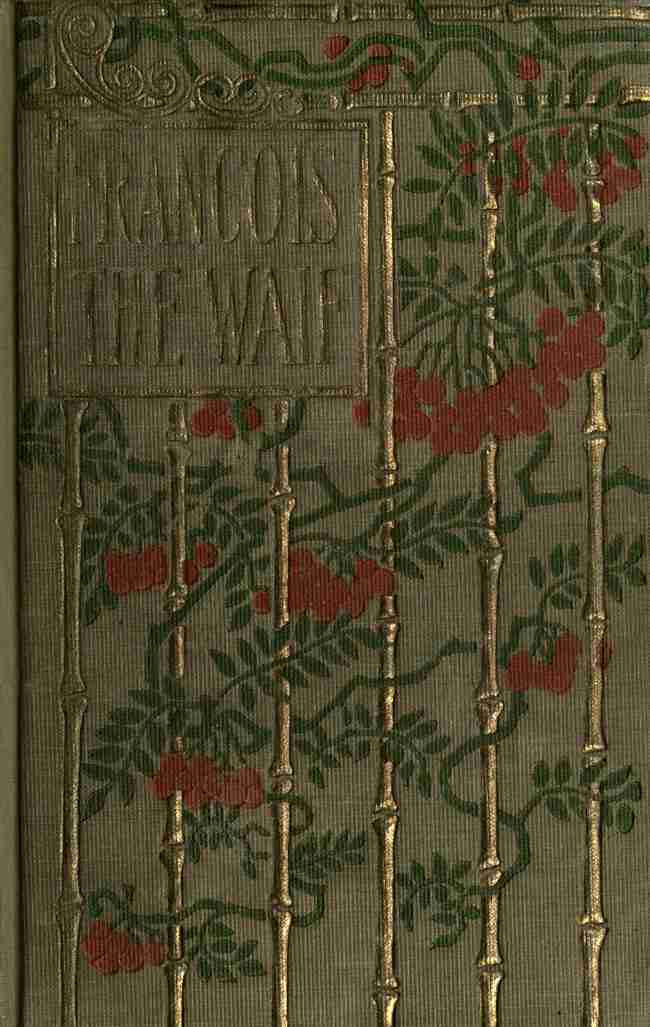
The Project Gutenberg eBook of François the waif
Title: François the waif
Author: George Sand
Illustrator: Eugène-Michel-Joseph Abot
Translator: Jane Minot Sedgwick
Release date: October 14, 2022 [eBook #69153]
Most recently updated: October 19, 2024
Language: English
Original publication: United States: G. H. Richmond & co, 1894
Credits: Laura Natal Rodrigues (Images generously made available by Hathi Trust Digital Library.)
FRANÇOIS THE WAIF
BY
GEORGE SAND
TRANSLATED FROM THE FRENCH BY
JANE MINOT SEDGWICK
WITH AN ETCHING BY E. ABOT
NEW-YORK
GEORGE H. RICHMOND & CO.
1894
CONTENTS
PREFATORY NOTE
PREFACE
INTRODUCTION
CHAPTER I
CHAPTER II
CHAPTER III
CHAPTER IV
CHAPTER V
CHAPTER VI
CHAPTER VII
CHAPTER VIII
CHAPTER IX
CHAPTER X
CHAPTER XI
CHAPTER XII
CHAPTER XIII
CHAPTER XIV
CHAPTER XV
CHAPTER XVI
CHAPTER XVII
CHAPTER XVIII
CHAPTER XIX
CHAPTER XX
CHAPTER XXI
CHAPTER XXII
CHAPTER XXIII
CHAPTER XXIV
CHAPTER XXV
PREFATORY NOTE
François le Champi, a pretty idyl that tells of homely affections, self-devotion, "humble cares and delicate fears," opens a little vista into that Arcadia to which, the poet says, we were all born. It offers many difficulties to the translator. It is a rustic tale, put into the mouths of peasants, who relate it with a primitive simplicity, sweet and full of sentiment in the French, but prone to degenerate into mawkishness and monotony when turned into English. Great care has been taken to keep the English of this version simple and idiomatic, and yet religiously to avoid any breach of faith toward the author. It is hoped that, though the original pure and limpid waters have necessarily contracted some stain by being forced into another channel, they may yet yield refreshment to those thirsty souls who cannot seek them at the fountain-head.
J. M. S.
Stockbridge, January, 1894.
PREFACE
FRANÇOIS LE CHAMPI appeared for the first time in the feuilleton of the "Journal des Débats." Just as the plot of my story was reaching its development, another more serious development was announced in the first column of the same newspaper. It was the final downfall of the July Monarchy, in the last days of February, 1848.
This catastrophe was naturally very prejudicial to my story, the publication of which was interrupted and delayed, and not finally completed, if I remember correctly, until the end of a month. For those of my readers who are artists either by profession or instinct, and are interested in the details of the construction of works of art, I shall add to my introduction that, some days before the conversation of which that introduction is the outcome, I took a walk through the Chemin aux Napes. The word nape, which, in the figurative language of that part of the country, designates the beautiful plant called nénufar, or nymphææ, is happily descriptive of the broad leaves that lie upon the surface of the water, as a cloth (nappe) upon a table; but I prefer to write it with a single p, and to trace its derivation from napée, thus leaving unchanged its mythological origin.
The Chemin aux Napes, which probably none of you, my dear readers, will ever see, as it leads to nothing that can repay you for the trouble of passing through so much mire, is a break-neck path, skirting along a ditch where, in the muddy water, grow the most beautiful nymphææ in the world, more fragrant than lilies, whiter than camellias, purer than the vesture of virgins, in the midst of the lizards and other reptiles that crawl about the mud and flowers, while the kingfisher darts like living lightning along the banks, and skims with a fiery track the rank and luxuriant vegetation of the sewer.
A child six or seven years old, mounted bare-back upon a loose horse, made the animal leap the hedge behind me, and then, letting himself slide to the ground, left his shaggy colt in the pasture, and returned to try jumping over the barrier which he had so lightly crossed on horseback a minute before. It was not such an easy task for his little legs; I helped him, and had with him a conversation similar to that between the miller's wife and the foundling, related in the beginning of "The Waif." When I questioned him about his age, which he did not know, he literally delivered himself of the brilliant reply that he was two years old. He knew neither his own name, nor that of his parents, nor of the place he lived in; all that he knew was to cling on an unbroken colt, as a bird clings to a branch shaken by the storm.
I have had educated several foundlings of both sexes, who have turned out well physically and morally. It is no less certain, however, that these forlorn children are apt, in rural districts, to become bandits, owing to their utter lack of education. Intrusted to the care of the poorest people, because of the insufficient pittance assigned to them, they often practise, for the benefit of their adopted parents, the shameful calling of beggars. Would it not be possible to increase this pittance on condition that the foundlings shall never beg, even at the doors of their neighbors and friends?
I have also learned by experience that nothing is more difficult than to teach self-respect and the love of work to children who have already begun understandingly to live upon alms.
GEORGE SAND.
Nohant, May 20, 1852.
THE WAIF
INTRODUCTION
R*** AND I were coming home from our walk by the light of the moon which faintly silvered the dusky country lanes. It was a mild autumn evening, and the sky was slightly overcast; we observed the resonance of the air peculiar to the season, and a certain mystery spread over the face of nature. At the approach of the long winter sleep, it seems as if every creature and thing stealthily agreed to enjoy what is left of life and animation before the deadly torpor of the frost; and as if the whole creation, in order to cheat the march of time, and to avoid being detected and interrupted in the last frolics of its festival, advanced without sound or apparent motion toward its orgies in the night. The birds give out stifled cries instead of their joyous summer warblings. The cricket of the fields sometimes chirps inadvertently; but it soon stops again, and carries elsewhere its song or its wail. The plants hastily breathe out their last perfume, which is all the sweeter for being more delicate and less profuse. The yellowing leaves now no longer rustle in the breeze, and the flocks and herds graze in silence without cries of love or combat.
My friend and I walked quietly along, and our involuntary thoughtfulness made us silent and attentive to the softened beauty of nature, and to the enchanting harmony of her last chords, which were dying away in an imperceptible pianissimo. Autumn is a sad and sweet andante, which makes an admirable preparation for the solemn adagio of winter.
"It is all so peaceful," said my friend at last, for, in spite of our silence, he had followed my thoughts as I followed his; "everything seems absorbed in a reverie so foreign and so indifferent to the labors, cares, and preoccupations of man, that I wonder what expression, what color, and what form of art and poetry human intelligence could give at this moment to the face of nature. In order to explain better to you the end of my inquiry, I may compare the evening, the sky, and the landscape, dimmed, and yet harmonious and complete, to the soul of a wise and religious peasant, who labors and profits by his toil, who rejoices in the possession of the life to which he is born, without the need, the longing, or the means of revealing and expressing his inner life. I try to place myself in the heart of the mystery of this natural rustic life—I, who am civilized, who cannot enjoy by instinct alone, and who am always tormented by the desire of giving an account of my contemplation, or of my meditation, to myself and to others.
"Then, too," continued my friend, "I am trying to find out what relation can be established between my intelligence, which is too active, and that of the peasant, which is not active enough; just as I was considering a moment ago what painting, music, description, the interpretation of art, in short, could add to the beauty of the autumnal night which is revealed to me in its mysterious silence, and affects me in some magical and unknown way."
"Let us see," said I, "how your question is put. This October night, this colorless sky, this music without any distinct or connected melody, this calm of nature, and the peasant who by his very simplicity is more able than we to enjoy and understand it, though he cannot portray it—let us put all this together and call it primitive life, with relation to our own highly developed and complicated life, which I shall call artificial life. You are asking what possible connection or direct link can there be between these two opposite conditions in the existence of persons and things; between the palace and the cottage, between the artist and the universe, between the poet and the laborer."
"Yes," he answered, "and let us be exact: between the language spoken by nature, primitive life, and instinct, and that spoken by art, science,—in a word, by knowledge."
"To answer in the language you have adopted, I should say that the link between knowledge and sensation is feeling."
"It is about the definition of feeling that I am going to question you and myself, for its mission is the interpretation which is troubling me. It is the art or artist, if you prefer, empowered to translate the purity, grace, and charm of the primitive life to those who only live the artificial life, and who are, if you will allow me to say so, the greatest fools in the world in the presence of nature and her divine secrets."
"You are asking nothing less than the secret of art, and you must look for it in the breast of God. No artist can reveal it, for he does not know it himself, and cannot give an account of the sources of his own inspiration or his own weakness. How shall one attempt to express beauty, simplicity, and truth? Do I know? And can anybody teach us? No, not even the greatest artists, because if they tried to do so they would cease to be artists, and would become critics; and criticism—"
"And criticism," rejoined my friend, "has been revolving for centuries about the mystery without understanding it. But, excuse me, that is not exactly what I meant. I am still more radical at this moment, and call the power of art in question. I despise it, I annihilate it, I declare that art is not born, that it does not exist; or, if it has been, its time is past. It is exhausted, it has no more expression, no more breath of life, no more means to sing of the beauty of truth. Nature is a work of art, but God is the only artist that exists, and man is but an arranger in bad taste. Nature is beautiful, and breathes feeling from all her pores; love, youth, beauty are in her imperishable. But man has but foolish means and miserable faculties for feeling and expressing them. He had better keep aloof, silent and absorbed in contemplation. Come, what have you to say?"
"I agree, and am quite satisfied with your opinion," I answered.
"Ah!" he cried, "you are going too far, and embrace my paradox too warmly. I am only pleading, and want you to reply."
"I reply, then, that a sonnet of Petrarch has its relative beauty, which is equivalent to the beauty of the water of Vaucluse; that a fine landscape of Ruysdael has a charm which equals that of this evening; that Mozart sings in the language of men as well as Philomel in that of birds; that Shakspeare delineates passions, emotions, and instincts as vividly as the actual primitive man can experience them. This is art and its relativeness—in short, feeling."
"Yes, it is all a work of transformation! But suppose that it does not satisfy me? Even if you were a thousand times in the right according to the decrees of taste and esthetics, what if I think Petrarch's verses less harmonious than the roar of the waterfall, and so on? If I maintain that there is in this evening a charm that no one could reveal to me unless I had felt it myself; and that all Shakspeare's passion is cold in comparison with that I see gleaming in the eyes of a jealous peasant who beats his wife, what should you have to say? You must convince my feeling. And if it eludes your examples and resists your proofs? Art is not an invincible demonstrator, and feeling not always satisfied by the best definition."
"I have really nothing to answer except that art is a demonstration of which nature is the proof; that the preëxisting fact of the proof is always present to justify or contradict the demonstration, which nobody can make successfully unless he examine the proof with religious love."
"So the demonstration could not do without the proof; but could the proof do without the demonstration?"
"No doubt God could do without it; but, although you are talking as if you did not belong to us, I am willing to wager that you would understand nothing of the proof if you had not found the demonstration under a thousand forms in the tradition of art, and if you were not yourself a demonstration constantly acting upon the proof."
"That is just what I am complaining of. I should like to rid myself of this eternal irritating demonstration; to erase from my memory the teachings and the forms of art; never to think of painting when I look at a landscape, of music when I listen to the wind, or of poetry when I admire and take delight in both together. I should like to enjoy everything instinctively, because I think that the cricket which is singing just now is more joyous and ecstatic than I."
"You complain, then, of being a man?"
"No; I complain of being no longer a primitive man."
"It remains to be known whether he was capable of enjoying what he could not understand."
"I do not suppose that he was similar to the brutes, for as soon as he became a man he thought and felt differently from them. But I cannot form an exact idea of his emotions, and that is what bothers me. I should like to be what the existing state of society allows a great number of men to be from the cradle to the grave—I should like to be a peasant; a peasant who does not know how to read, whom God has endowed with good instincts, a serene organization, and an upright conscience; and I fancy that in the sluggishness of my useless faculties, and in the Ignorance of depraved tastes, I should be as happy as the primitive man of Jean-Jacques's dreams."
"I, too, have had this same dream; who has not? But, even so, your reasoning is not conclusive, for the most simple and ingenuous peasant may still be an artist; and I believe even that his art is superior to ours. The form is different, but it appeals more strongly to me than all the forms which belong to civilization. Songs, ballads, and rustic tales say in a few words what our literature can only amplify and disguise."
"I may triumph, then?" resumed my friend. "The peasant's art is the best, because it is more directly inspired by nature by being in closer contact with her. I confess I went to extremes in saying that art was good for nothing; but I meant that I should like to feel after the fashion of the peasant, and I do not contradict myself now. There are certain Breton laments, made by beggars, which in three couplets are worth all Goethe and Byron put together, and which prove that appreciation of truth and beauty was more spontaneous and complete in such simple souls than in our most distinguished poets. And music, too! Is not our country full of lovely melodies? And though they do not possess painting as an art, they have it in their speech, which is a hundred times more expressive, forcible, and logical than our literary language."
"I agree with you," said I, "especially as to this last point. It drives me to despair that I am obliged to write in the language of the Academy, when I am much more familiar with another tongue infinitely more fitted for expressing a whole order of emotions, thoughts, and feelings."
"Oh, yes!" said he, "that fresh and unknown world is closed to modern art, and no study can help you to express it even to yourself, with all your sympathies for the peasant, if you try to introduce it into the domain of civilized art and the intellectual intercourse of artificial life."
"Alas!" I answered, "this thought has often disturbed me. I have myself seen and felt, in common with all civilized beings, that primitive life was the dream and ideal of all men and all times. From the shepherds of Longus down to those of Trianon, pastoral life has been a perfumed Eden, where souls wearied and harassed by the tumult of the world have sought a refuge. Art, which has always flattered and fawned upon the too fortunate among mankind, has passed through an unbroken series of pastorals. And under the title of 'The History of Pastorals' I have often wished to write a learned and critical work, in which to review all the different rural dreams to which the upper classes have so fondly clung.
"I should follow their modifications, which are always in inverse relation to the depravity of morals, for they become innocent and sentimental in proportion as society is shameless and corrupt. I should like to order this book of a writer better qualified than I to accomplish it, and then I should read it with delight. It should be a complete treatise on art; for music, painting, architecture, literature in all its forms, the theater, poetry, romances, eclogues, songs, fashions, gardens, and even dress, have been influenced by the infatuation for the pastoral dream. All the types of the golden age, the shepherdesses of Astræa, who are first nymphs and then marchionesses, and who pass through the Lignon of Florian, wear satin and powder under Louis XV., and are put into sabots by Sedaine at the end of the monarchy, are all more or less false, and seem to us to-day contemptible and ridiculous. We have done with them, and see only their ghosts at the opera; and yet they once reigned at court and were the delight of kings, who borrowed from them the shepherd's crook and scrip.
"I have often wondered why there are no more shepherds, for we are not so much in love with the truth lately that art and literature can afford to despise the old conventional types rather than those introduced by the present mode. To-day we are devoted to force and brutality, and on the background of these passions we embroider decorations horrible enough to make our hair stand on end if we could take them seriously."
"If we have no more shepherds," rejoined my friend, "and if literature has changed one false ideal for another, is it not an involuntary attempt of art to bring itself down to the level of the intelligence of all classes? Does not the dream of equality afloat in society impel art to a fierce brutality in order to awaken those instincts and passions common to all men, of whatever rank they may be? Nobody has as yet reached the truth. It exists no more in a hideous realism than in an embellished idealism; but there is plainly a search for it, and if the search is in the wrong direction, the eagerness of the pursuit is only quickened. Let us see: the drama, poetry, and the novel have thrown away the shepherd's crook for the dagger, and when rustic life appears on the scene it has a stamp of reality which was wanting in the old pastorals. But there is no more poetry in it, I am sorry to say; and I do not yet see the means of reinstating the pastoral ideal without making it either too gaudy or too somber. You have often thought of doing it, I know; but can you hope for success?"
"No," I answered, "for there is no form for me to adopt, and there is no language in which to express my conception of rustic simplicity. If I made the laborer of the fields speak as he does speak, it would be necessary to have a translation on the opposite page for the civilized reader; and if I made him speak as we do, I should create an impossible being, in whom it would be necessary to suppose an order of ideas which he does not possess."
"Even if you made him speak as he does speak, your own language would constantly make a disagreeable contrast; and in my opinion you cannot escape this criticism. You describe a peasant girl, call her Jeanne, and put into her mouth words which she might possibly use. But you, who are the writer of the novel, and are anxious to make your readers understand your fondness for painting this kind of type—you compare her to a druidess, to a Jeanne d'Arc, and so on. Your opinions and language make an incongruous effect with hers, like the clashing of harsh colors in a picture; and this is not the way fully to enter into nature, even if you idealize her. Since then you have made a better and more truthful study in 'The Devil's Pool.' Still, I am not yet satisfied; the tip of the author's finger is apparent from time to time; and there are some author's words, as they are called by Henri Mounier, an artist who has succeeded in being true in caricature, and who has consequently solved the problem he had set for himself. I know that your own problem is no easier to solve. But you must still try, although you are sure of not succeeding; masterpieces are only lucky attempts. You may console yourself for not achieving masterpieces, provided that your attempts are conscientious."
"I am consoled beforehand," I answered, "and I am willing to begin again whenever you wish; please give me your advice."
"For example," said he, "we were present last evening at a rustic gathering at the farm, and the hemp-dresser told a story until two o'clock in the morning. The priest's servant helped him with his tale, and resumed it when he stopped; she was a peasant-woman of some slight education; he was uneducated, but happily gifted by nature and endowed with a certain rude eloquence. Between them they related a true story, which was rather long, and like a simple kind of novel. Can you remember it?"
"Perfectly, and I could repeat it word for word in their language."
"But their language would require a translation; you must write in your own, without using a single word unintelligible enough to necessitate a footnote for the reader."
"I see that you are setting an impossible task for me—a task into which I have never plunged without emerging dissatisfied with myself, and overcome with a sense of my own weakness."
"No matter, you must plunge in again, for I understand you artists; you need obstacles to rouse your enthusiasm, and you never do well what is plain and easy to you. Come, begin, tell me the story of the 'Waif,' but not in the way that you and I heard it last night. That was a masterly piece of narrative for you and me who are children of the soil. But tell it to me as if you had on your right hand a Parisian speaking the modern tongue, and on your left a peasant before whom you were unwilling to utter a word or phrase which he could not understand. You must speak dearly for the Parisian, and simply for the peasant. One will accuse you of a lack of local color, and the other of a lack of elegance. But I shall be listening too, and I am trying to discover by what means art, without ceasing to be universal, can penetrate the mystery of primitive simplicity, and interpret the charm of nature to the mind."
"This, then, is a study which we are going to undertake together?"
"Yes, for I shall interrupt you when you stumble."
"Very well, let us sit down on this bank covered with wild thyme. I will begin; but first allow me to clear my voice with a few scales."
"What do you mean? I did not know that you could sing."
"I am only speaking metaphorically. Before beginning a work of art, I think it is well to call to mind some theme or other to serve as a type, and to induce the desired frame of mind. So, in order to prepare myself for what you ask, I must recite the story of the dog of Brisquet, which is short, and which I know by heart."
"What is it? I cannot recall it."
"It is an exercise for my voice, written by Charles Nodier, who tried his in all possible keys; a great artist, to my thinking, and one who has never received all the applause he deserved, because, among all his varied attempts, he failed more often than he succeeded. But when a man has achieved two or three masterpieces, no matter how short they may be, he should be crowned, and his mistakes should be forgotten. Here is the dog of Brisquet. You must listen."
Then I repeated to my friend the story of the "Bichonne," which moved him to tears, and which he declared to be a masterpiece of style.
"I should be discouraged in what I am going to attempt," said I, "for this Odyssey of the poor dog of Brisquet, which did not take five minutes to recite, has no stain or blot; it is a diamond cut by the first lapidary in the world—for Nodier is essentially a lapidary in literature. I am not scientific, and must call sentiment to my aid. Then, too, I cannot promise to be brief, for I know beforehand that my study will fail in the first of all requisites, that of being short and good at the same time."
"Go on, nevertheless," said my friend, bored by my preliminaries.
"This, then, is the history of 'François the Champi'" I resumed, "and I shall try to remember the first part without any alteration. It was Monique, the old servant of the priest, who began."
"One moment," said my severe auditor, "I must object to your title. Champi is not French."
"I beg your pardon," I answered. "The dictionary says it is obsolete, but Montaigne uses it, and I do not wish to be more French than the great writers who have created the language. So I shall not call my story 'François the Foundling,' nor 'François the Bastard,' but 'François the Champi'—that is to say, the Waif, the forsaken child of the fields, as he was once called in the great world, and is still called in our part of the country."
CHAPTER I
ONE morning, when Madeleine Blanchet, the young wife of the miller of Cormouer, went down to the end of her meadow to wash her linen in the fountain, she found a little child sitting in front of her washing-board playing with the straw she used as a cushion for her knees. Madeleine Blanchet looked at the child, and was surprised not to recognize him, for the road which runs near by is unfrequented, and few strangers are to be met with in the neighborhood.
"Who are you, my boy?" said she to the little boy, who turned confidingly toward her, but did not seem to understand her question. "What is your name?" Madeleine Blanchet went on, as she made him sit down beside her, and knelt down to begin to wash.
"François," answered the child.
"François who?"
"Who?" said the child stupidly.
"Whose son are you?"
"I don't know."
"You don't know your father's name?"
"I have no father."
"Is he dead then?"
"I don't know."
"And your mother?"
"She is over there," said the child pointing to a poor little hovel which stood at the distance of two gunshots from the mill, and the thatched roof of which could be seen through the willows.
"Oh! I know," said Madeleine. "Is she the woman who has come to live here, and who moved in last evening?"
"Yes," answered the child.
"And you used to live at Mers?"
"I don't know."
"You are not a wise child. Do you know your mother's name, at least?"
"Yes, it is Zabelle."
"Isabelle who? Don't you know her other name?"
"No, of course not."
"What you know will not wear your brains out," said Madeleine, smiling and beginning to beat her linen.
"What do you say?" asked little François. Madeleine looked at him again; he was a fine child, and had magnificent eyes. "It is a pity," she thought, "that he seems to be so idiotic. How old are you?" she continued. "Perhaps you do not know that either."
The truth is that he knew no more about this than about the rest. He tried his best to answer, ashamed to have the miller's wife think him so foolish, and delivered himself of this brilliant reply:
"Two years old."
"Indeed?" said Madeleine, wringing out her linen, without looking at him any more, "you are areal little simpleton, and nobody has taken the trouble to teach you, my poor child. You are tall enough to be six years old, but you have not the sense of a child of two."
"Perhaps," answered François. Then, making another effort, as if to shake off the lethargy from his poor little mind, he said:
"Were you asking for my name? It is François the Waif."
"Oh! I understand now," said Madeleine, looking at him compassionately; and she was no longer astonished that he was so dirty, ragged, and stupid.
"You have not clothes enough," said she, "and the weather is chill; I am sure that you must be cold."
"I do not know," answered the poor waif, who was so accustomed to suffering that he was no longer conscious of it.
Madeleine sighed. She thought of her little Jeannie, who was only a year old, and was sleeping comfortably in his cradle watched over by his grand-mother, while this poor little waif was shivering all alone at the fountain's brink, preserved from drowning only by the mercy of Providence, for he was too foolish to know that he would die if he fell into the water.
Madeleine, whose heart was full of kindness, felt the child's arm and found it warm, although he shook from time to time, and his pretty face was very pale.
"Have you any fever?" she asked.
"I don't know," answered the child, who was always feverish.
Madeleine Blanchet loosened the woolen shawl from her shoulders and wrapped it round the waif, who let her have her way without showing either surprise or pleasure. She picked up all the straw from under his knees and made a bed for him, on which he soon fell asleep; then she made haste to finish washing her little Jeannie's clothes, for she nursed her baby and was anxious to return to him.
When her task was completed, the wet linen was twice as heavy as before, and she could not carry it all. She took home what she could, and left the rest with her wooden beater beside the water, intending to come back immediately and wake up the waif. Madeleine Blanchet was neither tall nor strong. She was a very pretty woman, with a fearless spirit and a reputation for sense and sweetness.
As she opened the door of her house she heard the clattering of sabots running after her over the little bridge above the mill-dam, and, turning round, she saw the waif, who had caught up with her, and was bringing her her beater, her soap, the rest of the linen, and her shawl.
"Oh!" said she, laying her hand on his shoulder, "you are not so foolish as I thought, for you are obliging, and nobody who has a good heart can be stupid. Come in, my child, come in and rest. Look at this poor little boy! He is carrying a load heavier than himself! Here," said she to the miller's old mother, who handed her her baby, rosy and smiling, "here is a poor sick-looking waif. You understand fevers, and we must try to cure him."
"Ah! that is the fever of poverty!" replied the old woman, as she looked at François. "He could cure it with good soup, but he cannot get that. He is the little waif that belongs to the woman who moved in yesterday. She is your husband's tenant, Madeleine. She looks very wretched, and I am afraid that she will not pay regularly."
Madeleine did not answer. She knew that her husband and her mother-in-law were not charitable, and that they loved their money more than their neighbor. She nursed her baby, and when the old woman had gone out to drive home the geese, she took François by the hand, and, holding Jeannie on her arm, went with them to Zabelle's.
Zabelle, whose real name was Isabelle Bigot, was an old maid of fifty, as disinterested as a woman can be when she has nothing to live on, and is in constant dread of starvation. She had taken François after he was weaned, from a dying woman, and had brought him up ever since, for the sake of the monthly payment of a few pieces of silver, and with the expectation of making a little servant out of him. She had lost her sheep, and was forced to buy others on credit, whenever she could obtain it; for she had no other means of support than her little flock, and a dozen hens, which lived at the expense of the parish. She meant François to tend this poor flock along the roadsides, until he should be old enough to make his first communion, after which she expected to hire him out as best she could, either as a little swineherd or a plowboy, and she was sure that if his heart were good he would give part of his wages to his adopted mother.
Zabelle had come from Mers, the day after the feast of Saint Martin, leaving her last goat behind her in payment of what she owed on her rent, and had taken possession of the little cottage belonging to the mill of Cormouer, without being able to offer any security beside her pallet-bed, two chairs, a chest, and a few earthen vessels. The house was so poor, so ill-protected from the weather, and of such trifling value, that the miller was obliged to incur the risk of letting it to a poor tenant, or to leave it unoccupied.
Madeleine talked with Zabelle, and soon perceived that she was not a bad woman, and that she would do all in her power to pay the rent. She had some affection for the waif, but she was so accustomed to see him suffer and to suffer herself that she was at first more surprised than pleased by the pity which the rich miller's wife showed for the forlorn child.
At last, after she had recovered from her astonishment, and understood that Madeleine had not come to ask anything of her, but to do her a kindness, she took courage, related her story, which was like that of all the unfortunate, and thanked her warmly for her interest. Madeleine assured her that she would do her best to help her, but begged her to tell nobody, acknowledging that she was not her own mistress at home, and could only afford her assistance in secret.
She left her woolen shawl with Zabelle, and exacted a promise from her that she would cut it into a coat for the waif that same evening, and not allow the pieces to be seen before they were sewed together. She saw, indeed, that Zabelle consented reluctantly, thinking the shawl very convenient for her own use, and so she was obliged to tell her that she would do no more for her unless the waif were warmly clothed in three days' time.
"Do you not suppose," she added, "that my mother-in-law, who is so wide-awake, would recognize my shawl on your shoulders? Do you wish to get me into trouble? You may count upon my helping you in other ways if you keep your own counsel. Now, listen to me: your waif has the fever, and he will die if you do not take good care of him."
"Do you think so?" said Zabelle. "I should be very sorry to lose him, because he has the best heart in the world; he never complains, and is as obedient as if he belonged to a respectable family. He is quite different from other waifs, who are ill-tempered and unruly, and always in mischief."
"That is only because they are rebuffed and ill-treated. If yours is good, it is because you have been kind to him, you may be sure."
"That is true," rejoined Zabelle; "children are more grateful than people think, and though this little fellow is not bright, he can be very useful at times. Once, when I was ill last year, and he was only five years old, he took as good care of me as if he were a grown-up person."
"Listen," said the miller's wife: "you must send him to me every morning and evening, at the hour when I give soup to my child. I shall make more than is necessary, and the waif may eat what is left; nobody will pay any attention."
"Oh! I shall not dare bring him to you, and he will never have enough sense to know the right time himself."
"Let us arrange it in this way. When the soup is ready, I will put my distaff on the bridge over the dam. Look, you can see it very well from here. Then you must send the child over with a sabot in his hand, as if he were coming to get a light for the fire; and if he eats my soup, you will have all yours to yourself. You will both be better fed."
"That will do very well," answered Zabelle. "I see that you are a clever woman, and that I am fortunate in coming here. I was very much afraid of your husband, who has the reputation of being a hard man, and if I could have gone elsewhere I should not have taken his house, especially as it is in wretched repair, and the rent is high. But I see that you are kind to the poor, and will help me to bring up my waif. Ah! if the soup could only cure his fever! It would be a great misfortune to me to lose that child! He brings me but little profit, for all that I receive from the asylum goes for his support. But I love him as if he were my own child, because I know that he is good, and will be of use to me later. Have you noticed how well-grown he is for his age, and will soon be able to work?"
Thus François the Waif was reared by the care and kindness of Madeleine, the miller's wife. He soon recovered his health, for he was strongly built, and any rich man in the country might have wished for a son with as handsome a face and as well-knit a frame. He was as brave as a man, and swam in the river like a fish, diving even under the mill-dam; he feared neither fire nor water; he jumped on the wildest colts and rode them without a halter into the pasture, kicking them with his heels to keep them in the right path, and holding on to their manes when they leaped the ditches. It was singular that he did all this in his quiet, easy way, without saying anything, or changing his childlike and somewhat sleepy expression.
It was on account of this expression that he passed for a fool; but it is none the less true that if it were a question of robbing a magpie's nest at the top of a lofty poplar, or of finding a cow that had strayed far from home, or of killing a thrush with a stone, no child was bolder, more adroit, or more certain of success than he. The other children called it luck, which is supposed to be the portion of a waif in this hard world. So they always let him take the first part in dangerous amusements.
"He will never get hurt," they said, "because he is a waif. A kernel of wheat fears the havoc of the storm, but a random seed never dies."
For two years all went well. Zabelle found means to buy a few sheep and goats, though no one knew how. She rendered a good many small services to the mill, and Cadet Blanchet, the miller, was induced to make some repairs in her roof, which leaked in every direction. She was enabled to dress herself and her waif a little better, and looked gradually less poverty-stricken than on her arrival. Madeleine's mother-in-law made some harsh comments on the disappearance of certain articles, and on the quantity of bread consumed in the house, and once Madeleine was obliged to plead guilty in order to shield Zabelle from suspicion; but, contrary to his mother's expectation, Cadet Blanchet was hardly angry at all, and seemed to wink at what his wife had done.
The secret of Cadet Blanchet's compliance was that he was still very much in love with his wife. Madeleine was pretty, and not the least of a coquette; he heard her praises sung everywhere. Besides, his affairs were prosperous, and, as he was one of those men who are cruel only when they are in dread of calamity, he was kinder to Madeleine than anybody could have supposed possible. This roused Mother Blanchet's jealousy, and she revenged herself by petty annoyances, which Madeleine bore in silence, and without complaining to her husband.
It was the best way of putting an end to them, and no woman could be more patient and reasonable in this respect than Madeleine. But they say in our country that goodness avails less in the end than malice, and the day came when Madeleine was rebuked and called to account for her charities.
It was a year when the grain had been wasted by hail, and an overflow of the river had spoiled the hay. Cadet Blanchet was not in a good humor, and one day, as he was coming back from market with a comrade who had just married a very beautiful girl, the latter said to him:
"You, too, were not to be pitied in your day, for your Madelon used to be a very attractive girl."
"What do you mean by my day, and Madelon used to be? Do you think that she and I are old? Madeleine is not twenty yet, and I am not aware that she has lost her looks."
"Oh, no, I do not say so," replied the other. "Madeleine is certainly still good-looking; but you know that when a woman marries so young you cannot expect her to be pretty long. After she has nursed one child, she is already worn; and your wife was never strong, for you see that she is very thin, and has lost the appearance of health. Is the poor thing ill?"
"Not that I know of. Why do you ask me?"
"Oh, I don't know. I think she looks sad, as if she suffered or had some sorrow. A woman's bloom lasts no longer than the blossom of the vine. I must expect to see my wife with a long face and sober expression. And we men are only in love with our wives while we are jealous of them. They exasperate us; we scold them and beat them sometimes; they are distressed and weep; they stay at home and are afraid of us; then they are bored and care no more about us. But we are happy, for we are the masters. And yet, one fine morning, lo and behold, a man sees that if nobody wants his wife, it is because she has grown ugly; so he loves her no longer, and goes to court his neighbor's. It is his fate. Good evening, Cadet Blanchet; you kissed my wife rather too warmly to-night; I took note of it, though I said nothing. I tell you this to let you know that she and I shall not quarrel over it, and that I shall try not to make her as melancholy as yours, because I know my own character. If I am ever jealous, I shall be cruel, and when I have no more occasion for jealousy, I shall be still worse perhaps."
A good disposition profits by a good lesson; but, though active and intelligent, Cadet Blanchet was too arrogant to keep his self-possession. He came home with his head high and his eye bloodshot. He looked at Madeleine as he had not done for a long time, and perceived that she was pale and altered. He asked her if she were ill, so rudely that she turned still paler, and answered in a faint voice that she was quite well. He took offense, Heaven knows why, and sat down to the table, desirous of seeking a quarrel. He had not long to wait for an opportunity. They talked of the dearness of wheat, and Mother Blanchet remarked, as she did every evening, that too much bread was eaten in the house. Madeleine was silent. Cadet Blanchet wanted to make her responsible for the waste, and the old woman declared that she had caught the waif carrying away half a loaf that very morning. Madeleine should have been indignant and held her own, but she could only cry. Blanchet thought of what his companion had said to him, and was still more irritated; and so it happened that from that day on, explain it as you can, he no longer loved his wife, but made her wretched.