
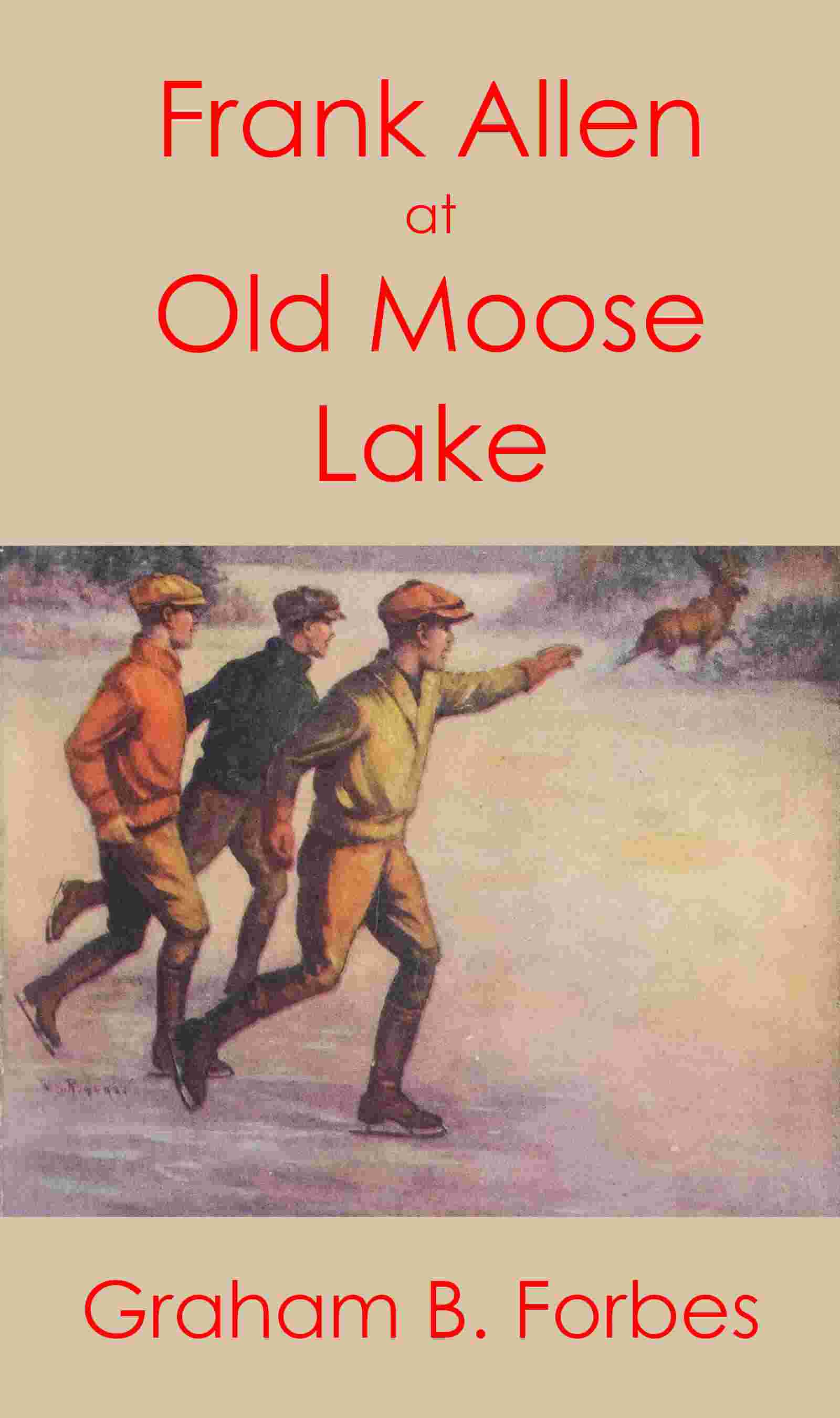
CHAPTER III
A BIG REWARD IS OFFERED
“Well—that’s that!” said Lanky Wallace as the sounds of the car died away.
“I don’t know whether that’s that or something else,” Frank replied. “That fellow Jeek doesn’t look good to me, and the two fellows he had with him looked as if they’d rather knock a fellow in the head than eat a square meal.”
The girls were still trembling over the excitement of the mad dog and its subsequent shooting, and the arrival of the men with their threats of harm.
Frank wished to dispel the gloom which had fallen on the little party, and now proposed that they continue with the nutting. On the other hand Minnie Cuthbert proposed that the boys go on with their target practice, the girls to sit and watch the contest. But now the boys seemed more inclined to gathering nuts than to gathering target scores.
“I believe that grove over further toward the river ought to have some fine nuts, and I don’t think any others have been after them, because it’s rather rough getting there,” suggested Frank, nodding toward the Harrapin River.
The entire party decided at once on going, for, like merry, happy young folks, it did not matter so very much that they found many nuts—not so much as the good time and the adventure of hunting for them.
Up and down, over little hillocks and through brush-covered glens, sometimes moving in a bunch and often moving single file through narrow places, they made their way through the woods until they came to the bank of the Harrapin and then turned upstream.
“There is the grove!” Frank pointed up the river a short distance, and, from where they stood, the little party saw that it was a fine grove for nutting.
Five minutes later they realized that Frank’s guess was good—that no one else had come through this rough woods to get the nuts.
In the meanwhile heavy clouds had drawn across the skies, finally permitting the broad expanse of gray, snow-filled clouds to predominate over the blue.
Several times Lanky and Frank looked up through the clearings and had noted the coming of a fall storm.
It was getting very much cooler, with the gray clouds hanging lower and lower, but the merry laughing and talking, jesting and snatches of song drowned out any thought or fear of getting caught in a storm.
The boys had filled their pockets and their hats with nuts, the hats having been set aside, all in a row beside a tree. And now the first little flakes of snow began falling.
“The first of winter,” said Ralph West. “It won’t be long before skating and sleighing will be fine.”
Very shortly they prepared to go home, but stopped at the spot where target practice had been started long enough to try a few more shots.
“Let me shoot once!” cried Minnie when it was Frank’s turn at the target. “I want to shoot a bear.”
She took Frank’s repeating rifle, and, after being shown by Frank how to keep it pointed away from the others and towards the target, she lifted it to her shoulder, closed the wrong eye, and tried to sight.
“I can’t see anything!”
While the laughing and joking continued, Frank taught Minnie how to sight along the rifle, how to hold it properly, and after many rather grotesque attempts, she took careful aim and fired.
At the crack of the rifle she thrilled with the pleasure of it, though startled to think she had started a bullet on its way to the target.
“Where did it go? Where did it hit?” she cried.
“Last I saw of it it was on its way up the river!” called Lanky Wallace. “You know, Minnie, it went right over the top of that tree,” he added, pointing high in the air.
But, undaunted, she tried again, and this time the target showed a hole, though at the outer ring.
A few more shots were fired, with Minnie gradually learning, for she was hitting the target or close around it each time.
All things must have an end, and finally they started toward home, burdened with nuts, though the distance to town was not great.
As they trooped in a group down the broad walk of the avenue toward Frank’s house, whither it had been determined they would go for a short while, the girls to make fudge while the boys cracked the nuts, they spied Mr. Allen, Frank’s father, coming slowly along the street from town.
Helen left the others and ran ahead to meet her father.
Mr. Allen, who had almost lost his life in the fire at his department store on the night of the robbery of Mrs. Parsons, and to save whose life Frank had raced his Rocket down the Harrapin River to the town of Coville to obtain a heart stimulant which could not be found in Columbia or near-by towns, still carried a heavy stick. He leaned on this and he and Helen waited at the front walk for the others.
“How do you feel, dad,” said Frank, coming up with the crowd.
“Fine. Getting stronger every day. What have you been doing—target practice, nutting, and all that? Fine! It’s worth while to be young.”
Frank asked how repairs were going on at the store, and learned that the work was almost finished. The place had been quite seriously damaged by fire and water in the conflagration, and the cellar timbers had been weakened to a very considerable extent. It was the weakening of these timbers during the fire that had caused the accident to Mr. Allen.
Into the house trooped the crowd, led by Frank. The noise of the young folks called Mrs. Allen to the front of the house, with her long apron as evidence that she had been in the kitchen getting something good to eat ready for her brood.
“Out of the kitchen, mother!” called Helen, as she ushered every one in. “We’re making fudge while the boys crack the nuts, and you and dad are to wait in the living room until we’re done.”
So it went, and in a short while the girls came into the spacious front room with the plates of chocolate fudge, while the boys brought in a few extra nuts beyond those which had been used in the fudge, with salt generously sprinkled over them.
It was Helen who told the story of the mad dog, and of Frank’s having killed it, and it was Minnie Cuthbert who continued the story by telling about Fordham Jeek, of Bellport, and his threats.
“What about it, Frank?” asked Mr. Allen. “Shall we pay him for the dog? It’s too bad to have a fine dog killed.”
“Dad,” replied Frank, “paying that fellow Jeek two hundred dollars or any other sum for the dog won’t bring the dog back to life, will it? If a dog is a menace to human life, then we must get rid of the dog. That dog was a menace at the time it was shot. My decision is that there is nothing to be paid.”
“Is that the man who is a race-track follower?” asked Mr. Allen. And on getting an affirmative reply he went on: “He’s a slippery eel, if what I have heard is true. And, besides being slippery, I suppose he is a little to be feared, too.”
“I’ve no fear of him, dad” said Frank. “I have found that when a man does a whole lot of threatening he isn’t dangerous in the open.”
“That’s just it, my boy,” quietly replied the elder Allen. “If he were dangerous in the open he would have made you promise to pay for the dog right then—or fought.”
“There’s Mr. Van Kirk!” came a sudden cry from Helen, as she saw the rich old man, thin and straight as an arrow, more like a young soldier in stature than anything else, though he invariably carried a crooked hickory stick in his right hand. “Let’s call him in. I love to hear him talk!”
“Sure,” said Mr. Allen, craning his neck to look out the window. “Tell Jacob to come in here.”
With that Frank’s sister ran to the door and hailed the lonely old man of Columbia, a man who had seen the latter part of the Indian wars in the West country, who had been a huntsman all his life, and who knew the ways of the wild.
All the young folks gave him a hearty welcome when he came in and shook hands with Mr. and Mrs. Allen, and then with all the others.
“Mr. Van Kirk,” said Frank, as he saw the gray-haired old gentleman properly seated on one of the most comfortable of the large easy chairs, “we boys are going to a camp pretty soon and we are just wondering if you can’t give us some advice.”
“Well, Frank, I guess that is about as easy for me to do as for most folks. Advice is the finest and worse thing in the world. Fact is, anything that’s free is about worthless. Where are you going to camp?”
They told him of the offer made by Mrs. Parsons up at Old Moose Lake, just on the edge of the mountains.
The lined face of the gray old hunter was very expressive of emotions, the eyes twinkled and around them came the slowly formed wrinkles of a smile as he lifted his hand to the long beak of a thin nose and stroked it carefully.
“Tell you, Frank. If you’re going up to Old Moose Lake you’ve got a prize to look for. I wish I could go up there myself! There’s a big bull moose, a tremendous fellow and a fighter, too. Parsons and I saw him last just before Parsons died. I have been told he is still there. He’s a monster. Tell you what I’ll do——”
He paused while the boys listened with their mouths open, their eyes glistening in rapt attention.
“I’ve got a little extra money that I’d like to spend. I’ve got it in for that old bull moose—he almost got me the last time I was there. I’ll offer a hundred dollars to the boy among you who brings down that old fellow!”
A hundred dollar prize put up by this champion old hunter to the boy who would get that big bull moose!