
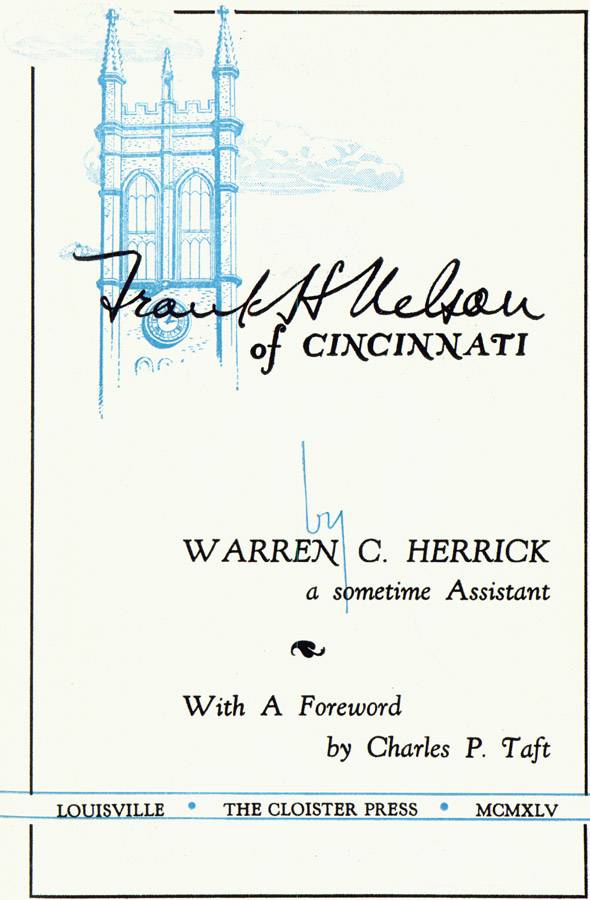
The Project Gutenberg eBook of Frank H. Nelson of Cincinnati
Title: Frank H. Nelson of Cincinnati
Author: Warren Crocker Herrick
Release date: October 20, 2008 [eBook #26980]
Most recently updated: January 4, 2021
Language: English
Credits: Produced by Mark C. Orton, Barbara Kosker and the Online
Distributed Proofreading Team at https://www.pgdp.net
Frank Nelson of Cincinnati
Writing is the offspring of thought, the lamp of remembrance, the tongue of him that is far-off, and the life of him whose age has been blotted out.
—Anon
Frank H Nelson
of CINCINNATI
by
WARREN C. HERRICK
a sometime Assistant
With A Foreword
by Charles P. Taft
LOUISVILLE · THE CLOISTER PRESS · MCMXLV
Copyright, 1945, By
The Cloister Press
All rights reserved. No part of this
book may be reproduced without the
written permission of The Cloister Press.
Printed in the United States of America
To My Wife
CONTENTS
| Page | ||
| 1. | "Arise, and go into the city" | 2 |
| 2. | Reclaiming A Church to Meet A New Age | 14 |
| 3. | The Shepherd Among His Flock | 30 |
| 4. | The Spokesman of The City's Conscience | 42 |
| 5. | They Came to Be in His Presence | 62 |
| 6. | Beyond Cincinnati | 76 |
| 7. | The Mystery of Personality | 88 |
| 8. | Last Years | 102 |
| 9. | The Afterglow | 110 |
ACKNOWLEDGMENTS
This book is made possible only through the interest and contributions of the many friends of Frank H. Nelson. Space does not permit my mentioning by name all who have furnished me with material, but I do wish to record my gratitude to them. In addition to the years 1925-1928 as Mr. Nelson's assistant I spent two weeks in the autumn of 1943 interviewing a cross-section of Cincinnati and Christ Church. Many business men gladly gave of their time because they enjoyed recounting memories of one whom they loved, and often detained me when I felt I had imposed myself long enough. I noticed also that Mr. Nelson's photograph occupied a place of honor in more than one office as well as in many homes.
There are others far better qualified than I to write this story, and I accepted the task, though with a keen sense of my inadequacy, first, because Mrs. Nelson honored me with the request, and second because I have the strong conviction that it should be done for the sake of those who knew Mr. Nelson, and also for those of a succeeding generation who ought to know how one minister more than met the requirements of an exacting profession. Furthermore, I have written as one who owes an incalculable debt, and, therefore, cannot be wholly objective. While I have endeavored not to make this biography a eulogy, it is frankly his life as I saw it, and depicts one whom I loved, admired, and have tried to follow.
For innumerable suggestions and for valuable material I am particularly grateful to Mrs. Frank H. Nelson, to Mr. Nelson's sisters, Miss Margaret[1] and Miss Dorothea Nelson, and to Mr. Howard N. Bacon, who have helped me more than perhaps they know. Then there is the pleasant duty of expressing my thanks to Mr. Charles P. Taft, the Junior Warden of Christ Church, Cincinnati, for writing the foreword; to the Vestry of Trinity Church, Melrose, Massachusetts for gladly granting me a leave of absence in 1943, and to Mrs. E. Howard Favor, my secretary, for the typing cheerfully undertaken. In the labor of preparing the final draft for the publishers I shall ever remember with gratitude the careful thought and skillful phrasing of Miss Mary Putnam of the English Department of the Melrose High School whose corrections and amendments were nothing less than creative. Finally, I wish to let stand my heartfelt thanks to the Right Reverend Henry Knox Sherrill, Bishop of Massachusetts, without whose encouragement and advice this little book could not have been written.
Warren C. Herrick
Trinity Church,
Melrose, Massachusetts;
1945.
FOOTNOTES:
[1] Deceased, July 6, 1945.
A FOREWORD
How does one life affect another?
I have tried to remember what Frank Nelson directly asked me to do. He asked me to teach in the Sunday School, and I did it. Gradually I found myself studying out an intellectual foundation for faith in God. He never said anything to me about that, except from the pulpit. He wrote me asking that I act as captain in the Nation-wide Campaign, and I answered that I could not. But the next thing I remember was being a visitor in the Nation-wide Campaign, and I was always in it after that. He asked me to serve on the Vestry, and somehow made me feel that nothing except being really sick was an excuse for not being there.
Certainly he never exhorted people to be civic patriots or reformers, and save the city. He just gave you such a human picture of the teeming life of a great city that it made a tear come to your eye to think of what the city could be at its best, and it made you love it and the people in it. Your own actions in civic affairs just naturally followed.
He wasn't an exhorter of virtue, but he made of clean living and noble service such a fascinating objective that people went to work on their own problems with fresh faith.
The only time I recall he was really annoyed with me was when I had an emergency operation for appendicitis in the middle of the night, and didn't let him know until the next day. He was my minister, and that meant minister. After that, when I had a major choice to make, I felt I was risking his disappointment unless I went down to talk to him about it.
He didn't want me to go to a great school as headmaster. "The city is the place that needs service and talents," said he. To that he had given his life, in the personal contact with his parish. His life stands as a symbol of the way a true love of home and community is tied to a love of all God's children everywhere.
Charles P. Taft
Arise, And Go
Into The City
"Arise, And Go Into The City"
—Acts 9:6
1
"Tell the rector of Christ Church that if he doesn't call off the Woman's Club, I'll bring the women of the streets to the polls." And he added, "He knows I can do it." The boss of old Ward Eight, in which Christ Episcopal Church in downtown Cincinnati is located, had become alarmed by a serious threat to his power. Although this incident took place long before the coming of universal suffrage, Reverend Frank H. Nelson, the young rector, had discovered that women had a legal right to vote in public school matters. Following his leadership, the Woman's Club of Christ Church was actively supporting as a candidate for the Board of Education John R. Schindel, a fearless young lawyer in the Ward. This independent action was an open challenge to the dominance of the boss of Ward Eight, Mike Mullen. Though the courageous lawyer was defeated, and without the aid of the women of the streets, the affair was one of many which presaged the uprising that eventually wrenched the control of Cincinnati from the hands of one of the most notorious political gangs in American democracy.
A second "passage of arms" between the rector and Boss Mullen had its origin in the work of Christ Church among boys, and ultimately involved the boss of the entire city and his powerful machine. The privilege of running gambling games throughout Cincinnati had been alloted to one of the higher-ups in the organization. Within a block of the Parish House of Christ Church was a flourishing candy store, so-called, but the chief "confection" was a crap game run for the boys of the neighborhood under the direction of a member of the City Council, and with the knowledge and acquiescence of the police department. It was inevitable that some members of Christ Church Boys' Clubs should lose their earnings, and whatever of character the church was building up was thus broken down. To meet this danger, Mr. Nelson organized a good citizenship club among his parishioners. The members made a survey of the gambling places which were catering especially to boys, and found nearly one hundred throughout the city. The publication of their findings was one of many "shots heard 'round the ward."[2] When in later years Frank Nelson spoke for the City Charter or Reform Party, he knew from first-hand experience the moral and spiritual influence of good government in the lives of boys and young men. Behind the youthful clergyman's deep concern for decent government was a vital religious faith, without which he was convinced social service and reform work can never attain the best results.
Frank H. Nelson was Rector of Christ Church, Cincinnati, Ohio, from 1900 to 1939, having been the assistant minister in the year 1899. These forty years in the one parish constitute a career seldom paralleled for breadth of vision and devoted service. He became one of the first citizens of a great city, a crusader for honest municipal government, and the foremost Protestant clergyman. For the understanding of his ministry and of his religious convictions, one must know something of his early life and family, and the preparatory years.
Frank Howard Nelson was born in Hartford, Connecticut on September 6, 1869. His father, Henry Wells Nelson, the nephew of the Reverend E. M. P. Wells, a pioneer in early Christian social service in Boston, was the Rector of the Church of The Good Shepherd in Hartford. Before Frank was ten years old, his father accepted a call to Trinity Church, Geneva, New York, and there exercised a distinguished ministry for twenty-five years. Geneva, an attractive college town situated on lovely Seneca Lake, was an ideal place in which to bring up a family. There were five children: Margaret, George, Frank, Mary, and Dorothea. George now lives in Brookline, Massachusetts, and Mary, who married Edward L. Pierce, lives in Princeton, New Jersey. After the father's retirement, Margaret and Dorothea lived with their parents in the family home at North Marshfield, Massachusetts where they still reside. Frank was not a strong child, but in the freedom and simplicity of the life which a small town affords, he gained strength rapidly. A sister relates that he was unusually venturesome, and sometimes horrified timid ladies in the parish by walking on stilts on open rafters, and by frequenting the canal, where once he fell in and was pulled out by a bargee. As all boys do, he roamed the environs of his home with his chums, occasionally pilfering fruit and getting into all kinds of mischief; but though other boys might go unpunished because of doting parents, he was always firmly chastised for his pranks.
The influence of both father and mother upon these strong-minded children was vital and enduring. The father possessed that happy combination of gaiety and goodness that commends religion. As he was deeply and naturally spiritual himself, the expression of religion in his home and parish was unusually beautiful and appealing. The last twenty-five years of his life were spent in blindness, but his courage and his deepened understanding of the ways of God because of this affliction led him to a thankful acceptance of his limitation; and his continuing interest in people "made the latter years of his ministry," to quote Bishop Lawrence, "as fruitful as the more active ones." His devoted wife, who was Hortense Chew Lewis of New London, Connecticut, guided the children through their formative years with skill and understanding. She was an intelligent mother, discriminating in taste and judgment. Because of her abounding love of good literature, the family passed many delightful evenings in listening to her readings from Scott, Milton, Shakespeare and many other great writers. Her fine gifts of interpretation made the masterpieces of English prose and poetry come alive. In later years, Christ Church people were to love Frank Nelson's readings at Christmas parties in the parish house and in his own home. The older he grew the deeper became his appreciation of the character of his parents. An intimate friend once said to him, "You are a fortunate and a blessed man to have had such a father and mother."
The family was privileged in possessing means beyond a minister's salary, and Frank, at the age of thirteen, was sent to aristocratic St. Paul's School in Concord, New Hampshire. The headmaster, Dr. Henry A. Coit, an austere and exacting teacher of the old New England type, stimulated the natural student, and under his influence Nelson achieved a scholastic standing among the first five in his class. He was not particularly skillful in athletics, and had even then a cough which persisted throughout his life. The lad was not noticeably popular, and had more than the average measure of shyness peculiar to adolescence. He was extremely sensitive, somewhat unhappy, and in many accomplishments and activities was overshadowed by his older brother who was in the same school.
In the fall of 1886, upon graduation from St. Paul's School, Frank returned to Geneva and entered Hobart College, a small church college of considerable standing. There he began to find himself, and became one of the popular men in his class and in the Sigma Phi Fraternity. Although in college he took more active interest in athletics and participated in rowing, tennis, and track, he never excelled in sports. At his graduation in 1890 he received the degree of Bachelor of Arts, Magna Cum Laude, being valedictorian and a member of Phi Beta Kappa. Throughout his life he maintained relationships with his Alma Mater, coming to know the successive presidents, and in 1907 was instrumental in securing a large gift for a new gymnasium. Still later he refused the presidency of the college. In 1906 Hobart bestowed upon him the honorary degree of Doctor of Sacred Theology.
In the course of his undergraduate days at Hobart, Frank Nelson had seriously considered the profession of the ministry, but graduation found him still undecided. As it turned out, the summer following the close of his college years was one of critical importance to his entire life. He accompanied a surveying expedition to the state of Washington. The party put up for a while in Merrysville, a rough-mannered, tough-living town of the old West. Into this place there came one day a circuit rider who fearlessly preached the Gospel in the face of opposition and outright hostility. This Methodist minister was utterly sincere, and Nelson saw what could be done by the sheer power of the spirit against the forces of evil. It surged over him that a man can hold the mastery over wrong, an inner conviction which at the same time was set aflame by a Communion Service held for the surveyors in the out-of-doors. The circumstances and surroundings were strikingly different from those associated in his mind with such a service. Possibly for the first time in his life he was intensely conscious of the presence of God. As in all such experiences the vision illumined and deepened his thinking and living. It has been said that in all great Christian leaders and reformers are found two elements: "The imperious commission from above, and the tumultuous experience within." Both these elements were present in the experiences of that eventful summer, and all Frank Nelson's doubts and waverings concerning the ministry were resolved. He returned East aware of being called to preach the Gospel. In the light of this happening one is not surprised that later when a professor dogmatically stated that there could be no true Sacrament without the Apostolic Succession, Nelson walked out of the classroom saying to himself, "It is a lie." To those who knew him through his forty years' ministry in Christ Church, this experience in the far West sheds light upon his burning sense of mission, for in those hours of inward tumult he had come close to God in the breaking of bread and in the society of his fellows, conditions which he preached throughout his life as being always the essence of fellowship with God.
On September 18, 1890, he matriculated at the General Theological Seminary in New York City. The General Seminary is directly under the government of the General Convention of the Episcopal Church, and while it has always been characterized by a conservative type of churchmanship, all shades of opinion were and are to be found within its faculty and student body. At this time the respectability of the Episcopal Church was considered an asset and not a liability, and the Seminary community was in the social forefront. When an upstanding man like Frank Nelson, whose background was well-known and whose intellectual gifts and social graces were obvious, entered this environment, it was inevitable that he should immediately take a leading place in the undergraduate body. His tall, commanding figure naturally attracted notice, and within a few days he was elected president of his class. There was magnetism in his personality, and he was soon welcomed among the socially distinguished in both seminary and city. His fellow-students at General, when speculating about the future, as students do, always considered him destined for the highest office of the church; throughout those now remote years he clearly revealed the qualities of the born leader. His class was a notable one, and through the passing years gave a good account of itself, listing four bishops and ten honorary degrees, Frank Nelson himself receiving the degree of Doctor of Sacred Theology from the General Seminary in 1934.
As a student he excelled in Pastoral Theology, Biblical Learning and Evidences, subjects which in their nature give some indication of his intensely human interest in all aspects of life. Like many theological students, he was groping and feeling his way through the multiple problems that center upon man in the light of God. One of his classmates says that the curriculum and the methods of instruction in that day bear poor comparison to modern standards, but Nelson, unlike many students, was never in a state of open or even tacit rebellion. He did his work faithfully and well. He was graduated in 1894, but for some reason was not present at Commencement to receive the degree of Bachelor of Sacred Theology, which is the mark of scholastic distinction at General. On May 19, 1894, he was made a deacon in his father's church in Geneva, New York by the Right Reverend Arthur Cleveland Coxe, the Bishop of Western New York. During his senior year he had assumed work on the staff of St. George's Church, New York City, and after his ordination was quickly absorbed into the work of that great parish. Because he did not feel ready, Frank Nelson, at his own request, was not advanced to the priesthood until November 14, 1897, when he was so ordered in St. George's Church by Bishop Henry Codman Potter of the Diocese of New York.
Another important element in Mr. Nelson's preparation for his unique ministry in Cincinnati was this experience on the staff of St. George's Church from 1894 to 1899 under the prophetic leadership of the Reverend William S. Rainsford. This notable rector possessed unusual gifts and exerted an incalculable influence upon the Episcopal Church. He gathered about him a group of young men the like of whom has never been found elsewhere. St. George's stands as the pioneer of what was known as the "institutional church," and in the midst of the teeming activities of the parish house and a heterogeneous congregation, Dr. Rainsford set loose his young and enthusiastic assistants. They experienced a training comparable to the clinical instruction gained by an intern in a modern hospital. Under his tutelage these men received a course in applied religion, and their rector set a standard of preaching, parish administration, and pastoral care that not one of his "boys," as he called them, failed to practice in an unusual manner. Dr. Rainsford's impassioned preaching of the essentials of Christianity as opposed to those aspects which are merely traditional, and his forceful efforts, radical for those times, to democratize a conventional Episcopal parish were significant contributions to church life throughout America.
Although Dr. Rainsford exerted a lasting influence upon all his young assistants, he set his stamp to a marked degree upon Frank Nelson. For the first time in his life this young man, the choicest flowering of a cultured home, lived among the underprivileged, spending his afternoons climbing interminable tenement stairs, and his evenings in the parish house. He came to know poverty and squalor and the honest worth of struggling humanity. If "The Rector," as Dr. Rainsford's "boys" called him, bade them preach on the street corners, he himself had done the same. His example and his personal religious faith were those of a living St. George touched with the heart-stirring Gospel of Love. Under him young Nelson found the services and work of the church taking on a meaning that was like a cool, refreshing breeze. Things concerning the Church, doctrine, and ritual, which had formerly perplexed his youthful mind, now seemed subordinate.
Dr. Rainsford evoked a loyalty which held his young men long after they had "graduated," and when he died in 1933 at the age of eighty-three, many of his former assistants were in the chancel of old St. George's for the burial service. One who was present said, "We shall not see a service like that again, for we shall never see and know another Rainsford." Eulogies are not customary at funerals in Episcopal Churches, but on this occasion the tradition was fittingly broken, and Mr. Nelson delivered a brief address from the pulpit in a breaking voice, barely audible at times. In this very moving tribute, the speaker reveals much of himself:
I am not here to presume to speak of the man we loved in any formal way; to try to weigh the imponderable, to measure the immeasurable—but only to say a word out of our hearts of thanksgiving to God that the rector was our rector in the days that are passed, was The Rector always and will be always, for those who knew him, who loved him, to whom he gave that tremendous love of his.
A book was written by a friend of his some years ago, and the dedication of that book was this: "To William Stephen Rainsford, who has seen the Christ and has shown Him to men."
I know of no more perfect description of the rector than that. For twenty years and more of his rectorship in this great parish he showed Christ to men; showed Him in the incomparable words that he poured forth Sunday after Sunday and year after year from this pulpit—in his great concern for the men and women and little children; for the strong and for the weak; for the wise and the foolish; for the saints and the sinners; for those who labor and were hungry and perplexed, and were strained by the tasks of life. They came here week by week; they heard from him the words that refreshed them and sent them back with courage and with faith in God and in man, to the tasks that were breaking them, to the problems that were perplexing them.
I suppose that to every one of us who knew him in his great days here and have known him in the years since, the one supreme thing that poured out of his life was his love of God. Not the love of God that theologians speak of, that men reason about, but that pure love that a man gives to his friend, to his loved ones—personal, intense, vital, real.
We came here church people, professing the Christian faith, thinking we believed in God and in His son, Jesus Christ, and as we sat under the rector here Sunday after Sunday, we came to know that our profession was a form of sound words, that in him was the form of unsound words, but that he poured forth reality for the thing that we professed to believe in, and he helped us to see the real work of God, the real passionate love of God for men—not for the chosen few, but the weak, the broken, the struggling—those in sorrow and the hungry—the love of God that drove him to lay down his life as few men had laid down their lives before. He gave of himself without stint, rejoicing in the chance to serve his God and his fellowmen with his whole heart and soul, with such passionate devotion that at last broke through his own conventional beliefs and tore them to shreds, and made him the voice of the living God, to us in St. George's, to New York and to America.
In the great days of his preaching, he took us who were his clergy—young, inexperienced and conceited—and made us over. He took us, to whom religion was a profession, and made of it a passion. He was ever patient with us, giving us his best; day after day walking with us around Stuyvesant Square in the morning, sometimes for hours, and then pouring out to us as we walked the best religious thought of his time, his judgment on the questions of the day, his interpretations of religion and the tremendous work of the church as a gift that God had put into the souls of men for service to their fellowmen.
He told us of his thought for men and women, of the problems of the time, of the problems of the church—not conventional, but vital, not formal, but distinctly real—and then he would take us into his study and we would kneel there. And never have I heard a man pray as the rector prayed—without any of the ecclesiastical technique and form of prayer, without any formal discussions of the value of prayer, but pouring out the things that we had been talking of; as real to God as they were real to us, bringing into them God; God's companionship, God's sympathy, God's understanding and patience; God's ruthless will that we should love our fellowmen and serve our fellowmen—without name, without a distinction.
That is the vivid life, a little of it, that we lived with, which made God real to New York and to us here at St. George's, and to his clergy. God has taken him home, and we meet here, every one of us, because the rector—broken though he was in these later years—because the rector, whose great and lovely smile we had loved to see, as we had loved just to touch his hand to gain strength, courage, faith and joy—because we cannot do that any more. His work is done and God gives him a safe lodging and he shall rest in peace to the last. Thank God who gave him to us, to know and to love, that we might be lifted by him to find God and Jesus through him.
He wrote a little prayer, and in closing I am going to read it and ask you to join with me in making it our own. Let us pray:
Heavenly Father, I am trying to do right and be right and help others to be right. Give me my daily bread. I am Thy child; Thy little, weak child. Give me Thy strength; Thy patience; Thy wisdom; Thy love—that with confidence and with joy I may do the work Thou hast given me to do in my home and among men. Amen.[3]
The charter of Frank Nelson's future is set forth in the impression he made at the General Theological Seminary, and in the zest and enlargement of vision which characterized his five years under Dr. Rainsford at St. George's. When the opportunity presented itself to create in Christ Church, Cincinnati, Ohio a work similar to that of St. George's, he displayed a characteristically wise judgment in making his decision. Henceforth he was to live "in the upper story" of that decision, conceiving of his work as a mission to the city, and pursuing it with a fidelity and a diligence that ranked him as an unusual servant of God.
FOOTNOTES:
[2] For these stories I am indebted to the Rev. J. Howard Melish, D.D. whose forthright denunciations of political corruption in Cincinnati were further "shots heard 'round" the city.
[3] The Churchman, January 1st, 1934.
Reclaiming A Church
To Meet A New Age
"By the grace of God, and the loyalty of the members of Christ Church I was enabled to carry on the work when Alexis Stein had to give it up."
—Frank H. Nelson
2
The surging currents of city life had left old Christ Church in a back eddy, and certain leaders including the senior warden advocated selling the property or turning it over to the Diocese for a mission. The population, as in many another American city, was shifting from the downtown district, and many believed that the parish had seen its best days. In those late nineties, parishioners of wealth and prominence were moving to the suburbs; the older, conservative members still attended the morning service, but the young people either attached themselves to churches nearer their residences or were drifting away from church affiliations altogether.
Christ Church was established in 1817 when Cincinnati was a small river town of nine thousand inhabitants; looking at the present church building which seats over one thousand people and is flanked by an enormous and ever busy parish house, one finds it difficult to picture Bishop Philander Chase meeting in that year with a group of men in the home of Dr. Daniel Drake to lay the foundations of what was to become one of the largest parishes in the Middle West. The first services were held in a cotton factory, and the church slowly developed into a strong parish, small in numbers but served by several very able rectors, one of whom later became the Bishop of Virginia. As the first Episcopal Church to be founded in Cincinnati, it was the parent of a number of other parishes; but at the close of the nineteenth century it appeared that the "mother-church" was about finished. Churches of other communions located in the downtown district were going through the same transition. The slump in finances by reason of removals created something akin to panic in the fearful and timid vestrymen, but because of some loyal and far-sighted women Christ Church was not disbanded. They wanted it to mean to their children what it meant to them, and they gave assurance of support in substantial ways.
These ardent supporters had a definite vision and plan. In 1897 Dr. William S. Rainsford had come on from New York City and had packed old Pike's Opera House for a week in Lent, and thrilled his hearers with the recital of his efforts to anchor St. George's Church in the heart of that great metropolis, and make it free to serve the community. When Bishop Vincent of Southern Ohio wrote him about the difficulties of Christ Church, he replied with this momentous letter:
I am going to give you the greatest proof I can of my love and deep interest in Cincinnati. I have a plan for Christ Church. Here it is. Take two of my men—let them work and live together; they could take a mighty strong hold, and do a really good work. I feel sure that in the future many a position of great difficulty can be much better occupied by two men, pulling together, than by one alone. There are two magnificent fellows—dear, dear boys after my own heart—who have been here with me for years; and I shall be lost without them, if you call them. Stein (Alexis) is the ablest preacher of his age (28) in our Church in these United States today. Nelson (Frank) is a strong, capable man, full of energy and charm and a first-class organizer. This is a big idea, my friend; but I believe God may be in it. It is like offering to cut off both my hands for you.
Thus the Reverend Alexis Stein became Rector of Christ Church in December, 1898, and within a few weeks of his arrival the people of Cincinnati awoke to the mighty fact that a prophet was in their midst; the doors of all churches were flung open to him, and everywhere he spoke, new interest and hope in the Church were born. Stein has been called a modern Savonarola, but, unlike the great reformer, he was burned within by the fire of his own consuming message. "He was a preacher of most unusual power with a message he burned to give; and a vision of truth that made him a leader of men. He loved God and showed Him to men; he loved men and led them to God."[4] Before Stein left New York, he had asked his friend, Frank Nelson, to join him in the new venture, but it was not until May 21, 1899 that he was free to come.
We came out to Cincinnati because Dr. Rainsford sent us; he told us that we ought to come—not that we wanted to come. Stein and I both had always lived in the East. It was the America that we knew, and it seemed a desirable place to live, just as those of you who have been born here think that Cincinnati is the most desirable place to live, because it is your home. But he, with a larger vision of America, and a larger vision of the calling of God to a man in the ministry, sent us here to do what we could.[5]
In February, 1900, the doctor ordered Alexis Stein out West, a victim of tuberculosis. He lived a short twelve years, but was never well enough to do more than a little incidental work. This tragedy was a deep, personal loss to his young associate, for all through their St. George's days they had been the closest of friends. They complemented one another and made an ideal team.
Invariably on Good Friday in the course of his address on the Sixth Word from The Cross, Frank Nelson spoke of Stein's influence upon him and upon Christ Church: "The work he began is witnessed to by you who are here. You wouldn't have been here forty years ago or the likes of you would not have been here, but he opened the door of life and the spirit to the people of this city, as to the members of this church. His work goes on. The thing that God wanted him to do he did, and it was finished." He expressed himself in more intimate fashion to his friend Bishop Touret: "The heart of all its worth (Nelson's own forty years' ministry) has been that I was carrying on for Alexis. I've first been his assistant in my own mind always, and that has made it possible for me to dare to undertake it." If Stein's work was finished, and a prophet needs no great length of time, then it was brought to fruition through the resolute efforts of this devoted servant who with great humility and genuine searchings of heart took up the reins so tragically relinquished.
Frank H. Nelson was elected Rector of Christ Church on May 5, 1900. In the light of subsequent events his letter of acceptance is of interest: