
Canvas. 26 × 32⅜ inches Painted c. 1890
Auguste Renoir (1841-1919)
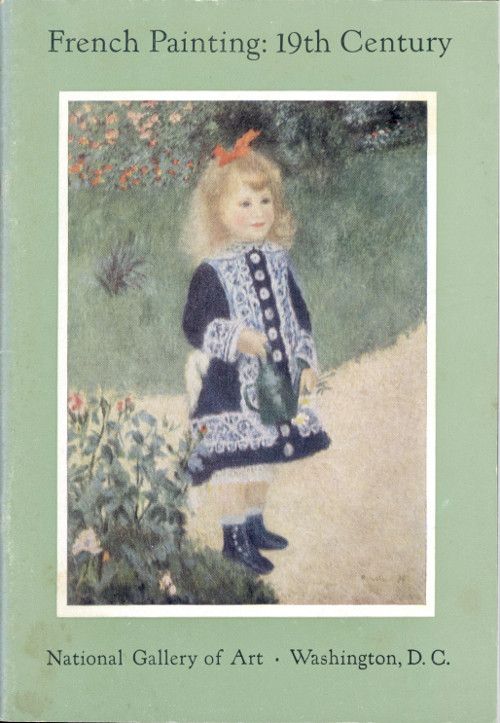
A Girl with a Watering Can (Illustrated on cover)
Canvas. 39½ × 28¾ inches. Dated 1876
Chester Dale Collection
This picture of a very dressed-up little girl, who has been watering flowers in her garden, inherits the long tradition of appealing children’s portraits which have been well loved since the days of Titian and Van Dyck. Renoir, with his love of the Old Masters, combined this tradition and his Impressionist style. He created delightful portraits, which were popular at once and gained wider understanding for the Impressionists. Their art was still entirely misunderstood in 1876, when this was painted. They were thought to be incompetent daubers, incapable of “finishing” a picture properly. But Renoir’s extraordinarily deft handling of delicate flesh tones, as in the child’s face, and the radiance of his coloring could silence such criticism.
By nature Renoir was too sympathetic with his fellow man—and too charmed by the loveliness of women and children—to be content with the strict limits of Monet’s Impressionism. Merely painting sensations of light in a landscape did not satisfy the humanist Renoir. Once he showed a friend a delicately tinted sketch of rose petals and told him it was really a study for flesh tones. “For me,” he said, “a painting should be a lovable thing, gay and pretty; yes, pretty. There are enough things to bore us in life without our making more of them.”
Index of Artists
Illustration pages in bold-faced italics.
| Artist | Page |
|---|---|
| Cézanne, Paul | 10-11, 28, 40, 41 |
| Corot, Jean-Baptiste-Camille | 3-4, 8, 18, 19, 24 |
| Courbet, Gustave | 5-6, 22, 23, 24 |
| Daumier, Honoré | 4-5, 6, 20, 21, 34 |
| David, Jacques-Louis | 1-2, 12, 13 |
| Degas, Edgar | 8-9, 11, 32, 33, 34 |
| Delacroix, Eugène | 3, 16, 17, 24 |
| Fantin-Latour, Henri | 6, 24, 25 |
| Gauguin, Paul | 10, 11, 38, 39 |
| Gogh, Vincent van | 9-10, 11, 36, 37 |
| Ingres, Jean-Auguste-Dominique | 2, 4, 9, 14, 15, 24 |
| Manet, Édouard | 6-7, 8, 9, 11, 26, 27, 30, 34 |
| Monet, Claude | 7-8, 11, 28, 29, 30, 42 |
| Morisot, Berthe | 7, 8, 30, 31, 34 |
| Renoir, Auguste | cover, 7, 8, 42 |
| Toulouse-Lautrec, Henri de | 9, 11, 34, 35 |
Transcriber’s Notes
- Silently corrected a few typos.
- Retained publication information from the printed edition: this eBook is public-domain in the country of publication.
- In the text versions only, text in italics is delimited by _underscores_.