
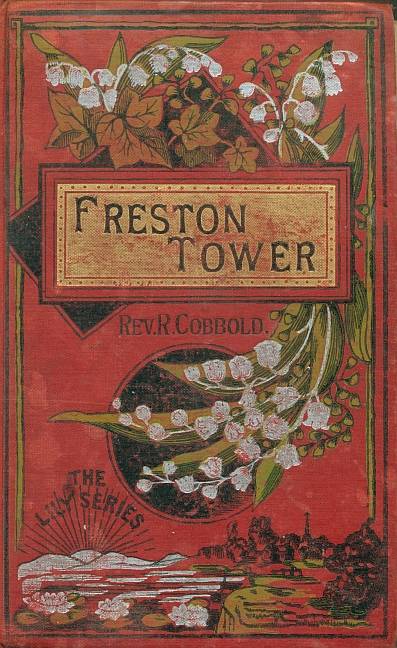
The Project Gutenberg eBook of Freston Tower
Title: Freston Tower
A tale of the times of Cardinal Wolsey
Author: Richard Cobbold
Release date: October 7, 2025 [eBook #76999]
Language: English
Original publication: London: Ward, Lock and Co, 1880
Credits: Al Haines
[Transcriber's note: Odd, inconsistent, and sometimes incorrect, spellings have been retained as printed. A Contents has been added for reader convenience.]
FRESTON TOWER:
A TALE OF THE
Times of Cardinal Wolsey.
BY THE
REV. R. COBBOLD, A.M., R.D.,
Rector of Wortham,
AUTHOR OF "MARGARET CATCHPOLE," "MARY ANNE WELLINGTON,"
"ZENON THE MARTYR," ETC.
WARD, LOCK AND CO.
LONDON: WARWICK HOUSE, SALISBURY SQUARE, E.C.
NEW YORK: BOND STREET.
TO
THE REVEREND JOHN CONNOP,
IN ACKNOWLEDGMENT
OF HIS UNSOUGHT AND UNMERITED KINDNESS
TO
THE AUTHOR AND HIS FAMILY,
THIS HISTORICAL
Record of Piety connected with the County of Suffolk,
IS WITH UNFEIGNED PLEASURE,
Dedicated
AS A MEMORIAL OF FRIENDSHIP,
BY
THE AUTHOR.
Contents
Preface
I. Genius
II. Rivalship
III. The Greeting
IV. The Conversation
V. The Castle and Company
VI. The Excursion
VII. The Visit
VIII. The Event
IX. College Career
X. Ellen and Her Suitors
XI. The Conversation
XII. The Palace
XIII. The Reception
XIV. The Recluse
XV. The Judgment
XVI. Judgment Continued
XVII. St. Ivan's Warning
XVIII. The Fall of the Palace of Wykes
XIX. St. Ivan's Funeral
XX. A Memorable Night
XXI. The Pain of the Swimmer
XXII. Wolsey
XXIII. Changes
XXIV. Affections
XXV. The Letter
XXVI. The Journey
XXVII. The Interview
XXVIII. The Marriage Procession
XXIX. The Marriage Ceremony
XXX. The Revelation
XXXI. The Punishment
XXXII. The Monasteries
XXXIII. The Reformers
XXXIV. The Arrest
XXXV. The Letter
XXXVI. The Summons
XXXVII. The Arrival
XXXVIII. The Departure
XXXIX. The Change
XL. The Interview
XLI. The Argument
XLII. Enjoyment
XLIII. Hospitality
XLIV. The Fall
XLV. The Courtier
XLVI. Goldwell Hall
XLVII. Pride
XLVIII. The Plot
XLIX. The Fool
L. Christmas Day
LI. The Incendiary
LII. The Conflagration
LIII. The Pursuit
LIV. The Last Visit to the Tower
LV. The Last Event
PREFACE.
Upon the banks of the beautiful river Orwell has stood for centuries, and still stands, Freston Tower. Every sailor belonging to the port of Ipswich knows it well; every traveller in the county of Suffolk, who has any love for the tranquil in nature, must have noticed, if he has sailed from Ipswich to Harwich, this picturesque object towering above the trees, and looking upon the widest expanse of water which the river scene affords.
Thousands of conjectures have been formed as to its origin and use. After many years of promised hope to unravel the mystery, the present work will afford an entertaining and instructive record of its origin.
It will be found connected with the history of one of the most learned youths of his age, even with that of the Boy-Bachelor of Oxford; with the stirring events of the Reformation; with the pride and downfall of the proudest Chancellor England ever knew, and will afford a lesson to readers of both sexes of the punishment of haughtiness, and the reward of true nobility and patience, even in their present existence.
In sending forth the present edition, the Author is gratified by the thought that some benefit may arise therefrom to the Hospital in his native town.
RECTORY, WORTHAM.
FRESTON TOWER.
CHAPTER I.
GENIUS.
Who is that youth walking upon the soft sands of Frestonstrand, intently meditating upon the contents of an old parchment-covered book, with silver clasps, which, from their length, proclaim that the work is one of some considerable size and depth? He seems to devour that work; and, if a stranger might judge from his countenance, to be enjoying, with great relish, the sentiments it contains—for, every now and then, he soliloquizes in a foreign tongue, as if repeating with admiration the lines he has been studying.
That book he holds in his hand is the first edition of the greatest Grecian poet ever printed. It is the Iliad, printed by Aldus, who first cast the Greek alphabet in the year 1476. The book has been lent him by Lord De Freston, his distant kinsman, and he is on his way from the ancient town of Gypesswick (now called Ipswich) to return it to its rightful owner.
Like a true valuer of his treasure, he seems to store up in his mind the most beautiful passages it contains. Every now and then he pauses, and, with his dark eye averted from the book, he scans the beauty of the scene around him. He is walking beside one of the loveliest rivers in England, and at a spot where hill, dale, wood, and water, under the influence of the bright beams of the rising sun, exhibit nature in those splendid colors which an early riser only can appreciate.
That eye, even in its glance across the waves of the river Orwell, is a most thoughtful one; for it can view all the tracery of nature, and find a corresponding beauty in the poetical ideas which crowd in upon his mind.
He has been reading high-sounding words, heroic actions, and exalted feelings; and his breast is as naturally inspired with the thoughts of what he has read as his eye is with the view before him. But nature is not able to chain down his soul to any terrestrial object, nor can the charms of scenery engross his attention; for his spirit seems on fire with enthusiasm, and his eye swells with a conscious hopefulness in himself, arising out of the question—For what purpose am I born?
The cap he wears proclaims him but a youth, and the curling locks, hanging from its sides and sweeping over his face, bespeak a native gracefulness, which well accords with his intellectual features. There is a golden tinge upon his brow, and a ruddy, healthy glow upon his cheek, which says that his occupation as a student has not been confined to an unhealthy cloister.
He is but a boy, yet there were many men in his day, who, after years of application, could not retain the memory of what they read with half the ease of that extraordinary youth.
The fact was, as was afterwards proved, his genius was as comprehensive as his energies were active, and a spirit was then stirring in him, a mind in embryo, which, though not confined to the drudgery of the scholastic routine of study, comprehended at a glance the value of education, and made him the greatest schoolmaster of his age.
As the beautiful stream then flowing before him in a sort of endless wave upon wave, that youth seemed desirous to command as endless a reputation; for his immortal mind possessed an unslaked thirst to discern every species of wisdom which either letters, nature, observation, or reflection could unfold.
Such was the genius of him who then stood upon the banks of the Orwell, imbibing wisdom with an ambitious desire of distinction which no future eminence could satisfy.
It was the youthful Wolsey, who, then unknown to fame, was noted by many of the best spirits of that age and country, as a boy of most acute intellect, and of an understanding beyond his years. He had left his native town early in a beautiful spring morning, to go by invitation to the castle of Lord De Freston—a nobleman celebrated for his great learning as well as his benevolent disposition.
The youth had left many friends in the town of Ipswich, who had encouraged his love of study, by lending him manuscripts and books, which he could not otherwise have obtained. Richard Peyvale, one of the most learned of the portmen of the town, and the compiler of the 'Ipswich Doomsday Book,' had been the first to discover the latent superiority of his mind; for, in an examination of boys in the Free Grammar School, the son of Robert Wooly or Wuly so acquitted himself in classical knowledge as to carry off the great prize given by Sir Humphrey Wyngfylde, to be presented by the town-clerk, which was done by Robert Bray, before the bailiffs, governors, and portmen of that ancient borough.
This was probably one of the spurs to genius. But Wolsey—the boy Wolsey—soon discovered so much dross amidst the confined system of school studies, that he told his father it was no use his sending him to school, for old Mr. Capon could teach him nothing more. Hence, after his twelfth year, he was under no tutors, but formed his own reading; and was frequently applied to, by many learned men, to solve difficulties of construction, which to him were very easily accounted for.
Every classical work then known to the world, and within the reach of the wealthy, whether from private families or from public libraries, was obtained for him upon loan; and at one time he had in his own garret, in the gable-end of his father's house, then dividing the two great streets in St. Nicholas, leading from Peter's Priory to the centre of the town, such a catalogue of eminent books, that had they been his own, he would have thought himself the wealthiest man in the land.
The names of Homer, Sophocles, Thucydides, Euripides, Xenophon, Plato, Horace, Cicero, Plautus, Pliny, Tibullus, together with the Scriptures, were familiar to him; and he was so great a man in his boyhood, as far as classical comprehension went, that he scarcely at any after-period of his life had to study these writings again.
It was not to be wondered at, then, that a boy with such precocity of intellect—such a handsome youth too as he really was—should be noticed by the richer and more independent portion of the community.
Lord De Freston had married a niece of the elder Daundy, one of the wealthiest and most enlightened of the inhabitants of Ipswich, and had, therefore, become connected with the female branch of Wolsey's family, for Joan, his mother, was sister to Edmund Daundy. He was a very early patron of the young student; and took such interest in his cousin, as he called him, as laid the foundation of his greatness in after life, though the youth's pride had well nigh lost him his friendship.
But there he stood upon the Freston shore, and caught the sound of the early matin bell, which came pealing from the opposite bank of the river, from the Priory of Alneshborne. The sound of the bell, and the mood in which the youth then stood, accorded well with each other. The former called the monks to prayer, and in some measure roused Wolsey from the reverie, and made him think of time. He looked intently along the bright gleaming waves of the Orwell to see if he could not discover some object which ought to interest his attention.
De Freston's lofty turrets were in view, peering over the spring foliage, just breaking forth in yellow tints from the oaks of the park. The castle shone conspicuously white, as the rays of the gloriously rising sun struck upon its walls. All nature seemed alive. The rooks were taking their flights for the distant marshes; the cuckoo's note saluted the early morn; and so bright and clear was the sky, that even the lark rose joyfully, carolling with his lively note, as if going to seek a purer clime than could be found on this earth.
Had not ambition inflated his breast, Wolsey would have enjoyed to the full the exquisite scene of that April morn. But ambition had so fired his genius that even the lovely river then flowing before him, the light of the heavens, the birds of the air chaunting their praises, and the monks at their matin prayers, had no charms for him. Not even the consciousness of classical knowledge could just then satisfy his mind; for he had received an indirect promise from Lord De Freston that he should go to Oxford, and such a vision of future glory had opened before him, that even his native town, with all the cordial friends it contained, were completely thrown into the back-ground.
Ambition is a syren who deprives of rest those who are once charmed by her voice; and when she prompts to grandeur, and all the imaginative self-consequences of a great name, fame, and power, there are no cruelties through which she will not urge her victims, and, like fabled deities of the heathen, cover them with her mantle or cloud of invisibility.
Moral reflection founded upon the only motive worthy of exertion, the good of others, is a very distant object in the aspirations of a vain man. Destroy selfishness, and all that is laudable, honorable, great, and worthy in the human character will then shine forth, and whether present success shall attend it, or future generations celebrate its worth, it cannot be destroyed by disappointment, since the serenity of equanimity is the same, whether the individual be humbled by the praises of men, or exalted by their persecutions.
Selfish ambition, however plausible or deluding, cannot bear, with an equal mind, the frowns of adversity. Success forms the criterion of its own excellence; and it can no more enjoy the quietude of retirement, than a famous actor can relish the coldness of his audience.
CHAPTER II.
RIVALSHIP.
The young student was evidently expecting to see something upon the waves of the Orwell more attractive than even the book in his hand, or the scenery before him; for, as the matin bell of the priory came pealing over the waters from the opposite shore, the warder's horn from De Freston's castle was heard to blow. The signal appeared to be well understood by the youth, who immediately began to close his thick and heavy tome, and to adjust the silver hooks of the clasps into their sockets.
His eye was turned towards the bend of the river, round which, close under the dipping boughs of the old chestnut trees, a boat, impelled by four stout rowers, was making progress against the wind, but with the tide in their favor. The sparkling waters which dashed from the head of the skiff, as the oars struck the waves, glittered with scarcely more lustre than did the eye of the youth, whilst he surveyed the expected comers, and awaited their approach.
He stood upon a ledge, or very ancient hardway, called John of Wiltshire's Gap, nearly opposite to the great gate of his Wherstead domain, which domain was forfeited to the crown after the decapitation of that ill-fated nobleman.
The scholar was as well known to the rowers as they were to him, for it was often their privilege to meet him by their lord's orders, at the very spot where he then stood. No sooner did they see him than they redoubled their efforts, and soon brought their boat to ground with the usual salutation of 'Ready, Master! ready!' as they respectfully rose to make way for him to go astern.
There must have been something remarkably captivating and even commanding in the manners of the youth at that early age; for, not only was he noted for his scholastic acquirements by the sober, grave, learned, and wise, but the sailors of the port, who occasionally rowed him upon his native stream, whilst he was deeply engaged in skimming over the pages of his book, would delight to rouse him from his reverie, on purpose to hear his conversation and remarks. He took peculiar delight in boarding the foreign vessels which came into the port, with cargoes consigned to his uncle Daundy; and often acted as interpreter whilst he amused himself with trying the brains of the Flemish, Dutch, French, or Norwegian seamen.
The boat's crew hailed him with pleasure, for they looked upon him not only as the favored guest of their master, Lord De Freston, but they knew that he was the peculiar favorite of Ellen De Freston, their master's graceful daughter.
Thomas Wolsey had received an especial message to breakfast with Lord De Freston, and to meet his Lordship's cousin, William Latimer, then a learned student at the University of Oxford. It had been part of Lord De Freston's promise that he should return to Oxford with Latimer, if Wolsey's father, and his fond mother Joan, could part with him, their only child. At all events, he was to be introduced to his future friend; and the nobleman had promised, that both he and his daughter Ellen should use all their influence with his friends, that very day, to obtain permission for him to go to the University.
Bright beams of future glory illumined the mind of the youth, as he took his station in the boat, and became a little more abstracted and thoughtful, and less communicative with his rough acquaintances than was his wont. They dropped their oars in silence, on gaining no reply from their usually animated scholar, and were all of opinion that they had never beheld him so little like himself as at that moment. At almost any other time, and under any other circumstances, a thousand questions would have been asked, and as many remarks made upon their costume, their boat, their lord, their lady, the wind, the weather, the wave, the tide, the monks of Alneshborne, and their father confessor.
But Wolsey was now silent. He watched the waters curling past the boat, as if he were making a calculation of the tide by the number of successive waves that passed him.
As he did not give a single word to the men (and no men are more inquisitive than sailors), they could not endure his silence.
'How now, my master, you heave us no log to-day, though we deserve your smile perhaps more this morning than any other. What's the matter, master? You seem to have cast anchor upon a dull shore, and are as mournful as if your vessel had gone to wreck upon the rocks. A-hoy, master! tip us a stave.'
But deep thought seemed to chain the scholar's mind, as the frost would bind up the river in the darkest days of winter. Yet his brow was smooth and calm as ice without a fall of snow. There was no ruffle upon it, but a fixed and settled tone of thought that seemed to say he was immoveable. He did not speak, and yet he altered his position, and cast his eyes wistfully upon the turrets of the castle as they came in view of the venerated walls. 'Ay, master, 'tis a fine old building, is it not? I should like to see your young honor, or your worship, or your reverence, comfortably hauled up there, high and dry: 'tis a friendly port, master, and comfortable quarters thereabouts.'
It was not until they came full in view of the green slanting lawn which came down to the water's edge, directly in front of the castle, and the young man's eye caught eight of three figures standing upon the very edge of the landing-place, that his features lightened up with expression:
'Who is the third person standing with your master and his daughter?' he asked.
'He's alive now, Jack, I'll warrant!' archly observed one of the rowers.
'And so he may well be,' said the other; 'a little rivalry will do the young scholar good. He has so long had his own way, that perhaps he might think no vessel could sail as well as his own.'
'That's my young mistress's cousin,' replied the man, 'and I hear, master, he's all at sea, like yourself.'
'What do you mean, my man?'
'Mean, sir? why, that he's as clever a chap as you are; that the broad sea of knowledge is as well explored by him as it is by you, and that he can talk to our young mistress in as elegant and entertaining a manner as yourself.'
There are some words which, from their homeliness, may do more to rouse the spirit within a man than all the classical beauties which he had studied in his youth; and at that moment these words, from a common sailor, proved to Wolsey that even men of few words, and no letters, can form no mean idea of intellectual pleasure.
He was effectually roused, for, till then, he certainly had no conception of a rival in letters with any living man he had yet met. He had found none to appreciate his talents so purely, so highly, and so encouragingly, as Lord De Freston and his daughter; and it might be truly said, that none could do so better than that learned and elegant scholar whose life had been devoted to study from his youth.
He had married the niece of the wealthiest Commoner in the land, and married her not for her property, since he was himself the owner of vast estates on the banks of the Orwell, as well as in the vale of Worcester. He had espoused the niece of Edmund Daundy, M.P. for Ipswich, and the most extensive merchant in that port.
His lady, with whom, for the first six years of their married state, he had lived in harmony and happiness, was taken from him at that most anxious period when she had just given birth to a son and heir. Infant and mother died, leaving him one bright companion, the image of her mother, and in qualities of mind and heart superior even in childhood to most of her sex.
Lord De Freston had thus become very early engrossed by the education and training of his affectionate daughter, and such was the delight he took in her, and so well were his parental anxieties repaid by the capacity, diligence, and sense of duty of his child, that years had imperceptibly fled away, until he found her growing more and more upon his affections.
He now made her his companion, not only in his studies, but in all his worldly affairs. She was, indeed, the admiration of all who knew her, and had such a powerful mind, such a cultivated taste for literature and for all the elegant arts, then in their progressive rise in this country, that Ellen De Freston was as famed upon the banks of the Orwell as Madame de Stael, or Madame d'Arblay, in after-days for their precocious powers. Hers, however, were of a different stamp, of a far deeper kind; and mind in that maiden might be said to have a texture so pure, that it gave unwonted charm to a face almost as beautiful as her intellect.
Young Wolsey, about her own age, was so attracted by these wonderful qualities, that it is not to be wondered at, that he should feel an interest in the only being he ever saw calculated to inspire him with the hope of excelling for the sake of pleasing her. Such was the delight he took in her society, and such her pure pleasure in his, that distant relatives as they were, Lord De Freston looked upon them as brother and sister; and neither he nor his daughter had the slightest idea of their young friend ever imbibing any deeper feeling than the love of literature, and the joy of sharing its pleasures.
So fondly wedded in mind to this counterpart of his existence had he imperceptibly become, that half the cherished elegancies of Grecian and Roman literature had been treasured in his heart on purpose that he might breathe their euphonious harmonies in the ear of his cousin Ellen. She, too, was ambitious of convincing Wolsey that she appreciated his talents, but she never had a dream of his aspiring to any nearer intimacy with her than a classical interchange of thought.
It was not to be wondered at, however, that in that early stage of their acquaintance, the youth at fourteen should be sensible to the personal as well as intellectual attractions of such a being as the heiress of De Freston. No feeling of his youth or of his life was ever purer than that which he then entertained towards his benefactor and his friend. It was like the brightest beam of light gleaming upon the path of youth, when that refined sentiment of soul burst upon him. It was like the morning clouds, tinged with the prospect of the rising sun, and proclaiming the approach of a lovely day.
He gazed at the stair as the boat approached the spot where Ellen De Freston, between the tall and portly figure of her father and the slender frame of William Latimer, stood awaiting his arrival.
There was some sensation of pain which stole over his proud spirit at that moment, as he looked at the young man's figure, and beheld his favorite, Ellen, resting her arm upon that of the scholar.
'Shall I,' he asked himself, 'shall I, indeed, meet a rival! Oh! if our merits be but weighed in the balance by the weights of future attainments, either in science, knowledge, industry, or application, I fear not the issue.'
It was a bold thought—the indication of a noble mind, though a feeling of rivalship might at the moment create a pang of jealousy. The man who feels all honor, and endeavors to prove himself worthy of the favorable regard of any one whom he loves, and to whom he attaches the idea of being able to reward his exertions, is a worthy competitor to enter the lists of love. The noblest souls in existence must breathe with such hope, and their exertions and attainments, their talents and their virtues, must form a bright beacon to guide their onward course.
The only drawback is, that all mortal rewards, be they what they may, are not enduring, and therefore fall short of satisfaction.
'As when the eastern sky is tinged
With clouds transparent, golden fring'd.
Bespeaks the coming sun:
So love anticipates a ray,
Bright as the orb's arising day,
Before his course is run.'
CHAPTER III.
THE GREETING.
A merry laugh and cheerful greeting saluted the ear of Wolsey as he stepped from the boat to the stairs, and received the cordial welcome of De Freston.
'How is our uncle Daundy? He is a loyal subject to his Majesty, and as friendly a supporter of the rights of the inhabitants of Ipswich as any man who lived before him. How fares your father, and your good and estimable mother? Thomas, let me introduce you to my cousin Latimer. There is so much wisdom in your young brains, that you must be akin to each other at Oxford, if not related by blood.'
The scholars bowed, and each could discern in the ease of the other, that there was more within worth knowing than any external qualities. They had never met before; but each had, through De Freston, obtained considerable knowledge of the character of the other.
Latimer was five years older than Wolsey, and already possessed the advantages of an Oxford school-training, and a university scholarship; so that, though he had heard much from Ellen and her father of young Wolsey's attainments, and, though he knew them capable of forming a good judgment, nevertheless he could not avoid feeling himself superior to his new friend, which Wolsey, from having attained a conscious superiority over every one with whom he had yet conversed upon classical subjects, was not in the least disposed to allow. He was desirous to meet Latimer, as much to measure himself by him, and judge of his chance of future acquirements, as to see one of whom he had heard so much, and who was a relative of the noble lord, his patron and friend.
'I am glad to meet you, Master Latimer,' he said, with the ease and importance of a man of years and station; 'it has unfortunately happened hitherto that, in your various visits to your relatives in this country, it has never been my lot to enjoy one hour of conversation with you. The Lady Ellen can tell you with what avidity I have read your letters, and indulged with her in those descriptive powers which you have so ably used upon the subject of this Tower. I hope you have already found that neither your elaborate plan of architectural beauty, nor your advice concerning the periods of studious regularity, have been neglected. Many have been the hours of improvement which have been permitted me in the society of these, our mutual friends—varied, indeed, according to your express instructions, and I can truly add, never tediously employed.'
There was something so manly, so easy, so unaffected, and yet so convincing in this youth's manner of address, that, in a moment, young Latimer was convinced that he had no common character to deal with. The thought of superiority vanished, and he found himself compelled, by the unexpected dignity and simplicity of the speech he had heard, to reply instanter upon terms of equality.
'My loss has equalled yours, but I will hope that, from this day forward, we may become better acquainted, and have more frequent opportunities of exchanging our opinions upon those classical subjects which are at this time beginning to circulate more freely among the nations of Europe. I see you have been reading the first printed edition of Homer, which I had the gratification of forwarding to Lord De Freston, and I am glad to see it in such hands, for I understand you can appreciate the beauties of the poet in every passage. I long to have some hours' conversation with you. My fair cousin has had the privilege of hearing you read the whole of the "Iliad," and she has greatly excited my curiosity concerning you. The Tower is complete, and both Lord De Freston and Ellen tell me that the place I proposed for acquiring knowledge is so good a one, as to make each day, nay, each hour, so devoted, of incalculable profit.'
'You must come with us, Thomas, to the Tower, at once,' laid Lord De Freston's daughter; 'I have ordered breakfast in my favorite room, and I shall confine you all, the greater portion of this day, for the indulgence of your conversation. I have often had each of you as my companion through the successive gradations of my ascending steps of knowledge. To-day you must permit me to be a listener to both. I greet you, therefore, as my guests in the library, and if you will only pursue the thread of your discourse upon ancient minstrelsy, I will be as unwearied as Penelope, and, I am sure, far more happy.'
'You do me great honor, Ellen. I can never refuse any of your requests, and one so agreeable as this it would be a punishment to be excused.'
'On with you then, young people! on, to the Tower!' exclaimed her father. And without more ceremony, whilst De Freston remained behind to give some charge to his boatmen, the young people bent their way towards a lofty tower, embosomed in the trees of the park, but commanding such scenes of the river and its banks, as, even now, in the nineteenth century, could not fail to create admiration.
The Tower still stands, apparently in the pride of beauty, looking over the waves of the Orwell; and the author has ascended to its summit, and indulged, years long gone by, in thoughts which now find their way into these pages.
Freston Tower was first designed by William Latimer, whence it was, for many years, called by the name of 'Latimer's Tower.' It was built by the Lord De Freston, his kinsman, who was related to the unfortunate William de la Pole, who took his final leave of his Suffolk friends at this spot, before he was beheaded upon the broad sea.
The converse of the party, as they went towards the Tower, touched upon this point, and, singularly enough, was introduced by Wolsey, as an example of ill-fated ambition.
'My father tells me that it was from this place that William de la Pole, the first Duke of Suffolk, took his departure thirty years ago. What an ambitious family has that been, and how soon do the rewards of iniquity fall upon the wicked!'
'My grandfather,' replied Ellen, 'was the last friend that met him at Ipswich, and brought him on his way to our castle. The vessel which was to bear him into exile could not get higher up the river than the channel opposite the priory, and from this spot my father's barge carried him on board his foreign ship. Alas! he soon heard of his destruction!'
'And must wo not own, fair Ellen, that the retributive hand of justice was here displayed against the murderer of the good Humphrey, Duke of Gloucester? No sooner is de la Pole beyond the precincts of his native power, than he finds he cannot escape. Oh! that Gloucester's friends had prevailed to keep the Parliament in the metropolis, and this blot upon the escutcheon of the Duke of Suffolk would never have been seen.'
'Say, rather, Latimer, that it would have been well for the merchant of Ravenspurn to have kept to his northern port, at the mouth of the Humber, or have come no further south than Hull, than to have purchased lands, title, and fame, to fall by such a foul and fiendish crime, and to finish his right of nobility in England!'
'I do not hold with thee, Wolsey, in such a doctrine, that man is never to aspire to lift himself beyond the mud. The mouth of the Humber may give birth to as noble blood as the banks of the Orwell; and, if I mistake not thy spirit, thou wouldst bid fair to be a candidate for nobility.'
'It should not be my wealth that should entitle me thereto. The king's favour should be purchased with wisdom, not with gold.'
'Yet wisdom brings gold as naturally as that folly wastes it.'
'Ay! but it wastes faster than it is attained. But here we are at the Tower.'
'Come, then, in to breakfast; I see Lord de Freston coming; let us drop the subject of the de la Poles: it always carries with it a pang to my father's heart.'
The party then stood before the celebrated Tower, the construction of which arose from an accidental conversation between De Freston and Latimer, two years previous. The latter had seen the uncommon genius and application of Ellen to study, and had remarked to her father that, if her studies were not diversified, she would lose the sprightliness and vivacity of youth, and forget quickly what she had learnt with difficulty.
'The way to retain anything is to let an impression of it remain upon the brain. Overstrained toil does but enfeeble the body, as overstrained application to any mental pursuit will assuredly one day create disgust. It will actually impair the powers of perception; and men who, at one time, have been the most intellectual students, find themselves overpowered by not being able to diversify their occupation. Besides,' added Latimer, 'I have found the body sicken, the brain turn dizzy, and the whole man enfeebled by too much application to one subject of thought. Hands were given us for manual labor, and our feet for bodily exercise, so that our frame may be preserved in health. Therefore, I say, diversify the occupation of your daughter's time and mind; and body and soul will be benefited.'
'Ah!' replied De Freston, 'the theory is good, but how is it to be done? It is now that I feel myself a widower, when my faithful child, rising into womanhood, requires the matronly guidance of a mother. If you could project a plan likely to be successful in its operation, you would indeed add a charm to my existence I could not easily repay.'
'I can fully imagine your anxiety; and, had I a daughter, at your time of life, and with your means at hand, I would follow the very plan I now propose.'
'What is it, cousin Latimer? What is it?'
'Simply this: I would build a tower in the liveliest spot of my domain. Every room of that tower should command an extensive view of the beautiful scenery around me, and I would dedicate each to a different occupation. Each should claim a separate hour for the work to be performed, and the higher story should possess the greatest charm; so that neither the hands nor the head of my child should be weary.'
'Well said! young philosopher. Let me hear your proposition more minutely laid down. I can imagine the utility, and see much good in your proposal. I will carry it out if you can satisfy my daughter as well as myself of the probability of its having a beneficial tendency.'
'To your daughter, then, as well as to yourself, will I unfold my scheme.'
It was agreed that the young man should write down his plan, and submit it to De Freston and Ellen on the following day.
This was most gallantly and ably done by young Latimer in the following poetical lines, which were presented to De Freston after the evening's meal:
De Freston's Tower.
Let not thy daughter's mind be fix'd
On learning only, but be mix'd
With arts and studies light:
And let her progress be to rise,
Through woman's duties to be wise.
She will thy care requite.
Nor let her in a cloistered cell,
Like monks and friars dully dwell,
Deprived of Nature's face.
Let life and liberty be seen,
With health and energy, to glean
Whate'er has virtue's grace.
The mind is useless, if the hand,
No occupation can command,
To ease the learning gained;
The eye grows dim o'er books alone
And dull and heavy in its tone,
If once 'tis overstrained.
Had I a daughter, I would try
To give of learning such supply
As other works should crown:
I'd build a tower six stories there.
With rooms ascending by the stair,
Each one with purpose known.
I'd choose a spot, whence far and wide
Yon lovely river in its pride
Glides gracefully along;
Where every room which higher rose,
A scene extended should disclose,
Fit theme for poet's song.
The basement story on the ground,
Should be with benches fitted round,
And wide the porch and door,
That here my daughter every morn,
Should know the wants of the lowly born,
And listen to the poor.
The story next I'd dedicate
To works of industry, of late
Becoming females bland:
To needlework or tapestry,
Her active fingers should apply.
Taught by some Flemish hand.
The story next—to music's sway
I should devote, that she might play
On lute or lyre with skill:
Her voice accompanied should sound,
Enchanting through the groves around,
And make all nature thrill.
My next to art of painting raised,
Should be with lightest windows glased.
A studio bright and clear:
The tints of nature should be seen,
Landscapes and figures intervene,
Alternate studies here.
My next should be with books supplied,
And writing instruments beside,
With learning's aids at hand:
This study should devoted be,
To learning's richest treasury
All other rooms command.
My last and highest should be given
To contemplate the stars of heaven,
And study their design:
Astronomy should here unfold
Worlds upon worlds, whose works untold
No mortal can define.
And here sometimes at night I'd be,
To let my daughter clearly see,
How works of wisdom shine:
The fires above her soul should charm,
As fires below our bodies warm,
That we may not repine.
So gratified was fair Ellen with this poetical device, that she scarcely closed her eyes that night for thinking of the spot, and of the kind of ornamental tower which should be raised for such a purpose. The next day, the site was fixed upon by Lord De Freston and his daughter; and Latimer promised to make plans of the dimensions of the rooms, and drawings of the elevation. How beautifully the works were completed even the lapse of so many centuries has not failed to prove. Workmen were soon engaged, Daundy's ships brought the Caen stone for ornamental copings, and the bricks from Ipswich were soon laid, and a tower, according in every respect with the plan of the projector, was erected.
It was before this building that the party then stood, and not until the previous day had Latimer beheld his fair project carried into execution. He had, from time to time, visited the work, and had corresponded with Lord De Freston and his cousin Ellen, concerning its completion. This, however, was his first visit since the graceful tower had been opened, and dedicated to the purpose for which it had been projected. Ellen, indeed, had occupied the different rooms as dedicated to her pursuits.
The lower room, to charity, from 7 to 8 o'clock.
The second, to working tapestry, from 9 to 10.
The third, to music, from 10 to noon.
The fourth, to painting, from 12 to 1.
The fifth, to literature, from 1 to 2.
The sixth, to astronomy, at even.
There was a turret from this last chamber upon which the only instruments then used in descrying and describing the stars were often fixed, when the evenings were such as would allow an observation, from the leads of the building, of the illumined sky. They arrived at the foot of the Tower, where awaiting their approach numerous applicants for the bounty of the Lord De Freston were sitting upon the benches around. A kind word Ellen had for all, a gracious greeting she gave them, and after distributing various donations, and making suitable inquiries, she dismissed them, one by one, to their respective homes, through the different paths across the park.
Ellen welcomed her visitors, and followed them up the winding staircase into the first apartment. She would not allow them to stop and admire the handy work she was then engaged in, namely, a piece of tapestry for Lord De Freston, representing the death of Harold, at Battle. Neither would she pause to indulge them that day with the sound of her harp, though there it stood, and before her some of the Welsh lays then so celebrated among minstrels. Neither would she permit them to waste time upon the beautiful scenery from her painting-room, though the bay-window from this height gave exquisite views for the lover of the picturesque.
Breakfast was set out in the room of literature, and thither she hurried them, determined that she would pass over the usual routine of her every-day engagements to gratify her mind with the conversation of her two intellectual friends.
'I have but a short day for your company, as my father has determined to go to Ipswich upon the business so interesting to you, Thomas Wolsey, and we must all accompany him this afternoon. Let us, then, lose no time in thinking about the progress I have made, but let your conversation be concerning those things by which you are surrounded.'
Handsome shelves, containing costly manuscripts and volumes of such works as were then printed, graced the sides of the room, and the only vacant places were the angular spaces between the windows.
Breakfast was placed upon a small table in the bay-window, and consisted of such plain fare as milk, eggs and butter, with a few preserves, which were the supplies for the table in that early day. It is true that the serving-men in the lord's hall had more substantial feast, for cold venison and boar's-head with large quarters of pork, were consumed upon broad wooden plates, and not a few of those plates were seen upon the long tables in the hall, so large was this nobleman's domestic establishment.
CHAPTER IV.
THE CONVERSATION.
It would be something strange in these days to find man's tongue, through fear, prevented from discoursing upon any subject, political, physical, or religious. Men are so enlightened, and civil and religious freedom are so strongly established in this kingdom, that no one is afraid of investigating any subject. Truth does not require any power but that of God to support it, and having his, it will predominate unto the end, through all discouragements and persecutions. The man who loves his kind will stand the least in awe of death, or of any consequences whatever arising from that position in which his faith in God may place him. But the men, in our day, who do not look deeply into times gone by, can scarcely conceive the terrors into which men were driven in those days when Freston Tower was first inhabited.
Throughout the length and breadth of England, in the years 1484 and 1485, awful divisions were created by the dissensions of the houses of York and Lancaster. Men scarcely trusted each other with open declarations of loyalty, or with their equally prevalent hatred of King Richard III. Nor were they much less happy in their feelings concerning their religion. The absolute power of the Pope had begun to be called in question. Wickliffe's Bible was doing its work, and Caxton's press began to disseminate the light of truth amidst inquiring minds.
Yet, upon the subject of religion, faith and practice seemed to be at a most appalling distance from each other; and men did not like to speak before strangers, even of the God who made them, for fear of incurring the threatened censures of the Papal Hierarchy.
It was a singular thing that politics and religion should chance to be the first subjects discoursed upon by the young men, then partaking of their earliest meal in the library of Ellen De Freston. This conversation arose from the circumstance of De Freston having received a curious edition of Æsop's Fables.
'I have a curiosity to show you here, young men,' said De Freston; and he took down from a shelf over the entrance-door, a volume, having the royal arms engraved, or rather worked, upon the inside of the cover. 'You are learned, Master Latimer—can you decypher the character?'
'Ha; I perceive,' replied the youth, 'this is a book I should have thought would never have been sold, at least, not until the death of her to whom it was given. It is Edward the Fourth's gift to his mistress, Jane Shore. How did you come by it?'
'Lord Latimer, your father's friend, purchased it at the new bookseller's in Ludgate; and knowing my taste for anything new, or old, in such works, sent it to me as a present and token of his esteem.'
'I thought, father,' said Ellen, 'that you told me this wretched woman was no more; that she died two years since, under the severe penance inflicted upon her by the order of the Protector.'
'Hush!' said Wolsey, 'hush! call not Richard, the Protector! call him King, or you will be deemed disloyal. I would, on purpose to share your accusation, call him murderer, not protector.'
'You would be a traitor, then, according to your own showing,' replied Ellen: 'but is not Jane Shore dead?'
'It was reported that she was. That she did penance is certain; that the king, in the days of his protectorate, did accuse Hastings of secretly plotting with this woman, whom he called a wicked witch, to afflict his person with decrepitude, is equally certain. But I hear she is still alive, and that Richard, though he persecuted her so unmercifully, has pardoned her, and given her in marriage to Thomas Hymore, who compassionated her sufferings and petitioned for this mercy.'
'Alas! beauty is a dangerous possession,' added Ellen, 'where the laws of God reign not in the heart. I am glad to hear she is a penitent. May mercy be with her!'
'This is certainly the signature of Edward.
R. E. to J. S. Rex Edvardus, ad J. S. It is valuable, as the first book having numbered pages, and a great acquisition this will be to science. I sigh, my lord, to think how this country is torn asunder by faction. When I last left Worcester, I can assure you men were there ripe for revolt. Richard is detested, his vices are so glaring, and his cruelty so great, that he reminds me more of the tyrant Domitian than of a Christian king.'
'Christian, indeed!' exclaimed the ardent Wolsey. 'Christian? He has murdered three relatives, who stood between him and power, and could Richmond but be reached, his neck would soon be stretched upon the block. I hope he will escape! nay, more, I hope to live to see the day when he may be King of England.'
'Hush! hush! young spirit,' added De Freston. 'Though we be five stories from the ground, you would soon be five feet under it, could Richard gain any knowledge of your language.'
'Yet I assure you,' added Latimer, 'these were things are openly discussed at Oxford, though each man, since the death of Buckingham, fears a traitor in his servant.'
'That hateful Banister must be the vilest of the vile. It was not an open enemy that betrayed poor Buckingham, but the very man who owed him suit and service, and pretended to be so grateful for his bounty. Had I been John Milton, high sheriff of Shropshire, I would have stabbed the traitor to the heart, who could betray such a confiding and afflicted master as the generous Buckingham.'
'I little thought,' said De Freston, 'that I should try your loyalty, young men, by introducing Æsop's Fables to your notice. I perceive, however, that your sentiments accord with my own, though I may not choose to speak out upon so slight an occasion. I can truly say, however, may the houses of York and Lancaster unite, and the divisions of our Christian land be settled.'
This last expression, 'Christian land,' gave rise to a sudden ejaculation upon the part of Wolsey, which rather surprised his friends and auditors: but at that day the youth's soul was full of the love of truth, and he hated most heartily the mummeries of a religion, which at that period were carried to the very verge of absurdity.
'Christian land! Oh! when will peace heal the divisions of this Christian land? In nothing will this country be more divided than in its ideas of the profession of Christianity!'
This was a bold declaration from so young a man, and it surprised Latimer, for though De Freston and himself entertained the enlightened views of that period, when men began to look into the Scriptures for truth, and into their souls for worship, Wolsey had started at once the expression of an opinion which both had entertained, but neither had declared. This led to such an animated conversation upon the errors and absurdities of the times, the almost absolute dominion of the Pope, and the terrors of the Inquisition, that had information been given to the authorities of St. Peter's Priory, all present might have incurred the penalties of heresy and conspiracy.
But Ellen De Freston was too well known for the strict piety of her life, her conformity to all the good usages of the times, and the enlightened benevolence of her disposition, to be affected by the breath of slander. It was not that there were no envious persons in that day, as in this, who were jealous of her superiority. There were individuals who were her equals in station, as well as others who were her inferiors, who could not brook the praises which were so freely given by those who were fortunate enough to know her. She was, however, happily ignorant of these attacks.
There are, in this day, many maidens who infinitely prefer the companions of mind to all the dignity of titled wealth and preponderating influence of station. But, in that day, outward pomp, external beauty, high rank, and large estates, exercised an influence over everything.
It was from no love of making herself conspicuous for singularity, that Ellen devoted herself to intellectual pursuits. Her father was a man of mind, a man of virtue, of a superior intellect, and she had an hereditary taste for these things. Permitted to think, and to express her thoughts, she was treated with deference, and gently argued with in things which her young mind could not fully understand, and hence her love of truth, and of searching for the truth, and obeying its dictates when understood.
Though she seldom discoursed much with her preceptors upon the sacred volume, yet, with her parent, she would hold long and interesting communications, which rarely failed to increase their mutual estimation of each other.
When the subject of religion was introduced by Thomas Wolsey, she maintained that deferential silence which she thought best adapted to her position. Latimer was much pleased with Wolsey's views, and, as some of the stars of the Reformation were then beginning to shine, both in England and in foreign countries, the young men entered into the spirit of the Wickliffites and Hussites with a degree of toleration, surprising indeed at that day, especially in the neighborhood of a town so celebrated for its papal institutions and prevailing bigotry as Ipswich was.
A century before, and this town had an episcopal jurisdiction; but it had now merged into the See of Norwich, and Goldwell then held his court in the ancient residence called Wyke's Bishop's Palace. The Church looked very closely to her rights, her possessions, and professions, and almost one-half of the wealth of the kingdom was in the keeping of ecclesiastics. Lands, houses, castles, monasteries, priories, livings, together with estates and jurisdictions, giving them power over the persons and lives of men, prevailed throughout the land; all in subjection to the Pope; and though at the close of the reign of Richard III., the bloody wars between the Houses of York and Lancaster for a time diverted men's attention from the growing tyranny of the Hierarchy, yet, when these houses became united, ecclesiastical sway assumed a frightful temporal power in this country, and met with consequent detestation.
It is singular that, at this period, Wolsey should have been such an advocate for the dissemination of truth, who was soon afterwards the strongest supporter of the dogmas of Rome. What circumstances were conducive to this change of mind in one so bold, so brave, so elegant, and so eloquent, and, at that time, so truthful and so virtuous, will be presently seen.
It is not intended to give, at full length, the detail of the conversation then going on in that elevated chamber of Freston Tower. It may suffice, for the reader's information, to say, that books were taken down from their shelves, their merits freely and easily discussed, their beauties expatiated upon, and passages from poets, historians, and orators, read with spirit, and devoured with that delight which kindred classical minds only could enjoy. Latimer and Wolsey proved themselves worthy of the fame they afterwards acquired—the former as the Greek tutor of the learned Erasmus, the latter as the great patron of literature throughout the kingdom, whose works of art remain to this day to prove the elegance of his mind, and the profuse liberality of his spirit.
Ellen was delighted; she sat with unmixed pleasure to hear the scholars dilate upon their subjects. She found the hours stealing away quicker than she wished them to do: nor was her peculiar taste for elegance of diction forgotten, and, in certain points of dispute, she was called upon to decide which was the most chaste and perfect translation.
It is strange, but too true, that the most learned men are so jealous of the laborious stores of knowledge they have obtained, that they will scarcely ever condescend to communicate them to the female sex, or to express their knowledge before them; as if they were not to be the companions of man's mind, as well as of his domestic affairs. It is true the world has seen such couples as Andrew Dacier and his beloved wife, Anne, in a past century, and that it does see, in this day, a young and most learned lord in this land, famous for the style of purity in which he writes his ancient and modern histories, appreciating the elegance of his lady's mind, and enjoying its cultivation; but in those days it was a rare thing indeed for a female, and she young, beautiful, and wealthy, to be permitted to join in those studies which were then considered too exclusively masculine.
In the mind of Wolsey, at that period, there lived the thought that such happiness he might one day share more intimately with the beauteous Ellen. It was a thought that had taken full possession of his soul, and he trembled as he avowed it to himself. He had ventured to indulge in the suggestions of Hope—that bright morning star that guides the young mind to distinction, and lightens up even the darkest caverns of despair, when the barriers of wealth and station stand between the object and the aspirant.
Wolsey's hope seemed to dawn upon him through the vista of future years of learned fame, like the sun rising over a most extensive wilderness; or, it seemed to him, like the light of a distant cottage which the poor traveller descries in the darkest night, upon some pathless moor, with which he connects the associations of home and comfort.
He had these feelings in his soul, and if for a moment they were diverted to the subjects of future ambition, fame, and glory, they always seemed to return again to the same point. Never was he more anxious to distinguish himself in the eyes of Ellen than at that period; and it is true that he shone with most uncommon splendor, and made Latimer confess that he was not only a better scholar than himself, but that he had a more comprehensive genius. Both De Freston and his daughter were proud of their young and learned acquaintance, and much enjoyed their intellectual conversation. How long this might have lasted no one could have told, had not De Freston broke off the discussion by reminding his daughter of her engagement to go to Ipswich.
'We must not spend much more time here, Ellen. Our mid-day repast is ready in the hall, and if we do not get off in time, we shall hardly be able to visit our friends. Come, my child, let us proceed to the castle.'
A shadow of disappointment passed over the brow of Ellen, but it did not remain there. She had taken her share in the discourse, and would have prolonged it, but that she knew well the wisdom of obedience to her father's suggestions. She rose, therefore, and, for a few moments stood admiring the brilliant scene from her lofty room, in which she was joined by those enthusiastic lovers of nature. The very turn of the conversation upon the broad waves of the Orwell, the distant hills and woods of the opposite shore, and the moving ships in the distance, then with clumsy and cumbersome hulls, yet picturesque enough to enliven the landscape, proved that Latimer was correct in his view, that deep study should be diversified with pleasant scenery to make both agreeable.
He rejoiced to see the lively glance which that broad view of the Orwell called forth from Ellen's countenance. It played like a sunbeam through the shade of the grove upon her graceful brow, ornamented as it was with a profusion of tresses, nature's richest ornament. At that moment the old hall bell announced the mid-day dinner, and the whole party descended to the castle.