
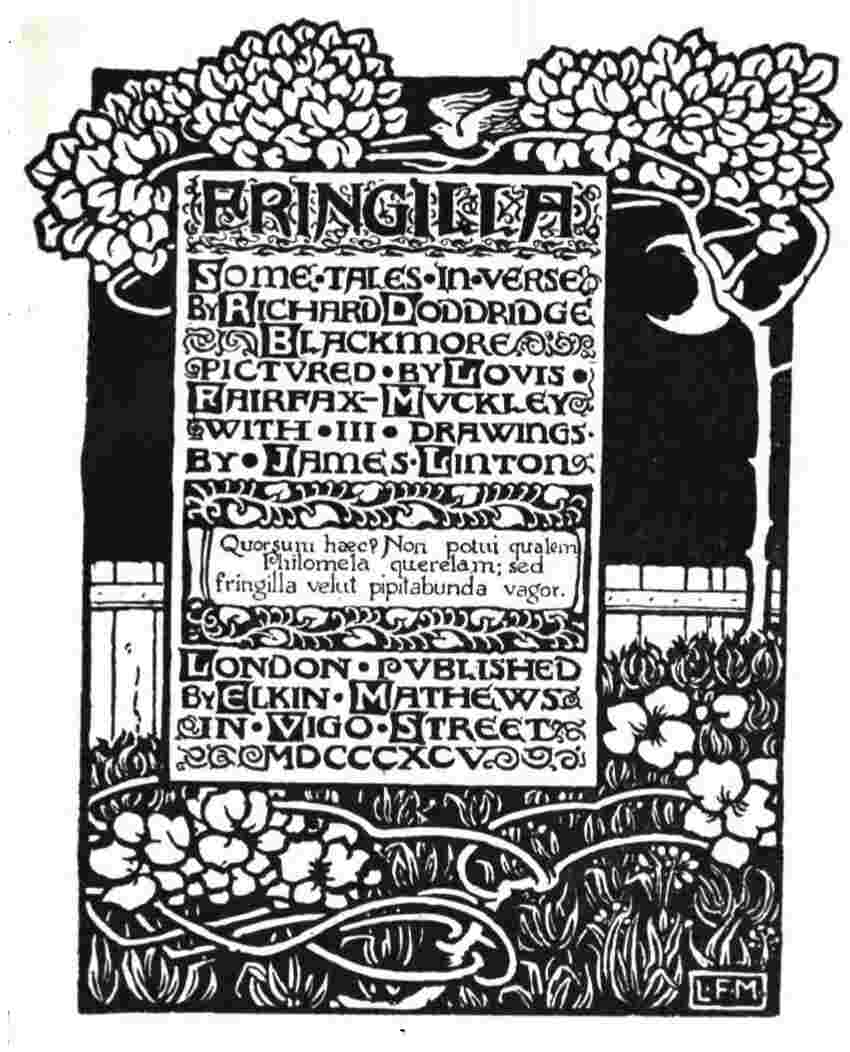
The Project Gutenberg eBook of Fringilla: Some Tales In Verse
Title: Fringilla: Some Tales In Verse
Author: R. D. Blackmore
Release date: August 31, 2007 [eBook #22474]
Most recently updated: December 23, 2012
Language: English
Credits: Produced by David Widger
FRINGILLA
SOME TALES IN VERSE
By Richard Doddridge Blackmore
Contents
|
KADISHA; OR, THE FIRST JEALOUSY PAUSIAS AND GLYCERA; OR, THE FIRST FLOWER-PAINTER |
[Fringilla loquitur]
"Being well aware that he cannot sing like a Nightingale,
He flits about from tree to tree, and twitters a little tale."
Albeit he is an ancient bird, who tried
his pipe in better days, and then was
scared by random shots, he is fain to
lift the migrant wing once more towards the
humble perch, among the trees he loves. All
gardeners own that he does no harm, unless
he flits into a thicket of young buds, or a very
choice ladies' seed-bed. And he hopes that he is
now too wise to commit such indiscretions.
Perhaps it would have been wiser still to
have shut up his little mandible, or employed it
only upon grub. But the long gnaw of last
winter's frost, which set mankind a-shivering,
even in their most downy nest, has made them
kindly to the race that has no roof for shelter
and no hearth for warmth.
Anyhow, this little finch can do no harm,
if he does no good; and if he pleases nobody,
he will not be surprised, because he has never
satisfied himself.
May-day, 1895.
NOTE
With kind consent of Messrs. Harper, "Buscombe" returns in altered form from the other side of the ocean. Two other little tales appeared of old, but nobody would look at them, and now they are offered after careful trimming.
Standing afar. I gaze with doubt at other trimmings which are not mine. They have conquered the taste of the day perhaps, and high art announces them as her last transfiguration. Moreover they are highly recommended— as the purest art not always is—by the modesty of the artist.
The cover design, borders, initial letters and the whole of the full-page illustrations—with the exception of the three to 'Pausias and Glycera' by James W. R. Linton—are by Louis Fairfax-Muckley.
TO MY PEN
I
Thou feeble implement of mind,
Wherewith she strove to scrawl her
name;
But, like a mitcher, left behind
No signature, no stroke, no claim,
No hint that she hath pined—
Shall ever come a stronger time,
When thou shalt be a tool of skill,
And steadfast purpose, to fulfil
A higher task than rhyme?
II
Thou puny instrument of soul,
Wherewith she labours to impart
Her efforts at some arduous goal;
But fails to bring thy coarser art
Beneath a fine control—
Shall ever come a fairer day,
When thou shalt be a buoyant plume,
To soar, where clearer suns illume,
And fresher breezes play?
Thou weak interpreter of heart,
So impotent to tell the tale
Of love's delight, of envy's smart,
Of passion, and ambition's bale,
Of pride that dwells apart—
Shall I, in length of time, attain
(By walking in the human ways,
With love of Him, who made and sways)
To ply thee, less in vain?
If so, thou shalt be more to me
Than sword, or sceptre, flag, or crown;
With mind, and soul, and heart in thee,
Despising gold, and sham renown;
But truthful, kind, and free—
Then come; though now a pithless quill,
Uncouth, unfledged, indefinite,—
In time, thou shalt be taught to write,
By patience, and good-will.
LITA OF THE NILE
A TALE IN THREE PARTS
I
"KING, and Father, gift and giver,
God revealed in form of river,
Issuing perfect, and sublime,
From the fountain-head of time;
"Whom eternal mystery shroudeth,
Unapproached, untracked, unknown;
Whom the Lord of heaven encloudeth
With the curtains of His throne;
"From the throne of heaven descending,
Glory, power, and goodness blending,
Grant us, ere the daylight dies,
Token of thy rapid rise,"
II
Ha, it cometh! Furrowing, flashing,
Red blood rushing o'er brown breast;
Peaks, and ridges, and domes, dashing
Foam on foam, and crest on crest!
'Tis the signal Thebes hath waited,
Libyan Thebes, the hundred-gated:
Rouse, and robe thee, River-priest
For thy dedication feast!
Follows him the loveliest maiden,
Afric's thousand hills can show;
White apparel'd, flower-laden,
With the lotus on her brow.
III
Votive maid, who hath espousal
Of the river's high carousal;
Twenty cubits if he rise,
This shall be his bridal prize.
Calm, and meek of face and carriage,
Deigning scarce a quicker breath,
Comes she to the funeral marriage,
The betrothal of black death.
Rosy hands, and hennaed fingers,
Nails whereon the onyx lingers,
Clasped, as at a lover's tale,
In the bosom's marble vale.
Silvery scarf, her waist enwreathing,
Wafts a soft Sabaean balm;
Like a cloud of incense, breathing
Round the column of a palm:
Snood of lilies interweaveth
(Giving less than it receiveth)
Beauty of her clustered brow,
Calmly bent upon us now.
Through her dark hair, spread before
See the western glory wane,
As in groves of dim Cytorus,
Or the bowers of Taprobane!
See, the large eyes, lit by heaven,
Brighter than the Sisters Seven,
(Like a star the storm hath cowed)
Sink their flash in sorrow's cloud.
There the crystal tear refraineth,
And the founts of grief are dry;
"Father, Mother—none remaineth;
All are dead; and why not I?"
Yet, by God's will, heavenly beauty
Owes to Heaven alone its duty;
Off ye priests, who dare adjudge
Bride, like this, to slime and sludge!
When they tread the river's margent,
All their mitred heads are bowed—
What hath browned the ripples argent,
Like the plume of thunder-cloud?
Where yestreen the water slumbered,
With a sickly crust encumbered,
Leapeth now a roaring flood,
Wild as war, and red as blood.
Every billow hurries quicker,
Every surge runs up the strand;
While the brindled eddies flicker,
Scourged as with a levin brand.
VII
Every bulrush, parched and welted,
Lifts his long joints yellow-belted;
Every lotus, faint and sick,
Hangs her fragrant tongue to lick.
Countless creatures, lone unthought of,
Swarm from every hole and nook;
What is man, that he make nought of
Other entries in God's book?
Scorpions, rats, and lizards flabby,
Centipedes, and hydras scabby,
Asp, and slug, and toad, whose gem
Outlasts human diadem.
VIII
Therefore hath the priest-procession
Causeway clean of sandal-wood;
That no foul thing make transgression
On the votive maiden's blood.
Pure of blood and soul, she standeth
Where the marble gauge demandeth,
Marble pillar, with black style,
Record of the rising Nile,
White-robed priests around her kneeling,
Ibis-banner floating high,
Conchs, and drums, and sistrals pealing,
And Sesostris standing nigh.
IX
He, whose kingdom-city stretches
Further than our eyesight fetches;
Every street it wanders down
Larger than a regal town;
Built, when each man was a giant,
When the rocks were mason's stones,
When the oaks were osiers pliant,
And the mountains scarcely thrones;
City, whose Titanic portals
Scorn the puny modern mortals,
In thy desert winding-sheet,
Sacred from our insect feet.
X
Thebes No-Amon, hundred-gated,
Every gate could then unfold
Cavalry ten thousand, plated,
Man and horse, in solid gold.
Glancing back through serried ranges,
Vivid as his own phalanges,
Every captain might espy
Equal host in sculpture vie;
Down Piromid vista gazing,
Ten miles back from every gate,
He can see that temple blazing,
Which the world shall never mate.
XI
But the Nile-flood, when it swelleth,
Recks not man, nor where he dwelleth;
And—e'en while Sesostris reigns—
Scarce five cubits man attains.
Lo, the darkening river quaileth,
Like a swamp by giant trod,
And the broad commotion waileth,
Stricken with the hand of God I
When the rushing deluge raging
Flung its flanks, and shook the staging,
Priesthood, cowering from the brim,
Chanted thus its faltering hymn.
XII
"Ocean sire, the earth enclasping,
Like a babe upon thy knee,
In thy cosmic cycle grasping
All that hath been, or shall be;
"Thou, that art around and over
All we labour to discover;
Thou, to whom our world no more
Than a shell is on thy shore;
"God, that wast Supreme, or ever
Orus, or Osiris, saw;
God, with whom is no endeavour,
But thy will eternal law:
XIII
"We, who keep thy feasts and fastings,
We, who live on thy off-castings,
Here in low obeisance crave
Rich abundance of thy wave.
"Seven years now, for some transgression,
Some neglect, or outrage vile,
Vainly hath our poor procession
Offered life, and soul to Nile.
"Seven years now of promise fickle,
Niggard ooze, and paltry trickle,
Freshet sprinkling scanty dole,
Where the roaring flood should roll.
XIV
"Therefore are thy children dwindled,
Therefore is thine altar bare;
Wheat, and rye, and millet spindled,
And the fruits of earth despair.
"Men with haggard bellies languish,
Bridal beds are strewn with anguish,
Mothers sell their babes for bread,
Half the holy kine are dead.
"Is thy wrath at last relaxing?
Art thou merciful, once more?
Yea, behold the torrent waxing!
Yea, behold the flooded shore!
XV
"Nile, that now with life-blood tidest,
And in gorgeous cold subsidest,
Richer than our victor tread
Stirred in far Hydaspes' bed;
"When thy swelling crest o'er-waveth
Yonder twenty cubit mark,
And thy tongue of white foam laveth
Borders of the desert dark,
"This, the fairest Theban maiden,
Shall be thine, with jewels laden;
Lift thy furrowed brow, and see
Lita, dedicate to thee!"
Thus he spake, and lowly stooping
O'er the Calasiris hem,
Took the holy water, scooping
With a bowl of lucid gem;
Chanting from the Bybline psalter
Touched he then her forehead altar;
Sleeking back the trickled jet,
There the marriage-seal he set.
"None of mortals dare pursue thee,
None come near thy hallowed side:
Nile's thou art, and he shall woo thee,—
Nile, who swalloweth his bride."
XVII
With despair's mute self-reliance,
She accepted death's affiance;
She, who hath no home or rest,
Shrank not from the river's breast.
Haply there she shall discover
Father, lost in wilds unknown,
Mother slain, and youthful lover,
Seen as yet in dreams alone.
Ha! sweet maid, what sudden vision
Hath dispelled thy cold derision?
What new picture hast thou seen,
Of a world that might have been?
XVIII
From Mount Seir, Duke Iram roveth,
Three renewals of the moon:
To see Egypt him behoveth,
Ere his life be past its noon.
Soul, and mind, at first fell under
Flat discomfiture of wonder,
With the Nile before him spread,
Temple-crowned, and tempest-fed!
Yet a nobler creed he owneth,
Than to worship things of space:
One true God his heart enthroneth
Heart that throbs with Esau's race.
XIX
Thus he stood, with calm eyes scorning
Idols, priests, and their adorning;
Seeing, e'en in nature's show,
Him alone, who made it so.
"God of Abraham, our Father,
Earth, and heaven, and all we see,
Are but gifts of thine, to gather
Us, thy children, back to Thee.
"All the grandeur spread before us,
All the miracles shed o'er us,
Echoes of the voice above,
Tokens of a Father's love."
XX
While of heaven his heart indited,
And his dark eyes swept the crowd,
Sudden on the maid they lighted,
Mild and haughty, meek and proud.
Rapid as the flash of sabre,
Strong as giant's toss of caber,
Sure as victor's grasp of goal,
Came the love-stroke through his soul
Gently she, her eyes recalling,
Felt that Heaven had touched their flight,
Peeped again, through lashes falling,
Blushed, and shrank, and shunned the light
XXI
Ah, what booteth sweet illusion,
Fluttering glance, and soft suffusion,
Bliss unknown, but felt in sighs,
Breast, that shrinks at its own rise?
She, who is the Nile's devoted,
Courted with a watery smile;
Her betrothal duly noted
By the bridesmaid Crocodile!
So she bowed her forehead lowly,
Tightened her tiara holy;
And, with every sigh suppressed,
Clasped her hands on passion's breast.
I
Twice the moon hath waxed and wasted,
Lavish of her dew-bright horn;
And the wheeling sun hath hasted
Fifty days, towards Capricorn.
Thebes, and all the Misric nation,
Float upon the inundation;
Each man shouts and laughs, before
Landing at his own house door.
There the good wife doth return it,
Grumbling, as she shows the dish,
Chervil, basil, chives, and burnet
Feed, instead of seasoning, fish.
II
Palm trees, grouped upon the highland,
Here and there make pleasant island;
On the bark some wag hath wrote—
"Who would fly, when he can float?"
Udder'd cows are standing—pensive,
Not belonging to that ilk;
How shall horn, or tail defensive,
Keep the water from their milk?
Lo, the black swan, paddling slowly,
Pintail ducks, and sheldrakes holy,
Nile-goose flaked, and herons gray,
Silver-voiced at fall of day!
III
Flood hath swallowed dikes and hedges,
Lately by Sesostris planned;
Till, like ropes, its matted edges
Quiver on the desert sand.
Then each farmer, brisk and mellow,
Graspeth by the hand his fellow;
And, as one gone labour-proof,
Shakes his head at the drowned shadoof
Soon the Nuphar comes, beguiling
Sedgy spears, and swords around,
Like that cradled infant smiling,
Whom, the royal maiden found.
IV
But the time of times foe wonder,
Is when ruddy sun goes under;
And the dusk throws, half afraid,
Silver shuttles of long shade.
Opens then a scene, the fairest
Ever burst on human view;
Once behold, and thou comparest
Nothing in the world thereto.
While the broad flood murmurs glistening
To the moon that hangeth listening—
Moon that looketh down the sky,
Like an aloe-bloom on high—
V
Sudden conch o'er the wave ringeth!
Ere the date-leaves cease to snake,
All, that hath existence, springeth
Into broad light, wide-awake.
As at a window of heaven thrown up,
All in a dazzling blaze are shown up,
Mellowing, ere our eyes avail,
To some soft enchanter's tale.
Every skiff a big ship seemeth,
Every bush with tall wings clad;
Every man his good brain deemeth
The only brain that is not mad.
VI
Hark! The pulse of measured rowing,
And the silver clarions blowing,
From the distant darkness, break
Into this illumined lake.
Tis Sesostris, lord of nations,
Victor of three continents,
Visiting the celebrations,
Priests, and pomps, and regiments.
Kings, from Indus, and Araxes,
Ister, and the Boreal axes,
Horsed his chariot to the waves,
Then embarked, his galley-slaves.
VII
Glittering stands the giant royal,
Four tall sons are at his back;
Twain, with their own corpses loyal,
Bridged the flames Pelusiac.
As he passeth, myriads bless him,
Glorious Monarch all confess him,
Sternly upright, to condone
No injustice, save his own.
He, well-pleased, his sceptre swingeth,
While his four sons strike the gong;
Till the sparkling water ringeth
Joy and laughter, joke and song.
VIII
Ah, but while loud merry-making
Sets the lights and shadows shaking,
While the mad world casts away
Every thought that is not gay,
Hath not earth, our sweet step-mother,
Very different scene hard by,
Tossing one, and trampling other,
Some to laugh, and some to sigh?
Where the fane of Hathor Iowereth,
And the black Myrike embowereth,
Weepeth one her life gone by;
Over young, oh death, to die!
IX
Nay, but lately she was yearning
To be quit of life's turmoil,
In the land of no returning,
Where all travel ends, and toil.
What temptations now entice her?
What hath made the world seem nicer?
Whence the charm, that strives anew
To prolong this last adieu?
Ah, her heart can understand it,
Though her tongue can ne'er explain:
Let yon granite Sphinx demand it—
Riddle, ever solved in vain.
X
No constraint of hands hath bound her,
Not a chain hath e'er been round her;
Silver star hath sealed her brow,
Holy as an Isis cow.
Free to wander where she listeth;
No immurement must defile
(So the ancient law insisteth)
This, the hallowed bride of Nile.
What recks Abraham's descendant
Idols, priests, and pomps attendant?
And how long shall nature heed
What the stocks and stones decreed?
XI
"Fiendish superstitions hold thee
To a vile and hideous death.
Break their bonds; let love enfold thee;
Off, and fly with me;"—he saith.
"Off! while priests are cutting capers—
Priests of beetles, cats, and tapirs,
Brutes, who would thy beauty truck,
For an inch of yellow muck.
"Lo, my horse, Pyropus, yearneth
For the touch of thy light form;
Like the lightning, his eye burneth;
And his nostril, like the storm.
XII
"What are those unholy pagans?
Can they ride? No more than Dagons.
Fishtails ne'er could sit a steed;
That belongs to Esau's seed.
"I will make thee Queen of far lands,
Flocks, and herds, and camel-trains,
Milk and honey, fruit and garlands,
Vines and venison, woods and wains.
"God is with us; He shall speed us;
Or (if this vile crew impede us)
Let some light into their brain,
By the sword of Tubal Cain."
XIII
"Nay," she answered, deeply sighing,
As the maid grew womanish—
"Love, how hard have I been trying'
To believe the thing I wish!
"Thou hast taught me holy teachings,
Where to offer my beseechings,
Homage due to Heaven alone,
Not to ghosts, and graven stone,
"Thou hast shown me truth and freedom,
Love, and faith in One most High;
But thou hast not, Prince of Edom,
Taught me therewithal, to lie.
XIV
"Little cause had I for fretting,
None on earth to be regretting;
Till I saw thee, brave and kind;
And my heart undid my mind.
"Better, if the Gods had slain me,
When no difference could be;
Ere the joy had come to pain me,
And, alas, my dear one, thee!
"But shall my poor life throw shame on
Royal lineage of Amor?
Tis of Egypt's oldest strains;
Kingly blood flows in my veins.
XV
"Thou hast seen; my faith is plighted,
That I will not fly my doom.
Honour is a flower unblighted,
Though the fates cut off its bloom.
"I have sent my last sun sleeping,
And I am ashamed of weeping.
God, my new God, give me grace
To be worthy of my race.
"Though this death our bodies sever,
Thou shalt find me there above;
Where I shall be learning ever,
To be worthy of thy love."
XVI
From his gaze she turned, to borrow
Pride's assistance against sorrow—
God vouchsafes that scanty loan,
When He taketh all our own.
Sudden thought of heaven's inspiring
Flashed through bold Duke Iram's heart;
Angels more than stand admiring,
When a man takes his own part.
'Tis the law the Lord hath taught us,
To undo what Satan wrought us;
To confound the foul fiend's plan,
With the manliness of man.
XVII
"Thou art right," he answered lowly,
As a youth should sneak a maid;
"Like thyself, thy word is holy;
Love is hate, if it degrade.
"But when thou hast well surrendered,
And thy sacrifice is tendered—
God do so, and more to me,
If I slay not, who slay thee!
"Abraham's God hath ne'er forsaken
Them who trust in Him alway.
Thy sweet life shall not be taken.
Rest, and calm thee, while I pray."
XVIII
Like a little child, that kneeleth
To tell God whate'er he feeleth,
Bent the tall young warrior there,
And the palm-trees whispered prayer.
She, outworn with woe and weeping,
Shared that influence from above;
And the fear of death went sleeping
In the maiden faith and love.
Less the stormy water waileth,
E'en the human tumult faileth;
Stars their silent torches light,
To conduct the car of night
I
Lo, how bright-eyed morn awaketh
Tower and temple, nook and Nile;
How the sun exultant maketh
All the world return his smile!
O'er the dry sand, vapour twinkleth,
Like an eye when old age wrinkleth;
While, along the watered shore
Runs a river of gold ore.
Temple-front and court resemble
Mirrors swung in wavering light;
While the tapering columns tremble
At the view of their own height.
II
Marble shaft, and granite portal,
Statues of the Gods immortal
Quiver, with their figures bent,
In a liquid pediment
Thence the flood-leat followeth swiftly,
Where the peasant, spade in hand,
Guideth many a runnel deftly
Through his fruit and pasture-land;
Oft, the irriguous bank cross-slicing,
Plaited trickles he keeps enticing;
Till their gravelly gush he feels,
Overtaking his brown heels.
III
Life—that long hath born the test of
More than ours could bear, and live,
Springs anew, to make the best of
Every chance the Gods may give,
Doum-tree stiffeneth flagging feather;
Pate-leaves cease to cling together;
Citrons clear their welted rind;
Vines their mildewed sprays unwind.
Gourds, and melons, spread new lustre
On their veiny dull shagreen;
While the starred pomegranates cluster
Golden balls, with pink between.
IV
Yea, but heaven hath ordered duly,
Lest mankind should wax unruly,
Egypt, garner of all lore,
Narrow as a threshing-floor.
East, and West, lies desolation,
Infinite, untracked, untold
Shroud for all of God's creation,
When the wild blast lifts its fold;
There eternal melancholy
Maketh all delight unholy;
As a stricken widow glides
Past a group of laughing brides.
Who is this, that so disdaineth
Dome and desert, fear and fate;
While his jewell'd horse he reineth.
At Amen-Ra's temple-gate?
He, who crushed the kings of Asia,
Like a pod of colocasia;
Whom the sons of Anak fled,
Puling infants at his tread.
Who, with his own shoulders, lifted
Thrones of many a conquered land;
Who the rocks of Scythia rifted—
King Sesostris waves his hand
VI
Blare of trumpet fills the valley;
Slowly, and majestically,
Swingeth wide, in solemn state,
Lord Amen-Ra's temple-gate.
Thence the warrior-host emeigeth,
Casque, and corselet, spear, and shield;
As the tide of red ore suigeth
From the furnace-door revealed.
After them, tumultuous rushing,
Mob, and medley, crowd, and crushing;
And the hungry file of priests,
Loosely zoned for larger feasts.
VII
"Look!" The whispered awe enhances
With a thrill their merry treat;
As one readeth grim romances,
In a sunny window-seat
"Look! It is the maid selected
For the sacrifice expected:
By the Gods, how proud and brave
Steps she to her watery grave!"
Strike up cymbals, gongs, and tabours,
Clarions, double-flutes, and drums;
All that bellows, or belabours,
In a surging discord comes.
VIII
Scarce Duke Iram can keep under
His wild steed's disdain and wonder,
While his large eyes ask alway—
"Dareth man attempt to neigh?"
He hath snuffed the great Sahara,
And the mute parade of stars;
Shall he brook this shrill fanfara,
Ramshorns, pigskins, screechy jars?
What hath he to do with rabble?
Froth is better than their babble;
Let him toss them flakes of froth,
To pronounce his scorn and wrath.
IX
With his nostrils fierce dilating,
With his crest a curling sea,
All his volumed power is waiting
For the will, to set it free.
"Peace, my friend!" The touch he knoweth
Calms his heart, howe'er it gloweth:
Horse can shame a man, to quell
Passion, where he loveth well.
"Nay, endure we," saith the rider,
"Till her plighted word be paid;
Then, though Satan stand beside her,
God shall help me swing this blade."
X
Lo, upon the deep-piled dais,
Wrought in hallowed looms of Sais,
O'er the impetuous torrent's swoop,
Stands the sacrificial group!
Tall High-priest, with zealot fires
Blazing in those eyeballs old,
Swathes him, as his rank requires,
Head to foot, in linen fold.
Seven attendants round him vying,
In a lighter vesture plying,
Four with skirts, and other three
Tunic'd short from waist to knee.
XI
Free among them stands the maiden,
Clad in white for her long rest;
Crowned with gold, and jewel-laden,
With a lily on her breast
Lily is the mark that showeth
Where that pure and sweet heart gloweth;
Here must come, to shed her life,
Point of sacrificial knife.
Here the knife is, cold and gleaming,
Here the colder butcher band.
Was the true love nought but dreaming,
Feeble heart, and coward hand?
XII
Strength unto the weak is given,
When their earthly bonds are riven;
Ere the spirit is called away,
Heaven begins its tranquil sway.
Life hath been unstained, and therefore
Pleasant to look back upon;
But there is not much to care for,
When the light of love is gone.
Still, though love were twice as fleeting,
Longeth she for one last greeting;
If her eyes might only dwell
Once on his, to say farewell
XIII
"Glorious Hapi," spake Piromis,
Lifting high his weapon'd hand;
"Earth thy footstool, heaven thy dome is,
We the pebbles on thy strand.
"Thou hast leaped the cubits twenty,
Dowering us with peace and plenty;
Mutha shows thee her retreat,
And the desert licks thy feet,
"We have passed through our purgation,
Once again we are thy kin;
God, accept our expiation,
Maiden pure of mortal sin."
XIV
"Ha!" the king cried, smiling blandly;
"Ha!" the trumpets answered grandly.
Proudly priest whirled, knife on high,
While the maiden bowed—to die.
Sudden, through the ranks beside her,
Scattering men, like sparks of flint,
Burst a snow-white horse and rider,
Rapid as the lightning's glint.
One blow hurls Arch-priest to quiver
Headless, in his beloved river,
In the twinkling of an eye,
All the rest are dead, or fly.
XV
Iram, from Pyropus sweeping,
As a mower swathes the rye,
Caught his love, in terror sleeping,
And her light form swings on high.
"Soul of Khons!" Sesostris shouted,
Striding down the planks blood-grouted—
Into his beard fell something light,
And he spat, and swooned with fright.
What hath made this great king stagger,
Reel, and shriek—"unclean, unclean!"
Thunderbolt, or flash of dagger?
Nay, 'twas but a garden bean.
XVI
Brave Pyropus, blood-bespattered,
Snorts at men and corpses scattered,
Throws his noble chest more wide,
Leaps into the leaping tide.
Vainly hiss a thousand arrows,
Launched at random through the foam;
Every stroke the distance narrows
Twixt him and his desert home.
Sorely tried, and passion-shaken,
Long amid her foes forsaken,
Now, in tumult of surprise,
Lita knows not where she lies.
Till a bright wave breaks upon her,
And her clear perceptions wake—
All his valour, prowess, honour,
Scorn of life, for her poor sake!
Gently then her eyes she raises,
(Eyes, whence all the pure soul gazes)
Softly brings her lips to his—
Lips, wherein the whole heart is.
Let the furious waters welter,
Let the rough winds roar above;
Waves are warmth, and storms are shelter,
In the upper heaven of love.
XVIII
Fierce the flood, and wild the danger;
Yet the noble desert-ranger
Flinches not, nor flags, before
He hath brought them safe ashore.
Lives there man, who would have striven,
Reckless thus of storm and sword;
Leaped into the gulf, and given
Heart and soul, to please his Lord?
With caresses they have plied him,
Hand in hand they kneel beside him,
While their mutual vows they plight
To the God of life and light
XIX
Ha! What meaneth yon sword-flashing?
Trumps, and shouts from wave and isle?
Lo, the warrior galleys dashing,
To avenge insulted Nile!
Haste! The brave steed, leaping lightly,
'Neath his double burden sprightly,
Challenges, with scornful note,
Every horse in Pharaoh's boat.
King of Egypt, curb thy rages;
Lo, how trouble should be borne!
Memnon soothes the woe of ages,
With a sweet song, every morn.
KADISHA; OR, THE FIRST JEALOUSY
AN EASTERN LEGEND
HERE IS A CURIOUS LEGEND AS TO THE ORIGIN OP JEALOUSY. WHEN ADAM AND EVE WERE IN PARADISE, THE FORMER WAS ACCUSTOMED TO RETIRE AT EVENTIDE TO THE RECESSES OF THE GARDEN, FOR THE PURPOSE OF PRAYER. ON ONE OF THESE OCCASIONS THE DEVIL APPEARED TO EVE, AND INFORMED HER THAT HER SOLITUDE WAS TO BE ACCOUNTED FOR BY THE ATTRACTIONS OF ANOTHER FAIR ONE. EVE REPLIED THAT IT COULD NOT BE SO, AS SHE WAS THE ONLY WOMAN IN EXISTENCE. "IF I SHOW YOU ANOTHER, WILL YOU BELIEVE ME?" RETURNED THE EVIL ONE, AND PRODUCED A MIRROR, IN WHICH SHE SAW HER OWN REFLECTION, AND MISTOOK IT FOR HER RIVAL. See "Life in Abyssinia," by Mr. Parkyns. Murray, Albemarle Street.
The Kadisha, flowing to the south of Lebanon, is called "the holy river," as having been a minor stream of Paradise.
True love's regale is incomplete,
'Till bitter leaven make it sweet;
Accept not then our tale amiss,
That jealousy was part of bliss;
But rather note a mercy here,
That fact was thus outrun by fear;
And so, before the harder bout,
When sin must be encountered too,
A woman's heart already knew
The way to conquer doubt
I
"When sleep was in the summer air,
And stars looked down on Paradise,
And palms and cedars answered fair
The visionary night-wind's sighs,
And murmuring prayer:
When every flower was in its hood
(By clasps of diamond dew retained),
Or sunk to elude Phalcena's brood,
Down slumber's breast with shadows veined,
In solitude:
The citron, stephanote, and rose,
Pomegranate, hoya, calycanth,
And yet unwanted amaranth,
Were sweetness in repose:
II
When rivulets were loth to creep,
Except unto the pillow moss,
And distant lake, encurtained deep,
Was but a silver thread across
The eyes of sleep:
When nightingales, in the sycamore,
Sang low and soft, as an echo dreaming;
And slept the moon upon heaven's shore—
The tidal shore of heaven, beaming
With lazuled ore:
When new-born earth was fain to lean
In Summer's arms, recovering
The unaccustomed toil of Spring,
Why slept not Eve, their Queen?
III
Upon a smooth fern-mantled stone
She sat, and watched the wicket-gate,
Not timid in her woman's throne,
Nor lonely in her sinless state,
Though all alone;
For having spread her simple board
With grapes, and peaches, milk, and flowers,
She strewed sweet mastic o'er the sward,
And waited through the bridal hours
Step of her lord.
Such innocence around her breathed,
And freshness of young nature's play,
The sensitive plant shrank not away,
And cactus' swords were sheathed.
IV
The vision of her beauty fell,
Like music on a moonlit place,
Or trembles of a silver bell,
Or memories of a sacred face,
Too dear to tell:
The grace that wandered free of laws,
The look that lit the heart's confession,
Had never dreamed how fair it was;
Nor guessed that purity's expression
Is beauty's cause:
No more that unenquiring heart
Perused the sweet home of her breast,
Than turtle-doves unline their nest
To scan the outer part
V
Although, in all that garden fair,
Whate'er delight abode, or grew,
Flowers, and trees, and balmy air,
Fountains, and birds, and heaven blue
Beyond compare:
In her their various charms had met,
And grown more varied by combining,
As budded plants do give and get,
Each inmate doubling while resigning
His several debt:
And yet she nursed one joy, above
Her thousand charms, nor bora of them,
But blooming on a single stem—
Her true faith in her love.
VI
And though, before she heard his foot,
The moon had climbed the homestead palm,
Flinging to her the shadowed fruit,
And tree-frogs ceased to break the calm,
And birds were mute,
With sudden transport ever new,
She blushed, and sprang from forth the bower,
Her eyes, as bright as moon-lit dew,
Her bosom glad as snow-veiled flower,
When sun shines through;
He, with a natural dignity
Untaught self-consciousness by harm,
Sustained her with his manly arm,
And smiled upon her glee.
VII
Next day, when early evening shone
Along the walks of Paradise,
Strewing with gold the hills, her throne,
Embarrassing the winds with spice
(Too rich a loan),
Fair Eve was in her bower of ease,
A cool arcade of fruit and flowers,
From North and East enclasped by trees,
But open to the Western showers,
And Southern breeze.
Here followed she her gardening trade,
Her favourites' simple needs attending,
And singing soft, above them bending,
A song herself had made.
VIII
In evening's calm, she walked between
The tints and shades of rich delight,
While overhead came, arching green,
Many a shrub and parasite,
To crown their Queen;
There laughed the joy of the rose, among
Myrtle and Iris, heaven's eye,
Magnole, with cups of moonlight hung,
And Fuchsia's sunny chandlery,
And coral tongue;
And where the shy brook fluttered through,
Nepenthe held her chalice leaf
(Undrained as yet by human grief),
And broad Nymphaea grew.
IX
But where the path bent towards the wood,
Across it hung a sombre screen,
The deadly night-shade, leaden-hued;
And there behind it, darkly seen,
A Being stood:
The form, if any form it had,
Was likest to a nightly vision
In mantle of amazement clad,
A terror-sense, without precision,
Of something bad.
A tremble chilled the forest shade,
A roving lion turned and fled,
The birds cowered home in hush of dread;
But Eve was not afraid.
X
She stood before him, sweetly bold,
To keep him from her garden shrine,
With hair that fell, a shower of gold,
Around her figure's snowy line
And rosy mould:
He (with a re-awakened sense
Of goodness, long for ever lost,
And angel beauty's pure defence)
Shrank back, unable to accost
Such innocence:
But envy soon scoffed down his shame;
And with a smile, designed for fawning,
But like hell's daybreak sickly dawning,
His crafty accents came.
XI
"Sweet ignorance, 'tis sad and hard
To break thy fond confiding spell;
And my soft heart hath such regard
For thine, that I will never tell
What may be spared."
He turned aside, o'erwhelmed with pain,
And drew a sigh of deep compassion:
She trembled, flushed, and gazed again,
And prayed him quick, in woman's fashion,
To speak it plain:
"Then, if thou must be taught to grieve,
And scorn the guile thou hast adored—
The man who calls himself thy lord,
Where goes he, every eve?"
XII
"Nay, then," she cried, "if that be all,
I care not what thou hast to say;
The guile that lurks therein is small—
My husband but retires to pray,
At evening call."
"To pray? Oh yes, and on his knees
May-hap to find a lovely being:
Devotions so devout as these
Are best at night, with no one seeing,
Among the trees."
She blushed as deep as modesty,
Then glancing back as bright as cride,
"What woman can he find,' she cried,
"In all the world, but me?"
XIII
He laughed with a superior sneer,
Enough to shake e'en woman's faith;
"Wilt thou believe me, simple dear,
If I am able now," he saith,
"To show her here?"
She cried aloud with gladsome heart,
"Be that the test whereon to try thee;
Nature and heaven shall take my part:
Come, show this rival; I defy thee
And all thy art."
A mirror, held in readiness,
He set upright before her feet—
"Now can thy simple charms compete
With beauty such as this?"
XIV
A lovelier sight therein she saw
Than ever yet had charmed her eyes,
A fairer picture, void of flaw,
Than any, even Paradise
Itself, could draw;
A woman's form of perfect grace,
In shadowy softness delicate;
Though flushed by sunset's rich embrace,
A white rose could not imitate
Her innocent face:
Then, through the deepening glance of fear,
The shaft of doubt came quivering,
The sorrow-shaft—a sigh its wing,
And for its barb a tear.
XV
"Ah me!" she cried, "too true it is!
A simple homely thing, like Eve,
Hath not a chance to rival this,
But must resign herself to grieve
O'er by-gone bliss.
"Till now it was enough for me
To be what God our Father made;
Oh, Adam, I was proud to be
(As I have felt, and thou hast said)
A part of thee.
"No marvel that my lord can spare
His true and heaven-appointed bride.
And yet affection might have tried
To fancy me as fair."
XVI
The Tempter, glorying in his wile,
Hath ta'en his mirror and withdrawn;
Again the flowers look up and smile,
And brightens off from air and lawn
The taint of guile.
But smiles come not again to Eve,
Nor brightens off her dark reflection:
Her garland-crown she hath ceased to weave,
And, plucking, maketh no selection;
Only to grieve.
She feels a dewy radiance steep
The languid petals of her eyes,
And hath another sad surprise,
To know the way to weep,