
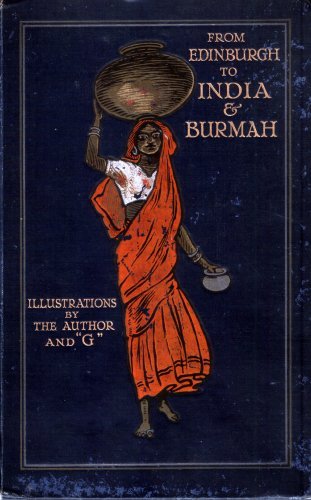
The Project Gutenberg eBook of From Edinburgh to India & Burmah
Title: From Edinburgh to India & Burmah
Author: W. G. Burn Murdoch
Release date: September 24, 2007 [eBook #22749]
Language: English
Credits: Produced by Chris Curnow, Leonard Johnson and the Online
Distributed Proofreading Team at http://www.pgdp.net
FROM EDINBURGH
TO INDIA AND BURMAH
FROM EDINBURGH TO
INDIA & BURMAH
BY
W. G. BURN MURDOCH
Author of
"From Edinburgh to the Antarctic," "A Procession of the
Kings of Scotland," etc.
WITH TWENTY-FOUR FULL-PAGE ILLUSTRATIONS IN COLOUR
FROM PAINTINGS BY THE AUTHOR
LONDON
GEORGE ROUTLEDGE & SONS, LTD.
NEW YORK: E. P. DUTTON & CO.
Contents
| CHAP. I | |
| Introducing these Digressions. Point of Departure. Edinburgh Street Scenes. Flying Impressions from the Train to LONDON. Street Scenes there — The Park and Regent Street. The People in the Streets. Our Royalties gone, and Loyalty — going. Piccadilly Circus by Night, and Mount Street. | pp. 1-8 |
| CHAP. II | |
| London to Tilbury, and the Platform at Victoria Station. The Embarkation on a P. & O. A Bugle Call. The luxury of being at sea. The Bay, and "Spun Yarns" on to | 9-18 |
| CHAP. III | |
| Orpheus and the Argo and the Sirens in heavy weather. Down the Portugese Coast. High Art in the Engine-Room. Our People going East. A Blustery Day, and the Straits of Gibraltar. Gib and Spain, and "Poor Barbara." | 19-26 |
| CHAP. IV | |
| A Blue Day at Sea, and Castles in Spain. A Fire Alarm, and A Dummy Dinner. The Beautiful French Lady. Marseilles and the Crowd on the Wharf. Bouillabaisses, and Réjane, and Cyrano, etc., and the head of a Serang for a tail-piece. | 27-34 |
| CHAP. V | |
| About the Crowd on Board, and the discomfort of a voyage first class — British types — Reflections on the Deck and on the Sea — of Sky, and People, and of things in general. A P. & O. yarn, Old Junk, or Chestnut. Respectability and Art. It gets warm — The Punkah Infliction. Egypt in Sight, and the Nile Water. | |
Port Said and its Inhabitants — Jock Furgusson and Ors.Corsica, Sardinia, Lipari Islands, Stromboli, Crete, and The Acts of the Apostles. | 35-45 |
| CHAP. VI | |
The saddest thing in Egypt — Dancing in the Canal, and the Search-light on the Desert — The fizzling hot blue Red Sea, and digressions about rose-red Italian wine, &Ulysses, and Callum Bhouie, and Uisquebaugh. | 46-53 |
| CHAP. VII | |
Is still about the Red Sea — "The Barren Rocks of Aden," and small talk about small events on board — a fancy dress dance, and sports, and so on to BOMBAY. | 54-62 |
| CHAP. VIII | |
Is — without apologies — of first impressions of India; and about the landing and entertainments of their Royal Highnesses the Prince and Princess of Wales — Great people and little people, and their affairs; Royal Receptions to snake-charmers — Illuminations, Gun-firing, and the Bands playing God save the King — Edward the — ? | 63-74 |
| CHAP. IX | |
This chapter continues to deal with splendid Royal Shows, and there is the precis of a dream of a Prince and an A.D.C., who correct the Abuses of the Privileges of the Royal Academies. | 75-84 |
| CHAP. X | |
And this is about the arrival of Lord Minto, and the departure of Lord Curzon, and the Tomasha connected therewith; Vice-regal Receptions, and Processions, and more band playing, and gun-firing. | 85-101 |
| CHAP. XI | |
Chronicles small beer — things about books and little Indian beasts and natives, and there is another digression to the subject of "English v. British Union, and the Imperial Idea," and a sail over the Bay with a piratical (looking) crew, to the caves of Elephanta. | 102-111 |
| CHAP. XII | |
Is a somewhat lengthy drawn-out chapter about a train journey from Bombay up the Western Ghats, and down south on the Deccan (Dekkan) Tableland to Dharwar — Rather a "carpet-bag chapter," to quote Professor Masson. | 112-122 |
| CHAP. XIII | |
| Dharwar. My Brother's Bungalow. Life in a small Station. The Club. Duck-shooting | 123-135 |
| CHAP. XIV | |
| A letter on the subject of Duck — And a Cholera Goddess. | 136-144 |
| CHAP. XV | |
Last evening at Dharwar, then notes in the train south to Bangalore. | 145-149 |
| CHAP. XVI | |
Is of notes and sketches about things you see in Bangalore. | 150-156 |
| CHAP. XVII | |
Is of a long journey for a small shoot — Life on the Railway Line, and a letter about SNIPE. Our day's shoot is cut in two by the Royal Procession, and we go to the Embassy, then to jail, and make a picture of the Bazaar by lamplight, and discourse on the subject of music with the Maharajah of Mysore. | 157-173 |
| CHAP. XVIII | |
Is about the Maharajah's Palace at Mysore — To Seringapatam in Trollies — Remarks about the Siege, mosquitoes, and landscape — Back to Mysore, and Dinner on the Track. | 174-185 |
| CHAP. XIX | |
Channapatna Village, and a free tip to artists — Our Camp in a railway siding in "beechen green, and shadows numberless" — Thoughts of Madras and the Ocean again — How we rule India, and ghosts on the railway track — A Bank in India, and about cooking, and the Indian squirrel or Chip-monk — The Maharajah — Red Chupprassies — The Museum, and Ants, etc., etc. | 186-196 |
| CHAP. XX | |
En route for Madras — A plague inspection in the grey of the morning — Madras and blue southern ocean, through Tamarisks, and the silvery Cooum and fishermen seine-netting on the strand — The Race-course — The Old Fort of the Company — Dinner at the Fort, and the people we saw there; and of those we remembered who once lived there — A Digression from Crows to ancient Naval Architecture, and the new Order of Precedence. | 197-209 |
| CHAP. XXI | |
A delightful Fishing Day — Surf Rafts. — Making Calls — Boating on the Adyar River — A Sunday in Madras Churches, and on a Surf Raft — End of the Year. | 210-220 |
| CHAP. XXII | |
1st Jan. 1906. — Call at Government House — The Fort again — More about Surf Rafts — Lord Ampthill's Government House Reception — Nabobs and nobodies. — Fireworks and pretty dresses, and the band playing. | 221-226 |
| CHAP. XXIII | |
Out of Madras, and on the blue sea again, bound West to Burmah — Packed with Natives — An unsavoury Passage Ruskin's English and Native Essayists. | 227-231 |
| CHAP. XXIV | |
Golden BURMAH, and the Golden Pagoda — a gymkhana dance — Sketching at the Pagoda entrance — Various races — Bachelor's quarters — The Shan Camp — Princesses and Chieftains, and their followings — Mr Bertram Carey, C.I.E. — The peace of the platform of The Shwey Dagon Pagoda. | 232-244 |
| CHAP. XXV | |
"The Blairin' trumpet sounded far," and the Prince comes over the sea, and lands at Rangoon — Receptions and processions; pandols, shamianas; and Royal Tomasha — Illuminations at night on the Lake, and the Royal Barges — Song about Our King Emperor — We start for Mandalay by river-boat up the Irrawaddy. | 245-250 |
| CHAP. XXVI | |
The Flotilla Co. — Bassein-Creek mosquitoes — Searchlight fantasies fairy-like scenes on the river by night and day — Up stream on a perfect yacht — Past perfectly lovely villages and scenes — The Nile nowhere — Mr Fielding Hall — Riverside delights — Prome — Pagodas — The Prince comes down the river. | 251-263 |
| CHAP. XXVII | |
Thayet Myo, 20th Jany. — It gets cooler — Thoughts of big game — Watteau trees — Sweet pea dresses — Country scenes — Popa Mountain — The Fanes of Pagan — A little about shooting and geese — and the pleasures of the river life to end of chapter. | 264-275 |
| CHAP. XXVIII | |
The shore at Mandalay — The Queen's (Supayalat) golden Kioung or Monastery — Street scenes — THE ARRAKAN PAGODA, and scenes for a Rubens or Rembrandt — The Mecca of this Eastern Asia — Burmese women bathing — A Burmese harper — The Phryne in hunting green kirtle — Mingun and the pagoda that was to have been the biggest in the world, and the 90-ton bell — Mr Graham's house — Life on S.S. "Mandalay" at the Mandalay shore — King Thebaw's Palace. | 276-293 |
| CHAP. XXIX | |
| Away to Bhamo! | |
Off again — In a cargo steamer up river to the end of the Empire this way — The markets on board and Burmese life — Changing views, flowers, sunlight and swirling river — Fishing — Geese — Painting — Cascades of beautiful people, Snipe-shooting, and more fishing. | 294-302 |
| CHAP. XXX | |
Anchor up — Mist on the river — "Stop her" — Pagodas and cane villages — Fishing with fly; A 35-lber — The Elephant Kedar Camp — Animal life on the river banks — We go aground — The crew strike work — We get away again — Kalone to Katha. | 303-313 |
| CHAP. XXXI | |
Sunshine and haar — Children of Cleutha — Moda — Girls and old ladies of Upper Burmah — We meet a Punitive Expedition, Sikhs and Ghurkas under a Gunner-Officer returning from Chin hills to Bhamo — Fog banks and the second Defiles — Jungle scenery — Shans and Kachins at Sinkan — We go shopping on an elephant at BHAMO — China Street — A Chinese gentleman's house — The Joss House — Painting in a Chinese crowd — Marooned. | 314-327 |
| CHAP. XXXII | |
The D.-C. Bungalow — Roses, orchids, and "The Mystery." | 328-330 |
| CHAP. XXXIII | |
Many pages, lengthy, descriptive, of an expedition in canoes, and on elephant back through pucca jungle to shoot snipe, and of our entertainment in the evening at the Military Police Fort, with Kachin dances in moonlight — A Review of Kachin native police. | 331-342 |
| CHAP. XXXIV | |
Preparations for our pilgrimage into China — Our servants, ponies, and live stock — On the Road — From Bhamo to the back parts of China — The first Rest-House. | 343-347 |
| CHAP. XXXV | |
Kalychet — A mid-day halt and Mahseer fishing — Views in the Kachin Highland Forests — Rivers — "Seven bens and seven glens" — Caravans on the track — The Taiping river — A Spate — Fishing | 348-357 |
| CHAP. XXXVI | |
"On the Water" continued — Nampoung — The edge of the Empire — Six to seven thousand feet up, and cold at night. | 358-362 |
| CHAP. XXXVII | |
Nampoung river — A fish in the bag, a cup, and a pipe, by the river side — We wade into China — Meet the Chinese army and wade back — Another cast in the Taiping — "G" collects many orchids — From Kalychet to Momouk — Riding in the sun in the morning and back to the plains alas! A pleasant evening with the Military Police. A study of a Kachin beauty, and of an average type of Upper Burmese girl — Good-bye Bhamo — Paddling down the Irrawaddy — More river-side notes — A.1. shooting, to the writer's mind — The Luxury of a Cargo Boat of the Flotilla Company — Deep Sea Chanties, and Mandalay again. | 363-379 |
| CHAP. XXXVIII | |
We drop from the comfort of the Cargo Steamer to the comparative discomfort of the train at Rangoon — Another plaguey inspection — Another joyous embarkation on another B.I. Boat — Calcutta — Benares and its Ghats; after the Golden Beauty of Burmah! — Street scenes and riverside horrors — A muddle of indecencies and religions — A superior Fakir's portrait — 333,000,000 gods — An artist's private deductions — Les Indes sans le British — Delhi and Agra. | 380-391 |
| CHAP. XXXIX | |
India generally speaking, as a preamble to several pages about Black Buck shooting. | |
The Taj Mahal not described — Sha Jehans portrait. | 392-401 |
LIST OF COLOURED ILLUSTRATIONS
BY
AUTHOR AND "G."
| By Author | ||
| Ayah and Child | Frontispiece | |
| A Glimpse of the North Sea | to face page | 4 |
| Piccadilly Circus, by Night | " | 8 |
| A Spanish Woman | " | 26 |
| A Café, Port Said | " | 44 |
| Aden, and Fan-sellers | " | 58 |
Waiting for Carriages after Reception at Government House, Bombay | " | 79 |
| Lord Minto's Landing in India | " | 92 |
| A Reception in Government House, Bombay | " | 98 |
| Sailing from Elephanta | " | 111 |
| An Indian Tank | " | 151 |
| A Street Corner, Bangalore | " | 171 |
| " | 237 | |
H.R.H. Prince and Princess of Wales landing at the Boat Club, Rangoon | " | 249 |
| A Burmese Harpist | " | 284 |
| A Priests' Bathing Pool | " | 302 |
| A Chinese Joss House | " | 324 |
| A Kachin Girl | " | 370 |
| A Girl of Upper Burmah | " | 372 |
| A Fakir at Benares | " | 387 |
| A Delhi Street Scene | " | 390 |
| Illustrations by "G." | ||
| A Sacred Lake near Rangoon | " | 244 |
| Sunset on the Irrawaddy | " | 251 |
| Mid-day on the Irrawaddy, distant Ruby Mountains | " | 298 |
CHAPTER I
Some time ago I wrote a book about a voyage in a whaler to the far south, to a white, silent land where the sun shines all day and night and it is quiet as the grave and beautiful as heaven—when it is not blowing and black as—the other place! A number of people said they liked it, and asked me to write again; therefore these notes and sketches on a Journey to India and Burmah. They may not be so interesting as notes about Antarctic adventure and jolly old Shell Backs and South Spainers on a whaler; but one journal ought at least, to be a contrast to the other. The first, a voyage on a tiny wooden ship with a menu of salt beef, biscuit, and penguin, to unsailed seas and uninhabited ice-bound lands; the other, in a floating hotel, with complicated meals, and crowds of passengers, to a hot land with innumerable inhabitants.
I trust that the sketches I make on the way will help out my notes when they are not quite King's-English, and that the notes will help to explain the sketches if they are not sufficiently academical for the general reader, and moreover, I fondly believe that any journal written in the East in these years of grace 1905-6, must catch a little reflected interest from the historic visit of their Royal Highnesses the Prince and Princess of Wales to India and Burmah.
Edinburgh is our point of departure; the date 13th Oct. and the hour 10 P.M. All journeys seem to me to begin in Edinburgh, from the moment my baggage is on the dickey and the word "Waverley" is given to the cabby. On this occasion we have three cabs, and a pile of baggage, for six months clothing for hot and cold places, and sketching, shooting, and fishing things take space. I trundle down to the station in advance with the luggage, and leave G. and her maid to follow, and thus miss the tearful parting with domestics in our marble halls.… Good-bye Auld Reekie, good-bye. Parting with you is not all sorrow; yet before we cross the Old Town I begin to wonder why I leave you to paint abroad; for I am positive your streets are just as picturesque and as dirty and as paintable as any to be found in the world. Perhaps the very fact of our going away intensifies last impressions.… There is a street corner I passed often last year; two girls are gazing up at the glory of colour of dresses and ribbons and laces in electric light, and a workman reads his evening paper beside the window—it is a subject for a Velasquez—all the same I will have a shot at it, and work it up on board ship; it will make an initial letter for this first page of my journal.
Across the Old Town we meet the North Sea mist blowing up The Bridges, fighting high up with the tall arc lights. What variety of colour there is and movement; the lights of the shops flood the lower part of the street and buildings with a warm orange, there are emerald, ruby, and yellow lights in the apothecary's windows, primary colours and complementary, direct and reflected from the wet pavements; the clothes of passing people run from blue-black to brown and dull red against the glow, and there's a girl's scarlet hat and an emerald green signboard—choice of tints and no mistake—we will take the lot for a first illustration, and in London perhaps, we will get another street scene or two, and so on; as we go south and east we will pick up pictures along the road—from Edinburgh to Mandalay with coloured pictures all the way, notes of the outside of things only, no inner meanings guaranteed—the reflections on the shop windows as it were—anyone can see the things inside.
An old friend met us at the station; he had just heard of our exodus and came to wish us good-bye as we used to do in school-days, when we considered a journey to England was rather an event. He spoke of "Tigers;" India and tigers are bracketed in his mind, and I am certain he would get tiger-shooting somehow or other if he were to go East; he looked a little surprised and sad when I affirmed that I went rather to paint and see things than to shoot. Shooting and other sports we can have at home, and after all, is not trying to see things and depict them the most exciting form of sport? I am sure it is as interesting; and that more skill and quickness of hand and eye is required to catch with brush or pen point a flying impression from a cab window or the train than in potting stripes in a jungle.
Look you—this I call sport! To catch this nocturne in the train, the exact tint of the blue-black night, framed in the window of our lamp-lit carriage; or the soft night effect on field and cliff and sea as we pass. No academical pot shot this, for we are swinging south down the east coast past Cockburnspath (Coppath, the natives call it) at sixty miles the hour, so we must be quick to get any part of the night firmly impressed. There is faint moonlight through low clouds (the night for flighting duck), the land blurred, and you can hardly see the farmer's handiwork on the stubbles; there are trees and a homestead massed in shadow, with a lamp-lit window, lemon yellow against the calm lead-coloured sea, and a soft broad band of white shows straight down the coast where the surf tumbles, each breaker catches a touch of silvery moonlight. The foam looks soft as wool, but I know two nights ago, an iron ship was torn to bits on the red rocks it covers.… I must get this down in colour to-morrow in my attic under the tiles of the Coburg. Who knows—some day it may be worth a tiger's skin (with the frame included).… There is the light now on the Farnes, and Holy Island we can dimly make out.
To the right we look to see if the bison at Haggerston are showing their great heads above the low mists on the fields.… The night is cold, there is the first touch of winter in the air. It is time to knock out my pipe and turn in, to dream of India's coral strand, as we roll away south across the level fields of England.
In London town we arrive very early; an early Sunday morning in autumn in the East of London is not the most delightful time to be there. It is smelly and sordid, and the streets are almost empty of people, but I notice two tall young men in rags, beating up either side of a street, their hands deep in their pockets as if they were cold; they are looking for cigarette ends, I expect, and scraps of food; and we are driving along very comfortably to our hotel and breakfast. An hour or two later we are in the park at church-parade; a little pale sun comes through the smoky air, and a chilly breeze brings the yellow leaves streaming to the ground. There are gorgeous hats on the lines of sparrows nests, and manifold draperies and corduroys and ermines and purple things, with presumably good-looking women inside. We men run to purple ties this year, quite a plucky contrast to our regulation toppers, black coats and sober tweed trousers. And one unto the other says, "Hillo—you here again! Who'd have expected to see you, dear fellow! What sort of bag did you get; good sport, eh?" "Oh, good—good—awfully good! Such a good year all round, you know, and partridges, they say, are splendid; hasn't been such a good season for years; awfully sorry to miss 'em. And when do you go back?—On the Egypt!—Oh, by Jove! won't there be a crowd! Horrid bore, you know—'pon my word everyone is goin' East now; you can't get away from people anywhere! It's the Prince's visit you know; what I mean is, it's such a draw, don't you know."
Monday morning in Regent Street.—Sauntering with St C., looking at the crowd and incubators and buying things we could probably get just as well in Bombay; but Indian ink and colours, and these really important things we dare not leave behind. What a pleasant street it is to saunter in once or twice in a year or so; what a variety of nationalities and pretty faces there are to see. The air is fresh and autumnal, and overhead a northerly breeze blows wisps of white cloud across a bright blue sky, and just floats out the French Tricolours and the Union Jacks with which the street is decorated. The houses on one side are in quite hot sun; the other side of the street is in cold bluey shade, which extends more than half across the road. A cart crawls up the shaded side, leaving a track of yellow sand in its wake; someone is coming, and the crowd waits patiently.… Now mounted police appear in the distant haze and come trotting towards us, and the guards with glittering breastplates are rattling past and away in a breath! Then outriders and a carriage, and a brown face, moustached and bearded, and the Prince goes by, and the crowd cheers—and I pray we may both get a tiger. Then the King passes with Lord Minto, I think. We have come to London for something!
Possibly in the fulness of time we may see kings in our Northern Capital oftener than we do now. We need ceremonies, a little sand on the street occasionally, and a parade or two—ceremonies are the expression of inward feelings; without occasion for the expression of the sentiment of loyalty, the sense must go … the loyalty of a second northern people—going—going—for a little sand and bunting—and—NO OFFER?
There is no chance of ennui in the week in London before a voyage; you have packing, shopping, insuring, and buying tickets and general bustling round—what charming occupations for the contemplative mind! Then you throw in visits to friends, and acquaintances call on you, all in the concentrated week; you breakfast late, lunch heavily, rush off to a hurried dinner somewhere, then rush off to a play or some function or other, supper somewhere else and then home, too late for half a pipe; engagements about clothes, hats, dresses, guns, lunches, dinners, theatres, you have all in your mind, awake and asleep, and as you run about attending to essentials and superfluities, you jostle with the collarless man in the street, and note the hungry look, and reflect how thin is the ice that bears you and how easy it is to go through, just a step, and you are over the neck—collar gone and the crease out of the trousers. A friend of mine went through the other day and no one knew; he lived on brown bread and water for ever so long, but stuck to his evening clothes, and now he sits in the seats of the mighty. What "a Variorem" it all is—tragedy and comedy written in the lines of faces and the cut of clothes. But I confess; what interests me in London more than types or individuals, are the street scenes and figures seen collectively. What pictures there are at every turning, and yet how seldom we see them painted. With the utmost modesty in the world I will have a try in passing at Piccadilly Circus. Is there a street scene so fascinating as that centre for colour and movement?—say on a May night, with people going to the theatres, the sky steely blue and ruddy over the house-tops, the Pavilion and Criterion lights orange and green glinting on the polished road and flickering on the flying hansom wheels—or The Circus in a wet night, a whirlpool of moving lights and shadows and wavering reflections! What a contrast to the quiet effects in some side street; for example this street seen half in moonlight, beneath my window in the Coburg; the only sound the click clack of the busy horse's feet on the wood pavement, as hansoms and carriages flit round from Berkeley Square—there's a levee to night, and their yellow lamps string up Mount Street and divide beneath me into Carlos Place.
… My tailor has sent me such an excellent cardboard box to paint on, so I will use it for this effect in Muzii colours; it will make a drop scene or tail piece to this first chapter of these "Digressions."
CHAPTER II
London to Tilbury.—If I am to write notes about a journey to the Far East, I must not miss out the exciting part between Grosvenor Square and Liverpool Street Station. The excitement comes in as you watch the policeman's hand at the block in the city and wonder if it will stop your journey; down it comes though, and we are in time, and have a minute to spare to rejoice on the platform with our cousin and niece who are going out with us, or rather with whom we home people are going out to India.
There were those on the platform not so happy as we were; an old lady I saw held the hand of a young soldier in pathetic silence, and the smiles on the faces of those left at home were not particularly cheerful, and the grey set expression of men leaving wives and children is hard to forget. A younger lady I saw on the platform smiling, and straight as a soldier, threw herself into her sister's arms as the train moved off in a perfect abandonment of grief, and the wrinkles in the old lady's face as we passed were full of tears—two to one against her seeing the young man, son, or grandson, on this side. But I suppose that is India all over—many partings, a few tears shed, and enough kept back to float a fleet.
Our 'guid brither'[1] and his wife have come in the train with us to Tilbury to see us on board, so we are all very jolly and the sun shines bright on the river and white cumulous clouds, and the brown sails of the barges are swelling with a brisk north-east breeze as they come up on the top of the flood. The "Egypt" lies in mid-stream, and all the passengers of our train go off to it in tenders, along with hundreds of friends who have come to see them off—there is a crowd! Passengers only bring hand baggage with them, the rest went on board yesterday; the embarkation is beautifully managed and orderly, there is an astonishing repression of excitement and show of out of place feeling. To compare this embarkation with that on a foreign liner; I have seen the whole business of taking passengers and luggage on board an Italian liner stopped for minutes by one Egyptian with a tin of milk on the gangway, holding forth on his grievances to the world at large, whilst handsome officers on deck smiled futilely, their white-gloved hands behind their backs. I suppose it is this military precision that gives the P. & O. their name and their passengers a sense of security; but there are people so hard to please that they ask for less pipeclay, less crowded cabins, and better service and more deck space, and these carpers will never be content, so long as they see other lines, such as the Japanese, giving all they clamour for, comfortable bath-rooms, beds, and a laundry at moderate rates.
[1] Brother-in-law.
A touch of militarism that I rather fancy on the P. & O. is the bugle call going round the ship before meals; it is such a jolly cheery sound to awaken to. It comes from far along the ship in the morning, at first faintly in the distance, when you are half-awake trying to account for the faint sound of machinery and the running reflections on your white roof, dimly conscious of the ever delightful feeling that you are sailing south across the widest and most level of all plains. Louder and louder it comes along the alley-way, till outside your cabin door it fairly makes you jump! A jolly, cheery sound it is, almost nothing in the world so stirring excepting the pipes. There's a laughing brazen defiance in it, and gentleness too, as it dies away—most masculine music! What associations it must have for soldiers; even to the man of peace it suggests plate armour, the listed field and battles long ago.… Did you ever hear it in Edinburgh? up in the empty, windy castle esplanade—empty of all but memories—You see no bugler, but the wide grey walls and sky are filled with its golden notes. It echoes for a moment, and then there is quietness, till the noise of the town comes up again. And at night have you heard it? from the Far Side of Princes Street, the ethereal notes between you and the stars, long drawn notes of the last post, from an invisible bugler in the loom of the rock and the rolling clouds.
G. murmurs, "It is abominable—but after all, going to sea is all a matter of endurance." What a difference there is in the point of view—G., I must say, had a hair mattress last night, and it was not properly blanketted and entailed a certain amount of endurance; on the other hand she is extremely fortunate in having such glorious pink roses and beautiful hangings for nicknacks, touching parting gifts from friends, so her cabin already looks fairly homely; and then, on the walls, there is the most perfect round picture, framed in the bright brass of the porthole—a sailing ship hull down on the horizon, her sails shining like gold in the morning sun, on a sea of mother of pearl.… There is just the faintest rise and fall, and the air is full of the steady silky rushing sound; what is there like it, which you hear in fine weather when the sea makes way to let you pass.
Painted at a sketch to-day of people coming on board the "Egypt" from the tender, no great thing in colour, less in a black and white reproduction, for eye and hand were a little taken up with luggage—a note of lascars in blue dungarees and red turbans—East meeting West—the Indies in mauve and lilac hats and white veils; for shades of purple are all the fashion this year.
I have found a corner in the waist between first and second class, where one can draw or paint without being very much overlooked; you can get under the sky there, elsewhere you can't, and only see the horizon, for our first class deck is under the officers' deck, and the second class is covered with awnings, a very poor arrangement I think for you only get light on your toes. A sailing ship's deck is ever so much nicer, for you have a reasonable bulwark to keep wind and water off your body instead of an open rail. You can look over a bulwark comfortably, your eyes sheltered from the glare off the sea; on these steam-liners it comes slanting up to your eyes under eyebrows and eyelashes—no wonder people take to blue spectacles! In the sailing ship too you can look up and watch the bends of white canvas and the spars-and cordage swinging to and fro across the infinite blue, an endless delight! Here you have a floor and blistered paint a few inches above you, on which you know the officers promenade with the full sweep of the horizon round them and the arc of the sky above. Still another advantage of the sailing ship is, that you are not just one of a crowd, ticketed No. so and so, bedded, fed, and checked off by a numeral; and you can generally count on a barometer, and learn the names of lights and lands you pass; possibly there may even be a thermometer, and certainly a compass. On this "Egypt," barring a small scale Mercator's projection of the world on which the ship's position is marked daily, there is no means of getting the information that can make a sea voyage so infinitely interesting. I would suggest large sized charts showing landmarks, ship's position, and barometrical readings. What is more interesting at sea than the charts of ocean depths, currents, winds, salinity, and temperature! If you go too fast to touch on Plankton, Nekton, and Benthos, at least let the poor first class passengers have a compass, if not a barograph and a thermometer, to eke out conversations on the weather, the day's run, and bridge.
"The Bay"—the Great Bay, calm as a mill pond—there's a jolly sense of rest and peace on board; I suppose everyone knows that feeling who has gone East. For weeks you have been doing things, shopping, packing, keeping appointments, then you get out of the bustle of town, breathe again clear air, and rest, on the level sea, that lovely water cushion, the most soothing of all beds.
Everyone is soporific and very restful. We begin to distinguish individuals amongst the many passengers, but so far no one seems particularly conspicuous. They are rather good-looking as a crowd, and one or two children are like angels—at least we hope so.
It is darker ahead now and to the east, the shadow of the World on Nothing, I suppose! possibly an October breeze coming—low banks of cirri-cumuli above the horizon—clear overhead with streaks of rusty red cloud fine as hair—the evening is cold, here is an attempt at it with a brush. And we had music in the place for music on deck; an Irish lady played the fiddle and played so well with a piano accompaniment to an audience of six—if the Bay keeps quite the audience ought to increase. After the sunset, dinner—what a tedious business it is; the waiting is perfectly planned, but the waiters themselves have to wait ages at the two service hatches, where they get all jammed together, so the time between the courses seems interminable; you almost forget you are at a meal at all. To-night dinner and conversation both hang fire at our end of the table, and I overhear from the other end where my cousin sits interesting scraps about India, which is distinctly annoying; R. is relating some of his experiences there that set his neighbours and my niece and Mrs Deputy-Commissioner all chuckling.