
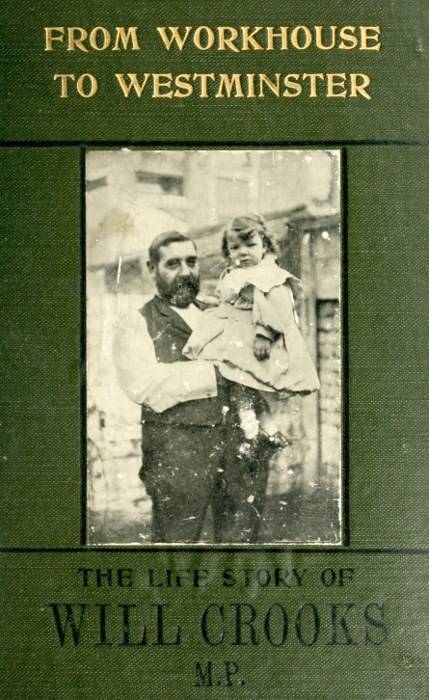
"How good the people are! Whenever I mention Poplar, it is truly inspiring to hear the magnificent response. Last night the moment the word passed my lips an audience of two thousand cheered like one man. It sometimes overwhelms me almost. Who am I to deserve it?...
"I am sometimes told that I affect to despise my critics. You know better, of course. But, really, after such experiences as these, I can't help laughing at them when I think of their ponderous official pronouncements against my policy and of the equally ponderous lectures read to me by certain sections of the Press and the Church. When will the Press and the Church, and 'all who are put in authority over us,' come to learn what the mind of the people really is, and begin to interpret it rightly? I know the heart of the people to be true. That is why I laugh and go on my way confident that the little piece of well-doing I have aimed at on behalf of the poor and the unemployed will in the end put to 'silence the ignorance of foolish men.'"
If his meetings were inspiring, the same can be said of his correspondence. Public men, in various parts of the country, including Guardians, wrote to congratulate him on the brave stand he had made against the forces of Bumbledom. From other quarters he had many encouraging letters.
Canon Scott Holland wrote: "You know how your friends feel for you in this cruel trouble. We need not tell you how we trust you, and believe in you, and stand by you."
"You have made many lives happier and better by your work on behalf of the poor," wrote a high official from a central Poor Law establishment. "I thought it might be a comfort to you to know we feel indignant that you have been rudely assailed."
It was encouraging also to receive a note from a prominent Woolwich Conservative. The writer commenced by saying that although he was a political opponent, and would continue to be so, he had the greatest respect for Crooks personally, and wished to assure him that he did not agree with the attacks that had been made on his Poor Law policy.
"Cheer up," came a message from the Rev. A. Tildsley, pastor of the Poplar and Bromley Tabernacle. "Don't get off your high pedestal to go down to your opponents' level. Leave the mud alone. The sun shines daily, and will soon dry it. Then it will drop off itself. All good men have to pay the price. This is not your first baptism of fire in defence of the poor."
From the Oxford House Settlement, Bethnal Green, the Rev. H. S. Woolcombe wrote:—"I am perfectly certain that this attack cannot do you any permanent harm, and that you and Lansbury are both men too big to let it abate your courage and determination to go on with your work."
Letters came to him from abroad long after the Inquiry. Unknown friends in America, France, and other countries sent him sympathetic letters. He told one of his Woolwich meetings—according to the report in the Labour Party's weekly newspaper, the Woolwich Pioneer:—
He had had a few letters that were not sympathetic (Laughter, and a voice, "Rub it in for Robb"). Well, he had rubbed it in as well as he could. Mr. Robb [the legal representative of the Alliance at the Inquiry] was not a bad chap at all. A man must earn his money, and Mr. Robb had earned his very well. He (Mr. Crooks) had not a word to say against anybody. Some mud had been thrown, but it would easily brush off. After all, there still remained the obligation to look after those who were unable to look after themselves, and to give to the poor and little children left to their care and mercy the best of their ability and service. They were proud that God had given them the opportunity to do the work they had done. And they were not ashamed.
It is noteworthy that when the Local Government Board was investigating the Guardians' contracts something was brought to light which even the Inspector records to the credit of Poplar. He found that some years previously the Guardians, recognising that the system of dealing with contracts by Poor Law authorities was a faulty one, liable to abuse, had appealed to the Local Government Board to establish a central authority for dealing with all Poor Law contracts in London, thus removing from the local Guardians the temptation towards favouritism and loose administration.
That appeal was disregarded, though it is understood the Local Government Board will shortly be compelled to carry out Poplar's suggestion, because of the demoralisation which the loose system has created. Had the appeal been heeded at the time—originated as it was by the Labour Members at Poplar—much of the corruption brought to light in several Poor Law Unions in respect to contracts could never have taken place. The Local Government Board's own loose system, therefore, has been indirectly responsible for corruption on Poor Law bodies.
This fact doubtless influenced Canon Barnett to pass very severe strictures on the Local Government Board's gross neglect of duty. "The inspectors of the Local Government Board," he stated in the Daily News, "hold inquiries into scandals for which they are themselves largely responsible. Why did they not discover and report these matters years ago? We ought to have independent inquiries, in which the inspectors are subjected to examination, for it is their perfunctory inspection which has allowed the growth of such evil."
Defeated over the Inquiry the Local Government Board carried out a minute analysis of the Guardians' accounts. The ordinary Local Government Board audit occupies only three days. In the case of Poplar, it was on this occasion extended over three months. Every item was carefully examined in accounts representing an expenditure of over a quarter of a million sterling. On the whole of this sum, the auditor, after his three months' investigation, only found half a dozen trifling items that he could question. These represented a few shillings for "Guardians' and other persons' teas," and about £5 in respect to excessive fares under the head of travelling expenses. These items were surcharged to the individual Guardians responsible, of whom Crooks, needless to say, was not one. Indeed, he as Chairman assisted the auditor in bringing to light what he considered the excessive fares which had been charged by some of his colleagues on the Board.
The surcharge for the teas revealed Bumbledom at its worst. The "other persons' teas" referred to included the occasional afternoon cup offered to the ladies of the Brabazon Society on their visiting days. Bumbledom, which connives at Guardians' six-course dinners at five shillings per head in other Unions, proved itself to be so far embittered against Poplar that it actually objected to a cup of tea and a lunch biscuit to lady visitors belonging to a society which has given thousands of pounds from the private purses of its members for brightening our workhouses.
It happened that these ladies were presenting their yearly report on Poplar Workhouse about the same time the Local Government Board attack took place. These good women are not influenced by the Local Government Board or by Municipal Alliances or by the party differences among the Guardians. Their opinion is that of a quiet body of independent, intelligent women. In their report on Poplar Workhouse they say:—
During the year forty-six meetings have been held, and at each some part of the House has been visited. The year has been singularly free from complaints, all the inmates seeming happy and contented.
The nurses in charge are kindness itself, and are uniformly good-tempered and active. The whole House is kept beautifully clean, and each ward is a picture of cosiness and comfort.
Every useful aid is procured for the infirm, to help them to move about easily. The sick are kindly tended, and the little children's health and comfort carefully supervised.
Observe, in connection with this three months' audit, that not a penny was surcharged in respect to the out-relief grants. Notwithstanding all the wild charges that had been made, not a single case could be found where Crooks's policy of helping the poor could be proved to be illegal. After all the hubbub, a three months' scrutiny under the eye of a capable Government auditor proved that Poplar had simply been carrying out the law relating to the poor.
The Local Government Board was badly beaten in its attempt to discredit Crooks's policy. Finally, it was argued on the Board's behalf, as though in a last grasp at a straw, that the decrease in the amount of out-relief during the year of the Inquiry was in itself a justification of the Local Government Board's action. Everybody outside the Board knows differently. The year referred to (1906) was the most prosperous this country has ever experienced. If anything, the industries of Poplar shared in that prosperity to a larger extent than other parts of the country. The primary cause of the decrease was not the Inquiry, but the lessening of want brought about by an extraordinary trade revival.
"Give us," Crooks has repeatedly stated in public, "the same terrible state of things that we had in some of the previous winters, and I shall apply the same remedy again. The law is there for the sake of the poor, not for the sake of officials. My policy is not a haphazard one. It is the outcome of years of experience. It is fundamentally sound, and will one day become a national policy."
Crooks had indeed played a part for the poor of the whole nation. Before the echoes of the Bumbledom agitation had died away the very Government which allowed one of its Departments to be made an instrument in that agitation was promising to carry out the very reforms for which Crooks had striven and suffered—Old Age Pensions, Amendment of the Poor Law, and Equalisation of London Rates.
The Government, however, shirked a discussion of the Poplar Report in the House of Commons. The Labour Party, backed by Conservative Members, pressed the Prime Minister for an opportunity to discuss the report. Mr. Keir Hardie and Crooks pointed out that, as the report stood, an injustice was done to a popularly elected body, the effect of which would be to deter other Boards of Guardians from carrying out the Poor Law in a humane spirit. They further maintained that the country was now without guidance as to how to treat poor people out of work and in need of food.
But the Government had learnt by this time that a departmental blunder had been committed by associating the Poor Law policy of Crooks with the faulty administration of some of his colleagues. The Prime Minister got out of the difficulty by informing the House that the report was not made by the Local Government Board, but to that Board by one of their officers, "and," he added, "I don't understand that it is proposed to call in question any action of my right hon. friend the President in regard to the report."
Indeed, the President of the Local Government Board assured a friend of Crooks in a conversation in the Lobby that there had been a misunderstanding somewhere. He sought an early opportunity of giving Crooks a similar assurance.
It was said of Crooks in Poplar about that time that he was going to leave the neighbourhood never to return. Working-men came round to him in solemn deputation, and women and children stopped him in the street, in order to hear from his own lips that the bodeful rumour bore no meaning. The rumour, which never had the smallest basis of truth, reached the workhouse, where he had not been seen for two or three weeks, weighed down as he was by a hundred public attacks, his own wearing illness and a heavy domestic trouble. But one afternoon he found time to go and see the inmates again. And old men hobbled towards him and clutched his arm and hand as they broke down in their efforts to tell him what was in their hearts. When he entered the women's wards there was a chorus of almost tearful appeals. "Say it isn't true, Mr. Crooks." "Don't go away and leave us, Mr. Crooks."
Sitting alone at the end of a bench was one old dame talking to herself in that vague, mumbling way common to many old women in our workhouses. As she rambled on in her talk she took up the cry:—
"Don't leave us, Mr. Crooks. For over seventy years I worked hard, Mr. Crooks, ever since I was eight years of age. Brought up a family of ten—two boys died in the wars, one drowned at sea. All the others left me long ago, and I don't know where they are. And my man was buried in 'eighty-nine—buried near the brickfields where we worked together thirty years before. And I kept myself outside for fifteen years, a lone old woman; and you helped me, Mr. Crooks, until I couldn't look after myself any longer, and then you made me comfortable here. So now I count the days between your coming to see us to cheer us up. So please don't leave us, Mr. Crooks. Don't—don't leave us, Mr. Crooks."
CHAPTER XXXIII "THE HAPPY WARRIOR"
A Cheerful Invalid and his Neighbours—The Starving Children in the Schools—Public Confidence in Crooks—Left Smiling.
Shortly afterwards he was laid low for two or three weeks, the victim of his old enemy, muscular rheumatism.
"Some of my ancestors must have been aristocrats," he used to tell his visitors good-naturedly from his sick bed in explanation of his recurring complaint.
As usual, the knocker at No. 81, Gough Street, knew no rest during his illness. Hundreds of people called to leave sympathetic little messages of goodwill. From Woolwich came a telegram from a party of children. An old bedridden man laboriously penned a letter, brought round by his aged wife, to say that Mr. Crooks might like to know that an "ole bloke as is pegging out fast" was thinking of him all day, and hoping he would soon get well.
This message cheered the invalid greatly, and he sent back a reply that renewed the old man's youth for weeks. For Crooks never lost his cheerfulness when lying bandaged in bed. He used to banter his wife and daughters, and his Labour colleagues in Parliament who came to visit him, until they had to hold their sides with laughter. His cheery doctor used to store up good stories for the invalid's delectation; but he always had to admit that Crooks could cap them all with better ones.
Once back at work again, Crooks threw all the time and energy he could spare from Parliament and his Labour meetings into a campaign for feeding starving school children. Perhaps the best instance of the people's trust in him was supplied by what happened in consequence of a powerful plea for hungry children he made on the London County Council. The Moderates were then in power, and he pleaded with them to persist no longer in their policy of refusing to exercise their powers under the Necessitous School Children's Act, which enables them to spend public money on food for starving scholars.
It was nigh on midnight before he got an opportunity of raising the question, and then—according to the Daily Mail, which had often been one of his bitterest opponents—he "electrified his sleepy colleagues as he expressed the agony of hungry children and the despair of parents unable to satisfy their cravings. The speech was spoken without a single note; it came from his heart. When Mr. Crooks sat down, exhausted by the effort—he was far from well—there was a moment of dead silence. Then there broke out the applause which relieved the tension. There was scarcely a dry eye in the Council chamber."
In the course of his speech to the Council Crooks said:—
There are no hard-hearted men and there are no hard-hearted women; there are only men and women ignorant of the need. Only the other day a teacher in one of our schools showed me a letter from a mother of three fatherless girls. It ran:—
Dear Teacher,—Will you allow my little girls to come home at half-past three? I shall have earned sixpence by then, and shall be able to give them something warm to eat. They have had nothing all day.
Here are we, satisfied after a good dinner. Yet I know that this very night hundreds of little children have gone to bed with nothing but a cup of cold water for their supper, and that in the morning they will have nothing but water for their breakfasts. What do you expect them to become? What sort of citizens of this great Empire City will they make?
I have seen the poor as they live, and I tell you that, much as they may forgive you for many things, they will never forgive you for neglecting the children—the children stunted in body and mind for want of food, old before their time, with the souls, not of children, but of old men and women.
A nation which neglects its children is damned. You are neglecting London's hungry children by leaving the provision of meals to private subscriptions which all over London have failed to meet the little people's need. You never talk of running the Army and Navy and the defence of the Empire generally by means of private subscriptions and charitable doles. Yet the thing that is of greater importance at the present moment than the Army and Navy to us, as an Imperial people, is that the children who are going to inherit the responsibility of the government of our vast Empire should be properly fed and clothed now.
What have you to say to facts like these? A woman, early the other morning, as soon as the shutters were down, entered a pawnbroker's shop, and took from under her shawl, in a shamefaced manner, a small bundle. The pawnbroker's assistant unrolled the bundle, and there, clean washed and scarcely dry, was the woman's chemise. She had taken it off her body, washed and partly dried it, and to the pawnbroker's assistant she said:
"For the love of God, lend me sixpence on this."
"I cannot," said the assistant. "It's not worth it."
"Then give me threepence," pleaded the woman. "I must give my children a mouthful before they go to school this morning."
You object to feed the children because it would increase the rates. Yes, it would increase the rates by a farthing. But indirectly you are increasing the rates to a far greater extent by starving the children. By neglecting them now you will be compelled to feed and shelter them later in life in workhouses and infirmaries.
I appeal to you to rise to a sense of your responsibilities, and see that these children are fed. If it meant that I should be driven out of public life by feeding starving children out of the rates, I should feed them out of the rates. I should then have done my duty.
The appeal moved the Council deeply, but on a party vote he was defeated, many of the Councillors who voted against him crowding round him afterwards to assure him of their individual sympathy.
The sequel came the day after his speech was reported in the Press. From all parts of London he and his wife had cheques and postal orders showered upon them from people in all walks of life, from little children to old people. Nearly £200 in all came to hand, together with huge parcels of boots and clothing, every donor leaving it entirely in Crooks's hands as to how the money and the things were distributed, so long as the needy children got them.
This is just the kind of thing that he deprecates, but, public bodies having failed to meet the need, he and his wife set to work, and did their best to meet it in their own neighbourhood. With the aid of a few friends they got in touch with some of the poorest schools in the East End, and soon thousands of hungry school children were fed and hundreds of the naked clothed.
Crooks gave the London County Council no rest on this subject. He went on agitating until the Moderate majority in the succeeding winter at last gave in and agreed to make the feeding of necessitous scholars a public charge.
Thus we leave him, still in the ranks fighting. We must part from him with a smile, since that is how he likes best to leave both friend and enemy. And those who heard him speak in the winter of 1908 at the City Temple smile every time they think of the occasion—a mass meeting of the London Federation of Pleasant Sunday Afternoon Brotherhoods.
No written word can adequately describe the hilarious effect of Crooks's speech. Without the man behind them, the words alone convey little, as I many times have been made to feel keenly while writing this narrative. Indeed, one of Mr. Crooks's colleagues in Parliament, a staid, dull man of much wealth, accosted him in the House one afternoon with the remark: "How is it, Mr. Crooks, that when I repeat your stories to my constituents, they never laugh?"
At the City Temple Crooks told his great audience how delighted he had been to observe the growth of the religious and civic spirit among the working classes since this movement for Sunday afternoon meetings began.
"At the meetings in the early days," he said, "you know how you used to be troubled with the irrelevant questioner. I was present once when the speaker, after narrating his experiences abroad, was asked whether he was in favour of compulsory vaccination! Another time a man got up, and after reading out a list of parsons who had been sentenced asked me what I had to say to that?
"'A bad lot,' I answered, 'but it doesn't shake my faith in Christianity any more than to-day's fog shakes my faith in the sun."
"On another occasion a man asked me what I meant by condemning betting, seeing that the aristocracy backed horses.
"'But the aristocracy know no better. You do. So set them an example.'
"Then there was the heckler who wanted to know whether I objected to a man leaving money for the propagation of atheism.
"'If he likes to do it, let him,' I answered. 'He's sure to regret it as soon as he is dead.'
"And that reminds me," continued Crooks, "of what happened at the last County Council election. A local undertaker, who had always supported me before, stopped me in the street to say he was going to vote on the other side this time.
"''Tain't as I don't believe in you, Mr. Crooks. I likes you as well as ever I did; but men in our calling must keep an eye on the party that best helps business, you know!'
"I told him I did not understand.
"'Why,' said the undertaker, 'I could make a decent living when the death rate was 20 per 1,000. I can even get along nicely when it's 18; but since you've bin on the move, Mr. Crooks, I can't make a living nohow, with a death rate no more'n 14.'"
INDEX
- A
- Afforestation for unemployed,
- B
- Baby-farming in London,
- Baptist Union, Crooks addresses the,
- Bishop of London, The,
- Blackwall Tunnel, Crooks and the,
- Boarding-out children,
- Brabazon Society and Poplar Workhouse,
- Brotherhoods, Men's,
- C
- Children, Starving School,
- Christianity and the working classes,
- Churches and Labour,
- City Temple Speech,
- Collins, Sir William,
- Coronation festivities at Poplar,
- Craftsmanship, Need of,
- Crooks, Will: born in a one-roomed home,
- 1;
- taken into the workhouse,
- 9;
- sent to a Poor Law school,
- 11;
- an errand-boy,
- at George Green schools,
- 19;
- at Sunday School,
- 19;
- books of his youth,
- 22;
- at work in a smithy,
- 33;
- apprenticed to coopering,
- 36;
- nicknamed "Young John Bright,"
- 37;
- first marriage,
- 43;
- dismissed as an agitator,
- 44;
- out of work,
- tramping experiences,
- 45;
- finds work at Liverpool,
- his child's death there,
- 46;
- gets work as a dock labourer,
- 50;
- his "college" at the dock gates,
- his part in the Great Dock Strike,
- 67;
- a dangerous illness,
- 69;
- death of his first wife,
- 72;
- his second marriage,
- 73;
- the Will Crooks Wages Fund formed,
- 75;
- his election to the London County Council,
- 76;
- declines a partnership,
- 81;
- refuses a rent-free house,
- 82;
- his work on the L.C.C.,
- helps to formulate the Fair Wage Clause,
- 87;
- is chosen Chairman of the Public Control Committee,
- 94;
- declines the Vice-chairmanship of the L.C.C.,
- 98;
- secures open spaces for Poplar,
- 98;
- his overcoat stolen,
- 99;
- pleads the cause of good craftsmanship,
- 100;
- the Blackwall Tunnel one of his monuments,
- 101;
- is chosen Chairman of the Bridges Committee,
- 102;
- becomes a Guardian for Poplar,
- 105;
- is elected Chairman of the Board,
- 112;
- changes the composition of the Board and of its staff,
- 112;
- abolishes the pauper's garb,
- 114;
- reforms the workhouse,
- sends Poor Law children to Board Schools,
- 120;
- provides a home for them,
- 123;
- his work on the Metropolitan Asylums Board,
- a peace-maker among the poor,
- 144;
- chosen Mayor of Poplar,
- 154;
- organises the King's Dinner to the Poor at Poplar,
- 169;
- receives the Prince and Princess of Wales,
- 169;
- raises funds for a Coronation treat to children,
- 170;
- his policy of paying old age pensions through the Poor Law,
- his first election for Woolwich,
- his maiden speech,
- 202;
- advocates the payment of members,
- 204;
- introduces a Women's Enfranchisement Bill,
- 206;
- retires from the Poplar Borough Council,
- 212;
- up and down the country,
- 213;
- ridicules Protection and Preference,
- his efforts for the unemployed,
- advocates the provision of useful work,
- 221;
- his activity as a member of the Poplar Distress Committee,
- his scheme for a Central Unemployed Committee adopted by Mr. Walter Long,
- 232;
- his appeal to Mr. Balfour for rating powers for providing work,
- overwork and illness,
- secures the passing of the Unemployed Bill,
- his children,
- his home life described by the World,
- 253;
- his morning's work sketched by Mr. G. R. Sims,
- his many-sided activity,
- his temperance work,
- 260;
- his relations with the Free Churches,
- his schemes for colonising England,
- defends the Poplar Board of Guardians at the Local Government Inquiry (1906),
- 272;
- sees his mistake in having remained Chairman of the Board,
- 274;
- his reply to the Inspector's report,
- 280;
- appeals to the public in defence of his policy,
- 281;
- receives letters of encouragement,
- 287;
- is assured by Mr. John Burns that there had been a misunderstanding,
- 294;
- is besought not to leave Poplar,
- Crown Lands and small holdings,
- D
- Daily News Woolwich Election Fund,
- Deaths from starvation,
- Dock Strike, The Great,
- E
- F
- Fair Rent Courts advocated by Crooks,
- Fair Wage Clause in the L.C.C.'s contracts,
- Feeding Necessitous Scholars,
- First offenders, Children as,
- Foreshore reclamation,
- Free Church Council, Crooks and the,
- Frenchman, A, on Poplar,
- Fry, Mr. C. B.,
- G
- General Election of 1906,
- George the Fourth at Blackwall,
- Gorst, Sir John,
- Government employees' wages,
- Guardians, see Poplar Board of Guardians
- Guildhall Poor Law Conference,
- H
- Hollesley Bay Farm Colony,
- Holyoake, George Jacob,
- Hungry 'Forties, The,
- I
- J
- Juvenile Offenders' Bill,
- K
- L
- Labour Co-partnership,
- Laindon Farm Colony,
- Lawson, Sir Wilfrid,
- Licensing Bill of 1904,
- Liddon, Canon,
- Little Englanders,
- M
- Mansion House scene, A,
- McDougall, Sir John,
- Metropolitan Asylums Board,
- Minister for Labour wanted,
- Morley, Mr. John,
- M.P.'s investments, Crooks on,
- O
- Oakum-picking, Cost of,
- Old Age Pensions,
- Open spaces for Poplar secured by Crooks,
- P
- Payment of Members,
- Peruvian Frigate Mutiny, The,
- Pirates hung at Blackwall,
- Poor Law, Pensions paid through the,
- Poor Law Commission,
- Poor Law Schools, Parliamentary Committee on,
- Poplar, A walk round, with Crooks,
- Poplar Municipal Alliance, The,
- Poplar Workhouse, Will Crooks an inmate of,
- 8-11;
- see also Poplar Board of Guardians
- Prince of Wales, The, and Crooks,
- Q
- Queen Alexandra and the unemployed,
- R
- Reformatory schools,
- Remand homes,
- S
- School of Marine Engineering at Poplar, Crooks and the,
- Scientific starvation,
- Slums as investments,
- Small holdings,
- Stanley, The Hon. Maud,
- Stone-breaking condemned by Crooks,
- Sutton Poor Law School, Crooks an inmate of the,
- T
- Talbot, Bishop,
- Technical Education Board, The,
- Technical Education for workhouse children,
- Trade Unionism and Protection,
- Tree, Mr. Beerbohm-,
- U
- V
- W
- Wages Fund, The Will Crooks,
- Watermen, Old, at Poplar,
- Welby, Lord,
- Women's enfranchisement,
- Women's march to Whitehall, The,
- Woolwich by-election,
- Woolwich Labour Association,
- Workmen's drinking habits, Crooks on,
- Wyckoff, Professor,
Printed by Cassell & Company, Limited, La Belle Sauvage, London, E.C.
20.1009.