
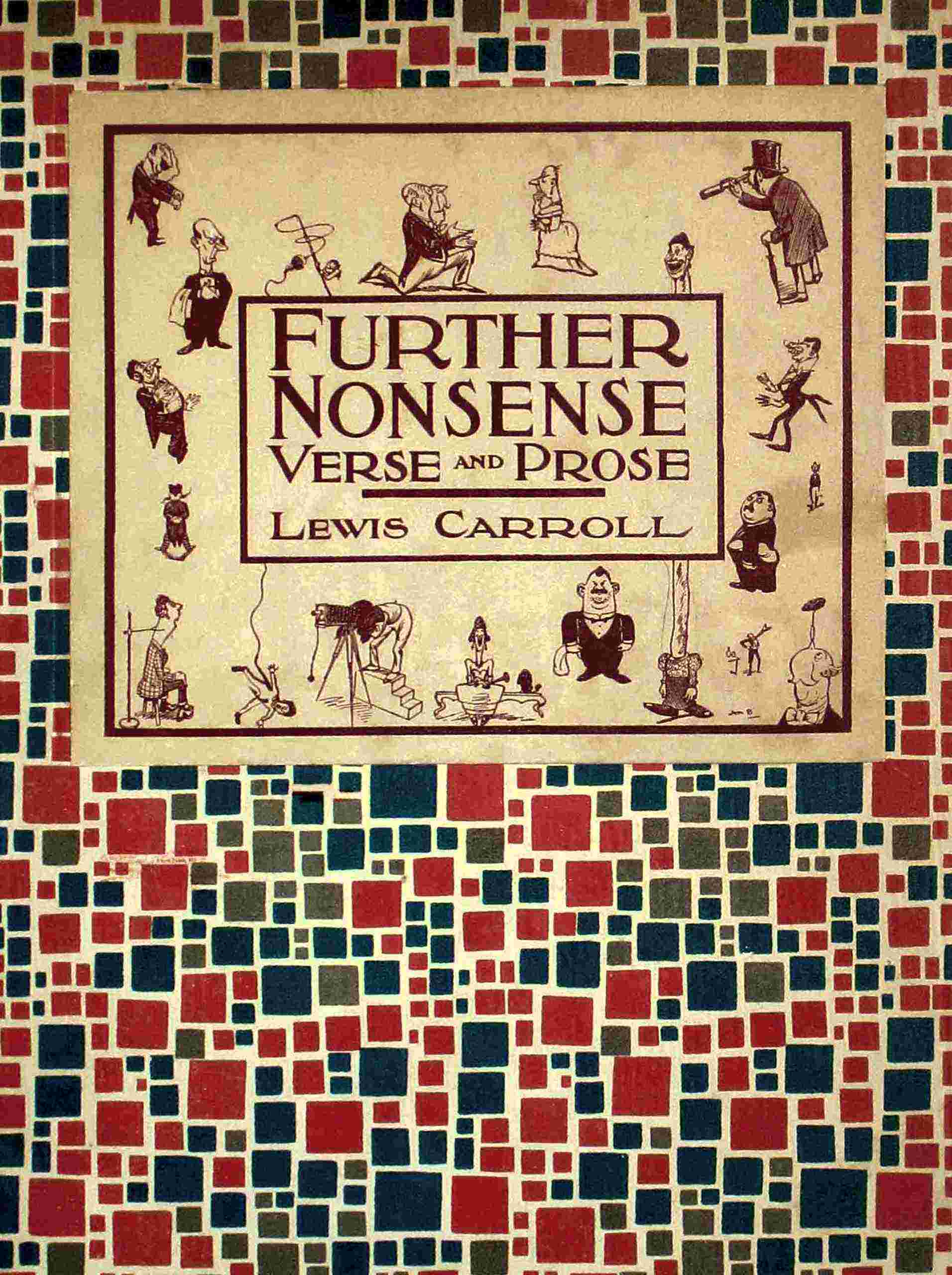
FOREWORD
This present collection of writings by Lewis Carroll—the King of “Nonsense Literature”—is particularly opportune. Most, if not all, the matter in it will be new to the present generation; some of it, indeed, has never appeared in print before.
Apart from other material, more than one hundred and fifty letters have been examined. Lewis Carroll was a prolific correspondent, and his letters, especially to his child friends, reflected his joyous personality and characteristic humour in no uncommon degree. In this connection, and for some of the biographical details in his introduction, the editor wishes to acknowledge his indebtedness to Mr. Stuart Dodgson Collingwood’s “Life and Letters of Lewis Carroll” (a fascinating book long out of print), and to Miss Vera Beringer, Mrs. Barclay, Mrs. Spens, and Mrs. Morton (formerly the three little Miss Bowmans), four ladies who, when children, were among the most intimate of Lewis Carroll’s juvenile comrades. The courtesy of the proprietors of “The Whitby Gazette” in giving permission for the inclusion of “The Lady of the Ladle” and “Wilhelm von Schmitz” must be acknowledged.
The Real Lewis Carroll
Lewis Carroll’s real name, as most of his adult admirers are aware, was Charles Lutwidge Dodgson, and he was born on January 27, 1832, in the Cheshire village of Daresbury, where his father was the local parson.
In this secluded hamlet young Dodgson spent the first eleven years of his life, and in his quaint diversions and hobbies gave promise of the whimsical and bizarre genius which was destined to make him famous.
His biographer has left it on record that he made pets of snails and other queer creatures, and endeavoured to encourage organised warfare among insects by supplying them with pieces of stick with which they might fight, if so disposed.
He also showed early signs of mathematical and scientific talent which, if not rare enough to make the name of Charles Lutwidge Dodgson as imperishably and as internationally illustrious as that of Lewis Carroll, rendered it well known in his own generation among his own countrymen, and proved that he was one of those singular geniuses whom, in his own quaint phraseology, he would have described as a “portmanteau” man—that is to say, one man packed with several individualities!
Of the delightful surroundings of his birthplace he has left the following impression in his serious poem, “The Three Sunsets” (first published in “All the Year Round” in 1860):
In 1843 the Rev. Mr. Dodgson became rector of Croft, a Durham village near Darlington, with a quaint old church which contains a Norman porch and an elaborate covered-in pew resembling a four-post bedstead. Soon after the transference he was appointed examining chaplain to the Bishop of Ripon, and later became Archdeacon of Richmond (Yorkshire), and one of the Canons of Ripon Cathedral.
“Young Dodgson at this time,” says the authority already quoted, “was very fond of inventing games for the amusement of his brothers and sisters; he constructed a home-made train out of a wheelbarrow, a barrel, and a small truck, which used to convey passengers from one ‘station’ in the rectory gardens to another. At each of these stations there was a refreshment room, and the passengers had to purchase tickets from him before they could enjoy the ride. The boy was also a clever conjuror, and arrayed in a brown wig and a long white robe, used to cause no little wonder to his audience by his sleight of hand tricks. With the assistance of various members of the family and the village carpenter he made a troupe of marionettes and a small theatre for them to act in. He wrote all the plays himself and he was very clever at manipulating the innumerable strings by which the movements of his puppets were regulated.”
A Prophecy That Came True
It was in 1844, at the mature age of twelve, when he was a pupil at Richmond School, that he wrote his first story. It was called “The Unknown One,” and appeared in the school magazine.
That the headmaster anticipated that his young pupil might one day astonish the world may be gathered by the following extract from his first report upon him:
“I do not hesitate to express my opinion that he possesses, along with other and excellent natural endowments, a very uncommon share of genius; he is capable of acquirements and knowledge far beyond his years, while his reason is so clear and so zealous of error, that he will not rest satisfied without a most exact solution of whatever appears to him obscure. You may fairly anticipate for him a bright career.”
At the age of fourteen Charles was sent to Rugby School, becoming a pupil a few years after the death of the great Dr. Arnold, immortalised in “Tom Brown’s Schooldays.” The headmaster was Dr. A. C. Tait, who afterwards became Archbishop of Canterbury. His opinion of his pupil’s ability was thus expressed in a letter to Archdeacon Dodgson:
“I must not allow your son to leave school without expressing to you the very high opinion I entertain of him. His mathematical knowledge is great for his age, and I doubt not he will do himself credit in classics; his examination for the Divinity Prize was one of the most creditable exhibitions I have ever seen.”
Young Dodgson’s literary activities appear to have definitely commenced about the year 1845, when the first of a series of amateur magazines, which he edited during the holidays for the benefit of the inmates of Croft Rectory made its appearance. The most ambitious of these home-made journals was “The Rectory Umbrella,” for which, in addition to editing, he wrote most of the matter and made all the illustrations.
In the spring of 1850 he matriculated, and in January, 1851, following in the footsteps of his father, he became a student at Christ Church College, Oxford, and commenced a personal association with it which lasted until the day of his death, forty-seven years later. Scholastic honours and distinctions were his almost from the very first, for he soon won a Boulter Scholarship and obtained First Class Honours in Mathematics and Second in Classical Moderations. The degrees of Bachelor of Arts and Master of Arts followed.
In 1853, during a stay at Ripon, he met a singular person who identified with remarkable accuracy the qualities and characteristics which were to make him famous. This was a Miss Anderson, who professed to have clairvoyant powers, and by merely holding a folded paper containing writing by a person unknown to her to be able to describe his or her character. This was her delineation of young Dodgson’s:
“Very clever head, a great deal of imitation; he would make a good actor; diffident; rather shy in general society; comes out in the home circle; rather obstinate, very clever; a great deal of concentration; very affectionate; a great deal of wit and humour; not much faculty for remembering events; fond of deep reading; imaginative; fond of reading poetry; may compose.”
The following year he contributed the poem and short story to “The Whitby Gazette” which are included in this present volume.
His love of the theatre alluded to by the psychical lady was an early one. In his diary for June 22, 1853, he thus refers to an evening spent at the Princess’s Theatre, London:
“Then came the great play ‘Henry VIII.,’ the greatest theatrical treat I have ever had or expect to have. I had no idea that anything so superb as the scenery and dresses was ever to be seen on the stage. Kean was magnificent as Cardinal Wolsey, Mrs. Kean a worthy successor to Mrs. Siddons as Queen Catherine, and all the accessories without exception were good—but oh, that exquisite vision of Queen Catherine! I almost held my breath to watch, the illusion is perfect, and I felt as if in a dream the whole time it lasted. It was like a delicious reverie or most beautiful poetry. This is the true end and object of acting—to raise the mind above itself and out of its petty cares.”
Another entry is full of the diffidence about himself and his work which was characteristic of the man. It read as follows:
“I am sitting alone in my bedroom this last night of the old year (1857) waiting for midnight. It has been the most eventful year of my life: I began it as a poor bachelor student, with no definite plans or expectations; I end it as a master and tutor in Christ Church, with an income of more than £300 a year, and the course of mathematical tuition marked out by God’s providence for at least some years to come. Great mercies, great failings, time lost, talent misapplied—such has been the past year.”
At Christmas he became the editor of a college publication called “College Rhymes,” in which first appeared “A Sea Dirge” and “My Fancy,” both of which are included in this present volume. About the same period he contributed several poems to “The Comic Times,” and later to “The Train.” Edmund Yates, the editor of both publications, expressed the warmest appreciation of his work.
The “Birth” of “Lewis Carroll”
It was during young Dodgson’s association with the latter journal that the pseudonym, which is to-day world-famous, originated. It was selected by Edmund Yates from the names Edgar Cuthwellis,[1] Edgar W. C. Westhall, Louis Carroll, and Lewis Carroll. The first two were formed from letters of his Christian names, Charles Lutwidge; the others are merely variant forms of them. Thus Lewis is developed from Ludovicus and Ludovicus from Luteridge, while Charles develops into Carolus and thence to Carroll.
The first effort from his pen to which the new pseudonym was appended was “The Path of Roses,” a serious poem which appeared in “The Train” in 1856.
Mr. Dodgson was ordained a deacon of the Church of England in 1861, but never undertook regular duties as a priest, although he preached occasionally at the University Church and elsewhere. Despite the slight stammer which marred his diction his sermons—models of earnestness, lucidity, and reasoning—were always impressive, especially those on the subject of Eternal Punishment, in which devilish and anti-Christian doctrines he was, of course an emphatic disbeliever.
His literary activities and personal charm gained him the friendship of eminent writers in various fields of artistic and professional endeavour, including Tennyson, Ruskin, Thackeray, the Rossetti Family, Tom Taylor the dramatist (author of “Still Waters Run Deep,” etc.), Frank Smedley (author of that admirable novel “Frank Fairleigh”), Stuart Calverley, Coventry Patmore, Mrs. Charlotte the novelist, Millais, Holman Hunt, Val Prinsep, Watts, the Terry family, Lord Salisbury, the Bishop of Oxford, Canon King (afterwards Bishop of Lincoln), Canon Liddon, Dr. Scott (Dean of Rochester), Dr. Liddell (Dean of Christ Church), Professor Faraday, Mr. Justice Denman, Sir George Baden-Powell, Mr. Frederick Harrison, etc.
Most of these distinguished people were photographed by him, for this man of many talents had a flair for artistic photography which undoubtedly would have made him successful as a professional photographer had he been compelled to depend upon it for a living. Photographing from life, particularly photographing children, was, indeed, his principal hobby, and in his rooms at Christ Church he kept a large and varied assortment of fancy costumes in which to attire his little friends for picturesque effect.
The Beginning of “Alice”
It was on July 4, 1862, that there occurred that epochal expedition up the river to Godstow with the three small daughters of Dr. Liddell, Dean of Christ Church, which was destined to have such important and far-reaching results. The first inception of the resultant masterpiece has been charmingly described in the beautiful verses which preface it:
If the final verse is not proof enough that sweet Alice Liddell was Lewis Carroll’s favourite of the three, and that for her he fashioned his immortal fantasy, the opening verses from the exquisite poem which precedes the sequel to the story, “Alice through the Looking Glass,” will dispel all doubt:
It is pleasant to reflect that Lewis Carroll was wrong in his assumption that his little comrade would forget him. She remained his lifelong friend, and many years after the trip to Godstow, when she had become Mrs. Reginald Hargreaves, she wrote the following account of the scene:
“I believe the beginning of ‘Alice’ was told me one summer afternoon when the sun was so hot that we had landed in the meadows down the river, deserting the boat to take refuge in the only bit of shade to be found, which was under a new-made hay-rick. Here from all three came the old petition of ‘Tell us a story,’ and so began the ever-delightful tale. Sometimes to tease us—perhaps being really tired—Mr. Dodgson would stop suddenly and say, ‘And that’s all till next time.’ ‘Ah, but it is next time,’ would be the exclamation from all three; and after some persuasion the story would start afresh. Another day, perhaps, the story would begin in the boat, and Mr. Dodgson, in the middle of telling a thrilling adventure, would pretend to go fast asleep, to our great dismay....”
The original title of the story, which its creator took the trouble to write out in manuscript and have specially bound for the living Alice, was “Alice’s Adventures Underground”; later it became “Alice’s Hour in Elfland.” It was not until June 18, 1864, that its author finally decided upon “Alice’s Adventures in Wonderland,” and it was a year later before it was published. He had no thought of publication at first, and it was his friend Mr. George Macdonald who persuaded him to submit the story to Messrs. Macmillan, who immediately appreciated its value.
Few books have met with such unequivocal praise from the critics and such instantaneous favour from the public, and the writer of these notes feels sure that in any public enquiry conducted into the popularity of children’s books to-day, either in Great Britain or America, “Alice in Wonderland” would come at easy first. His own little daughter, Joan, ætat. nine, never tires of the wonderful adventures, and thinks it “the very best story in the world,” and this opinion is probably typical of nine children out of ten.
The story has been translated into French, German, Italian, and Dutch—tasks which the peculiarly Anglo-Saxon character of its appeal must have rendered very difficult.
Four years after the publication of his masterpiece there appeared its author’s collection of poems grave and gay, known under the general title of “Phantasmagoria,” followed two years later by “Alice through the Looking Glass.”
Soon after this he commenced to work out the story of “Sylvie and Bruno,” and on the last night of 1872 related a great deal of it to several children, including Princess Alice, who were members of a party at Hatfield, where Mr. Dodgson was the guest of Lord Salisbury.
In 1871 appeared his “Notes by an Oxford Chiel,” a collection of whimsical papers dealing with Oxford controversies; and in March, 1879, “The Hunting of the Snark” was published. According to its creator, the first idea for the whole poem was suggested by its last line, “For the Snark was a Boojum, you see,” which came into his mind, apparently without reason, while he was enjoying a country walk. Many of his admirers have contended that “The Hunting of the Snark” is an allegory, but Lewis Carroll himself always declared it had no meaning at all, which, however, is very different from saying it had no point, for the meticulous skill with which each effect is achieved shows the master-hand throughout.
All this time Mr. Dodgson, in addition to his professional duties, was writing mathematical and technical and other serious works, for which he was responsible for more than a dozen books alone, including “Euclid and his Modern Rivals” (1882), which ran into eight editions.
Inventor of Cross Word Puzzles
In addition, he invented many ingenious table games and puzzles, and an examination of some of these has suggested to the editor that in all probability he was the real inventor of “Cross Word Puzzles.”
As, however, this introduction is concerned principally with the humorous literary achievements and characteristics of Lewis Carroll, anything more than a passing reference to matters outside that scope would be inappropriate, particularly since time has to a great extent already endorsed the uncompromising prophecy which appeared at the end of a wonderful laudation of Lewis Carroll in “The National Review” a few days after his death, which stated: “Future generations will not waste a single thought upon the Rev. C. L. Dodgson.”
In 1855 appeared “A Tangled Tale,” in which Mr. Carroll successfully combined mathematics and nonsense in a series of ingenious problems; and at the end of 1889 “Sylvie and Bruno,” on which he had been engaged for several years. “Sylvie and Bruno Concluded” followed in 1893.
Neither of these stories achieved anything approaching the success of the “Alice” books or “The Hunting of the Snark,” for in them he made the mistake of endeavouring to combine a fairy-tale with a serious and controversial novel full of religious and political arguments; and commendable though this may have been from the Christian and ethical standpoint, it made neither for unity nor clarity. Mingled with this extraneous matter, however, is some delightful nonsense, equal to anything in the “Alice” books, particularly in respect of the Mad Gardener and his weird optic delusions; while his heroine, Sylvie, is an idealistic and entrancing creature who appeals to the very best that is in humanity, which brings me to the question: “What is it precisely which delights and amuses us in Lewis Carroll’s fantasies?”
It is a difficult question to answer, for his humour is of that rare quality that is intangible and, so to speak, incomplete. It approximates to that of Shakespeare in “A Midsummer Night’s Dream” and Barrie in “Peter Pan.” I can think of no others. His quaint conversations and fantastic scenes abound in ideas that seem to vanish before we can quite grasp them—like the Cheshire Cat, leaving only the smile behind, or like our conception of his immortal Snark, that was not strictly a Snark because it was a Boojum! He never makes the mistake of less responsible and less “designing” writers of satiating us with good things; on completing a story by him we are always left with the impression that, had he felt so disposed, he could have added another chapter or two as alluring as the previous matter. And, more than any other writer, he has fathomed the mysterious depths of childhood that lie within us—even within the hearts of those of us who are but children of a longer growth. It is these various propensities, together with his command of language and “technique”—noticeable even when his imagination and fancy run at their most preposterous riot—which surely provide the answer to the question as to what are the constituent factors responsible for Lewis Carroll’s popularity; and I disagree emphatically with the opinion in a recent anthology compiled by a distinguished and charming foreign writer who considers that “the poetry of nonsense as Carroll understood it is entirely irresponsible, and the main point about it is that there is no point.”
This gentleman has, I venture to think, made the mistake of attempting to regard Lewis Carroll from a literal point of view (which, of course, cannot be done) instead of from a literary one, for such a description, if true, would reduce his work to the level of the “eenar deenar dinar doe” gibberish of the nursery, or to the unconscious nonsense babblings of idiocy. To carry the argument a step further, any combination of words picked haphazard from the dictionary might be called a nonsense story!
The present writer agrees that legitimate Nonsense Verse and Prose appears to be entirely irresponsible, but surely that is one of the phrases of paradox which make the fantasies of Carroll and Barrie so elusive and so charming to every individual between seven and seventy who retains anything of the divine spark of childhood within his heart, whether he realises the reason for his enchantment or not.
Lewis Carroll’s Technique
Actually the Nonsense writings of Lewis Carroll are a highly technical form of conscious and responsible humour, which, when analysed, are found to contain plot (or “idea”), achievements, climax, and, in the case of his poems, rhyme and rhythm. “Jabberwocky” offers excellent proof of this. Rhyme and rhythm, indeed, are absolutely essential to good Nonsense Verse, which the further removed it is from rules of sense must conform the more closely to rules of sound. It is these factors and the others mentioned in conjunction with them which render Nonsense Poetry so superior to the nonsense rhymes of the nursery and the folk song, including the sea chanty. One type is Nonsense, the other D—— Nonsense. Then, of course, there is sheer Nonsense; but as this is principally confined to the speeches and writings of politicians, we need not enlarge on that aspect of the question here.
So responsible and conscious a literary jester was Lewis Carroll that it is doubtful if there has ever been a more meticulous precisian in the use and intentional misuse of words, including those coined by himself. Every word, every comma, had to be printed exactly as he had planned in his development of the spontaneous idea upon which the particular story or poem was based, and no author took more trouble to ensure that the illustrations to his books exactly corresponded to his conception of the subject. He would send back drawings again and again, no matter how distinguished the artist might be, until some little defect in suggestion, as he saw it, was remedied, and was equally fastidious with regard to the style in which his books were produced. Thus, “Sylvie and Bruno Concluded” appears on announcement which states:
“For over twenty-five years I have made it my chief object, with regard to my books, that they should be of the best workmanship obtainable at the price. And I am deeply annoyed to find that the last issue of ‘Through the Looking Glass,’ consisting of the Sixtieth Thousand, has been put on sale without its being noticed that most of the pictures have failed so much in the printing as to make the book not worth buying. I request all holders of copies to send them to Messrs. —— with their names and addresses, and copies of the new issue shall be sent them in exchange.”
Undoubtedly he has his limitations, particularly in his best and most characteristic work. This may appear paradoxical, but the writer of these notes is strongly of the opinion that one of the most fascinating qualities about Lewis Carroll’s work is that its popularity is never likely to be universal. His humour is essentially “Anglo-Saxon,” and its “psychology” also, which explains why Carroll’s “immortality” as a genius is founded on British and American appreciation, and why the various foreign translations of his works were comparative failures. A remarkable endorsement of the American popularity of his works appeared on July 14th, this year, in the London papers. The account in “The Daily News” read as follows:
“In the handbook of the American students who will be touring England this summer, issued by the National Union of Students, a number of books are recommended as calculated to give young Americans ‘some comprehension of English life and thought.’
“Among them I observe: ‘Alice in Wonderland,’ ‘Pride and Prejudice,’ Chesterton’s ‘The Flying Inn,’ ‘The Forsyte Saga,’ ‘Tess of the d’Urbervilles,’ ‘A Shropshire Lad,’ ‘Major Barbara,’ and ‘Man and Superman.’”
The Golden Age of Literature
It may be contended of Lewis Carroll (as of all the Victorian writers), that he lived in the “golden age” in respect of opportunity for literary achievement. In his day, life flowed on smoothly and uneventfully for the great majority of people. Our fathers laboured and loved, or did the reverse, with a freedom from worry and responsibility that may not have been very stimulating, but must have been decidedly comfortable. Those were the days when “gaunt tragedy,” transpontine melodrama, and “crescendos” of horror and gloom were more popular than humour; indeed, thoughtful people turned towards them as a relief and “inspiration” when compared with the uneventful and prosaic tenor of life. It says much, therefore, for Lewis Carroll’s unique genius that he was able to achieve immediate fame in an altogether different medium.
It must be admitted that the argument that his love for children was partial, inasmuch as boys were excluded from it, rests upon a great deal of truth. Though essentially a manly man himself, who did not fear to use his fists at school against attempted aggression by other boys, or in defence of the weak, he has left it on record that he did not understand boys, and felt shy in their presence, while the only literary tribute he paid to boy-nature was in his creation of “Bruno.” Nor has the compiler of this volume been able to discover any record of friendship between him and a small member of his own sex.
The fact that he had eight sisters and only two brothers may have contributed something to this partiality, which, however, is a very natural one. Nearly all normal men prefer little girls to little boys, just as most women would prefer to make a pet of one of the latter, rather than of a miniature specimen of their own adorable sex. Is it not proverbial that the small daughter is “daddy’s darling,” and the small son mother’s? And if Lewis Carroll has typified this characteristic in his idealistic “Alice,” has not a famous woman writer on the other side of the Atlantic made equivalent representation in her “Little Lord Fauntleroy”?
In his natural preference for the feminine side of humanity it is remarkable that Lewis Carroll apparently never had a love affair. He does not seem to have had any flirtations even, although he must have known many charming young ladies whose friendship he had first gained as children. How emphatic was his resolve to maintain his bachelor freedom may be gathered from the following extract from a letter, written when he was fifty-two years old, to an old college friend: “So you have been for twelve years a married man, while I am still a lonely old bachelor! And mean to keep so for the matter of that. College life is by no means an unmixed misery, though married life has no doubt many charms to which I am a stranger.”
Mr. Dodgson died at Guildford on January 14, 1898, following a few days’ illness from influenza, which had attacked him at his sister’s house, “The Chestnuts,” where, in accordance with his usual custom, he had gone to spend Christmas. He was hard at work at the time upon the second volume of his “Symbolic Logic.”
He was buried in the old portion of Guildford Cemetery, and on June 14th of the present year the writer of these notes and his wife visited the spot. A plain white cross and a triple pediment, “erected in loving memory by his brothers and sisters,” record that—
CHARLES LUTWIDGE DODGSON
(Lewis Carroll)
Fell asleep, January 14, 1898,
Age 65 years,
together with the following inscriptions, singularly appropriate to one whose whole life was one of service:
“Where I am, there shall also My servant be.”
“His servants shall serve Him.”
“Father, in Thy gracious keeping
Leave we now Thy servant sleeping.”
A grave as modest and unpretentious as the man himself, surmounted by no “immortelles,” or other examples of the undertaker’s art, as was the case, at the time of our visit, with adjacent graves. Nature, however, has paid a more graceful tribute than any which could be made by the hand of man. A drooping and beautiful yew tree stands sentinel at the head of the tomb, its foliage sheltering it lovingly from storms and heat, and its trunk entwined with little heart-shaped ivy leaves, just as the genius sleeping there attracted the hearts of little children a generation ago and his works will continue to do for all time.
On the other side the white blossoms of a verdant syringa were scattering themselves across the foot of the grave as if in votive offering to the white spirit which once tenanted the mortal reliquiæ within it.
The cemetery is beautifully situated on the slopes of that famous and picturesque Surrey hill known as “The Hog’s Back,” and though the steep and toilsome ascent must be very trying to mourners who make it on foot, of such travail is your true pilgrimage made. Few if any of the people of Guildford make it for the purpose of visiting the last resting-place of Lewis Carroll, however. Indeed, it seems extremely improbable that more than a tiny minority of them are aware that he is buried there.
Three local ladies of whom we made enquiries in the cemetery were astonished when we informed them that it contained the last resting-place of the author of “Alice in Wonderland,” and listened with the greatest interest to a discursive and aged sexton whom we contrived to “unearth,” who had not only buried him, but had been acquainted with him in life. He told us that not many people visited the grave, but those that did were nearly all Americans! How surprised some of these Transatlantic enthusiasts must be when they find that “The Chestnuts,” where Lewis Carroll died and spent so much of his time during the last twenty years or so of his life, is without the usual plaque to distinguish it as a habitation of the Great!
They do these things better in Copenhagen, where, it seems, a Hans Christian Andersen Memorial Park has been planned, which is to contain statues of the Danish author’s most charming characters, set among leafy bowers and flower gardens, the latter to be tended by teams of children from the various Council Schools.
Besides, such a memorial plaque on “The Chestnuts” would be a very small tribute materially, and yet as a mark of spiritual recognition it would be sufficient. Assuredly Lewis Carroll would not wish for more, for the fact that his works will never be forgotten he would consider remembrance enough.
All the same, there is something fine and exultant in the feeling which inspires people to pay reverence to one who by achieving honour and fame himself has brought honour and fame to his country, whether the “departed” be symbolical of “collective achievement,” as in the case of the “unknown soldier,” or whether he be a great poet, writer, inventor, scientist, general, king or president, or even a politician or commercial magnate.
Langford Reed.
Hampstead,
London.
[1] Actually used by Mr. Dodgson in his story, “The Legend of Scotland,” included in this volume.
FURTHER NONSENSE
VERSE AND PROSE