
CHAPTER X
Into the Fray
"Oh, you make me sick," came in another voice, lower-toned but angry, the voice of Bill's older brother, Frank. "Do you think I'm going to have a kid like you bossing me? The crowd's all right. They make a lot of noise, that's all, and all the old crabs in town take turns in picking on them."
As Garry backed out on the porch and was pulling the door shut behind him he heard Bill say:
"That sounds just like Sandy Podder or Lent Stewart. You can think I'm a crab all you like, Frank, but I'm telling you that if you don't leave that bunch alone they'll get you in Dutch some day. That's as sure as my name's Bill Sherwood."
Garry, once outside, pressed his finger on the bell button.
Bill himself answered the ring a moment later, his face wearing an angry frown.
"Hello!" he said, his face clearing as he saw Garry. "Why didn't you come right in? I left the door open on purpose."
Garry did not tell Bill that he had overheard part of the conversation between him and Frank. But he thought of it a good deal during the day and wished there were some way in which he might add his warning to Bill's.
Ugly rumors of dirty work about Mooney's poolroom had been circulating ever since the trouble over Mr. Podder's three thousand dollars that had so mysteriously disappeared while in Sandy Podder's possession. Garry's father was a lawyer, and Garry had heard at the home table of many things unknown to his mates. A movement was taking form among the better citizens of the town to have the poolroom wiped out as a public nuisance. Garry felt with Bill that if Frank did not break with the fast crowd that hung out at the resort he might soon find himself in trouble, involved in some ugly scandal that might prove a bad blot on his reputation.
However, in the days that followed Garry had a great deal to think about besides Frank Sherwood's recklessness.
For football was in the air and engrossed all the time of the players that could be spared from their studies.
On the day after the appointments for the two teams had been made, the boys met in the gymnasium to don the suits they had brought with them, eager for the feel of the gridiron under their feet and the pigskin in their hands.
Coach Garwin was there, eyes alert and keen behind their half-closed lids.
He assigned each boy a locker and directed them curtly to get into their togs as soon as possible.
"That guy means business to-day," said Rooster to Garry, as he pulled on his cleated shoes. "He'll make us work for our positions even on the scrubs, let me tell you."
"And past reputations won't cut any ice with him," affirmed Nick.
"It matters not what once you were, it's what you are to-day," chanted Ted.
"Well, we weren't so bad last year, and we ought to be better now," remarked Garry.
"To hear us tell it, yes," declared Nick. "But Coach Garwin's the doctor now, and he may take a different view of the case."
Out on the gridiron in the crisp air and the bright sunshine the boys found that Coach Garwin was a hard taskmaster. But they liked him and worked beneath his forceful driving as they never had worked before.
"We'll have practice in punting, blocking, passing, and tackling to-day," he announced. "Also we'll have a short scrimmage between the two teams. But we'll postpone the real games until we've warmed to our work a bit more. Now then, you fellows, I want you to show your stuff."
The boys went to work with a will. Under Mr. Garwin's direction they broke up into groups of three and four, some blocking, some tackling, others trying to place kick and punt.
The coach watched their work with a critical eye and caustic tongue. He abused them far more liberally than he praised and for that reason the boys worked like mad to get even the crumbs of his approbation.
Bill Sherwood was one of the first to be rasped by the rough edge of Al Garwin's tongue.
Bill, while endeavoring with another boy to tackle a runner, made a great leap for the flying knees, only to fall flat on his face in the dust as the runner dodged. The miss was by only a fraction of an inch, but still it was a miss.
The coach's scorn was scathing.
"That's one of the best examples of tackling I ever saw," he remarked, as Bill picked himself up, red and sheepish. "Suppose that had been a member of an opposing team legging it for the goal! You'd have let him get by, wouldn't you, Sherwood? You'd have lost the game perhaps for your team. Tackling! That's a joke. You've got to do better than that."
Bill's face became scarlet. His hands clenched at his sides. He was fighting mad.
"My foot slipped," he said in self-defense. "I'd have got him if it hadn't."
"Maybe," replied the coach, his keen eyes mercilessly raking Bill's dusty figure, "with a couple of men to help you. Ploughing up the gridiron never saved a goal yet."
"I don't need a couple," declared Bill. "That fellow wouldn't get away from me another time! Give me another chance at him!"
Coach Garwin wheeled.
"Dittler," he called curtly to one of the regulars. "Take the ball and start running from the forty-yard line. There's your chance, Sherwood. Let's see you stop him."
Dittler picked up the ball with a grin and started off like a hound slipped from the leash. Bill started to meet him with equal speed and vigor. His blood was up. His resentment lashed him on toward the flying figure. To reach him, tackle him, and bring him to earth was at that moment the great object of his life.
Dittler was one of the best runners on the first team. The coach for that very purpose had chosen him in order to test Bill's mettle.
Long and thin as a greyhound, Dittler was flying across the field in a long, diagonal slant, trusting to his agility and his dodging powers to evade the figure bearing down upon him.
The boys were shouting, the regulars urging Dittler on, the scrubs yelling for Bill.
The eyes of Coach Garwin narrowed as the opponents neared each other.
Just as Bill was within a few feet of him, Dittler halted, swerved and was off like a flash at another angle.
But Bill had sensed the strategy and himself had turned so that Dittler found him right in his path.
Dittler dodged, squirmed, tried to run around his adversary. For a moment it looked as though he would get past those outstretched arms.
"Get him, Bill! Get him!" cried Garry, wild with excitement.
"Come on, you Dittler!" came from the throats of the regulars.
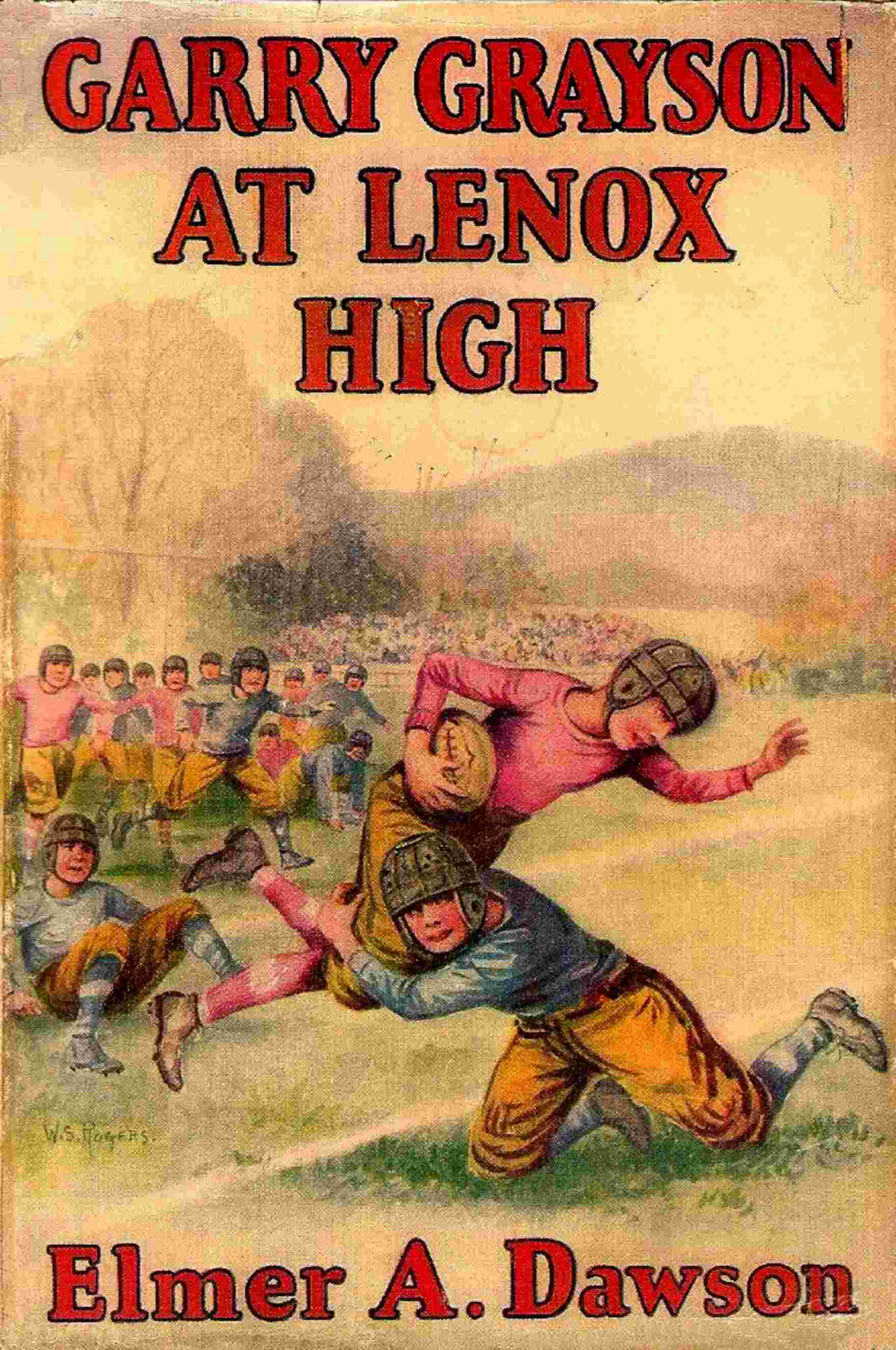
With muscles as tense as whipcord, jaw set, the blood pounding in his ears, Bill put all his strength in one magnificent leap. His arms closed joyfully about the legs of his opponent. Tackler and tackled came to the ground in a cloud of dust.
"Another Indian bit the dust!" crowed Rooster.
"I'll say that Bill is poor!" chuckled Ted.
Dittler, wiping the grime from his eyes, looked up grinningly at the coach as he approached.
"This boy sure can tackle, coach," he said generously. "I thought a house fell on me. You've sure got to hand it to him."
"So it seems," drawled Garwin. "You've redeemed yourself, Sherwood. Any one who can bring Dittler to earth is good."
As a climax to the afternoon's practice, the coach lined the two teams up against each other in a series of short scrimmages. In these, as was to be expected, the regulars had the advantage, owing to their weight and experience. But all the same the scrubs gave them plenty to do. It was a hot, pell-mell, ding-dong fight. The regulars were out to show that the coach was right when he picked them. The scrubs were equally determined to show that the coach had made a mistake in not putting them on the first team.
In this the scrubs did not quite succeed. But they did at least give Al Garwin food for thought. Those sleepy-looking eyes of his missed nothing that took place. Oftenest, perhaps, they were fixed on Garry Grayson.
For that young man was nothing less than a wildcat that afternoon. He fought for every advantage, was quick as a flash, as cold and hard as steel. He was here, there, and everywhere, instilling his own fighting spirit into his team. Twice he himself got through for what would have been a sure touchdown in a regular game.
Tom Allison and Pete Maddern played finely. Ted, Rooster, Nick and Bill gave a good account of themselves. But it was Garry who shone as the bright particular star of the scrubs.
When at last Al Garwin called it a day's work the coach walked off the field with a smile of satisfaction on his face, which, however, he was careful to conceal from the boys.
"It looks as though I had two good teams instead of one," he mused.
In the gymnasium, as the boys shed their dusty togs, got under showers, and slipped into their street clothes, there was a babble of excited conversation between Garry and his friends.
"Old Hill Street didn't show up so badly this afternoon," chuckled Bill.
"That tackle of Dittler was a peach, Bill," observed Nick Danter. "And the way Garry broke through their defense has given the regulars something to think about. Gee, Garry, you just ran rings around those fellows."
"Oh, I don't know," said Garry modestly. "I had some lucky breaks. But one swallow doesn't make a drink, you know, and we may stub our toes the next time out. We've just got to keep working like the mischief all the time."
On their way home the boys passed Trompet Shrugg, who gave them a stiff nod in response to their salutations and glanced disdainfully at the football that Garry carried under his arm. Then the cold dislike in his eyes shifted to Garry's face.
"He just loves you, Garry," chuckled Ted.
"Yes," grinned Garry, "as he loves poison ivy!"