
CHAPTER XI
Struggling Against Odds
"Trompet Shrugg's after your scalp and won't be satisfied until he gets it, Garry," warned Nick Danter.
"He hasn't lifted it yet," returned Garry carelessly. "He tried to yesterday, but he didn't get away with it."
"All the same he'll bear watching," surmised Bill. "He's one of the kind that never forgives and never forgets."
"I never had a teacher that I disliked so much," declared Ted Dillingham fervently.
"He may be a boon to his family, but he's only a baboon to me!" sang Rooster.
"Rooster, I'm ashamed of you," said Garry, with mock sternness. "Is that the way to speak of our dear teacher? It is not!"
But in the days that followed there were many times when Garry was inclined to believe that Rooster had struck it right. Trompet Shrugg certainly "had it in" for Garry, and lost no opportunity of annoying and humiliating him.
In his position of authority this was comparatively easy. Garry was well up in the studies of his grade, in fact was one of the very best scholars of the class. Any fair, legitimate question that came within the scope of what he was supposed to know he could answer clearly and promptly.
But Mr. Shrugg had a habit when it came to Garry of suddenly shooting at him some difficult question more appropriate for a college than a high school class, something that was away over Garry's head and clearly intended to be so. And when the boy had to confess ignorance, Trompet Shrugg would appear disgusted and get off some bit of the sarcasm in which he was an adept. Then Garry would take his seat, flushed and irritated, with his heart full of resentment against his tormentor.
He was in a position where he could not answer back, any more than a private in the army can give back talk to his captain. Mr. Shrugg had the whip hand, and he knew it. His petty nature delighted in punishing the lad who had unwittingly affronted his dignity.
It is probable that Garry might have had some redress had he appealed to Mr. Allen, the principal, and laid the matter before him. He could have easily been backed up by the testimony of his fellow classmates, who shared his indignation at the way he was treated.
"It's a shame the way that fellow is treating you," snorted Bill on one occasion when Trompet Shrugg had been especially tyrannical "He isn't fit to be a teacher. He ought to be thrown out of the school on his head."
"I wish that football had been filled with pig iron when it struck him!" declared Ted, with a vicious gritting of his teeth.
"You ought to carry the matter up to Mr. Allen," suggested Rooster.
"Nothing like that," returned Garry gloomily. "I won't peach on him. But I wish that he was a fellow of my size and age so that I could get a crack at him."
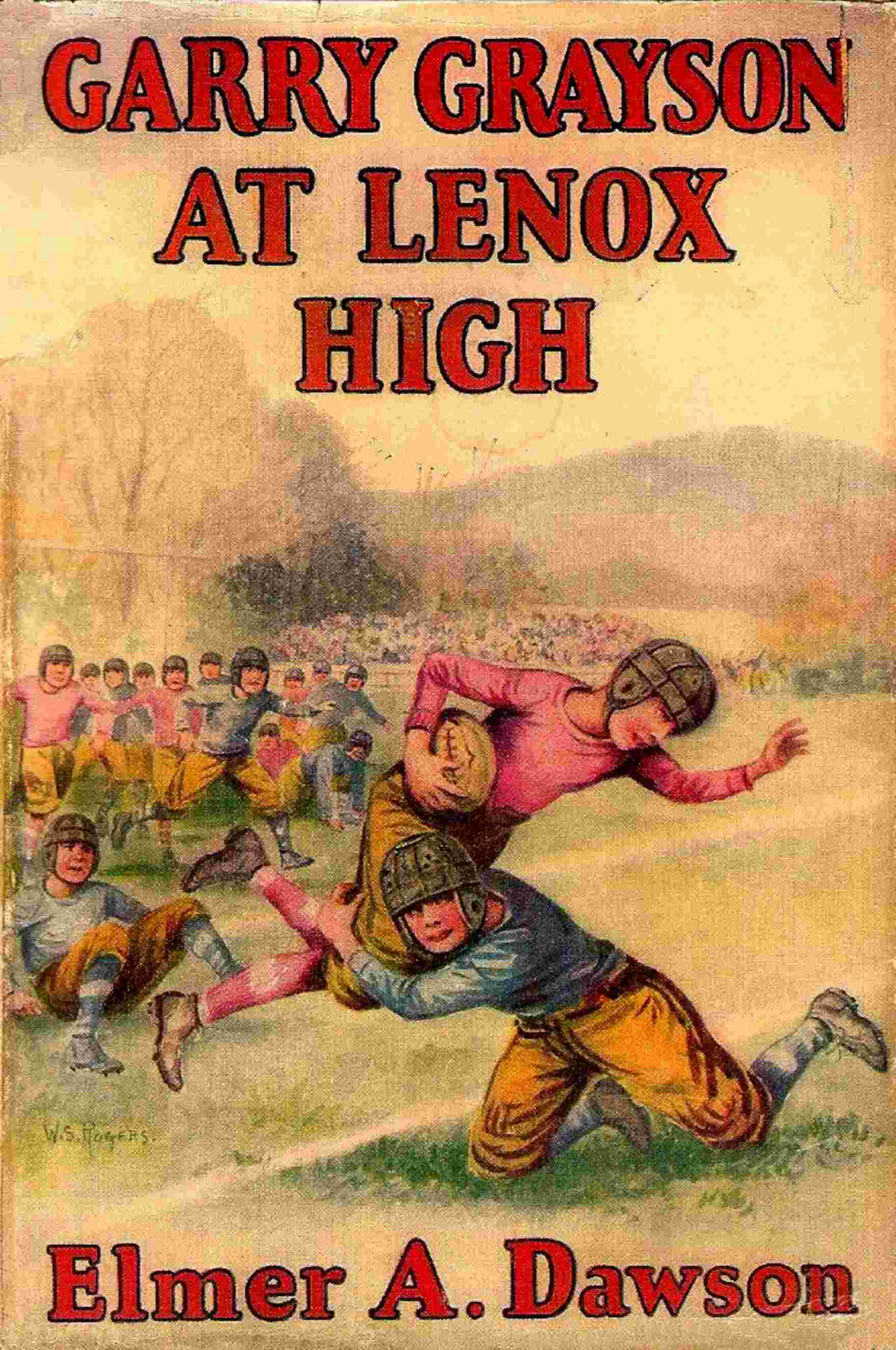
Trompet Shrugg learned that Garry had been chosen a member of the scrub football team. This was his opportunity. He had not a drop of sporting blood in his veins anyway, and regarded athletic games as a waste of time. He had an especial antipathy to football, which had been strengthened by his experience on that fateful day in the open lot.
He knew that the practice took place after the lessons of the day were ended. Then the boys were off with a whoop that was discord to his ears. What could be a sweeter morsel under his tongue than to keep Garry from the game in which he delighted?
So when he had caused Garry to fail on some unfair question he did not content himself with a sarcastic remark, but gave the boy as a penalty long compositions to write that detained him in the building after hours. He knew that he could not do this too often without bringing on an investigation of his methods. But he did it as often as he dared, and on several occasions Garry sat within toiling and listening to the shouts that came from his companions on the field.
More than once Garry was goaded to such desperation that he came almost to the point of open defiance. But by a great effort he mastered his anger. A flare-up would do him more injury than benefit. He knew that in such cases the teacher was supposed to be right and the pupil wrong. The discipline of the school had to be maintained at all hazards. For the time he was the under dog. But even at that he comforted himself by the adage that every dog has his day. When would his day come?
When he did get out on the field after some such exasperating session he would find the practice half over or nearing its end. His place would have been taken by some one else, and at times he could not get into the game at all.
But there were many days when even Trompet Shrugg could find no excuse for detaining him, and then Garry made up for what he had lost in the way of practice. As a matter of fact, the persecution to which he had been subjected had its compensations. For with the blood boiling in his veins from the sense of injustice he was all the more formidable on the field. He tackled his opponents as though he were tackling the English teacher, and when he went through the line it was with the force of a catapult.
Coach Garwin watched him with those sleepy eyes that seemed to see little, but in reality noted everything. But he was puzzled at his frequent absence from practice. He had questioned the lad about it and Garry had simply told him the truth, that he had been made to do work after school for having failed in his recitation. Garry was too proud to explain further. If he hated anything, it was a telltale.
"Too bad, Wynn," Coach Garwin remarked to the captain of the regulars, "that young Grayson isn't keeping up in his scholarship. He's the most promising young player I've seen in years, almost good enough for the regulars, if he weren't a freshman."
"Quite good enough, I should say," returned Ralph, with a wry smile. "I'm sore yet from the way he tackled me a few minutes ago. He goes into a fellow like a battering ram. But what do you mean about his scholarship? I thought he was one of the brightest young fellows in the school. He stood at the head of his class in Hill Street."
"Seems a clever lad," said Garwin, "but he's told me himself that he's had to stay after school several times because he failed in his recitations."
"Do you know why?" came a voice from behind them.
They turned to see Bill Sherwood, who had come up in time to hear part of this conversation.
"I'll tell you why," went on Bill, his voice shaking with indignation. "It's because Mr. Shrugg has it in for him! He's riding him all the time! There isn't a fellow in the class that he treats as he does Garry! In every other class in the school Garry's right up at the top. Why isn't he in the English class? Because Mr. Shrugg won't let him. He asks him questions no one in the class is expected to know, things away beyond the grade. He takes delight in flunking him."
Coach Garwin and Ralph Wynn exchanged amazed glances.
"That's very strange," said Ralph. "I know Mr. Shrugg is rather eccentric and not very popular with any of the boys. But it doesn't seem as if any teacher could be as small as that. I know that Mr. Allen wouldn't stand it for a minute if he knew. Are you sure that he's riding Grayson deliberately?"
"There isn't any doubt of it," replied Bill. "Ask any fellow in the class. They're all talking about it."
"Grayson didn't tell me anything about that," remarked Mr. Garwin.
"That's just because he's a thoroughbred and won't tell tales," declared Bill. "He takes his medicine and lets it go at that. But I'm giving you a straight story. Garry's getting it in the neck."
"What do you suppose the reason is?" asked Ralph, a frown of perplexity on his brow.
"Oh, I know the reason all right," explained Bill. "A bunch of the fellows were practicing in an open lot near Garry's house and Garry let go a punt just as Mr. Shrugg came around a corner into the lot. The ball was muddy and it caught him in the face. He was a sight, I must confess. Of course it was all an accident. Garry was mighty sorry, apologized to him, and wanted him to go into his house and clean up. But Mr. Shrugg was as sore as a boil. He's never forgotten that muddy football, and ever since school began he's been making Garry sweat for it."
"It's a bad thing for Lenox High to have a teacher of that kind in it," said Ralph in disgust. "The sooner it gets rid of him the better."
"And as for keeping Garry after school," went on Bill, "Mr. Shrugg does that for two reasons. He knows Garry is on the scrubs and is crazy about football. So he keeps him away from practice all he can. Then, too, when the question of scholarship comes up, he'll be able to point to the many times he's had to keep him in, and that will give him a chance to say that Garry doesn't stand high enough to be permitted to play. Oh, he's a foxy guy, that Trompet Shrugg!"
"I'm glad that you told me all this, Sherwood," said Coach Garwin. "It explains a lot of things that have puzzled me. And I think all the more of the lad for not making excuses. He's the right stuff."
"And don't let the question of Garry's scholarship keeping him out of the game worry you," put in Ralph Wynn. "If that thing ever comes to an issue, I'll see that the truth is told. I think the amiable Mr. Shrugg will find that he has overreached himself."
All of this was balm to Garry Grayson's troubled heart when Bill narrated the conversation to him on the way home. He had been standing up under Mr. Shrugg's persecution without a whimper. But it had galled him horribly, especially the fear that he might not be allowed to play on account of the marks that the teacher of English was giving him. Loyal Bill Sherwood had done for him what his own pride would not permit him to do for himself.
"It was mighty good of you, old boy," he said to Bill gratefully.
The next day, Mr. Garwin told the boys that on the following Saturday there would be a real game between the first and second teams.
"I haven't hurried to bring you boys along," he said. "I wanted to get you limbered up and get some of the kinks out of your muscles. Then, too, I've wanted to size you up. But now I think you're in shape for a regular game."
There was a murmur of assent from the eager boys who wanted nothing better than to show the stuff of which they were made.
"I want each team to play against the other as hard as though they were tackling Pawling or Wimbledon," went on the coach, referring to rival teams in the High School League. "If there's any let-down I'll be on hand to see it. You regulars have got to try to walk all over the scrubs—"
"Swell chance," piped up Ted Dillingham, and there was a general laugh from his comrades on the scrubs. Mr. Garwin smiled quizzically.
"That's the spirit I like to see," he said. "I was just going on to urge the scrubs to take some of the conceit out of the regulars."
On the following Saturday the two teams faced each other, each full of determination to show the other up.
"Now, fellows," said Garry, as he gathered his scrubs about him just before the game began, "those fellows think we are easy meat. They think they're going to walk all over us, beat us to a frazzle, throw us to the lions. It's up to us to show them that they have another guess coming. How about it? Are you with me?"