
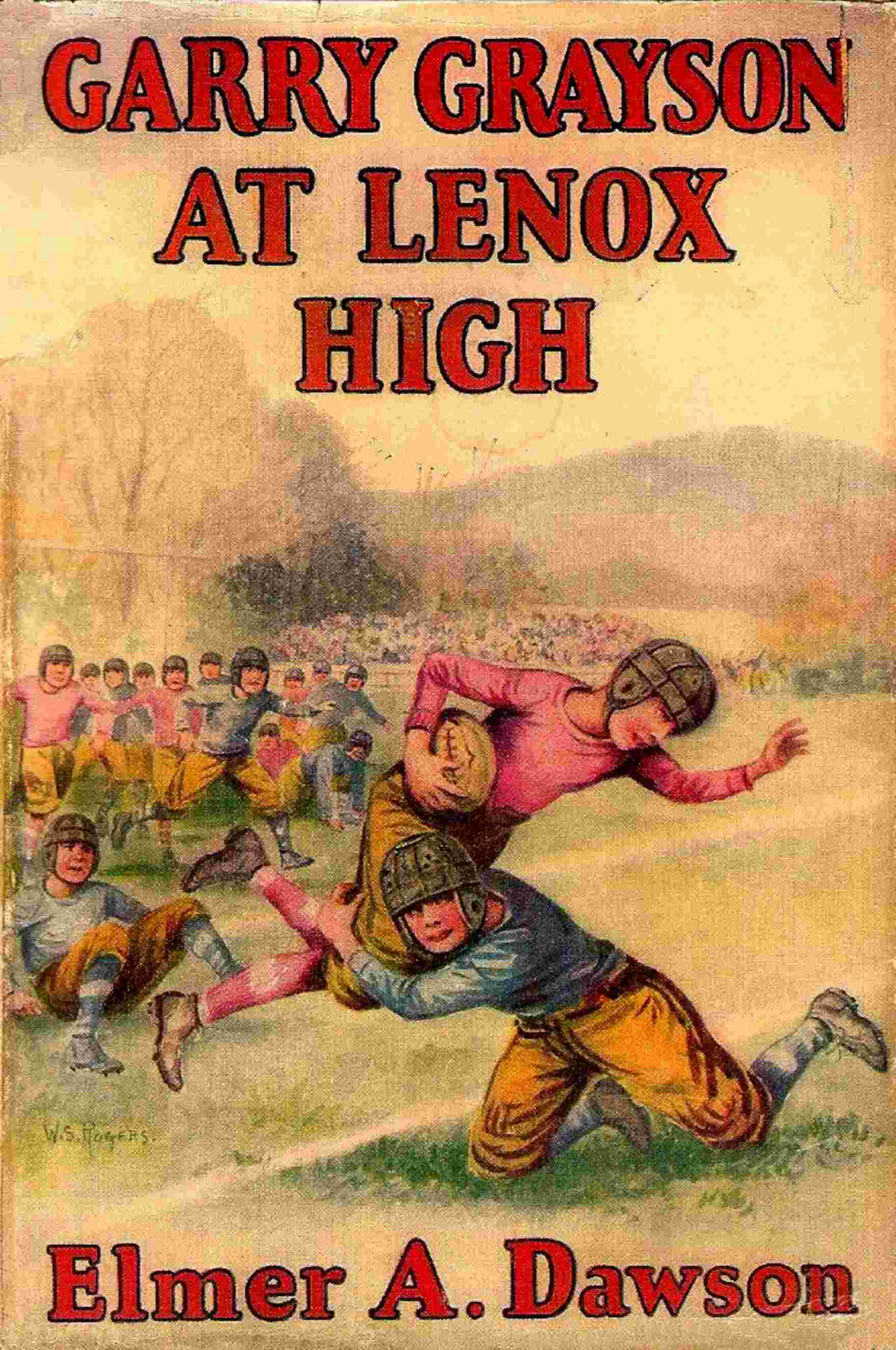
CHAPTER III
The Muddy Football
Such an outburst from good-natured Bill Sherwood was startling. His companions looked at him with surprise. On the face of it, his wrath against Jerry Cox seemed unfounded. This then was the explanation of Bill's coldness and lack of hospitality.
"What's the deep, dark secret, Bill?" asked Garry, voicing the desire to know that all were feeling. "The way you talk about Jerry Cox would make one think you were his best enemy."
"I am," growled Bill.
"What do you know against him?" queried Nick Danter.
"I came to know about him through my brother Frank," replied Bill. "Jerry Cox is one of that fast poolroom bunch. He hangs about Mooney's place all the time with Sandy Podder, Lent Stewart and that gang. He used to be all right before he got in with that lot. Now he's as bad as the rest of them."
"Well, I don't see that that's any of our funeral," put in Ted. "I'm mighty sure I'm not losing any sleep over that poolroom bunch. As long as we don't have to mix with 'em, why should we worry?"
"It's all right for you fellows to talk," returned Bill moodily. "But this Jerry Cox—"
He broke off and looked frowningly straight ahead, while his comrades regarded him curiously.
"Well, he's a friend of my brother Frank's," Bill burst forth, "and he's doing his best to keep Frank in with that rotten poolroom crowd. Do you wonder that I'm sore at him?"
"Not a bit, if that's the case," replied Garry promptly. "I'd feel the same way myself. I'm sorry if Frank has got into that gang. Let's see, Frank is a good deal older than you, isn't he?"
"About five years," answered Bill. "He finished his course in the high school last year, and now he's had a year in college. He'll be in the sophomore class in the fall. He's planning, you know, to be a doctor."
"I've heard it said he was a mighty smart scholar in the high," remarked Ted.
"So he was," replied Bill. "Walked away with most of the prizes. I wish I were as good a scholar as he was. Used to love his books. But now that he's got in with that gang he's neglecting his work and has fallen 'way behind in his studies. The folks have talked to him about it, but it doesn't seem to do any good. As for me, he treats me like a kid."
"It's too bad," said Nick sympathetically.
"Take the time you fellows have been up here, for instance," continued Bill. "How many times have you seen Frank at the bungalow?"
"Just once," replied Garry thoughtfully. "And then he seemed in an all-fired hurry to get back to town," he added.
"Where does he stay at night in Lenox?" Booster asked.
"Oh, at the house of one or other of the gang. Usually he pals with Jerry Cox," Bill explained. "Do you wonder," he added, with another vicious twist of the wheel, "that I could barely bring myself to be decent to the fellow?"
"It's enough to make any one sore," admitted Garry, who felt that he knew now why Mr. and Mrs. Sherwood had often seemed so sad and abstracted during the visit of the boys to the bungalow.
They were entering Bass Lake now, almost at the place where Lent Stewart's motorboat had met with disaster. They stared at the fatal rock reminiscently.
"It's a wonder that Lent Stewart wouldn't learn to pilot a motorboat before he took it out for a spin," commented Ted. "The end sure came fast and furious."
"Shouldn't wonder if he had been drinking," remarked Nick. "I caught sight of a bottle in the bottom of the boat."
"Of course you can't blame him for feeling pretty sore," conceded Garry. "It must be pretty tough to lose a new boat like that. It must have cost a lot of money."
"You can blame him for showing that he was sore, though," declared Bill disgustedly. "The ungrateful goof never even thanked you for saving his life, Garry."
"I was thankful enough for saving my own life," returned Garry, and then told them of the panic-stricken way in which Stewart had clutched him and drawn them both under water.
"Sounds just like him," Bill said contemptuously. "That whole poolroom gang is rotten. That's why it makes me mad enough to bite nails to think of Frank being in with them."
All his friends sympathized heartily with Bill. Having come in contact with that fast, dissipated crowd through Sandy Podder, who was one of the bunch, they knew how worthless it was. They knew, too, that Bill had always looked up to his older brother as a model of everything that was intelligent and fine. There had been a strong bond between the two lads. Small wonder that Bill had found it hard to be polite to Jerry Cox!
"Guess we'd better get over to the house and jump into our clothes," remarked Bill after a silence. "Supper will be just about ready when we get there."
The boys agreed, and after making the motorboat fast to the dock hurried to the house.
That evening at the table the guests were able to read a new meaning into Mrs. Sherwood's anxious glances toward the door and in the conscious effort that Mr. Sherwood made to be companionable and cheerful.
"They are hoping Frank will come home to supper," thought Garry. "I suppose he's having eats with some of the gang and planning a full evening at the poolroom."
Rooster, thinking on the subject, wondered how he could ever have felt a liking for Jerry Cox.
Two days later the visit at the bungalow came to an end.
"Hate to leave, Bill," said Garry. "We've had a mighty slick time while we've been here."
The other boys expressed themselves in similar fashion.
"I hate just as much to have you go," replied Bill. "But I sha'n't be long behind you. The folks are going to close the bungalow earlier this year than usual."
He did not say why, but Garry surmised that this was because they wanted to get back to town so as the better to keep their eye on Frank and try to get him under control.
With warm thanks to their host and hostess, the boys made their way back to their homes at Lenox, hiking it by preference, though Mr. Sherwood offered to send them in the car.
At the corner of Maple and Cherry Streets, they met Dick Randolph and Con Riley, who greeted them like long lost brothers.
"You old deserters!" exclaimed Dick. "We thought you weren't coming back till the first day of school."
"We've been having some fine practice in that open lot back of your house, Garry," said Con. "Dick's developed a great punt, and our forward passing hasn't been so worse."
"I'll have to get in with you," replied Garry. "My hands are itching for the feel of the good old pigskin."
As they reached the front of Garry's home, Mrs. Grayson came hurrying out to meet her son. After a warm greeting to the wanderer, she turned to his chums.
"Come in with Garry, boys," she said smilingly. "Hannah's just putting lunch on the table."
The lads made some objections as a matter of form, but they did not require much urging. Mrs. Grayson was used to having Garry's friends in her house at all hours of the day and at any meal.
She liked to have them, and it might be observed that Hannah, the maid, though she often grumbled over the necessity of setting extra plates at the table, always served the boys with the best there was and looked on with beaming approval as the fruits of her labors disappeared.
The boys' appetites were keen after their hike, and they did full justice to the appetizing lunch spread before them. While they ate they recurred to the ever fascinating topic of their chances to play football at Lenox High during the coming fall.
"You knew, of course; that Pete Maddern and Tom Allison were entering high, didn't you?" Dick asked Garry.
"Yes," replied Garry, as he passed his plate for a second piece of pie. "I'm glad of it, too. They're both of them good fellows and mighty fine football players."
"I can see where we'll have some tall old scrambling to make the team," said Dick lugubriously, "with three husky captains of grammar school elevens fighting for a berth."
"And none of 'em getting it," predicted Ted Dillingham.
"Maybe. But meantime there's nothing to keep us from kicking the ball around," said Garry cheerfully. "Who's with me? That is, if you fellows are all through."
"If we're not, we ought to be," laughed Rooster, pushing back his chair after Mrs. Grayson had given the signal, an example followed by the others. "Lead on, Garry. Get that pigskin. What we'll do to it will be a sin and a shame."
They ran around to the barn at the back of Garry's home, that had been fitted up as a gymnasium, and there Garry possessed himself of the football that had been given him on his last birthday and which, despite rough usage, was still serviceable.
"Make believe it doesn't feel good to get hold of this old football again," he murmured, hugging the ball lovingly in the crook of his arm as he trotted with the other boys to the open field back of the house. "I wish some of the other fellows were here," he added. "We might get in some good practice."
As though in answer to his wish, a group of boys who had also played on the Hill Street eleven appeared at that juncture, coming up Maple Street.
"There's Sizz Snider and Si Rowe!" yelled Rooster Long.
"And Carl Zukor and Sloppy Hume," added Nick. "Hooray! Now we'll have some fun."
The other boys came running, and there were some jubilant greetings.
"If Bill were here now, it would seem like old times!" exclaimed Ted.
Garry nodded assent.
"Almost a full eleven here now," he said. "Too bad that we haven't got another team to play against. But we can get some good group practice anyway at punting, kicking, and forward passing. We'll have five on each side, and we'll try to play as hard as though we were in a regular game."
They divided up accordingly, with Garry's group in possession of the ball.
"Now, fellows, snap into it!" called Garry. "Let's see if you still have some of your old stuff."
He called out a signal, received the ball from Carl Zukor, who acted as center, straightened with a swift movement, and threw the ball to Nick Danter at right half.
Nick turned and threw the ball to Ted, who legged it down the field at a great rate amid the encouraging shouts of his comrades.
He was downed at last by Dick Randolph, who made a rattling tackle.
"Good for forty yards, I bet," sang out Rooster.
"Easy enough to make a long run when there are not many in front of you," laughed Garry. "Bring it back, Ted, and we'll try another."
There had been a fairly heavy rain the night before, and the field was slippery. Also there were small depressions here and there filled with muddy water, into which a runner was apt to fall unless he watched his step.
One of these proved the undoing of Rooster after he in his turn had received the ball and started to run. He had gone about fifteen yards when his feet found one of those mud-filled pockets in the ground.
Down he went in one grand splash, while his mates gathered round to gibe at his downfall.
The ball fell under him, and when Rooster struggled to his feet it was hard to tell which was muddier, the ball or himself.
"Is that what you call making a touchdown?" asked Dick Randolph, with a grin.
"Cock-a-doodle-doo!" crowed Ted.
Rooster regarded his tormentors with a sour expression of countenance.
"You're a great bunch, you are!" he grumbled. "The next one that grins will get this pigskin right on the end of his nose. Now laugh that off."
Before this formidable threat the boys scattered, still jeering, though at a safe distance from Rooster and his weapon.
Garry, laughing, held out his hands.
"Chuck it," he invited. "I'll give it a punt that will shake some of the mud off of it."
Rooster complied, and Garry received the ball gingerly, holding it at either end with the palms of his hands only.
Then he opened his hands. The ball dropped, met his foot squarely, and went whizzing through the air.
At the same moment a tall, thin, preoccupied gentleman turned from the street into the lot.
Ball and man came together with a plop.
"Oof!" exclaimed the man explosively.