
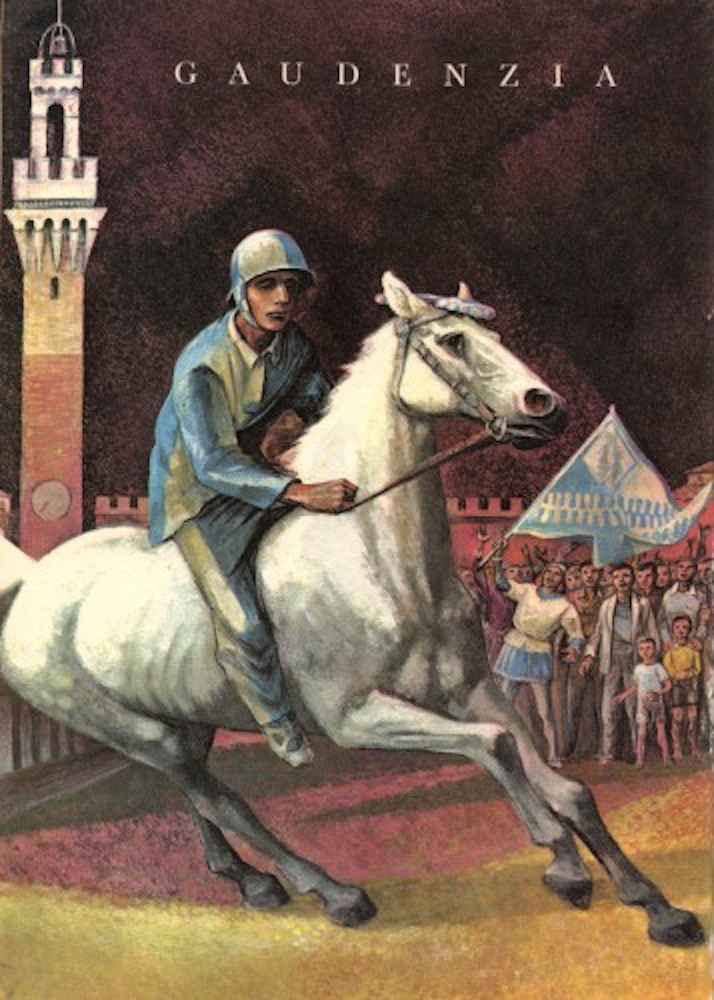
The Project Gutenberg eBook of Gaudenzia, Pride of the Palio
Title: Gaudenzia, Pride of the Palio
Author: Marguerite Henry
Illustrator: Lynd Ward
Release date: April 6, 2022 [eBook #67783]
Most recently updated: October 18, 2024
Language: English
Original publication: United States: Rand McNally & Company, 1960
Credits: Greg Weeks, Mary Meehan and the Online Distributed Proofreading Team at https://www.pgdp.net
Gaudenzia
Pride of the Palio
By MARGUERITE HENRY
Illustrated by Lynd Ward
RAND McNALLY & COMPANY
Chicago New York San Francisco
Copyright 1960 by Rand McNally & Company
Copyright 1960 under International Copyright Union
by Rand McNally & Company
All rights reserved
Library of Congress Catalog Card Number 60-8264
Edition of 1960
A
LITHOGRAPHED IN THE UNITED STATES OF AMERICA
To the half-bred Arabian, Gaudenzia,
and to her boy trainer, Giorgio,
who lived this book
with honor and valor
CONTENTS
Foreword
For months I wrote the story of the Palio in my mind. I pictured a fearless boy rider in this wildest of all horse races, a boy who dared defy the ancient rules and willed his horse to win—in spite of the strict orders of his captain.
When I finally went to Siena and faced the real battle of the Palio, I had to scuttle my preconceived plot. No rider, no matter how brave, would ever defy the ancient rules of the race. They are as firm and immutable as the walls of the city.
But the story I found was of heroic proportions, much bigger than the one I had dreamed. A peasant boy, named Giorgio Terni, and a half-bred Arabian mare seemed pawns of fate, doomed to a life of tragedy. Their battle to outwit destiny is a drama of human and animal courage.
The secret plotting of the Palio is so strange that I had to journey from America to Siena three times in order to understand the inner workings. There is a need in the people to relive the past, a need so intense that they change themselves into knights and noblemen of the Middle Ages for a brief moment each year.
While I was there, I myself became embroiled in the passion of the Palio. I attended the solemn ritualistic banquet on the eve of the race, and afterward I went with Giorgio Terni and his bodyguards to listen to music in the heart of the Piazza, and I went with him into the stable of the mare, Gaudenzia. I wanted to study this courageous youth who was fully aware that tomorrow his blood and that of his mount might crimson the race course.
I visited with Giorgio's parents, too, and with his brother and sister in the huddled village of Monticello, far away in the Maremma country. Because I spoke no Italian we had to communicate in pantomime, but it was more exciting than any game of charades. It concerned life, and death.
Twice I watched spellbound the pageant-parade on Palio day, and twice I shouted and prayed during the breakneck race that Gaudenzia would sweep wildly through the pack to victory.
Dozens of people—cobblers and captains, peasants and princes—gave of their time and energy to help make this book an authentic recreation of the oldest horse race in the long history of the sport of kings.
At last I understood that the Palio is a fire banked but never quenched. Every summer it blazes anew into a festival of such drama and color that the characters who take part might have stepped out of the Middle Ages.
Marguerite Henry
Gaudenzia
Pride of the Palio
CHAPTER I
The First Signpost
In a hill town of Italy, close by the Tyrrhenian Sea, lives the boy, Giorgio Terni. He is slight of build but hard-muscled and lithe, with dark wavy hair and amber eyes the color of a young fox's. His town, Monticello Amiata, is named for nearby Mount Amiata. But the countryside that dips down to the sea is known as the Maremma, or "marshy place." It was once wild and desolate, and it bred strong, earthy men who grappled their living from the wetlands.
In the rest of Italy, people still think of the Maremma as a savage, wind-blown place where land and sea are not yet separated. They have heard that only work horses and bullocks are reared there, and the people who survive the fever-laden mosquitoes are wild as the sea that goes to meet the sky.
But now things are changing. The bogs and sea ponds are being ditched and drained, and the tangle of brown swamp grass is giving way to fields of golden wheat, and to olive groves and vineyards.
Giorgio's father is one of the new farmers. He cultivates a narrow strip of land, and at harvest time pays a little money to the state so that in twenty or thirty years it will be his. But at heart the new farmers remain unchanged. The love of animals is strong in their blood, and they tell with pride that the horses of the Maremma stand taller and and show more stamina than those bred elsewhere.
It was in Giorgio's thirteenth year that he resolved to make animals his life. Two experiences came to him in swift succession—one brutal, one tantalizing. When he thought about them later, he knew they were signposts, pointing the way to his future.
Work-hardened and tough as he was, the first one shook him like a thunderbolt. He was driving Pippa, his donkey, from the hilltop village of Monticello down to the valley of his father's farmland. It was a clear, bright day, with only a capful of wind. Spring was in the air—grapevines sending out new runners, swallows hunting straws.
Then all at once the bright morning went black with horror. Near a wayside shrine Giorgio came upon a swineherd mercilessly beating a small, shaggy donkey. With each blow the dust rose in little clouds from the donkey's back. As Giorgio drove up, he saw that the creature was trying to lunge away, but he was tied fast to a tree. The sight threw the boy into a blinding rage. He jumped from the cart and caught at the rope.
"Stop it!" he shouted to the swineherd. "You'll kill him!"
The man turned in surprise, sweat dripping from the beardy stubble on his chin. He jerked the rope from Giorgio's hand. "Why not kill him?" he bawled out. "Too stubborn he is to live!" Taking a fresh hold on the stick, he hit the donkey across the rump, the back, the ears.
"Stop!" Giorgio shouted again. He braced his feet. His arm muscles went hard and tight. He waited for the stick to crack across his face. But it did not come. It kept right on flogging the mouse-colored donkey, a-whack, a-whing, and a-whack, until with a grunt more sob than bray, he fell to his knees.
Giorgio crouched over the poor beast and stroked his head. Nearby he saw two crates filled with squealing pigs. He gave the swineherd a scornful look. "Let me load your donkey," he cried. "Let me drive him to market."
With one arm the man flung the boy out of his path, then came stalking at him, making bull's horns of his first and fourth fingers. He thrust them almost into Giorgio's eyes. "You meddling runt! How'd you like the stick against your hide! Run for your life, or I...." His hand came up in a threat.
Giorgio stood his ground. He was only a little afraid. He hated the smell of the sweat-dripping man.
Something in the boy's face made the man change his mind. He threw the stick far off into the field. "All right, you runt!" He spat the words between his yellowed teeth. "You so smart, you load Long-ears! You drive my shoats to market."
"I will! But first I drive Pippa to our farm." The boy ran back to his cart, lifted Pippa's head with the lines, and down the road the donkey clippety-clopped as if there were no time to lose. Giorgio glanced back to make sure the swineherd would wait. The man had flopped down in a slab of shade made by the shrine. He was mopping his face and at the same time pulling a plug of tobacco from his pocket.
The farm was only a kilometer away, and Giorgio soon returned on foot. With tiny new carrots and a pocketful of grain, he coaxed the donkey to his feet. Carefully he loaded him with the crates of pigs, making sure the ropes did not bind, and he tucked rags under the pack to cushion the weight against the sores. Then slowly he led the donkey to market, talking and praising him all the way. The swineherd, sullen and silent, plodded along behind.
Three times that week Giorgio worked Long-ears, and he neither kicked nor balked. He seemed to know a friend was leading him. He accepted each load meekly, as if it were the sun or the rain. He even let himself be ridden, the boy sitting far back between the crates singing "Fu-ni-cu-li! Fu-ni-cu-la!" at the top of his lungs.
The market men poked fun at the swineherd. "Giorgio, he makes cuckoo of you!" they laughed in his face. "Long-ears is fine worker, for the boy."
The taunts enraged the man, and when no one was looking, he continued to take out his fury on the donkey. There came a morning when the little beast no longer felt the pain of the floggings. He was dead.
When the news reached Giorgio, he stopped what he was doing and made a hard fist of his right hand. Then he struck the palm of his other hand again and again, until the stinging made him quit. The hurt somehow helped him feel better, as if he had delivered the blows to the swineherd's fat, dripping face.
On the surface, life went on as before. Giorgio worked in the fields with his father and his younger brother, Emilio. And he worked for his mother and his sister, fetching water in great copper pitchers from the street fountain, and carrying trays of neatly shaped dough to the public bake oven. But he thought often of the swineherd's cruelty.
One noontime when he and his father had stopped their span of white bullocks, he spoke in great seriousness. "Babbo," he asked, "you will not laugh if I tell you what I will do when I have a few more years?"
"I will not laugh," the father replied as he opened Giorgio's schoolbag that now served as lunchbag.
"You promise it?"
"I promise."
The boy accepted the hunk of bread and the wild boar sausage the father offered. Then his arm made a great arc toward the mountains. "Some day," he said in a hushed tone, "I will be a trainer of animals, not just donkeys. And I will climb Mount Amiata and live in the land on the other side."
The father nodded as he chewed. Young boys' heads were full of dreams. He had once dreamed of leaving the Maremma country himself. "It costs dear to travel," he warned.
"That I know, Babbo, but I will have my own horse and he will take me." Giorgio's imagination was on fire. "Everyone will try to buy him. For me he will walk forward or backward, trot or gallop, or spin around in a circle. All this he will do—not in fear, but because he wants to please me."
"For you, my son, I hope all comes true. But do you forget that times are hard and your Babbo has to sell horseflesh for eating, not riding?"
Giorgio was only half listening; he was on a big-going horse, sailing right over the cone of Mount Amiata.
If the swineherd and his donkey had planted a seed in Giorgio's mind, it was the Umbrella Man who made it grow. He came yodeling into Monticello one misting morning three months later.
"Om-brel-lai-o-o-o!" His voice rang out strong and clear as the bell in the church tower. "Om-brel-lai-o-o-o! I doctor the broken ribs! I patch and mend! Pots and pans, and china, too. Om-brel-lai-o-o-o!" And he strung out the word until it rolled and bounced from house to house.
Shutters flew open, heads popped out of windows. A crock of geraniums fell with a crash on the cobblestones below. Children danced for joy, old men brandished their canes like batons. Giorgio, who had been filling pitchers at the public fountain, ran for home, spilling the water as he flew.
"Mammina!" he cried as he burst into the kitchen. "He is here! Uncle Marco, the Umbrella Man!"
His mother turned away from the stove, smiling. It was good for a change to have Giorgio seem more boy than man. She took from the opposite wall, next to the family's hats and caps, an enormous green umbrella with a loose hanging fold made by a broken rib. "The tinker man works magic if he can fix this," she laughed.
In a flash Giorgio was at the door, umbrella in hand.
"Wait, son! Wait!" She looked at the eager boy and quickly counted in her mind the pieces of money in the sugar pot—the soldi and the lire. Yes, if she carried the big red hen and one or two rabbits to market, there would again be the same money in the pot.
She went to the end of the narrow room that served as kitchen, dining, and living room. Opening the bottom doors of a tall cupboard, she took out the broken pieces of a bake dish. It was the one, Giorgio saw, that he had clumsily dropped on the stone floor. Next she counted out a hundred lire.
"Now then," she said, putting the money and the broken dish into his hands, "go quickly. With the umbrella and the bake dish to mend, you can ask more questions than anyone who brings just the umbrella. You are happy, no?"
Thinking of the cost, Giorgio looked at his mother in astonishment. Ever since the incident of the donkey she had tried in little ways to make up for his sorrow. She had fried crispy hot fritelle for him when it wasn't even a feast day. And only last night he had found under his pillow the last piece of nougat left from Christmas. Now this joy! For it was Uncle Marco's rule that whoever brought him the most work could ask the most questions.
"Si! Si!" he answered, kissing her soundly on the cheek. Then he threw back his head, and whinnying like a King Horse ran joyously out of the house.
CHAPTER II
The Umbrella Man
On the edge of the public fountain, where three narrow lanes come together, the Umbrella Man sat perched like some Robin Hood alighted only for the moment. He wore a brimmed hat with the tail feathers of a cock pheasant stuck through the felt. His shoes were brown leather curled upward at the toes, and the soles were of wood, rubbed shiny. When he lifted his arms one could tell that his jacket had once been bright green. Now it was powdered by dust—not gray dust, not brown, but tawny red—testimony to long days of walking the hills of Tuscany.
Yet with all his traveling the Umbrella Man showed no sign of weariness. His eyes, dark and beady, sparkled in delight, as if this were a day he had long awaited, as if it held a special quality, rare and magical.
"Buon giorno! Buon giorno!" He opened wide his arms to welcome his friends who came laughing and breathless to greet him. One other boy brought a sagging umbrella, and a girl carried a pitcher with a broken snout. They, with Giorgio, placed their crippled possessions at his feet, like precious offerings laid before a god.
Before starting to work, Uncle Marco looked from face to face, beaming. He was actor as well as tinker. He had certain little curtain-raiser habits to whet the excitement. First he made a ritual of taking off his hat, running his fingers over the bright glinting feathers, and putting it back on again at a rakish angle. Then while his audience watched in growing impatience, he took a copper mug from his pocket, and let the fountain water flow into it. He drank long and heartily, sucking the water through his ragged red whiskers with a loud hissing sound.
"Bello! Bello!" he sang out. "No water so delicious as water of Monticello!" His voice rolled strong and vibrant, full of the juices of living. "Bello, bello—Monticello!" he sang again, clapping his hands, chuckling over his rhyme.
At last, with a grand flourish, he unhooked the pack on his back and spread out its contents on the cobblestones.
The children craned their necks to see umbrella ribs made of canewood, patches of green and black and purple cloth, rolls of thin wire, an old fish tin, a needle curved like a serpent's tongue, and a wondrous drill that looked for all the world like a bow and arrow. With a jovial wink in Giorgio's direction, the Umbrella Man now took up the broken bake dish.
"Giorgio Terni!" he pronounced in his best stage voice. "With you we begin. Of the world beyond the mountain, what is it you want to know? Ask, boy."
Giorgio's heart beat wildly. He swallowed; he gulped. Emilio, his little brother, and Teria, his sister, crowded in on him, nudging him with their elbows. "Ask it!" they urged. "Ask!"
Giorgio knew what to ask, but he muffled and stammered the words so they ran all together. "YoujustcomefromSiena?" he whispered.
"Eh? Speak out. Speak out, boy! Forte!"
"You just come from over the mountain? From city of Siena?" This time the question could be heard by everyone, even by people leaning out the windows.
The pheasant feathers danced and nodded a vigorous "yes," and the twinkling black eyes looked up, encouraging the next question.
"You see the big horse race? The Palio?"
"I see it, all right. I see both July and August Palio!"
Everyone pressed close, heads canted, listening.
A spotted pig wandered into the crowd, snuffling and snorting, but went unnoticed. All eyes were fixed on the Umbrella Man, watching fascinated, as slowly, deliberately, he worked on the bake dish. First he loosened the bowstring of the drill. Then he sawed away clockwise, then counterclockwise, making the tip of the arrow drill a neat little hole in the dish.
Impatience mounted while he drilled three more holes and inspected each one carefully, nodding in approval.
"We wire and glue later. Now then," he sighed, with a glance to the far-off hills. "Now I carry everyone over the mountain to old, walled city of Siena!" He opened up the big green umbrella as if they could all hang onto the spokes and fly away together.
"The Palio," he began, taking a deep breath, "is fierce battle and race all at same time. If I tell you, you must listen. Even if it makes the hairs on your spine to quiver. Even if you do not believe it can be so!"
The fountain place was so still that the drip-drip from the spigot sounded like hammer strokes.
"Anciently," he went on, "in old, old times before anyone remembers, city of Siena was very powerful nation."
Giorgio nodded to himself. This was going to be good. Not a tall tale but a true one.
"Inside her high old walls she is divided like inside this umbrella. Only instead of cloth and ribs, she is divided sharp and clean into districts called contradas."
Giorgio opened his mouth. "Do they have names?"
"Oh, splendid names—mostly for animals. One contrada is the Dragon, another the Panther, the Eagle, the Porcupine, the Wolf, the Owl. Like that," he said, ticking them off on his nimble fingers. "Seventeen they number in all."
The pig came back, stole a piece of apple from a child's fingers, and scampered away again. But the child did not even whimper. There was just the Umbrella Man, his eyes hypnotic, his voice carrying his audience along, farther and farther from Monticello.
"In Middle Ages, each contrada was great military company of knights in armor, and each had beautiful flag with emblem in gold. And they fought blood wars."
Suddenly the Umbrella Man's face beaded in sweat. His skin paled.
"Uncle Marco! What is it?" an elderly man asked anxiously. "Are you sick?"
"No, no." He narrowed his eyes and leaned forward. "How can I explain how fierce, how strong, how loyal are feelings in each contrada even to this day?" He shook his head in despair. "Just for suppose: A father belongs to the Contrada of the Panther, the mother to the Dragon, one son to the Eagle, the other to the Ram. You see, it's where you're born that makes you Eagle or Ram or Panther or Dragon."
He stopped to blot the perspiration with a bright red handkerchief.
"How do I explain? All year long this family lives together in happy feelings. Then come the preparations for the Palio, and—pffft!—they are enemies! In the father the Panther blood runs like fever. He forgets home; he goes to the meetings. Every afternoon, every night, in every spare time he joins the other Panthers. They make questions. 'Who will be our jockey in the Palio race?' 'Shall we make the alliances with other contradas?' 'Who shall paint with gold the hoofs of our horse if we win?' 'Who shall be in charge of our Victory Dinner?'
"And Mamma? She is not like Mamma at all. She lets the spaghetti burn. She snips and sews all day for the Dragon—mending their silken banners and the velvet costumes for the parade.
"Mind you," Uncle Marco shook his forefinger wildly, "some costumes were designed by Leonardo da Vinci! No wonder the Mamma's hands tremble while she works ... so great the honor is!"
Giorgio interrupted. "Uncle Marco! What about the two brothers?"
"Well, those boys, they grow warlike against each other and their father must separate them; he sends them to stay with friends or cousins in their special contradas."
"For both Palios?"
"For both!" The man shrugged helplessly. "Who can understand this mystic feeling—mad, wonderful?" He waved his hand in staccato rhythm. "It is war! It is history! It is religion! All year long the Palio is a fire banked. Then it stirs; it blazes; it comes like flames sweeping down the centuries. Oh, how beautiful the faces light up and the voices sing and the banners wave!" He closed his eyes to see it all the better, and the quiet was like an intermission, only no one stirred.
Giorgio waited in a torment of suspense until at last he had to break through. "But Uncle Marco! Speak of the race! Please!"
The man shook off his trance. "I enter into that now." He shivered in excitement. "First comes the story parade. Is it a common parade?" he bellowed to his rapt audience.
"No!" they roared in reply.
With an elfish chuckle, he clapped his hands approvingly. "Siena," he sucked in a long breath, "lives upon remembrance of her ancient glory. Each year, for seven hundred years, she is celebrating the Victory of Montaperti. Even the gold battle car is there in the parade. And the people watch in awe, remembering their blood is the blood of their fathers shed to win that battle."
"But the race! The race!" Giorgio insisted.
"All right! All right! When the parade is over, a bomb explodes bang! And out come the horses wearing the bright colors of their contradas. Away they go like quiver of arrows shot all at once. Around the town square—one time, two times, three times! And the fantinos who ride them sit bareback. They cling like the monkey. They risk life. Heads broken. Shoulders. Legs. Arms. Only the brave...."
"Uncle Marco!" cried Giorgio. "Must the fantinos belong to a contrada?"
"No, no! They are outsiders, from beyond the city walls. But listen!" He lowered his voice to a whisper. "That race course is death trap. Up, down, up, down, and around sharp curves. Dizzy-high buildings come so close they bump the horses, almost.
"But now comes the best part!" His voice rose in power and excitement. "If the fantino falls off, the horse can win all by himself—if...."
"If what?" the children cried.
"If no one has knocked off his spennacchiera."
The children's eyes popped. "His what?"
Uncle Marco pushed back his hat and held three fingers upright against his forehead. "This is my spen-nac-chie-ra," and he spun out the syllables until they seemed to have springs in them. "You see, my friends, it is like colored plumes in the headband of each horse. It is the badge of his contrada."
With his free hand he now picked up an umbrella rib. "This is my nerbo," he explained. "It is fierce whip of ox hide, used always by fantinos since olden years." In make-believe anger he used it to whack his fingers away from his forehead.
Emilio and the younger children all made imaginary plumes of their fingers and some tried to knock off their neighbor's until the audience was in a shrieking uproar.
While Uncle Marco waited for quiet, he went to work on the green umbrella, snipped out the offending rib, and with the long, curved needle sewed a new one in place.
Giorgio watched with unseeing eyes. He was still far away in Siena. When the noise died down he said, "Uncle Marco, the contrada that wins, what does it win?"
"What does it win! Why, it wins the Palio, the silken banner!"
"Only a banner?"
The needle went in and out, fast and faster, and the man's face darkened in displeasure. "Only a banner! How can you say it? The picture of the Madonna is hand-painted on it! Why, the winning of the banner is like...." He rummaged around in his mind for something big enough ... "is like finding the Holy Grail."
"Oh." Giorgio's face went red. He lowered his head in embarrassment.
The time for asking questions was nearly up. The Umbrella Man was mixing cement in the old fish tin, gluing the broken dish together, fastening it through the drilled holes with fine wire. While his fingers worked, his eye stole a glance now and then at Giorgio.
"Maybe some year you go to Siena? You see a Palio?"
Giorgio's head jerked up. Of course he would go! Then his eyes widened in sudden panic. Suppose the race stopped before he had saved enough money. Suppose next year, or the next, there should be no Palio!
He spoke his fears aloud.
"Ho! Ho!" The Umbrella Man rocked with laughter. "Palio has always been! That is fine reason why it always will be. You go any year. Time only sharpens the appetite."
At sundown that evening, with the mended dish put away in the cupboard and the umbrella, good as new, hanging on its peg, Giorgio stood before the window at the end of the long room. It was flung wide to the hills of Tuscany, but the boy did not see the trees flaming from the touch of sun, nor the swallows tumbling in the sky, nor the mountains growing bluer with the oncoming night. All he saw was the clay model of the horse in his hands. As he pinched and shaped the legs to a breedy fineness, a piece of leftover clay fell to the floor. He picked it up, examining it in disbelief. Did he imagine, or could anyone see it for what it was?
"Emilio! Teria!" he called. "Come here! Come and see!"
He held up the fanlike piece of clay, the smaller end between his thumb and forefinger, and he moved it toward the head of the horse. "What is it?" he asked, scarcely daring to breathe.
"Why, it's a spen-nac-chie-ra!" the answer came in chorus. "A spen-nac-chie-ra!"
Giorgio laughed out loud. He moistened his finger tips and firmly pressed the bit of clay on the poll of the horse's head. "Let no fantino knock it off!" he spoke to the little image. "You win all by yourself, you hear?"
Already the seed of the Palio was bursting in its furrow.
CHAPTER III
Bianca, the Blind One
After the Umbrella Man left, there was a sense of urgency in the way Giorgio lived and worked. If he was to become a fantino in the Palio, or a horse trainer, or only a groom, he must grow hard, wiry, quick; and stronger than boys twice his size.
His mother and father could not understand the change in their eldest. Instead of turning over for an extra sleep in the morning, he was up before the sun—feeding the cats in the kitchen, clanking the copper pitchers as he went to fetch the drinking water, graining Pippa, mending harness.
And when the cocks had only begun to crow, he was already at the door with the donkey hitched to the cart. Together he and his father went whistling off into the morning.
It was only nine kilometers to their farm, but the road wound down through stern country. Pippa was trail-wise. Where the footing was good she went trotting along, ears flopping, tail swinging; but through the tangled brake where the wild boar lurked, she kept her head down, watchful, snuffing. Of the few hovels they passed she always remembered the one where the swineherd and his poor donkey had lived; there she slowed her steps and gave out a sad, wheezy bray. Giorgio's whistling stopped, for he remembered, too. Then he looked away, looked at the great dark hulk of Mount Amiata, and knew that on the other side the morning sun was warming the foot-hills and somewhere there in the brightness was the ancient, walled city of Siena. The very name made his hairs stir. It was like a finger beckoning to him, urging him to hurry in his growing.
He always sat up straight then and called out, "Pippa! Get along! We go to work."
Plash! Plash! Pippa's feet plunged through the ditch at the edge of their farm, clambered up the other side, and headed for the barn.
To Giorgio, his whole life seemed wrapped up in the big barn made of bricks and straw. Here were the horses his father bought and sold—sometimes five, sometimes seven—and here were the team of white bullocks, and the milk-cow, and a frisky goat and her twin kids. With a sad sort of smile Babbo each morning encouraged Giorgio to grain the horses well, for the more fat on their bones the better price they would bring.
There was one mare, however, that Giorgio fed meagerly, for he loved her most and wanted no one to buy her. She was steel-gray with lively ears and enormous eyes, but they were blind. He felt guilty in his heart when he grained the others; it was like sending them to their death. But he felt guiltier still when he gave only small measure to Bianca, the blind one. Her ribs showed when he cleaned her off, and when he rode her, his legs could feel each one separately. He took to sitting well forward to ease his conscience. Then he was scarcely any weight at all.
To make up for the scanty meals, he often brought her fistfuls of clover. And in her stall the straw bedding was always the deepest.
One day Giorgio's father, pointing to Bianca, said, "That one is a terrible sorrow to me. It is not enough she is blind and unable to work. But besides, she does not fatten."
"Give her time, Babbo."
"Time! Already dozens of horses come and go, but Bianca, she stays. And only from pity I took her. I say to myself, 'We give her two, three weeks of good eating; then we let her go.'" The father shook his head, frowning. "A blind mare, she is good for nothing."
"Maybe," Giorgio ventured, "she could make a good colt."
"No, no. Her colts, too, could come blind. And she is not good for the riding, either."
"Oh, but she is! She is more sure-footed than...." Giorgio suddenly broke off his praise. If anyone knew how big-going she was and how willing and trustful, she would be sold in a hurry to some traveler, or even as a race horse. Then he would never see her again. Never ride her again. Never feel her lips nuzzling his neck to make sure that he was he! "Yes," he nodded in agreement, "it is too bad about the blind one." And he became very busy, mucking out her stall to hide his blushing.
Giorgio's tasks were endless. With the bullock team he plowed and cultivated the cornfield. By hand he hoed the beans and peas. He milked the cow. He kept the rabbit hutch clean. He staked out the she-goat by day and brought her in at night.
But these seemed mere child's tasks. He liked better to swing the scythe in harvest time. Cutting down the sun-ripened hay was man's work. He could feel his muscles hardening, his lungs swelling. He took a fierce pride in piling the hay around a pole, piling it higher and higher until it was ready for the thatched roof that became the watershed.
If he tired toward the end of the day, he made himself remember the mocking grin of the swineherd and the voice sneering, "You meddling runt, you!" The memory gave him a new burst of strength. He gripped the scythe like one possessed of a demon, and he cut the hay in great wide swaths.
He felt better then, and to reward himself for the extra work he went around to the barn, bridled Bianca, and rode pell-mell into the gathering dusk. It was good to let the wind wash his face, to let the smooth, rocking motion ease his body. He could ride for miles through weeds and grasses without crossing a road, and he exulted in the fearlessness with which Bianca faced the unknown.
Heading back to the stable one night, Giorgio let his bare legs dangle along the mare's sides, and to his surprise he could not feel her ribs.
"Babbo!" he exclaimed when he brought her in. "Bianca is shaping up! But please...."
The father interrupted. "I know, I know, and it is costing dear. Since you grain her night and morning, I grain her extra at noon. A heaping measure I give her, with sugar added."
Giorgio looked up in fear. "Please, Babbo, please don't sell her. I pretend always she is mine. With her, the eyes are not needed. She's got eyes—in her ears, in her feet, in her heart. Babbo, don't sell her."
There was a mark of pain between the father's eyes. "Son," he said, "she goes sure-footed only with you. With the others she stumbles. Her owner before us told me she breaks a man's leg in falling on him. Giorgio, I got nothing to say. Families come first. Emilio and Teria and Mamma got to eat."
Two mornings later the blind mare's stall was empty. Giorgio felt himself too old to cry. He found some of her tail hairs caught in the wood of the manger, and very gently he pulled them out, as if they were still a part of her. He braided them and put them as a keepsake in the back of the big watch his grandfather had left him.
It was not until he arrived in Monticello that evening and his mother said, "Giorgio, maybe somebody today hurt you?" that he wept. The room was empty. Emilio and Teria had gone to their cousins' for supper and the father was unhooking Pippa. Now, alone with his mother, the boy's pent-up feelings burst.
She put her mending aside and with a quiet hand on his shoulder said, "I think I know. It is Bianca who is gone this time. Your father, too, is troubled. All night long he can't sleep."
Giorgio did not ask the fate of the blind mare. He knew. But in his sorrow he clung to a frail thread of comfort. After his voice steadied he asked, "When a creature goes to die, do you believe...." The words came strained, begging for help, trying to find a way to ask it. "That is, do you think a newborn comes to take the place of the other?"
The mother understood the boy's need. Slowly, thoughtfully, she said, "This I have pondered also." Then a look of triumph lighted her face, as if two things suddenly fitted together. "Si!" she said with conviction, "when one leaves this life, another must come into it. Yesterday," she went on, "when I was washing our bed linen at the public washbasins, a farmer from Magliano Toscano galloped by." She drove her needle in and out of a button already sewn fast. "He was followed by a veterinarian on a second beast. They were in a very great hurry. You see," she added with a quick catch of her breath, "the farmer's mare had been bred to the Arabian stallion, Sans Souci, and she was due to foal. Her colt, of course, would be of royal blood!"
"Well, did she?"
The mother's hand made the sign of the cross. Then she looked happily at Giorgio and her voice was full of assurance. "She did! The news today carried all the way to our market-place. Her colt, Giorgio, is a filly. And she has the eyes to see!"