
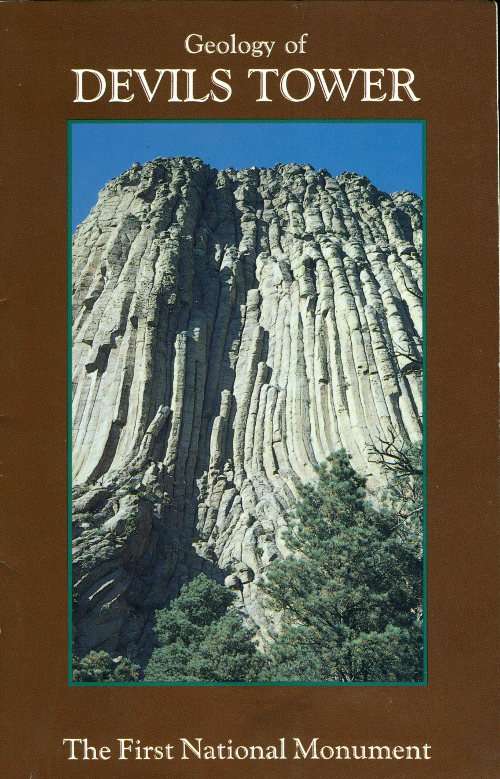
Geology of Devils Tower National Monument, Wyoming / A Contribution to General Geology
Explore more books like this:
About This Book
A steep-sided igneous monolith is described, composed of phonolite porphyry that weathers from gray to green or brown and is divided by vertical joints into polygonal columns. Surrounding hills consist of about 400 feet of sedimentary sandstone, shale, and gypsum, including parts of the Spearfish, Gypsum Spring, and Sundance formations with named members, dipping gently toward the monolith. The report documents minor faulting and folding, terrace and talus deposits, and stratigraphic relations, and interprets the landform as the resistant core of a magma intrusion whose cooled shape largely corresponds to the present exposed mass.
About the Author

You May Also Like
6 picks
 A bacteriological study of ham souring
by Charles Neil McBryde
A bacteriological study of ham souring
by Charles Neil McBryde
 A Brief History of Forestry. / In Europe, the United States and Other Countries
by B. E. Fernow
A Brief History of Forestry. / In Europe, the United States and Other Countries
by B. E. Fernow
 A Century's Progress in Astronomy
by Hector Macpherson
A Century's Progress in Astronomy
by Hector Macpherson
 A decade of negro extension work, 1914-1924
by O. B. Martin
A decade of negro extension work, 1914-1924
by O. B. Martin
 A Description of the Bar-and-Frame-Hive / With an Abstract of Wildman's Complete Guide for the Management of Bees Throughout the Year
by William Augustus Munn
A Description of the Bar-and-Frame-Hive / With an Abstract of Wildman's Complete Guide for the Management of Bees Throughout the Year
by William Augustus Munn
 A Hand-book of Precious Stones
by Meyer D. Rothschild
A Hand-book of Precious Stones
by Meyer D. Rothschild