
The Project Gutenberg eBook of George Crabbe: Poems, Volume 1 (of 3)
Title: George Crabbe: Poems, Volume 1 (of 3)
Author: George Crabbe
Editor: Sir Adolphus William Ward
Release date: September 14, 2014 [eBook #46858]
Most recently updated: October 24, 2024
Language: English
Credits: Produced by Heike Leichsenring and the Online Distributed
Proofreading Team at http://www.pgdp.net (This file was
produced from images generously made available by The
Internet Archive/Million Book Project)
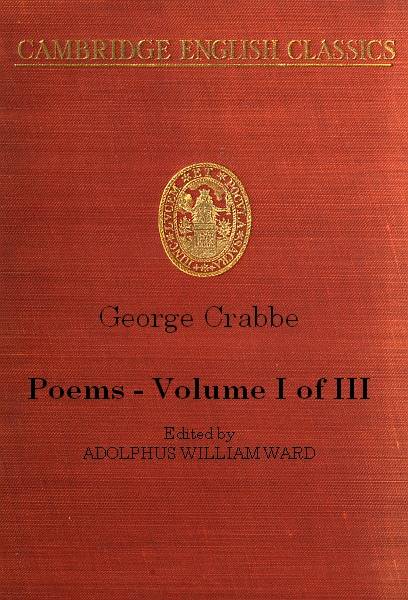
The cover image was created by the transcriber and is placed in the public domain.
CAMBRIDGE ENGLISH CLASSICS
Poems
by
George Crabbe
In Three Volumes
GEORGE CRABBE
Born, 1754
Died, 1832
GEORGE CRABBE
POEMS
EDITED BY
ADOLPHUS WILLIAM WARD,
Litt.D., Hon. LL.D., F.B.A.
Master of Peterhouse
Volume I
Cambridge:
at the University Press
1905
CAMBRIDGE UNIVERSITY PRESS WAREHOUSE
C. F. CLAY, Manager.
London: FETTER LANE, E.C.
Glasgow: 50, WELLINGTON STREET.
Leipzig: F. A. BROCKHAUS.
New York: THE MACMILLAN COMPANY.
Bombay and Calcutta: MACMILLAN AND CO., Ltd.
[All Rights reserved]
PREFATORY NOTE.
In the present edition of Crabbe's Poems the general arrangement adopted is that of the chronological order of publication. The poem entitled Midnight has been inserted at a conjectural date as belonging to the period of the Juvenile Poems (1772-1780); but all other poems contained in this edition which have hitherto remained unpublished will be printed after the published poems, in the sequence of their production so far as this is ascertainable. With the poems hitherto unpublished I have also been fortunate enough to obtain permission to include in a later volume, among other posthumously printed pieces, the Two Poetical Epistles by Crabbe, first published, from a manuscript in the collection of Mr Buxton Forman, in Vol. II of Literary Anecdotes of the Nineteenth Century edited by W. Robertson Nicoll and Thomas J. Wise (London, 1896). From the second of these Epistles were taken, but not in their original order, the ten lines reproduced in the present volume from George Crabbe the younger's 1834 edition of his father's Poems.
The earliest of the Juvenile Poems here printed are taken from The Lady's Magazine, or Entertaining Companion for the Fair Sex, appropriated solely to their Use and Amusement, for the year 1772, printed at London for Robinson and Roberts, 25 Paternoster Row. The first volume of this Magazine seems to have been that for the year 1770, and to have comprised the numbers from August to December inclusive; but the earlier portion of this volume had been previously published in the same year 1770 under the same title by J. Wheble at 20 Paternoster Row, 'by whom letters to the Editor are requested and received.' This then must be the 'Wheble's Magazine for 1772,' of which George Crabbe the younger in the Life prefixed to the 1834 edition of his father's Poems (p. 22) states that he had after long search discovered a copy. The Magazine seems itself to have been a revival of an earlier Lady's Magazine, of which portions of the volumes for 1760 and 1761 are extant, and which, according to the title-page of the volume for 1761, was printed for J. Wilkie at the Bible in St Paul's Churchyard.
But the younger Crabbe's account of his father's verses in 'Wheble's Magazine for 1772' does not tally with the actual contents of the volume for 1772 of The Lady's Magazine which has been used for the present edition. It is possible, of course, though there is no evidence to support the supposition, that The Lady's Magazine published by Wheble was continued at all events till 1772, parallel to The Lady's Magazine published by Robinson and Roberts, with which in 1770 it had been in some measure blended. It is equally possible that the younger Crabbe made some mistake or mistakes. In any case, his statement is, that Wheble's Magazine for 1772 'contains besides the prize poem on Hope,' from which he proceeds to quote the concluding six lines, 'four other pieces, signed "G. C., Woodbridge, Suffolk," "To Mira," "The Atheist reclaimed," "The Bee," and "An Allegorical Fable."' The volume published by Robinson and Roberts contains no pieces corresponding to these, except that in its October number there is printed an Essay on Hope, in which the lines cited by the younger Crabbe and reprinted, on his authority, in the present edition, do not appear, but of which the concluding lines seem to imply that it was a copy of verses written in competition for a prize. It cannot however be by Crabbe. For it is signed 'C. C., Rotherhithe, 1772'; and the July number of the same volume contains a piece of verse of some length entitled The Rotherhithe Beauties and signed 'C. C., Rotherhithe, July 15,' which is certainly not by Crabbe; and later in the volume follows another piece entitled Night, signed 'C. C., Rotherhithe, November 19, 1772,' which likewise cannot be attributed to Crabbe.
On the other hand the 1772 volume of The Lady's Magazine contains certain pieces of verse which may without hesitation be assigned to him, and which are accordingly reprinted in the present edition. These are, in the September number, Solitude and A Song, which bear as a signature the quasi-anagram 'G. EBBARE'; in the October number, the lines To Emma, with the quasi-anagram 'G. EBBAAC' and the date 'Suffolk'; and, in the November number, Despair, Cupid, and a Song, signed with the earlier form 'G. EBBARE.' This Song is followed by some lines in blank verse On the Wonders of Creation, and, further on, by some stanzas To Friendship, likewise signed 'C. C.'; but manifestly neither blank verse nor stanzas are by Crabbe.
Finally, it should be noted that in the October number in the same volume the following occurs among the notices To our Correspondents: 'The birth of a Maccaroni, by Ebbare, in the style of the Scriptures, seems to be taking too great a liberty with things sacred; and it is our maxim, as far as possible, to abstain from every appearance of evil.' The Lady's Magazine continued to be published by Robinson and Roberts for many subsequent years; and it is a curious coincidence that No. 5 of Vol. XLVII (for May, 1816) contains some stanzas entitled Myra's Wedding-Day.
The remaining Juvenilia printed in the present edition are partly reproduced from the Fragments of Verse, from Mr Crabbe's early Note-Books in Vol. II of the 1834 edition, partly from the Life in Vol. I of the same. The lines On the Death of William Springall Levett are quoted in the latter from Green's History of Framlingham, which has been compared.
Of the poems which follow in the present volume, Inebriety is here printed from a copy of the quarto of 1775, which lacks a title-page and which bears on p. 1 the following deprecation in Crabbe's handwriting: 'NB.—pray let not this be seen at [cipher] there is very little of it that I'm not heartily asham'd of.' The imprint of the title-page here given is taken from the Life (1834, p. 28).
Midnight, a Poem, is now first printed from the original manuscript which formed part of Dawson Turner's collection, in which it was numbered 121 at the sale of Dawson Turner's manuscripts in June, 1859. Its handwriting, as Professor Dowden points out, is identical with that of a facsimile in a passage from the Two Epistles mentioned above, given in the Literary Anecdotes of the Nineteenth Century.
The Candidate is printed from the edition of 1834 (Vol. II, Appendix). This poem is not included in the edition of 1823, and after a long quest it has proved impossible to obtain a copy of the original edition of 1780 (published in quarto by H. Payne, opposite Marlborough House, Pall Mall). This edition is not in the British Museum. It was only possible to compare the forty-six lines of the poem quoted in The Monthly Review for September, 1780; but no variants have been found in these.
The subsequent poems contained in the present volume are all printed from the edition of 1823, the last edition published in England in the poet's lifetime. The Variants enumerated at the close of this volume are in each case the readings of the first editions of the several poems, viz., The Library, 1781, The Village, 1783, The Newspaper, 1785, The Parish Register &c., 1807, and The Borough, 1810. The address To the Reader prefixed to The Newspaper, which does not appear in the edition of 1823, has been restored from that of 1785, as it appears in the younger Crabbe's edition of 1834.
The list of Errata includes all the misprints, slips of the pen, and unintentional mistakes of spelling or quotation, which have been found in the texts which have been reprinted in this volume. The reading substituted here is in each case enclosed in square brackets. The list is a long one, for Crabbe was a careless writer; and in the matter of quotations (as the concluding sentence of the Preface to The Borough indicates) was not given to over-conscientiousness. It has seemed permissible, where this could be done, to supplement the poet's statements as to the sources of his quotations; but there are instances in which these statements themselves remain more or less doubtful. Crabbe's interpunctuation is so arbitrary, and, though no doubt largely determined by what might be described as the movement of the writer's mind, so frequently at variance even with the practice (it can hardly be called system) which he more usually follows, that it has been thought right to use as much freedom on this head as seemed consistent with a due respect for the author's intention. No alteration has been made in the matter of interpunctuation which was not warranted either by the poet's ordinary practice, or by the primary necessity of making his meaning clear.
As complete as possible a bibliography of Crabbe's Poems will, it is hoped, be published in the concluding volume of this edition.
There remains the pleasant duty of thanking those whose kindness has been of assistance in the preparation of this volume. The relatives of my dear friend the late Canon Ainger have allowed me to retain for this purpose the first editions of Inebriety (with Crabbe's autograph), The Village and The Newspaper which he had lent me not long before his death. The Vice-Master of Trinity, Mr W. Aldis Wright, besides enabling me to borrow from Trinity Library the first edition of The Library, kindly lent his own copy of the Poems published in 1807. I am indebted to Professor Edward Dowden, LL.D., of Trinity College, Dublin, for various services generously rendered by him to this edition of Crabbe, which will benefit from them in its concluding as it has in its opening volume. He has readily allowed me to print the whole of the interesting blank verse poem of Midnight, which, in his own words, 'unless it be a transcript by Crabbe from some other eighteenth-century poet, of which there is no evidence, may be assumed to be of his authorship.'
To the same kind friend, and to the special courtesy of Mr J. W. Lyster, Librarian of the National Library of Ireland, Kildare Street, Dublin, I owe the opportunity of tracing fide oculata, so far as it seems possible to make sure of it, the elusive volume of The Lady's Magazine containing the earliest of Crabbe's printed verse.
Mr A. R. Waller, of Peterhouse, Assistant Secretary to the Syndics of the University Press, has in many ways facilitated the preparation of this volume. And without the unstinting and unflagging cooperation of another member of my College, Mr A. T. Bartholomew, of the University Library, who has compiled the list of variants, besides giving me much other assistance, I could not, amidst other engagements, have carried so far the execution of a delightful task.
A. W. WARD.
Peterhouse Lodge, Cambridge.
CORRIGENDA.
- p. 5, for Ovid read Ovid [?].
- p. 48, l. 41, for Meonides read [Maeonides].
- p. 55, l. 297, for [threat'ned] read [threaten'd].
- p. 232, l. 319, for Rubens read [Rubens].
- p. 252, l. 5, for dolor read [labor].
- p. 256, l. 4, for deplorant read [deplangunt].
- p. 329, l. 11, for and worship me read [and worship me].
- ib. l. 12, for Part I read Part II.
- p. 364, l. 12, for [erat] read erant.
CONTENTS.
| PAGE | |
|---|---|
| Juvenilia | 1 |
| Solitude | 1 |
| A Song | 3 |
| Concluding Lines of Prize Poem on Hope | 4 |
| To Emma | 4 |
| Despair | 5 |
| Cupid | 7 |
| Song | 8 |
| [On the Death of William Springall Levett] | 8 |
| Parody on [Byrom's] "My Time, Oh ye Muses" | 9 |
| The Wish | 10 |
| Inebriety | 11 |
| Juvenilia | 37 |
| [The Learning of Love] | 37 |
| Ye Gentle Gales | 37 |
| Mira | 38 |
| Hymn | 39 |
| The Wish | 40 |
| The Comparison | 40 |
| Goldsmith to the Author | 41 |
| Fragment | 41 |
| The Resurrection | 42 |
| My Birth-day | 43 |
| To Eliza | 43 |
| Life | 44 |
| The Sacrament | 44 |
| Night | 45 |
| Fragment, written at Midnight | 45 |
| Midnight | 47 |
| Juvenilia | 61 |
| [A Farewell] | 61 |
| Time | 62 |
| The Choice | 63 |
| [A Humble Invocation] | 65 |
| [From an Epistle to Mira] | 66 |
| [Concluding Lines of an Epistle to Prince William Henry, afterwards King William IV] | 66 |
| [Drifting] | 68 |
| To the Right Honourable the Earl of Shelburne | 69 |
| An Epistle to a Friend | 70 |
| The Candidate | 73 |
| The Library | 100 |
| The Village | 119 |
| The Newspaper | 137 |
| The Parish Register | 158 |
| The Birth of Flattery | 223 |
| Reflections | 234 |
| Sir Eustace Grey | 238 |
| The Hall of Justice | 252 |
| Woman! | 261 |
| The Borough | 263 |
JUVENILIA
(1772—1780.)
SOLITUDE.
[September, 1772.]
Free from envy, strife and sorrow,
Jealous doubts, and heart-felt fears;
Free from thoughts of what to-morrow
May o'er-charge the soul with cares—
Live I in a peaceful valley,
By a neighbouring lonely wood;
Giving way to melancholy,
(Joy, when better understood).
Near me ancient ruins falling
From a worn-out castle's brow;
Once the greatest [chiefs] installing,
Where are all their honours now?
Here in midnight's gloomy terror
I enjoy the silent night;
Darkness shews the soul her error,
Darkness leads to inward light.
Here I walk in meditation,
Pond'ring all sublunar things,
From the silent soft persuasion,
Which from virtue's basis springs. 20
What, says truth, are pomp and riches?
Guilded baits to folly lent;
Honour, which the soul bewitches,
When obtain'd, we may repent.
By me plays the stream meand'ring
Slowly, as its waters glide;
And, in gentle murmurs wand'ring,
Lulls to downy rest my pride.
Silent as the gloomy graves are
Now the mansions once so loud;
Still and quiet as the brave, or
All the horrors of a croud.
This was once the seat of plunder,
Blood of heroes stain'd the floor;
Heroes, nature's pride and wonder,
Heroes heard of now no more.
Owls and ravens haunt the buildings,
Sending gloomy dread to all;
Yellow moss the summit yielding,
Pellitory decks the wall.
Time with rapid speed still wanders,
Journies on an even pace;
Fame of greatest actions squanders,
But perpetuates disgrace.
Sigh not then for pomp or glory;
What avails a heroe's name?
Future times may tell your story,
To your then disgrace and shame.
Chuse some humble cot as this is,
In sweet philosophic ease;
With dame Nature's frugal blisses
Live in joy, and die in peace.
A SONG.
[September, 1772.]
I.
As Chloe fair, a new-made bride,
Sat knotting in an arbour,
To Colin now the damsel ty'd,
No strange affection harbour.
II.
"How poor," says [she, "'s a] single life,
A maid's affected carriage;
Spent in sighs and inward strife,
Things unknown in marriage.
III.
"Virgins vainly say they're free,None so much confin'd are;
Lovers kind and good may be,
Husbands may be kinder.
IV.
"Then shun not wedlock's happy chain,
Nor wantonly still fly man;
A single life is care and pain,
Blessings wait on Hymen."
CONCLUDING LINES OF PRIZE POEM ON HOPE.
[Before October, 1772.]
* * * * * * * * * * * * *
But, above all, the Poet owns thy powers—
Hope leads him on, and every fear devours;
He writes, and, unsuccessful, writes again,
Nor thinks the last laborious work in vain;
New schemes he forms, and various plots he tries
To win the laurel, and possess the Prize.
TO EMMA.
View, my fair, the fading flower,
Clad like thee in [beauty's] arms,
Idle pageant of an hour;
Soon shall time its tints devour,
And what are then its charms?
Early pluck'd, it might produce
A remedy to mortal pain,
Afford a balmy cordial juice,
That might celestial ease diffuse,
Nor blossom quite in vain.
So 'tis with thee, my Emma fair,
If nature's law's unpaid,
If thou refuse our vows to hear
And steel thy heart to ev'ry pray'r,
A cruel frozen maid.
But yield, my fair one, yield to love,
And joys unnumber'd find,
In Cupid's mystic circle move,
Eternal raptures thou shalt prove,
Which leave no pang behind.
Suffolk, Oct. 15, 1772.
'Multa cadunt inter calicem supremaque labra.'
DESPAIR.
[November, 1772.]
Heu mihi!
Quod nullis amor medicabilis herbis.
Tyrsis and Damon.
D. Begin, my Tyrsis; songs shall sooth our cares,
Allay our sorrows, and dispel our fears;
Shall glad thy heart, and bring its native peace,
And bid thy grief its weighty influence cease.
No more those tears of woe, dear shepherd, shed,
Nor ever mourn the lov'd Cordelia dead.
T. In vain, my Damon, urge thy fond request
To still the troubles of an anxious breast:
Cordelia's gone! and now what pain is life
Without my fair, my friend, my lovely wife?
Hope! cheerful hope! to distant climes is fled,
And Nature mourns the fair Cordelia dead.
D. But can thy tears re-animate the earth,
Or give to sordid dust a second birth?
Mistaken mortal! learn to bear the ill,
Nor let that canker, grief, thy pleasures kill.
No more in Sorrow's sable garb array'd,
Still [mourn] thy lov'd, thy lost Cordelia dead.
T. Can I forget the fairest of her kind,
Beauteous in person, fairer still in mind?
Can I forget she sooth'd my heart to rest,
And still'd the troubl'd motion in my breast?
Can I, by soothing song or friendship led,
Forget to mourn my lov'd Cordelia dead?
D. Another fair may court thee to her arms,
Display her graces, and reveal her charms;
May catch thy wand'ring eye, dispel thy woe,
And give to sorrow final overthrow.
No longer, then, thy heart-felt anguish shed,
Nor mourn, in solitude, Cordelia dead.
T. Sooner shall lions fierce forget to roam,
And peaceful walk with gentle lambs at home;
Sooner shall Discord love her ancient hate,
And Peace and Love with Rage incorporate;
Sooner shall turtles with the sparrow wed,
Than I forget my lov'd Cordelia dead.
D. Must then Dorintha ever sigh in vain,
And Cælia breathe to echoing groves her pain?
Must Chloe hope in vain to steel that heart
In which each nymph would gladly share a part?
Must these, dejected shepherd, be betray'd.
And victims fall, because Cordelia's dead?
T. By those who love, my friend, it stands confest,
No second flame can fill a lover's breast:
For me no more the idle scenes of life
Shall vex with envy, hatred, noise, or strife;
But here, in melancholy form array'd,
I'll ever mourn my lov'd Cordelia dead.
CUPID.
[November, 1772.]
Whoe'er thou art, thy master know;
He has been, is, or shall be so.
What is he, who clad in arms,
Hither seems in haste to move,
Bringing with him soft alarms,
Fears the heart of man to prove;
Yet attended too by charms—
Is he Cupid, God of Love?
Yes, it is, behold him nigh,
Odd compound of ease and smart;
Near him [stands] a nymph, whose sigh
Grief and joy, and love impart;
Pleasure dances in her eye,
Yet she seems to grieve at heart.
Lo! a quiver by his side,
Arm'd with darts, a fatal store!
See him, with a haughty pride,
Ages, sexes, all devour;
Yet, as pleasure is describ'd,
Glad we meet the tyrant's power.
Doubts and cares before him go,
Canker'd jealousy behind;
Round about him spells he'll throw,
Scatt'ring with each gust of wind
On the motley crew below,
Who, like him, are render'd blind.
This is love! a tyrant kind,
Giving extacy and pain;
Fond deluder of the mind,
Ever feigning not to feign;
Whom no savage laws can bind,
None escape his pleasing chain.
SONG.
[November, 1772.]
Cease to bid me not to sing.
Spite of Fate I'll tune my lyre:
Hither, god of music, bring
Food to feed the gentle fire;
And on Pægasean wing
Mount my soul enraptur'd higher.
Some there are who'd curb the mind,
And would blast the springing bays;
All essays are vain, they'll find,
Nought shall drown the muse's lays,
Nought shall curb a free-born mind,
Nought shall damp Apollo's praise.
[ON THE DEATH OF WILLIAM SPRINGALL LEVETT.]
[1774.]
What though no trophies peer above his dust,
Nor sculptured conquests deck his sober bust;
What though no earthly thunders sound his name,
Death gives him conquest, and our sorrows fame:
One sigh reflection heaves, but shuns excess—
More should we mourn him, did we love him less.
PARODY ON [BYROM'S] "MY TIME, OH YE MUSES."
[Woodbridge, about 1774.]
My days, oh ye lovers, were happily sped
Ere you or your whimsies got into my head;
I could laugh, I could sing, I could trifle and jest,
And my heart play'd a regular tune in my breast.
But now, lack-a-day! what a change for the worse,
'Tis as heavy as lead, yet as wild as a horse.
My fingers, ere love had tormented my mind,
Could guide my pen gently to what I design'd.
I could make an enigma, a rebus, or riddle,
Or tell a short tale of a dog and a fiddle.
But, since this vile Cupid has got in my brain,
I beg of the gods to assist in my strain.
And whatever my subject, the fancy still roves,
And sings of hearts, raptures, flames, sorrows, and loves.
* * * * * * * * * * * * *
THE WISH.
[Woodbridge, about 1774.]
My Mira, shepherds, is as fair
As sylvan nymphs who haunt the vale,
As sylphs who dwell in purest air,
As fays who skim the dusky dale,
As Venus was when Venus fled
From watery Triton's oozy bed.
My Mira, shepherds, has a voice
As soft as Syrinx in her grove,
As sweet as echo makes her choice,
As mild as whispering virgin-love;
As gentle as the winding stream
Or fancy's song when poets dream.
* * * * * * * * *
INEBRIETY.
[Inebriety, a Poem, in three Parts. Ipswich, printed and sold by C. Punchard, Bookseller, in the Butter-Market, 1775. Price one shilling and sixpence.]
The PREFACE.
Presumption or Meanness are but too often the only articles to be discovered in a Preface. Whilst one author haughtily affects to despise the public attention, another timidly courts it. I would no more beg for than disdain applause, and therefore should advance nothing in Favor of the following little Poem, did it not appear a Cruelty and disregard to send a first Production naked into the World.
The World!—how pompous, and yet how trifling the sound. Every Man, Gentle Reader, has a World of his own, & whether it consists of half a score, or half a thousand Friends, 'tis his, and he loves to boast of it. Into my World, therefore, I commit this, my Muse's earliest labor, nothing doubting the Clemency of the Climate, nor fearing the Partiality of the censorious.
Something by way of Apology for this trifle, is perhaps necessary; especially for those parts, wherein I have taken such great Liberties with Mr. Pope; that Gentleman, secure in immortal Fame, would forgive me; forgive me too, my friendly Critic; I promise thee, thou wilt find the Extracts from the Swan of Thames the best Parts of the Performance; Few, I dare venture to affirm, will pay me so great a Compliment, as to think I have injured Mr Pope; Fewer, I hope, will think I endeavoured to do it, and Fewest of all will think any thing about it.
The Ladies will doubtless favor my Attempt; for them indeed it was principally composed; I have endeavored to demonstrate that it is their own Faults, if they are not deemed as good Men, as half the masculine World; that a personal Difference of Sex need not make a real Difference; and that a tender Languishment, a refin'd Delicacy, and a particular attention to shine in Dress, will render the Beau-Animal infinitely more feminine, than the generality of Ladies, whatever arcane Tokens of Manhood the said Animal may be indued with; and yet, ye Fair! these creatures pass even in your catalogue for Men; which I'm afraid is a Demonstration that the real Man is very scarce.
Some grave Head or other may possibly tell me, that Vice is to be lash'd, not indulg'd; that true Poetry forbids, not encourages, Folly; and such other wise and weighty Sentences, picked from Pope and Horace, as he shall think most appertaining to his own dignity. But this, my good Reader, is a trifle; People now a Days are not to be preach'd into Reflection, or they pay Parsons, not Poets for it, if they were; they listen indeed to a Discourse from the Pulpit, for Men are too wise to give away their Money without any consideration; and though they don't mind what is said there, 'tis doubtless a great Satisfaction to think they might if they choose it; but a Man reads a Poem for quite a different purpose: to be lul'd into ease from reflection, to be lul'd into an inclination for pleasure, and (where I confess it comes nearer the Sermon) to be lul'd—asleep.
But lest the Apology should have the latter effect in itself, and so take away the merit of the Performance by forestalling that agreeable Event: I without further ceremony bid thee Adieu!
PART the FIRST.
The mighty Spirit and its power which stains[1]
The bloodless cheek, and vivifies the brains,
I sing. Say ye, its fiery Vot'ries true,
The jovial Curate, and the shrill-tongu'd Shrew;
Ye, in the floods of limpid poison nurst,
Where Bowl the second charms like Bowl the first;
Say, how and why the sparkling ill is shed,
The Heart which hardens, and which rules the Head.
When Winter stern his gloomy front uprears,
A sable void the barren earth appears;
The meads no more their former verdure boast,
Fast bound their streams, and all their Beauty lost;
The herds, the flocks, their icy garments mourn,
And wildly murmur for the Spring's return;
The fallen branches from the sapless tree
With glittering fragments strow the glassy way;
From snow-top'd Hills the whirlwinds keenly blow,
Howl through the Woods, and pierce the vales below;
Through the sharp air a flaky torrent flies,
Mocks the slow sight, and hides the gloomy skies;
The fleecy clouds their chilly bosoms bare,
And shed their substance on the floating air;
The floating air their downy substance glides
Through springing Waters, and prevents their tides;
Seizes the rolling Waves, and, as a God,
Charms their swift race, and stops the refl'ent flood;
The opening valves, which fill the venal road,
Then scarcely urge along the sanguine flood;
The labouring Pulse a slower motion rules,
The Tendons stiffen, and the Spirit cools;
Each asks the aid of [Nature's] sister Art,
To Cher the senses, and to warm the Heart.
The gentle fair on nervous tea relies,
Whilst gay good-nature sparkles in her eyes;
An inoffensive Scandal fluttering round,
Too rough to tickle, and too light to wound;
Champain the Courtier drinks, the spleen to chase,
The Colonel burgundy, and port his Grace;
Turtle and 'rrack the city rulers charm,
Ale and content the labouring peasants warm;
O'er the dull embers happy Colin sits,
Colin, the prince of joke and rural wits;
Whilst the wind whistles through the hollow panes,
He drinks, nor of the rude assault complains;
And tells the Tale, from sire to son retold,
Of spirits vanishing near hidden gold;
Of moon-clad Imps, that tremble by the dew,
Who skim the air, or glide o'er waters blue.
The throng invisible, that doubtless float
By mould'ring Tombs, and o'er the stagnant moat;
Fays dimly glancing on the russet plain,
And all the dreadful nothing of the Green.
And why not these? Less fictious is the tale,
Inspir'd by Hel'con's streams, than muddy ale?
Peace be to such, the happiest and the best,
Who with the forms of fancy urge their jest;
Who wage no war with an Avenger's Rod,
Nor in the pride of reason curse their God.
When in the vaulted arch Lucina gleams,
And gaily dances o'er the azure streams;
When in the wide cerulean space on high
The vivid stars shoot lustre through the sky;
On silent Ether when a trembling sound
Reverberates, and wildly floats around,
Breaking through trackless space upon the ear—
Conclude the Bacchanalian Rustic near;
O'er Hills and vales the jovial Savage reels,
Fire in his head and Frenzy at his heels;
From paths direct the bending Hero swerves,
And shapes his way in ill-proportion'd curves;
Now safe arriv'd, his sleeping Rib he calls,
And madly thunders on the muddy walls;
The well-known sounds an equal fury move,
For rage meets rage, as love enkindles love;
}
The buxom Quean from bed of flocks descends
}
With vengeful ire, a civil war portends,
}
An oaken plant the Hero's breast defends.
In vain the 'waken'd infant's accents shrill
The humble regions of the cottage fill;
In vain the Cricket chirps the mansion through,
'Tis war, and Blood and Battle must ensue.
As when, on humble stage, him Satan hight
Defies the brazen Hero to the fight;
From twanging strokes what dire misfortunes rise,
What fate to maple arms, and glassen eyes;
Here lies a leg of elm, and there a stroke
From ashen neck has whirl'd a Head of oak.
So drops from either power, with vengeance big,
A remnant night-cap, and an old cut wig;
Titles unmusical, retorted round,
On either ear with leaden vengeance sound;
'Till equal Valour equal Wounds create,
And drowsy peace concludes the fell debate;
Sleep in her woolen mantle wraps the pair,
And sheds her poppies on the ambient air;
Intoxication flies, as fury fled,
On rocky pinions quits the aching head;
Returning Reason cools the fiery blood,
And drives from memory's seat the rosy God.
Yet still he holds o'er some his madd'ning rule,
Still sways his Sceptre, and still knows his Fool;
Witness the livid lip and fiery front,
With many a smarting trophy plac'd upon't;
The hollow Eye, which plays in misty springs,
And the hoarse Voice, which rough and broken rings.
These are his triumphs, and o'er these he reigns,
The blinking Deity of reeling brains.
See Inebriety! her wand she waves,
And lo! her pale, and lo! her purple slaves;
Sots in embroidery, and sots in crape,
Of every order, station, rank, and shape;
The King, who nods upon his rattle-throne;
The staggering Peer, to midnight revel prone;
The slow-tongu'd Bishop, and the Deacon sly,
The humble Pensioner, and Gownsman dry;
The proud, the mean, the selfish, and the great,
Swell the dull throng, and stagger into state.
Lo! proud Flaminius at the splendid board,
The easy chaplain of an atheist Lord,
Quaffs the bright juice, with all the gust of sense,
And clouds his brain in torpid elegance;
In china vases see the sparkling ill,
From gay Decanters view the rosy rill;
The neat-carv'd pipes in silver settle laid,
The screw by mathematic cunning made;
The whole a pompous and enticing scene,
And grandly glaring for the surplic'd Swain;
Oh! happy Priest whose God like Egypt's lies,
At once the Deity and sacrifice!
But is Flaminius, then, the man alone,
To whom the Joys of swimming brains are known?
Lo! the poor Toper whose untutor'd sense[2]
Sees bliss in ale, and can with wine dispense;
Whose head proud fancy never taught to steer
Beyond the muddy extacies of Beer;
But simple nature can her longing quench
Behind the settle's curve, or humbler bench;
Some kitchen-fire diffusing warmth around,
The semi-globe by Hieroglyphics crown'd;
Where canvas purse displays the brass enroll'd,
Nor Waiters rave, nor Landlords thirst for gold;
Ale and content his fancy's bounds confine,
He asks no limpid Punch, no rosy Wine;
But sees, admitted to an equal share,
Each faithful swain the heady potion bear.
Go, wiser thou! and in thy scale of taste
Weigh gout and gravel against ale and rest.
Call vulgar palates, what thou judgest so;
Say, beer is heavy, windy, cold and slow;
Laugh at poor sots with insolent pretence,
Yet cry when tortur'd, where is Providence?
If thou alone art, head and heel, not clear,
Alone made steady here, untumour'd there;
Snatch from the Board the bottle and the bowl,
Curse the keen pain, and be a mad proud Fool.