
WeRead Powered by ReaderPub
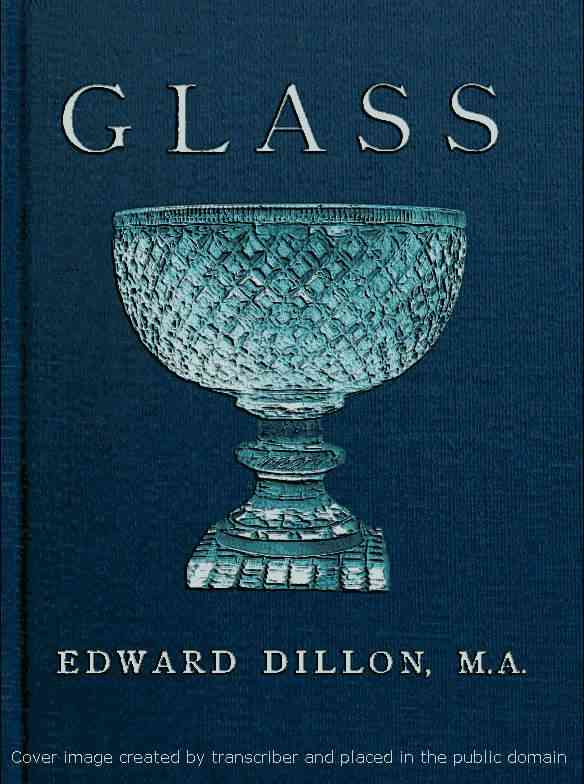
Glass cover

Glass

Chapter 45: Transcriber's Notes
Open in WeRead

Explore more books like this:

About This Book

A comprehensive survey traces the artistic development of glass from ancient Egyptian and Syrian origins through Greek and Roman moulded, cast, and blown techniques. It examines Early Christian and Byzantine production, medieval Eastern and Western traditions, and examples recovered from Anglo-Saxon and Frankish tombs. The work discusses medieval treatises, the rise of Venetian enamelled glass and other Renaissance centres in France, Spain, the Low Countries, and Germany, and later Dutch, English, and Asian glass of the seventeenth and eighteenth centuries. Technical analyses, catalogued illustrations, and museum exemplars are employed to explain methods, decoration, enamelling, national styles, and contemporary developments.

Transcriber's Notes

Dashes used to represent duplicated entries in the Index have been replaced by the text they represent.

Some Plates containing multiple illustrations and photographs were marked in the original with numbers. In some cases, these numbers have been replaced by larger numbers for readability. Numbers were also added to figures and the corresponding captions in some cases in order to improve readability.

Some presumed printer's errors have been corrected. In particular, punctuation has been normalized. Spelling in the Index has been corrected to match the spelling in the main text. Additional corrections are listed below with the text as printed (top) and the corrected text (bottom):

might have have been
might have been (p. 255)
of that of European origin three is no need to speak
of that of European origin there is no need to speak (p. 342)
Lorraine was was not yet
Lorraine was not yet (Footnote 172)