
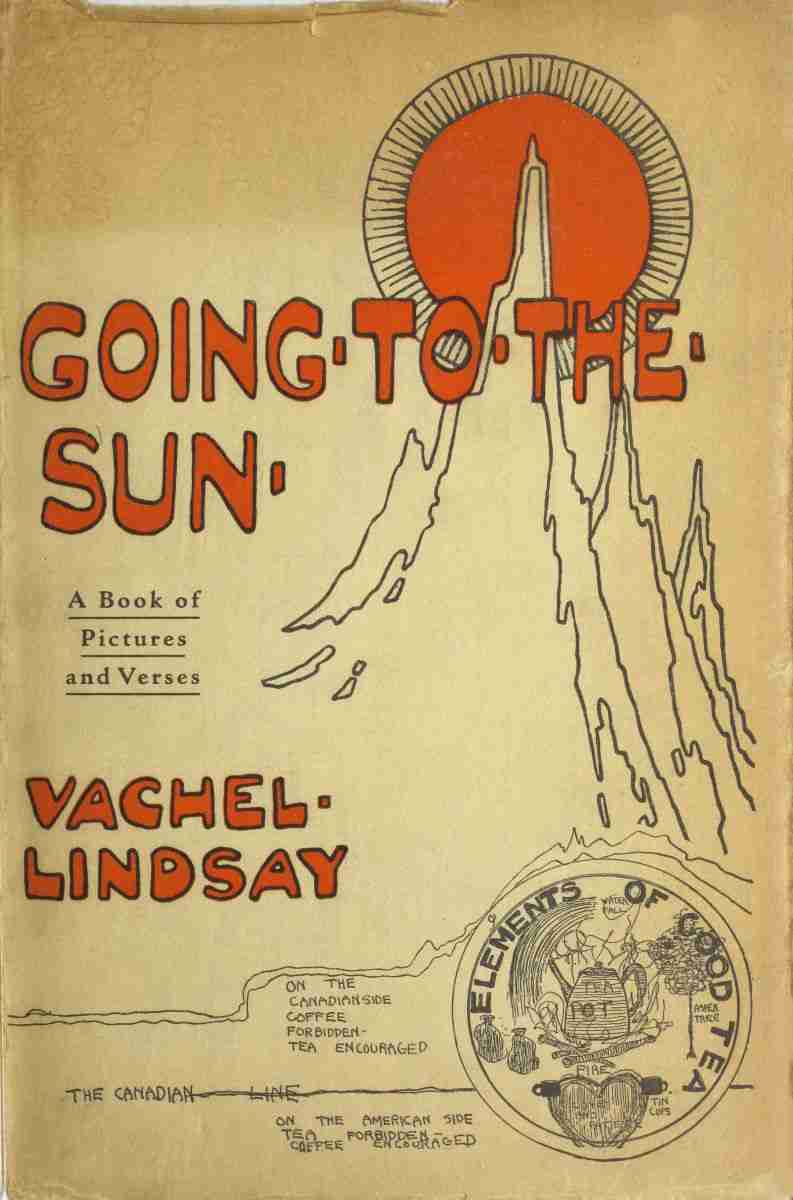
The Project Gutenberg eBook of Going-to-the-Sun
Title: Going-to-the-Sun
Author: Vachel Lindsay
Release date: October 26, 2020 [eBook #63554]
Most recently updated: October 18, 2024
Language: English
Credits: Produced by Tim Lindell, Chuck Greif and the Online
Distributed Proofreading Team at https://www.pgdp.net (This
file was produced from images generously made available
by The Internet Archive/American Libraries.)
| Contents Illustrations |
GOING-TO-THE-SUN
GOING-TO-THE-SUN
BY
VACHEL LINDSAY
AUTHOR OF “GENERAL WILLIAM BOOTH
ENTERS HEAVEN,” “THE CONGO,” ETC.
D. APPLETON AND COMPANY
NEW YORK :: LONDON :: MCMXXIII
COPYRIGHT, 1923, BY
D. APPLETON AND COMPANY
PRINTED IN THE UNITED STATES OF AMERICA
CONTENTS
ILLUSTRATIONS
| Elements of Good Tea | 1 |
| We Start for the Waterfalls | 9 |
| Going-To-The-Sun | 11 |
| The Mystic Rooster of the Montana Sunrise | 13 |
| The Bird Called “Curiosity” | 15 |
| The Thistle Vine | 17 |
| And They Laughed (Poppies) | 19 |
| The Fairy Circus | 21 |
| The Battle-Ax of the Sun | 23 |
| The Christmas Trees | 25 |
| The Pheasant Speaks of His Birthdays | 27 |
| The Mystic Unicorn of the Montana Sunset | 31 |
| Johnny Appleseed Still Further West | 35 |
| And Fairies Came from Them | 37 |
| The Apple-Barrel of Johnny Appleseed | 39 |
| The Comet of Going-To-The-Sun | 41 |
| The Boat with the Kite String and the Celestial Eyes | 43 |
| The Big-Eared Rat of Boston | 51 |
| The Boston Mouse | 53 |
| The Tower-of-Babel Cactus | 55 |
| A Back-Bay Whale | 59 |
| The Bat | 65 |
| Rockets on the Way to Saturn | 71 |
| Rockets in Saturn | 73 |
| Meditation | 75 |
| The Moon is a Devil-Jester | 77 |
| Elizabeth Barrett Browning | 79 |
| Some Balloons Grow on Trees | 81 |
| Babylon’s Gardens are Burning | 85 |
| The Ape Rode the Jumbo | 87 |
| A Political Campaign | 89 |
| Old Judge Hoot Owl | 91 |
| Pearls | 93 |
| The Land Horse | 95 |
| The Sea Horse | 97 |
| Concerning the Mouse with Two Tails | 99 |
| Words about an Ancient Queen | 101 |
GOING-TO-THE-SUN
THE ELEMENTS OF GOOD TEA
This book is a sequel and a reply to a book by Stephen Graham, explorer-poet, and Vernon Hill, artist.
I had a splendid six weeks tramping with my lifetime friend, Stephen Graham, in the Rockies. We climbed northwest through Glacier Park, Montana, across the Canadian line into Alberta, Canada. There it is in two sentences.
It would take more than the Encyclopædia Britannica to tell on how many points I differ from Stephen, and on how many points I agree with him. I had not the least idea that so much Lindsay was going into Graham’s fireside notes—while I was asleep at noon, often recovering in an hour from ten hours of restless, sleepless freezing by night. I do not hold myself liable in court for any opinions of mine then recorded by Graham. My daytime strength was not all given to thought, however, but often to trying to keep Graham in sight when he was a quarter of a mile ahead of me climbing mountains absolutely perpendicular. As I remember our first fireside discussions, they were as to whether there was actually such a person as Patrick Henry. Graham had an idea he was a perverse invention of my own fancy. But he looked him up afterwards and found there was such a man. As I remember our conversations after that provocation, I kept trying to deliver to him from memory Bryce’s American Commonwealth, unabridged, two volumes, one thousand pages each. I remember those volumes well. I read every page in lonely country hotels and on slow local trains while a Sunday field-worker for the Anti-Saloon League. And now invisible leaves of Bryce often made the chief ingredient of our tea. So I have indicated in the design.
I did not tell Graham I was quoting the great ambassador, and so many unsupported, heavy and formidable statements he quite properly hesitated to write out, without further confirmation, though he drank them down quite cheerfully. In the great blank spaces in Graham’s narrative where he skips really splendid scenery, I was quoting Bryce—not always singing hymns!
The most authentic part of my book, the part Mr. Vernon Hill has left out, is that the mountains were as steep as I have drawn them. His mountains, otherwise quite correct, are not sufficiently perpendicular. Vernon Hill, of course, was not physically with us on the expedition. He was in London, drawing beautiful and famous Arcadian Calendars. When later he came to illustrate Graham’s book in London, with Graham bending over him, no one mentioned the fact that the mountains were all like church steeples. Graham had not noticed it, and it did not occur to Vernon Hill by wireless. Otherwise Vernon Hill was in excellent communication with us, and every picture in Graham’s book expresses exactly what Graham was talking to me about to make me forget the tumbles and the briers, and to drown out the Bryce.
After I had hunted for years and years to find an explorer-poet who would take a long walk with me, and had scared every one off by the elaborateness of the proposal, the first troubadour that took me up on it almost broke my neck. It was a grand and awful time. The sensible reviews of Graham’s book have been by Walter Prichard Eaton. He does not discuss Graham’s opinions or mine. But he is very plain about the fact that we almost slid into eternity. He has tried those mountains himself, and he knows. He should write several more reviews.
Stephen Graham is a lifetime friend, and I have assembled these drawings as a sign thereof. But because I have been studying Hieroglyphics in the Metropolitan Museum all this summer, and because United States Hieroglyphics of my own invention are haunting me day and night, this book is drawn, and not written. I serve notice on the critics—the verses are most incidental, merely to explain the pictures. And so, directly considered, it is much more a reply to Vernon Hill, the artist, than to Stephen.
The artist of the Arcadian Calendar discerned rightly. Graham and I were in Arcady, even if it was a bit rough.
Going-To-The-Sun Mountain is the very jewel of the mountains of Glacier Park. All the tourists love it, and they are right. Its name fits it.
Going-To-The-Sun Mountain is our American Fujiyama, as all testify who have seen it.
Obviously, an ingredient of good tea is talk on Egyptian Hieroglyphics. I had an invisible copy of an Egyptian Grammar with me and I put a leaf from it into every pot of tea. Graham did not take to the taste of it as much as he did to the pages of Bryce, but he was nobly patient, as one may say, with Egypt.
The Hieroglyphics in this work are based on two more British-Egyptian grammars he sent me after he reached London. Still, they may be described as United States Hieroglyphics, and almost any Egyptologist will be willing to describe them that way, having about as much to do with Egypt as Egyptian cigarettes. The Egyptians were, briefly, a nation of Vernon Hills, who drew their “Arcadian Calendar” for four thousand years in red and black ink, or cut it in granite. I keep thinking about them! A free translation of the hieroglyphic inscription at the bottom of the first picture following is:
The beating heart of the waterfall of the
double truth, as it appears to a scribe,
a servant of Thoth—Thoth, who is god of
picture-writing, photoplays and hieroglyphics,
and an intense admirer of waterfalls.
With this start, the reader can go straight through the book without a mistake.
Now, a last word as to the seal, The Elements of Good Tea.
On the southern side of the Canadian-United States boundary, just as we reached it, our coffee gave out. Most symbolical happening! There in the deep woods, as we passed to the northern side, Graham said with a sigh of insatiable anticipation: “Now we will have some tea.” We had had tea all along, alternated with coffee. But now Stephen, on his own heath, was emphatic about it. So he made tea, a whole potful, with a kick like a battering ram, and I drank my half.
Certainly the most worth-while thing in Stephen’s book, and mine, is a matter known to all men long before the books were written. That is, that a Britisher and a United Stateser can cross the Canadian-American line together and discover that it is hardly there; can discover that an international boundary can be genuine and eternal and yet friendly. If there is one thing on which Stephen and I will agree till the Judgment Day, it is that all the boundaries in the world should be as open, and as happy, as the Canadian-United States line. To many diplomats such a boundary is incredible, and yet it exists, one of the longest in the world.
WE START WEST FOR THE WATERFALLS
The dreams of the dreams, with books of the dreams,
Haunt the homes of the town this day;
The visions of rivers, with rhymes of the waterfalls,
Haunt the yards of the town this day;
The fairies of the fairies, with the flowers of the fairies,
Haunt the factories of the town this day;
And we throw them kisses, and they fly away.
GOING-TO-THE-SUN
THE MYSTIC ROOSTER OF THE MONTANA SUNRISE
I saw the rooster that no storm can tame,
The center of the sun was but his eye,
His comb was but the sun rays and the flame.
There in the Glacier Park, above white glaciers,
There, above Montana and the west,
He crowed and called his boast around the world,
Emotion shook his red embroidered vest.
There is humor in the very biggest rooster,
But even more magnificence than fun.
I laugh because he acted like a rooster,
I am solemn, for he was the biggest one.
I like a rooster or a turkey gobbler,
I like their forthright impudence at times.
They are neither larks, nor trilling nightingales,
And yet they always sing in splendid rhymes.
When I heard the vast bird of the sunrise crying,
The world held not one inch of silly prose.
Any rooster is a flowerlike fowl,
And this one was a crimson Yankee rose.
THE BIRD CALLED “CURIOSITY”
In Glacier Park, a steep and soaring one,
Circled a curious bird with pointed nose
Who led us on to every cave, and rose
And swept through every cloud, then brought us berries,
And all the acid gifts the mountain carries,
And let us guess which ones were good to eat.
And even when we slept his sharp wings beat
The weary fire, or shook the tree-top cones,
Or rattled dead twigs like a fairy’s bones.
The vulgar bird, “Curiosity”! When we
Were tired, and lean, and shaking at the knee,
We put this bird in harness. He was strong
As any ostrich, pulled our packs along,
Helped us up over the next annoying wall,
And dragged us to the chalet, and the tourists’ resting hall.
THE THISTLEVINE
AND THEY LAUGHED
THE FAIRY CIRCUS
THE BATTLE-AX OF THE SUN
THE CHRISTMAS TREES
THE PHEASANT SPEAKS OF HIS BIRTHDAYS
I saw the Pheasant-Of-The-Sunrise fly.
Jewels in his feathers, mixed with dew.
Dew and jewels made his jeweled eye.
He paused to make a sonnet, which he sang,
Though nowhere else are pheasants sonneteers.
He emphasized with swooping and with skipping,
With winkings and intoxicated leers.
And how the bushes twinkled as he caroled:
And I have lived so many happy birthdays!
There are gifts with all the suns that here ascend!
Each bush, you see, has an unextinguished candle
And angel-food, and icing, and candy flowers,
And this long vine that climbs from earth to heaven
Gives me thoughts, and most erratic powers.
I eat its scarlet berries and its frosting.
If I choose, it is my present every day.
Then I can fly straight up to heaven’s doorstep
Following the green line all the way.
THE MYSTIC UNICORN OF THE MONTANA SUNSET
I saw the Unicorn-No-Storm-Can-Tame.
The center of the sun was but his eye,
His mane was but the sun rays and the flame.
There in that Glacier Park, above green pastures,
There above Stephen’s camp fire in the rocks,
He foamed and pawed and whinnied round the world,
His feathered sides and plumes and bristling locks
Seemed but the banners of a great announcement
That unicorns were spry as heretofore,
That not a camp fire of the world was dead,
That dragons lived in them, and thousands more
Camp-born, were clawing at the clouds of Asia,
Were rising with to-morrow’s dawn for men,
Camp-fire dragons, with the ancient unicorn
Bringing the Rosicrucian days again.
Any unicorn can drive away
Any thoughts the grown-up race has spoiled.
When I heard the Unicorn-of-Sunset ramping
New fancies in my veins bubbled and boiled.
And so we fed him bacon, and we made
An extra cup of tea, which he drank.
Then he curled up coltwise, and in slumber sank.
Dragons sprang up, next day, where he had stayed.
They were in Fujiyama silks arrayed,
Or spoke of Everest to Stephen. Then began
Discussing the strange peak in Darien
That poets climb to see the Pacific well.
How Stephen climbed it later, I will let him tell.
Following the Unicorn-No-Storm-Can-Tame
Alone, in tropic woods, is a great game.
JOHNNY APPLESEED STILL FURTHER WEST
I saw old Johnny Appleseed once more.
He ate an apple, threw away the core.
Then turned and smiled and slackly watched it fall
Into a crevice of the mountain wall.
In an instant there was an apple tree,
The roots split up the rocks beneath our feet,
And apples rolled down the green mountainside
And fairies popped from them, flying and free!