
I
The objects of this autobiography, written at the age of thirty-three, are simple enough: an opportunity for a formal good-bye to you and to you and to you and to me and to all that; forgetfulness, because once all this has been settled in my mind and written down and published it need never be thought about again; money. Mr. Bentley once wrote:
The science of geographyIs different from biography:Geography is about maps,Biography is about chaps.
The rhyme might have been taken further to show how closely, nevertheless, these things are linked. For while maps are the biographical treatment of geography, biography is the geographical treatment of chaps. Chaps who are made the subjects of biography have by effort, or by accident, put themselves on the contemporary map as geographical features; but seldom have reality by themselves as proper chaps. So that Who’s Who? though claiming to be a dictionary of biography, is hardly less of a geographical gazetteer than Burke’s Peerage.... One of the few simple people I have known who have had a philosophic contempt for such gazetteering was Old Joe, a battalion quartermaster in France. He was a proper chap. When he had won his d.s.o. for being the only quartermaster in the Seventh Division to get up rations to his battalion in the firing line at, I think, the Passchendaele show, he was sent a slip to complete with biographical details for the appropriate directory. He looked contemptuously at the various headings. Disregarding ‘date and place of birth,’ and even ‘military campaigns,’ he filled in two items only:
Issue . . Rum, rifles, etc. Family seat . My khaki pants.
And yet even proper chaps have their formal geography, however little it may mean to them. They have birth certificates, passports, relatives, earliest recollections, and even, sometimes, degrees and publications and campaigns to itemize, like all the irrelevant people, the people with only geographical reality. And the less that all these biographical items mean to them the more particularly and faithfully can they fill them in, if ever they feel so inclined. When loyalties have become negligible and friends have all either deserted in alarm or died, or been dismissed, or happen to be chaps to whom geography is also without significance, the task is easy for them. They do not have to wait until they are at least ninety before publishing, and even then only tell the truth about characters long dead and without influential descendants.
As a proof of my readiness to accept biographical convention, let me at once record my two earliest recollections. The first is being held up to the window to watch a carnival procession for the Diamond Jubilee in 1897 (this was at Wimbledon, where I had been born on 24th July 1895). The second, an earlier recollection still, is looking up with a sort of despondent terror at a cupboard in the nursery, which stood accidentally open and which was filled to the ceiling with octavo volumes of Shakespeare. My father was organiser of a Shakespeare reading circle. I did not know until long afterwards that it was the Shakespeare cupboard, but I, apparently, had then a strong instinct against drawing-room activities. It is only recently that I have overcome my education and gone back to this early intuitional spontaneousness.
When distinguished visitors came to the house, like Sir Sidney Lee with his Shakespearean scholarship, and Lord Ashbourne, not yet a peer, with his loud talk of ‘Ireland for the Irish,’ and his saffron kilt, and Mr. Eustace Miles with his samples of edible nuts, I knew all about them in my way. I had summed up correctly and finally my Uncle Charles of the Spectator and Punch, and my Aunt Grace, who came in a carriage and pair, and whose arrival always caused a flutter because she was Lady Pontifex, and all the rest of my relations. And I had no illusions about Algernon Charles Swinburne, who often used to stop my perambulator when he met it on Nurses’ Walk, at the edge of Wimbledon Common, and pat me on the head and kiss me; he was an inveterate pram-stopper and patter and kisser. Nurses’ Walk lay between ‘The Pines,’ Putney (where he lived with Watts-Dunton) and the Rose and Crown public-house, where he went for his daily pint of beer; Watts-Dunton allowed him twopence for that and no more. I did not know that Swinburne was a poet, but I knew that he was no good. Swinburne, by the way, when a very young man, went to Walter Savage Landor, then a very old man, and asked for and was given a poet’s blessing; and Landor when a child had been patted on the head by Dr. Samuel Johnson; and Johnson when a child had been taken to London to be touched by Queen Anne for scrofula, the King’s evil; and Queen Anne when a child....
But I mentioned the Shakespeare reading circle. It went on for years, and when I was sixteen curiosity finally sent me to one of the meetings. I remember the vivacity with which my mother read the part of Katherine in the Taming of the Shrew to my father’s Petruchio, and the compliments on their performance which the other members gave me. Mr. and Mrs. Maurice Hill were two of the most popular members of the circle. This meeting took place some years before they became Mr. Justice Hill and Lady Hill, and some years, too, before I looked into The Shrew. I remember the lemonade glasses, the cucumber sandwiches, the petits fours, the drawing-room knick-knacks, the chrysanthemums in bowls, and the semi-circle of easy chairs around the fire. The gentle voice of Mr. Maurice Hill as Hortentio was admonishing my father: ‘Thou go thy ways, thou hast tamed a cursed shrew.’ I myself as Lucio was ending the performance with: ‘’Tis a wonder by your leave she will be tamed so.’ I must go one day to hear him speak his lines as Judge of the Divorce Courts; his admonishments have become famous.
After earliest recollections I should perhaps give a passport description of myself and let the items enlarge themselves. Date of birth.... Place of birth.... I have given those. Profession. In my passport I am down as ‘university professor.’ That was a convenience for 1926, when I first took it out. I thought of putting ‘writer,’ but people who are concerned with passports have complicated reactions to the word. ‘University professor’ wins a simple reaction—dull respect. No questions asked. So also with ‘army captain (pensioned list).’
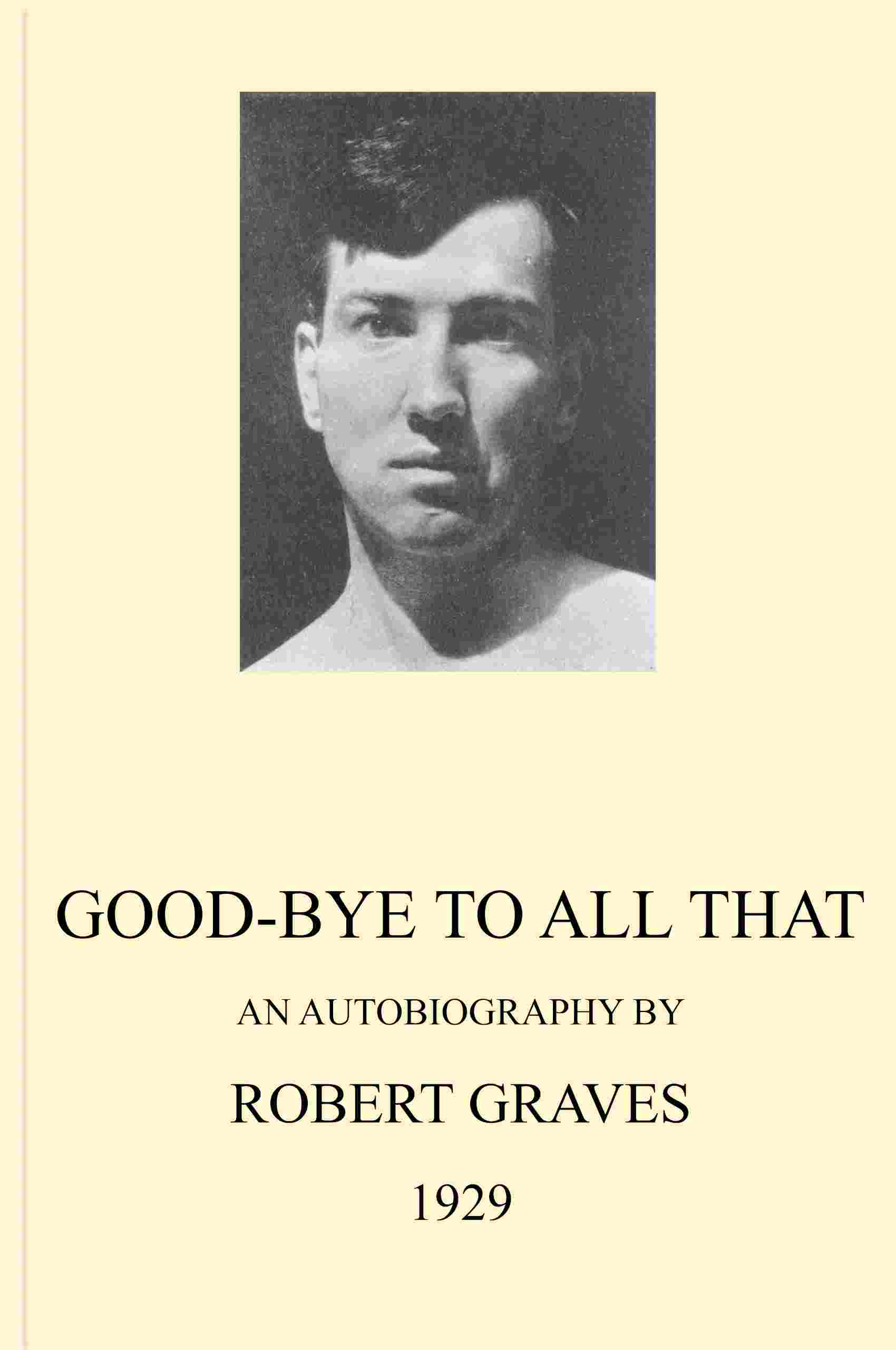
My height is given as six feet two inches, my eyes as grey, and my hair as black. To ‘black’ should be added ‘thick and curly.’ I am described as having no special peculiarity. This is untrue. For a start, there is my big, once aquiline, now crooked nose. I broke it at Charterhouse playing Rugger with Soccer players. (I broke another player’s nose myself in the same game.) That unsteadied it, and boxing sent it askew. Finally, it was operated on. It is very crooked. It was once useful as a vertical line of demarcation between the left and right sides of my face, which are naturally unassorted—my eyes, eyebrows, and ears being all set noticeably crooked and my cheek-bones, which are rather high, being on different levels. My mouth is what is known as ‘full’ and my smile is crooked; when I was thirteen I broke two front teeth and became sensitive about showing them. My hands and feet are large. I weigh about twelve-stone four. My best comic turn is a double-jointed pelvis; I can sit on a table and rap like the Fox sisters with it. One shoulder is distinctly lower than the other, but that is because of a lung wound in the war. I do not carry a watch because I always magnetize the main-spring; during the war, when there was an army order that officers should carry watches and synchronize them daily, I had to buy two new ones every month. Medically, I am a thoroughly ‘good life.’
My passport gives my nationality as ‘British subject.’ Here I might parody Marcus Aurelius, who begins his Golden Book with the various ancestors and relations to whom he owes the virtues of a worthy Roman Emperor. Something of the sort about myself, and why I am not a Roman Emperor or even, except on occasions, an English gentleman. My mother’s father’s family, the von Ranke’s, was a family of Saxon country pastors, not anciently noble. Leopold von Ranke, the first modern historian, my great-uncle, brought the ‘von’ into the family. To him I owe my historical method. It was he who wrote, to the scandal of his contemporaries: ‘I am a historian before I am a Christian; my object is simply to find out how the things actually occurred,’ and of Michelet the French historian: ‘He wrote history in a style in which the truth could not be told.’ Thomas Carlyle decried him as ‘Dry-as-Dust’; to his credit. To Heinrich von Ranke, my grandfather, I owe my clumsy largeness, my endurance, energy, seriousness, and my thick hair. He was rebellious and even atheistic in his youth. As a medical student at a Prussian university he was involved in the political disturbances of 1848. He and a number of student friends demonstrated in favour of Karl Marx at the time of his trial for high treason. Like Marx, they had to leave the country. He came to London and finished his medical course there. In 1859 he went to the Crimea with the British forces as a regimental surgeon. All I know about this is a chance remark that he made to me as a child: ‘It is not always the big bodies that are the strongest. When I was at Sevastopol in the trenches I saw the great British Guards crack up and die by the score, while the little sappers took no harm.’ Still, his big body carried him very well.
He married, in London, my grandmother, a Schleswig-Dane. She was the daughter of Tiarks, the Greenwich astronomer. She was tiny, saintly, frightened. Before her father took to astronomy the Tiarks family had, it seems, followed the Danish country system, not at all a bad one, of alternate professions for father and son. The odd generations were tinsmiths and the even generations were pastors. My gentler characteristics trace back to my grandmother. She had ten children; the eldest of these was my mother, who was born in London. My grandfather’s atheism and radicalism sobered down. He eventually returned to Germany, where he became a well-known children’s doctor at Munich. He was about the first doctor in Europe to insist on clean milk for his child patients. When he found that he could not get clean milk to the hospitals by ordinary means he started a model dairy-farm himself. His agnosticism grieved my grandmother; she never ceased to pray for him, but concentrated more particularly on saving the next generation. She was a Lutheran. My grandfather did not die entirely unregenerate; his last words were: ‘The God of my fathers, to Him at least I hold.’ I do not know exactly what he meant by that, but it was a statement consistent with his angry patriarchal moods, with his acceptance of a prominent place in Bavarian society as Herr Geheimrat Ritter von Ranke, and with his loyalty to the Kaiser, with whom once or twice he went deer-shooting. It meant, practically, that he was a good Liberal in religion as in politics, and that my grandmother need not have worried. I prefer my German relations to my Irish relations; they have high principles, are easy, generous, and serious. The men have fought duels not for cheap personal honour, but in the public interest—called out, for example, because they have protested publicly against the scandalous behaviour of some superior officer or official. One of them who was in the German consular service lost seniority, just before the war, I was told, because he refused to use the consulate as a clearing-place for secret-service reports. They are not heavy drinkers either. My grandfather, as a student at the regular university ‘drunks,’ was in the habit of pouring his beer down into his eighteen-fortyish riding-boots. His children were brought up to speak English in their home, and always looked to England as the home of culture and progress. The women were noble and patient, and kept their eyes on the ground when they went out walking.
At the age of eighteen my mother was sent to England as companion to a lonely old woman who had befriended my grandmother when she was an orphan. For seventeen years she waited hand and foot on this old lady, who for the last few years was perfectly senile. When she finally died, my mother determined to go to India, after a short training as a medical missionary. This ambition was baulked by her meeting my father, a widower with five children; it was plain to her that she could do as good work on the home-mission field.
About the other side of my family. The Graves’ have a pedigree that dates back to the Conquest, but is good as far as the reign of Henry VII. Colonel Graves, the regicide, who was Ireton’s chief of horse, is claimed as the founder of the Irish branch of the family. Limerick was its centre. There were occasional soldiers and doctors in it, but they were collaterals; in the direct male line was a sequence of rectors, deans, and bishops. The Limerick Graves’ have no ‘hands’ or mechanical sense; instead they have a wide reputation as conversationalists. In those of my relatives who have the family characteristics most strongly marked, unnecessary talk is a nervous disorder. Not bad talk as talk goes; usually informative, often witty, but it goes on and on and on and on and on. The von Ranke’s have, I think, little mechanical aptitude either. It is most inconvenient to have been born into the age of the internal-combustion engine and the electric dynamo and to have no sympathy with them; a push bicycle, a primus stove, and an army rifle mark the bounds of my mechanical capacity.
My grandfather, on this side, was Protestant Bishop of Limerick. He had eight, or was it ten, children. He was a little man and a remarkable mathematician; he first formulated some theory or other of spherical conics. He was also an antiquary, and discovered the key to ancient Irish Ogham script. He was hard and, by reputation, far from generous. A gentleman and a scholar, and respected throughout the countryside on that account. He and the Catholic Bishop were on the very best terms. They cracked Latin jokes at each other, discussed fine points of scholarship, and were unclerical enough not to take their religious differences too seriously.
When I was in Limerick as a soldier of the garrison some twenty-five years after my grandfather’s death, I heard a lot about Bishop Graves from the townsfolk. The Catholic Bishop had once joked him about the size of his family, and my grandfather had retorted warmly with the text about the blessedness of the man who has his quiver full of arrows, to which the Catholic answered briefly and severely: ‘The ancient Jewish quiver only held six.’ My grandfather’s wake, they said, was the longest ever seen in the town of Limerick; it stretched from the cathedral right down O’Connell Street and over Sarsfield Bridge, and I do not know how many miles Irish beyond. He blessed me when I was a child, but I do not remember that.
Of my father’s mother, who was a Scotswoman, a Cheyne from Aberdeen, I have been able to get no information at all beyond the fact that she was ‘a very beautiful woman.’ I can only conclude that most of what she said or did passed unnoticed in the rivalry of family conversations. The Cheyne pedigree was better than the Graves’; it was flawless right back to the medieval Scottish kings, to the two Balliols, the first and second Davids, and the Bruce. In later times the Cheynes had been doctors and physicians. But my father is engaged at the same time as myself on his autobiography, and no doubt he will write at length about all this.
My father, then, met my mother some time in the early ’nineties. He had previously been married to one of the Irish Coopers, of Cooper’s Hill, near Limerick. The Coopers were an even more Irish family than the Graves’. The story is that when Cromwell came to Ireland and ravaged the country, Moira O’Brien, the last surviving member of the great clan O’Brien, who were the paramount chiefs of the country round Limerick, came to him one day and said: ‘General, you have killed my father and my uncles, my husband and my brothers. I am left as the sole heiress of these lands. Do you intend to confiscate them?’ Cromwell is said to have been struck by her magnificent presence and to have answered that that certainly had been his intention. But that she could keep her lands, or a part of them, on condition that she married one of his officers. And so the officers of the regiment which had taken a leading part in hunting down the O’Briens were invited to take a pack of cards and cut for the privilege of marrying Moira and succeeding to the estate. The winner was one Ensign Cooper. Moira, a few weeks after her marriage, found herself pregnant. Convinced that it was a male heir, as indeed it proved, she kicked her husband to death. It is said that she kicked him in the pit of the stomach after making him drunk. The Coopers have always been a haunted family and Hibernicis ipsis Hibernicores. Jane Cooper, whom my father married, died of consumption.
The Graves family was thin-nosed and inclined to petulance, but never depraved, cruel, or hysterical. A persistent literary tradition; of Richard, a minor poet and a friend of Shenstone; and John Thomas, who was a mathematician and jurist and contributed to Sir William Hamilton’s discovery of quaternions; and Richard, a divine and regius professor of Greek; and James, an archaeologist; and Robert, who invented the disease called after him and was a friend of Turner’s; and Robert, who was a classicist and theologian and a friend of Wordsworth’s; and Richard, another divine; and Robert, another divine; and other Robert’s, James’s, Thomas’s and Richard’s, and Clarissa, one of the toasts of Ireland, who married Leopold von Ranke (at Windermere Church) and linked the Graves and von Ranke families a couple of generations before my father and mother married. See the British Museum catalogue for an eighteenth and nineteenth-century record of Graves’ literary history.
It was through this Clarissa-Leopold relationship that my father met my mother. My mother told him at once that she liked Father O’Flynn, for writing which my father will be chiefly remembered. He put the words to a traditional jig tune, The Top of Cork Road, which he remembered from his boyhood. Sir Charles Stanford supplied a few chords for the setting. My father sold the complete rights for a guinea. The publisher made thousands. Sir Charles Stanford, who drew a royalty as the composer, also made a very large sum. Recently my father has made a few pounds from gramophone rights. He has never been bitter about all this, but he has more than once impressed on me almost religiously never to sell for a sum down the complete rights of any work of mine whatsoever.
I am glad in a way that my father was a poet. This at least saved me from any false reverence of poets, and his work was never an oppression to me. I am even very pleased when I meet people who know his work and not mine. Some of his songs I sing without prejudice; when washing up after meals or shelling peas or on similar occasions. He never once tried to teach me how to write, or showed any understanding of my serious work; he was always more ready to ask advice about his own work than to offer it for mine. He never tried to stop me writing and was glad of my first successes. His light-hearted early work is the best. His Invention of Wine, for instance, which begins:
Ere Bacchus could talkOr dacently walk,Down Olympus he jumpedFrom the arms of his nurse,And though ten years in allWere consumed by the fallHe might have fallen furtherAnd fared a dale worse.
After he married my mother and became a convinced teetotaller he lost something of this easy playfulness.
He broke the ecclesiastical sequence. His great-grandfather had been a dean, his grandfather a rector, his father a bishop, but he himself was never more than a lay-reader. And he broke the geographical connection with Ireland, for which I cannot be too grateful to him. I am much harder on my relations and much more careful of associating with them than I am with strangers. But I can in certain respects admire my father and mother. My father for his simplicity and persistence and my mother for her seriousness and strength. Both for their generosity. They never bullied me or in any way exceeded their ordinary parental rights, and were grieved rather than angered by my default from formal religion. In physique and general characteristics my mother’s side is stronger in me on the whole. But I am subject to many habits of speech and movement characteristic of the Graves’, most of them eccentric. Such as finding it difficult to walk straight down a street, getting tired of sentences when half-way through and leaving them in the air, walking with the hands folded in a particular way behind the back, and being subject to sudden and most disconcerting spells of complete amnesia. These fits, so far as I can discover, serve no useful purpose, and the worst about them is that they tend to produce in the subject the same sort of dishonesty that deaf people have when they miss the thread of conversation. They dare not be left behind and rely on their intuition and bluff to get them through. This disability is most marked in very cold weather. I do not now talk too much except when I have been drinking or when I meet someone who was with me in France. The Graves’ have good minds for purposes like examinations, writing graceful Latin verse, filling in forms, and solving puzzles (when we children were invited to parties where guessing games and brain-tests were played we never failed to win). They have a good eye for ball games, and a graceful style. I inherited the eye, but not the style; my mother’s family are entirely without style and I went that way. I have an ugly but fairly secure seat on a horse. There is a coldness in the Graves’ which is anti-sentimental to the point of insolence, a necessary check to the goodness of heart from which my mother’s family suffers. The Graves’, it is fair to generalize, though loyal to the British governing class to which they belong, and so to the Constitution, are individualists; the von Ranke’s regard their membership of the corresponding class in Germany as a sacred trust enabling them to do the more responsible work in the service of humanity. Recently, when a von Ranke entered a film studio, the family felt itself disgraced.
The most useful and at the same time most dangerous gift that I owe to my father’s side of the family—probably more to the Cheynes than the Graves’—is that I am always able, when it is a question of dealing with officials or getting privileges from public institutions which grudge them, to masquerade as a gentleman. Whatever I happen to be wearing; and because the clothes I wear are not what gentlemen usually wear, and yet I do not seem to be an artist or effeminate, and my accent and gestures are irreproachable, I have even been ‘placed’ as the heir to a dukedom, whose perfect confidence in his rank would explain all such eccentricity. In this way I have been told that I seem, paradoxically, to be more of a gentleman even than one of my elder brothers who spent a number of years as a consular official in the Near East. His wardrobe is almost too carefully a gentleman’s, and he does not allow himself the pseudo-ducal privilege of having disreputable acquaintances and saying on all occasions what he really means. About this being a gentleman business: I paid so heavily for the fourteen years of my gentleman’s education that I feel entitled occasionally to get some sort of return.